
Karahan Tepe: Gobekli's Eerie Twin
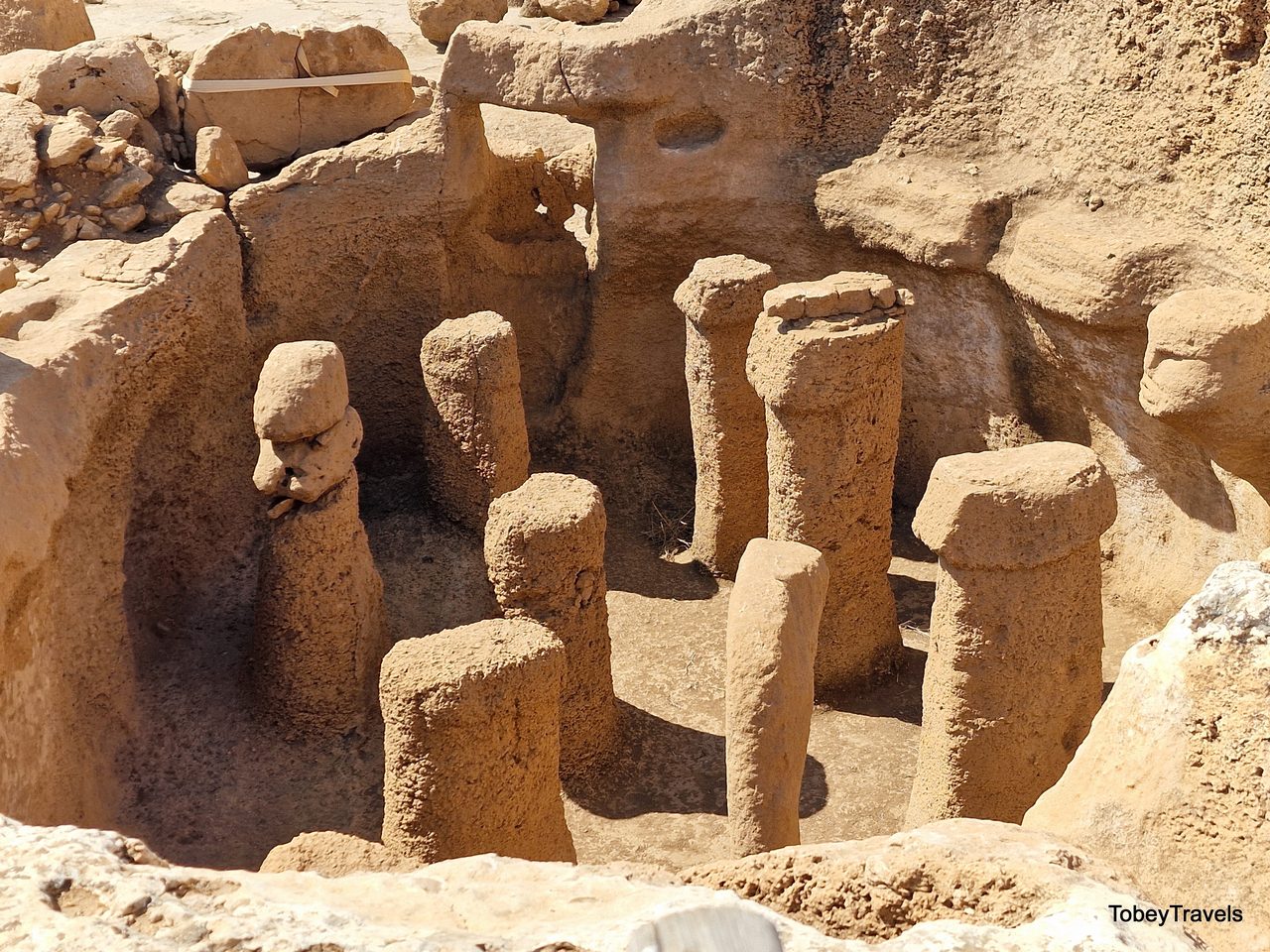
Structure AB is an oval room about seven meters by six, cut into the crown of a limestone hill in southeastern Turkey. Eleven pillars stand in it: ten carved directly out of the bedrock floor, one free-standing. From the western wall a human head emerges in three dimensions, face turned into the room. Radiocarbon puts the site at roughly 9400 to 8200 BCE, which is before pottery, before domesticated grain, and before herds. The eleven is solid. What the room was for is not: our own research file offers four readings and crowns none of them. Here is the file, opened claim by claim, each one wearing its evidence.
Start in one room, because the rest of this hill is easier to hold once you have stood in it. Structure AB is an oval chamber sunk into the crown of a limestone hilltop in southeastern Turkey and cut partly out of the living rock. Eleven pillars stand inside it. Ten of them were carved directly out of the bedrock floor, left standing while the stone around them was taken away. The eleventh stands free. A rock-cut bench runs the circumference of the wall. And out of the western wall a human head emerges in three dimensions, eyes and nose and mouth and chin, its face turned into the room as though a figure were pushing through the stone from behind. The people who made it had no pottery, no domesticated grain, and no herds. Let's open the file.
01The Room of Eleven Pillars
Structure AB is a semi-subterranean oval chamber, carved partially into the bedrock, measuring approximately 7 meters by 6 with a trapezoidal plan and rounded corners. Our own research file calls it the most iconic space at Karahan Tepe and states that it contains at least eleven carved limestone pillars set in a roughly oval configuration. That eleven does not rest on our file alone: three independent sources reach the same total. Two of them give eleven directly; a third counts ten pillars cut from the bedrock, with the eleventh standing free. A specific number corroborated four ways gets stated without hedging, and this one is.
Several of those pillars are carved as naturalistic phallic forms: tapered, rounded shafts of varying heights rising from the bedrock floor, with anatomically explicit sculpted heads. The independent sources describe the bedrock-cut set collectively in the same terms, and one of them gives each pillar a height of roughly 1.6 to 1.7 meters. This is an iconographic choice unlike anything found at Gobekli Tepe.
A carved human head emerges from the bedrock wall of Structure AB: a naturalistic face with defined eyes, nose, mouth, and chin, sculpted in three dimensions as though a figure were pushing through the stone from behind, on an elongated neck that may itself represent a serpent. One detail in that sentence is corrected rather than repeated. Our own research file places the head on the chamber's north wall. Two independent sources place it on the western wall, and this article uses the western wall. Our file additionally states that the head sits directly above a carved serpent; that spatial relation was not independently re-checked, so it travels here as our file's own statement rather than as a verified one.
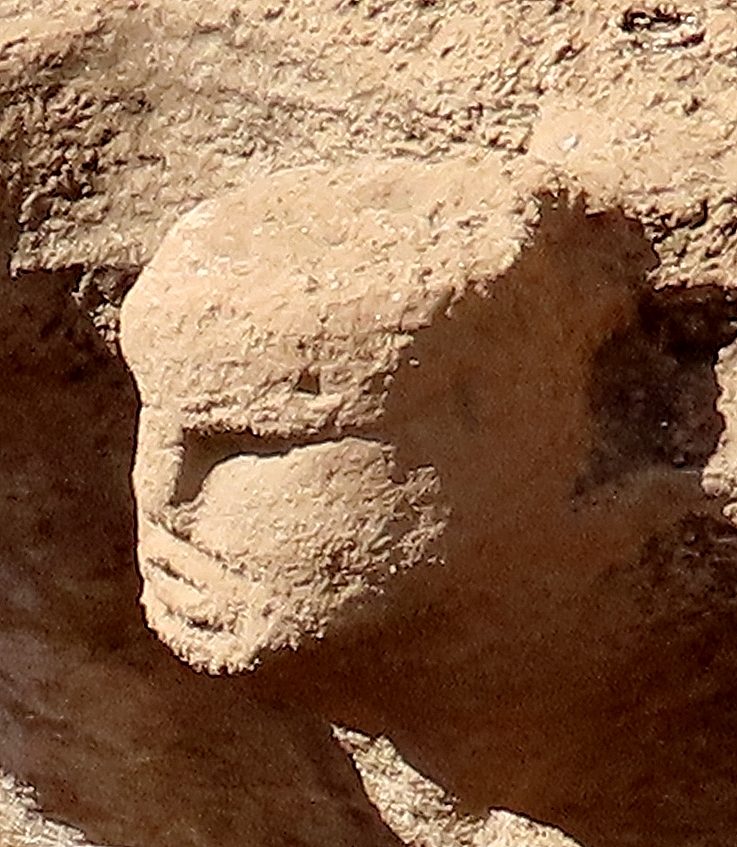
Nothing quite like this has turned up at any other known Pre-Pottery Neolithic site.
A continuous rock-cut bench runs along the chamber's circumference, which suggests an audience or a congregation space.
The word twin travels with this site, and it is worth testing early rather than late. Karahan Tepe is a second field of T-shaped pillars, raised by the same broad culture, in the same region, at broadly the same time, so the label has a real basis. But almost nothing in the four claims above happens at Gobekli Tepe. The chamber cut into living rock, the pillars left standing in the floor, the phallic forms, the face coming out of the wall: those are Karahan Tepe's own. Gobekli Tepe has its own file in this wing and its own article, and this one stays out of both except where the two sites are being directly compared.
02The Hill, and Who Dug It
Karahan Tepe was identified during a 1997 surface survey by the archaeologist Bahattin Celik, who noted concentrations of T-shaped pillar fragments, stone tools, and carved stone fragments lying on the surface of a low hilltop. A correction belongs here rather than in a footnote. Our own research file gives Celik's affiliation as Istanbul University. Independent checking puts him at Harran University, and Istanbul University is in fact the correct affiliation for Necmi Karul, who directs the later excavation, which suggests our file may have conflated the two men rather than getting each of them wrong separately. This article states Harran University for Celik.
Celik published the surface finds in 2000 and again in 2011, classifying Karahan Tepe as a Gobekli Tepe-type Pre-Pottery Neolithic ritual site. Limited test trenches followed between 2000 and 2014. For more than two decades after the survey, that was the extent of it: a known site, surveyed and published, largely undug.
Full-scale systematic excavation began in September 2019 under the Tas Tepeler project, Stone Hills, directed by Prof. Necmi Karul of Istanbul University and sponsored by the Turkish Ministry of Culture and Tourism. Karul's Istanbul University affiliation is independently confirmed. Tas Tepeler takes in at least twelve Pre-Pottery Neolithic sites in the Sanliurfa region: Gobekli Tepe, Karahan Tepe, Sayburc, Harbetsuvan Tepesi, Gurcu Tepe, Ayanlar Hoyuk, Yeni Mahalle, Cakmak Tepe, Kurt Tepesi, Tasli Tepe, Sefertepe, and Hamzan Tepe. Karahan Tepe is the second-most intensively excavated of them, after Gobekli Tepe.
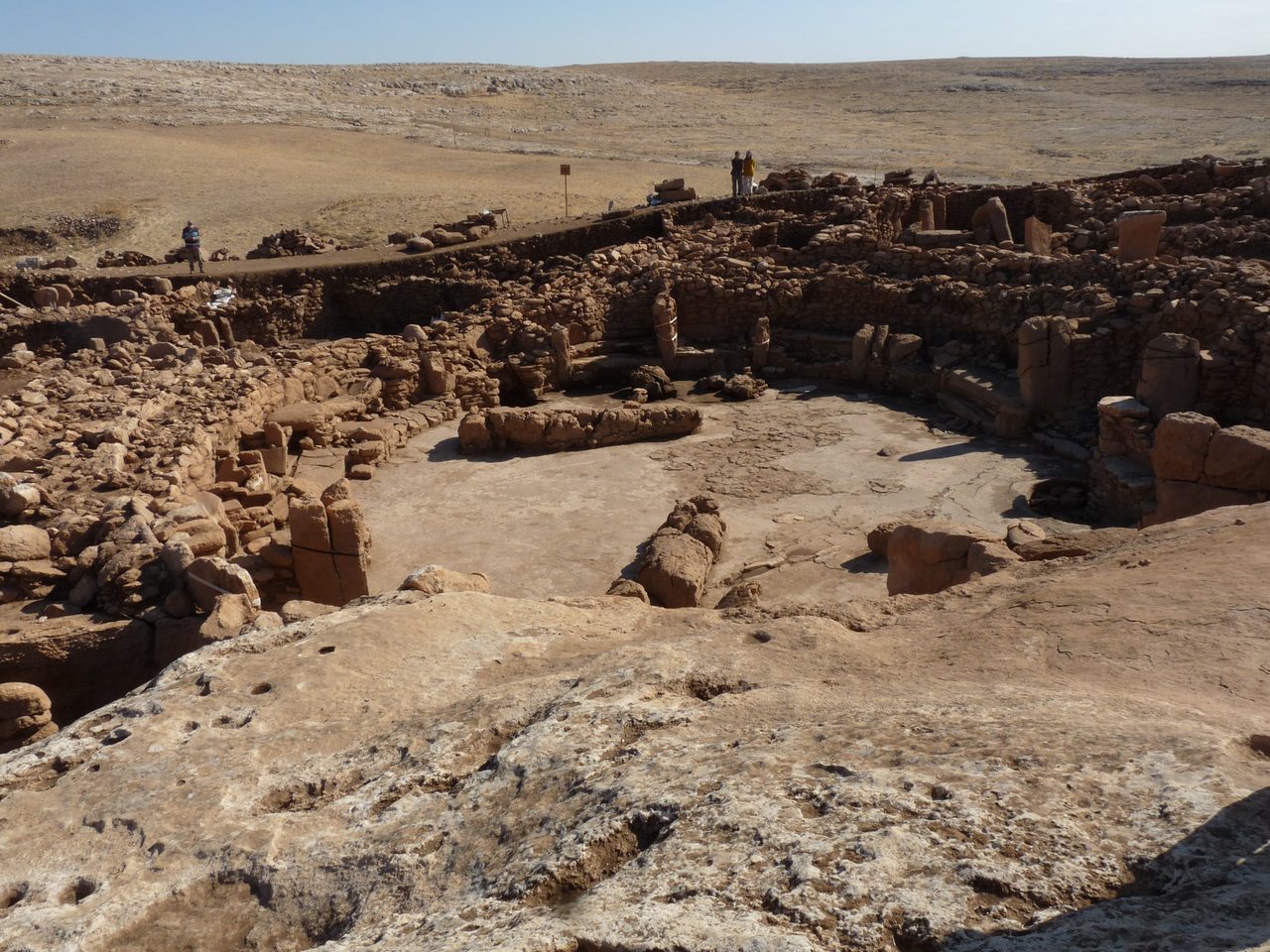
Excavation is active and ongoing, and almost all of this hill is still underground. Our research file puts roughly 5 percent of the estimated site area uncovered as of early 2026. A 2025-dated secondary source says only 1 percent. The precise fraction evidently depends on which season and which estimate of total area is being described, so the honest statement is a range rather than a figure: somewhere between about 1 and 5 percent of Karahan Tepe has been dug. Everything below is a report on that fraction.
03Before Pottery, Before Herds
Radiocarbon dates from the 2019 to 2024 excavation campaigns place Karahan Tepe at approximately 9400 to 8200 BCE, running from the Pre-Pottery Neolithic A into the early Pre-Pottery Neolithic B. That makes it broadly contemporary with Gobekli Tepe's earliest phases, at about 9600 to 8000 BCE, and possibly slightly later. The opening date is the soft end of this. One independent source gives the same 9400 to 8200 BCE window; another gives between 10,000 and 9500 BCE with construction around 9750 BCE. They cluster in the same broad window, and this article treats the exact starting date as approximate rather than settled.
There is no pottery at Karahan Tepe. The subsistence economy runs on wild plant gathering and hunting, primarily gazelle, aurochs, and equids, with no evidence of domesticated cereals and no evidence of domesticated animals. The monumental construction on this hill firmly predates agriculture in this region.
Zooarchaeological analysis identifies gazelle, Gazella sp., as the dominant faunal taxon, followed by aurochs, Bos primigenius, then equids, Equus sp., wild boar, and smaller mammals. All are wild species and none show morphological indicators of domestication. Bird remains include large raptors, eagles and vultures, consistent with the prominent vulture iconography at Gobekli Tepe.
Charred wild plant remains include einkorn wheat, Triticum boeoticum, wild barley, Hordeum spontaneum, and various pulses, all of them in their wild morphological forms, with non-shattering rachises absent. That is the signature of intensive wild plant exploitation, and it is specifically not the signature of cultivation.
Limestone and basalt ground-stone tools, mortars, pestles, and querns, processed those wild plant foods. The sheer energy invested in stone grinding equipment suggests intensified wild cereal processing, which is a plausible precursor to domestication. Large quantities of limestone flaking debris around the pillars and inside the structures document that the monumental sculptures were carved on site rather than imported finished.
The chipped-stone assemblage is dominated by flint and obsidian: pressure-flaked projectile points, bladelets, scrapers, and micro-drills. The obsidian was imported from sources in eastern Anatolia, Bingol and Nemrut Dag, at distances of 250 to 400 km. Long-distance exchange networks existed here among people who were not farming.
Concentrations of animal bone, grinding equipment, and fire-cracked stone associated with the monumental structures are consistent with communal feasting: ritual meals involving large quantities of prepared food. Dietrich and colleagues documented similar feasting assemblages at Gobekli Tepe in 2012 and read them as evidence that large-scale ritual gatherings motivated surplus food production and ultimately fed into the domestication process. That reading is picked up again in section 07, where it belongs to a live argument rather than to the finds themselves.
| Evidence Class | What the Excavation Found |
|---|---|
| Pottery | None |
| Animals | Gazelle dominant, then aurochs, equids, wild boar, and smaller mammals; all wild, none with morphological indicators of domestication; birds include eagles and vultures |
| Plants | Charred einkorn wheat, wild barley, and pulses, all in wild morphological forms, with non-shattering rachises absent |
| Ground Stone | Limestone and basalt mortars, pestles, and querns for wild plant foods; bowls finished by rotary grinding and internal polishing |
| Chipped Stone | Flint and obsidian: pressure-flaked projectile points, bladelets, scrapers, and micro-drills |
| Obsidian Sources | Bingol and Nemrut Dag in eastern Anatolia, 250 to 400 km away |
| Feasting | Animal bone, grinding equipment, and fire-cracked stone concentrated around the monumental structures |
04Architecture Cut Out of the Hill
At Gobekli Tepe the structures sit on the natural hilltop surface. At Karahan Tepe much of the monumental architecture has been carved directly into the bedrock: floors, benches, and even some of the pillars emerge from the living rock, which blurs the boundary between architecture and sculpture. The technique is a hybrid, combining free-standing pillars erected in sockets with rock-cut excavation, and it is not prominently seen at Gobekli Tepe.
Karahan Tepe also displays a wider range of architectural forms than its neighbor's predominantly circular enclosures: oval structures, sub-circular structures, and rectangular structures stand on the same hill. Our file reads that variety as experimentation with spatial organization, or as different functional requirements. Which of those it is, the file does not say.
Geophysical survey, georadar and magnetic, has revealed at least 250 T-shaped pillars across the site, most of them still in situ or visible only in survey data. Independent sources agree: one states that over 250 T-shaped pillars have been identified across the hillside, another that more than 266 were observed as of the year 2000. That is potentially more pillars in total than Gobekli Tepe, which has about 200 across roughly 20 enclosures, most of them still unexcavated. Karahan Tepe's are smaller, though. Its largest stand approximately 3 to 4 meters, where Gobekli Tepe's largest reach 5.5 meters and 16 tonnes.
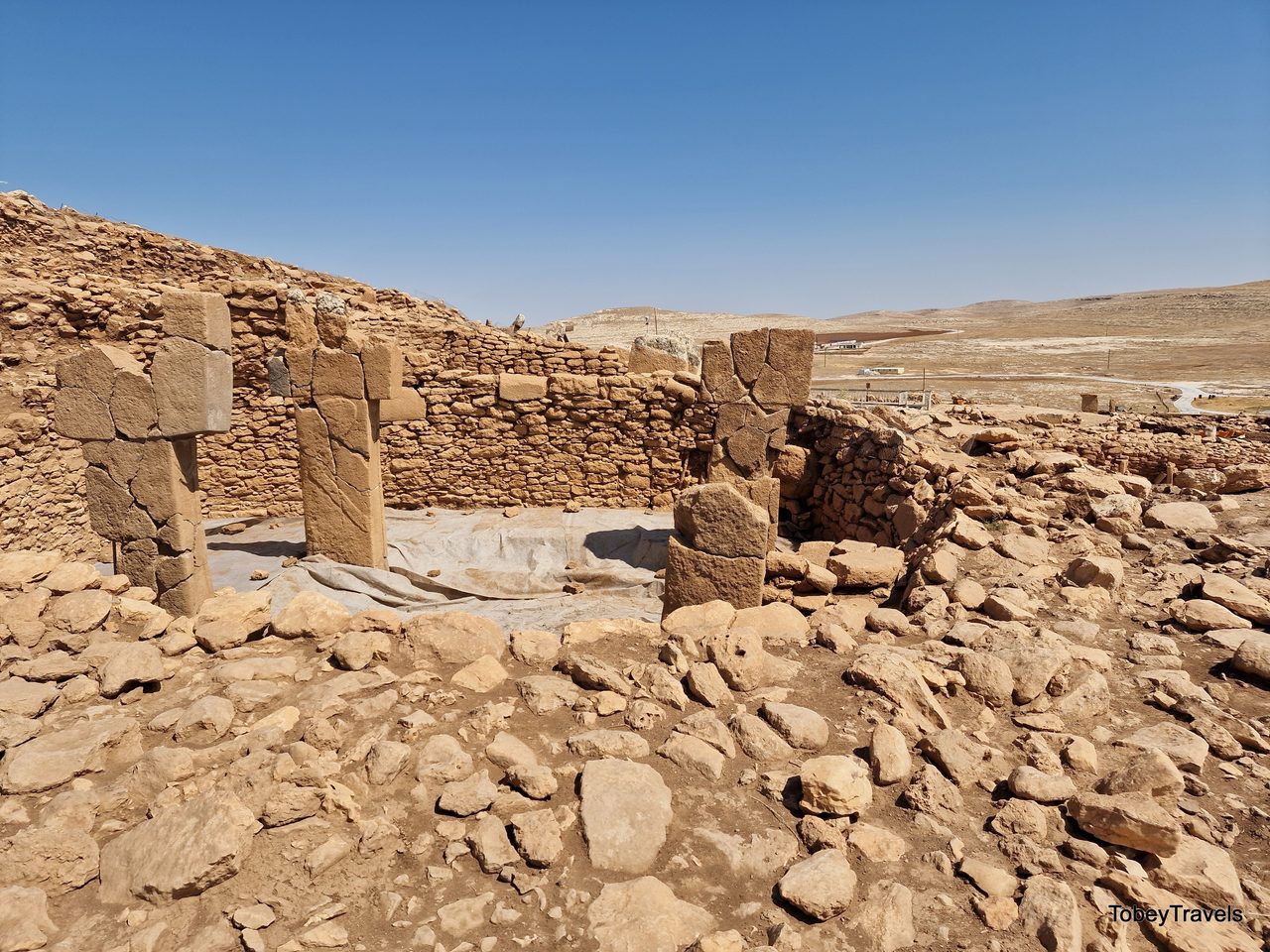
The exposed and excavated remains cover approximately 1 hectare, with ground-penetrating radar indicating substantial unexcavated structures beyond them. Our file puts the total site extent across the limestone hilltop at approximately 11 hectares. An independent source gives almost 10 hectares, rising by another five if the quarries for the T-shaped columns are counted in. Those are broadly consistent rather than identical, and this article carries both rather than picking the tidier one.
A partially quarried, unfinished T-shaped pillar has been found in situ in the bedrock quarry immediately next to the site. Channel-cutting and wedge-splitting marks in that quarry document the extraction process step by step. The pillars were made on this hill, out of this hill. No pillar was transported in from a distance, and there is no transport mystery here to solve for the stonework itself, whatever the obsidian's own supply chain looked like.
| Feature | Gobekli Tepe | Karahan Tepe |
|---|---|---|
| Pillar Scale | Largest reach 5.5 m and 16 tonnes | Largest approximately 3 to 4 m, and lighter |
| Enclosure Shape | More uniformly circular, with paired central pillars | Oval, sub-circular, and rectangular forms on the same hill |
| Relation to the Bedrock | Structures sit on the natural hilltop surface | Much of the architecture cut directly into bedrock; floors, benches, and some pillars left standing in the living rock |
| Pillars Identified | About 200 across roughly 20 enclosures, most still unexcavated | At least 250 identified by georadar and magnetic survey |
| Relief Motifs | Foxes, wild boar, snakes, and vultures | Human heads, phallic forms, serpents, a leopard or large cat, and geometric patterns |
That table is a comparison and nothing more. It is drawn from our own research file's own comparisons, and every Gobekli Tepe figure in it is there to give a Karahan Tepe figure a scale. Gobekli Tepe's construction sequence, its burial history, and the astronomical alignment proposals made for its pillars are all real subjects, and none of them are this article's; the wing carries a separate file and a separate article on that site.
05A Sculpture Program Full of People
A T-shaped pillar bearing a realistically carved human face, with eyes, nose, and jaw, is the most explicit anthropomorphic rendering of the T-pillar concept found so far at Karahan Tepe. It confirms and then exceeds the standard reading of T-pillars as stylized human figures. Smithsonian Magazine reported the find in October 2025: a pillar about 4.5 feet tall, which converts to roughly 1.4 meters, with a prominent brow bone and a straight nose, dated to approximately 11,000 years old, the 10th millennium BCE, and found in a structure that also contained domestic elements such as grinding stones. Necmi Karul is quoted directly on both points. “The human-faced pillar we encountered in a structure containing domestic elements, such as grinding stones, fills this gap,” and “This example provides clear evidence that T-shaped pillars symbolized humans.”
Multiple carved three-dimensional human heads have been recovered at Karahan Tepe, some sculpted from bedrock and some as portable objects, with naturalistic detailed eyes, noses, mouths, and jaw lines. One head from Structure AB appears to depict an older individual, with defined wrinkles.
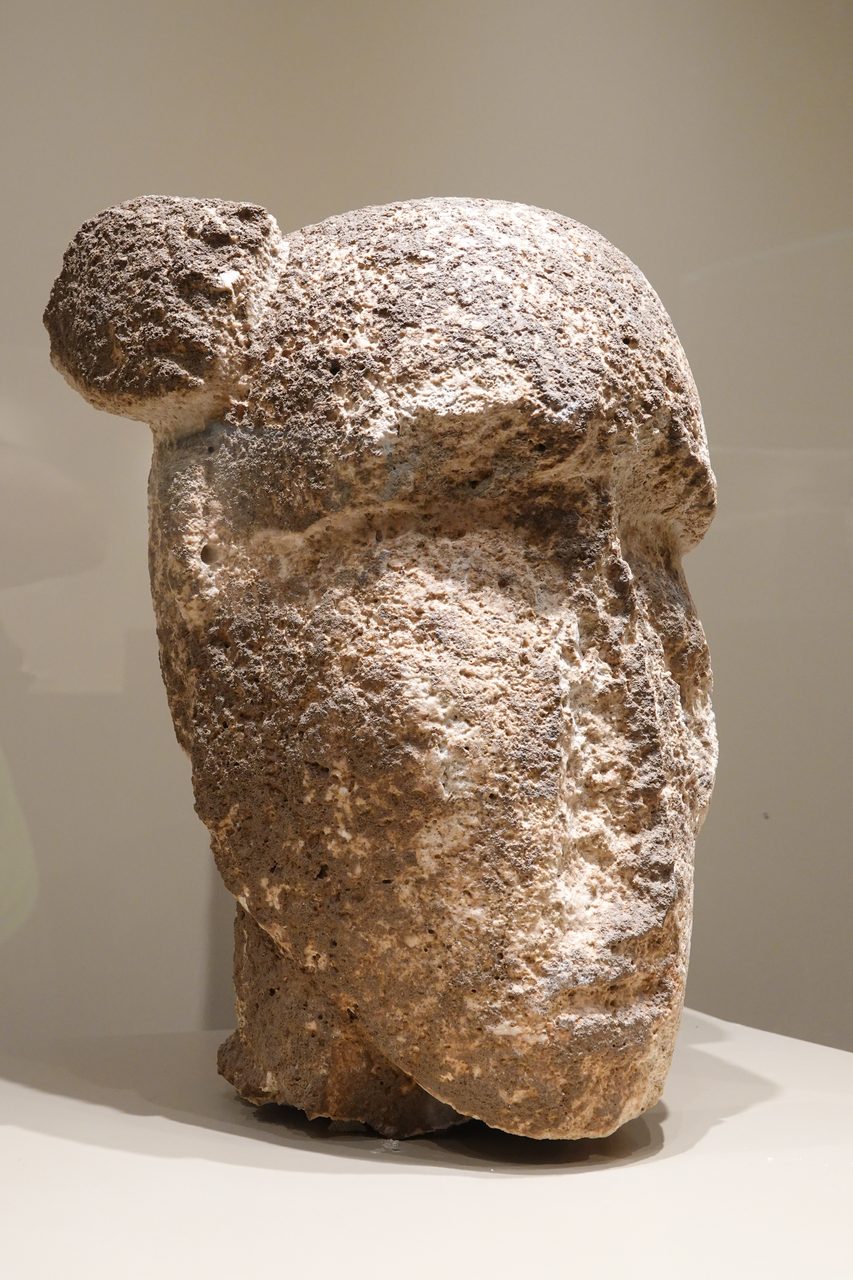
This one sits in a museum case; the Structure AB head is still in the wall it was cut from.
T-shaped pillars and walls at the site carry carved reliefs of serpents, a prominent and recurring motif across multiple structures, along with a leopard or large cat carved in high relief on a pillar, and geometric patterns.
Structure AD, a smaller chamber separate from Structure AB, contains phallus-shaped pillars carved directly from the bedrock rather than free-standing. One of those sculptures stands approximately 2.3 meters tall, integrated with the surrounding rock floor. It is part of the hill and has never moved.
In September 2023, excavators uncovered a 2.3-meter human statue at Karahan Tepe. It was found broken in two, originally fixed in a seated position on a stone bench, holding its own phallus with both hands, with a strong V-neck collar motif, carved ribs, and a square raised protrusion between those ribs. It came out of a newly opened enclosure alongside a separate vulture or bird statue positioned beneath a circular holed stone on the northern wall. Five independent outlets covered the find in October 2023, and it has been widely described as one of the earliest known naturalistic, true-to-life-scale human sculptures. Now the housekeeping, because two things at this site are described at about 2.3 meters and they are not the same thing. Structure AD's phallic pillar is bedrock, fixed, and part of the floor it rises from. This seated statue is free-standing, was found broken in two, and comes from a different enclosure entirely. The shared height is a coincidence of measurement, nothing more.
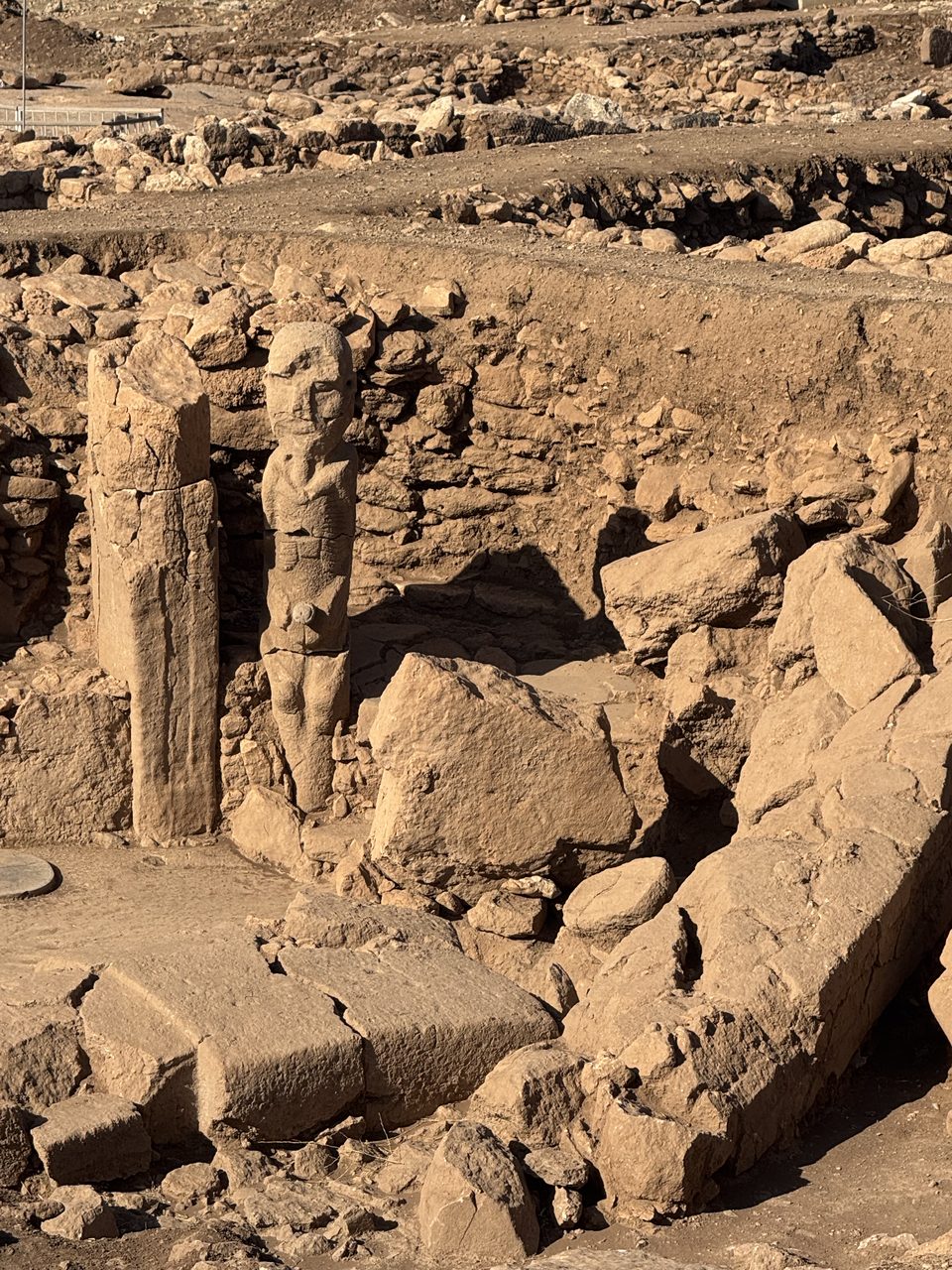
Found broken in two, originally fixed to a stone bench.
Ground-stone objects recovered from the site include stone bowls, pestles, and carved miniature replicas of the T-shaped pillars themselves, which points at both utilitarian and symbolic activity in the same assemblage. The bowls show sophisticated manufacturing, including rotary grinding and internal polishing, which indicates specialized craft production rather than expedient tool-making.
Microscopic analysis of some pillar surfaces has revealed faint traces of red ochre. That raises the possibility that the carved reliefs and sculptures were originally painted, which would dramatically alter the visual experience of these ritual spaces. Note how thin that evidence is: faint traces, found under a microscope. It is enough to raise the possibility and not enough to establish it, and what these surfaces looked like when they were new is not necessarily what stands on the hill today.
Where Gobekli Tepe's relief program emphasizes animals, foxes, wild boar, snakes, vultures, Karahan Tepe's emphasis on human heads, phallic forms, and serpents may indicate a distinct ritual program, potentially oriented toward human ancestry, fertility, and chthonic symbolism rather than, or in addition to, totemic animal associations. Karul has made the same contrast in public, saying that human symbolism dominates Karahan Tepe while animal imagery is more prevalent at Gobekli Tepe, and offering a reason for it: that “the growing number of human sculptures can be read as a direct outcome of settled life,” with people gradually distancing themselves from nature and placing “the human figure and the human experience at the center of the universe.” The inventory of motifs is Tier 1. The explanation for the inventory is Tier 2, and it is an interpretation offered by the excavator rather than a result the excavation produced.
One detail in this section should not be smoothed over. The human-faced pillar came out of a structure that also held grinding stones, and the comparative reading in section 07 records that both Karahan Tepe and Gobekli Tepe show minimal evidence of residential occupation inside their monumental structures. Both statements come from our own sources and neither cancels the other. Where the line runs between ritual space and domestic space at these sites is one of the things still being worked out on the ground.
06What Structure AB Was For
This is where the evidence stops being ground and starts being argument. Everything above can be measured, counted, dated, or photographed. Nothing below can. The tier tags carry the difference, and they are the most important thing in this section.
Karul, in publications of 2020 and 2021, reads the combination of phallic pillars, the human head, serpent iconography, and bench seating as a ritual space connected to themes of fertility, ancestor veneration, death-and-rebirth symbolism, or clan initiation. Note the shape of that sentence. It is four candidate functions joined by or, from the excavator himself. No scholarly consensus exists on the specific function of Structure AB, and the excavation is still running. This article does not pick one of the four, because our file does not, and because there is nothing yet out of the ground that would justify picking.
Some researchers have suggested that the seated statue from the 2023 enclosure represents a deceased ancestor associated with the building it was found in. That is a suggestion attached to a find, in the same family as the ancestor-veneration reading above, and it carries the same weight: plausible, unfalsified, and unproven.
The Structure AB assemblage, phallic pillars plus serpent imagery plus a head coming out of stone, has been compared to cross-cultural shamanic cosmologies, with the head-through-wall motif read as a portal between worlds; the neuropsychological model of cave art developed by Lewis-Williams, built on entoptic phenomena and trance states, has been speculatively applied to it. There is no direct evidence for this at Karahan Tepe: no psychoactive plant residues, and nothing standing in for them. There is also a specific reason to be more careful here than usual. The head-emerging-from-stone motif has no direct parallel at any other known Pre-Pottery Neolithic site. Cross-cultural analogy works by matching a thing to comparable things, and this particular thing has no comparables in its own period and region, which makes analogies drawn from other continents and other millennia weaker here rather than stronger.
As at Gobekli Tepe, there is evidence that some structures at Karahan Tepe were deliberately buried after a period of use, filled in with rubble, soil, and refuse. At Gobekli Tepe that practice is what preserved the enclosures for 11,000 years, and it is interpreted there as intentional decommissioning. Karahan Tepe's own evidence for the practice is still being assessed, which is why this sits at Tier 2 and not higher.
Why anything was buried at all has two readings and neither has won. Some researchers interpret the deliberate backfilling of pillar enclosures at both sites as a form of ritual killing or burial of the structure, analogous to the intentional breaking of objects documented in Neolithic contexts elsewhere, which would imply buildings with finite ritual lifespans: built, used, ceremonially decommissioned, replaced. Others interpret backfilling pragmatically, as site management, preparing a stable surface for new construction above, with no ceremonial content whatsoever. Both readings explain the same fill.
Whatever the buildings meant, making them took coordination. Quarrying heavy stones, moving them even short distances, carving elaborate reliefs, and maintaining the structures afterward is not work a single family band does casually. Estimates for Gobekli Tepe run to more than 500 workers; Karahan Tepe's smaller scale may need fewer, but it still demands organizational capacity beyond one band. That implies nascent social hierarchy, or at least temporary leadership structures, among Pre-Pottery Neolithic populations, which is a revision of the standard model of hunter-gatherer social organization.
07Karahan Tepe Is Not Alone
The identification of twelve or more Pre-Pottery Neolithic sites with T-shaped pillar architecture across the Sanliurfa plateau demonstrates something that took decades to become visible: Gobekli Tepe was not unique. It was the largest node in a regional network of ritual and ceremonial sites. Karul's Tas Tepeler framework proposes a coordinated or interrelated social system connecting them, possibly involving seasonal aggregation events at which dispersed hunter-gatherer bands converged for ritual, feasting, exchange, and social reproduction. The geographical distribution spans approximately 200 km east to west across the northern Harran Plain.
Sayburc, a Pre-Pottery Neolithic site excavated since 2021 and located approximately 50 km northwest of Karahan Tepe, contains a relief panel depicting two human figures flanking wild animals, bulls and leopards, which has been described as the first known Neolithic narrative scene. Its discovery confirms that the regional pattern extends beyond Karahan Tepe and Gobekli Tepe.
Both Karahan Tepe and Gobekli Tepe show minimal evidence of residential occupation, with no securely identified hearths, cooking areas, or sleeping quarters inside the monumental structures, though recent work at Gobekli Tepe has challenged the purely temple interpretation of that site. The two were likely occupied at least partially at the same time. That raises questions our file states and does not answer: whether they served different communities, different functions within one social network, or different seasons of one mobile group's annual cycle.
The traditional model, Childe's Neolithic Revolution, holds that surplus agriculture was a prerequisite for monumental architecture, social stratification, and organized religion. Gobekli Tepe challenged that model, and Karahan Tepe and the wider Tas Tepeler network reinforce the same challenge: monumental construction, elaborate ritual, long-distance exchange, and probable social coordination, all among communities with no evidence of food production. Revised models propose that ritual and social aggregation drove sedentism and agriculture rather than the reverse, making the monuments a catalyst for farming rather than its product. The debate continues, and it is largely Gobekli Tepe's argument to carry; what Karahan Tepe adds is that the pattern is not one anomalous hill.
The Tas Tepeler survey has identified twelve or more sites so far. Systematic satellite imagery analysis and ground-penetrating radar survey suggest potentially dozens more Pre-Pottery Neolithic sites across the Harran Plain and the surrounding uplands. The full extent of the network remains unknown, which is a statement about survey coverage rather than a discovery.
The Pre-Pottery Neolithic sites of Upper Mesopotamia emerge in the immediate aftermath of the Younger Dryas cold event, at roughly 10,900 to 9700 BCE. Researchers have hypothesized a causal link, with climatic stress forcing social reorganization, ritual innovation, and intensified wild cereal processing that eventually contributed to agriculture. The chronological coincidence is suggestive and the causation is undemonstrated, and an alternative model proposes the opposite driver: that post-Younger-Dryas climatic improvement, not stress, gave the ecological opportunity for population growth and social complexity. The Younger Dryas has its own file and its own wing on this site, and this article takes it only as a date lying on one side of a site.
08The Chamber Nobody Has Opened Yet
The 2025 excavation season uncovered Structure BH, a rectangular building measuring approximately 9 meters by 7. It has two-tiered benches, four T-shaped pillars, walls preserved to 3.5 meters in height, a large stone basin, and a channel that appears to have carried liquid through the building, which suggests organized communal activity of some kind. Large flat stone slabs seal the chamber's upper section. Archaeologists plan to remove them individually and enter from above during the 2026 excavation season, which is expected to run until October 2026 under Necmi Karul as excavation coordinator of the Tas Tepeler project. The deliberate sealing is consistent with the pattern section 06 records, credible but still under assessment at this site, in which special-purpose buildings may have been intentionally filled and sealed rather than simply abandoned.
Reporting dated November 2025 records roughly 30 newly unearthed artifacts from the Karahan Tepe excavations, described in that reporting as illustrating the transition from hunting and gathering to more settled ways of life over 11,000 years ago. The haul includes statues of humans and animals, various vessels, necklaces, and beads. Three items are named specifically: a stone figurine with stitched lips, further carved stone faces, and a black serpentinite bead with expressive faces carved on both of its sides.
| When | What | Where It Comes From |
|---|---|---|
| September 2023 | A 2.3-meter human statue, found broken in two, originally seated on a stone bench and holding its own phallus with both hands, with a V-neck collar, carved ribs, and a square raised protrusion between them; found with a separate vulture or bird statue beneath a circular holed stone on the northern wall | Five independent outlets covering the same find in October 2023 |
| October 2025 | A T-shaped pillar carrying a carved human face with a prominent brow bone and a straight nose, about 4.5 feet tall, dated to roughly 11,000 years old, found in a structure that also held grinding stones | Smithsonian Magazine, with direct quotes from Necmi Karul |
| November 2025 | About 30 newly unearthed artifacts: human and animal statues, vessels, necklaces, and beads, among them a stone figurine with stitched lips and a black serpentinite bead with a face carved on each side | Regional reporting dated November 2025 |
| The 2025 Season | Structure BH: a rectangular building about 9 by 7 meters, with two-tiered benches, four T-shaped pillars, walls standing to 3.5 meters, a large stone basin, and a channel that appears to have carried liquid through the building | Excavation reporting on the 2025 season |
| The 2026 Season | The flat slabs sealing Structure BH's upper section are to be lifted one at a time so the chamber can be entered from above; the season is expected to run until October 2026 | Excavation reporting on the planned season |
09Where the Story Runs Off the Map
A site this strange, this old, and this incompletely excavated attracts big stories. One of them is a real question that simply has no study behind it yet. The rest fail on the evidence outright, and walking through them plainly is worth the space, because the documented version of Karahan Tepe is stranger than any of the substitutes.
Astronomical alignment proposals, stellar, solar, or precessional encoding in T-shaped pillar enclosures, have been made for Gobekli Tepe by Sweatman and Tsikritsis in 2017, where they are contested, and some have extended them to Karahan Tepe. The extension is the problem. There is no published archaeoastronomical study specific to Karahan Tepe at all. That is not a claim that has been tested and failed. It is a claim that has not been tested.
Two cautions from our file's own counter-arguments section apply with unusual force here. Many Tas Tepeler sites remain incompletely excavated, so extraordinary claims about them should be treated as preliminary; and interpretation of any site is vulnerable to confirmation bias, since natural formations, weathering, and coincidental alignments can look intentional to someone already expecting intention. At a site where between about 1 and 5 percent of the ground has been opened, both of those cut in every direction, including against the readings this article has just called credible.
Claims that Karahan Tepe represents technology from a lost advanced civilization, or extraterrestrial intervention, have no support. The lithic technology is stone-tool-based, the construction methods are bedrock quarrying with stone and antler tools, and the iconographic repertoire is fully consistent with documented Pre-Pottery Neolithic material culture. The unfinished pillar still lying in the quarry next door, with the channel-cutting and wedge-splitting marks around it, is a direct physical answer to how these were made, found at the place where they were made.
No, the site is not 50,000 or more years old; proposals that date it that way misrepresent the radiometric evidence. No, it is not the oldest temple in the world superseding Gobekli Tepe; the same radiocarbon record that dates Karahan Tepe puts it broadly contemporary with its neighbor, possibly slightly later. No, the carved human head in Structure AB is not a portal or a stargate; that is a modern fantasy projected onto Neolithic iconography with no archaeological basis of any kind. And no, there is no documented advanced mathematics encoded in the pillar arrangements; those claims lack any published measurement or peer-reviewed analysis behind them.
Fast Facts
- Site
- Karahan Tepe, a Pre-Pottery Neolithic monumental site on a limestone hilltop in the Sanliurfa region of southeastern Turkey
- Discovery
- Identified in a 1997 surface survey by Bahattin Celik, of Harran University; our own research file's Istanbul University attribution for him is corrected here
- Excavation
- Surface finds published 2000 and 2011; limited test trenches 2000 to 2014; full systematic excavation from September 2019 under the Tas Tepeler project, directed by Prof. Necmi Karul of Istanbul University
- How Much Is Dug
- Between about 1 and 5 percent of the site, depending on the source and the season
- Dating
- Approximately 9400 to 8200 BCE by radiocarbon, Pre-Pottery Neolithic A into early Pre-Pottery Neolithic B; the opening date is approximate across sources
- Site Extent
- About 1 hectare exposed; total extent about 11 hectares in our file, and almost 10 hectares plus roughly five more for the quarries in an independent source
- The Pillars
- At least 250 T-shaped pillars identified by georadar and magnetic survey; the largest approximately 3 to 4 meters
- Structure AB
- A semi-subterranean oval chamber about 7 by 6 meters, trapezoidal in plan with rounded corners, holding eleven pillars: ten carved out of the bedrock, one free-standing, several of them naturalistic phallic forms at roughly 1.6 to 1.7 meters each, with a continuous rock-cut bench around the wall
- The Carved Head
- A naturalistic human face in three dimensions emerging from Structure AB's western wall, on an elongated neck that may represent a serpent; our own file's north wall is corrected to western here
- Structure AD
- A separate, smaller chamber with phallus-shaped pillars carved from the bedrock; one stands about 2.3 meters and is part of the rock floor
- The Seated Statue
- A different object of similar height: a free-standing 2.3-meter human statue found in September 2023, broken in two, originally seated on a bench holding its own phallus, with a V-neck collar and carved ribs
- The Head Pillar
- A T-shaped pillar with a realistically carved human face, about 4.5 feet tall, announced October 2025, dated to roughly 11,000 years old and found in a structure that also held grinding stones
- Iconography
- Human heads, phallic forms, serpents as a recurring motif, a leopard or large cat in high relief, geometric patterns, and faint traces of red ochre raising the possibility that the carvings were once painted
- Subsistence
- No pottery, no domesticated cereals, no domesticated animals; wild gazelle, aurochs, and equids; wild einkorn, barley, and pulses; monumental building here predates agriculture in the region
- Long-Distance Contact
- Obsidian imported from Bingol and Nemrut Dag in eastern Anatolia, 250 to 400 km away
- Structure BH
- A rectangular building about 9 by 7 meters found in the 2025 season, with two-tiered benches, four T-shaped pillars, walls to 3.5 meters, a stone basin, and a liquid channel; its upper section is sealed by flat slabs due to be lifted in the 2026 season
- The Open Question (Tier 2)
- What Structure AB was for. The excavator offers fertility, ancestor veneration, death-and-rebirth symbolism, or clan initiation, joined by or. No scholarly consensus exists, and this article picks none of the four
- Interesting But Unproven (Tier 3)
- Astronomical alignment at Karahan Tepe specifically, which has never been studied; the shamanic-portal reading of the carved head, which has no direct evidence and no parallel motif at any other Pre-Pottery Neolithic site; whether the buried buildings were ritually killed or pragmatically filled; whether dozens more sites await survey; and whether the Younger Dryas caused any of this. Arguable, and not established
- Not Supported (Tier 4)
- That a lost advanced civilization or extraterrestrials built it; that it is 50,000 or more years old; that it is the oldest temple in the world superseding Gobekli Tepe; that the carved head is a portal or stargate; that advanced mathematics is encoded in the pillar arrangements. These are a different category from the Tier 3 items above. Those are unproven; these are contradicted by the record
What We Can Actually Stand Behind
Structure AB is a semi-subterranean oval chamber of approximately 7 by 6 meters, trapezoidal in plan with rounded corners, cut partly into the bedrock of a limestone hilltop in southeastern Turkey. It holds eleven carved limestone pillars: ten cut directly out of the bedrock and one free-standing. That total comes from our own research file and from three independent sources in agreement, which makes it one of the firmest specific numbers on this page. Several of the pillars are naturalistic phallic forms at roughly 1.6 to 1.7 meters each. A continuous rock-cut bench runs the circumference. A naturalistic human head emerges in three dimensions from the western wall, on an elongated neck that may represent a serpent. Two details are corrected against our own file rather than repeated from it: the head is on the western wall, not the north wall, and the site's discoverer Bahattin Celik is at Harran University, not Istanbul University.
Radiocarbon from the 2019 to 2024 campaigns places the site at approximately 9400 to 8200 BCE, with the opening date approximate across sources. There is no pottery. The fauna is entirely wild, gazelle dominant, then aurochs, equids, wild boar, and smaller mammals, with no morphological indicators of domestication anywhere in the assemblage. The plant remains are wild einkorn, wild barley, and pulses, with non-shattering rachises absent. Obsidian came 250 to 400 km from Bingol and Nemrut Dag, so long-distance exchange was running among people who were not farming. Monumental construction on this hill firmly predates agriculture in this region.
Much of the monumental architecture is carved directly into bedrock, floors, benches, and some pillars left standing in the living rock, a hybrid of rock-cut excavation and free-standing pillars set in sockets that is not prominently seen at Gobekli Tepe. The enclosure forms are varied rather than uniform: oval, sub-circular, and rectangular on the same hill. Geophysical survey has identified at least 250 T-shaped pillars, potentially more in total than Gobekli Tepe, though smaller, at approximately 3 to 4 meters against 5.5 meters and 16 tonnes. And the production question is closed: an unfinished T-shaped pillar sits in the bedrock quarry beside the site, surrounded by channel-cutting and wedge-splitting marks.
September 2023 produced a free-standing 2.3-meter human statue, broken in two, originally seated on a bench and holding its own phallus, with a V-neck collar and carved ribs, found with a separate vulture or bird statue. October 2025 produced a T-shaped pillar with a realistically carved human face, about 4.5 feet tall, dated to roughly 11,000 years old, found in a structure that also held grinding stones, with Necmi Karul quoted saying it provides clear evidence that T-shaped pillars symbolized humans. November 2025 reporting adds roughly 30 further artifacts. And the 2025 season opened Structure BH, a rectangular building of about 9 by 7 meters whose upper chamber is still sealed under flat stone slabs, due to be lifted one at a time in the 2026 season.
Nobody knows. Karul reads Structure AB's combination of phallic pillars, human head, serpents, and bench seating as a ritual space connected to fertility, ancestor veneration, death-and-rebirth symbolism, or clan initiation, and that or is doing real work in the sentence: it is four candidate functions from the excavator, not a conclusion. There is no scholarly consensus on the specific function, the excavation is still running, and this article declines to crown one of the four. Deliberate burial of some structures is credible and still being assessed at this site, and the labor implication is credible too: building these needed coordination beyond a single family band, which implies nascent hierarchy or at least temporary leadership among Pre-Pottery Neolithic populations.
Twelve or more Pre-Pottery Neolithic sites with T-shaped pillar architecture across the Sanliurfa plateau show that Gobekli Tepe was the largest node in a regional network rather than a solitary anomaly, and Karul's Tas Tepeler framework proposes a coordinated social system across roughly 200 km of the northern Harran Plain, possibly built around seasonal aggregation. Both Karahan Tepe and Gobekli Tepe show minimal residential evidence inside their monumental structures, and whether they served different communities, different functions, or different seasons is an open question our file states without answering. Karahan Tepe also reinforces Gobekli Tepe's challenge to Childe's Neolithic Revolution model, with revised models proposing that ritual aggregation drove sedentism and agriculture rather than the reverse. That debate continues, and it is mostly argued at the neighboring site.
Four ideas here are honest to hold and impossible to bank. Astronomical alignment at Karahan Tepe has been proposed by extension from a contested Gobekli Tepe study, and no archaeoastronomical study of Karahan Tepe itself has ever been published, so the claim is untested rather than tested. The shamanic-portal reading of the carved head has no direct evidence, no psychoactive residues, and a specific extra weakness: the head-emerging-from-stone motif has no direct parallel at any other known Pre-Pottery Neolithic site, so the cross-cultural analogies have nothing local to anchor to. Whether backfilled buildings were ritually killed or pragmatically filled has two readings and no winner. And satellite and radar survey suggesting dozens more sites is a statement about coverage, not a discovery.
No, there is no lost advanced civilization and no extraterrestrial intervention in this hill. The lithic technology is stone-tool-based, the construction is bedrock quarrying with stone and antler tools, and the iconography is fully consistent with documented Pre-Pottery Neolithic material culture. The unfinished pillar in the quarry beside the site, with its channel-cutting and wedge-splitting marks, is a direct physical answer to how the pillars were made, and it was found where they were made.
No, Karahan Tepe is not 50,000 or more years old; that misrepresents the radiometric evidence, which puts it at approximately 9400 to 8200 BCE. No, it is not the oldest temple in the world superseding Gobekli Tepe; it is broadly contemporary with it and possibly slightly later. No, the carved head is not a portal or a stargate; that is a modern projection onto Neolithic iconography with no archaeological basis. And no, there is no advanced mathematics documented in the pillar arrangements; those claims come with no published measurement and no peer-reviewed analysis at all.
So the honest account of Karahan Tepe puts the hard part somewhere other than where the mythology puts it. Eleven pillars in an oval room, cut out of living rock by people working flint and obsidian, with no pots and no grain and no herds, is a fact with a firm floor under it, corroborated four ways and dated by radiocarbon. What that room was for has four candidate answers in our own file and no winner among them, and at least some buildings on this hill appear to have been filled in rather than simply left, a pattern credible but still under assessment. One of those seals is still in place. Large flat slabs cover the upper section of Structure BH, and the plan is to lift them one at a time in the 2026 season and go in from above. Our own file offers two readings for why a building here might be sealed at all: a ceremonial ending, or a floor prepared for whatever was built next on top of it. So the interesting question about that chamber is not what is inside it. It is which of those two the inside of it will argue for.
Sources & further reading
Everything above is drawn from our research library on Theories of Anything, principally the Karahan Tepe file D_1_14, whose own header rates it Tier 1 for excavation evidence and Tier 2 for interpretive models, plus independently verified reporting from 2023 to 2026 that postdates or sharpens the file's own February 2026 state. Several housekeeping notes belong here rather than being passed along quietly. Two statements in D_1_14 are corrected in this article rather than repeated: it gives Bahattin Celik's affiliation as Istanbul University where independent checking puts him at Harran University (Istanbul University is correct for Necmi Karul, which is likely where the confusion came from), and it places Structure AB's carved human head on the chamber's north wall where two independent sources place it on the western wall. One bibliography entry carries an identifier that resolves to the wrong work: the DOI attached to the Clare and colleagues 2019 Neo-Lithics paper in fact resolves to Klaus Schmidt's 2011 Oxford Handbook chapter, so that paper is named here by author and date and is not linked. A second is unresolved rather than wrong: our file cites Karul's 2021 Turk Arkeoloji ve Etnografya Dergisi article at volume 82, pages 21 to 34, while secondary listings give volume 86 with page ranges of 19 to 31 or 21 to 31, and this pass could not determine which is right. The file's cross-reference apparatus needs a hygiene pass too: four of its six cross-reference entries carry the wrong document ID for the file they actually point at, and one names a subject, a Bimaran Casket, that appears nowhere else in the corpus. And the file's closing Counter-Arguments section reads as generic boilerplate shared across many of our documents rather than as Karahan Tepe scholarship, so only its two site-relevant cautions are used above, in section 09. Open the full file to check the sourcing and go deeper.
Image credits
- Structure AB, the pillar shrine with the carved head, at Karahan Tepe tobeytravels, via Wikimedia Commons (CC BY-SA 4.0). CC BY-SA 4.0 Source.
- Close-up of the carved human head, Structure AB, Karahan Tepe tobeytravels, via Wikimedia Commons (CC BY-SA 4.0). CC BY-SA 4.0 Source.
- Karahan Tepe hilltop overview Frantisek Trampota, via Wikimedia Commons (Public Domain Mark). Public Domain Mark Source.
- A T-shaped pillar enclosure at Karahan Tepe tobeytravels, via Wikimedia Commons (CC BY-SA 4.0). CC BY-SA 4.0 Source.
- Carved head artifact from Karahan Tepe, Sanliurfa Archaeology Museum Marco Restano, via Wikimedia Commons (CC BY-SA 4.0). CC BY-SA 4.0 Source.
- The September 2023 seated statue, Karahan Tepe Resulkarahasanmd, via Wikimedia Commons (CC0 1.0). CC0 1.0 Source.
- Card crop of Structure AB's pillar shrine tobeytravels, via Wikimedia Commons (CC BY-SA 4.0). CC BY-SA 4.0
,_Turkey_(2).jpg)
,_Turkey.jpg)

,_Turkey_(2).jpg)

