
Integrated Information Theory: Putting a Number on Consciousness
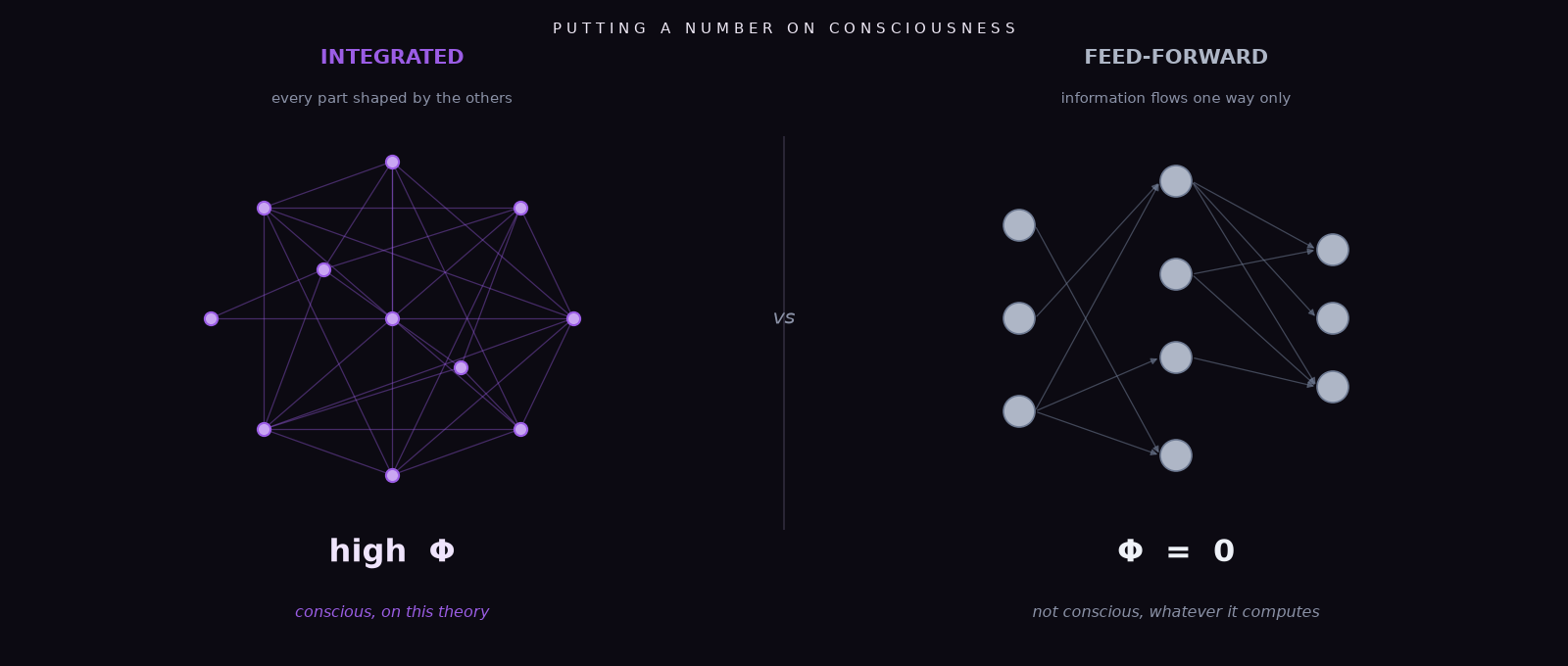
Most theories of consciousness try to describe it. Integrated Information Theory tries to measure it. It proposes a single quantity, Phi, that says how conscious any system is, from a person to a photodiode, and it makes hard predictions: today's AI scores zero, a living brain scores high, and a perfect computer simulation of you would feel nothing. It has a real clinical success behind it and a hundred and twenty-four researchers calling it pseudoscience. This is the file on the boldest theory in the science of mind, opened claim by claim, each one wearing its evidence.
Every theory of consciousness has to answer a question it would rather avoid: what, exactly, has it? Rocks presumably do not. People do. Somewhere in between sit bees, fetuses, patients who cannot respond, and, now, machines that talk. Most theories describe the brain activity that goes along with awareness and stop there. Integrated Information Theory does something far more daring and far more falsifiable. It proposes a single number, written with the Greek letter Phi, that is meant to say how much consciousness any physical system has, and it uses that number to draw a hard line between the systems that feel something and the systems that only act as if they do. Let's open the file.
01The Boldest Bet in the Science of Mind
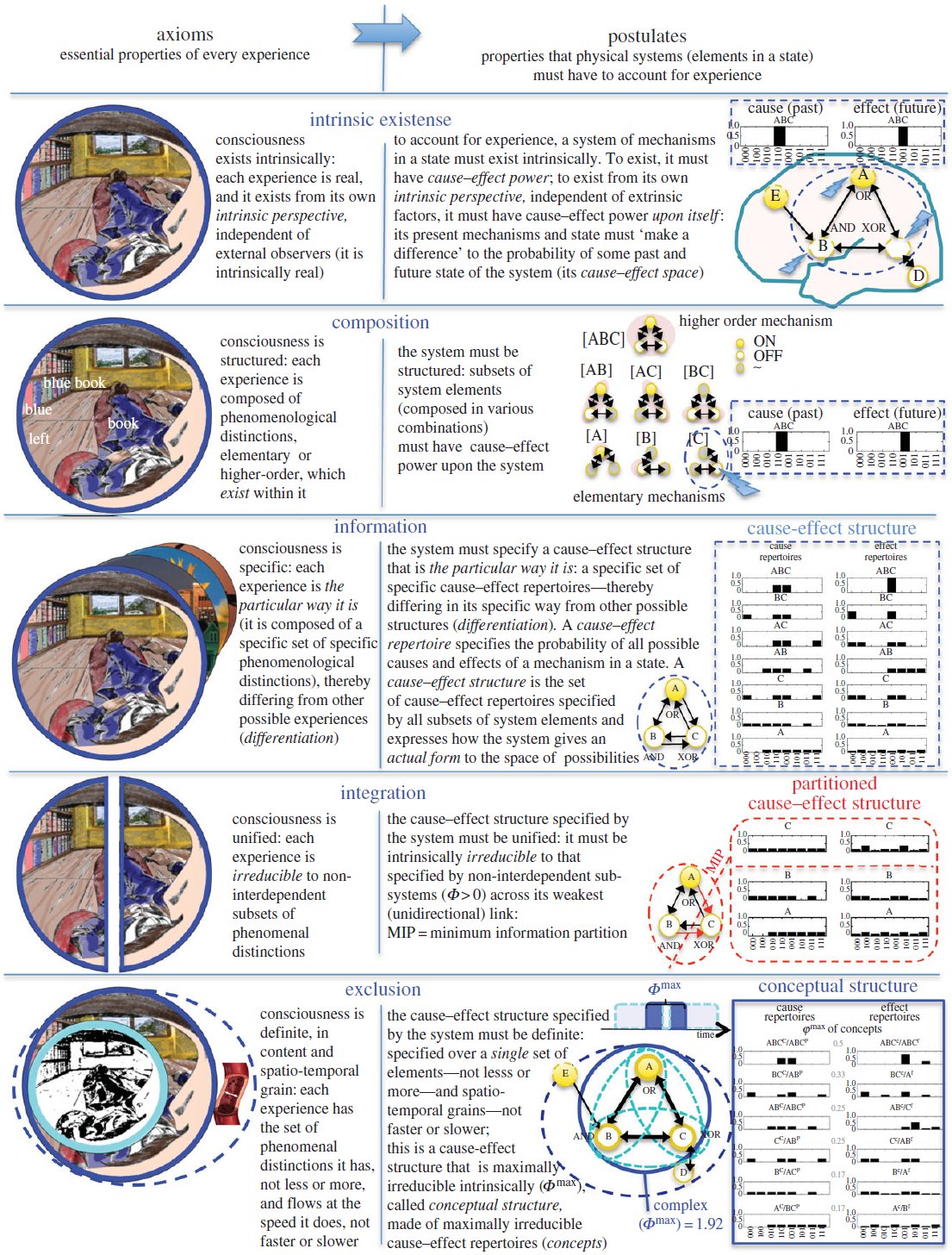
The theory begins with the neuroscientist Giulio Tononi, whose foundational paper appeared in 2004. Rather than start from the brain and work toward experience, IIT starts from experience itself and asks what any physical system would need in order to have it. In its mature form, laid out in 2014 and refined since, it distills experience into five axioms, claims so basic they are meant to be undeniable: your experience exists for you, from the inside; it is structured, made of parts; it is specific, this scene and not another; it is unified, not a bundle of separate pieces; and it has definite borders, a clear edge where it stops.
From those axioms IIT derives Phi, its measure of integrated information. The intuition is that a conscious system must be more than the sum of its parts: the whole must generate information that no independent collection of the pieces could. To compute Phi, you carve the system every possible way and find the weakest cut, the partition that loses the least when severed. Phi is how much is still lost even across that weakest cut. High Phi means the system genuinely cannot be reduced to independent parts. That irreducibility, IIT claims, is what experience is made of.
And here is the move that makes IIT unlike almost any rival: it does not say Phi correlates with consciousness, or causes it, or accompanies it. It says Phi structure IS consciousness, the way temperature simply is the motion of molecules. Tononi and the neuroscientist Christof Koch call the specific shape of a system's integrated information its conceptual structure, and claim that this shape does not merely track the quality of an experience, the particular redness of red, but constitutes it. This is an identity claim, and it is the theory's most ambitious and least tested commitment. Critics answer that an identity can be asserted but not simply declared: why should integrated information BE experience rather than just go with it?
02What the Number Predicts
A theory that assigns a number to every system makes predictions most theories cannot, and some of them are startling. This is where IIT earns both its admirers and its enemies.
The sharpest prediction concerns machines. A feed-forward network, one where information flows in a single direction through its layers without looping back, has a Phi of exactly zero, however complex it is. Because today's leading artificial intelligence, including the large language models behind the current boom, is built on feed-forward architectures, IIT's verdict is blunt: these systems, whatever they say, are not conscious. Note carefully what is Tier 1 here. That this is what the theory predicts is a plain fact about the math. Whether the prediction is true of the world is a further question, and a far more uncertain one.
Taken as a claim about reality rather than about the theory, the consequence is radical. If IIT is correct, no feed-forward system could ever be conscious no matter how human its behavior, while a relatively simple circuit with the right looping connectivity could have genuine experience. Stranger still, IIT holds that a perfect digital simulation of a brain would feel nothing, because a computer running through sequences of simple gates lacks the intrinsic, woven causal structure that Phi measures. That directly contradicts the functionalist view that consciousness rides on what a system computes, not what it is made of. It is IIT's most controversial practical claim, and it is unproven.
The theory also reaches in the other direction, toward the very small. Any system with a Phi above zero has some flicker of experience. A single photodiode, on IIT's accounting, has a tiny but nonzero Phi, and therefore an almost unimaginably simple shred of what it is like to be it. Tononi accepts this openly: IIT implies a form of panpsychism, though a graded and quantitative one, a smooth scale from the barely-there experience of a diode up to the rich inner life of a brain, not the claim that rocks daydream. Whether that implication is a strength or a fatal embarrassment is one of the fault lines of the whole debate.
Closer to home, IIT points at a specific piece of anatomy. It predicts that consciousness lives in the posterior cortex, the parietal and occipital regions at the back of the brain, rather than the prefrontal cortex at the front. The evidence fits: damage to the prefrontal cortex does not extinguish consciousness, while damage to the posterior hot zone can erase specific contents of experience. This has become one of IIT's genuine points in its favor, and it sets up a direct collision with its main rival, Global Workspace Theory, which bets on the front of the brain.
03The Part That Actually Works
For all the philosophical fireworks, IIT has produced one thing that is not contested at all, and it sits at the bedside in real hospitals.
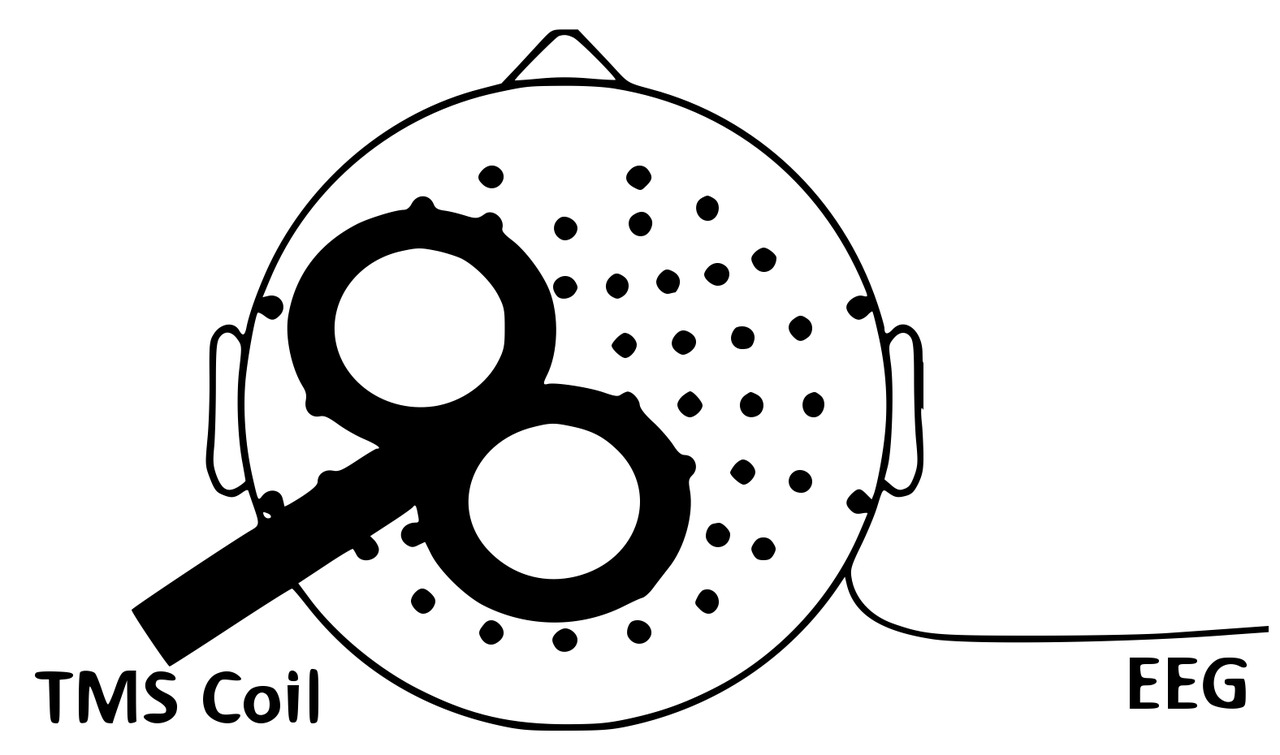
The tool is called the Perturbational Complexity Index, or PCI, introduced by Adenauer Casali and colleagues in 2013. It works exactly the way IIT would suggest a consciousness meter should. Send a magnetic pulse into the cortex, record the electrical echo with EEG, and measure how complex that echo is. Across 208 measurements spanning wakefulness, sleep, anesthesia, coma, the vegetative state, and locked-in syndrome, PCI sorted conscious from unconscious states with better than 95 percent accuracy. It is the closest thing the field has to an objective consciousness detector.
The numbers line up cleanly with awareness. Waking and dreaming both score high, around 0.4 to 0.7, because both are richly integrated states. Deep dreamless sleep and general anesthesia score low, down around 0.1 to 0.3, as the cortex fragments into local, disconnected responses. Most striking of all, PCI has flagged high complexity in some patients diagnosed as vegetative, hinting at a conscious mind trapped in an unresponsive body, and it correctly identifies locked-in patients, fully aware but paralyzed, as conscious. That last result is not just a scientific win but an ethical one, with direct consequences for how such patients are treated. This is IIT's strongest empirical achievement, and even critics grant it.
One honest caution has to travel with that success, because it is routinely overstated. PCI does not measure Phi. Nobody has ever computed Phi, in its full mathematical sense, for a human brain, and nobody can with current methods. PCI is inspired by IIT and measures a related kind of complexity, but the theory's actual quantity remains out of reach. The clinical tool works; that is not the same as the theory being proven.
04The Wall of Intractability
That last caution is not a detail. It points at a problem that sits underneath the entire theory, and it is made of pure mathematics.
Computing Phi means checking every possible way to partition a system, and the number of partitions explodes super-exponentially as the system grows. William Marshall showed in 2016 that even approximation methods hit this wall. The scale is hard to overstate: a system of only a few hundred simple on-or-off elements already has more possible partitions than there are atoms in the observable universe. A real brain has roughly 86 billion neurons. Calculating its true Phi is not merely hard; it is, by any known method, impossible. IIT's central quantity cannot be measured in the one system we most want to measure it in.
Defenders of the theory reply that intractability is not the same as unfalsifiability. Plenty of real quantities in physics cannot be computed exactly, and proxies like PCI let the theory make contact with data anyway. Critics counter that a theory whose defining measure can never be checked against its own definition, in any real brain, is in a strange scientific position no matter how elegant the mathematics. Both are fair points, and the gap between them is where much of the fight lives.
05The Critics With Names
IIT does not lack for critics, and the best of them are specific, technical, and worth taking seriously. This is not a case of a lone genius versus a hidebound establishment, nor of an obvious crank theory swatted down. It is a genuine, unresolved fight among serious people.
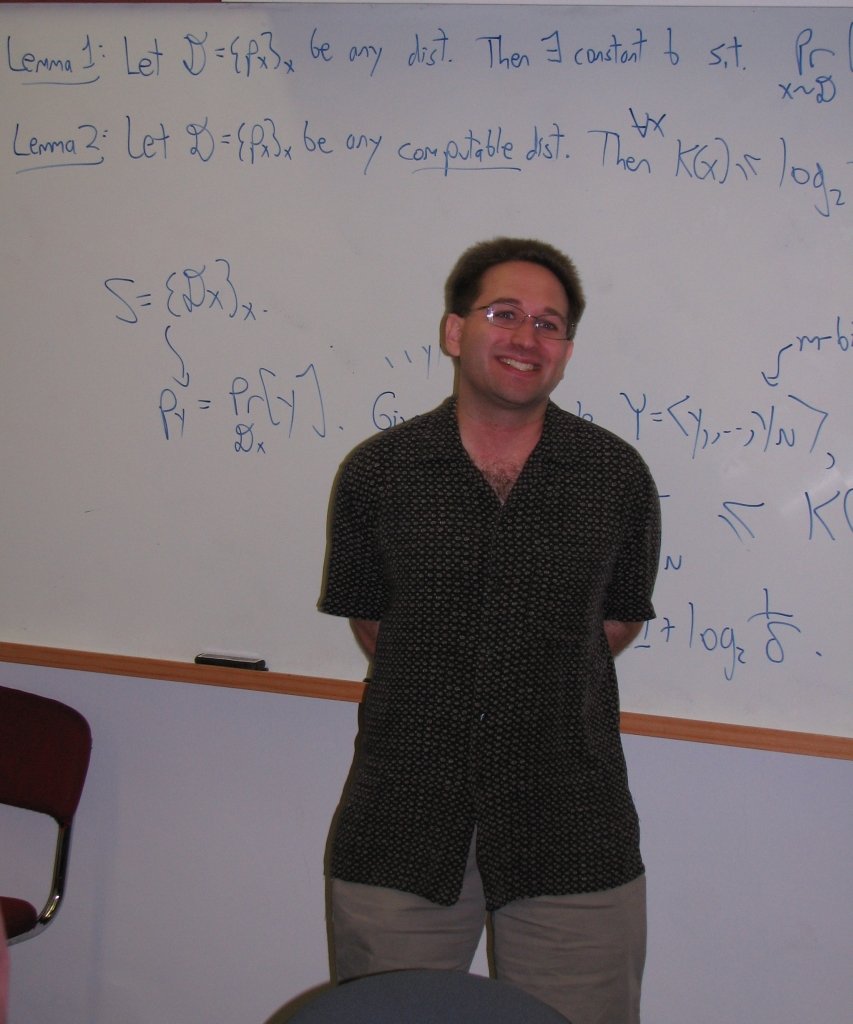
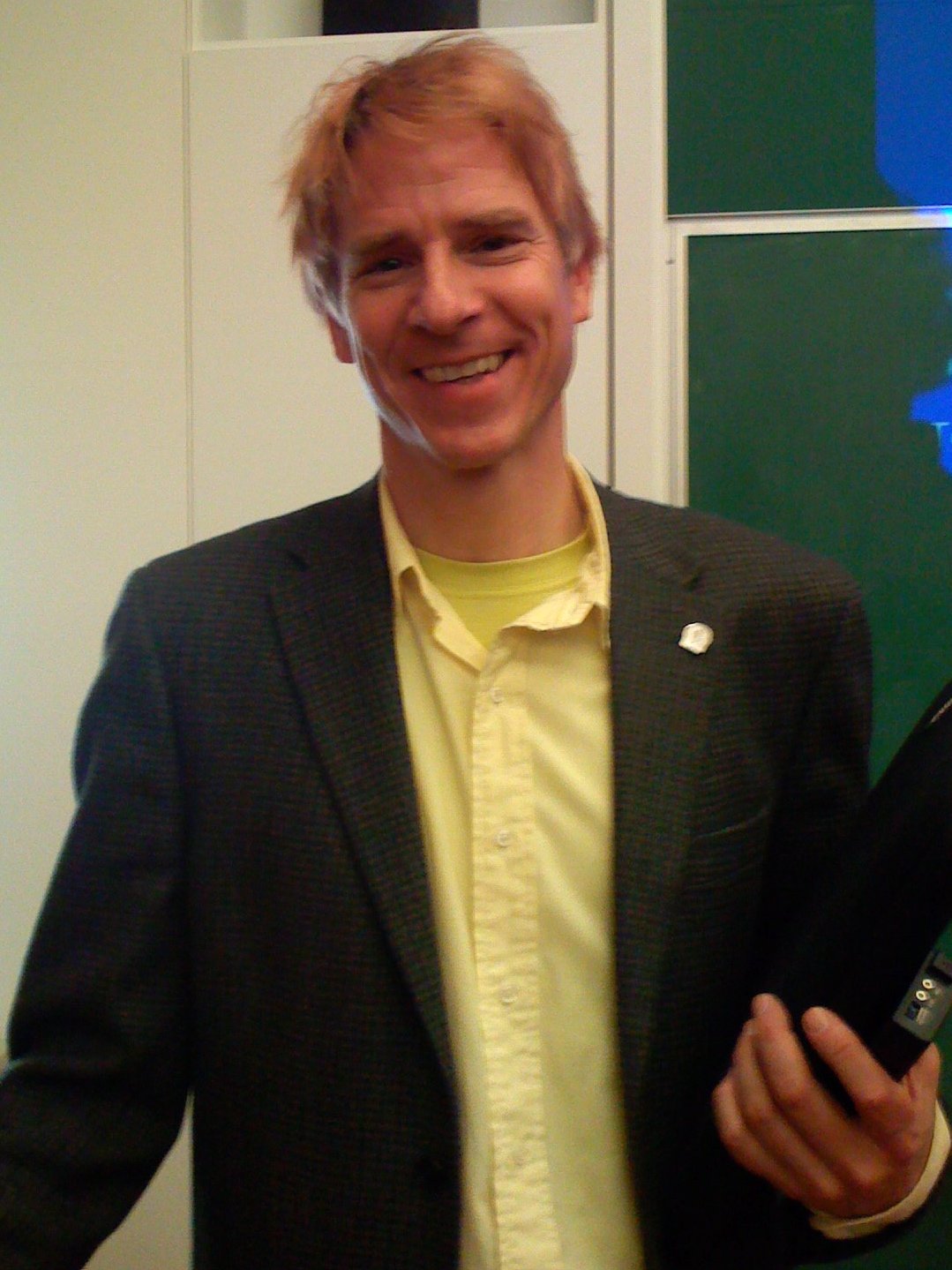
The most famous technical objection came from the theoretical computer scientist Scott Aaronson in 2014. He proved that IIT assigns an arbitrarily high Phi to certain dead-simple systems, in particular a two-dimensional grid of exclusive-or logic gates, a lattice that computes almost nothing interesting and that nobody believes is conscious. If the theory says that grid has more experience than a person, something has gone wrong. Tononi has responded by accepting that consequence rather than dodging it, and by adjusting later versions of the theory, but the objection has never been cleanly dissolved.
The philosopher Daniel Dennett dismissed IIT as a head-fake, arguing that starting from phenomenological axioms quietly assumes the very thing that needs explaining, and that all the mathematical machinery buys precision without genuine understanding. Others press the panpsychism problem: the philosopher Eric Schwitzgebel pointed out that IIT's logic, followed consistently, seems to imply that the United States, as a vast integrated network of communicating people, is itself conscious, unless the theory adds a rule specifically to forbid it.
Not every consequence that sounds absurd actually counts against the theory, and honesty cuts both ways here. IIT predicts that the cerebellum, which holds about 69 billion neurons, roughly 80 percent of all the neurons in the brain, contributes almost nothing to consciousness, because its circuitry is largely feed-forward and modular rather than richly interconnected. That sounds wrong until you check the clinic: people born without a cerebellum, or who lose it, keep their conscious experience largely intact, losing coordination rather than awareness. Here the counterintuitive prediction is actually correct, which is a real point in the theory's favor even as other predictions cut against it. And the philosopher Philip Goff defends the panpsychist implication outright, treating IIT as the most rigorous framework yet for taking consciousness to be fundamental.
06The Pseudoscience Letter
In 2023 the argument spilled out of the journals and into the open, in a way that was itself revealing about how raw the nerves are.
That September, an open letter signed by 124 consciousness researchers used a word rarely thrown in public science: pseudoscience. The signatories argued that IIT's empirical support was being oversold and that its panpsychist implications put it outside real science. Tononi and colleagues fired back that the letter confused being untestable in practice, which they conceded, with being unfalsifiable in principle, which they denied, and pointed to PCI as genuine empirical progress. The exchange was unusually bitter for a scientific disagreement.
The letter is also a lesson in reading past a headline. A follow-up survey of the broader consciousness-research community, not just the letter's signatories, found that among the 60 who responded, only about 8 percent fully agreed with the pseudoscience label, while about 20 percent rejected it outright and most landed somewhere in between. Many who signed objected specifically to panpsychism, not to IIT's mathematics or its clinical predictions. When the field's own biggest experiment reported its results, a Nature editorial went out of its way to say that pseudoscience language has no place in a collaborative scientific process. The strong word made news; the field's actual center of gravity was far more measured.
07The 2025 Verdict, Honestly Read
The best test yet came from an unusual experiment: a formal contest, agreed in advance, between IIT and its great rival. It is tempting to declare a winner. The honest answer is more interesting.
Beginning in 2019, a Templeton-funded adversarial collaboration set IIT against Global Workspace Theory, with both camps committing in advance to what each theory predicted, then testing it on the same 256 people using fMRI, MEG, and direct intracranial recordings. The results, published in Nature in 2025, were genuinely mixed and do not hand either side a clean win. On the big question of where consciousness lives, the data favored IIT: awareness tracked the posterior cortex, and the frontal ignition that Global Workspace Theory predicted did not show up as required. But on one of IIT's own specific predictions, that the posterior hot zone would show sustained synchronized activity in the gamma frequency band, the data did not cooperate; that signature was not found. IIT came out ahead on the broad question and stumbled on a specific one of its own.
That is the honest shape of it, and even the collaborators disagreed publicly about what it meant. A contest designed to be decisive turned out, like most real science, to be a partial result that moved the field without settling it. IIT looks stronger than its loudest critics allow and weaker than its most fervent boosters claim. Both of those can be true at once, and here they are.
Fast Facts
- The Theory
- Integrated Information Theory, proposed by Giulio Tononi in 2004
- The Core Claim
- Consciousness IS integrated information; it does not merely correlate with it
- The Measure
- Phi, how much a system's information is irreducible to its independent parts
- Boldest Prediction
- Feed-forward systems, including today's AI, have Phi = 0 and are not conscious
- The Clinical Win
- PCI sorts conscious from unconscious states at over 95 percent accuracy (Casali 2013)
- The Math Problem
- Computing true Phi for a real brain is intractable; PCI measures a proxy, not Phi
- The Panpsychism
- Any system with Phi above zero has some experience, down to a photodiode
- The Controversy
- A 2023 letter by 124 researchers called IIT pseudoscience; the charge is contested
- The 2025 Test
- Adversarial collaboration: favored IIT on location, failed one of IIT's own predictions
What We Can Actually Stand Behind
IIT is a real, rigorous, and clinically productive theory. The five axioms, the Phi framework, and the specific predictions are all genuinely defined, not hand-waving. Its clinical spin-off, PCI, really does sort conscious from unconscious brains at better than 95 percent accuracy and has flagged hidden awareness in patients thought to be vegetative. Its prediction that the cerebellum contributes little to consciousness is counterintuitive and correct. This is serious science with a track record.
The core theory is neither proven nor debunked. It faces real, unanswered objections: Aaronson's grid, the panpsychism problem, and above all the fact that its defining measure cannot be computed for any real brain. Its defenders have real replies. The 2025 adversarial test favored IIT on where consciousness lives but failed one of IIT's own specific predictions. The 2023 pseudoscience charge is itself disputed, with most of the field declining the strong word. This is a live fight, not a settled question.
The theory's deepest claims are speculation, honestly labeled. That Phi structure literally IS experience, that a digital simulation of a brain would feel nothing, that today's AI is definitely not conscious while a simple recurrent circuit might be, these follow from IIT but are not established by it. They are among the most consequential ideas in the field and among the least tested.
No, IIT has not been proven to be the correct theory of consciousness; the adversarial collaboration was mixed and PCI is not a measurement of Phi. And no, IIT does not imply the internet or the universe is conscious; it predicts loosely coupled systems have very low Phi despite their size. Both claims are common, and both misread what the theory actually says.
So here is a theory that dares more than any of its rivals. It refuses to settle for describing the neural shadow of consciousness and insists on measuring the thing itself, on saying with a number what has an inner life and what does not. That daring is exactly why it draws such heat: a theory bold enough to tell you your laptop feels nothing and a simple loop of circuitry feels something is bold enough to be spectacularly wrong, and its critics may yet prove it so. But it has also given medicine its best consciousness detector and given philosophy its most rigorous attempt to turn the hardest question into a quantity. Whether Phi is the true measure of the soul or an elegant wrong turn, we cannot yet say. What would it take to actually settle it? On IIT's own terms, a machine we cannot build, measuring a number we cannot compute, in the one place we most need to look.
Sources & further reading
Everything above is drawn from our research library on Theories of Anything. Open the full file to check the sourcing and go deeper.
Image credits
- Original diagram contrasting a high-Phi integrated recurrent network (which IIT counts as conscious) with a zero-Phi feed-forward network (which IIT counts as not conscious) Original diagram by Theories of Anything. CC BY-SA 4.0 Source.
- Colorized version of Ernst Mach's 1886 self-portrait sketch, annotated by Tononi and Koch to illustrate the five axioms and postulates of Integrated Information Theory Giulio Tononi and Christof Koch, Philosophical Transactions of the Royal Society B (2015), via Wikimedia Commons. CC BY 4.0 Source.
- Schematic diagram of combined transcranial magnetic stimulation and electroencephalography (TMS-EEG), the method behind the Perturbational Complexity Index Nahian Shahmat Chowdhury et al., eLife (2025), via Wikimedia Commons. CC BY-SA 4.0 Source.
- Photograph of the theoretical computer scientist Scott Aaronson lecturing at the Hebrew University of Jerusalem, 2010 Wikimedia Commons user Easy n (own work), August 17 2010, via Wikimedia Commons. Public Domain Source.
- Photograph of the neuroscientist Christof Koch, a leading proponent of Integrated Information Theory Wikimedia Commons user Romanpoet (self-made), 2008, via Wikimedia Commons. Public Domain Source.
- Card crop of the original integration-versus-feed-forward diagram Original diagram by Theories of Anything. CC BY-SA 4.0


