
Hydrothermal Vents: Life Without the Sun
Until 1977, every biology textbook agreed that sunlight was the ultimate source of all food, and that the deep sea was a cold, dark desert. Then a submarine dropped onto the Galapagos Rift and found, around cracks of warm water two and a half kilometers down, some of the densest animal communities on Earth: giant red-plumed worms, ghost-white crabs, mussels and clams, all thriving in total darkness. They run not on sunlight but on chemistry, on the poison hydrogen sulfide welling up from inside the planet. This is the story of that discovery, how life without the sun actually works, and why it quietly rewrote the boundaries of where life can exist, on this world and perhaps on others.
For as long as there had been a science of biology, one rule seemed beyond question: sunlight is the source of all food. Green plants and algae capture it, everything else eats the plants or eats the plant-eaters, and the whole living world is, at bottom, running on light. The deep sea, sunless and cold and crushing, was therefore assumed to be very nearly a desert, a dark plain scattered with a few scavengers living on scraps drifting down from above. Then, on a February day in 1977, a small submarine settled onto the seafloor two and a half kilometers down, and the crew looked out the porthole at something that should not have been there: a riot of life, thick as a jungle, clustered around cracks in the volcanic rock. Not a few hardy survivors, but one of the densest animal communities anyone had ever seen, in a place with no light at all. It was one of the great surprises in the history of science, and it forced biology to rewrite one of its oldest rules. This is what is down there, how it lives without the sun, and, just as important, what that discovery does and does not mean.
01The Discovery That Rewrote Biology
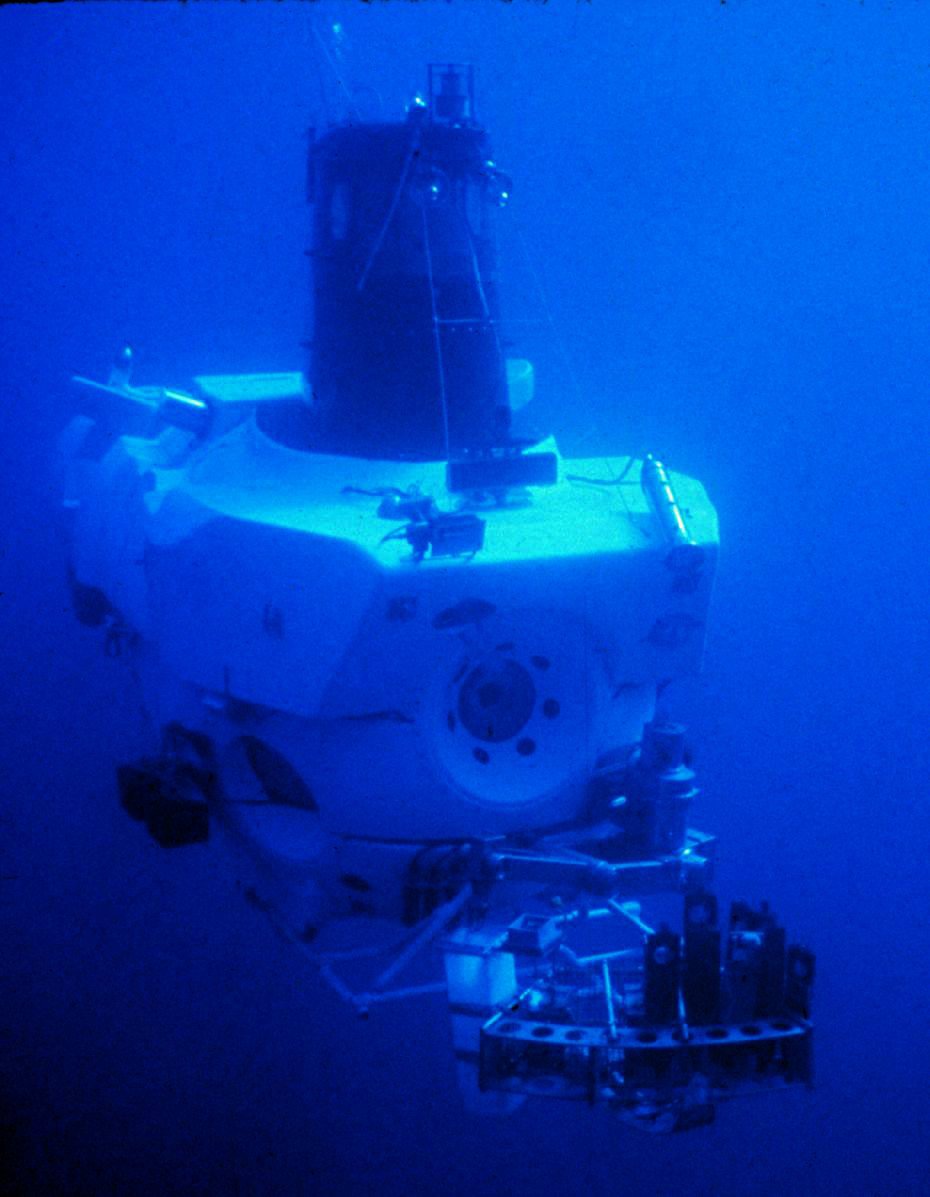
The discovery came on 17 February 1977, on the Galapagos Rift, during dive 713 of the deep-submergence vehicle Alvin. Alvin was piloted by Jack Donnelly and carried two geologists, Jack Corliss of Oregon State and Tjeerd van Andel of Stanford, as scientific observers. They had come to study the geology of a mid-ocean ridge, the seam where two of Earth's plates pull apart and fresh seafloor is born. What they found instead was biology. Around fissures venting shimmering warm water into the frigid dark, they saw dense clusters of giant tube worms, big white clams, mussels, and crabs, an entire thriving ecosystem where the textbooks predicted almost nothing. One detail deserves to be stated precisely, because it is often garbled: the water the 1977 team actually measured was warm, about 17 degrees Celsius against a near-freezing background of 2 degrees, not scalding. The famous scorching 'black smokers' were not this discovery. The revelation of 1977 was not extreme heat; it was the sheer existence of a rich community of animals living with no sunlight and no connection to the surface food web. Corliss and his colleagues published the formal description in 1979, and biologists grasped the significance at once: here was a whole world running on something other than the sun.
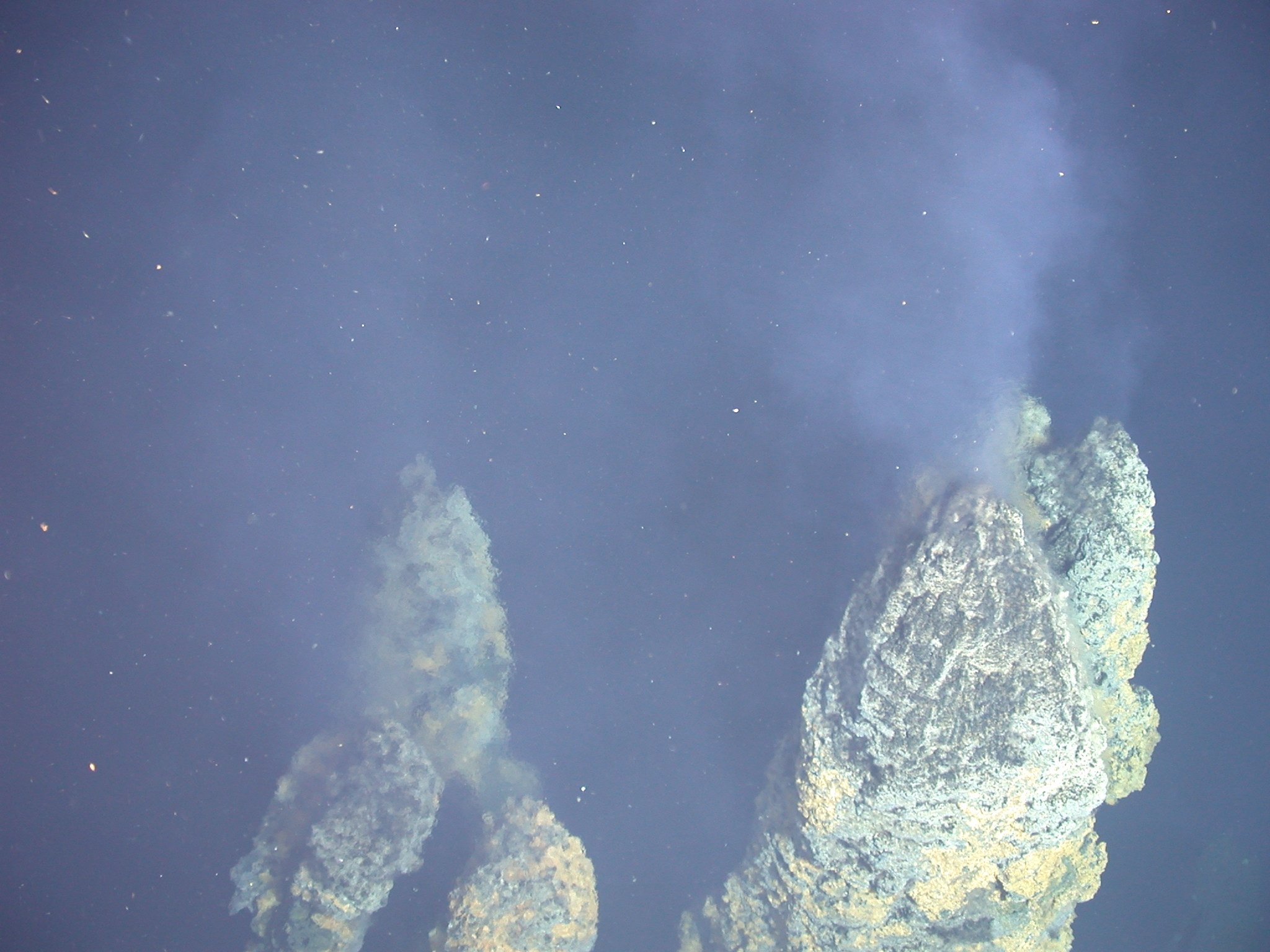
The black smokers, when they were found, were their own kind of wonder. Two years after Galapagos, in 1979, an expedition to the East Pacific Rise came upon towering mineral chimneys belching what looked like plumes of black smoke into the sea. It is not smoke. It is water, superheated to 350 or even 400 degrees Celsius by contact with the hot rock below, and kept liquid only by the crushing pressure of the deep. That water is saturated with dissolved metals, and the instant it meets near-freezing seawater those metals crystallize into a blizzard of tiny black particles of iron and copper and zinc sulfide, which also pile up to build the chimney itself. Lower-temperature vents, around 200 to 300 degrees, make paler 'white smokers.' The hottest vent fluid ever measured, a scorching 407 degrees Celsius, was recorded in 2010 at the Beebe Vent Field in the Cayman Trough, the deepest known vents in the world at nearly five kilometers down. These are among the most extreme, and most beautiful, structures on the planet, and yet, as we will see, the astonishing thing about them is not the heat itself but what manages to live around it.
02Eating Rock, Not Sunlight
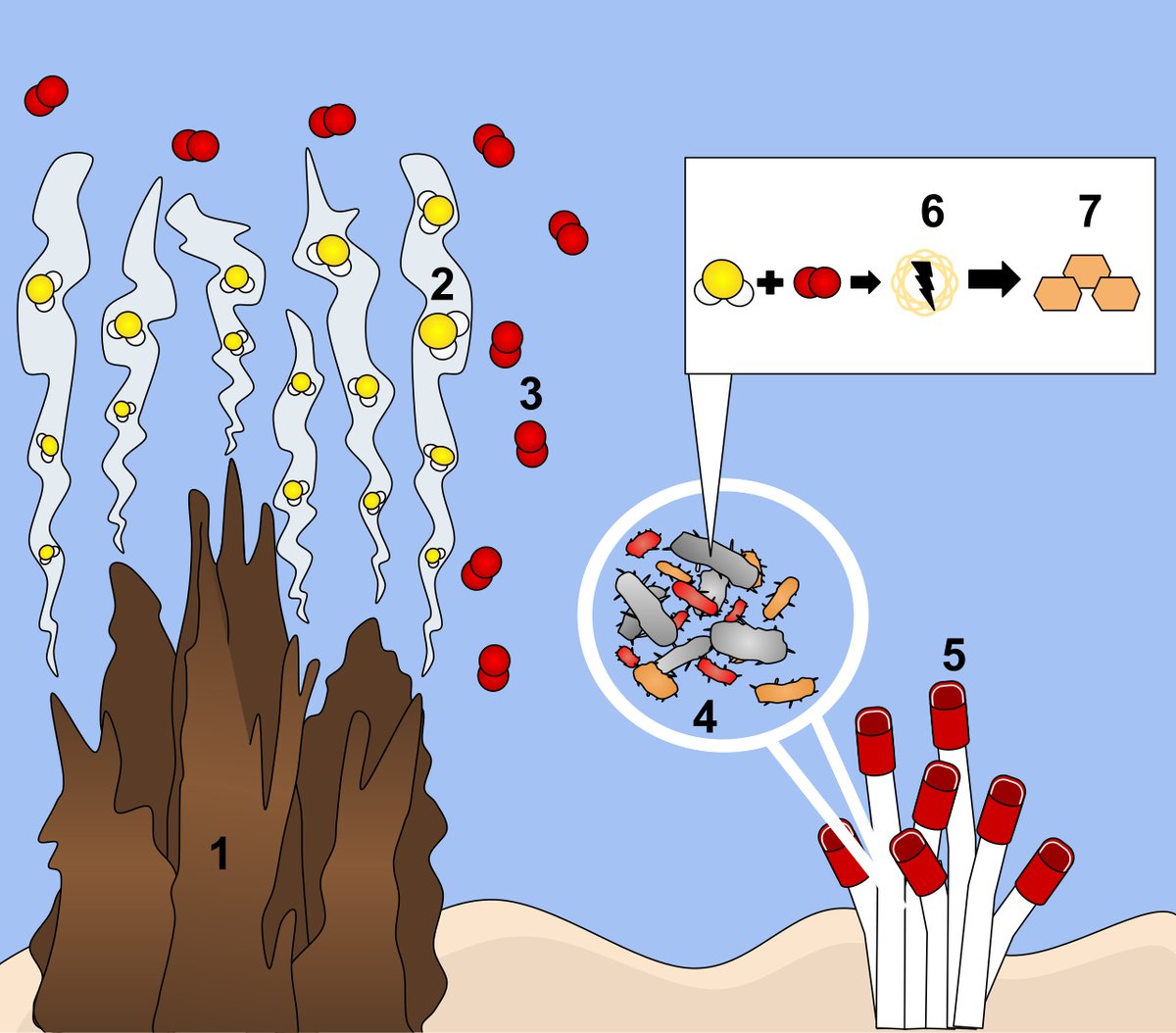
So if not sunlight, what feeds a vent? The answer is chemistry, and it is the single fact that overturned the old rule. The warm fluid seeping from a vent is loaded with chemicals that are, to most life, simply poison: above all hydrogen sulfide, the gas that smells of rotten eggs, along with methane and hydrogen. Certain bacteria and archaea have learned to make a living by oxidizing those chemicals, harvesting the energy released to build sugars out of carbon dioxide. It is exactly the trick that green plants perform, using energy to turn simple carbon into food, except the energy comes not from light but from the chemical mismatch between the reduced vent fluid and the oxygen in seawater. The process is called chemosynthesis, and these microbes are the pastures of the vent, the base of a food web that never once touches the sun. Everything else at the vent, directly or indirectly, is eating them, or eating the animals that host them. An entire ecosystem, it turned out, could be founded on the chemistry of the planet's own interior.
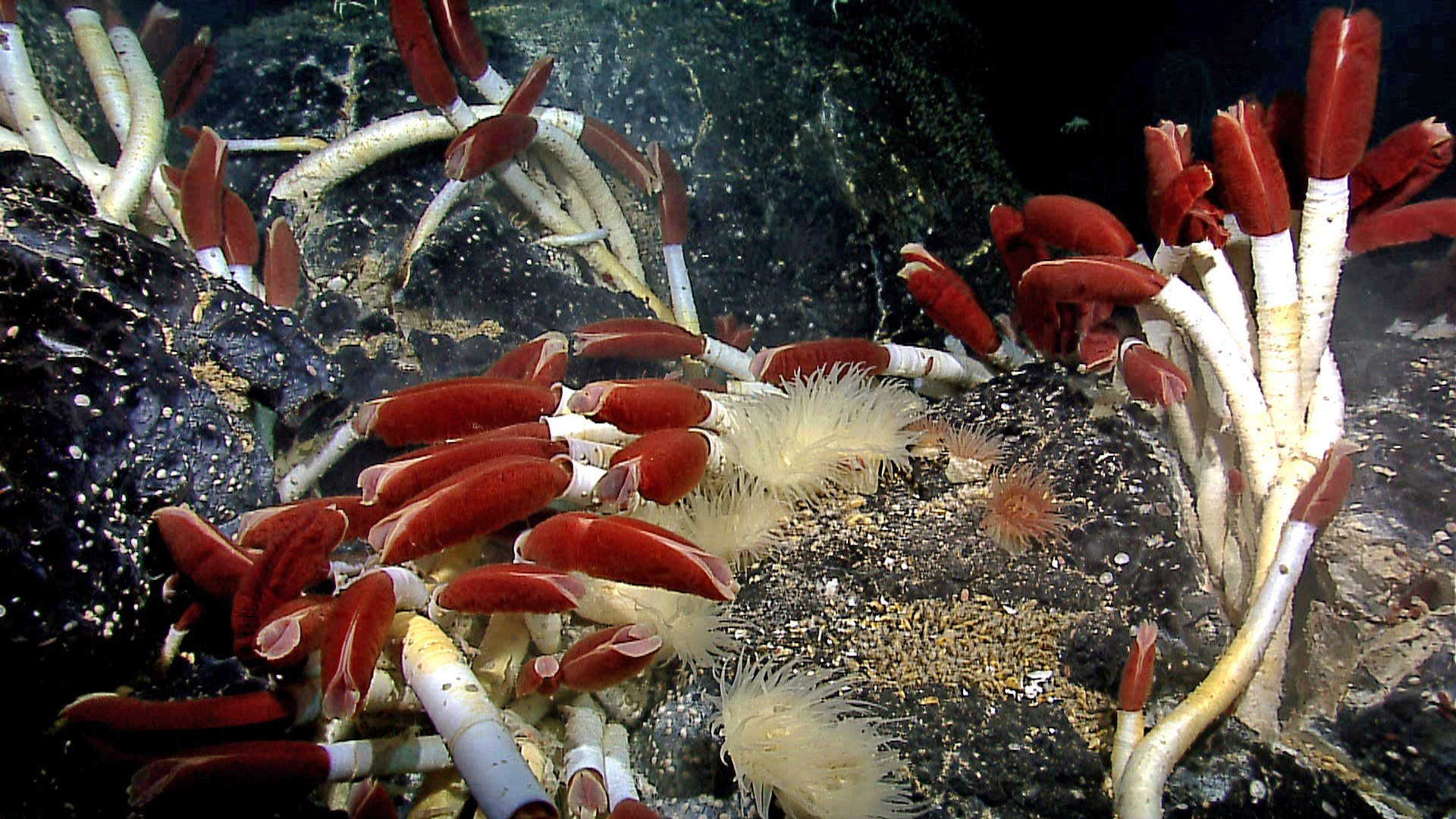
The most spectacular embodiment of this arrangement is the giant tube worm, Riftia pachyptila, which grows up to two meters tall in swaying, blood-red-tipped white tubes. Look closely and you find something almost unbelievable: an adult Riftia has no mouth, no gut, and no anus at all. It cannot eat, in any ordinary sense, and it does not need to. Packed inside a special internal organ called the trophosome, which can make up half the worm's body weight, live billions of chemosynthetic bacteria. The worm's brilliant red plume, colored by a special hemoglobin, absorbs hydrogen sulfide and oxygen from the water and ferries them down to its bacteria; the bacteria make food and share it back with their host. It is one of the most complete partnerships in nature, an animal that has effectively turned itself into a garden. And it is spectacularly successful: Riftia grows up to about 85 centimeters a year, the fastest growth rate known for any marine invertebrate, letting it colonize a brand-new vent in a matter of a year or two. That this was really how the worm lived was shown in 1981 by Colleen Cavanaugh, then a graduate student, who realized the packed bacteria in the trophosome were the key and demonstrated the sulfur-oxidizing symbiosis, the first such case ever proven in an animal.
03A City in the Dark
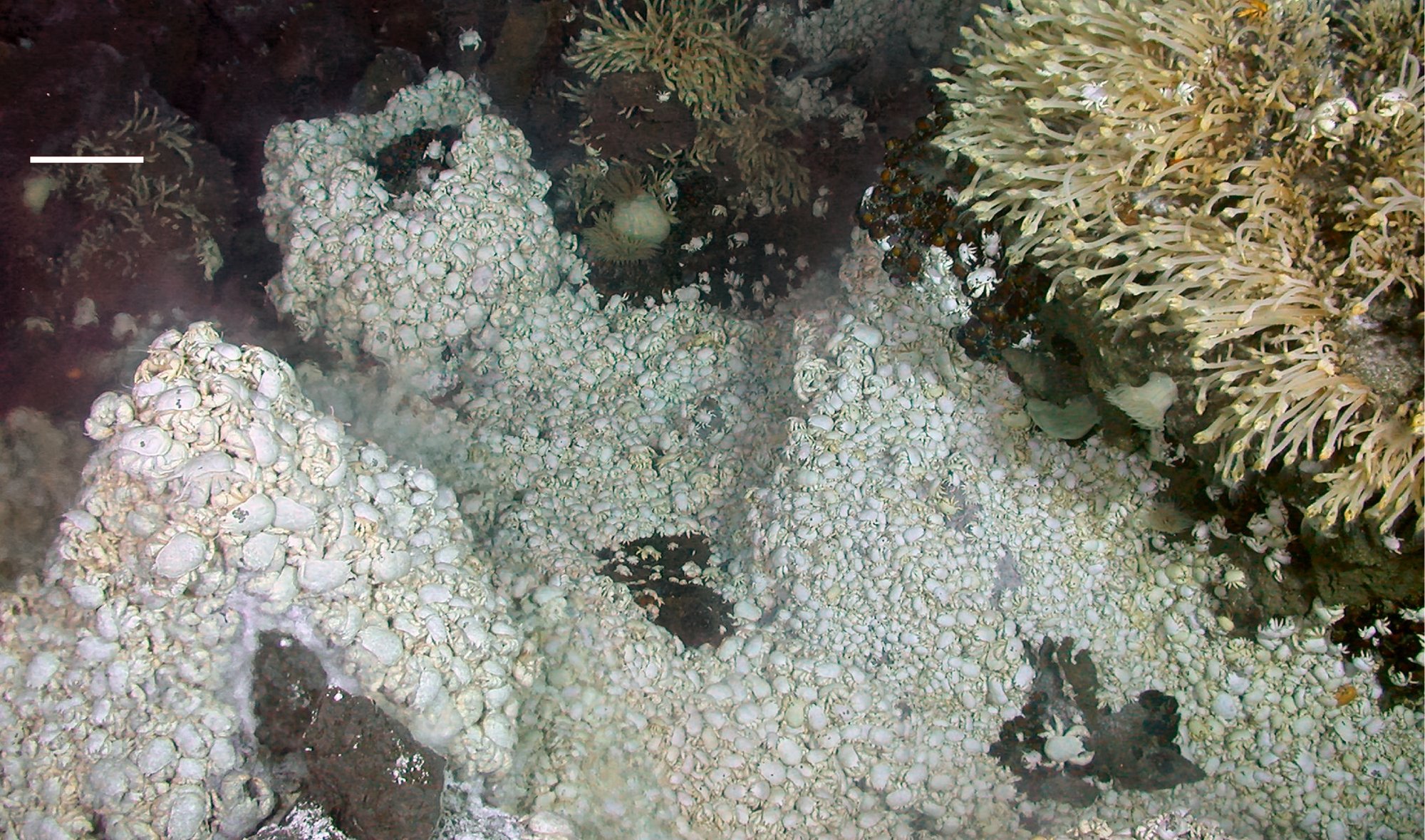
The tube worms are only the headline act. A vent is a crowded, competitive city, and more than 700 species have now been described from vents around the world, of which roughly 95 percent are found nowhere else on Earth. There are clams and mussels by the thousand, acorn barnacles, and above all a bestiary of remarkable crustaceans. Around some vents, pale 'yeti crabs' of the genus Kiwa swarm in densities that beggar belief, hundreds packed onto every square meter, piling over one another to stay in the thin sweet spot of warm, chemical-rich water. The eyeless vent shrimp Rimicaris turns out not to be truly blind: it carries a specialized patch of photoreceptor on its back, sensitive enough to detect the faint thermal glow that a 350-degree black smoker gives off, so it can graze on the bacteria near the searing chimney without being cooked. And then there is the animal that best captures the sheer extremity of the place.
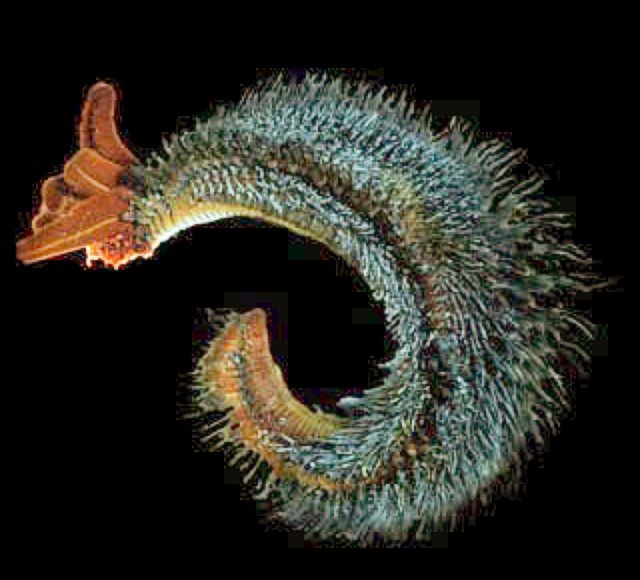
The Pompeii worm, Alvinella pompejana, lives in papery tubes built onto the sides of black-smoker chimneys, in what may be the most brutal thermal environment any animal endures. The worm's own body tolerates temperatures only up to about 55 degrees Celsius, but the base of its tube, warmed by the chimney and by a thick coat of symbiotic bacteria the worm wears like a fleece across its back, can reach roughly 105 degrees. Individual worms have been measured enduring a temperature difference of nearly 80 degrees Celsius between their head and their tail, one of the steepest gradients tolerated by any known creature. Life at a vent pushes right up against a hard physical wall: the current record for the hottest temperature at which any organism can grow and reproduce is 122 degrees Celsius, set by a microbe called Methanopyrus kandleri, isolated from a vent, cultured under deep-sea pressure. Above that, so far as anyone has found, the molecules of life simply come apart. The vent is where we have learned where that boundary lies.
04Vents Everywhere, and Their Cousins
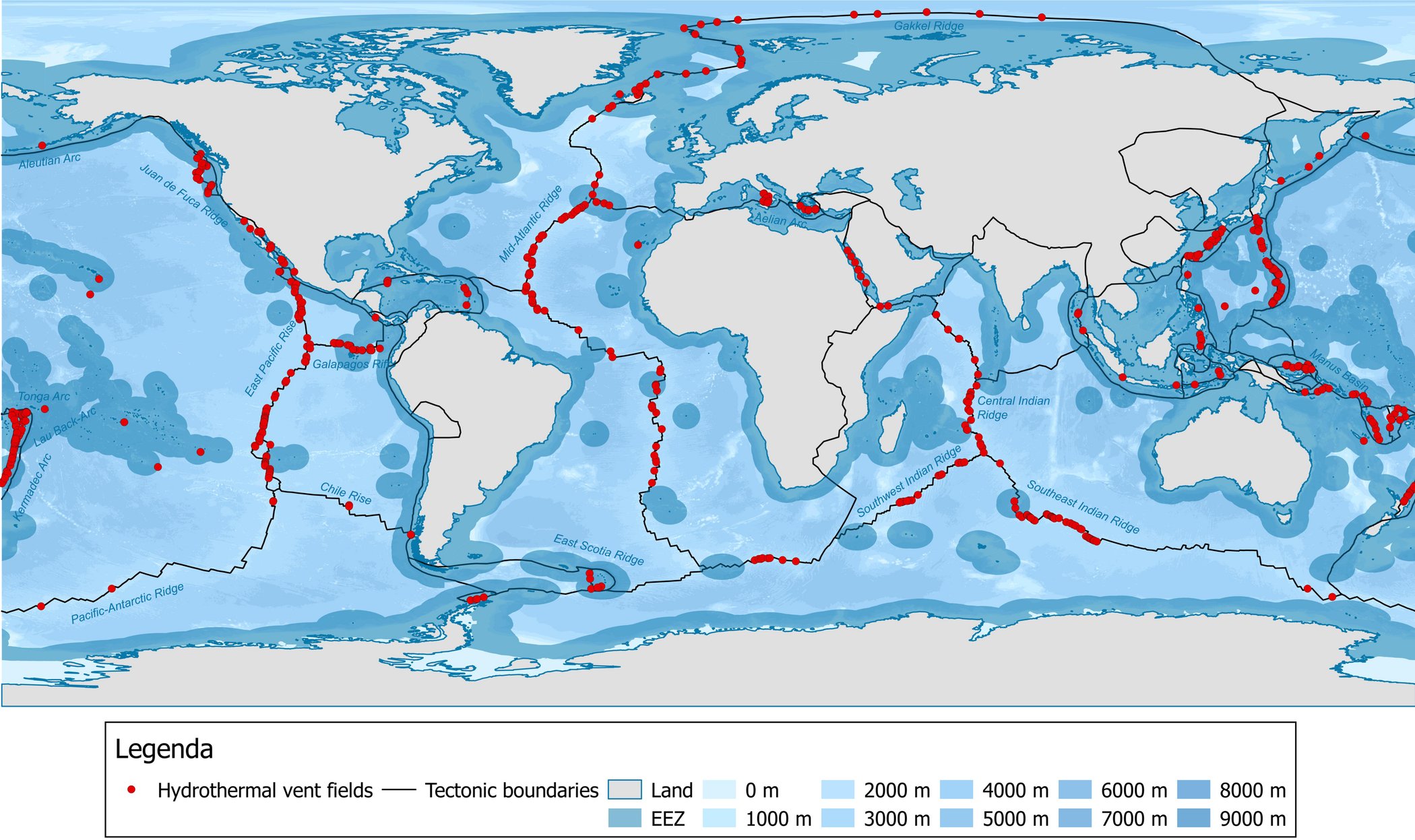
The single Galapagos site was just the beginning. In the decades since, hydrothermal vents have been found along essentially every major mid-ocean ridge on the planet: the East Pacific Rise, explored from 1979; the Mid-Atlantic Ridge, whose first vents were found at the TAG site in 1985; the Central Indian Ridge in 2001; even beneath the ice at the Arctic's Gakkel Ridge in 2005. Vents turn out to be a fundamental feature of a geologically living planet, strung like beads along the tens of thousands of kilometers of seam where the seafloor is continually being made. And chemosynthesis, it emerged, is not unique to vents. The same sunlight-free strategy powers two related deep-sea habitats. Cold seeps, first described in 1984, are places where methane and hydrogen sulfide ooze up from the seabed at ordinary cold temperatures, often over buried petroleum, supporting communities of mussels and tube worms much like a vent's but far longer-lived; one seep tube worm may survive more than 250 years, among the longest-lived animals known. And when a dead whale sinks to the abyss, its rotting, oil-rich skeleton becomes a temporary chemosynthetic oasis all its own, a 'whale fall' that can feed a specialized community for decades, and that may serve as a stepping stone letting vent and seep species hop across the empty deep.
05The Honest Caveats
It would be easy to let this story run away with itself, so here are the honest brakes. First and most important: most of the deep sea does not run on chemosynthesis. The overwhelming majority of deep-sea life still depends, in the end, on the sun, feeding on the perpetual drizzle of dead plankton and organic debris, the 'marine snow,' that sinks from the sunlit surface. Vents, seeps, and whale falls are remarkable precisely because they are the dramatic exceptions, local islands of sunlight-free life, not because chemosynthesis has taken over the ocean floor. There is even a subtler wrinkle: the animals at a vent breathe oxygen, and that oxygen was itself made by photosynthesis at the surface, so a vent ecosystem is not quite as independent of the sun as the headline suggests. Second, vents are fragile and fleeting. An individual vent may run for only decades before the plumbing seals off and its whole community dies, which makes vents natural laboratories for how life colonizes, connects across the dark, and goes locally extinct. That fragility is now also a live conservation issue: the same seafloor holds metals coveted for batteries, and a real, active debate surrounds deep-sea mining, with a coalition of scientists calling for a moratorium until the consequences of tearing up habitats that recover over centuries are better understood.
A place this strange attracts tall tales, and a few deserve to be named and set aside. No, the giant prehistoric shark megalodon is not lurking in the deep, kept secret by the vents or anything else; it went extinct millions of years ago, and the cold, dark, food-poor abyss is the last place a warm-water giant that hunted whales near the surface could survive. No credible sonar or submersible survey has ever found artificial alien structures on the deep seafloor, despite tens of thousands of hours of mapping. Vent animals do not run on mysterious 'free energy' and do not break the laws of thermodynamics; they need a constant supply of chemical fuel, and when a vent shuts off, its community starves and collapses within a few years. And the vivid claim that vent creatures are unchanged 'living fossils,' relics from the dawn of life, is simply false: most vent groups are geologically young, and today's vent communities look nothing like the earliest ones. The reality needs no embroidery. That entire cities of complex animals live in perpetual darkness on the chemistry of the Earth's interior is astonishment enough.
06Worlds Without a Sun
The deepest consequence of the vents reaches far past our own ocean. Before 1977, the search for life beyond Earth was essentially a search for sunlight and surface warmth, for a second Earth. The vents demolished that assumption. If complex ecosystems can run on chemistry in cold darkness here, then a sunless ocean elsewhere is no longer disqualified. And the solar system has such oceans. Jupiter's moon Europa hides a global saltwater ocean beneath its ice, its existence inferred from the way it disturbs Jupiter's magnetic field. Saturn's little moon Enceladus actively jets water into space from its south pole, and when the Cassini spacecraft flew through those plumes it found hydrogen gas, a strong sign of hot rock reacting with water on the seafloor below, exactly the kind of chemical energy that feeds Earth's own vents. These are now among the highest-priority targets in the search for life, and the reason is the tube worm. It has to be said plainly, though: these are candidate worlds, not discoveries. No life of any kind has ever been detected on Europa, on Enceladus, or anywhere else beyond Earth. The vents make the question serious; they do not answer it. There is one more thread, and it is deliberately left as a thread. Some researchers argue that life on Earth may itself have begun at a gentle, alkaline kind of vent, like the ghostly carbonate towers of the 'Lost City' field, where natural chemical gradients across mineral walls resemble the way living cells make energy. It is a serious idea and a genuinely open one, and it has its own full story to tell elsewhere in this wing; here it is enough to note that the vents may be not only a place life clings to, but perhaps, just perhaps, the place it started.
Fast Facts
- The discovery
- 17 February 1977, Galapagos Rift, ~2,500 m down, from the submersible Alvin (dive 713). The water measured was WARM (about 17C), not scalding. The 350 to 400C black smokers were a separate 1979 discovery at the East Pacific Rise
- How it lives
- Chemosynthesis: bacteria and archaea oxidize hydrogen sulfide, methane, and hydrogen to build food from carbon dioxide, with no sunlight. It is the base of the entire vent food web
- The tube worm
- Riftia pachyptila grows up to 2 m with no mouth, gut, or anus; it houses billions of symbiotic bacteria in an internal organ (the trophosome) that can be half its body weight. It grows up to ~85 cm per year, the fastest of any marine invertebrate
- The extremes
- Over 700 vent species, about 95% found nowhere else. The Pompeii worm endures ~105C at its tube base. The upper temperature limit of all known life is 122C (a vent microbe). Hottest vent fluid on record: 407C (Beebe Vent Field)
- The honest caveat
- MOST of the deep sea does NOT run on chemosynthesis; it runs on 'marine snow' sinking from the sunlit surface. Vents, cold seeps, and whale falls are the dramatic exceptions, not the rule
- Beyond Earth
- Vents prove sunless ecosystems are possible, making the buried oceans of Europa and Enceladus (which vents hydrogen, per Cassini) high-priority targets. But these are CANDIDATES only; no life has been detected anywhere off Earth
- Refused
- That megalodon survives in the deep; that alien bases sit on the seafloor; that vent life defies thermodynamics or runs on 'free energy'; and that vent animals are unchanged 'living fossils' from the origin of life
What We Can Actually Stand Behind
The core science is settled. Sunlight-independent ecosystems were discovered at hydrothermal vents in 1977, and they run on chemosynthesis, microbes oxidizing hydrogen sulfide and other chemicals to make food. The giant tube worm Riftia lives by housing those bacteria internally (shown by Cavanaugh, 1981). Over 700 vent species are known, about 95 percent endemic. Black smokers reach 350 to 400C, and the upper temperature limit of life, 122C, was established from a vent microbe. These are facts.
Much is real but still being worked out: the true total of vent species and the rate of new discoveries, how vent populations stay genetically connected across the dark, and the degree to which vents depend on surface-made oxygen. Deep-sea mining is a genuine, active threat and policy debate, not a settled matter.
The big open questions remain open. Whether life on Earth began at an alkaline vent is a serious but unproven hypothesis, developed fully elsewhere in this wing. Whether the buried oceans of Europa or Enceladus host life is genuinely unknown; the vents make it a serious question, but no detection has ever been made. And the true size of the deep biosphere is honestly uncertain.
The tall tales get a clear no. Megalodon is not hiding in the abyss; there are no alien installations on the seafloor; vent life obeys thermodynamics and dies when the fuel stops; and vent animals are not unchanged 'living fossils.' And the crucial honest caveat: most of the deep sea still runs on sunlight-derived marine snow. The vents are a spectacular exception to the rule that sunlight feeds all life, not a repeal of it.
Hydrothermal vents earn their place in The Living World's band of the deep because they are the purest proof of the wing's central conviction: that life is stranger, tougher, and more inventive than our tidy rules predict. For a century, biology was certain that the sun fed everything and that the deep sea was all but dead. A single dive in 1977 overturned both ideas at once, and revealed animals that farm bacteria in their own bodies, shrimp that see heat, and worms that thrive at the edge of boiling, all in a darkness that has never known a sunrise. The honest account keeps its balance: the wonder is real, but most of the ocean still runs on sunlight, the ocean moons are candidates and not colonies, and the question of where life first sparked is still open. What the vents settled, permanently, is narrower and larger than any single claim. They proved that life does not require the sun. And that one fact quietly redrew the map of where, in this ocean and in others, a living thing might be found.
Sources & further reading
Everything above is drawn from our research library on Theories of Anything, with the specific studies below. Open the full file to check the sourcing and go deeper.
Image credits
- Active black smoker chimney, East Diamante volcano (NOAA) NOAA Vents Program (Submarine Ring of Fire 2006), via Wikimedia Commons (public domain). Public domain Source.
- DSV Alvin, 1978 NOAA, via Wikimedia Commons (public domain). Public domain Source.
- Chemosynthesis at a hydrothermal vent (schematic) ENtrustMe, via Wikimedia Commons (CC BY-SA 4.0). CC BY-SA 4.0 Source.
- Riftia pachyptila tube worm colony, Galapagos Rift 2011 NOAA Okeanos Explorer Program, via Wikimedia Commons (public domain). Public domain Source.
- Dense swarm of Kiwa yeti crabs at a hydrothermal vent A. D. Rogers et al., PLoS Biology (2012), via Wikimedia Commons (CC BY 2.5). CC BY 2.5 Source.
- Alvinella pompejana, the Pompeii worm National Science Foundation, via Wikimedia Commons (public domain). Public domain Source.
- Global distribution of hydrothermal vent fields DeDuijn (from the InterRidge database), via Wikimedia Commons (CC BY-SA 4.0). CC BY-SA 4.0 Source.
- Card crop of an active black smoker chimney NOAA Vents Program, via Wikimedia Commons (public domain). Public domain


