
Human Chromosome 2: The Join Is Still Visible
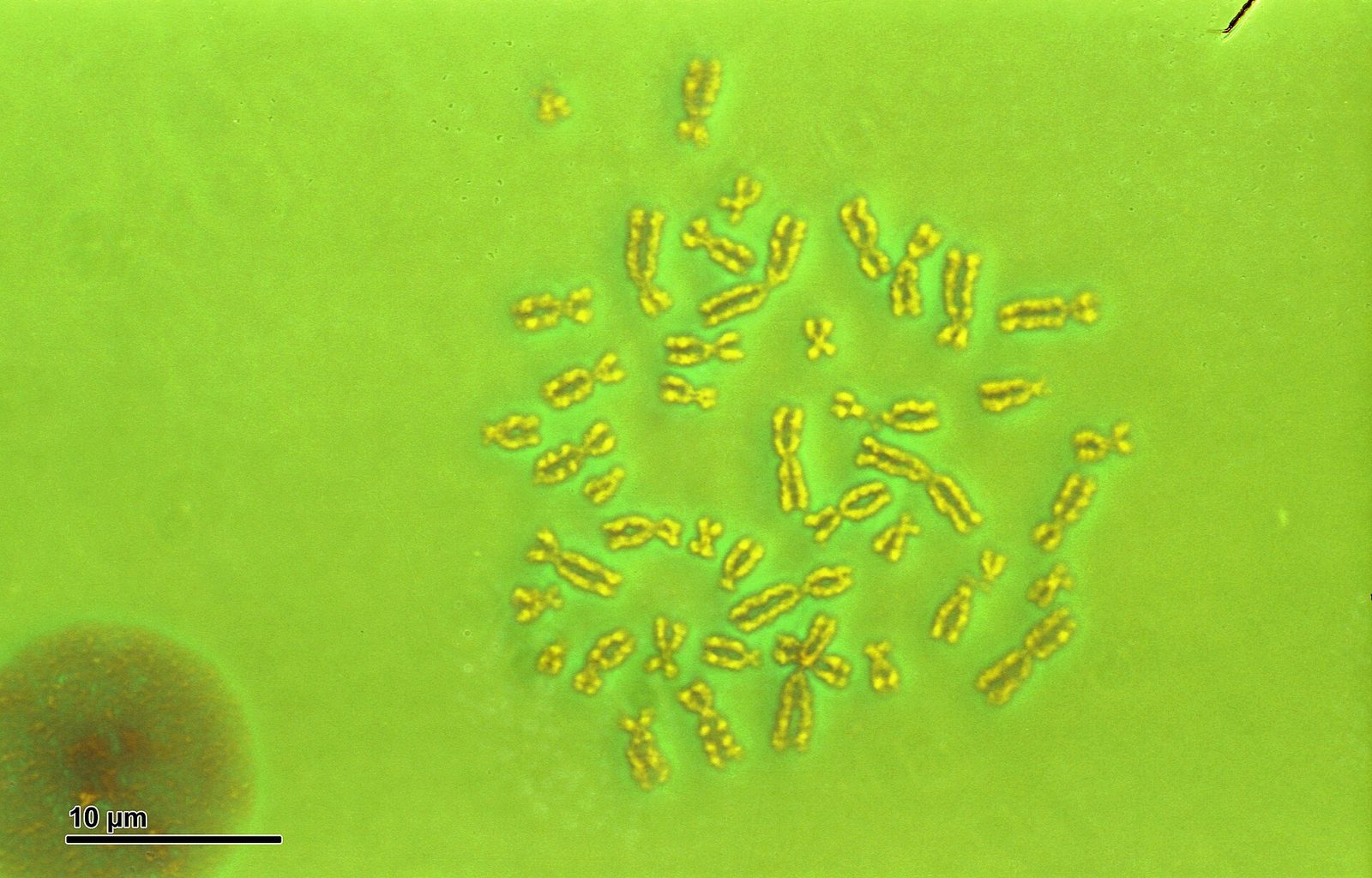
Every other great ape has 48 chromosomes. We have 46, because two of ours are stuck together, and the seam left three separate marks that are still readable. For decades textbooks said humans had 48 as well, which was wrong in the most interesting possible direction.
Start with the mistake, because it is better than the answer. For most of the twentieth century, the human chromosome count was given as 48. Textbooks said 48. Researchers who looked down microscopes and counted got 48. Then Tjio and Levan counted again and the number was 46, and it has been 46 ever since.
Forty-eight is the number chimpanzees have. And bonobos, and gorillas, and orangutans. For decades we were assigned the ape karyotype by clerical error, and the correction is what created the puzzle: if every one of our closest relatives has 48 and we have 46, where did the missing pair go?
01The Answer, And Why It Is Not A Guess
Humans have 46 chromosomes in 23 pairs. Chimpanzees, bonobos, gorillas and orangutans each have 48 in 24 pairs, and in every one of those species TWO separate chromosomes correspond to our single chromosome 2. Nothing else is missing and nothing else is doubled. The whole discrepancy sits in one place. Our file adds gibbons at 44 to 52 depending on species, with rearrangements extensive enough that they are not directly comparable.
Since all four other great apes carry 48 with two chromosomes matching our chromosome 2, the ancestral state was 48 and the change happened on our lineage, after the split from the chimpanzee line at roughly six to seven million years ago. This was predicted from banding patterns before anyone could check it at the sequence level: our file credits Turleau, de Grouchy and Klein with the first high-resolution banding comparison in 1972, and Yunis and Prakash with the systematic great-ape analysis published in Science in 1982 that made the fusion an explicit hypothesis.
02Three Marks, Left By Two Different Accidents
The reason this case is unusually strong is not that there is a lot of evidence. It is that there are three marks, they are independent of one another, and two of them are things that should not exist at all in a normal chromosome. A prediction that says a specific abnormality will be found at a specific address is a much harder thing to satisfy than a general resemblance.
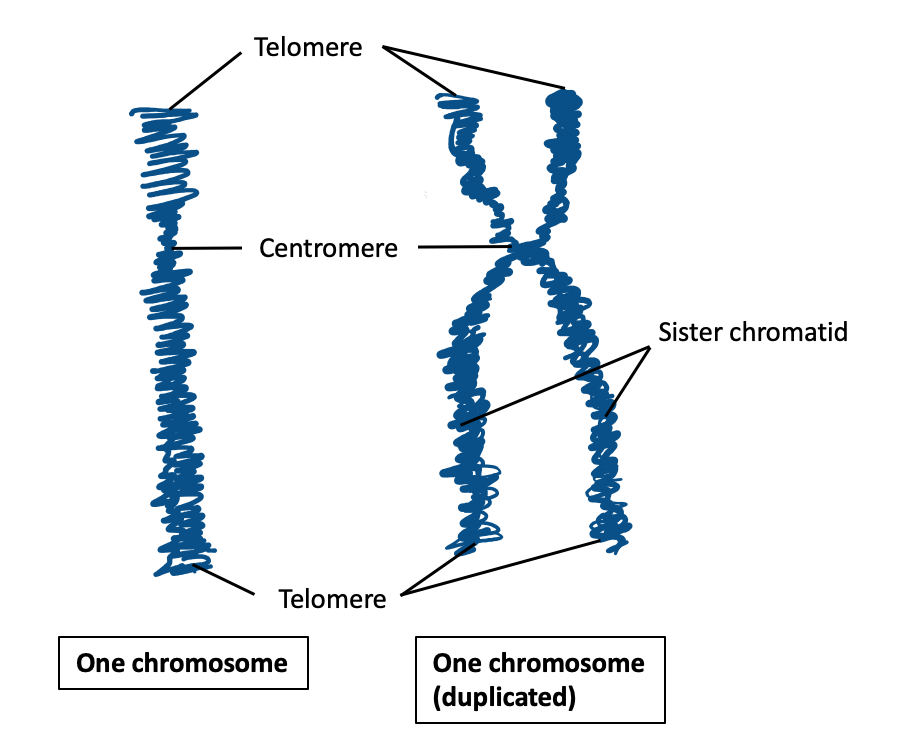
Telomeres are repeats of the sequence TTAGGG that cap the ends of chromosomes. Human chromosome 2 carries telomeric repeats in its interior, at band 2q13, arranged head to head, which is precisely the arrangement that two chromosomes joining end to end would leave behind. IJdo, Baldini, Ward, Reeders and Wells cloned and sequenced that region and published it in the Proceedings of the National Academy of Sciences in 1991, under a title that says the whole thing: Origin of human chromosome 2, an ancestral telomere-telomere fusion.
A chromosome has one centromere, the pinch point where the machinery of cell division grips it. Two chromosomes fusing would briefly produce a chromosome with two, which is unstable and tends to tear. Our file records Fan, Newman, Linardopoulou and Trask identifying a remnant centromere at band 2q21, made of degenerate alpha-satellite DNA of exactly the kind found at working centromeres, and no longer functional. Its position matches where the second ancestral chromosome's centromere should be, predicted from the chimpanzee karyotype. Something switched it off, and our file lists the mechanism of that silencing among the questions still open.
Giemsa staining gives every chromosome a characteristic pattern of light and dark bands. Place the chimpanzee chromosomes 2A and 2B end to end and the combined pattern matches human chromosome 2 with near-perfect correspondence. Our file notes that approximately 23 rearrangements in total distinguish the human and chimpanzee karyotypes, of which this fusion is the largest single one, and that gene order on our chromosome 2 matches gene order on 2A plus 2B concatenated, meaning the fusion joined the two without shuffling what was inside them.
03What 2022 And 2025 Added
The Telomere-to-Telomere Consortium published the first complete human genome in Science in 2022. In its own abstract, the human reference had until then covered only the euchromatic fraction, and the consortium presented a complete 3.055 billion base pair sequence, T2T-CHM13, with gapless assemblies for every chromosome except Y, adding nearly 200 million base pairs. Chromosome 2 is the largest, at roughly 242.2 megabases on our file's figure, and the fusion point at 2q13 and the dead alpha-satellite array at 2q21 were read through without a break for the first time. Our file gives the fusion signature as about 800 base pairs of head-to-head telomeric repeats, against normal telomeres of five to fifteen kilobases, and answers the obvious objection itself: millions of years of mutation erode a sequence that is no longer doing a job.
Our research file was last updated in March 2026 and refers to the chimpanzee assembly only as a draft published in 2024. The finished work appeared in Nature in 2025: Yoo, Rhie, Hebbar, Antonacci, Logsdon and one hundred and eighteen further authors, Complete sequencing of ape genomes. Haplotype-resolved reference genomes for six species, chimpanzee, bonobo, gorilla, Bornean orangutan, Sumatran orangutan and siamang. Their own numbers: 215 gapless chromosomes sequenced telomere to telomere, at fewer than one error in 2.7 megabases. Among the regions they resolved, in their own list: centromeric DNA, acrocentric chromosomes and subterminal heterochromatin.
It does NOT mean the fusion case was circular. The interstitial telomeric repeats and the dead centromere are properties of the human chromosome, found by looking at the human chromosome, and no ape sequence was needed to see them. What it means is narrower and better: until 2025 the ape side of the comparison was assembled with the human genome as a scaffold, which is a reasonable method and a weaker test. Now both sides exist as independently complete assemblies, and the comparison can be made without either one being built out of the other. The harder test was run and the result did not move.
One more thing came out of the completed ape genomes, and it lands directly on a line our own file cites. In 1994 Royle, Baird and Jeffreys reported a subterminal satellite next to chimpanzee telomeres that is absent from the human genome. In 2025 Yoo, Munson and Eichler took the region up with complete sequence and reconstructed its history: the caps arose independently in the Pan and gorilla lineages, emerging in chimpanzee and bonobo about 7.7 million years ago and expanding more recently in gorilla, about 5.0 million years ago, where they now make up 8.5 per cent of the entire genome. An observation of something missing became a dated account of how it came to be there in the first place.
04The Objections, Including The Serious One
| The Objection | Where Our File Attributes It | The Response Our File Gives |
|---|---|---|
| Interstitial telomeric sequences can arise by other mechanisms, such as genomic repair or transposable element insertion | Azzalin and colleagues, Chromosoma, 2001. A peer-reviewed paper, and the only named scientific source in the table | The head-to-head arrangement, the positional correspondence and the dead centromere together make fusion far more parsimonious; interstitial telomeric sequences of other origin are typically short and differently oriented |
| The fusion site holds only about 800 base pairs, far less than a normal telomere of five to fifteen kilobases | General observation | Expected. Millions of years of mutational erosion, and loss of non-functional DNA is a general genomic trend |
| A 46-to-48 mismatch would cause sterility, so the fusion could never have spread | Creationist literature | Empirically false. Carriers of chromosome fusions in humans and in many other species show near-normal fertility |
| Design rather than fusion could explain the structure | Creationist literature | The dead centromere, the degenerate telomeric repeats and the exact correspondence to two great ape chromosomes are best explained by fusion, and have no basis in any alternative scientific hypothesis |
How a chromosome rearrangement in one individual becomes universal in a species is not settled. Our file gives three routes: genetic drift in a small population, meiotic drive, or reduced fertility in the unfused variants, and says drift is the leading hypothesis. It supports the fertility point with two figures: that roughly 1 in 1,000 people carries a chromosome fusion of the Robertsonian type, and that heterozygous carriers show only a 1 to 2 per cent decrease in viable offspring. NEITHER FIGURE CARRIES A CITATION IN OUR FILE and neither was independently checked for this article. They are reported here as our file's, not as established.
05Four Places Our Own File Argues With Itself
This document is the best-sourced file used in this run: Tier 1, twenty sources, and four of its five identifiers resolve exactly, which is not something the other files in this programme can say. Its problems are of a different kind, and they are worth showing because they are the kind a reader cannot see from outside.
| Where | What Our File Says | The Problem |
|---|---|---|
| The discovery table | Dates the Tjio and Levan correction of the human chromosome count to 1962 | The journal record is Hereditas volume 42, issue 1-2, pages 1 to 6, by Joe Hin Tjio and Albert Levan, under an identifier encoding 1956, with no registered print date and a 2010 digital deposit. 1962 matches neither, and the paper is not in our file's bibliography at all |
| The counter-argument table | Describes carriers of a Robertsonian translocation as 44-chromosome individuals | The same file defines a Robertsonian translocation as two chromosomes fusing into one, which takes 46 to 45. Our file's own definition does not produce our file's own number |
| The closing section | States that no significant counter-arguments exist in the scholarly literature for the core claims | The same document contains a table of four criticisms with responses, four sections earlier. It lists four and then says there are none |
| The source tier block | Announces that the document draws on Tier 3 popular books and journalism and Tier 4 speculative interpretations | Its bibliography is twenty peer-reviewed papers and contains no Tier 3 or Tier 4 source at all |
| The summary | Says the fusion joined chimpanzee chromosomes 2A, now called 2p, and 2B, now called 2q | 2p and 2q are the short and long ARMS of the human chromosome. The ancestral chromosomes correspond to those arms; they were not renamed into them. The file uses 2A and 2B correctly everywhere else |
Fast Facts
- The Discrepancy
- Humans 46 chromosomes, 23 pairs. Chimpanzee, bonobo, gorilla and orangutan 48 each, 24 pairs
- The Old Error
- Humans were long counted at 48, the ape number, until Tjio and Levan got 46. Our file dates that to 1962; the journal record does not
- Mark One
- Telomeric TTAGGG repeats INSIDE chromosome 2, at band 2q13, arranged head to head. IJdo and colleagues, PNAS, 1991
- Mark Two
- A dead centromere at 2q21 made of degenerate alpha-satellite DNA, where the second ancestral chromosome's centromere should be. Fan and colleagues, Genome Research, 2002
- Mark Three
- Chimpanzee 2A plus 2B, placed end to end, match human chromosome 2's banding pattern almost exactly, with gene order preserved
- Size Of The Seam
- About 800 base pairs of head-to-head telomeric repeat, against five to fifteen kilobases in a working telomere. Our file's figures
- Our Side Completed
- 2022. T2T-CHM13, 3.055 billion base pairs, gapless for all chromosomes but Y
- Their Side Completed
- 2025. Six ape species, 215 gapless chromosomes telomere to telomere, under one error in 2.7 megabases
- Still Open
- When in six to seven million years the fusion happened, how it reached fixation, whether it changed gene expression nearby, and how the dead centromere was silenced
What We Can Actually Stand Behind
Human chromosome 2 formed by the end-to-end fusion of two chromosomes that the other great apes still carry separately. Three independent marks say so: interstitial telomeric repeats in head-to-head orientation at 2q13, a non-functional alpha-satellite centromere at 2q21 in the predicted position, and banding and gene-order correspondence to chimpanzee 2A and 2B. IJdo and colleagues published the sequence evidence in 1991, Fan and colleagues the centromere remnant in 2002, the T2T Consortium the complete human sequence in 2022, and Yoo and colleagues the complete ape genomes in 2025. Our own file records no active scholarly dispute over any of this and neither does this page.
How the fused chromosome went from one individual to every human alive. Drift in a small population is the leading hypothesis and it is a hypothesis. The two fertility figures our file uses to support the argument carry no citation in the file and were not verified here. And our file's own list of open questions is worth taking at face value: the timing within the hominin lineage, the functional consequences near the fusion, and the mechanism that silenced the second centromere.
That a chromosome-number mismatch would have made the fusion impossible to spread. That design explains a dead centromere, degenerate telomeric repeats stranded mid-chromosome, and an exact positional match to two ape chromosomes. Both are refused in our own file's counter-argument table, and both are attributed there to creationist literature rather than to any scientific source.
The part I keep returning to is the dead centromere. The telomeres in the wrong place are the famous evidence, and they are good evidence, but they are a leftover: two ends that got stuck together and never fully rotted away. The centromere at 2q21 is different. It is a working part that was switched off. Somewhere in the ancestry of every person now alive, a chromosome carried two grips where it should have had one, which is the kind of thing that tears a genome apart, and instead of tearing, one grip was silenced and the chromosome held. That silenced machinery is still sitting there, in all of us, at a known address, doing nothing at all.
Sources & further reading
WHERE THIS WORKED FROM, AND WHERE IT CAN BE CHECKED. This article worked from one file in our own research library, Z_1_02, and it deserves saying plainly that this is the strongest file used in this run: Source Confidence 5 out of 5, Tier 1, twenty peer-reviewed sources, and FOUR OF ITS FIVE IDENTIFIERS RESOLVE EXACTLY when called against Crossref. After seven articles in which broken identifiers were the norm, that is worth reporting as loudly as the failures. THE ONE DEFECT IS A NEW KIND. The identifier our file attaches to Turleau, de Grouchy and Klein 1972, the first high-resolution banding comparison and the observation this whole subject rests on, resolves instead to 'In memoriam: Jean de Grouchy, 1926-2003', an obituary of one of that paper's own authors, written by another of its authors, published in the same journal thirty-two years later. It would pass any check based on journal or author name. The tell is in the identifier itself, which encodes 2004 while sitting on a 1972 citation. No replacement was found, so the 1972 paper is cited here by journal, volume and pages with no identifier. SEVEN IDENTIFIERS WERE RECOVERED. Our file leaves the DOI column empty for most of its bibliography, including four of the most important papers in it. Resolved and supplied here: the 2022 T2T human genome, the 2005 chromosome 2 and 4 sequences, Royle and colleagues 1994 on the chimpanzee subterminal satellite, Ferguson-Smith and Trifonov 2007 on mammalian karyotype evolution, Schueler and colleagues 2001 on functional centromeres, Tjio and Levan on the chromosome number of man, and Azzalin and colleagues 2001, which is the source of the strongest scientific objection our file lists and the one row it gives no identifier for. ONE BIBLIOGRAPHY ROW IS OFF-TOPIC: Caputo and colleagues 2016 on microRNA regulation of BDNF expression has no discernible connection to chromosome fusion and is never cited in the document. Routed to corpus hygiene with the rest. WHERE THIS PAGE DEPARTS FROM OUR FILE. Our file was last updated in March 2026 and refers to the chimpanzee telomere-to-telomere assembly as a draft published in 2024. The completed work is Yoo and colleagues in Nature in 2025, covering six ape species and 215 gapless chromosomes, and this page carries it, along with the 2025 companion paper on ape subterminal heterochromatin that takes up the region our file cites Royle and colleagues for. Section 05 lists four further places where our own document contradicts itself; none of them touches the fusion evidence. AN IMAGE GAP WORTH STATING. The defining picture of this subject is the side-by-side banding comparison of human chromosome 2 against chimpanzee 2A and 2B. Two candidates exist on Wikimedia Commons and BOTH are below usable resolution, at 484 and 454 pixels wide. This page therefore carries no such image, and a reader should not conclude from its absence that the comparison is unavailable, only that it is not freely licensed at a size a web page can use. WHAT IS CARRIED AS OUR FILE'S OWN, UNVERIFIED HERE: the 800 base pair fusion signature, the 2q13 and 2q21 band positions, the 242.2 megabase chromosome length, the roughly 23 human-chimpanzee rearrangements, the five to fifteen kilobase normal telomere length, and both Robertsonian figures.
Image credits
- Human metaphase chromosome spread, light micrograph Doc. RNDr. Josef Reischig, CSc., via Wikimedia Commons. CC BY-SA 3.0 Source.
- Diagram of chromosome structure: telomeres, centromere and sister chromatids Ultrabem, via Wikimedia Commons. CC0 Source.
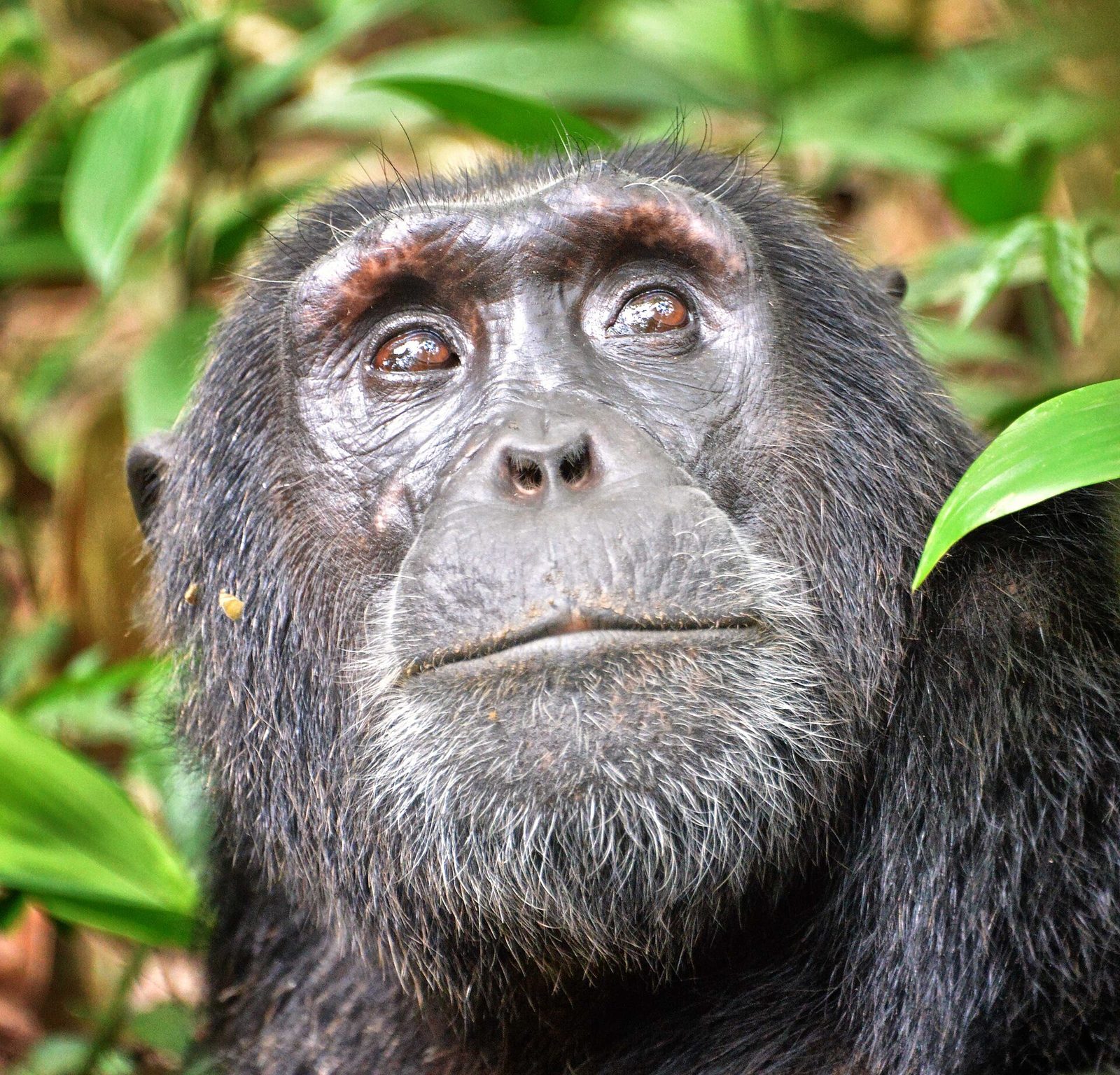
- Chimpanzee (Pan troglodytes), Kibale, Uganda Rod Waddington, via Wikimedia Commons. CC BY-SA 2.0 Source.
_Karyotype_Human_46,XY_(man).jpg)

.jpg)