
The Hittites: What Survives, And What Only Nearly Does
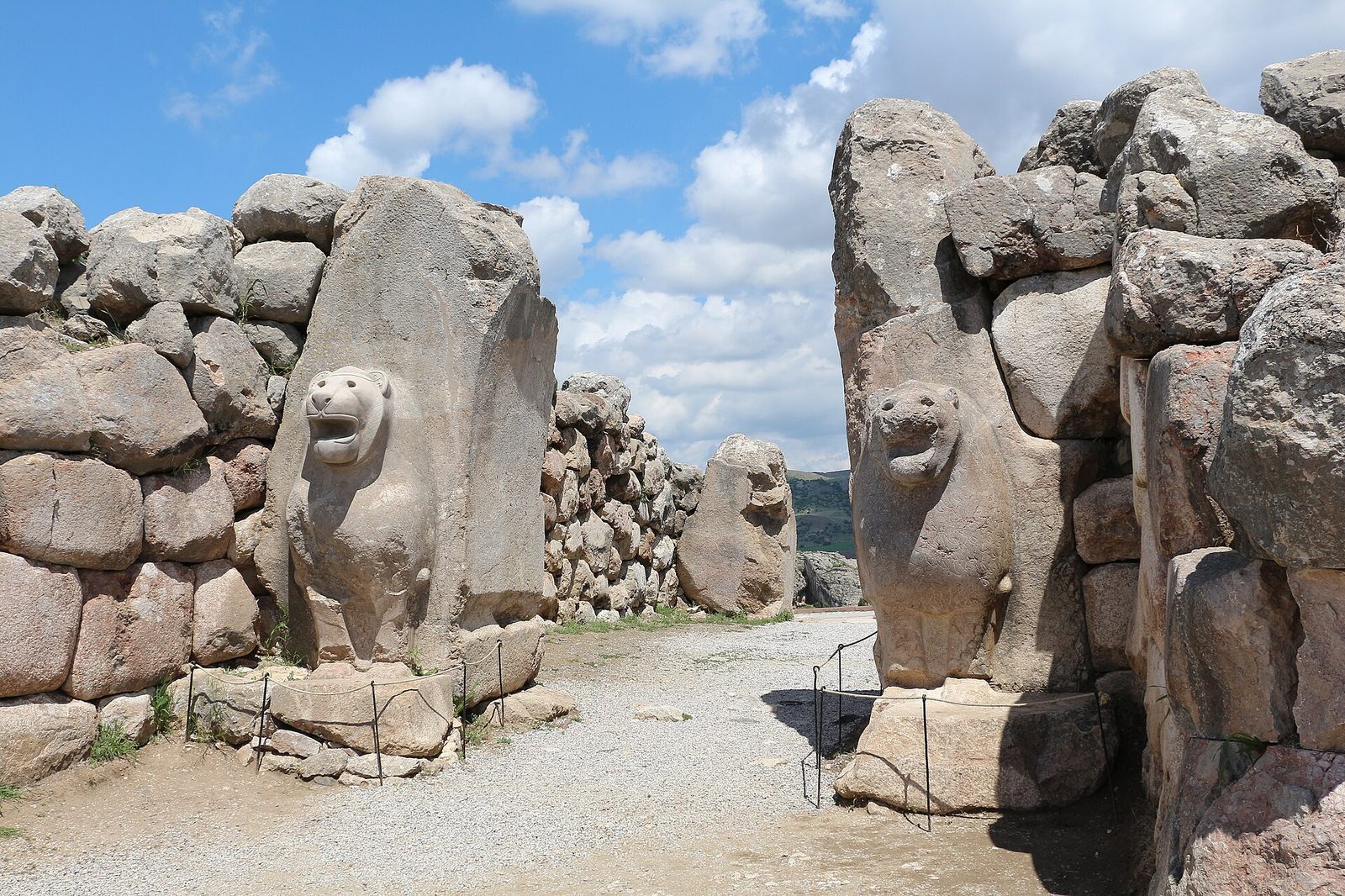
One of the four great powers of the Bronze Age vanished so completely that nobody knew it had existed until 1906. The oldest peace treaty on earth survives as a broken third of a tablet held on a sheet of clear plastic cut to the shape of what is missing.
In 1906 a German archaeologist dug into a hillside in central Turkey and found thirty thousand clay tablets. They were the state archive of an empire that had been one of the four great powers of the Late Bronze Age, that had fought Egypt to a standstill and then signed a treaty with it, and that nobody in the modern world had known was there.
That is the usual way to tell it, and it is true. What is more interesting is how thin the surviving evidence actually is, and what happens when you go and check it.
01The Empire, Briefly
The Hittite Empire ran from roughly 1650 to 1178 BCE across Anatolia and northern Mesopotamia, ranking with Egypt, Babylon and Assyria as one of the Late Bronze Age's four Great Powers. Its capital was Hattusa, modern Boğazkale. Excavations by Hugo Winckler in 1906 and then Kurt Bittel from 1931 to 1977 recovered the royal archives: over 30,000 cuneiform tablets in six languages, Hittite, Akkadian, Hurrian, Luwian, Hattic and Sumerian. The site became a UNESCO World Heritage Site in 1986.
In 1915 Bedřich Hrozný showed that Hittite, which its own speakers called Nesili, was an Indo-European language, and the oldest attested member of the family. Our research file records what that did: it established Indo-European speakers in Anatolia by at least the early second millennium BCE, and the Anatolian branch is now taken to be the earliest-diverging branch of Proto-Indo-European. A language that could not be read at all until 1915 turned out to be the oldest cousin of the one you are reading now.
The Hittite law code, about 1650 to 1500 BCE with later revisions, ran to roughly 200 articles on property, assault, marriage, slavery and agriculture. Our file's comparative point is the one worth keeping: set beside contemporary Mesopotamian codes such as Hammurabi's, Hittite law was notably less retributive, favouring restitution and compensation over corporal punishment, and murder penalties shifted from blood revenge to compensation in silver.
02The Treaty, And What Is Left Of It
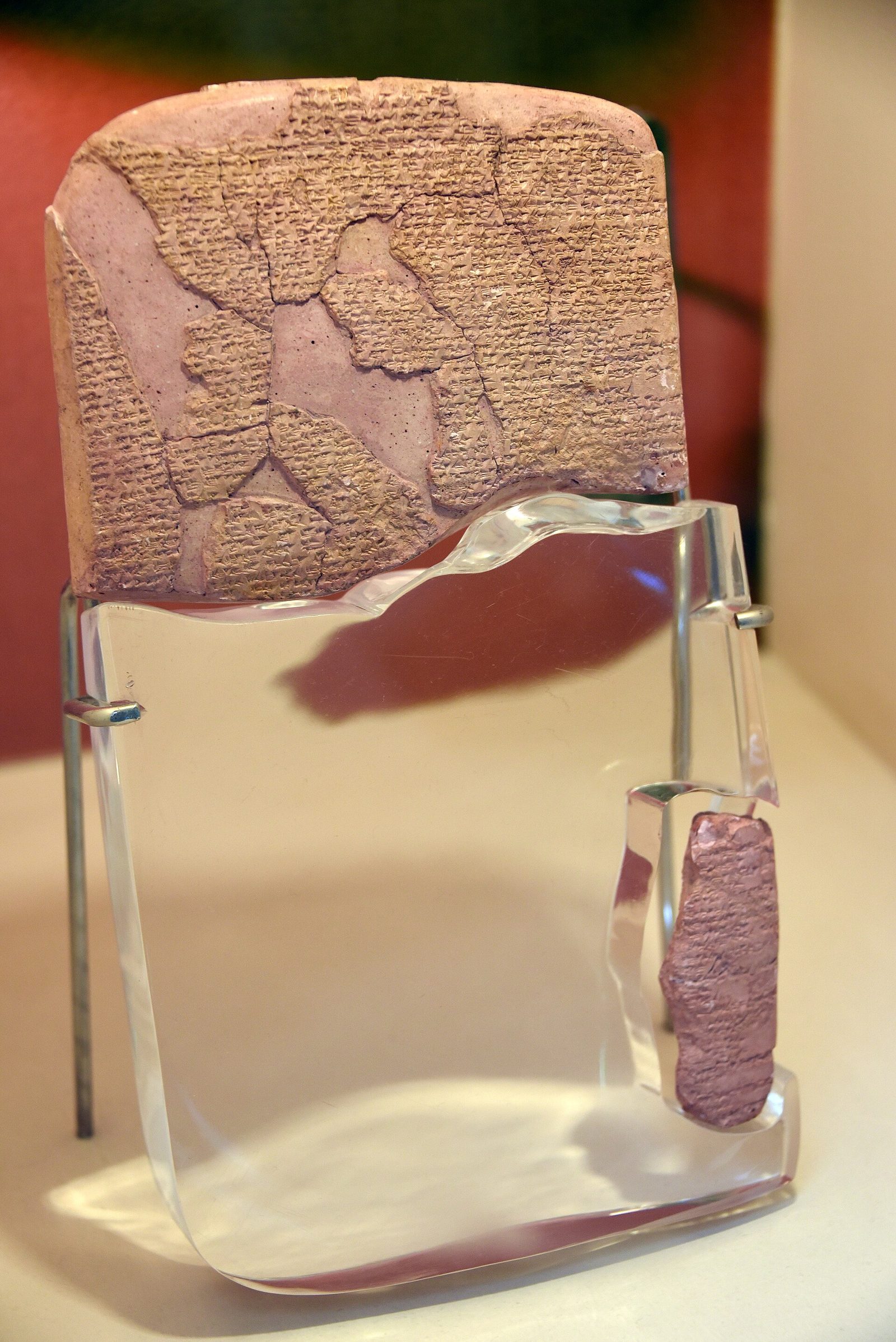
The Egyptian-Hittite treaty of about 1259 BCE, between Hattusili III and Ramesses II, followed the Battle of Kadesh of about 1274 BCE. It is the oldest known international peace treaty preserved in BOTH parties' records, which is what makes it different from a proclamation. Our file notes that a copy hangs at United Nations headquarters. The battle behind it, on our file's figures, involved an estimated 5,000 to 6,000 chariots on both sides and is the earliest battle for which detailed tactical accounts survive from both combatants.
03A Thousand Gods, In Fairly Poor Condition
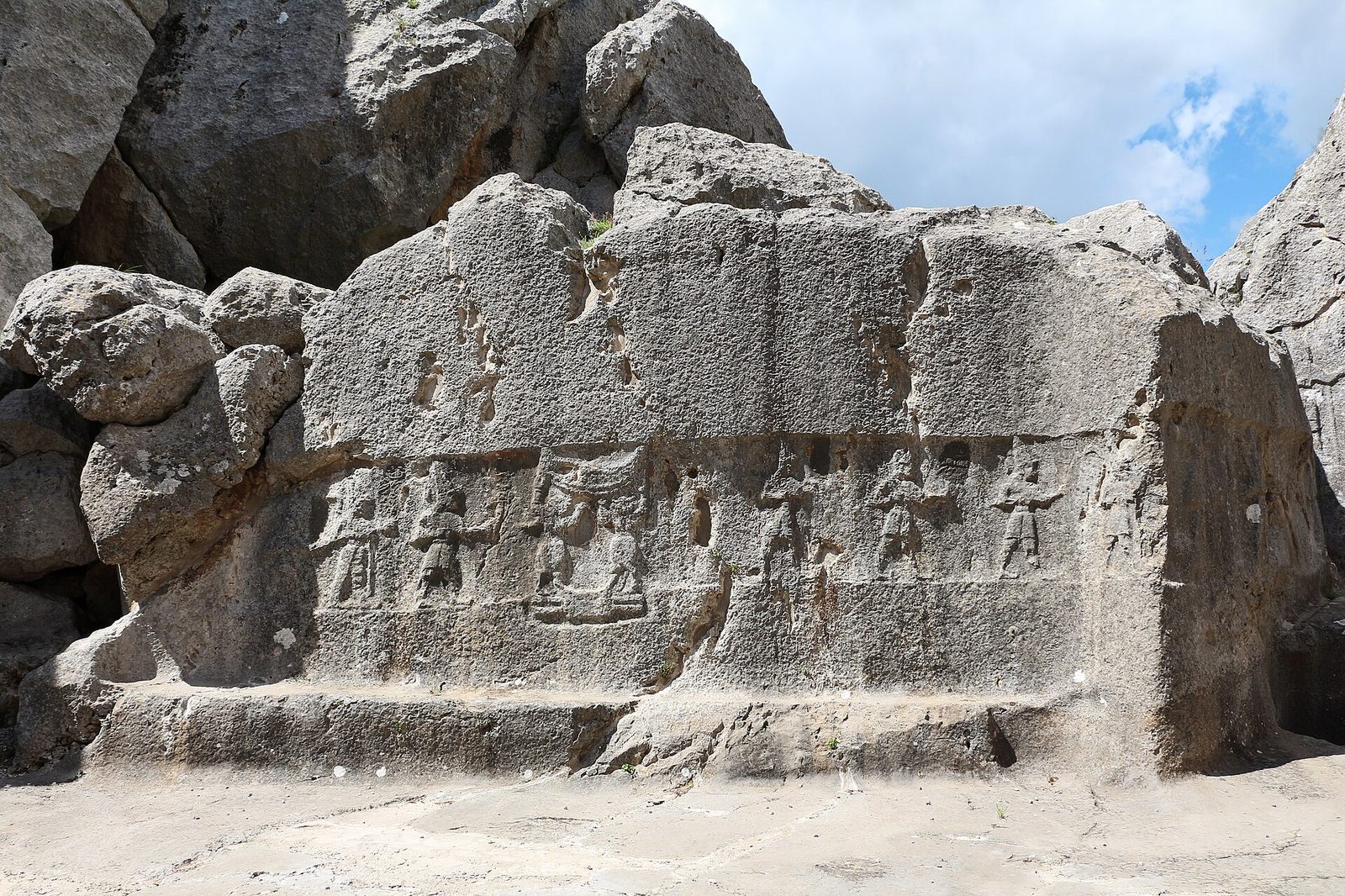
The Hittites systematically took conquered peoples' deities into a state pantheon, the Thousand Gods of Hatti. The Yazılıkaya open-air sanctuary near Hattusa shows a procession of at least 63 deities drawn from Hittite, Hurrian, Mesopotamian and Hattic traditions. Gary Beckman, writing in A Companion to the Ancient Near East in 2005, reads this as deliberate theological diplomacy: a tool of imperial cohesion rather than mere accumulation. Our file's identifier for Beckman resolves exactly, which is worth saying because several others in it do not.
04The Collapse, And What The Trees Say
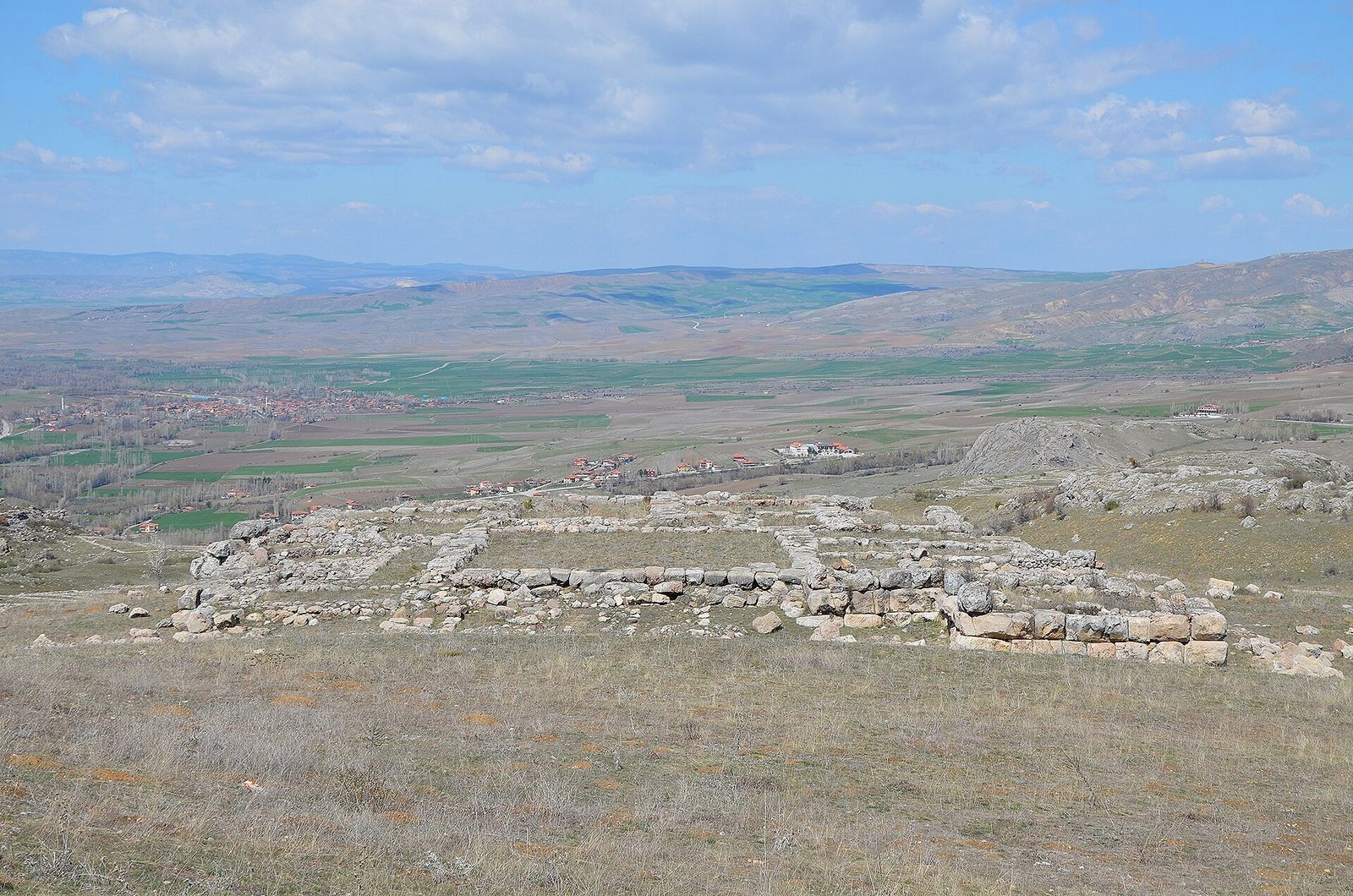
Hattusa's destruction around 1178 BCE sits inside the wider Bronze Age Collapse. Our file cites Eric Cline's 1177 B.C. of 2014 for a systems-collapse model in which drought, migrations including the Sea Peoples, internal rebellion and severed trade combined to bring down interlinked palatial economies. It adds a good detail: Hattusa shows evidence of deliberate, selective burning, which points at internal upheaval rather than purely external invasion.
In 2023 Sturt Manning, Cindy Kocik, Brita Lorentzen and Jed Sparks published in Nature, volume 614, pages 719 to 724. They read ring widths and stable isotopes from central Anatolian juniper and got a high-resolution dryness record. Verbatim from the abstract: "This analysis identifies an unusually severe continuous dry period from around 1198 to 1196 (±3) bc, potentially indicating a tipping point, and signals the type of episode that can overwhelm contemporary risk-buffering practices." Our file was last updated in April 2026 and does not cite it.
The paper's contribution is a distinction, and the abstract makes it plainly. A 300-year, low-frequency shift to drier, cooler conditions around 1200 BC has long been associated with these collapses, but as the authors put it, "The archaeological-historical record contains multiple instances of human societies successfully adapting to low-frequency climate change." What breaks a society is different: "consecutive multi-year occurrences of rare, unexpected extreme climatic events may push a population beyond adaptation and centuries-old resilience practices." The Hittites are described there in terms our file would recognise, an empire "centred in a semi-arid region in Anatolia" which "for a long time proved resilient". SLOW CHANGE IS SURVIVABLE. THREE BAD YEARS IN A ROW MAY NOT BE.
Our file dates the destruction to around 1178 BCE. The Nature paper's own title places the collapse at around 1198 to 1196 BC, twenty years earlier. This page is not going to adjudicate that. Hittite chronology depends on synchronisms with Egyptian and Mesopotamian king-lists, and our file's own counter-arguments section says so: competing high and low chronologies shift key events by decades. Both figures are printed here because both are in the literature.
05The Iron, Which Was Never A Monopoly
The popular claim that the Hittites held a deliberate monopoly on iron production, giving them a decisive military edge, is refused by our own file. Iron artefacts appear across the Near East before the Hittite period, and smelting technology spread by multiple independent pathways. What our file keeps is milder and better attested: the "iron letter" from Hattusili III to an Assyrian king treats iron as a prestige material, evidence from Kaman-Kalehöyük puts smelting in Anatolia at least as early as the 18th century BCE, and the transition looks gradual rather than revolutionary.
Ünsal Yalçın's paper on early Anatolian iron opens with a fact that puts the whole subject in proportion. Verbatim: "The earliest iron finds, which are not more than a dozen, occur in the third millennium BC in Anatolia... Considering that pure iron occurs rarely in nature, the most important question is: what were these objects made of? Preliminary analyses of a few Bronze Age finds show that some of them contain nickel. Because of this it is generally accepted and frequently cited that these finds were made of meteoric iron." NOT MORE THAN A DOZEN OBJECTS. THE RETRIEVABLE ABSTRACT STOPS AT THAT QUESTION and does not give the paper's answer, so no answer is asserted here.
For its iron claims our file cites a 2003 chapter by James Muhly on metalworking in the Levant. Muhly, with R. Maddin, T. Stech and E. Özgen, had already written the paper actually about this subject: "Iron in Anatolia and the Nature of the Hittite Iron Industry", Anatolian Studies volume 35, pages 67 to 84, 1985. Its abstract sets out the story it means to test, that iron made weapons better and much cheaper and so "made it possible to arm a large peasant infantry in order to challenge the military superiority of the chariot forces of the Late Bronze Age aristocracy". That is the framing being examined, not the conclusion, and it is not quoted here as one.
06A Note On Our Own Sources, In Which This File Does Well
Every article in this series resolves the identifiers in the research file behind it, live, and reports what comes back. The file audited immediately before this one had five identifiers and none of them was right. This one is the best result of the run so far, and it is worth being as loud about that as about the failures.
Two of the five DOIs resolve exactly to what they claim: Beckman's chapter and Mendenhall's 1954 article in The Biblical Archaeologist, right down to volume, issue and pages. AND ALL FOUR ISBNS ARE RIGHT, each resolving at Open Library to the named book with matching author, publisher and year: Bryce's Life and Society in the Hittite World, Latacz's Troy and Homer, the Eisenbrauns reader that holds the Muhly chapter, and Singer's Hittite Prayers. Three identifiers are bad. Two are the familiar shape, a review standing in for the book it reviews: Ilya Yakubovich on Bryce in the Journal of Near Eastern Studies, and Antonis Kotsonas on Cline in The Classical Review.
Entry 12 reads: Yalçın, Ünsal, 2016, "The Beginning of Iron Use in Anatolia", Anatolian Studies 66:75-93. Every locator in that is wrong, and the DOI attached to it resolves to a real article sitting a few pages away in the same volume, Michael Taylor on an Attalid victory plaque from Pergamon, pages 81 to 90. Hellenistic epigraphy, not metallurgy. BUT THE PAPER OUR FILE MEANS IS REAL. Ünsal Yalçın published "Early iron metallurgy in Anatolia" in Anatolian Studies volume 49, pages 177 to 187, in 1999. Right author, right journal, right subject, and everything used to find it replaced.
The page range gives it away on its own. Anatolian Studies volume 66 is indexed complete: twelve items, continuous pagination running 1-16, 17-22, 23-42, 43-65, 67-79, 81-90, 91-124, 125-139, 141-183 and 185-199, plus front and back matter. Page 75 falls inside Trevor Bryce's "The land of Hiyawa (Que) revisited", and page 93 falls inside a paper on Roman Lycia. THE CLAIMED RANGE STRADDLES THREE REAL ARTICLES AND MATCHES NONE, and there is no paper on iron in the volume at all. Any citation carrying a journal, a volume and a page range can be tested against that volume's real pagination, mechanically, before anybody opens a book.
| Our File's Entry | Identifier | What It Returns |
|---|---|---|
| 1. Bryce 2005, The Kingdom of the Hittites | 10.1086/654955 | Ilya Yakubovich reviewing it, Journal of Near Eastern Studies 69(1):104-107, 2010. WRONG |
| 2. Cline 2014, 1177 B.C. | 10.1017/s0009840x15000128 | Antonis Kotsonas reviewing it, The Classical Review 65(2):611-612, 2015. WRONG |
| 3. Beckman 2005, How Religion Was Done | 10.1002/9780470997086.ch25 | Gary Beckman, that chapter, in A Companion to the Ancient Near East. CORRECT. Crossref gives pp.343-353 against our file's 343-354, a one-page difference not worth calling an error |
| 4. Bryce 2002, Life and Society in the Hittite World | isbn 9780199241705 | Trevor Bryce, that book, Oxford University Press, November 2002. CORRECT |
| 7. Latacz 2004, Troy and Homer | isbn 9780199263080 | Joachim Latacz, that book, Oxford University Press, 2004. CORRECT |
| 8. Mendenhall 1954, Covenant Forms in Israelite Tradition | 10.2307/3209151 | George E. Mendenhall, that article, The Biblical Archaeologist 17(3):50-76, 1954. CORRECT on every field |
| 9. Muhly 2003, in Near Eastern Archaeology: A Reader | isbn 9781575060835 | Suzanne Richard (ed.), that volume, Eisenbrauns, August 2003. CORRECT |
| 11. Singer 2002, Hittite Prayers | isbn 9781628374285 | Itamar Singer, that book, Society of Biblical Literature, 2002. CORRECT, and this one is the Corrections block's own replacement |
| 12. Yalçın 2016, The Beginning of Iron Use in Anatolia | 10.1017/S0066154616000065 | Michael J. Taylor on an Attalid plaque from Pergamon, same journal, same volume, pp.81-90. WRONG, and the real paper is Yalçın 1999 in volume 49 |
This file carries a Corrections block making three claims, and all three check out arithmetically. The old ISBN for Singer's Hittite Prayers really does fail its check digit; the replacement passes and resolves to the right book; and both of the ISBNs removed as invalid really are invalid. THAT IS WORTH REPORTING BECAUSE THE SAME CHECK HAS GONE THE OTHER WAY ELSEWHERE. An audit of 2,307 of these correction rows across the whole library found the stock explanation true in 72.8 per cent of them and false in 23.6 per cent, with a further 3.6 per cent recording a change that never happened. This file is a clean instance of the majority case.
Earlier articles in this series reported a measured correlation: research files rated 4 or 5 for Source Confidence carried about 91 per cent correct identifiers, and files rated 2 or 3 about 29 per cent. It has been quoted here three times as a triage signal. THIS FILE IS RATED 3 AND RETURNED SIX OF NINE. The file audited immediately before it is ALSO rated 3 and returned zero of five. Two documents, the same rating, opposite outcomes. The correlation may still describe the library in aggregate. It plainly does not predict a single file, and saying so is part of using it honestly.
One claim in this file is worth flagging rather than repeating. Its Kikkuli bullet is Tier 1 and says the horse-training manual of about 1345 BCE prescribes a 214-day conditioning programme with interval training, controlled diet and progressive workload, and that these are "methods that modern equine physiologists have verified as scientifically sound". The only source given is a single book from a small press, whose ISBN the file's own Corrections block removed as invalid. A search of the citation registries for peer-reviewed work on the Kikkuli text returned nothing relevant. THAT IS A FAILURE TO FIND AND NOT A DEMONSTRATION OF ABSENCE, but the clause about modern verification is the part doing the persuading and it is the part with nothing under it.
Several files audited in this series print a boilerplate line saying no significant counter-arguments exist, sometimes on pages where the dispute is the subject. THIS ONE DOES NOT. It raises three, and they are good. That early Hittitology was shaped by a wish to find Aryan roots in the Near East, overweighting the Indo-European aspect against indigenous Hattic and Hurrian contributions. That the surviving texts are overwhelmingly palace administrative, legal and religious, so ordinary Hittite life is barely known and the portrait skews to a top-down imperial machine. And that the whole chronology hangs on synchronisms with Egyptian and Mesopotamian king-lists, so competing high and low schemes move key events by decades.
Fast Facts
- The Span
- About 1650 to 1178 BCE, five centuries, one of the four Late Bronze Age Great Powers
- The Archive
- Over 30,000 cuneiform tablets from Hattusa, in six languages
- Found In
- 1906, by Hugo Winckler. Excavated by Kurt Bittel from 1931 to 1977
- The Treaty
- About 1259 BCE, Hattusili III and Ramesses II, preserved in both parties' records
- The Battle
- Kadesh, about 1274 BCE. Our file's figure: an estimated 5,000 to 6,000 chariots
- The Language
- Hittite, or Nesili. Shown Indo-European by Bedřich Hrozný in 1915; oldest attested member of the family
- The Gods
- The Yazılıkaya procession draws deities from Hittite, Hurrian, Mesopotamian and Hattic traditions at once
- The Iron
- Not a monopoly. And the earliest Anatolian iron finds are, in Yalçın's words, "not more than a dozen"
- The Collapse
- Our file: around 1178 BCE. Manning and colleagues in Nature, 2023: a severe dry period around 1198 to 1196 BC
- Our File's Identifiers
- Nine checked, six correct. Two review-DOIs, one drifted citation. Two identifiers recovered
What We Can Actually Stand Behind
The empire, the capital, the 30,000-tablet archive and the six languages. The Egyptian-Hittite treaty of about 1259 BCE, preserved by both sides. Hrozný's 1915 demonstration that Hittite is Indo-European and the oldest attested member of the family. The law code's preference for compensation over corporal punishment. And on our own sources: six of nine identifiers correct, two review-DOIs, one drifted citation, three claims in the Corrections block all true, and two identifiers recovered.
Yazılıkaya as deliberate theological diplomacy rather than accumulation. The Bronze Age Collapse as a systems failure, now with a measured three-year drought window from Anatolian juniper as a candidate tipping point. The gradual, non-monopoly picture of early Anatolian iron. And the Source Confidence rating as a signal about a library rather than about any one file in it.
That Ahhiyawa is Mycenaean Greece and Wilusa is Troy, and that the Trojan War has a kernel in Hittite-Mycenaean rivalry over western Anatolian vassals. And that Hittite vassal-treaty structure specifically shaped biblical covenant form, where the counter-reading is that both draw on generic Near Eastern convention.
The Hittite iron monopoly, refused by our own file and by the evidence for independent smelting pathways. And the identification of the biblical children of Heth with the Anatolian empire, which modern scholarship generally reads as Neo-Hittite or Luwian populations in Syria-Palestine instead.
The thing that stays with you about the Hittites is not that they were forgotten. It is how narrow the thread back to them is. One hillside, one season of digging, one philologist in 1915, one broken tablet top on a perspex mount. A citation in a file can lose its year, its volume, its pages and its title and still be recoverable, because the author and the subject survived. An empire can lose almost everything and still be recoverable, for the same reason. It is worth checking the thread now and then to see what is still attached to the other end.
Sources & further reading
WHERE THIS WORKED FROM. One file in our own research library, W_1_16, at Source Confidence 3 out of 5, last updated 1 April 2026, plus eight external records resolved live on 26 August 2026. THE SUBSTANCE IS OUR FILE'S AND IT IS GOOD. The chronology, the archive figures, the treaty, Hrozný's decipherment, the law code, Suppiluliuma and the Zannanza affair, the Yazılıkaya reading, the collapse model, the iron picture and both Tier 4 refusals all come from it. Its counter-arguments section is a real one, raising the Aryan-roots bias in early Hittitology, the palace-documentary skew and the chronological disputes, and this page uses all three. WHAT THE PAGE ADDS. Manning, Kocik, Lorentzen and Sparks in Nature in 2023, the juniper tree-ring and stable-isotope study that dates a severe continuous dry period to around 1198 to 1196 BC, which our file predates by three years and does not cite; Yalçın's actual 1999 paper in Anatolian Studies, recovered while auditing the file's corrupted entry 12; and Muhly, Maddin, Stech and Özgen's 1985 paper on the Hittite iron industry, which is the paper on the subject and is not in our bibliography. TWO OF THOSE ABSTRACTS STOP AT THEIR SETUP AND THE PAGE SAYS SO: neither Yalçın's answer about meteoric iron nor Muhly's conclusion about the iron industry is asserted here, because neither is in the retrievable text. THE IDENTIFIER AUDIT IS IN SECTION 06 with a full table. Nine identifiers checked, six correct, which is the best result in this series. Two are reviews standing in for the books they review. The third is a shape not previously seen: entry 12 keeps Yalçın and keeps the subject and replaces the year, the volume, the pages, the title and the DOI, and the DOI it ends up with belongs to a real neighbouring article in the same volume. The page range alone disproves it, because volume 66's pagination is continuous and has no slot at 75 to 93. The file's Corrections block was also tested and all three of its claims are true, which is worth recording because the same test has gone the other way in other files. ONE CAUTION IS RAISED RATHER THAN REPEATED: the Tier 1 Kikkuli claim, including the clause about modern equine physiologists verifying the method, rests on a single small-press book whose ISBN this file itself removed as invalid, and no peer-reviewed work on the Kikkuli text was found. That is a failure to find and not a demonstration of absence. ON THE IMAGES. Four were fetched and opened; one was dropped, a modern interpretive signboard at the Lower City whose content is sign text and therefore unreadable at the size a column delivers.
Image credits
- The Lion Gate, Hattusa, Boğazkale, Çorum, Turkey Bernard Gagnon, via Wikimedia Commons (CC BY-SA 3.0). CC BY-SA 3.0 Source.
- The Kadesh Treaty tablet, Akkadian, from Boğazköy, Museum of the Ancient Orient, Istanbul Osama Shukir Muhammed Amin FRCP(Glasg), via Wikimedia Commons (CC BY-SA 4.0). CC BY-SA 4.0 Source.
- Chamber A, Yazılıkaya rock sanctuary near Hattusa Bernard Gagnon, via Wikimedia Commons (CC BY-SA 3.0). CC BY-SA 3.0 Source.
- Hattusa, foundations and the Anatolian plain beyond Carole Raddato, via Wikimedia Commons (CC BY-SA 2.0). CC BY-SA 2.0 Source.


