
The Hadal Zone: A Ceiling Predicted, And Then Tested
In 2014 a team measured the body chemistry of a fish caught at seven kilometres down and calculated the depth past which no fish could work. Nine years later a camera found one at 8,336 metres, just above the line.
Below six kilometres the ocean stops being a plain and becomes a set of cracks. About forty-six of them, mostly along the subduction zones of the Pacific, adding up to something like one or two per cent of the seafloor. That is the hadal zone, and it is named after Hades because somebody in oceanography had a sense of occasion.
The interesting thing about it is not that it is dark and cold and crushing. It is that somebody worked out, from the chemistry inside a fish, roughly how deep a fish can go. And then people went and looked.
01The Shape Of The Place
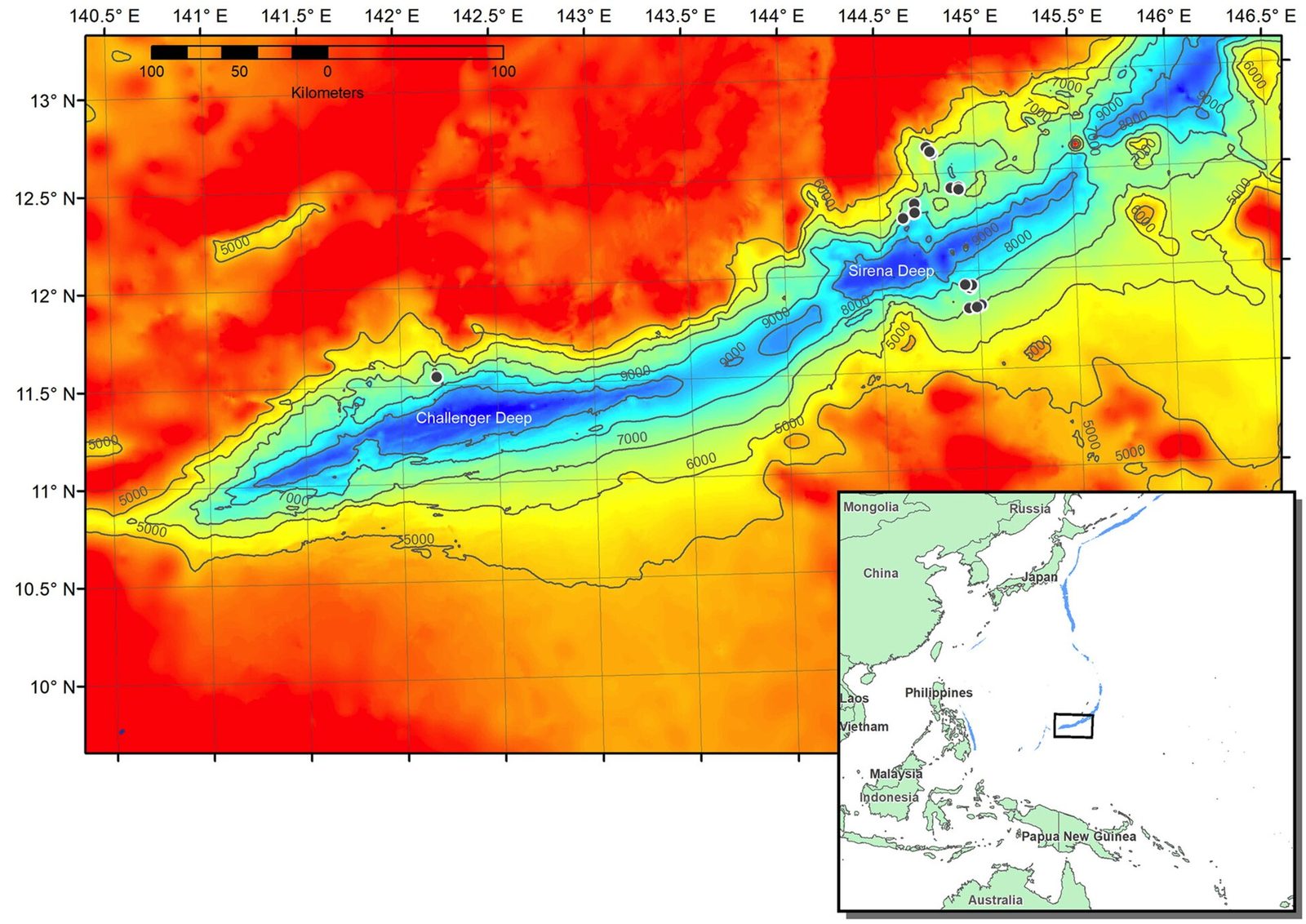
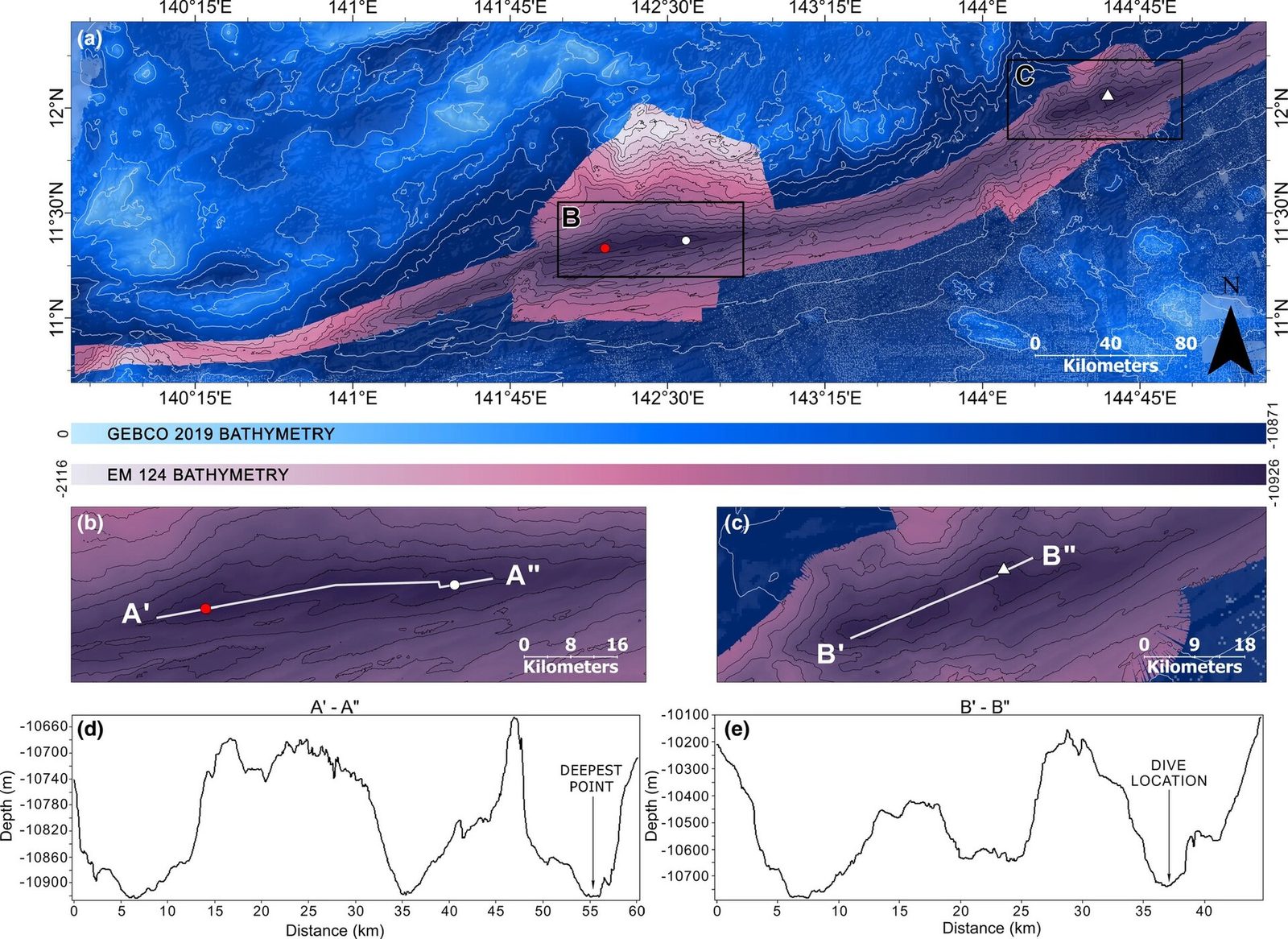
The hadal zone is everything below 6,000 metres: about 46 trenches and troughs, roughly 800,000 square kilometres, one to two per cent of the global seafloor. The Challenger Deep in the Mariana Trench reaches 10,935 metres plus or minus 25, measured by the DSSV Limiting Factor and multibeam sonar between 2019 and 2021. The Mariana Trench itself is 2,550 kilometres long and up to 69 wide. Tonga reaches about 10,882 metres, Kuril-Kamchatka about 10,542, the Philippine Trench about 10,540, Kermadec about 10,047, and the Izu-Ogasawara and Japan system about 9,810.
Pressure rises by about one atmosphere for every ten metres, so full ocean depth is roughly 1,100 atmospheres, 110 megapascals. Temperature is 1 to 4 degrees Celsius throughout, except near hydrothermal vents. The trenches are largely cut off from ocean circulation and hold their own water masses. Food arrives as marine snow drifting down from the surface, plus occasional large carcasses, plus, in some trenches, seismically triggered turbidity currents that sweep sediment and organic matter down into the axis.
02The Ceiling
Deep-sea animals carry trimethylamine N-oxide, TMAO, which stabilises proteins against being pulled apart by pressure. It rises with depth. Paul Yancey, Mackenzie Gerringer, Jeffrey Drazen, Ashley Rowden and colleagues published the arithmetic in PNAS in 2014. Verbatim from the abstract: "The common osmolyte trimethylamine N-oxide (TMAO) stabilizes proteins against pressure and increases with depth, going from 40 to 261 mmol/kg in teleost fishes from 0 to 4,850 m." They caught five hadal snailfish at 7,000 metres in the Kermadec Trench and measured them: "We found their muscles to have a TMAO content of 386 ± 18 mmol/kg and osmolality of 991 ± 22 mOsmol/kg. These data fit previous extrapolations and, combined with new osmolalities from bathyal and abyssal fishes, predict isosmotic state at 8,200 m."
What that means in plain terms: to keep working at greater depth a fish needs more TMAO, and more TMAO makes its body saltier. Somewhere around 8,200 metres its insides would be as salty as the sea outside. Past that point the flow reverses and its whole system for managing water runs backwards. Not a wall. A place where the arithmetic stops being survivable.
In 2023 Alan Jamieson, Paige Maroni, Todd Bond, Yakufu Niyazi, Jessica Kolbusz, Prema Arasu and Hiroshi Kitazato published in Deep Sea Research Part I. The title is the finding: "New maximum depth record for bony fish: Teleostei, Scorpaeniformes, Liparidae (8336 m, Izu-Ogasawara Trench)". NO ABSTRACT IS RETRIEVABLE FOR IT AND NOTHING BEYOND THE TITLE IS CLAIMED HERE. A prediction of about 8,200 metres, made in 2014 from the body chemistry of a fish caught three kilometres shallower. A fish filmed at 8,336 metres nine years later.
Our research file says: no fish have been found below about 8,400 metres, a physiological limit hypothesised to relate to TMAO. Yancey's paper keeps those apart and so should we. 8,400 METRES IS WHERE THE OBSERVED ABSENCE BEGINS, the top of the deepest quarter of the ocean where nobody has ever seen a fish. 8,200 METRES IS THE PREDICTED ISOSMOTIC POINT, calculated from measured chemistry. One is a fact about the record of sightings. The other is a calculation about what a body can do. 8,200 and 8,400 are not the same claim.
Our file's summary says the snailfish was "identified at 8,178 m in the Izu-Ogasawara Trench, the deepest fish ever recorded, 2023". Its own section 1.2 says the team FILMED one at 8,336 metres in 2022 and COLLECTED a specimen at 8,178 metres. Those are two different events, a sighting and a capture, and the summary keeps the shallower number and calls it the record. The 8,336 figure is the one printed in the 2023 paper's title. The 8,178 collection depth is carried here as our file's own and was not independently verified for this page.
03What Else Is Down There
Hadal communities run on scavenging. Amphipods are the signature animal: Hirondellea gigas and relatives appear at every trench ever surveyed, thousands of them per bait fall, carrying pressure-adapted enzymes and the same TMAO that limits the fish. Xenophyophores, single-celled foraminiferans up to 20 centimetres across, carpet the sediment in some trenches, with species endemic to individual ones. And the microbes are busier at the very bottom than on the plain above: Ronnie Glud and colleagues measured oxygen consumption in Challenger Deep sediment in 2013 and found activity twice that of the adjacent abyssal plain at 6,000 metres, most likely because slope failures funnel organic matter into the axis.
Trenches are separated by thousands of kilometres of abyssal plain at 4,000 to 6,000 metres, which to a hadal-adapted animal is a shallow-water barrier. Jamieson proposed in 2015 that each major trench works as a hadal island with its own amphipod assemblage, and Kermadec and Tonga, adjacent and linked by the Louisville Seamount Chain, do carry distinct species. But Hirondellea gigas turns up in several Pacific trenches. Our file is careful here and it is right to be: molecular work is early, sampling is brutally difficult, and whether trenches are evolutionary dead ends or cradles of speciation is genuinely open.
There are no undiscovered monsters in the trenches, and our file's argument for that is the good one rather than the dismissive one. Organic carbon reaching the trench floor is typically under 1 to 5 grams per square metre per year. That does not feed a large predator. Every hadal animal anyone has found is small, amphipods 2 to 10 centimetres and snailfish 15 to 30, which is what a severely energy-limited place produces. New species turn up regularly and they are invariably small invertebrates, microbes or fish.
04The Bottom Of The World Is Not Clean
Jamieson and colleagues found PCBs, banned since 1979, and PBDEs in amphipod tissue from the Mariana and Kermadec trenches at up to 905 nanograms per gram of lipid, exceeding levels in surface crustaceans from industrialised coastal waters. Peng and colleagues found microplastic particles in Mariana Trench sediment at 10,890 metres in 2018. The routes in are sinking contaminated marine snow, lateral drift from continental margins and bioaccumulation up the food web. What it does to these animals is unknown, and our file says so plainly: they have no evolutionary exposure to synthetic chemicals at all.
Our file's counter-arguments section does not hedge. It says hadal science is in a stamp-collecting phase, heavy on descriptive taxonomy and light on population dynamics, trophic structure, reproduction and larval dispersal. It says sampling bias is severe, with most data from about six Pacific trenches while the Atlantic and Indian Ocean trenches are barely studied. It says baited-camera data is biased toward scavengers and misses anything immobile or uninterested in bait. It notes that the pristine framing was already destroyed by the contamination work, which raises the question of whether deep-sea mining should ever be extended to trenches. And it points out that the hadal zone falls outside virtually every marine protected area and is covered by no specific international treaty.
05Five People, Ever
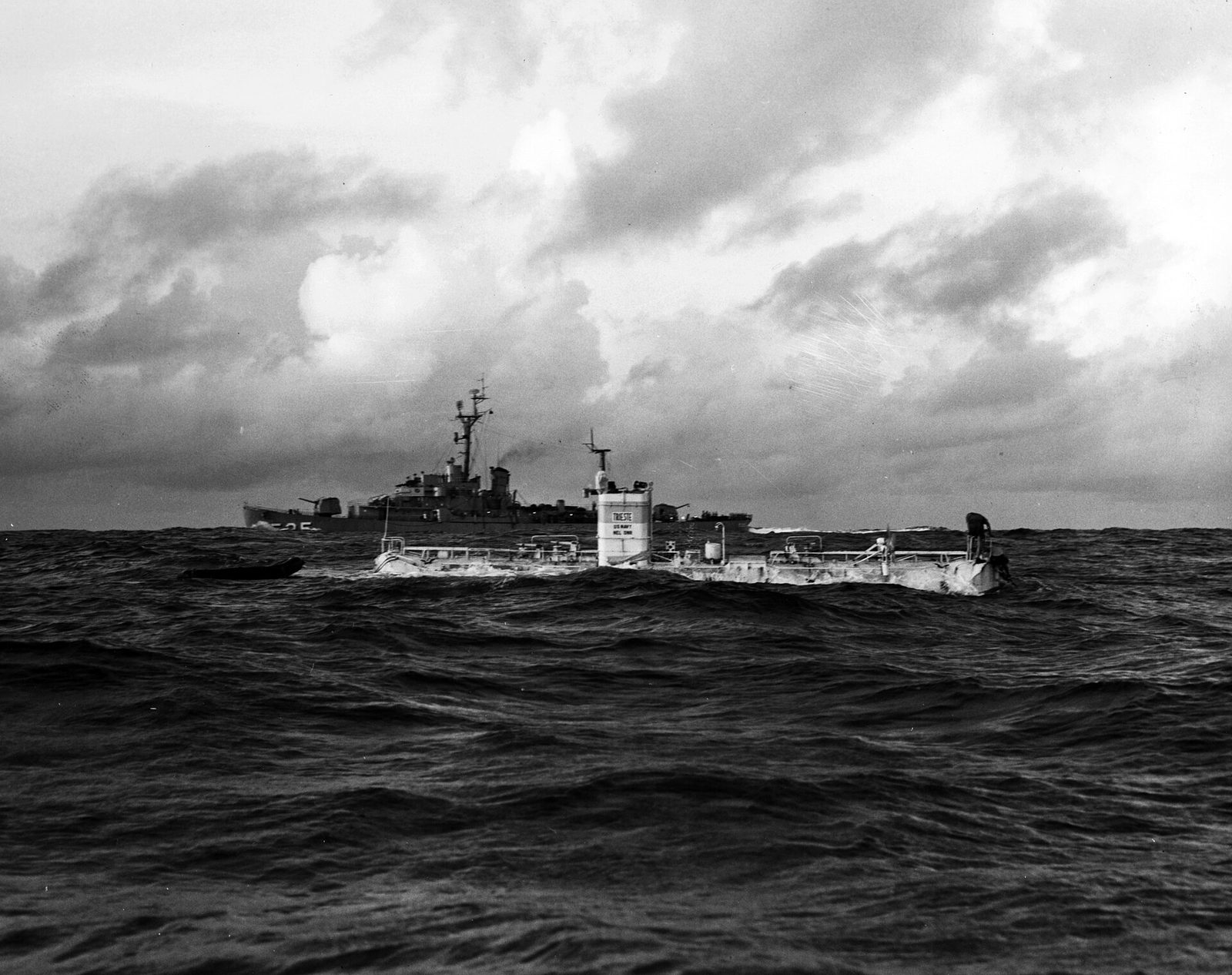
Five crewed descents past 10,000 metres have ever happened. Jacques Piccard and Don Walsh in the bathyscaphe Trieste on 23 January 1960, about 10,916 metres, twenty minutes on the bottom. Victor Vescovo in the DSV Limiting Factor, three solo dives to the Challenger Deep in May 2019. James Cameron in the Deepsea Challenger on 26 March 2012, solo, about 10,908 metres, three hours. Robots have done far more: the Japanese Kaiko in 1995, the Chinese Fendouzhe in 2020 at 10,909 metres with three aboard, and many autonomous landers across dozens of trenches.
06A Note On Our Own Sources, Which Are Mostly Right
Every article in this series resolves the identifiers in the research file behind it and reports what comes back. This file gave the best result yet. It also gave the clearest look so far at how the bad ones go wrong.
Correct: the ISBN for Jamieson's 2015 book, and the identifiers for Jamieson on pollutants, Glud on microbial turnover, Linley on hadal fishes, Yancey on the TMAO limit, Peng on microplastics, Fujii on the liparid aggregation, Blankenship-Williams and Levin on trench ecology, Stewart and Jamieson on habitat heterogeneity, and Taira on currents in the Challenger Deep. Every one of those resolves to exactly the work it is attached to, with matching authors, journal, volume and pages. Three are wrong. AND ALL THREE ARE WRONG IN THE SAME WAY.
Entry 6 gives the Nunoura hadal biosphere paper as PNAS volume 115, 2018, DOI ending 1421816115. That returns nothing at all. The real paper is DOI ending 1421816112, PNAS VOLUME 112, ISSUE 11, 2015. A PNAS DOI suffix ends in the volume number, so THE SAME WRONG DIGITS APPEAR TWICE: 112 became 115 in the identifier and 112 became 115 in the volume. That is one slip surfacing in two fields, not two separate mistakes.
Entry 8 gives Don Walsh's memoir piece "In the Beginning..." as Marine Technology Society Journal 46(5):4-6, 2012. The identifier resolves to Robert Weisberg and colleagues, "A Critique of Alternative Power Generation for Florida by Mechanical and Solar Means", in the same journal, the same volume and the same issue, pages 12 to 23. The real Walsh piece is "In the Beginning... A Personal View", Marine Technology Society Journal 43(5):9-14, 2009. AND OUR FILE ALREADY POINTS CORRECTLY INTO THAT ISSUE: entry 11 is in the same MTSJ 43(5) and resolves exactly. One entry finds the right issue and the one next to it does not.
Entry 14 gives Jamieson and Stewart, "Hadal ecology and the identification of new deep-sea environments", Trends in Ecology and Evolution 36(12):1089-1098, 2021. The identifier resolves to a paper on how fruit chemistry shapes seed dispersal, same journal, same volume, same issue, pages 1113 to 1123. The issue is indexed complete, thirteen items running continuously from 1061 to 1163, and THERE IS NO SLOT AT 1089-1098: page 1089 sits inside an article running 1083 to 1092, page 1098 inside one running 1093 to 1101. The range straddles two real articles and matches neither, and there is no hadal paper in the issue. A title search finds nothing matching. Jamieson and Stewart are real and publish together often; no paper of this title was found.
| What Our File Says | Journal | What The Identifier Returns |
|---|---|---|
| Nunoura et al, Hadal biosphere, PNAS 115(25), 2018 | PNAS | Nothing. The real paper is PNAS 112(11), 2015, and the DOI differs by one character. The volume drifted the same way the DOI did |
| Walsh, In the Beginning, MTSJ 46(5):4-6, 2012 | Marine Technology Society Journal | SAME journal, SAME volume, SAME issue: a critique of alternative power generation for Florida, pp.12-23. The real Walsh piece is in MTSJ 43(5), 2009 |
| Jamieson and Stewart, Hadal ecology..., TREE 36(12):1089-1098 | Trends in Ecology and Evolution | SAME journal, SAME volume, SAME issue: fruit secondary metabolites and seed dispersal, pp.1113-1123. No paper of the claimed title was found anywhere |
| Yalçın, The Beginning of Iron Use in Anatolia, Anatolian Studies 66:75-93, 2016 (from the Hittite file, audited the same day) | Anatolian Studies | SAME journal, SAME volume: an Attalid victory plaque from Pergamon, pp.81-90. The real Yalçın paper is in volume 49, 1999 |
Four failures across two research files audited on the same day, and not one of them is wrong at random. In every case the journal is right. In three of the four the volume is right too. In two of them the issue is right as well, and the identifier points at an article a few pages away. THESE ARE NOT RANDOM WRONG NUMBERS. They are what you get from a process that knows where a paper was published and does not know which paper it is. That matters for repair, because it means the venue is usually salvageable even when the pointer is not.
Entry 11 is a correct citation, but our file gives its first author as Lisa Blankenship-Williams. The record gives Lesley E. Blankenship-Williams. The second author is Lisa A. Levin. THE GIVEN NAME OF THE SECOND AUTHOR APPEARS TO HAVE MOVED ONTO THE FIRST. That is the third wrong author name found in this series, and it is the first one where the mechanism is visible in the citation itself.
Entry 9 is Lacey and colleagues, "The Mariana Trench", Oceanography 33(2):56-57, 2020, with no identifier at all. A title search returns nothing matching. THE PAGE-RANGE TEST DOES NOT WORK HERE, because the registry's records for that issue mostly carry no page numbers, so the volume cannot be checked for a gap. UNVERIFIED IS NOT DISPROVEN. This entry is recorded as unchecked, and it would be dishonest to file it with the three above.
Fast Facts
- The Definition
- Everything below 6,000 metres. About 46 trenches and troughs, roughly 1 to 2 per cent of the seafloor
- The Deepest
- Challenger Deep, 10,935 metres plus or minus 25, surveyed 2019 to 2021
- The Pressure
- About 1,100 atmospheres at full ocean depth. Roughly one more atmosphere every ten metres
- The Temperature
- 1 to 4 degrees Celsius, everywhere, except at vents
- The Predicted Ceiling For Fish
- About 8,200 metres, calculated by Yancey and colleagues in 2014 from TMAO and osmolality
- The Observed Absence
- No fish found below about 8,400 metres. A different number from the one above
- The Record
- 8,336 metres, Izu-Ogasawara Trench, published by Jamieson and colleagues in 2023
- The Food
- Under 1 to 5 grams of organic carbon per square metre per year reaches the trench floor
- The Pollution
- PCBs at up to 905 nanograms per gram of lipid in trench amphipods. Microplastics in Mariana Trench sediment at full ocean depth
- Our File's Identifiers
- Thirteen checked, ten correct. Three wrong, all pointing into the right journal. Two recovered
What We Can Actually Stand Behind
The hadal zone is everything below 6,000 metres, about 46 trenches, one to two per cent of the seafloor. The Challenger Deep is 10,935 metres plus or minus 25. Yancey and colleagues measured TMAO and osmolality in snailfish from 7,000 metres and predicted an isosmotic point at 8,200 metres. Jamieson and colleagues recorded a fish at 8,336 metres in 2023. Glud and colleagues found microbial activity in Challenger Deep sediment at twice the rate of the plain above. PCBs and microplastics are present at full ocean depth. And in our own file, ten of thirteen identifiers resolve correctly.
That each trench functions as an island for hadal-adapted animals, with the caveat that at least one amphipod species crosses between them. That the crewed exploration record is exactly five descents past 10,000 metres. And that the three bad identifiers in our file share a single shape rather than being independent slips, on the strength of four instances across two documents.
That significant macrofauna remain undiscovered below 8,000 metres, where under five per cent of the hadal zone has been directly observed. And what the accumulated pollutants are actually doing to animals with no evolutionary exposure to them, which is unknown rather than reassuring.
Undiscovered megafauna in the trenches. The energy budget forbids it: under 1 to 5 grams of organic carbon per square metre per year does not feed anything large, and every animal found down there so far is small.
The pleasing thing about the hadal zone is that it is one of the few remaining places where a prediction can still be made and then physically tested by going there. Somebody measured a molecule in a fish and said: about eight thousand two hundred metres. Somebody else lowered a camera into a trench and found one at eight thousand three hundred and thirty-six. That is not a refutation. That is a boundary being felt for in the dark by two different methods, and both of them arriving at nearly the same place.
Sources & further reading
WHERE THIS WORKED FROM. One file in our own research library, ZF_2_22, at Source Confidence 4 out of 5, last updated 12 April 2026, plus nine external records resolved live on 26 August 2026. THE SUBSTANCE IS OUR FILE'S AND IT IS THE BEST-SOURCED FILE AUDITED IN THIS SERIES. The definitions, the trench inventory and depths, the pressure and temperature figures, the food supply, the amphipods and xenophyophores, the microbiology, the endemism argument, the exploration history, the contamination results and the Tier 4 refusal all come from it. Its counter-arguments section is unusually self-critical and this page uses all five of its points. WHAT THE PAGE ADDS. The 2023 depth-record paper by Jamieson, Maroni, Bond, Niyazi, Kolbusz, Arasu and Kitazato, which our file describes in detail and does not cite; NO ABSTRACT IS RETRIEVABLE FOR IT and only its title is used here. The Zootaxa paper that named Pseudoliparis swirei, which is the source of this page's photograph. And a precision correction: our file merges the observed absence boundary for fish, about 8,400 metres, with Yancey's predicted isosmotic point, 8,200 metres. Those are two different numbers doing two different jobs and Yancey's abstract keeps them apart. OUR FILE ALSO ARGUES WITH ITSELF about which depth is the 2023 record, and the page prints both readings. The 8,178 metre collection depth is carried as our file's own and was not independently verified. THE IDENTIFIER AUDIT IS IN SECTION 06 with a table. Thirteen checked, ten correct, the best result in this series. The three failures share one shape: in every case the identifier lands in the right journal, and in two of them the right volume and issue as well, pointing at an article a few pages away. A fourth instance of the same shape was found the same day in the research file behind this series' Hittite article, and the table carries it for comparison. Two identifiers were recovered outright. ONE ENTRY IS RECORDED AS UNCHECKED RATHER THAN MISSING: entry 9 has no identifier, a title search finds nothing, and the page-range test is unavailable because the registry's records for that journal issue carry no pagination. Unverified is not disproven. ON THE IMAGES. Six were fetched and opened and three were dropped: two anatomical plates fetched by figure number that turned out to show a dissected head and a fin skeleton rather than the animal, and one photograph of xenophyophores that is genuinely of xenophyophores but was taken on the New England Seamount Chain rather than in a hadal trench.
Image credits
- Bathyscaphe Trieste with USS Lewis (DE-535) over the Mariana Trench, 23 January 1960 U.S. Navy, via Wikimedia Commons (public domain). Public domain Source.
- Bathymetric map of the Mariana Trench showing the Challenger Deep and Sirena Deep Gerringer, Linley, Jamieson, Goto and Drazen (2017), via Wikimedia Commons (CC BY 3.0). CC BY 3.0 Source.
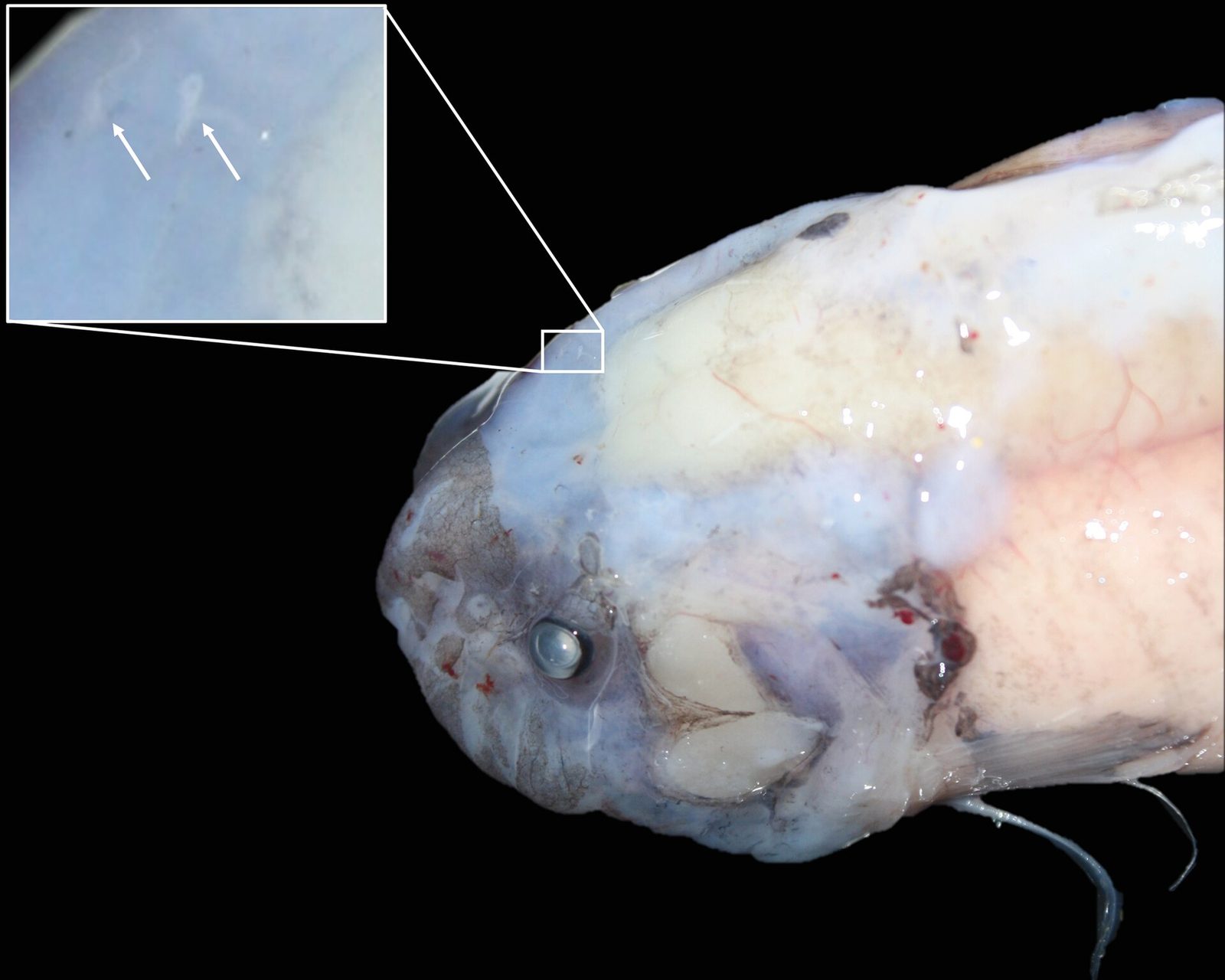
- Head of the hadal snailfish Pseudoliparis swirei, from the paper describing the species Gerringer, Linley, Jamieson, Goto and Drazen (2017), via Wikimedia Commons (CC BY 3.0). CC BY 3.0 Source.
- GEBCO 2019 and EM 124 bathymetry of the Challenger Deep and Sirena Deep, with depth profiles Cassandra Bongiovanni, Heather A. Stewart and Alan J. Jamieson, via Wikimedia Commons (CC BY 4.0). CC BY 4.0 Source.
_over_the_Marianas_Trench_on_23_January_1960_(USN_710619).jpg)

_Figure_8.jpg)
