
The Great Pyramid: The Most Precise Building of the Ancient World
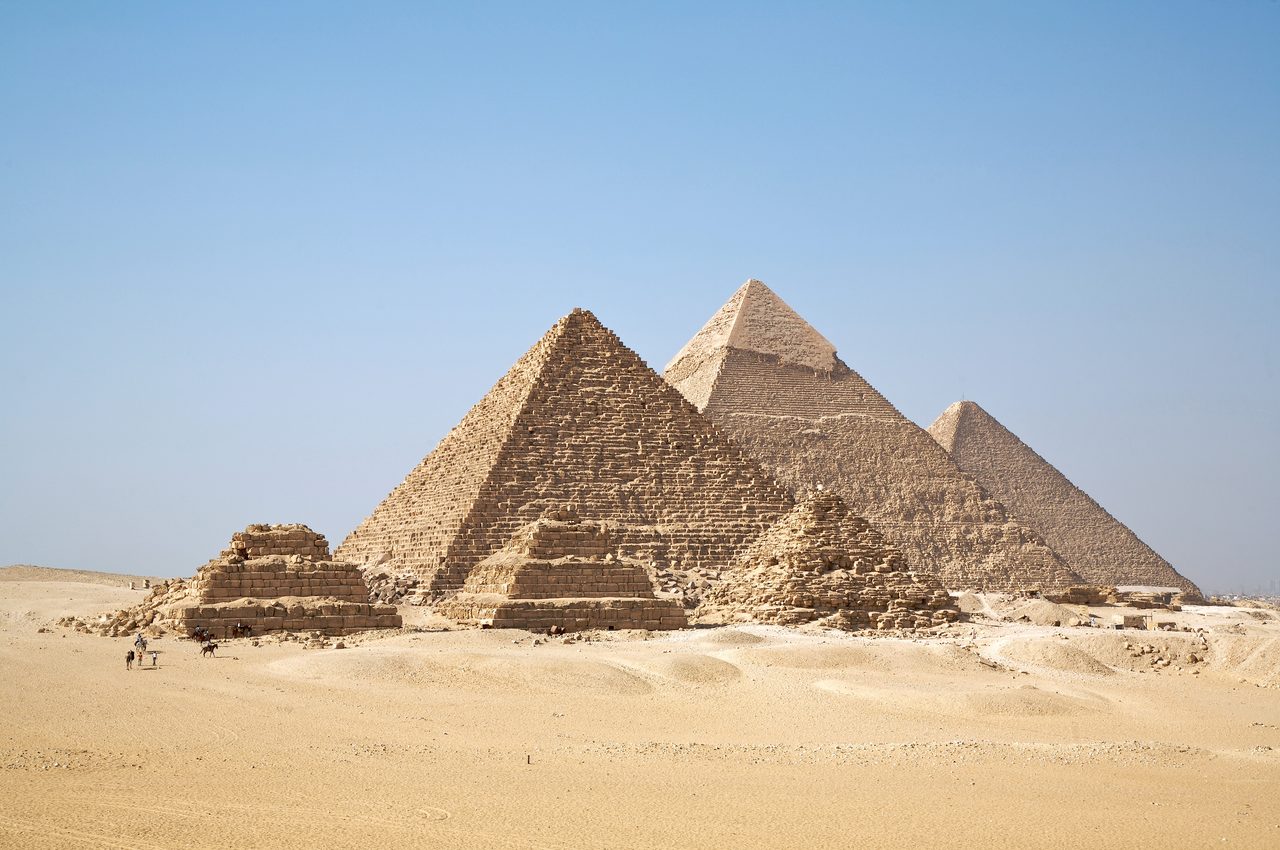
It is the most precisely built large structure of the ancient world. Six million tons of stone, some 2.3 million blocks, aligned to true north within a twentieth of a degree and set on a base level to within 2.1 centimeters across thirteen acres. That precision is exactly why the Great Pyramid of Giza draws every claim that human hands could not have raised it. Here is the file, opened claim by claim, each one wearing its evidence.
Almost everyone who tries to prove the Great Pyramid could not have been built by ordinary people starts from the same place: the numbers. The precision is real, it is extraordinary, and it is measurable. That is exactly why the honest way to read this monument is not to wave the numbers away, but to take them seriously and then ask, one claim at a time, what they actually support. Let's open the file.
01A Building Measured in Fractions
The Great Pyramid was built for Pharaoh Khufu, also called Cheops, and is dated to about 2560 BCE. Its original height was 146.6 meters, 481 feet, on a base 230.4 meters, 756 feet, to a side. Its estimated weight is roughly 6 million tons, assembled from about 2.3 million individual blocks.
Now the precision. The pyramid is aligned to true north within 3/60 of a degree, a twentieth of a degree. Its base is level to within 2.1 centimeters across thirteen acres. And its perimeter divided by its height equals 2 pi, to within 0.05 percent. These are not vague impressions; they are surveyed figures, and they are the reason the building has fascinated engineers for two centuries.
The outer casing carried the same discipline. The casing stones were cut to a precision the research file describes as 1/100 of an inch, and fitted so tightly that, by repeated report, a razor blade cannot be slid into the joints between them.
| Measure | Figure |
|---|---|
| Built for | Pharaoh Khufu (Cheops), about 2560 BCE |
| Original height | 146.6 m (481 ft) |
| Base length | 230.4 m (756 ft) to a side |
| Estimated weight | About 6 million tons |
| Number of blocks | About 2.3 million |
| Alignment to true north | Within 3/60 of a degree |
| Base level | Flat to within 2.1 cm across 13 acres |
| Perimeter to height | Equals 2 pi, within 0.05 percent |
| Casing stone precision | Cut to about 1/100 of an inch |
02Inside the Mountain of Stone
The precision does not stop at the surface. Inside, the pyramid holds a small set of chambers and passages arranged with the same care, and each one is a fact in its own right.
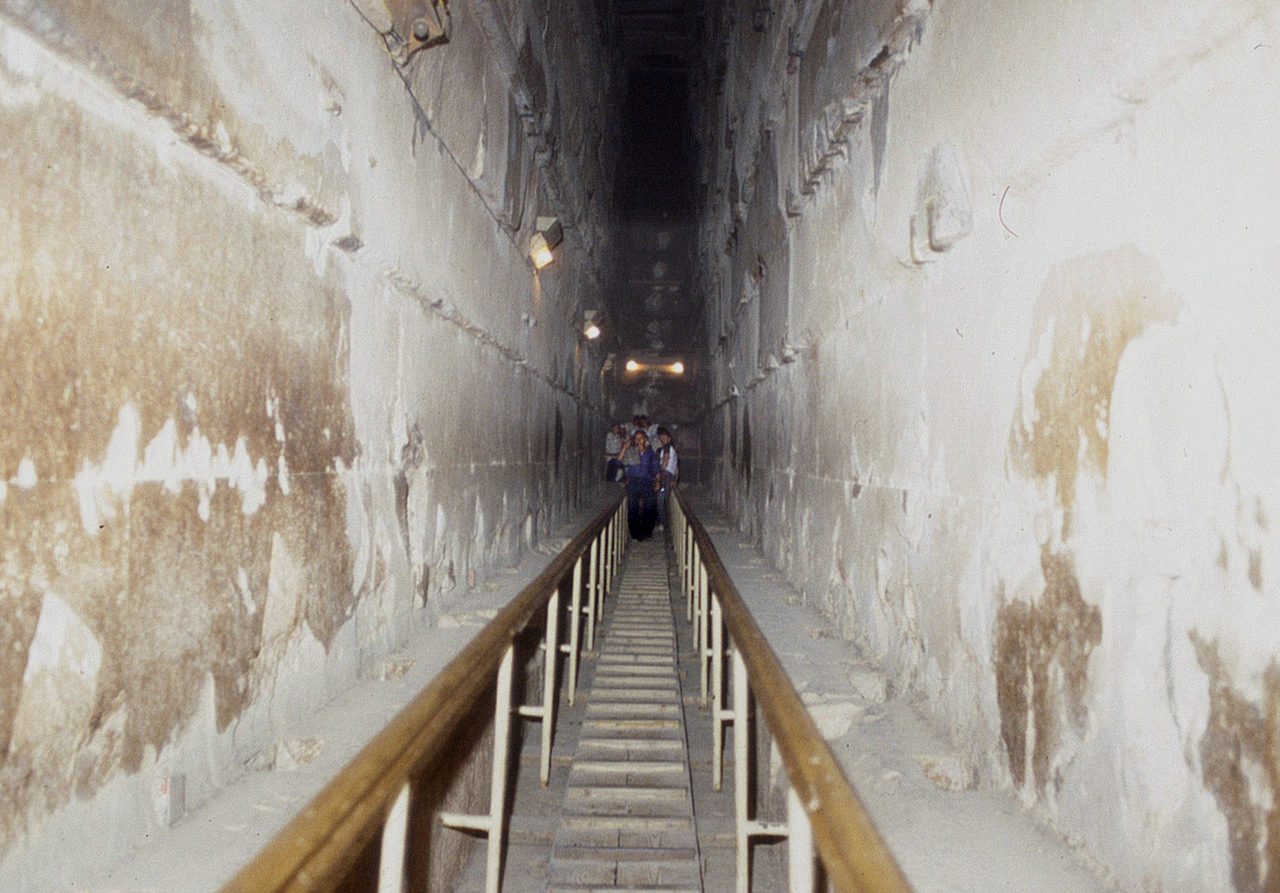
The Grand Gallery is the showpiece of the interior: a corbelled ascending passage 47 meters long and 8.5 meters high, its walls stepping inward course by course as they climb. The muon scan that found a new void in 2017 found it directly above this gallery.
The King's Chamber is built entirely of red granite quarried at Aswan and hauled roughly 800 km down the Nile. Blocks of that granite weigh from about 25 to 80 tons each, though the file's own construction table narrows the heaviest to 70 to 80 tons, a discrepancy the source does not reconcile. Above the chamber, five relieving chambers stack granite slabs totaling roughly 3,000 tons.
Lower down, the Queen's Chamber is limestone and holds the two narrow shafts often called air shafts. Beneath everything, a Subterranean Chamber is cut straight into the bedrock and left apparently unfinished, its purpose still argued.
Two absences are worth stating plainly. No mummy has ever been found inside the Great Pyramid. And no hieroglyphs appear anywhere in it, except for quarry marks in the relieving chambers, discovered by Howard Vyse in 1837. That the marks exist and were found by Vyse is settled; whether they are genuinely ancient or a later addition is still debated.
03A Family of Pyramids, and a Wider World
The Great Pyramid did not appear from nowhere. The oldest Egyptian pyramid is the Step Pyramid of Djoser at Saqqara, about 2670 BCE, six stacked steps whose architect, Imhotep, was later deified as a god of wisdom and medicine. At Dahshur, Sneferu's Bent Pyramid, about 2600 BCE, changes its angle from 54 to 43 degrees partway up, and his Red Pyramid, about 2590 BCE, is the first true smooth-sided pyramid. The form was worked out, in stone, across a few generations before Khufu's builders raised the largest of them all.
Khufu's is the largest of the three at Giza, but not the only one. Khafre's Pyramid, about 2530 BCE, stands 136.4 meters on a 215.3 meter base at roughly 4.8 million tons and about 2 million blocks. Menkaure's, about 2510 BCE, is smaller at 65.5 meters on a 108.5 meter base. And Giza is only the most famous corner of a much larger field: over 130 pyramids have been identified across Egypt in total.
| Pyramid or Place | Detail |
|---|---|
| Great Pyramid (Khufu) | About 2560 BCE, 146.6 m, base 230.4 m, about 6 million tons |
| Khafre's Pyramid | About 2530 BCE, 136.4 m, base 215.3 m, about 4.8 million tons |
| Menkaure's Pyramid | About 2510 BCE, 65.5 m, base 108.5 m |
| Egypt in total | Over 130 pyramids identified, not just the three at Giza |
| Meroe, Sudan | Over 200 pyramids, more than all of Egypt combined (Kush, 800 BCE to 350 CE) |
| Cholula, Mexico | Largest pyramid by volume on Earth, about 4.45 million cubic meters vs Giza's 2.6 million |
Egypt does not even hold the records. Meroe, in Sudan, has over 200 pyramids, more than all of Egypt combined, built by the Kingdom of Kush between about 800 BCE and 350 CE. And the largest pyramid by volume anywhere on Earth is not at Giza at all: it is the Great Pyramid of Cholula in Mexico, roughly 4.45 million cubic meters against Giza's 2.6 million. Giza wins on height and precision, not on bulk or on numbers.
04New Rooms, Found With Cosmic Rays
For two centuries it looked as though the Great Pyramid had given up all its rooms. Then physics found more, and it did so without moving a single block.
The ScanPyramids collaboration reads the pyramid with cosmic-ray muons, particles created when cosmic rays strike the upper atmosphere and rain down through everything below. Muons pass through empty space more easily than through solid stone, so counting how many arrive from each direction lets researchers image hidden voids inside the mass without excavation.
In 2017 Morishima and colleagues reported the result in Nature: a previously unknown void at least 30 meters long, sitting directly above the Grand Gallery. What it was for is not yet known.
In 2023 Procureur and colleagues confirmed a second find in Nature Communications: a 9-meter corridor tucked behind the chevron blocks on the pyramid's north face. An endoscopic camera threaded through a joint in the stone then showed it directly, the first new internal space actually observed inside the Great Pyramid since the 19th century.
Scanning continues under the ScanPyramids partners, the HIP Institute, France's CEA, and Nagoya University. In 2025 a separate team confirmed the North Face Corridor again with three more non-destructive methods, ground-penetrating radar, ultrasonic testing, and electrical resistivity, each independently detecting the same air-filled space. The pyramid is still revealing rooms, and it is doing so through ordinary physics.
05So How Was It Built?
This is where the real mystery lives, and it is worth being honest that it is a genuine one. The precision is settled. The logistics are not.
The scale is hard to hold in the mind. The heaviest granite, 70 to 80 tons a block, came 800 km from Aswan. And if the whole pyramid went up in the roughly 20 years of Khufu's reign, a block had to be quarried, moved, and set on average about every two and a half minutes, around the clock, every day of the year, for two decades.
There is no single, fully satisfying consensus on the construction logistics. The ramps, levers, sledges, and watered sand that Egyptologists reconstruct are all plausible and partly evidenced, but no one reconstruction closes every question about how it was done at this speed and scale. That gap is real, and it is where most of the honest mystery actually sits.
What is not a gap is who did it. The evidence indicates the builders were skilled, paid laborers, not slaves, organized on a scale that also demonstrated a pharaoh's power. Mainstream readings of pyramid purpose run from tombs and funerary ritual to temple centers, astronomical markers for solstice and equinox calendars, political theater in stone, and the social cohesion of a shared project.
And we have a name. The Wadi al-Jarf papyri, found in 2013 and the oldest inscribed papyri ever recovered in Egypt, include the day-by-day logbook of Merer, a real, named, mid-ranking inspector, recording his crew cutting limestone at the Tura quarries and ferrying it by boat to Giza for the Great Pyramid, during Khufu's own reign. Alongside it, account records track the bread, beer, and grain rations of a workforce numbering in the tens of thousands. It is the closest thing we have to a construction diary, and it describes ordinary, organized, human labor.
06The Numbers That Aren't There
A building this exact invites people to find more exactness in it than is really present. Two of the most repeated claims fall apart on a close look, and it is worth walking through why.
You will often read that Giza sits at the exact intersection of the longest lines of latitude and longitude on Earth. As commonly stated, that is simply not true: the longest line of latitude is the equator, and every line of longitude is the same length. Fact-checkers at Snopes and Full Fact trace the phrasing back to the 1870s and find nothing to it. There is a far narrower, more technical version, about the longest stretches of land a great circle can cross, but that is a disputed geodesic footnote, not the tidy cosmic coincidence the popular version promises.
A related favorite: the pyramid's latitude, 29.9792 degrees north, echoes the speed of light, 299,792,458 meters per second. The digits really do line up. But the research file flags this itself as a debated coincidence, and it is one. Decimal-degree coordinates are a modern convention laid over the Earth thousands of years after the pyramid was built. Reading the speed of light out of them tells you about our numbering system, not about Khufu's engineers, and as proof that the builders knew light's velocity it has no support at all.
07The Power Plant Question
The boldest claim of all is that the Great Pyramid was not a tomb but a machine. This one deserves careful handling, because parts of it are true, and the temptation is to let the true parts carry the rest.
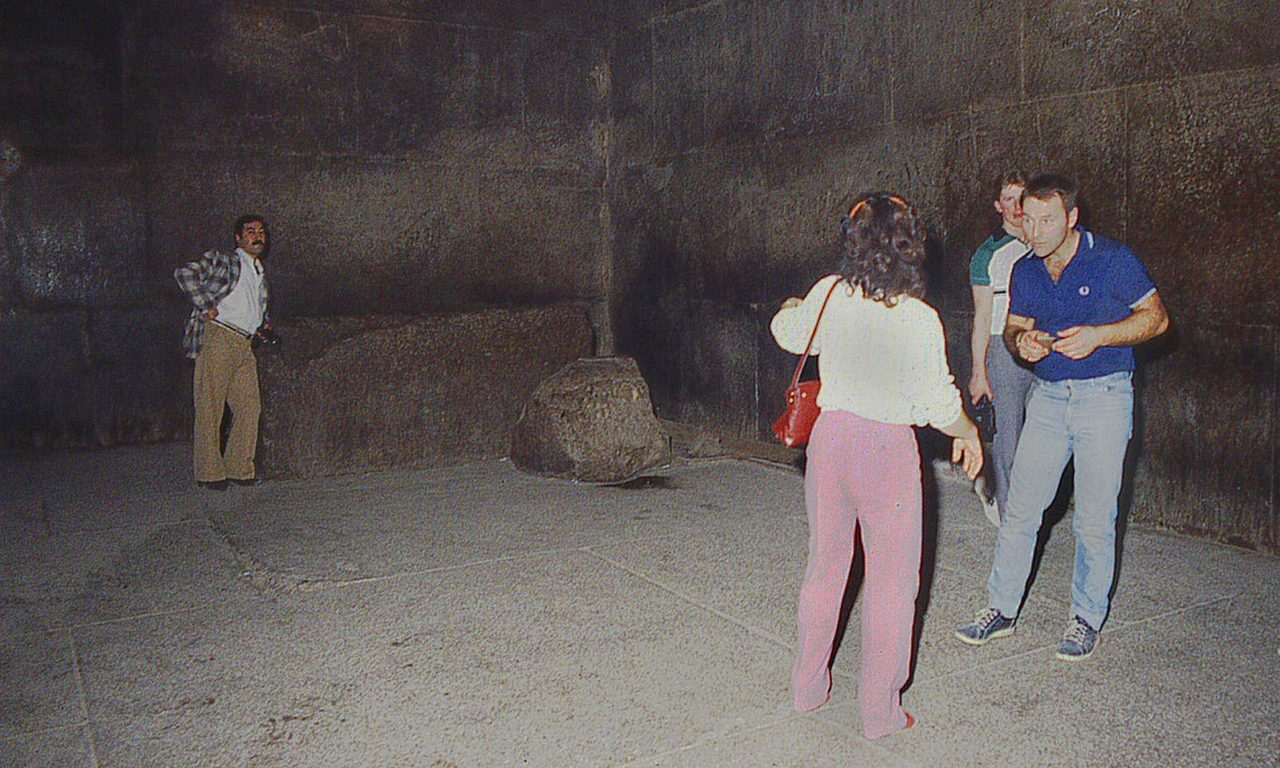
Start with what is measurable. The red granite of the King's Chamber resonates at about 117 to 121 Hz. Granite is rich in quartz, which is piezoelectric, meaning it produces a small electric charge under mechanical stress. And a dead-end passage in the pyramid has been recorded resonating at 5.13 Hz, as if it were a tuned tube. These acoustic properties are real, repeatable, and genuinely striking. Whether they were designed or are simply what happens when you stack this much quartz-bearing granite this precisely is not settled.
A 2018 study in the Journal of Applied Physics by Balezin and colleagues at ITMO University modeled the pyramid's response to radio waves and found its geometry can concentrate electromagnetic energy in its internal chambers at wavelengths of 200 to 600 meters. It is a real, peer-reviewed physics result. It is also, in the authors' own framing, a property of the shape, not a claim that anyone designed it that way. The leap from this to an ancient power system is one the researchers pointedly did not make.
Christopher Dunn's 1998 book The Giza Power Plant builds on exactly these facts, arguing the pyramid converted the Earth's vibrational energy into microwave radiation: hydrogen generation in the subterranean chamber, resonator acoustics in the Grand Gallery, piezoelectric transduction in the granite, and a beam out through the now-missing capstone. The parts he starts from, the precision, the acoustics, the quartz, are real. What is missing is everything downstream: no trace of hydrogen production, no microwave output, no distribution system, and no ancient text describing any such function. The research file's own verdict is blunt.
The theory is often paired with Nikola Tesla, whose Wardenclyffe Tower, built between 1901 and 1917 over an aquifer, aimed to send power wirelessly through the Earth. Tesla's underlying physics were sound: electromagnetic resonance and low-frequency waves really do propagate through the cavity between Earth and the ionosphere, an effect confirmed at small scale by the 1952 discovery of the Schumann resonances, near frequencies Tesla had guessed decades earlier. But sound physics for Tesla's tower is not physics for Dunn's pyramid, and there is no record that Tesla himself ever studied the pyramids as power devices.
The one genuine electrical artifact in this whole family of claims is not Egyptian at all. The Baghdad Battery, a clay jar with a copper cylinder and iron rod from roughly 250 BCE to 224 CE, physically exists and, when reconstructed, produces measurable voltage, about half a volt to a volt in early replicas and over 1.4 volts in a 2026 build using an alkaline electrolyte. It is the only ancient object anywhere in this area with a demonstrated electrical property. What it is not is proof of ancient electricity: whether it was ever used that way is unknown, and readings from a scroll holder to a ritual vessel remain live.
And here is the objection that sinks the whole electrical reading. Across every candidate artifact, the Baghdad Battery included, and every Egyptian site, no one has ever found a wire, a circuit, a bulb, or any distribution system connected to any of it. A battery or a resonating chamber with nothing wired to it cannot power anything outside itself. That single absence is the most damaging fact for the power-plant story, and it has never been filled.
The specific claim that ancient Egyptians lit their tombs with electricity is not merely unproven, it is contradicted. Soot from oil lamps is found on tomb walls exactly where the painting was done, which electric light would not have left. Egyptologists, including Frood and Ikram, have shown that polished copper mirrors can throw sunlight deep into a passage, a real, soot-free method the Egyptians actually had. And no wiring, component, or power source has ever turned up in any Egyptian archaeological context.
08Where the Story Runs Past the Evidence
Beyond the machine reading lies a whole outer ring of claims, some worth weighing as open questions, others not. Here they are, plainly.
The Great Sphinx, carved from the same plateau, is conventionally dated to about 2500 BCE.
An alternative dating, argued by Robert Schoch and John Anthony West, reads the deep weathering on the Sphinx enclosure as the work of heavy rainfall rather than wind and sand, and pushes its origin back to somewhere between 7,000 and 10,000 BCE. It is a genuine minority proposal, not a settled result, and the research library routes the full argument to its own dedicated Sphinx file rather than resolving it here.
A wider idea threads the sites together: Alfred Watkins's 1921 concept of ley lines, extended into a claimed global grid along the 30th parallel linking Giza, Angkor Wat, Nazca, and Easter Island. The mainstream reply is statistical: scatter enough notable sites across a planet and some will fall into lines by chance.
Traditions of non-human help, of gods or sky-beings lending a hand, do recur across pyramid-building cultures, in Egypt, in Mesoamerica, and elsewhere. That these stories exist and repeat is a real, observed pattern. What they actually mean, whether they record anything beyond myth, is interpretation, and it is not established fact.
From this, some researchers argue the precision at Giza exceeds what simple tools should allow and propose a shared architectural source, an Atlantis or a lost pre-flood civilization, noting that Caral in Peru and Giza in Egypt both rose around 3000 BCE with no known contact between them. The file frames this explicitly as one side of an open debate, and it rests on inference rather than on any recovered evidence of such a civilization.
It helps to see how the same field handles a clear fake. The Bosnian Pyramid of the Sun, announced by Semir Osmanagic in 2005, is a natural hill, an eroded formation of inclined rock slabs shaped by differential erosion, and the European Association of Archaeologists formally condemned the excavations in 2006 as damaging to legitimate sites. Calling a mountain a pyramid does not make it one.
The discipline polices its own, too. A 2023 paper claiming buried construction at Gunung Padang in Indonesia dated to 27,000 years ago was formally retracted in 2024, after review found it had mistaken natural soil carbon for evidence of human building and turned up peer-review irregularities. The retraction is not a cover-up. It is the system working.
And there is common ground. Both mainstream and alternative camps agree that the pyramids are an extraordinary human achievement, that real construction questions remain genuinely open, and that pyramid-building appears independently across the world in a pattern that honestly asks to be explained. The disagreement is about the explanation, not about the wonder.
Fast Facts
- Structure
- The Great Pyramid of Giza, tomb of Pharaoh Khufu (Cheops)
- Built
- About 2560 BCE, roughly 4,500 years ago
- Scale
- 146.6 m tall originally, base 230.4 m, about 6 million tons, about 2.3 million blocks
- Precision
- Aligned to true north within 3/60 of a degree; base level to within 2.1 cm across 13 acres
- Interior
- King's Chamber (Aswan granite), Queen's Chamber, Grand Gallery, Subterranean Chamber
- Newest finds
- The Big Void (2017) and North Face Corridor (2023), detected by muon scanning
- Builders
- Skilled, paid laborers, documented in the Diary of Merer (papyri found 2013)
- Mummy
- None has ever been found inside
- World context
- Over 130 pyramids in Egypt; Meroe has 200+, Cholula is largest by volume
What We Can Actually Stand Behind
The precision is real and extraordinary. Built for Khufu around 2560 BCE, roughly 6 million tons in about 2.3 million blocks, aligned to true north within 3/60 of a degree, level to within 2.1 cm across thirteen acres, perimeter to height equal to 2 pi. Muon scanning found genuine new spaces inside it, the Big Void in 2017 and the North Face Corridor in 2023, the latter confirmed by camera and again in 2025. And the Diary of Merer records, day by day, the paid human crews who did the work.
The pyramid's geometry really can concentrate electromagnetic energy at certain wavelengths, a published, peer-reviewed result, and its granite really does have measurable acoustic and piezoelectric properties. But the physics authors call the EM effect a property of the shape, not evidence of a machine, and whether the acoustics were intended or incidental is unresolved. The exact construction logistics, how they moved 70 to 80 ton blocks and set one every few minutes, also have no full consensus. These are real open questions, not answers in disguise.
The dramatic readings, the Giza Power Plant theory, the Tesla parallel, ley-line grids, the Sphinx water-erosion redating, and a shared Atlantis-style source for the world's pyramids, are interesting to think about but unproven. Their true cores, the precision, the acoustics, the quartz, do not carry them the rest of the way. Dunn's power plant in particular has ingenious analysis and zero corroborating evidence of actual energy production, and it stays at Tier 3.
There is no credible archaeological, textual, or artifactual evidence that the Great Pyramid was built with help from extraterrestrial or other non-human beings. Different cultures built pyramids independently for their own stated reasons, and for Giza specifically the Diary of Merer is a contemporaneous, primary logbook of ordinary organized human labor. The claim survives only on the argument that we cannot fully explain the how, which is not evidence of anyone else's hand.
There is no evidence that ancient Egyptians possessed electric lighting, and here the evidence actively points the other way: lamp soot on tomb walls where the painting was done, a documented soot-free method of channeling sunlight with copper mirrors, and not a single wire, circuit, bulb, or power source ever recovered from any Egyptian context. This one is contradicted, not merely unproven.
So the honest answer is human ingenuity, and it is not the smaller story. It is the larger one: that people with copper, stone, rope, and an astonishing amount of shared purpose raised the most precisely built large structure the ancient world ever produced, and did it in a couple of decades. The file stays open on the parts that are genuinely open. What was the Big Void above the Grand Gallery for, and how, exactly, do you set a seventy-ton block every few minutes for twenty years? The stone is still holding those answers, and it has held them for four and a half thousand years.
Sources & further reading
Everything above is drawn from our research library on Theories of Anything. Open the full file to check the sourcing and go deeper.
Image credits
- Aerial view of the three Giza pyramids photograph by Ricardo Liberato, via Wikimedia Commons. CC BY-SA 2.0 Source.
- The Grand Gallery inside the Great Pyramid photograph by Mike McBey, via Wikimedia Commons. CC BY 2.0 Source.
- The King's Chamber and its granite sarcophagus photograph by Mike McBey, via Wikimedia Commons. CC BY 2.0 Source.
- The Grand Gallery inside the Great Pyramid photograph by Mike McBey, via Wikimedia Commons. CC BY 2.0 Source.

.jpg)
.jpg)