
Gravitational Waves: Hearing Spacetime Ring
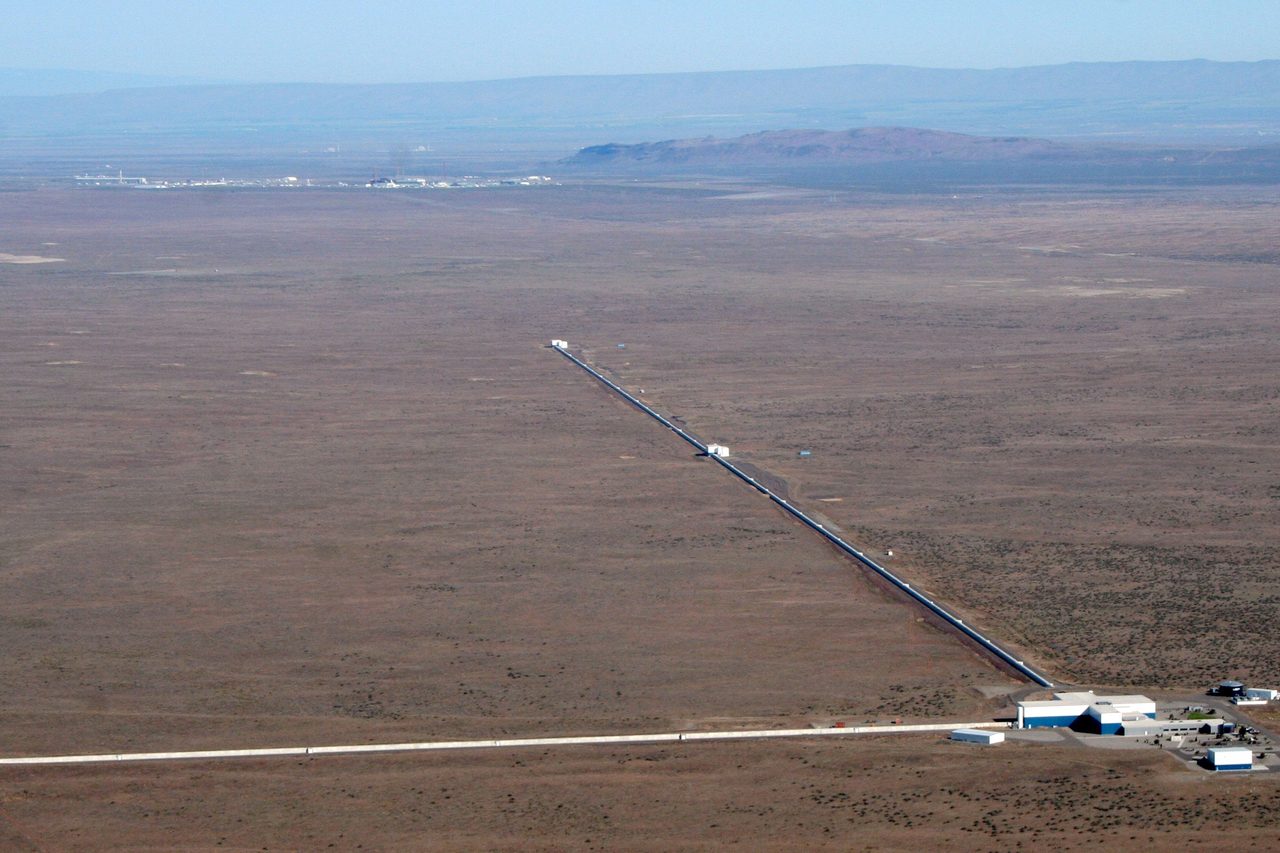
On 14 September 2015, two machines 3,000 km apart traced the same twitch, seven milliseconds apart, for two tenths of a second, and a prediction Einstein published in 1916, and in 1936 concluded was mistaken, became a measurement. What crossed them was neither sound nor light but a change in the length of space itself, with a peak strain of 1.0 x 10^-21. This page follows that measurement from the quadrupole formula to the roughly 390 events the network had confirmed by May 2026, and it is careful at the two places this subject reliably inflates: the comparison objects used to say how small the effect is, and the distance between evidence for a gravitational-wave background and detection of one.
Two tenths of a second is a blink. On 14 September 2015, in about that much time, something crossed the Earth and changed the distance between the mirrors at the ends of two four-kilometer vacuum tubes near Livingston in Louisiana, and then, about seven milliseconds later, the distance between two more in eastern Washington, inside the ten milliseconds that light needs to travel between the two sites. Nothing was heard. There was nothing to hear: a gravitational wave is not a pressure wave in a medium, and the instruments are optical, comparing the length of one light path against another. What arrived was a change in the geometry of space, and two machines 3,000 km apart both recorded it. That is the event. Everything else on this page is either the century of work that made two such machines possible, or the decade since, in which the count of confirmed events went from one to roughly 390. The wonder in this subject is not the size of the objects. It is the smallness of the measurement.
01Two Tenths of a Second
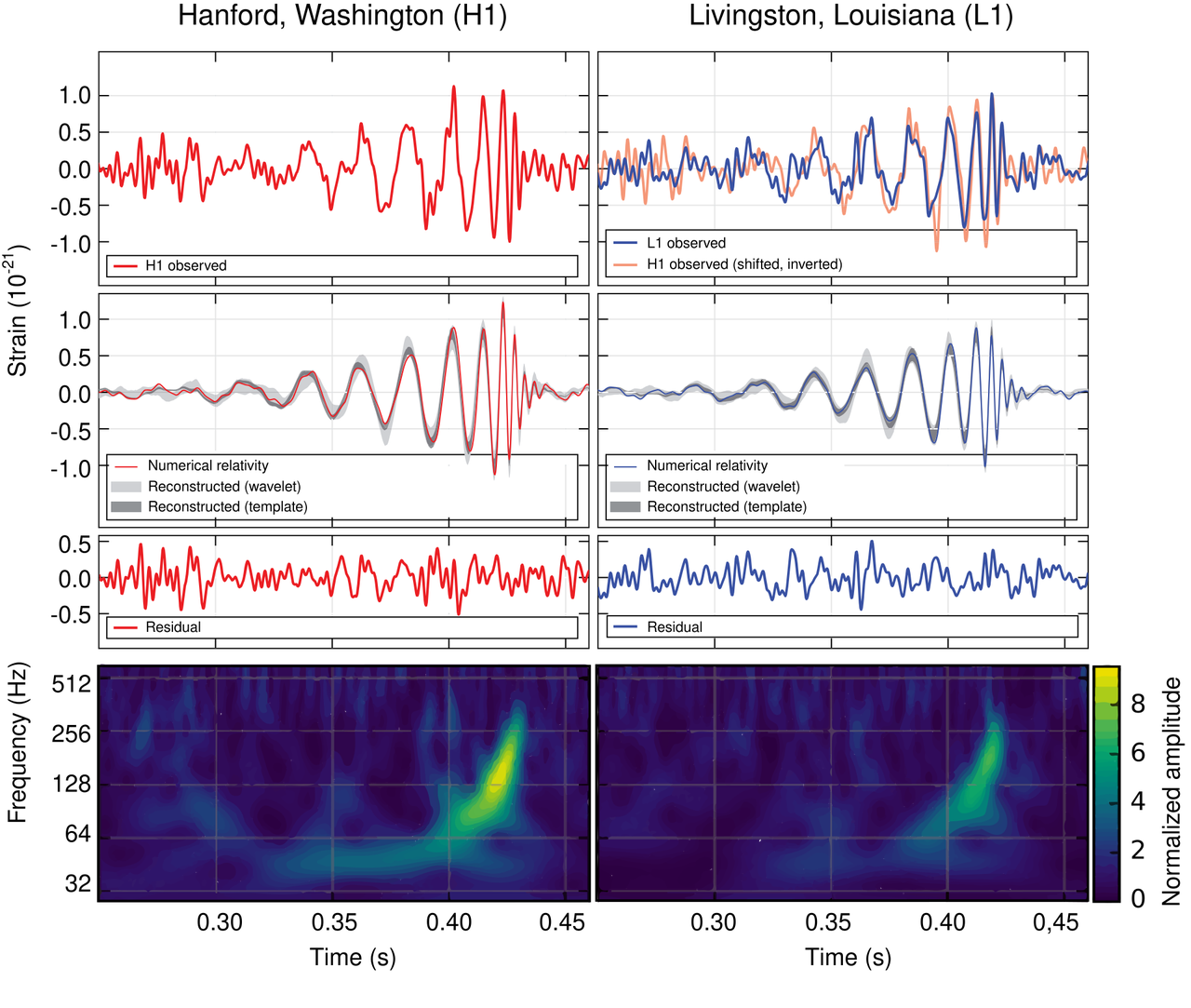
The discovery paper opens with the fact and the clock: 'On September 14, 2015 at 09:50:45 UTC the two detectors of the Laser Interferometer Gravitational-Wave Observatory simultaneously observed a transient gravitational-wave signal.' The word carrying the weight there is simultaneously. Then the signal: 'The signal sweeps upwards in frequency from 35 to 250 Hz with a peak gravitational-wave strain of 1.0 x 10^-21.' And then what it was: 'It matches the waveform predicted by general relativity for the inspiral and merger of a pair of black holes and the ringdown of the resulting single black hole.' Inspiral, merger, ringdown. That three-part shape is the standard anatomy of a compact-binary signal, and it is why the rising sweep is called a chirp: the two objects circle faster and faster as they close, so the wave they radiate rises in frequency until the moment they become one object, which then rings down and the signal ends.
How confident, and on what grounds: 'The signal was observed with a matched-filter signal-to-noise ratio of 24 and a false alarm rate estimated to be less than 1 event per 203 000 years, equivalent to a significance greater than 5.1 sigma.' Our own research file states that significance flatly, as 5.1 sigma, and the difference is not pedantry. Greater than 5.1 sigma is a floor set by how much background the collaboration was able to estimate, not a measurement of how loud the signal was. The paper's wording is the one this page carries.
What collided, in the paper's own numbers: 'In the source frame, the initial black hole masses are 36 +5 -4 M_sun and 29 +4 -4 M_sun, and the final black hole mass is 62 +4 -4 M_sun, with 3.0 +0.5 -0.5 M_sun c^2 radiated in gravitational waves.' Thirty-six solar masses and twenty-nine make sixty-five; the object left behind is sixty-two. Three solar masses of matter stopped being matter and left the scene as waves, and that missing three is the whole event. The companion parameter-estimation paper adds that the remnant carries a spin of 0.67 +0.05 -0.07, that the more massive of the two original holes had a dimensionless spin bound below 0.7 at 90 percent probability, and that the source could be placed only within an annulus section of 610 square degrees of sky, mostly in the southern hemisphere. Hold that last figure. It is the number that changes most over the following decade.
How far away, and here the popular version drops something large. The paper says: 'The source lies at a luminosity distance of 410 +160 -180 Mpc corresponding to a redshift z = 0.09 +0.03 -0.04', and it states of every figure it gives that 'All uncertainties define 90% credible intervals.' Four hundred and ten megaparsecs is the roughly 1.3 billion light-years that made the headlines, and it is a fair headline. It is a poor sentence to leave unqualified: the interval runs from about 230 to about 570 megaparsecs, which is an uncertainty of roughly plus forty and minus forty-four percent. The collision is real, the black holes are real, and the distance carries an uncertainty of that size, which the round headline number hides. As for how long it took, the collaboration's own science summary describes the frequency as having 'swept sharply upwards, from 35 Hz to about 150 Hz over two tenths of a second'. Note that the summary says 150 Hz where the peer-reviewed abstract says 250. Both texts are the collaboration's; where they differ, this page takes the paper.
The signal arrived on 14 September 2015. The announcement came on 11 February 2016, five months later, and the gap is worth a sentence of its own: it is the interval in which a collaboration checked its own instrument against the possibility that what it had detected was itself. When the announcement did come, LIGO put the energy this way: 'About 3 times the mass of the sun was converted into gravitational waves in a fraction of a second - with a peak power output about 50 times that of the whole visible universe.' That sentence is quoted rather than restated, for two reasons. First, it compares a computed gravitational-wave luminosity against an estimated electromagnetic one, and nobody measured either directly. Second, it is one of three wordings in play at three different strengths, two of them the collaboration's own. That release is the strongest of the three, at about 50 times the whole visible universe. The collaboration's science summary for the same result, the page this section already quotes for the frequency sweep, says twice that the peak power was 'more than ten times greater than the combined light power from all the stars and galaxies in the observable Universe'. And our own research file is weaker still, saying only that the peak gravitational-wave luminosity exceeded the combined electromagnetic luminosity of all the stars in the observable universe. All three are defensible. They are not the same claim, and this page will not blend them or convert any of them into physical units, because no source this page was able to read gives the peak luminosity in physical units. The 2017 Nobel Prize in Physics went to Rainer Weiss, Barry Barish and Kip Thorne.
02What a Passing Wave Does
A gravitational wave is transverse and quadrupolar, which is a compact way of saying something quite specific. Take a ring of test masses floating freely. As the wave passes through them, the ring is stretched along one axis while being squeezed along the axis at right angles to it, then the two swap, twice for every cycle of the wave. There are two independent polarizations, conventionally called plus and cross, rotated 45 degrees from one another. What is measured is not a distance but a strain, written h, and strain is dimensionless: it is the change in a separation divided by that separation. Everything about the engineering follows from that one fact. Because the effect is fractional, a longer instrument yields a larger absolute displacement from the same wave, and that is the entire reason LIGO's arms are four kilometers long rather than four meters.
Three things the stretch-and-squeeze cartoon hides, each worth saying out loud. First, it is the proper distance between freely falling test masses that changes, not the masses moving through a space that stays the same; the geometry itself is what oscillates. Second, a solid object is not free to follow that geometry, because its own internal forces resist, and that resistance is not a nuisance but the point: it is precisely what makes the effect detectable, as an argument from 1957 established and section 04 describes. The intuition that everything stretches equally so nothing can be measured is simply wrong, and it is wrong for a reason that can be stated in one sentence. Third, the animated ring of dots that every explainer uses, including every good one, shows a wave amplitude exaggerated by roughly twenty orders of magnitude. On a ring of test masses a meter across, the real effect is far below any atomic scale. If you have seen the animation, you have seen an honest teaching aid and a wildly dishonest picture of the size of the thing.
And since it is in the title of this page: nobody heard anything. There is no sound. Sound is a pressure wave in a medium, gravitational waves are not, and the detectors are optical instruments measuring the length of a light path. The metaphor is nevertheless everywhere, and it is defensible, because the signals from merging compact objects happen to fall in the same frequency range as audible sound, tens to thousands of hertz. That means the strain time series can be sent straight to a loudspeaker and a human ear can follow the chirp. Those audio clips are real, but they are real in the way a graph is real: they are a rendering of a measurement, not a recording of an event. Every audio file connected with any of these detections is data converted into sound afterwards.
03The Machine and Its Twin
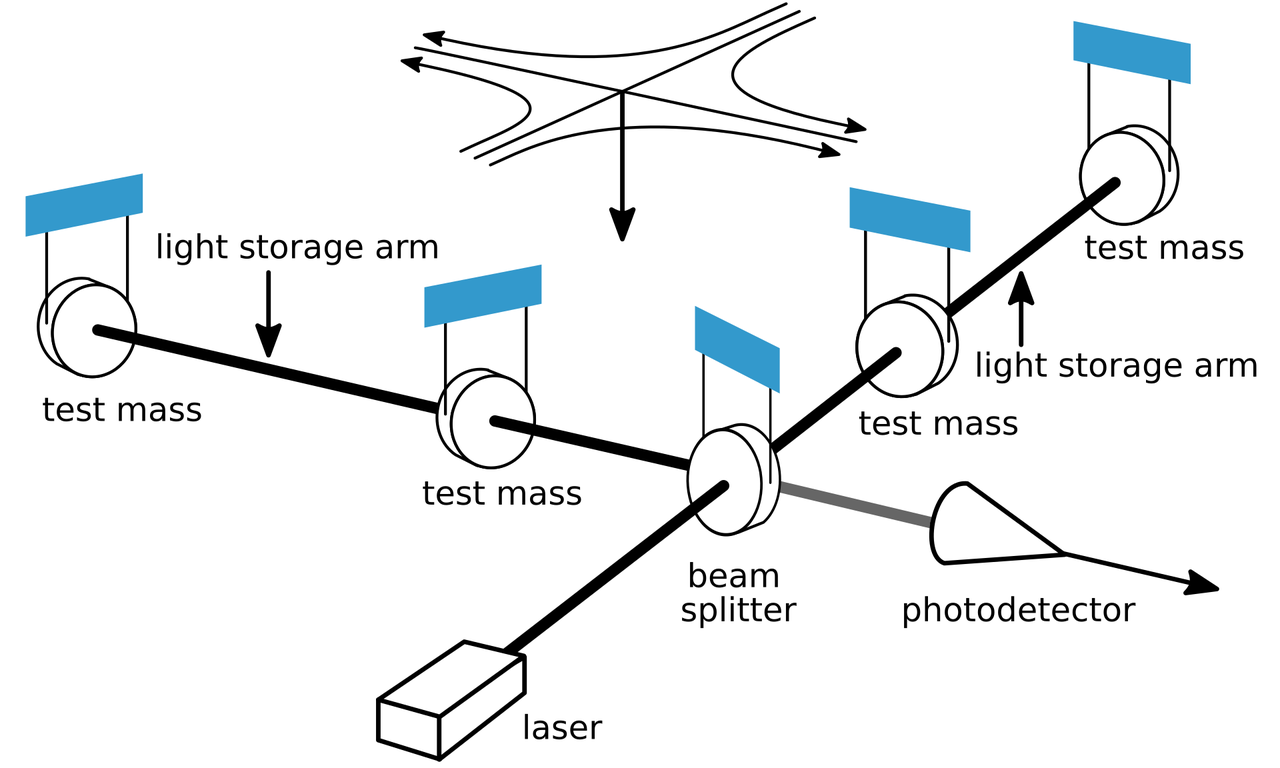
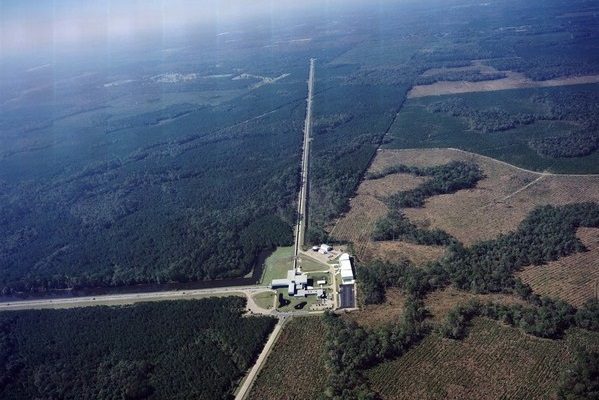
LIGO is a pair of twin Michelson-type laser interferometers with four-kilometer Fabry-Perot cavity arms. Its own facts page gives the configuration as 'Two L-shaped detectors with 4 km long vacuum chambers', and the same laboratory describes the pair like this: 'LIGO operates two detectors located 3000 km (1800 miles) apart: One in eastern Washington near Hanford, and the other near Livingston, Louisiana.' That separation is deliberate. A real astrophysical signal must appear at both sites within the light-travel time between them, at most about ten milliseconds; local noise appears at one. Two instruments is what converts a wiggle into evidence.
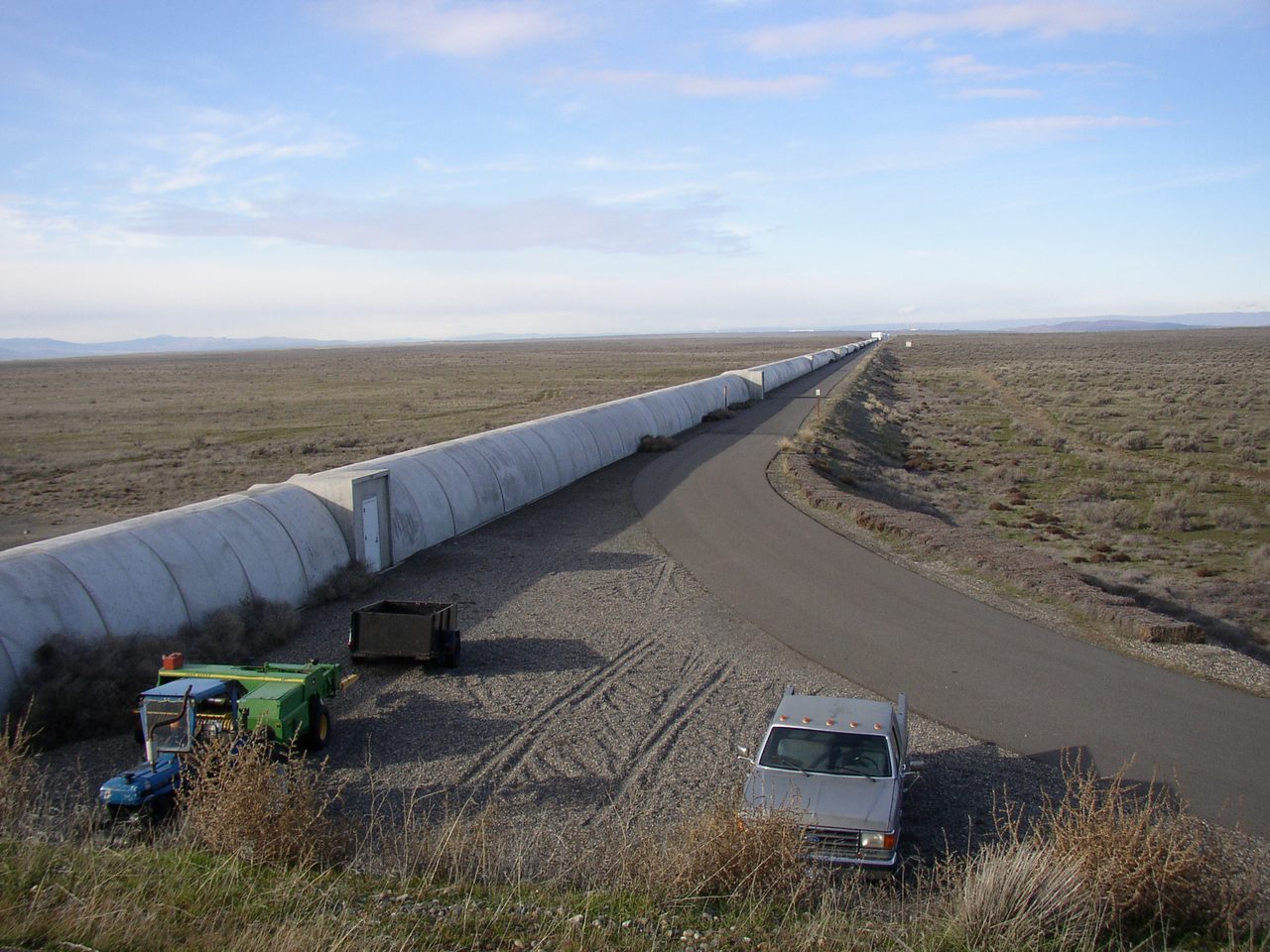
For the sensitivity, LIGO's own words are better than any paraphrase. Its facts page states the instrument's floor, and then offers its own scale for it: 'This is equivalent to noticing a change in distance to the nearest star (some 4.2 light years away) of the width of a human hair.' Both sentences are quoted here rather than reworked, because this exact comparison is where the subject goes wrong, and it goes wrong in our own library first.
Our two research files disagree with each other about this by a factor of ten. Q_4_02 says LIGO detects length changes smaller than a ten-thousandth of the diameter of a proton across its four-kilometer arms. ZA_2_02 says GW150914 stretched spacetime by about 10^-21, which it renders as a thousandth of a proton diameter over the same arms. They cannot both be right, and the reason they differ is more useful than the discrepancy itself: they are describing two different quantities that popular writing conflates constantly. One is the detector's smallest measurable displacement, which is what LIGO's own sentence is about. The other is the displacement produced by one particular event, which for a peak strain of 1.0 x 10^-21 across four-kilometer arms is a different and larger number. This page therefore does what the two docs did not: it quotes LIGO for the instrument and the discovery paper for the event, and it computes no proton fraction for GW150914 at all. A comparison nobody published is not evidence, however vivid it sounds.
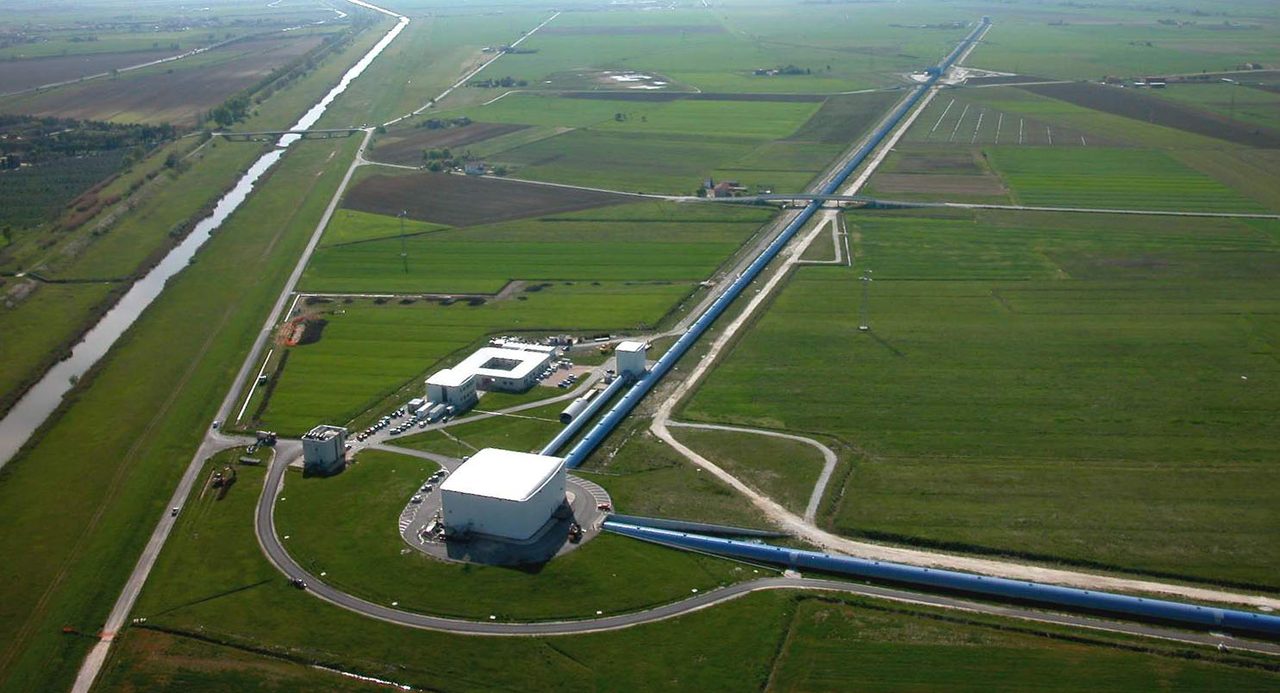
LIGO is also not alone, and the article would mislead if it left the network out. Virgo, near Pisa in Italy, is a three-kilometer interferometer, and the collaboration's own aerial photograph of the site describes its three-kilometer west arm and the beginning of its north arm. KAGRA, in Japan, also has three-kilometer arms and sits underground in the former Kamioka mine, the only major detector built below the surface, which is a genuinely different engineering answer to the problem of ground noise. The collaboration name used throughout the current literature is LIGO-Virgo-KAGRA, abbreviated LVK. KAGRA has taken data alongside the others: the LIGO Laboratory's own end-of-run release records the fourth observing run as the first in which KAGRA took science data simultaneously with Virgo and LIGO. Nothing on this page states KAGRA's sensitivity, because the sources gathered for this page do not establish it.
04The Hundred Years Before
Einstein predicted gravitational waves in 1916, in a paper on the approximate integration of the field equations, as a straightforward consequence of general relativity: accelerating masses radiate ripples in spacetime, and those ripples travel at the speed of light. There are, however, two papers rather than one, and our own research file cites only the first. Einstein returned to the subject in 1918 with a second paper, on gravitational waves, which is where the quadrupole radiation formula appears in the form physics actually uses; the 1916 derivation contained an error in the energy calculation, and the 1918 paper corrects it. This is worth one clean sentence and no more drama than that. It is an ordinary correction inside a hard new calculation, and it matters here only because of what happened next.
In 1936 Einstein concluded, with Nathan Rosen, that gravitational waves do not exist. The paper they submitted to Physical Review argued exactly that. It drew a critical anonymous referee report, Einstein withdrew it in irritation and sent it elsewhere, and it appeared in 1937 in the Journal of the Franklin Institute under the title 'On gravitational waves', with its conclusion reversed after he was persuaded the objection was correct. The episode is documented in detail by the historian Daniel Kennefick. It is worth pausing on, because it calibrates how the century felt from inside: the man who predicted the waves spent part of a decade unsure they were real, in print, and the research file this page was written from does not mention it.
What settled it was two beads on a rod. Put two beads on a rigid rod so they can slide. A passing wave holds the rod's length fixed, because the atomic forces inside it resist, while the proper distance between the beads oscillates. So the beads rub against the rod, and the friction makes heat. If a wave can heat a bead it carries energy, and if it carries energy it is real and in principle detectable. Richard Feynman presented this at the 1957 Chapel Hill conference on the role of gravitation in physics; a history of his contribution on the preprint archive records that there 'he presented in particular the celebrated sticky bead argument, which was devised to intuitively argue that gravitational waves must carry energy, if they exist at all'. Hermann Bondi, who was present, published a variant shortly afterwards in Nature, and the argument is often credited to him. Both statements are true at once: Feynman devised it, Bondi published and popularized a version of it, and the attribution is genuinely contested rather than settled. Notice also what the argument is really doing. It is the answer to the objection in section 02, that if everything stretches together nothing can be measured. Things do not stretch together. That is the whole of it.
It helps to be clear about what the hundred years were not. They were not a hundred years of doubting general relativity. Long before any wave was caught, the theory had accounted for the anomalous precession of Mercury's perihelion with no free parameters, survived Eddington's 1919 eclipse measurement of light deflection, passed the Pound and Rebka gravitational redshift experiment to about one percent, been confirmed on the Shapiro time delay to 0.002 percent via Cassini, and become a routine engineering correction inside GPS. Our own file on the tests of general relativity puts it plainly: the theory has passed every test to date, and the search for deviations continues. So the century was not a century of doubt about the theory. It was a century of not being able to build an instrument quiet enough. The 1936 episode is the genuine exception, and the person doing the doubting was Einstein.
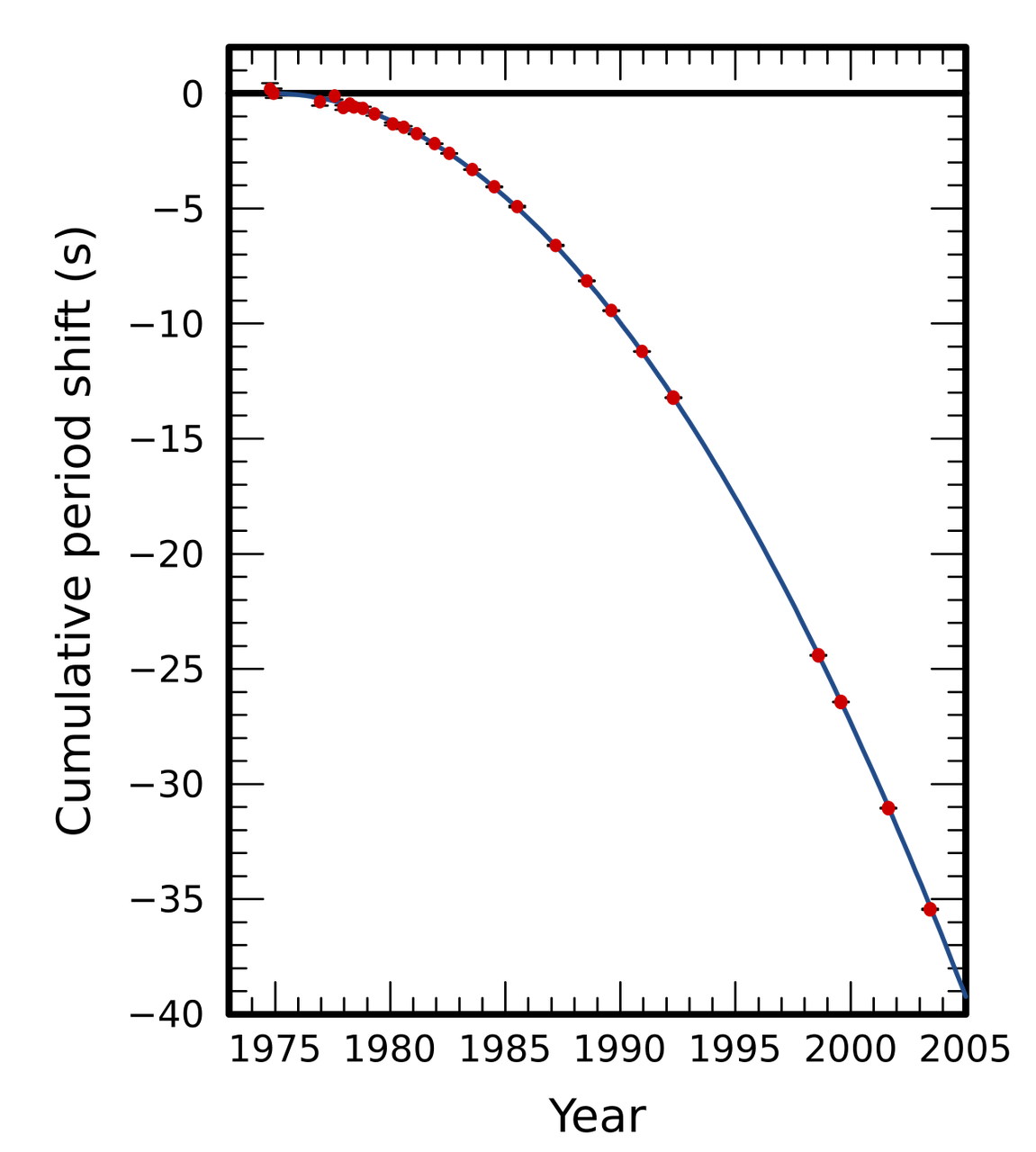
The proof arrived decades before the instruments did, from a completely different direction. In 1974 Russell Hulse and Joseph Taylor discovered PSR B1913+16, two neutron stars orbiting each other, one of them a pulsar, which means the system carries its own precision clock. General relativity predicts that such an orbit must shrink as the system radiates energy away as gravitational waves. It does, at the predicted rate. Our own file states the agreement as within 0.2 percent; the modern published figure is better and says more about what was actually compared. Weisberg and Huang analyzed 9,257 timing measurements spanning 35 years and report that 'the ratio of observed orbital period decrease due to gravitational wave damping (corrected by a kinematic term) to the general relativistic prediction, is 0.9983 pm 0.0016' (the pm is how the preprint archive's plain-text abstract renders plus or minus). The same paper gives the pulsar's mass as 1.438 plus or minus 0.001 solar masses and its companion's as 1.390 plus or minus 0.001. Hulse and Taylor received the 1993 Nobel Prize in Physics. After that, the open question was not whether gravitational waves exist. It was whether anything on Earth could be made still enough to feel one.
05When the Light Came Too
Two years later came the event that turned a physics experiment into astronomy. 'On August 17, 2017 at 12:41:04 UTC the Advanced LIGO and Advanced Virgo gravitational-wave detectors made their first observation of a binary neutron star inspiral.' The signal had a combined signal-to-noise ratio of 32.4 and a false-alarm-rate estimate of less than one per 8.0x10^4 years. The component masses lie between 0.86 and 2.26 solar masses, narrowing to 1.17 to 1.60 once the spins are constrained, for a total system mass of 2.74 +0.04 -0.01 solar masses. The source sits at a luminosity distance of 40 +8 -14 Mpc, and it was localized to a sky region of 28 square degrees. Where GW150914 lasted two tenths of a second, this signal ran for about a hundred seconds inside the detectors' band, because lighter objects spiral for far longer before they merge. That extra hundred seconds, and the third detector, are why this one could be pointed at.
And 1.74 seconds later, gamma rays. The collaboration paper states the coincidence and what follows from it: 'The probability of the near-simultaneous temporal and spatial observation of GRB 170817A and GW170817 occurring by chance is 5.0x10^-8. We therefore confirm binary neutron star mergers as a progenitor of short GRBs.' The measured gap is given as an observed time delay of 1.74 plus or minus 0.05 seconds. Our own file rounds this to 1.7, and the next claim is the reason the extra digit matters.
That 1.74 second delay, at the end of a journey from a source 40 megaparsecs away, is a measurement of how closely gravity and light travel at the same speed. The paper uses it to 'constrain the difference between the speed of gravity and the speed of light to be between -3x10^-15 and +7x10^-16 times the speed of light'. Our own research file states this as traveling at the speed of light to within about 10^-15 fractional deviation, which does two things wrong at once: it flattens an asymmetric two-sided bound into a single rounded number, and it misses in both directions. On the positive side, where the paper allows +7x10^-16, our rounded 10^-15 is about one and a half times looser. On the negative side, where the paper allows -3x10^-15, our same 10^-15 is about three times tighter than the published bound, and that is the worse of the two, because a tighter bound claims a constraint the paper does not support. The same abstract records two further results our file omits: new bounds on violation of Lorentz invariance, and a new test of the equivalence principle by constraining the Shapiro delay between gravitational and electromagnetic radiation. Our file adds that this ruled out many modified theories of gravity. That is a fair consequence and it is widely drawn, but it is drawn by others and it is not a claim inside the paper, so it is carried here as our file's inference and not as the paper's result.
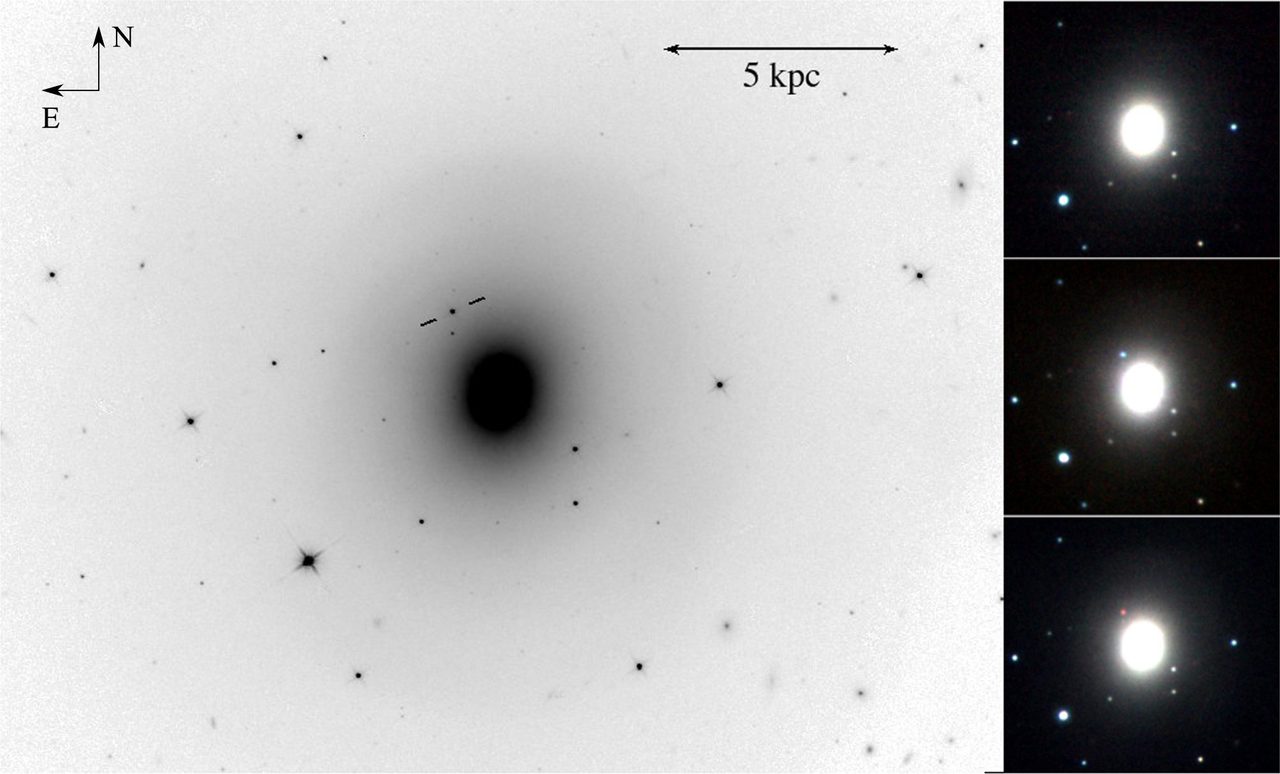
Then the telescopes. In the collaboration's own words: 'An extensive observing campaign was launched across the electromagnetic spectrum leading to the discovery of a bright optical transient (SSS17a, now with the IAU identification of AT 2017gfo) in NGC 4993 (at ~40 Mpc) less than 11 hours after the merger by the One-Meter, Two Hemisphere (1M2H) team using the 1 m Swope Telescope.' Other teams found it independently within an hour of that. What followed was a light curve read in every band available: 'Early ultraviolet observations revealed a blue transient that faded within 48 hours. Optical and infrared observations showed a redward evolution over ~10 days.' X-ray and radio emission appeared at the position of the transient about nine and about sixteen days after the merger, following earlier non-detections. And the honest negative, which belongs here as much as any of the rest: 'No ultra-high-energy gamma-rays and no neutrino candidates consistent with the source were found in follow-up searches.'
The fading, reddening glow is called a kilonova, and its spectrum is where the story reaches the periodic table. Spectroscopic analysis of AT2017gfo found the products of rapid neutron capture, the r-process, which is the pathway that builds elements heavier than iron. Our own file's framing is careful and correct: the observation confirmed that neutron star mergers are a primary site of r-process nucleosynthesis, producing heavy elements including gold, platinum and uranium. Keep both halves of that. A primary site is a hedge, and it is the right one. And the one element actually identified by name in the peer-reviewed spectrum cited here is strontium; gold, platinum and uranium are inferences from the r-process pathway rather than lines anybody read off this spectrum. The claim that all the gold on Earth was made in neutron star collisions is a popular extrapolation, and it is not what these papers say.
GW170817 is what made this field astronomy rather than physics. For the first time a single cosmic event was recorded in gravitational waves and in light, and the two records constrained one another: the waves gave the masses and the distance, the gamma rays gave the timing, the optical and infrared gave the chemistry, and the delay between the first two gave a test of fundamental physics. Our own file calls this the inauguration of multimessenger astronomy, which is the standard phrase, and it needs one qualification the file does not make. Neutrinos and light had already been combined once before, for supernova SN 1987A, so multimessenger astronomy as a practice is older than 2017. What 2017 added was gravitational waves as one of the messengers.
06From One Event to About Four Hundred
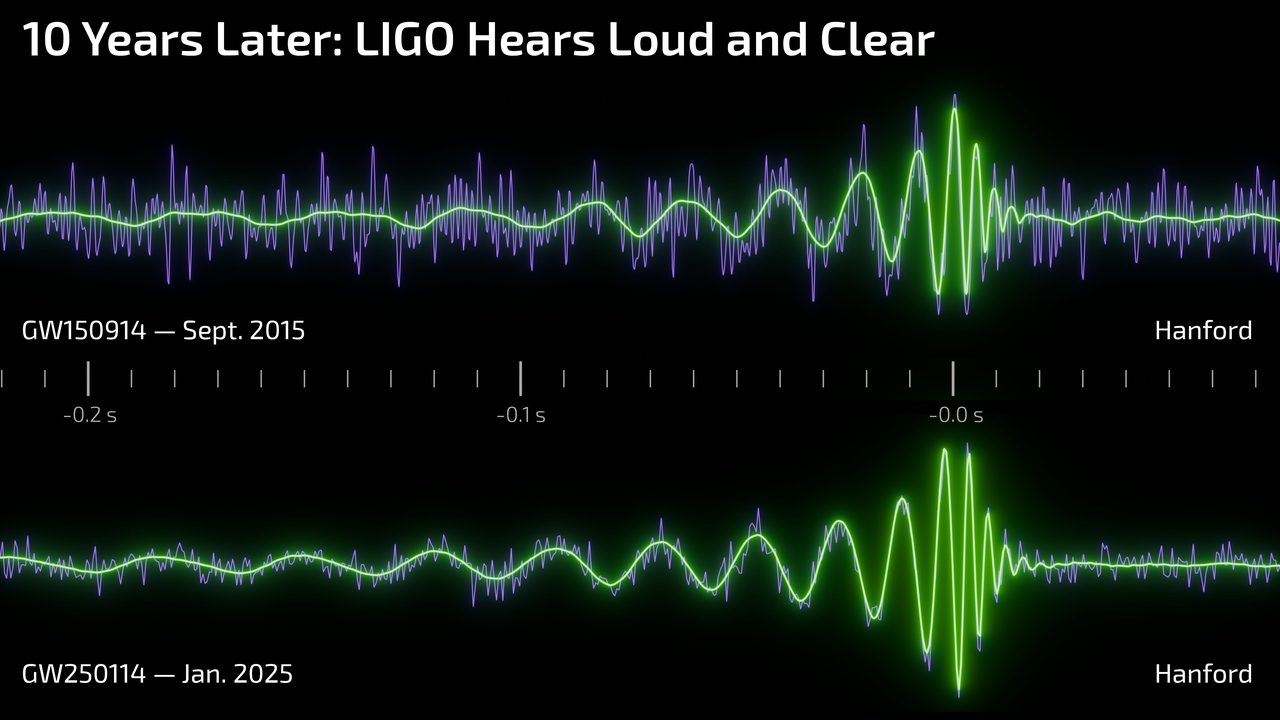
Our research file was last updated on 9 March 2026 and still describes the catalogue as it stood after the third observing run, at more than 90 events. The real figure is now more than four times that, and it moved while the file sat still. The fourth observing run, O4, began on 24 May 2023, with the detectors starting, in LIGO's words, 'with an increase in sensitivity of approximately 30 percent', and it ended on 18 November 2025. It had been announced as a twenty-month run and in the end ran about thirty months. During it, the detectors 'observed roughly 250 candidate signals in real time'; re-analysis of the first segment yielded '128 significant events (an increase of around 50% compared to those announced in real time)'; and the rapid response team 'processed a total of 283 candidates over the course of two and a half years'. O4 alone more than doubled the number of confident detections relative to the first three observing runs put together, which had produced 90.
The current public catalogue is GWTC-5.0, announced on 26 May 2026 and covering 10 April 2024 to 28 January 2025. The collaboration's own announcement gives the count: during that window '161 new gravitational wave events were detected, bringing the total number of confirmed events observed by the network since the first detection in 2015 to an astounding 390'. That is the number this page uses, with its date attached, because it will move again. Two small honesties belong with it. The open-data portal that publishes the catalogue listed 391 events on 28 August 2026, one more than the announcement; this page does not attempt to reconcile the two, and either way about 390 is the right thing to say. And that same portal's broader listing of all events, including low-significance and discovery-paper entries, contains 671 records. That is a different quantity from a detection count and it should never be quoted as one. For the record of where things stood before O4, the correct citation is the GWTC-3 catalogue, published in 2023.
| Event | When | What It Was | What Was Published About It |
|---|---|---|---|
| GW150914 | 14 September 2015 | Two black holes of 36 +5 -4 and 29 +4 -4 solar masses, merging into 62 +4 -4, with 3.0 +0.5 -0.5 radiated away | The first direct detection. Matched-filter signal-to-noise ratio 24; significance greater than 5.1 sigma; luminosity distance 410 +160 -180 Mpc; the source constrained only to an annulus section of 610 square degrees |
| GW170817 | 17 August 2017 | Two neutron stars, total system mass 2.74 +0.04 -0.01 solar masses | Combined signal-to-noise ratio 32.4; luminosity distance 40 +8 -14 Mpc; localized to 28 square degrees in the discovery paper and 31 in the multimessenger paper, which are different analysis stages and are not averaged here. A gamma-ray burst followed 1.74 plus or minus 0.05 seconds later, and a kilonova was found in NGC 4993 in under eleven hours |
| GW240615 | 15 June 2024 | A black hole merger more than 3 billion light-years away | The best sky localization in the GWTC-5.0 release: identified, in the collaboration's own phrase, within an area of just 6 square degrees |
| GW250114 | 14 January 2025 | Two nearly equal-mass black holes, over a billion light-years away | The clearest signal in the release, at a signal-to-noise ratio of 76.9. Used to test the black hole area theorem: LIGO puts the two original horizons at a combined area of roughly 240,000 square kilometers and the remnant at roughly 400,000 |
| GW241011 and GW241110 | October and November 2024 | Two black hole mergers | The release says these could be second-generation black holes, meaning black holes that are themselves the result of previous coalescences. The hedge is the collaboration's own and it is kept here |
Two of those rows deserve a sentence each. The sky areas trace the arc of the whole field: 610 square degrees for GW150914 in 2015, then 28 square degrees for GW170817 in its discovery paper and 31 in the multimessenger paper in 2017, and 6 for GW240615 in 2024. That is two orders of magnitude in nine years, and it is the difference between knowing a wave passed and knowing which galaxy it came from. Time alone did not do it, and the release names the mechanism for the last of those: GW240615 was triangulated with Virgo, which had rejoined the observing run in April 2024. That is the same mechanism section 05 describes for GW170817. And GW250114 was clean enough to be used on a theorem: the companion paper states that 'These results constitute the most stringent single-event verification of GR and the Kerr nature of black holes to date, and outline the power of black-hole spectroscopy for future gravitational-wave observations.' What that theorem says, and what black hole spectroscopy is, belong to this wing's article on black holes rather than to this one. The point that belongs here is narrower and still remarkable: the instruments have become precise enough that a single event can be turned against a theorem.
Where the network stands as this page is written, on 28 August 2026, with the date attached because it is the fastest-moving fact here. O4 ended in November 2025 and the detectors are between runs. The collaboration's own observing plan, last updated on 15 August 2026, describes an intermediate run, IR1, 'beginning between late October and mid-November of 2026', and states that plans and the timeline for the fifth observing run 'are in discussion'. Any sentence on this subject that says currently without saying when is a sentence that will be quietly wrong within months.
07The Nanohertz Question
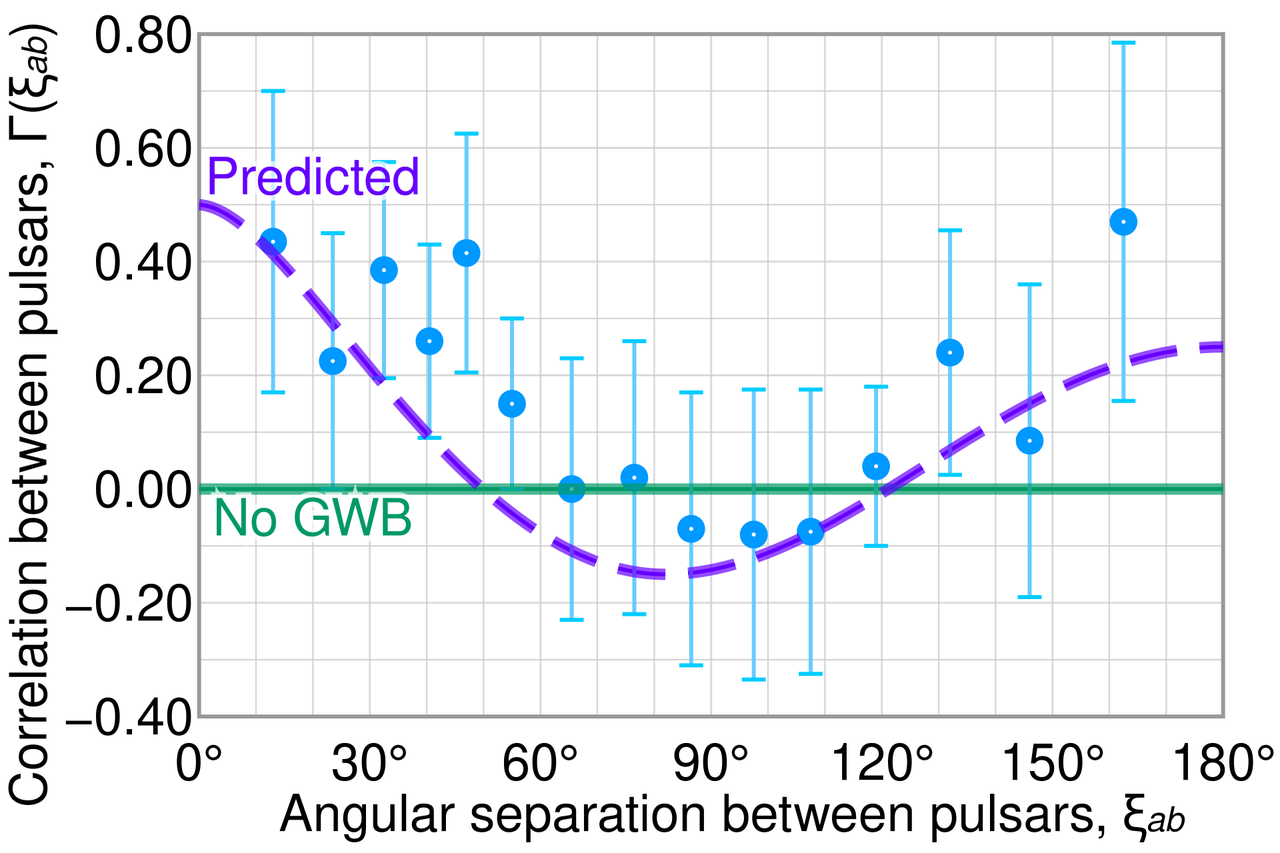
There is a second way to look for gravitational waves, at nanohertz frequencies far below anything a ground interferometer can reach, and it uses the galaxy itself as the instrument. Pulsars are clocks of extraordinary regularity, and a pulsar timing array watches many of them at once for correlated departures from their expected timing. A gravitational-wave background produces a specific pattern in those correlations, one that depends on the angle between any two pulsars on the sky. That pattern has a name, Hellings-Downs, and it is the signature the whole method rests on. In 2023 the NANOGrav collaboration published its fifteen-year data set, and the title of that paper is the most important thing about it: evidence for a gravitational-wave background. The abstract begins, 'We report multiple lines of evidence for a stochastic signal that is correlated among 67 pulsars from the 15-year pulsar-timing data set collected by the North American Nanohertz Observatory for Gravitational Waves', and states that 'The correlations follow the Hellings-Downs pattern expected for a stochastic gravitational-wave background.' The amplitude, assuming the spectrum expected from an ensemble of binary supermassive black holes, is 2.4 +0.7 -0.6 x 10^-15 at a reference frequency of one per year.
The significance, given in full because the full version is the only honest one. Against a model with only independent pulsar noises, the background model is favored by a Bayes factor in excess of 10^14. Against an uncorrelated common power-law model, which is the comparison that actually matters, the Bayes factors are 200 to 1000 depending on spectral modeling choices. Building a statistical background distribution for those latter Bayes factors gives 'p = 10^-3 (approx. 3 sigma) for the observed Bayes factors in the null no-correlation scenario', and a frequentist test statistic built as a weighted sum of inter-pulsar correlations 'yields p = 5 x 10^-5 - 1.9 x 10^-4 (approx. 3.5 - 4 sigma)'. On the source, the paper hedges deliberately: the amplitude and spectrum 'are consistent with astrophysical expectations for a signal from a population of supermassive black-hole binaries, although more exotic cosmological and astrophysical sources cannot be excluded.' Several other pulsar timing collaborations released concordant results in the same window of 2023. No citation, no more precise date and no significance figure is attached to any of them here, because the sources gathered for this page do not carry any.
So: the nanohertz gravitational-wave background has not been detected, and it is not known to come from supermassive black hole binaries. Three separate softenings are required, and every one of them has a source. The collaboration's own significance is about 3 sigma on one test and about 3.5 to 4 sigma on another, where 5 sigma is this field's conventional threshold for the word detection, and where GW150914 cleared that threshold and this has not. The paper's own title says evidence for, and the collaboration's public framing keeps that word. And the source is genuinely open, because the abstract says in its own voice that more exotic possibilities cannot be excluded. Our own research file gets this right in one line, writing strong evidence, and then wrong in the next, writing that combined datasets strengthen the detection. This page carries the paper. What is probably there is a hum from supermassive black holes circling one another. Probably is doing real work in that sentence and is not decoration.
08Different Octaves
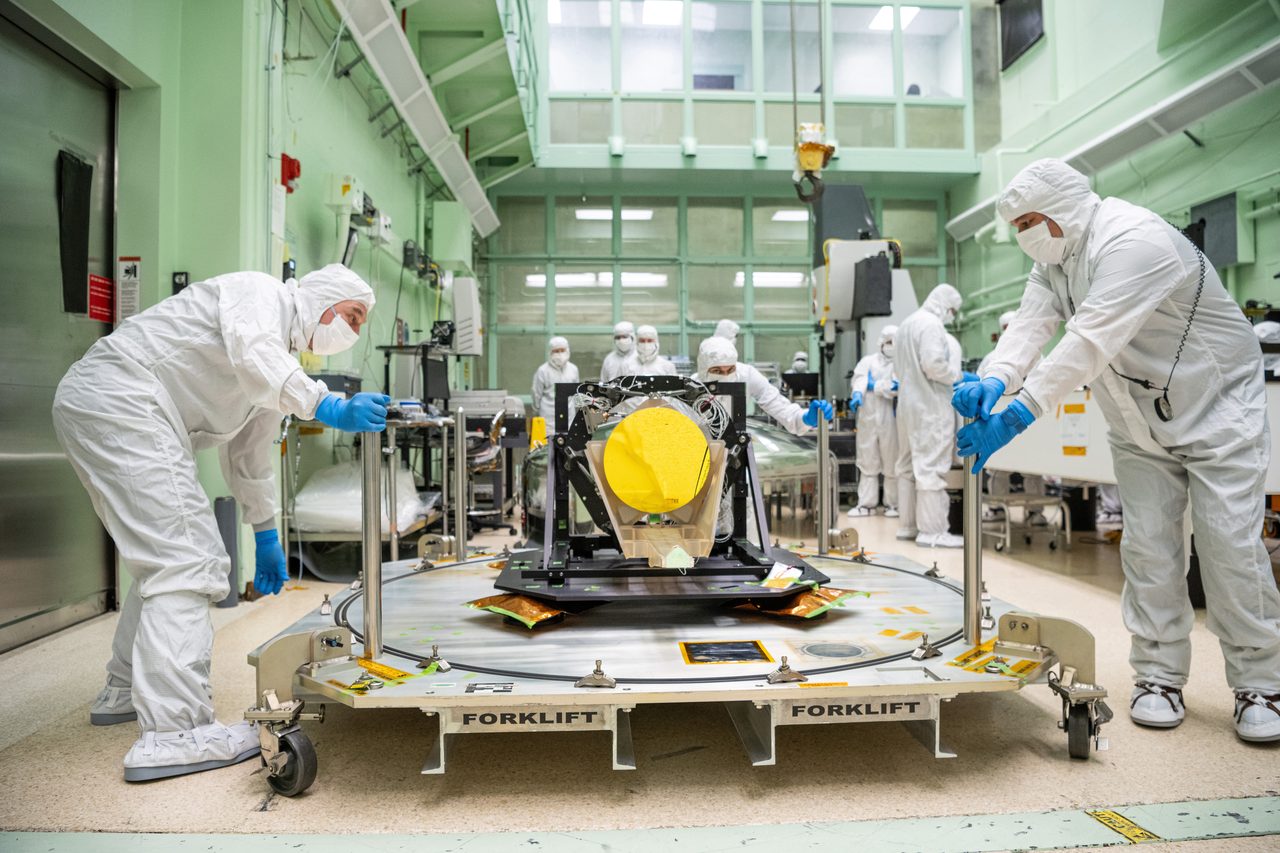
The single most important thing that has happened to this mission is missing from the research file this page was written from. On 25 January 2024, at its 175th meeting, the European Space Agency's Science Programme Committee adopted LISA, the Laser Interferometer Space Antenna. Adoption is the formal step that authorizes construction of the instruments and spacecraft; it is the difference between a proposal and a mission, and the cleanroom photograph above was taken in May of that year. ESA's own factsheet gives the launch as about 2035, three spacecraft, arms of around 2.5 million km between each, a heliocentric orbit trailing Earth by roughly 50 million km, and a four-year prime mission with a possible six-year extension. Our files disagree with each other here too: Q_4_02 says a planned launch around 2037 and ZA_2_02 says around 2035. ESA says about 2035, so ZA_2_02 is right and Q_4_02 is wrong, and Q_4_02 does not record the adoption at all.
What LISA is for, in the mission proposal's own words: 'The observatory will be based on three arms with six active laser links, between three identical spacecraft in a triangular formation separated by 2.5 million km', and it 'will measure source parameters with astrophysically relevant sensitivity in a band from below 10^-4 Hz to above 10^-1 Hz.' That band is the entire point of building it. Ground interferometers work from tens to thousands of hertz, LISA from a ten-thousandth of a hertz upward, and the pulsar timing arrays down at nanohertz. They are not rival machines chasing the same thing; they are different octaves, and the octave decides the source. LISA's targets are mergers of supermassive black holes of ten thousand to ten million solar masses out to high redshift; galactic compact binaries, including thousands of white dwarf pairs the proposal calls verification binaries because their electromagnetic counterparts are already known; and extreme mass-ratio inspirals, stellar-mass objects spiraling slowly into supermassive black holes and mapping the geometry as they go.
| Instrument | Band | Sources It Can Reach | Status, With Its Date |
|---|---|---|---|
| Ground interferometers: LIGO, Virgo, KAGRA | Tens to thousands of hertz. GW150914 swept from 35 to 250 Hz | Merging stellar-mass black holes and neutron stars, over seconds to a couple of minutes inside the band | Operating. The fourth observing run ran 24 May 2023 to 18 November 2025; as of 28 August 2026 the network is between runs, with an intermediate run described as beginning between late October and mid-November of 2026 |
| Pulsar timing arrays | Nanohertz | A background, consistent with a population of supermassive black hole binaries, though the paper states that more exotic cosmological and astrophysical sources cannot be excluded | Evidence reported by NANOGrav in 2023 at about 3 sigma on one test and about 3.5 to 4 sigma on another. Not a detection |
| LISA | From below 10^-4 Hz to above 10^-1 Hz, in the mission proposal's own words | Mergers of supermassive black holes out to high redshift, galactic compact binaries including known white dwarf pairs, and stellar-mass objects spiraling into supermassive black holes | Adopted by ESA on 25 January 2024. Launch given by ESA as about 2035 |
On the ground, two third-generation observatories are proposed, and the difference between proposed and adopted is exactly the difference LISA illustrates. The Einstein Telescope, whose reference paper dates from 2010, is designed to sit underground in a triangular layout with ten-kilometer arms, in Europe, targeted at the 2030s. Cosmic Explorer, the United States concept, is described on its own project site as two facilities: a primary observatory with forty-kilometer arms, about ten times Advanced LIGO's, and a second with twenty. Its funding record as that site gives it: the National Science Foundation distributed approximately nine million dollars across three years to twelve institutions in August 2023, and in March 2024 an NSF advisory subcommittee recommended 'that the Cosmic Explorer Observatory concept will be adopted by the NSF', saying of the 40 km detector design that it has 'extraordinary potential for new discoveries while at the same time carrying the lowest technical risk'. Neither is built, and Cosmic Explorer is not funded through to construction. Our own file's phrase, ten times better sensitivity than Advanced LIGO, is a design goal rather than a measurement and is carried here as one. The Einstein Telescope's current site-selection and funding position could not be established for this page and is therefore not stated.
Further out sit the sources nobody has caught. Gravitational waves from cosmic inflation would leave a B-mode polarization imprint on the cosmic microwave background, and our own file is blunt about the position: detecting them directly at the relevant frequencies would be definitive evidence for inflation, and the sensitivity required is beyond current technology. That story, and the episode in which a claimed detection was withdrawn, belong to this wing's articles on inflation and primordial waves, not here. Alongside it are cosmic strings, phase transitions in the early universe, dark matter annihilation in compact objects, and mergers of hypothetical primordial black holes, all predicted by various theories beyond the Standard Model and none of them yet detected. There is one live connection worth drawing carefully. The nanohertz background's own paper says exotic cosmological and astrophysical sources cannot be excluded, and the nanohertz band is precisely where several of these candidates would show up. That is a possibility, not a claim, and it is one of the reasons the nanohertz result matters even while it stays short of a detection.
09What This Page Will Not Say
Every detection so far is consistent with general relativity, and our own file places that at Tier 2 rather than Tier 1, which is the correct place for it. No deviation has appeared in the strong-field regime; the observations constrain the graviton mass to below 1.27 x 10^-23 eV/c^2, along with Lorentz invariance violation, the post-Newtonian parameters, and the no-hair theorem, that a black hole is characterized only by its mass, spin and charge. But a null result is a null result. Every one of these tests returns no deviation at some finite precision, and no deviation at finite precision is not a proof of exactness. The honest form of the sentence is that nothing has shown up yet, and the instruments keep getting quieter, so the interesting thing about the next decade is that the null results get harder to keep returning.
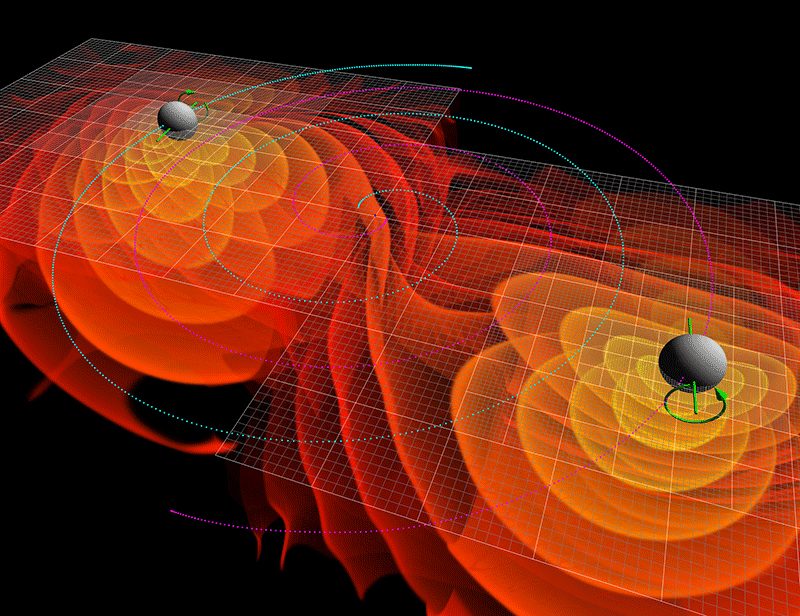
Nobody has photographed, imaged or seen a black hole merger. The merger emits no light. Every colliding-black-hole picture in circulation is a numerical-relativity simulation or an artist's illustration, and every rippling-spacetime graphic and every LISA constellation render is the same. What can be photographed are the instruments and the places, the data, and, in the one case of GW170817, the glow of the debris afterwards.
The detections are not instrumental artifacts or glitches. The specific published challenge, a 2017 claim about residual noise correlation, was addressed by the LIGO team and in independent analysis, and it should be refused without a sneer: it was raised in a real journal by real physicists, it was answered, and that is what the process is supposed to look like from the outside. Three things carry the refusal. The statistical significance of GW150914 is overwhelming, and it is quoted here as the paper quotes it, greater than 5.1 sigma rather than 5.1. The signal matches the theoretical templates in detail. And the argument that was already the strongest is now far stronger than when our file was written, because the count has gone from 90 to about 390 events with consistent properties. Refusing an overclaim with an overclaim would be the easiest mistake to make in this paragraph, and it is the one being avoided.
Fast Facts
- What a wave is
- A transverse, quadrupolar oscillation of spacetime geometry itself: a ring of freely floating test masses is stretched along one axis and squeezed along the perpendicular one, twice per cycle. The measured quantity is strain, a dimensionless fraction
- Predicted
- Einstein, 1916, with the quadrupole formula corrected in a second paper in 1918. In 1936 Einstein and Rosen concluded the waves do not exist; the version published in 1937 reversed that conclusion
- Settled by
- Feynman's sticky-bead argument at Chapel Hill in 1957, with a variant published by Bondi: if a wave can heat a bead by friction, it carries energy. Attribution between the two is genuinely contested
- First proof
- The Hulse-Taylor binary pulsar PSR B1913+16, found in 1974. Its orbit decays at the rate general relativity predicts; a 35-year timing analysis puts the ratio of observed to predicted decay at 0.9983 plus or minus 0.0016. 1993 Nobel Prize
- First direct detection
- GW150914, 14 September 2015 at 09:50:45 UTC. Black holes of 36 +5 -4 and 29 +4 -4 solar masses merging into 62 +4 -4, with 3.0 +0.5 -0.5 radiated. Significance greater than 5.1 sigma. Announced five months later; 2017 Nobel Prize
- The instrument
- Two four-kilometer interferometers 3,000 km apart, at Hanford, Washington and near Livingston, Louisiana, joined by Virgo in Italy and KAGRA in Japan, both with three-kilometer arms, KAGRA underground
- Light as well
- GW170817, 17 August 2017: a binary neutron star merger, a gamma-ray burst 1.74 plus or minus 0.05 seconds later, and a kilonova found in NGC 4993 in under eleven hours. Strontium was identified in its spectrum
- The count
- About 390 confirmed events since 2015, per the LIGO-Virgo-KAGRA GWTC-5.0 announcement of 26 May 2026. The figure moves; our own research file still says more than 90
- Nanohertz background
- Reported by NANOGrav in 2023 as evidence, not detection: about 3 sigma on one test and about 3.5 to 4 sigma on another, and the source is not established
- Next
- LISA, adopted by ESA on 25 January 2024, launch given as about 2035. The Einstein Telescope and Cosmic Explorer are proposed and neither is built. Cosmic Explorer carries partial funding and is not funded through to construction; the Einstein Telescope's funding position is not stated here
- Refused
- That anyone heard a merger; that anyone photographed one; that the nanohertz background is a detection; that the signals are instrumental artifacts; and any proton fraction computed for a single event
What We Can Actually Stand Behind
The prediction, the indirect proof and the direct detections are established. Einstein predicted gravitational waves in 1916 and corrected the calculation in 1918. The Hulse-Taylor binary pulsar's orbit has decayed at the predicted rate for decades, with a 35-year analysis giving a ratio of 0.9983 plus or minus 0.0016, and it took the 1993 Nobel Prize. GW150914 was recorded at both LIGO sites on 14 September 2015 at a significance the discovery paper states as greater than 5.1 sigma, and it took the 2017 Nobel Prize. GW170817 was recorded in gravitational waves and then in gamma rays 1.74 plus or minus 0.05 seconds later and then in light across the spectrum, with strontium identified in the kilonova spectrum. The catalogue stood at about 390 confirmed events at the GWTC-5.0 announcement of 26 May 2026.
Several things are strong and unfinished. The nanohertz gravitational-wave background is supported by multiple lines of evidence at about 3 sigma on one test and about 3.5 to 4 sigma on another, with an amplitude and spectrum consistent with supermassive black hole binaries, and the paper itself says more exotic sources cannot be excluded. LISA is adopted and funded rather than flown, with ESA giving a launch of about 2035. Every test of general relativity in the strong field has returned a null result at some finite precision, which constrains deviations without proving there are none. The Einstein Telescope and Cosmic Explorer are serious proposals with published designs, and neither is built. Cosmic Explorer carries partial funding; the Einstein Telescope's funding position could not be established for this page and is not stated.
The furthest reaches stay open. Primordial gravitational waves from inflation would be definitive evidence for it, and our own file states plainly that the required sensitivity is beyond current technology. Cosmic strings, early-universe phase transitions, dark matter annihilation in compact objects and primordial black hole mergers are all predicted by theories beyond the Standard Model, and none of them has been detected.
The overclaims get a flat no, including two this page was tempted by. Nobody heard anything: there is no sound, and every audio clip is strain data converted afterwards. Nobody has photographed a black hole merger, and nobody can, because it emits no light; every colliding-black-hole image is a simulation or an illustration. The nanohertz background has not been detected, and our own file's word detection is not carried here. The signals are not instrumental artifacts; the published challenge was raised properly and answered, and the case against it is stronger now than when it was made. And this page states no proton fraction for GW150914 and no peak luminosity in physical units, because our two research files contradict each other on the first by a factor of ten and no source this page was able to read supplies the second.
A prediction made with pencil and paper in 1916. A correction to it in 1918. A decade in which the man who made it decided he had been wrong, and an anonymous referee who changed his mind back. An argument about two beads on a rod that settled whether the waves could carry energy at all. A pair of neutron stars whose orbit shrank at exactly the rate the theory demanded, decades before anyone could catch a wave directly. And then two machines 3,000 km apart, twitching together for two tenths of a second. What is still open deserves naming as plainly as what is settled: whether the nanohertz background is really there and what makes it; whether any deviation from general relativity will ever appear in the strong field, given that every test so far comes back null at some finite precision; and whether the waves from the first instant of the universe are reachable at all with any technology now foreseeable. None of that needs inflating. The astonishing part was never the size of the black holes. It was that a length four kilometers long could be measured finely enough to catch the passing of one, twice, in two states at once, and that the two records agreed.
Sources & further reading
WHERE THIS PAGE WORKED FROM, AND WHERE IT CAN BE CHECKED. Three files in our own research library stand behind it: Q_4_02 on gravitational wave astronomy, ZA_2_02 on gravity and gravitational waves, and Q_4_03 on the tests of general relativity, which supplies the context in section 04 for why a century passed. Those files are where the work started, and they are our own claims, so they cannot corroborate themselves. The thirty-nine external entries below are where this page can be checked; each names the section it supports rather than standing as general reading. THIS PAGE CORRECTS ITS OWN FILES IN SIX PLACES, every one disclosed on the claim it belongs to. (1) Our two files disagree with each other by a factor of ten on the proton comparison, and they are describing two different quantities, so this page quotes LIGO for the detector and the discovery paper for the event and computes no proton fraction at all. (2) Q_4_02 states GW150914's significance bare as 5.1 sigma where the paper says greater than 5.1 sigma. (3) Q_4_02 gives the GW170817 speed-of-gravity result as a single rounded figure of about 10^-15 where the published bound is asymmetric, running from -3x10^-15 to +7x10^-16; our file is about one and a half times looser than the paper on the positive side and about three times tighter on the negative, and the tighter half claims a constraint the paper does not support. (4) Q_4_02 uses the word detection for the nanohertz background one line after correctly writing strong evidence; the source paper's own title says evidence, and this page carries evidence. (5) Q_4_02's count of more than 90 events through the third observing run is now more than four times too small. (6) Q_4_02 gives LISA's launch as about 2037 where ESA says about 2035, which is also what ZA_2_02 says, and Q_4_02 does not record the January 2024 adoption that turned the mission from a proposal into a build. FIVE IDENTIFIERS CARRIED BY OUR OWN FILES ARE NOT REPRODUCED HERE, because each resolves to a different work from the entry it is attached to. Two of the five are the hard case, where the returned title is identical to the intended paper's and only the venue reveals the swap, so a title check passes them. One of the five appears verbatim in two of our files, which means the fault is upstream of either. The correct identifiers are the ones listed above, resolved live in August 2026. WHAT THIS PAGE DELIBERATELY DOES NOT PRINT: any Nobel committee citation wording, because nobelprize.org could not be read for this page; any peak gravitational-wave luminosity in physical units, because no source this page was able to read gives one, which is why the collaboration's own wordings are quoted rather than restated; any citation, more precise date or significance figure for the EPTA, PPTA and CPTA results, which our own file names without identifiers; any statement of KAGRA's sensitivity; and any figure for how far GW150914 moved LIGO's mirrors as a fraction of a proton. A NOTE ON THE QUOTATIONS. House style carries no long dashes and no mathematical typesetting, so every quotation above renders superscripts, the multiplication sign, the plus-or-minus sign and any long dash in plain characters: 10^-21 for ten to the minus twenty-one, x for the multiplication sign, and a plain hyphen where a source printed a longer dash. No word, hedge or qualifier has been altered, added or dropped inside any quotation. Where an abstract was read from a preprint archive rather than from the journal, the archive's own plain-text rendering is carried, and section 04 says so on the spot.
Image credits
- Aerial view of the LIGO Hanford Observatory LIGO Laboratory, via Wikimedia Commons. Public domain Source.
- The GW150914 signal recorded at LIGO Hanford and LIGO Livingston, with the predicted waveform overlaid B. P. Abbott et al., LIGO Scientific Collaboration and Virgo Collaboration, via Wikimedia Commons. CC BY 3.0 Source.
- Aerial view of the LIGO Livingston Observatory, Louisiana Caltech/MIT/LIGO Laboratory, via Wikimedia Commons. Public domain Source.
- Schematic of a laser interferometer with light storage arms Malyszkz, Rothwild, Yinweichen, Mfb, Bjankuloski06 and other Wikimedia contributors, via Wikimedia Commons. Public domain Source.
- The northern arm of the LIGO interferometer at Hanford, seen from the ground Umptanum, via Wikimedia Commons. CC BY-SA 3.0 Source.
- Cumulative periastron shift of PSR B1913+16 against the general-relativity prediction Inductiveload, via Wikimedia Commons, redrawn from published observational data. Public domain Source.
- Aerial view of the Virgo interferometer near Pisa The Virgo collaboration, via Wikimedia Commons. CC0 Source.
- The location of AT2017gfo within NGC 4993, with pre-discovery, discovery and fading frames N. R. Tanvir, A. J. Levan, C. Gonzalez-Fernandez, O. Korobkin, I. Mandel and colleagues, from The Emergence of a Lanthanide-rich Kilonova Following the Merger of Two Neutron Stars, via Wikimedia Commons. CC BY 3.0 Source.
- Two black hole mergers detected ten years apart, showing the reduction in detector noise Courtesy Caltech/MIT/LIGO Laboratory, via Wikimedia Commons. Public domain Source.
- Correlation between pulsars against their angular separation, redrawn from the published NANOGrav result Cmglee, via Wikimedia Commons. CC BY-SA 4.0 Source.
- The LISA engineering development unit telescope at NASA Goddard NASA's Scientific Visualization Studio / Francis Reddy / Scott Wiessinger / Dennis J. Henry, via Wikimedia Commons. Public domain Source.
- Numerical-relativity simulation of two black holes inspiraling and merging NASA / Ames Research Center / C. Henze, via Wikimedia Commons. Public domain Source.
- Card crop of the LIGO Hanford aerial photograph LIGO Laboratory, via Wikimedia Commons. Public domain Source.


.svg)


_location_within_NGC_4993_galaxy.jpg)


.jpg)
