
Gobekli Tepe: The Temple Built Before Farming
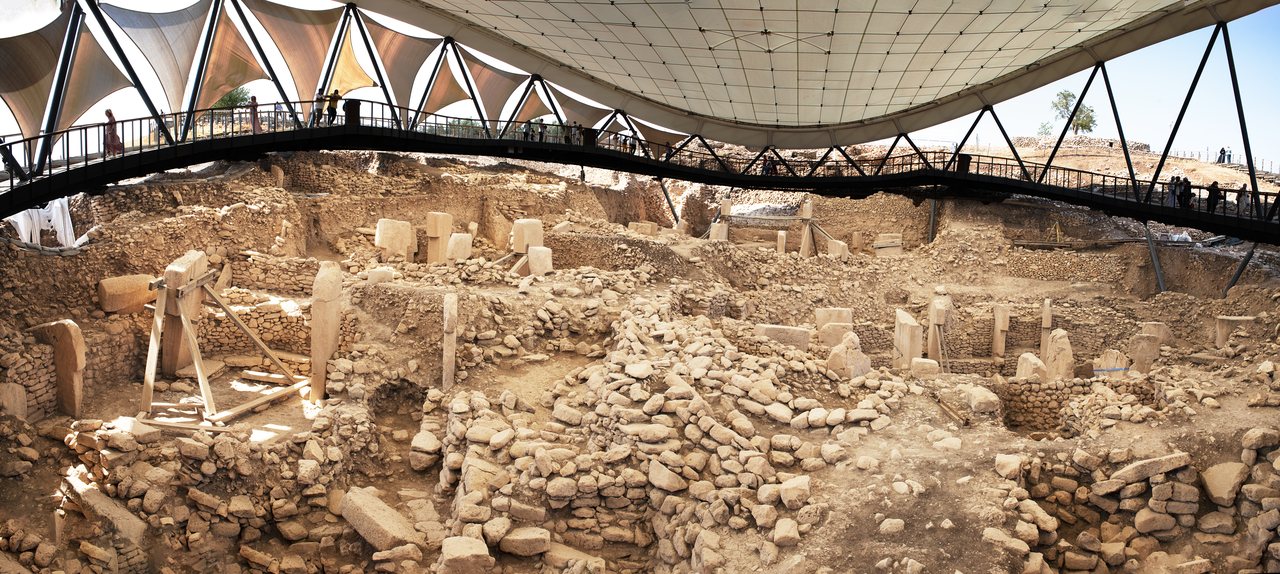
Eleven and a half thousand years ago, before pottery, before metal, and before large-scale farming, hunter-gatherers in southeastern Turkey raised rings of carved stone pillars weighing up to twenty tons. Gobekli Tepe is roughly six thousand years older than Stonehenge. Here is the file, opened claim by claim, each one wearing its evidence.
Set the timeline straight first, because everything about Gobekli Tepe depends on it. When the oldest rings of pillars here were raised, around 9600 BCE, there were no cities, no pottery, no metal, and no large-scale farming. The people who quarried, carved, and stood these stones were hunter-gatherers. That single fact is what makes the site one of the most important discoveries in the history of archaeology, and it is also what makes it a magnet for every claim that human beings could not possibly have done this alone. Let's open the file.
01Older Than Farming, Older Than Metal
The oldest structures at Gobekli Tepe, the large circular enclosures with their monumental T-shaped pillars, belong to the Pre-Pottery Neolithic A and are radiocarbon dated to roughly 9600 to 8500 BCE. Smaller rectangular rooms built above the filled-in enclosures date to the Pre-Pottery Neolithic B, about 8500 to 8200 BCE. The whole occupation runs from about 9600 to 8000 BCE, which makes the earliest rings roughly 11,500 years old.
When those enclosures were built there was no pottery, no large-scale farming, and no urban life anywhere in the region. There was also no metal. Every pillar was quarried, carved, and finished with flint tools and probably implements of wood and bone. Nothing at the site required a technology more advanced than a very well organized Stone Age toolkit.
To feel the gap, line the site up against the monuments people usually think of as ancient. Gobekli Tepe's first enclosures are roughly six thousand years older than Stonehenge and roughly seven thousand years older than the Great Pyramid of Giza. The complex had already been deliberately buried and forgotten for thousands of years before the first stone of that pyramid was cut.
| Human Milestone | Its Place at the Time of the First Enclosures |
|---|---|
| The first stone enclosures at Gobekli Tepe | Raised about 9600 BCE, the baseline for everything below |
| Pottery | Not yet invented in the region |
| Metal tools | Did not exist; the pillars were carved with flint and stone |
| Large-scale farming | Came afterward, not before |
| Cities | Thousands of years in the future |
| Stonehenge | Roughly 6,000 years younger |
| Great Pyramid of Giza | Roughly 7,000 years younger |
02A Buried Hill Above Sanliurfa
Gobekli Tepe sits on a limestone ridge in southeastern Turkey, about 12 to 15 km northeast of the city of Sanliurfa, the ancient Edessa. A joint Istanbul University and University of Chicago survey first noted the mound in 1963, but its significance went unrecognized for three decades. In 1994 Klaus Schmidt of the German Archaeological Institute reexamined the site, understood what the T-pillars were, and began excavating in 1995. He directed the work until his death in 2014, and it has continued since under the German Archaeological Institute and the Sanliurfa Museum.
Gobekli Tepe was inscribed as a UNESCO World Heritage Site in 2018. Despite that fame, and decades of digging, only about 5 to 10 percent of the site had been excavated as of 2025. Almost everything we can say about it rests on a small fraction of what is actually there.
03Stones That Look Back at You
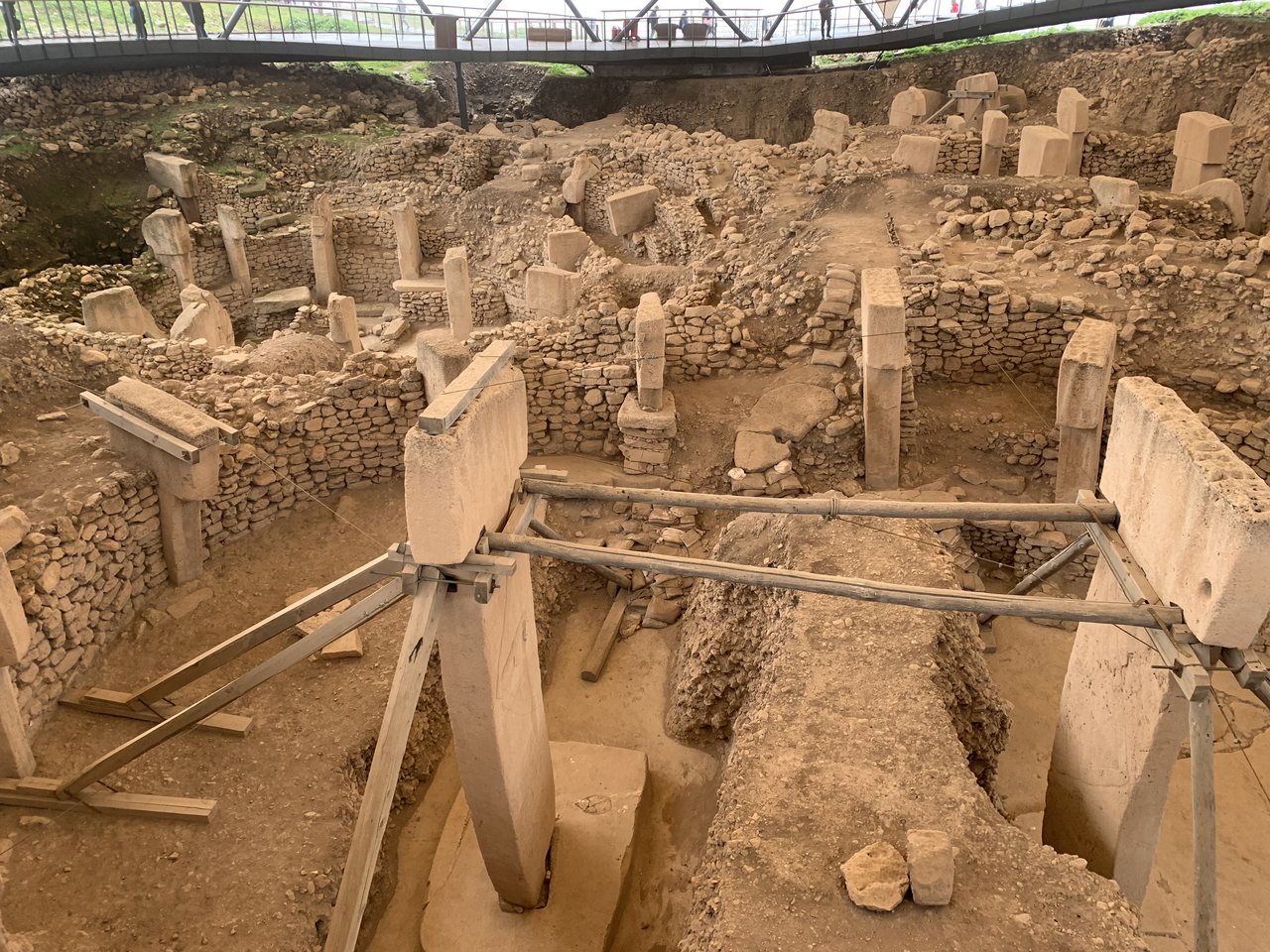
The signature feature is the T-shaped limestone pillar. They stand between 3 and 6 meters tall, roughly 10 to 20 feet, and individually weigh up to 10 to 20 metric tons. Each enclosure is organized around two larger central pillars, up to about 5.5 meters tall, standing face to face at its heart.
The largest pillar of all was never finished. It still lies in the quarry, about 7 meters long, with weight estimates ranging from roughly 16 to 50 tons depending on the density assumed for the stone. The quarry sits only about 100 meters from the enclosures, and the pillars were carved in place there before being moved that short distance and raised. The builders also laid terrazzo-like lime floors and finished their stone cleanly, all without a single metal tool.
These are not abstract slabs. The T shape is widely read as a stylized human figure seen in profile: the horizontal top is the head and shoulders, the vertical shaft is the body. Some pillars carry carved arms running down the sides, with hands and long fingers meeting at the front near the navel, and a few wear carved belts and loincloths. The central pillars in particular read as towering, faceless beings.
Estimates suggest that quarrying, carving, moving, and raising each pillar would have taken hundreds of workers acting in coordination. That is an inference from the engineering, not a head count from any record, so it carries genuine uncertainty. But it points to organized labor on a scale no one expected from hunter-gatherers.
04Four Rings of Stone, and Fifteen More Still Buried
| Enclosure | Nickname | Signature Imagery |
|---|---|---|
| A | Pillar of the Snake | Dominated by serpent reliefs |
| B | Pillar of the Fox | Foxes in flat relief and near-sculptural form |
| C | Circle of the Boar | The largest excavated ring, most elaborate carvings, dominant boars |
| D | Pillar of the Vulture | Home of Pillar 43, plus vultures, a scorpion, handbag motifs, and a headless human figure |
Ground-penetrating radar has mapped at least 20 circular enclosures across the ridge, and only a handful have actually been dug. Each follows the same template: a pair of large central pillars facing each other, ringed by smaller pillars set into a curving stone wall, with the diameter changing from one enclosure to the next.
The four excavated enclosures carry nicknames from their dominant carvings. Enclosure A is the Pillar of the Snake, thick with serpent reliefs. Enclosure B, the Pillar of the Fox, features foxes in both flat relief and near-sculptural form. Enclosure C, the Circle of the Boar, is the largest excavated ring and the most elaborately carved. Enclosure D, the Pillar of the Vulture, holds the single most famous stone at the site, Pillar 43.
Roughly fifteen or more further enclosures are known only from radar. About 90 to 95 percent of Gobekli Tepe is still in the ground, unexcavated and unseen.
05A Menagerie Carved in Stone
The pillars and walls are covered in high-relief carvings of animals: lions, bulls, boars, foxes, gazelles, snakes, scorpions, and spiders among them. Two things stand out. Every species depicted is wild; not one domesticated animal appears anywhere at the site. And there are no clear hunting scenes. The animals do not read as prey but as symbols, most likely totemic or mythic figures tied to particular groups.
Of everything carved here, serpents are the most persistent. Snake imagery appears in virtually every excavated enclosure and among the oldest pillars at the site, making Gobekli Tepe one of the earliest known places where serpent symbolism is built directly into monumental architecture.
06The Vulture Stone
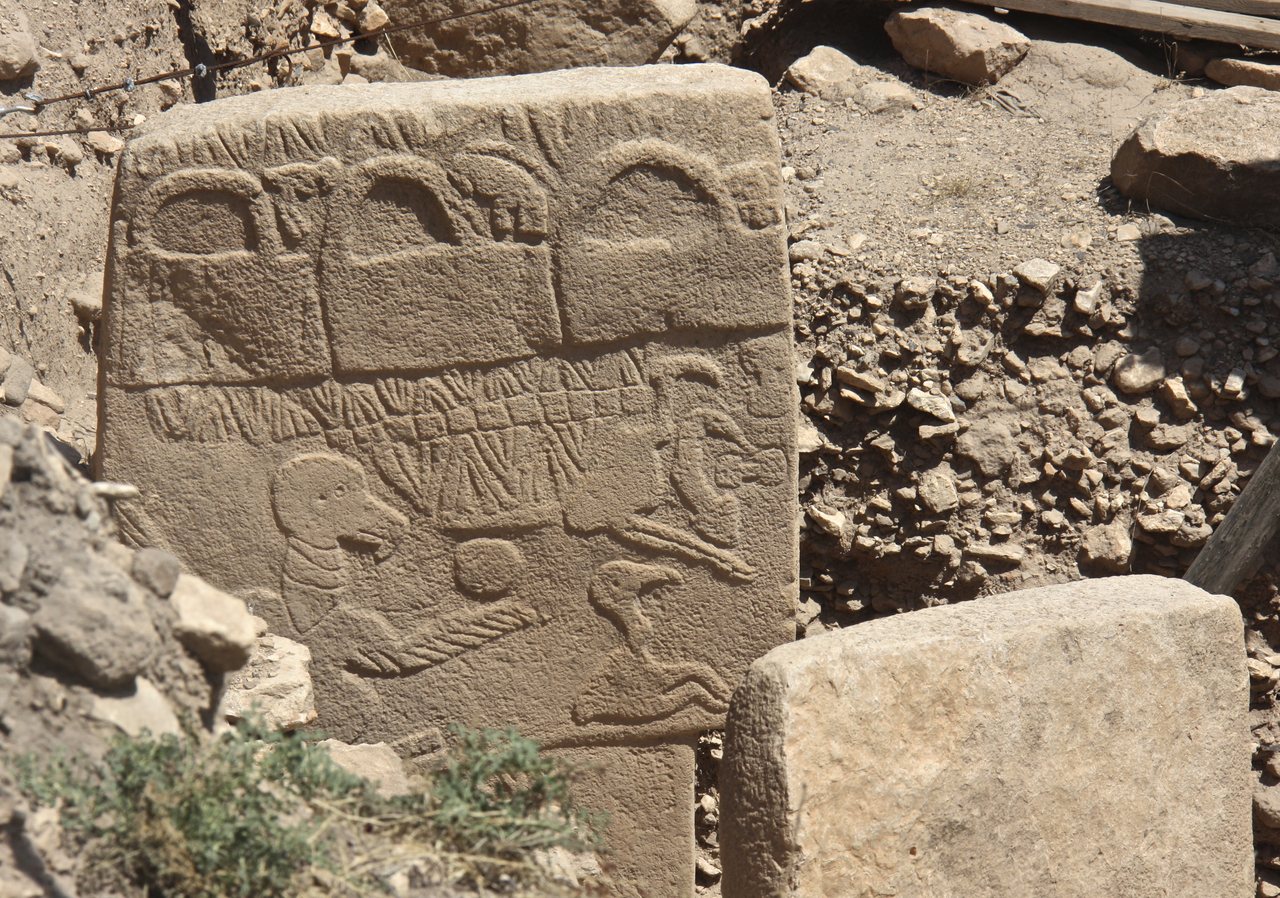
Pillar 43, the Vulture Stone, stands in Enclosure D. Its panel shows a vulture or large bird with a round disc set above or within its wing, a headless human figure below, a prominent scorpion, and a cluster of other animals arranged around them. That the carving exists and looks like this is not in question. What it means is where the arguments begin.
In 2017 Martin Sweatman and Dimitrios Tsikritsis argued in a peer-reviewed journal that Pillar 43 is an astronomical record, reading its animals as constellations and dating the scene to around 10,950 BCE. The paper passed peer review, but it drew a direct published rebuttal from the site's own excavation team and is not accepted by mainstream archaeology. It is a real proposal, not a consensus.
Three shapes along the top of Pillar 43 resemble handbags or purses. The odd part is that the same motif recurs far away in space and time: in Mesopotamian palace reliefs carried by fish-cloaked sages, in Olmec carvings in Mexico, and in traditional Maori figures in New Zealand. Mainstream diffusion models have no clean explanation for the repetition, and honest scholarship logs it as unexplained rather than solved.
A further step, that Pillar 43 specifically records a comet strike at the end of the last Ice Age, is a speculative extrapolation stacked on top of Sweatman's astronomical reading. It is an interpretation of an interpretation, and it has not been independently established.
07First Came the Temple
Here is why the dating matters so much. At Gobekli Tepe the monumental architecture comes first, around 9600 BCE, and organized farming appears afterward, closer to 8500 to 8000 BCE. The nearby sites of Karahan Tepe and Nevali Cori show the same order. For a century the standard model held that agriculture produced surplus, surplus produced towns, and towns eventually produced temples. Gobekli Tepe runs that sequence backward.
The region around Gobekli Tepe is the natural home of wild einkorn wheat, and DNA fingerprinting published in Science in 1997 traced the domestication of einkorn to Karaca Dag, a massif roughly 20 to 30 km away and the oldest known domesticated einkorn, an ancestor of the grain we still grow. At the site itself, grinding stones and cereal residues are present, but no clearly domesticated crops turn up in the earliest layers. The farming came, but it came after the stones.
One influential idea inverts the old model directly. Feeding the crowds who quarried, built, and gathered at Gobekli Tepe may itself have created the pressure to cultivate wild grain at scale, so that the demands of the monument helped drive the invention of farming rather than the other way around. It is a serious hypothesis, and still a hypothesis.
What the site was for is likewise argued rather than settled. The leading readings are a ritual or ceremonial center, a seasonal pilgrimage site where scattered groups gathered, or a proto-temple whose role in bringing people together helped push them toward settled, agricultural life.
08The Day They Buried It
Around 8000 BCE the enclosures were deliberately filled in. Thousands of tons of rubble, stone chips, animal bones, and tools were packed over them, different enclosures at different times. Far from destroying the site, this backfilling sealed and preserved it for roughly ten thousand years. The act of organized, intentional burial is well supported by the excavation.
Not every reading of the site is settled, though. In 2011 E. B. Banning challenged the pure temple interpretation, arguing that some of these structures may have been domestic, lived-in buildings, and that part of the fill could be ordinary occupational debris rather than a single ceremonial closing. The temple-versus-dwelling question is genuinely open.
Why they buried it at all has no accepted answer. The strongest mainstream candidates are a deliberate ritual closing of the enclosures, or the creation of a level platform for the smaller structures built on top, a reading the stratigraphy supports. More speculative suggestions range from a shift in belief that retired the old gods to a response to some remembered upheaval. No single explanation has won consensus.
09Gobekli Tepe Was Never Alone
Gobekli Tepe is not a lone anomaly. It is the most famous member of a whole regional network, at least 10 to 12 similar sites across the Sanliurfa region collectively called Tas Tepeler, the Stone Hills. Karahan Tepe, about 50 km to the southeast, has carved human heads emerging from its pillars and a chamber ringed by carved pillars around a human head; its major excavation began in 2019 under Necmi Karul. Nevali Cori, another site of the same tradition with its own T-pillars and carved heads, was lost to a dam reservoir in 1992.
At Sayburc, excavated by Eylem Ozdogan and published in Antiquity in 2022, a carved panel shows a human figure flanked by leopards and another figure gripping a serpent while facing a bull. It has been described as the oldest known narrative scene in the history of art, older than anything found at Catalhoyuk.
In that Sayburc scene the serpent is not menacing but held in what looks like a calm, ceremonial context, a detail directly relevant to how the recurring serpent imagery across these sites should be read.
Boncuklu Tarla, about 300 km east in Mardin Province and under excavation since 2012, has produced preliminary dates as early as roughly 10,300 BCE, which could make its oldest layers older than Gobekli Tepe. The early end of that range is not yet broadly confirmed through peer review, so it is promising rather than proven.
The work is very much alive. The German Archaeological Institute's Sanliurfa Neolithic Research Project, led by Necmi Karul since 2021, now treats Gobekli Tepe, Karahan Tepe, Sayburc and their neighbors as one shared cultural landscape of T-pillar monuments dated between roughly 10,000 and 7,000 BCE, and its current focus includes the living areas around the monuments, not only the ceremonial structures.
By late 2025 the wider project spanned 12 excavation sites worked by more than 200 researchers from dozens of institutions, and Gobekli Tepe itself was approaching a million visitors a year. A traveling exhibition on the discovery drew millions of visitors in Rome and is set to continue in Berlin, a measure of how far a buried Stone Age hill has traveled into the public imagination.
10Where the Story Runs Off the Map
A site this old, this sophisticated, and this incompletely understood inevitably attracts bigger stories. Some are worth taking seriously as open questions. Others are not supported by anything in the ground. It is worth walking through them plainly, because the honest version is more interesting than the mythology.
The backdrop to all of it is real. The Younger Dryas, roughly 12,800 to 11,600 years ago, was a sudden return to near-glacial cold in the middle of the post-Ice-Age warming, lasting about 1,200 years and bringing genuine extinction and upheaval. What caused it is debated: a comet or asteroid impact, the mainstream reading of disrupted ocean circulation from meltwater, or volcanic activity. The impact version in particular has met strong, recent, peer-reviewed refutation.
Graham Hancock and others build on that backdrop to argue that the Younger Dryas destroyed an advanced civilization before recorded history, and that Gobekli Tepe is a monument raised by survivors trying to preserve lost knowledge. This is presented as speculation, and it runs directly against the mainstream position that no material evidence for such a civilization has ever been found.
Others note a loose resonance between the sudden appearance of masonry, symbolic art, and early cultivation in this one region and the Book of Enoch's account of Watchers who taught humanity the crafts of civilization. The parallel is explicitly speculative. Nothing carved or written at the site connects it to that story.
And because some readers place the Garden of Eden near the headwaters of the Tigris and Euphrates, within the same rough radius as Gobekli Tepe and the einkorn homeland at Karaca Dag, the two get linked. That is a coincidence of geography, not archaeological proof. No text at the site confirms or denies any Eden connection.
Mainstream archaeology reads Gobekli Tepe as a ritual center built by unexpectedly sophisticated hunter-gatherers, part of the same broad family of Neolithic symbolic art seen at sites like Catalhoyuk. It is worth noting that the popular books making the grander claims, by Andrew Collins, Graham Hancock, and Hugh Newman, are catalogued separately from the peer-reviewed literature for good reason. And Klaus Schmidt, the man who dug the site until his death, never once attributed it to non-human hands.
The claim that reptilian or extraterrestrial beings built Gobekli Tepe or inspired its serpent carvings is not supported by anything at the site. Serpent imagery is common in Neolithic art and is most simply explained by the real snakes of the region and their symbolic weight. The reading has no textual or physical evidence behind it, and Schmidt himself never entertained it.
The broader lost-advanced-civilization reading fails for the same reason: there is no supporting material culture, no tools, no metallurgy, no writing, nothing an advanced society would leave behind. It survives on a single move, we do not fully understand it, therefore someone more advanced must have made it. That is the God of the Gaps fallacy, the same shape as we do not understand lightning, therefore Zeus. What the evidence actually shows is human beings, organized and inventive, doing something remarkable.
Fast Facts
- Site
- Gobekli Tepe, a limestone ridge about 12 to 15 km northeast of Sanliurfa, southeastern Turkey
- Age
- First enclosures about 9600 BCE, occupation to about 8000 BCE, roughly 11,500 years old
- Builders
- Pre-Pottery Neolithic hunter-gatherers, without pottery, metal, or large-scale farming
- Excavator
- Klaus Schmidt (1953 to 2014), German Archaeological Institute, from 1995
- The Enclosures
- At least 20 mapped by radar, four excavated (A Snake, B Fox, C Boar, D Vulture)
- Signature Stone
- Pillar 43, the Vulture Stone, in Enclosure D
- The Burial
- Deliberately filled in around 8000 BCE, which is why it survived
- Excavated So Far
- Only about 5 to 10 percent, as of 2025
- Status
- UNESCO World Heritage Site, 2018
What We Can Actually Stand Behind
The age is real and it is extraordinary. The first enclosures date to about 9600 BCE, before pottery, before metal, before large-scale farming, and the builders were hunter-gatherers. Around 8000 BCE they deliberately buried the site, which is why it survived. First came the temple, then the city, exactly as Schmidt put it.
Several questions are genuinely unresolved: whether some structures were lived-in dwellings as well as shrines, whether Pillar 43 encodes a real astronomical scene, and exactly what the complex was for. These are live debates among archaeologists, not settled facts in either direction.
The more dramatic readings, that Pillar 43 records a comet strike, that the site echoes the Watchers of Enoch or the location of Eden, or that it was raised by survivors of a vanished Ice Age civilization, are interesting to think about but unproven. They rest on interpretation and coincidence, not on evidence recovered from the ground.
There is no credible evidence for a lost advanced civilization behind Gobekli Tepe. No tools, no metal, no writing, nothing such a culture would leave. The claim survives only as a God of the Gaps argument from what we do not yet know.
There is no credible evidence for extraterrestrial or reptilian involvement in the site's construction or its serpent carvings. The snakes are most simply the snakes of the region, and the excavator who knew the site best never suggested otherwise.
So the real answer is not less astonishing than the myths. It is more. Ordinary human beings, with flint and bone and an extraordinary amount of shared purpose, raised the oldest monumental sanctuary we know of, thousands of years before anyone thought people like them could. And here is the part that keeps the file open: roughly nine out of ten of Gobekli Tepe is still buried, at least twenty enclosures mapped and barely touched, with more of the ridge still unscanned. What is still down there, waiting under the soil that hid it for ten thousand years?
Sources & further reading
Everything above is drawn from our research library on Theories of Anything. Open the full file to check the sourcing and go deeper.
Image credits
- Panoramic view of the Gobekli Tepe enclosures photograph by Spica-Vega Photo Arts (Banu Nazikcan), via Wikimedia Commons. CC BY-SA 4.0 Source.
- Pillar 43, the Vulture Stone photograph by Sue Fleckney, via Wikimedia Commons. CC BY-SA 2.0 Source.
- T-pillars in one of the enclosures photograph by Beytullah eles, via Wikimedia Commons. CC BY-SA 4.0 Source.


