
The Star in a Bottle: The Race to Ignite Fusion
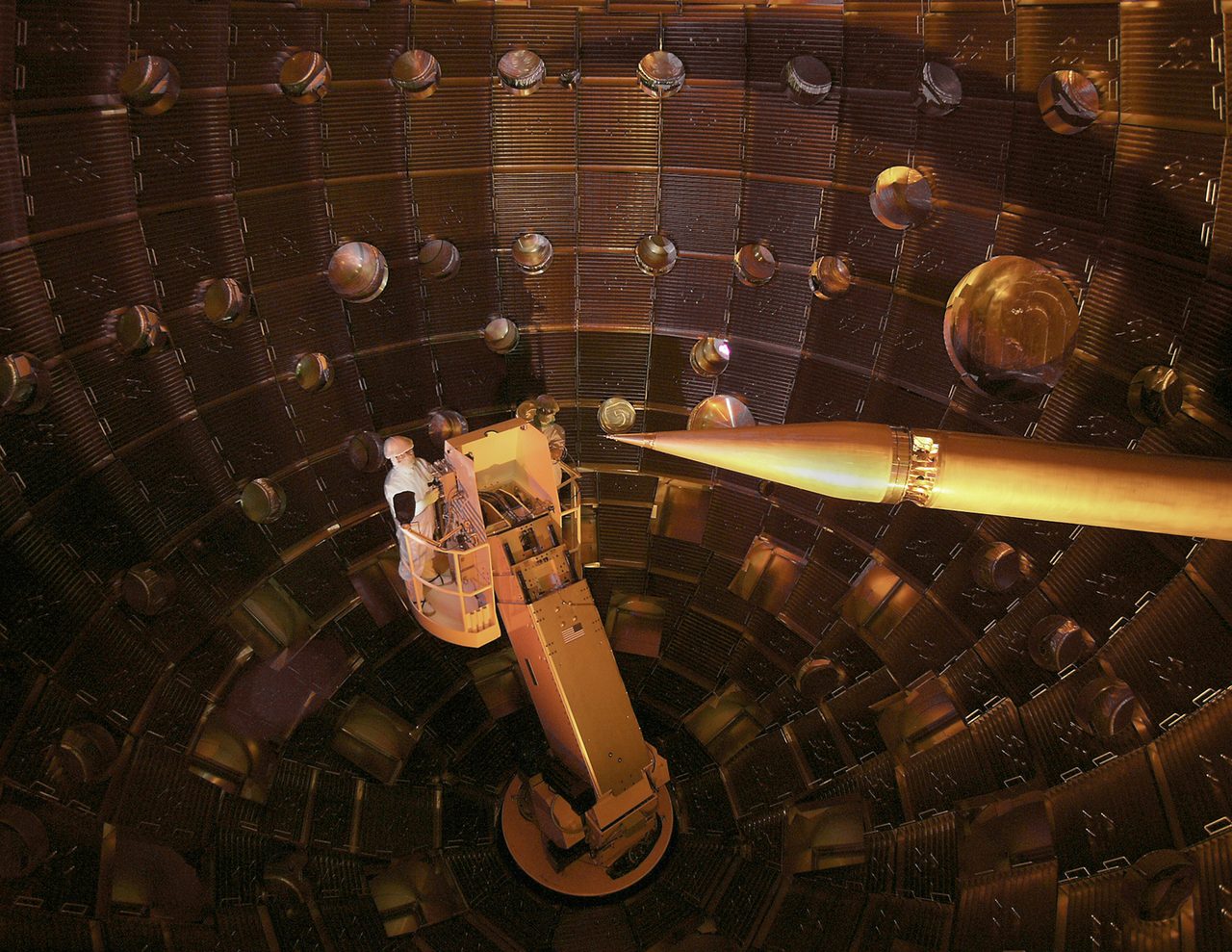
On December 5, 2022, 192 lasers converged on a gold cylinder holding a capsule of hydrogen fuel two millimeters across, and the fuel gave back more energy than the light that reached it. That had never happened before, it is peer-reviewed, and it is genuinely historic. It is also not a power plant: the laser system drew roughly 300 megajoules of electricity from the wall to deliver 2.05 megajoules of light into that cylinder. Almost everything worth knowing about fusion lives in the gap between those two sentences. Here is the file, opened claim by claim, each one wearing its evidence, and every company's promised date left standing in its own name.
In a star, gravity does the containing. Nothing here weighs anything like enough for that, so every fusion machine ever built is an attempt to substitute for the weight of a star: with magnetic fields, with lasers, or with pistons driving a plasma inward. The physics of the reaction itself is not in doubt and has not been for a very long time. What is in doubt is the machine, and almost every confusion about fusion comes from a result belonging to the first category being reported as though it belonged to the second. So this file keeps the two apart, line by line, and says out loud which one each number is. Let's open the file.
01The Bargain the Physics Offers
Fusion is not one technology. It is one reaction pursued down two very different roads, and both roads are measured against a single threshold that was written down in 1957 by someone who was not trying to sell anything.
The reaction nearly every serious effort is built around is the easiest one available: deuterium plus tritium, fusing into a helium-4 nucleus carrying 3.5 MeV and a neutron carrying 14.1 MeV, for 17.6 MeV released per reaction. That neutron is the entire business case and the entire engineering problem at once. It carries about 80 percent of the energy released, which is the primary route by which a fusion plant would ever heat anything, and it is also a 14.1 MeV projectile that damages and radioactively activates the structural materials of the reactor around it over time.
The threshold was set by John Lawson in 1957, in the Proceedings of the Physical Society. The Lawson criterion states the minimum condition for a deuterium-tritium reaction to sustain itself, meaning the point at which the alpha particles thrown off by the reaction heat the plasma enough that no external heating is needed at all. It is a triple product: plasma density, multiplied by confinement time, multiplied by temperature, has to exceed roughly 3 x 10²¹ keV seconds per cubic meter. Every machine in this article is an attempt to get above that line and stay there.
There is a catch buried in the fuel choice. Tritium is radioactive, with a half-life of 12.3 years, and it does not occur naturally in any usable quantity. A deuterium-tritium reactor therefore has to manufacture one of its own fuels while it runs, breeding tritium inside blanket modules wrapped around the plasma: a neutron strikes lithium-6, and out come a helium-4 nucleus and a fresh tritium nucleus. The reactor's own neutron flux is what makes the fuel it burns. Whether that loop can actually be closed at reactor scale is a question this file returns to, because it is not a detail.
There are two roads to the Lawson line. Magnetic confinement holds a hot, thin plasma inside a magnetic bottle for seconds or minutes at a time, which is the tokamak, the stellarator, and most of the world's public fusion budget. Inertial confinement takes the opposite bet, crushing a very small amount of fuel so hard and so fast that it fuses before it can fly apart. The first road has produced the longest-running machines. The second road produced the single most quoted result in the field's history, and that is where the file has to start.
02December 5, 2022, and the Sentence That Travels With It
What happened at Lawrence Livermore on December 5, 2022 is the most reported result in the history of fusion research, and it is also the most misreported. Both halves of that are true at the same time, and holding them true at the same time is the whole discipline this file is built on.
On December 5, 2022, the National Ignition Facility at Lawrence Livermore National Laboratory achieved what the field calls scientific ignition, for the first time in history. A single laser shot delivered 2.05 megajoules of ultraviolet light into the hohlraum holding a deuterium-tritium fuel capsule, and the fuel released 3.15 megajoules of fusion energy: a target gain of about 1.54, roughly 154 percent of what was put in. No controlled fusion experiment anywhere had ever produced more energy from the reaction than the laser energy delivered to the fuel. This one did, on a dated day, and the figures were re-confirmed for this article against Lawrence Livermore's own reporting, the United States Department of Energy, and AIP's FYI bulletin.
The method matters, because it explains the achievement and its limits in the same breath. NIF's 192 laser beams delivered that 2.05 megajoules as ultraviolet light at 351 nanometers into a small gold cylinder called a hohlraum, which held a capsule of deuterium-tritium ice about 2 millimeters across. The lasers never touch the fuel. They heat the inside of the gold cylinder until it floods with X-rays, and the X-ray radiation field crushes the capsule from every side at once, compressing the fuel to roughly 1,000 times liquid density at temperatures beyond 100 million degrees Celsius. That is indirect drive: the fuel is squeezed by radiation, not by the light itself.
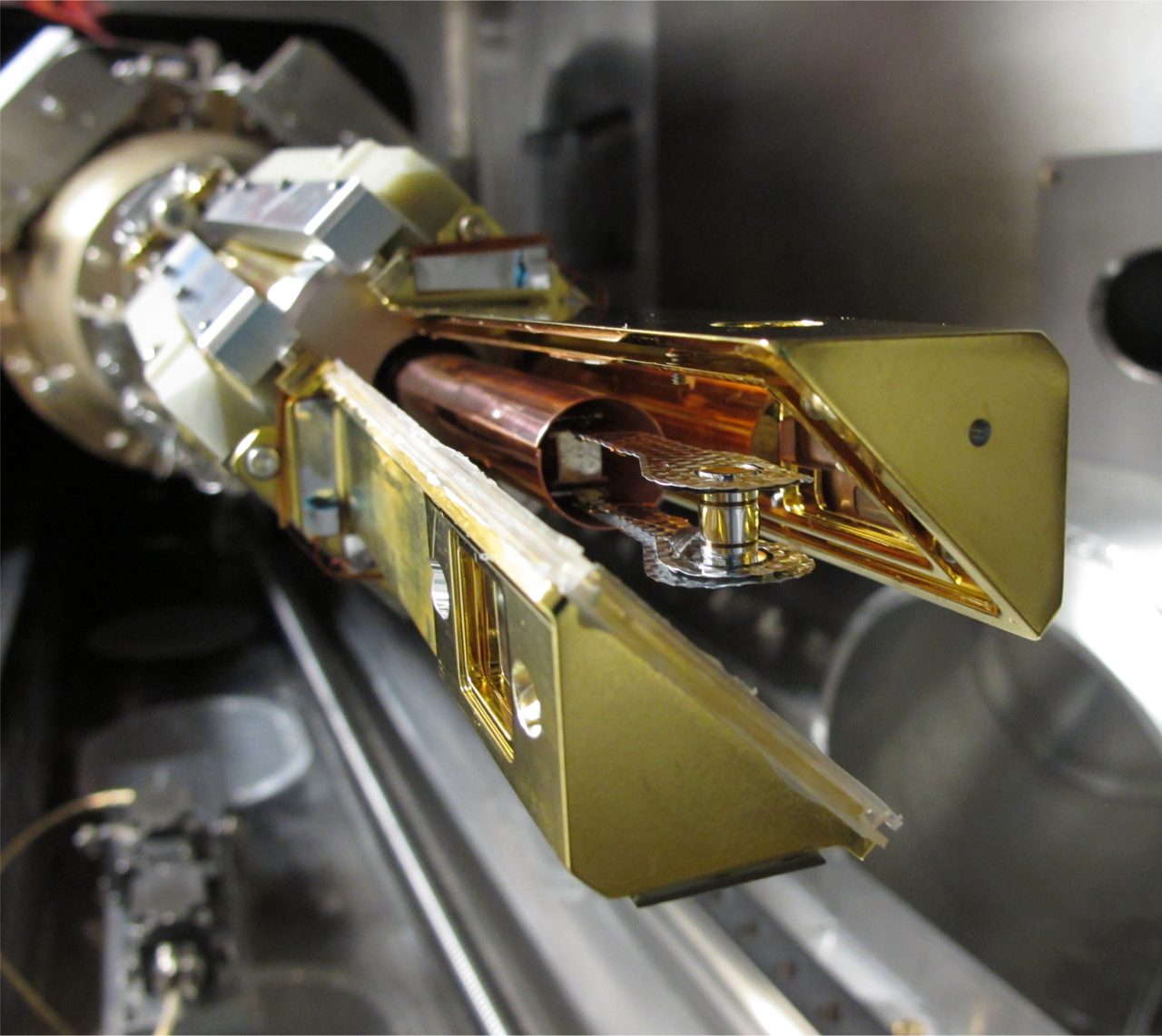
The scale is easy to state and hard to picture: a fuel capsule two millimeters across, inside a hohlraum, inside a chamber ten meters wide.
The December 2022 shot achieved scientific ignition, not engineering ignition, and the distinction is the load-bearing honesty point of this entire article. The 2.05 megajoules is the light that reached the target. It is not what it cost to make that light. The laser system drew roughly 300 megajoules of electricity from the wall to produce those 2.05 megajoules of ultraviolet, a total wall-plug efficiency under 1 percent, put at about 0.7 percent in one of our own source files. Measured from the fuel's point of view, more energy came out than went in, and that is a genuine first. Measured from the wall socket, the facility spent something close to 300 megajoules to get back 3.15. Both statements are true, and only the first one is what net energy gain meant in the headlines. Saying this plainly diminishes nothing about the achievement. What it diminishes is the impression that a power plant follows from it.
It was also not a fluke, which is the strongest thing that can be said for any single result. Subsequent NIF shots through 2023 reproduced the December 2022 result and then exceeded it, reaching fusion energy yields as high as 3.88 megajoules.
One more fact belongs beside all of that, and it is the kind that rarely survives a news cycle. NIF was not built to make electricity. Its primary institutional mission is stewardship of the United States nuclear weapons stockpile: it exists to study the physics of thermonuclear detonation without detonating anything. The ignition milestone is a scientific result from a facility built for a different national purpose, which is part of why the distance from this shot to a power station is longer than the shot itself makes it sound.
The result is properly published, twice, by the same collaboration. The ignition milestone was reported by Abu-Shawareb and colleagues in Physical Review Letters in 2022 as "Lawson Criterion for Ignition Exceeded in an Inertial Fusion Experiment." The refined post-shot analysis confirming a target gain greater than unity followed in Physical Review Letters in 2024 as "Achievement of Target Gain Larger than Unity in an Inertial Fusion Experiment." Both are peer-reviewed, and both digital object identifiers were checked against the journal's own pages while this article was being researched.
| What Was Measured | The Figure | What It Supports |
|---|---|---|
| Laser light delivered to the target | 2.05 MJ | The input side of the target-gain calculation |
| Fusion energy released by the fuel | 3.15 MJ | A target gain of about 1.54, the first time in history |
| Electricity drawn from the wall by the laser system | Roughly 300 MJ | Total wall-plug efficiency under 1 percent. No net energy from the socket |
| Best subsequent NIF yield, through 2023 | 3.88 MJ | The result reproduced and exceeded, not a one-off |
| The facility's primary institutional mission | Nuclear weapons stockpile stewardship | A scientific result from a facility built for a different national purpose |
03The Machines That Have Been Running
The inertial road produced the headline. The magnetic road produced the running time, and two machines carry it: one that has just finished its life's work, and one that is still setting records.
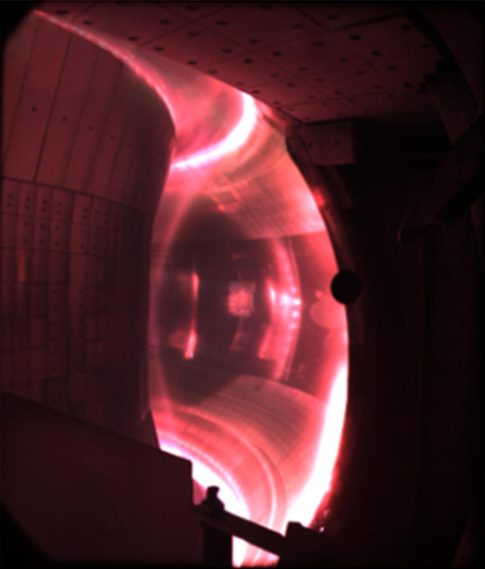
JET's plasma has no openly-licensed photograph, and ITER has never produced a plasma to photograph; this is the closest real substitute, honestly captioned as a different machine.
JET, the Joint European Torus in the UK, is the machine that proved deuterium-tritium fusion could be run in a magnetic bottle at all, and it held the records for doing it until it was shut down. In 1997 it produced 16.1 megawatts of fusion power sustained for about a second, at a gain of roughly 0.67 and a triple product of about 1.5 x 10²¹ keV seconds per cubic meter: below the Lawson line, but within sight of it. On February 9, 2022, it beat its own energy record, releasing 59 megajoules of fusion energy over five seconds at an average fusion power of about 11 megawatts, against the 22 megajoules it had managed in 1997.
JET's last word came after its last shot. In its final experimental campaign, run before the facility's permanent shutdown at the end of 2023 and reported in 2024, JET released 69.26 megajoules of fusion energy in a single pulse sustained over roughly five to six seconds, from 0.21 milligrams of deuterium-tritium fuel. Two tenths of a milligram. That is the honest scale of what fusion fuel actually weighs, and it is the single best argument for why people keep working on this at all.
The other machine is a different shape of bet entirely. Wendelstein 7-X, at the Max Planck Institute for Plasma Physics in Greifswald, Germany, is the largest stellarator in operation anywhere. It produced its first plasma on December 10, 2015: helium, about 1 million degrees Celsius, held for one tenth of a second, after nine years of construction and more than a million assembly hours.
What took nine years is visible in the coil count. The magnet system is 70 superconducting coils: 50 non-planar coils in five different geometries, each wound from 960 meters of niobium-titanium conductor, plus 20 planar coils in two geometries at 390 meters each, arranged in a twisted, non-axisymmetric three-dimensional geometry that nobody would ever choose for ease of manufacture. The twist is the entire point. It is what a stellarator does instead of driving a current through its own plasma.
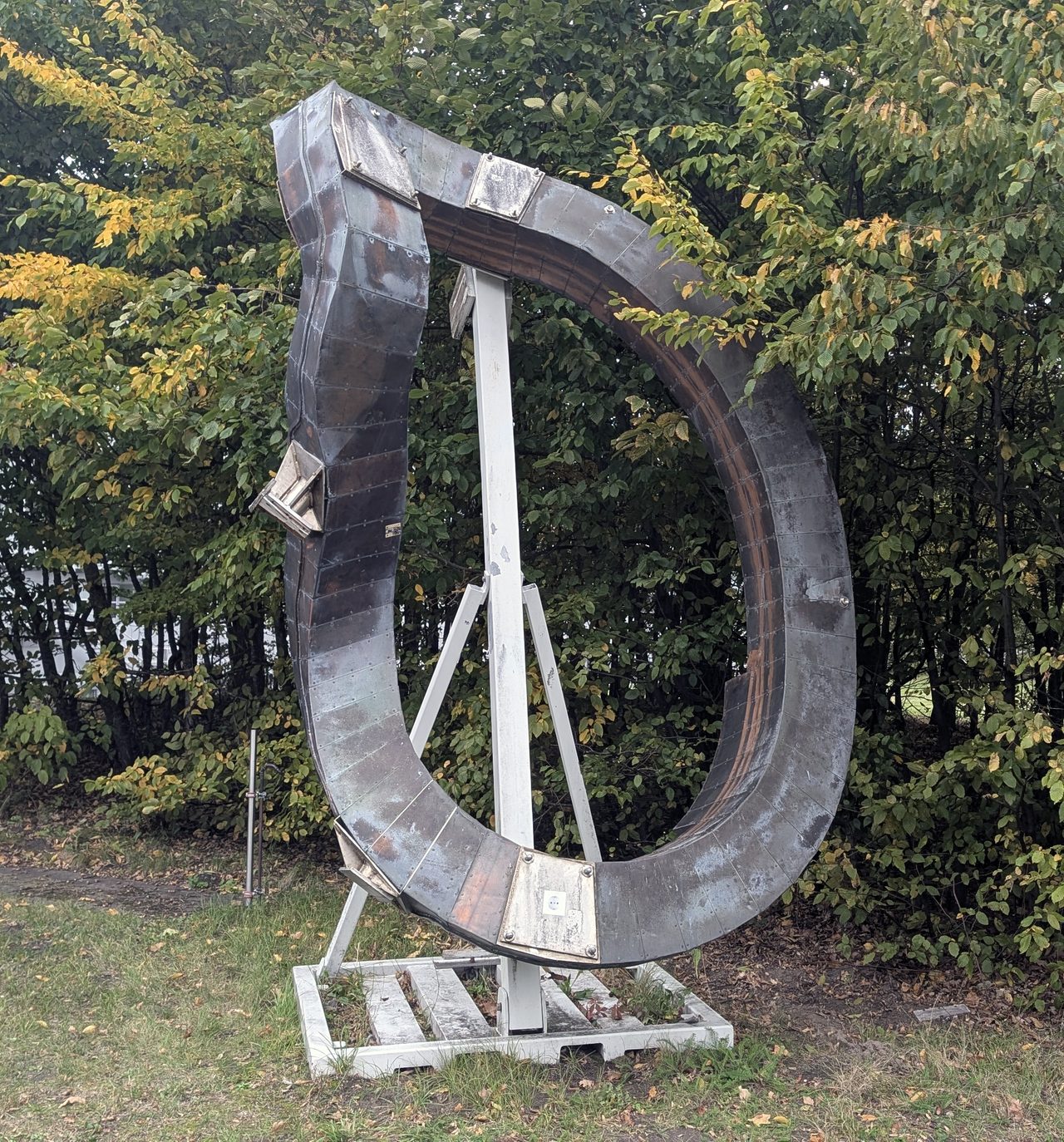
Fifty of these, each in one of five different geometries, is what nine years of construction actually bought.
The twist has bought performance that is now on the record. In 2023 Wendelstein 7-X reached electron temperatures above 20 million degrees Celsius with confinement times exceeding 100 seconds, and on February 15 of that year it turned over 1.3 gigajoules of energy for the first time, holding the plasma for a record discharge of 8 minutes. In 2025 it went further still: a new stellarator triple-product record sustained for 43 seconds, with energy turnover raised to 1.8 gigajoules across a 6-minute discharge, independently reported by EUROfusion and the Princeton Plasma Physics Laboratory. Our own research file has not caught up to that 2025 figure yet. This article states it because it was independently checked, not because the file says so.
The stellarator's advantage over the tokamak is structural rather than incremental. A tokamak confines its plasma partly with a current driven through the plasma itself, and that current can fail suddenly and destructively: the disruptions tokamak designers spend careers trying to avoid. A stellarator does not rely on the current, so it does not suffer the disruption, and it is inherently better suited to running steadily rather than in pulses. The price is the shape. A tokamak is a ring. A stellarator is that ring after it has been twisted into a form that has to be computed rather than drawn, which makes it dramatically harder to design, engineer, and optimize.
| Machine | Approach | The Result on the Record |
|---|---|---|
| NIF, Lawrence Livermore, United States | Inertial confinement, 192 lasers, indirect drive | December 5, 2022: 2.05 MJ of light delivered from roughly 300 MJ of wall electricity, 3.15 MJ of fusion energy released. Later shots to 3.88 MJ |
| JET, the UK, now retired | Magnetic confinement, tokamak | 1997: 16.1 MW for about a second, gain about 0.67. February 2022: 59 MJ over five seconds. Final campaign, reported 2024: 69.26 MJ from 0.21 mg of fuel |
| Wendelstein 7-X, Greifswald, Germany | Magnetic confinement, stellarator, 70 coils in a twisted geometry, 50 of them non-planar | 2023: above 20 million degrees, 1.3 GJ turnover, 8-minute discharge. 2025: 1.8 GJ across a 6-minute discharge, a new stellarator triple-product record |
| ITER, Cadarache, France | Magnetic confinement, tokamak | Under construction. No plasma produced yet. First Plasma now targeted for 2034 |
04ITER: The Biggest Machine and the Longest Wait
If fusion has a flagship, it is a construction site in France. Everything about it is worth stating precisely, because this is the machine most often described in the present tense for things it has not yet done.
ITER, the International Thermonuclear Experimental Reactor, is being built at Cadarache in France by a collaboration of 35 partner nations and blocs, among them the European Union, the United States, Russia, China, Japan, South Korea, and India. It has been under construction since 2010.
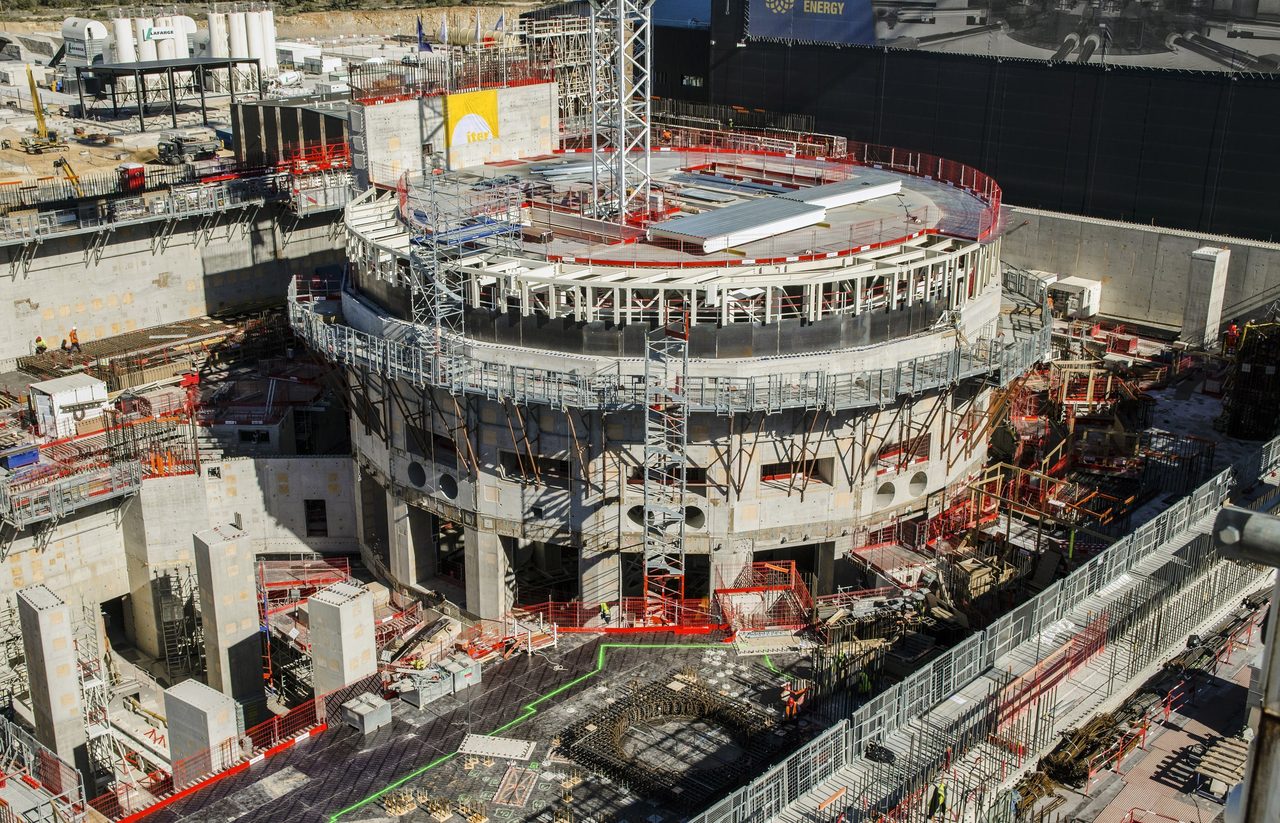
The design specifications are public and specific. ITER is a tokamak with a plasma major radius of 6.2 meters and a plasma volume of 840 cubic meters, confined by a superconducting magnet system built from Nb3Sn and NbTi, with toroidal field coils reaching a peak field of 11.8 tesla. Its stated goal is to demonstrate a fusion gain Q of at least 10, meaning 500 megawatts of fusion power out for 50 megawatts of external heating in, in pulses lasting 400 to 600 seconds. That is the design. It is not yet a measurement, because the machine has not run.
The date it will run has moved by about a decade, and the project published the move itself. First Plasma was originally targeted for 2025. Under ITER's own official rebaseline, announced in July 2024, First Plasma, meaning the first hydrogen and deuterium plasmas, is now targeted for 2034. Full-magnetic-energy deuterium operation follows in 2036. Deuterium-tritium operation, the run on real fusion fuel at the reactor's design conditions and the point closest to a genuine net-energy demonstration, is now targeted for 2039. The same announcement recognized roughly another 5 billion euros of cost overrun. None of this was concealed. It is simply not what most people picture when they hear that the world is building a fusion reactor.
There is a second thing most people picture that is also not true. ITER is a physics experiment, not a power station. It is not designed to generate electricity for the grid and it will not do so, even at complete success. The first fusion device intended to actually put power onto a grid is DEMO, the planned demonstration power plant that would follow ITER, currently placed in the 2050s. So the honest sentence about the world's flagship fusion project is this: it has not made plasma, it is aiming to in 2034, and when it succeeds it still will not power anything.
The cost is real, and the exact figure depends on what is being counted, which is worth admitting rather than picking the most dramatic number. Two of our own research files put ITER's budget at roughly 22 billion dollars. A third gives a range of about 25 to 65 billion in its main text while its own counter-arguments section quotes a different figure again, so the files do not agree with each other or, in one case, with themselves. Independent reporting supports both ends: the total is widely described as having grown past roughly 22 billion dollars as of 2024, while separately reported full-lifetime estimates that include all the in-kind contributions from all the partner nations run as high as 65 billion under a different accounting scope. What can be said without hedging is the direction. The budget has grown substantially from the original estimate, and the July 2024 rebaseline added roughly another 5 billion euros to it.
| Milestone | Original Plan | Now Targeted, per the July 2024 Rebaseline |
|---|---|---|
| First Plasma, hydrogen and deuterium | 2025 | 2034 |
| Full-magnetic-energy deuterium operation | Not separately stated in our files | 2036 |
| Deuterium-tritium operation at design conditions | Not separately stated in our files | 2039 |
| Electricity onto a grid | Never. ITER is not designed to do it | DEMO, the planned successor, in the 2050s |
05The Private Race, and What Money Cannot Buy Yet
While ITER slipped, something genuinely new grew up around it. A private fusion sector appeared, and it was built on one piece of engineering that is not speculative at all.
In September 2021, Commonwealth Fusion Systems, an MIT spinoff founded in 2018, demonstrated a large-bore high-temperature superconducting magnet reaching 20 tesla, wound from REBCO tape. That is a real, independently reported engineering milestone, and it is the reason the rest of this section exists. High-temperature superconducting magnets produce stronger magnetic fields in a smaller physical volume than the older superconductor technology ITER was designed around, and a stronger field in a smaller volume is exactly what a compact design would need. That is what makes a machine far smaller than ITER plausible at all, and it is the entire thesis of the compact tokamak.
Around that thesis, a sector formed. As of 2023 the private fusion companies had collectively raised somewhere above 6 billion dollars in private investment. Commonwealth Fusion Systems is pursuing the compact tokamak with those magnets. TAE Technologies, at roughly 1.2 billion dollars raised, works on a field-reversed configuration with a long-run ambition of aneutronic proton-boron-11 fuel. Helion Energy, which took 500 million dollars from Sam Altman, runs a pulsed field-reversed-configuration approach aimed at deuterium and helium-3. General Fusion is building magnetized target fusion, compressing a plasma with pistons. The dollar figures are facts of record and countable. The performance is not, and our own research file says so without softening it: none of them has demonstrated net energy gain.
One of those designs is published in enough detail to be checked. Commonwealth Fusion Systems' SPARC tokamak was described by Creely and colleagues in the Journal of Plasma Physics in 2020: a high-field, compact, superconducting deuterium-tritium tokamak at 12.2 tesla, with a major radius of 1.85 meters and a minor radius of 0.57 meters, against ITER's 6.2. Its stated design goal is a fusion gain Q greater than 2, which would be a first for a magnetically confined plasma, with a modeled potential of about 11 under nominal physics assumptions. What is verified here is the paper: it is real, it is peer-reviewed, and its specifications were checked against the published abstract. The performance inside it is a design goal and a model, not a measurement.
Commonwealth Fusion Systems' own numbers have kept moving, in both directions, and both directions are informative. Its cumulative funding has risen to nearly 3 billion dollars as of 2026, including a 2026 round that raised 863 million dollars with participation from Nvidia's venture arm, NVentures. Its public target has moved too. The company now states first plasma around 2026 to 2027 and a net-energy demonstration around 2027 for SPARC, which is already a slip from the late-2020s framing in our own research file. Every one of those dates is Commonwealth Fusion Systems' statement about Commonwealth Fusion Systems' unproven machine. Not one of them is an outcome anybody has verified, because the machine has not run.
Helion Energy has gone further than any of them in public commitment, which is not the same as going further in demonstrated physics. In 2023 Helion signed a power purchase agreement with Microsoft, described by Helion as the first agreement to buy fusion electricity ever signed anywhere, with Constellation Energy serving as the facility's power marketer. In July 2025 the company broke ground on a plant it calls Orion, in Malaga, Washington, and it still targets delivery of at least 50 megawatts of electricity to Microsoft data centers by 2028. That is a signed contract and a real construction site. It is also a commercial promise about a machine that has never demonstrated net electrical energy gain, because no fusion company anywhere has, Helion included. The contract is evidence of confidence and capital. It is not evidence about physics.
| Company | Approach | Funding on the Record | The Company's Own Stated Target | Net Energy Gain Demonstrated |
|---|---|---|---|---|
| Commonwealth Fusion Systems | Compact high-field tokamak, REBCO high-temperature superconducting magnets | Nearly 3 billion dollars as of 2026, including an 863 million dollar round | SPARC first plasma around 2026 to 2027, net energy around 2027, Q greater than 2 by design | None |
| Helion Energy | Pulsed field-reversed configuration, deuterium and helium-3 | 500 million dollars from Sam Altman | At least 50 MW to Microsoft by 2028; Orion plant broke ground July 2025 | None |
| TAE Technologies | Field-reversed configuration, long-run aneutronic proton-boron-11 | Roughly 1.2 billion dollars | Aneutronic fusion as a long-term bet | None |
| General Fusion | Magnetized target fusion, piston-driven plasma compression | Part of the sector's total above 6 billion dollars as of 2023; not broken out separately in our files | Not stated in our files | None |
06The Problems Ignition Did Not Solve
A physics milestone was reached. The engineering problems standing between that milestone and a power station were not touched by it, and our own research files list them without softening a single one.
A working inertial fusion plant would need to fire roughly 10 shots per second. NIF fires about once per day. It would need laser wall-plug efficiency lifted from about 1 percent toward something like 10. And it would need fuel targets that are precisely made, durable, and cheap, manufactured at industrial volume, where today each one is effectively a laboratory artifact. The file's own phrase for this list is "formidable engineering challenges that may take decades," and nothing in the December 2022 result addressed any of them.
The sharpest published objection is not about whether the plasma works. It is about whether the building does. Daniel Jassby, a retired physicist from the Princeton Plasma Physics Laboratory, has argued in print that even if ITER hits its plasma-physics target of Q at 10 or above, the ratio that actually matters for a power plant is engineering Q: the total electricity consumed by the whole facility set against the useful output. He argues that figure will likely stay below 1. On that reading a reactor could work in every sense a plasma physicist cares about while consuming more electricity than it produces. His best-confirmed statement of the case is "Fusion reactors: Not what they're cracked up to be," published in the Bulletin of the Atomic Scientists on April 19, 2017. Our own files cite this argument to two different venues and dates, and only the 2017 one could be confirmed while this article was being researched, which is worth saying out loud. The argument itself is real either way, and it is the strongest counter in this file.
Then there is the fuel loop, and it comes with an inventory number attached. Tritium's 12.3-year half-life means it does not exist naturally in usable quantity, so essentially the entire world supply today is a byproduct of one particular design of conventional nuclear reactor, and the global inventory is estimated at only about 25 kg and declining. Mohamed Abdou, at UCLA, calculated in 2021, in the journal Nuclear Fusion, that a reactor's own breeding blanket must achieve a tritium breeding ratio above 1.05 for the machine to be self-sufficient in its own fuel. That ratio has never been demonstrated experimentally at reactor scale. A deuterium-tritium plant that cannot breed more tritium than it burns is not a power plant. It is a very expensive consumer of a substance almost nobody makes.
07Thirty Years Away, and Always Will Be
Which brings the file to the thing almost everyone already knows about fusion, and which the field says about itself, in print, in our own source document.
The forecasts split cleanly by who is making them. Optimistic projections, mostly from private companies, put demonstration fusion power plants in the 2030s. Mainstream and institutional estimates place the first commercial fusion electricity as unlikely before 2040 to 2050 at the earliest. And the historical record on fusion timelines is not ambiguous: they have consistently proven overly optimistic, which is why the field carries a joke about itself that our own research file quotes verbatim.
The joke is not cynicism and it is not a reason to stop. It is a calibration instrument. Every previous generation of this field had a real result in hand, a credible extrapolation from it, and a date that did not survive contact with the engineering. The December 2022 shot is a real result. The extrapolation from it is credible. What the joke asks is whether anything about this generation makes its dates different from the last one, and the honest answer is that the magnets are genuinely new, the capital is genuinely new, and neither of those has yet moved a single electron onto a grid.
08The Questions That Are Genuinely Open
Two questions in this territory are not settled by anybody, and both are labelled here as what they are rather than dressed up as near-term prospects.
The most attractive version of fusion is the one nobody knows how to do. Aneutronic fusion means reactions that release no neutrons, or almost none, and the leading candidate is a proton fusing with boron-11 to produce three helium-4 nuclei and nothing else. No 14.1 MeV neutron would mean no neutron damage, no activated structural materials, and a far simpler machine around the plasma. It would also mean temperatures around 3 billion degrees Celsius, roughly 200 times hotter than deuterium-tritium ignition conditions, worked against a reaction cross-section far lower than deuterium-tritium's. Whether it can ever be made practical is genuinely unresolved. TAE Technologies is betting on it over the long run, and a bet is exactly what that is.
The second open question is the one the entire private sector rests on, and our own research file states it in exactly those terms: whether compact devices built around high-temperature superconducting magnets can reach commercial viability without needing ITER's much larger scale. The file's own words are that this is "the central bet of the private fusion sector, promising but unproven at net-energy-producing scale." The magnet is proven. The reactor built around it is not, and no amount of funding converts one into the other.
09Where the Story Runs Past the Evidence
Some claims in this territory are not speculative. They are wrong, or they are promises the evidence does not support, and saying so plainly is part of taking the real work seriously.
Cold fusion is not an underdog theory awaiting vindication. It is scientifically discredited, and presenting it as a live debate would itself be a failure of this file's standard. On March 23, 1989, at a press conference at the University of Utah, Stanley Pons and Martin Fleischmann announced that they had achieved nuclear fusion at room temperature by electrolysis of heavy water using palladium electrodes. Major laboratories attempted replication, MIT, Caltech, and Harwell among them, and found neither excess heat nor any nuclear fusion products. Mainstream physics has rejected the claim for more than three decades. Sometimes rebranded as LENR, Low Energy Nuclear Reactions, it still has no reproducible, independently verified demonstration: a Google-funded replication study published in Nature in 2019 found no evidence of cold fusion, though it did surface some unrelated materials-science leads worth studying on their own terms. All three of our own research files reach that assessment independently.
Fusion power will not be too cheap to meter in the near future, and our own research file refuses that claim outright rather than hedging it. Even a fully successful fusion reactor faces substantial real costs: engineering complexity, tritium handling and accountancy, management of neutron radiation damage to the reactor's own materials, and regulatory compliance. Succeeding at the physics eliminates none of those. Clean, abundant power is the reason to do this work. It is not a consequence that follows automatically from ignition.
Fast Facts
- The Reaction
- Deuterium plus tritium, fusing to helium-4 and a neutron, releasing 17.6 MeV, about 80 percent of it carried away by the neutron
- The Threshold
- The Lawson criterion (1957): density times confinement time times temperature above roughly 3 x 10^21 keV seconds per cubic meter
- The Milestone
- December 5, 2022, at the National Ignition Facility: 2.05 MJ of laser light delivered, 3.15 MJ of fusion energy released, a target gain of about 1.54
- The Caveat That Travels With It
- The laser system drew roughly 300 MJ from the wall to make those 2.05 MJ of light. Scientific ignition, not engineering ignition
- Best Magnetic Result
- JET's final campaign, reported 2024: 69.26 MJ in a single pulse from 0.21 mg of fuel
- The Stellarator
- Wendelstein 7-X, 70 superconducting coils in a twisted geometry, 50 non-planar, 1.8 GJ turnover across a 6-minute discharge in 2025
- ITER's Status
- Under construction at Cadarache, France, since 2010. No plasma produced yet. First Plasma targeted for 2034, deuterium-tritium operation for 2039
- What ITER Will Not Do
- Put electricity onto a grid. That step belongs to DEMO, the planned successor, placed in the 2050s
- The Private Sector
- Somewhere above 6 billion dollars raised collectively as of 2023, across Commonwealth Fusion Systems, TAE Technologies, Helion Energy, and General Fusion
- What No Company Has Done
- Demonstrated net energy gain from any reactor. Every company target date in this article is that company's own claim about its own machine
- The Standing Joke
- Fusion is 30 years away, and always will be
- What Is Not Supported
- Cold fusion, and the promise that fusion electricity will shortly be too cheap to meter
What We Can Actually Stand Behind
Fusion ignition happened, on a dated day, and it is peer-reviewed. On December 5, 2022, the National Ignition Facility delivered 2.05 megajoules of laser light to a deuterium-tritium capsule and got 3.15 megajoules of fusion energy back, a target gain of about 1.54. It was published twice in Physical Review Letters and reproduced through 2023 at yields up to 3.88 megajoules. Nothing like it had been done before. It is the real thing.
That same shot cost roughly 300 megajoules of wall-socket electricity to produce its 2.05 megajoules of light, a total system efficiency under 1 percent. It is scientific ignition, not engineering ignition: net energy from the fuel's point of view, not from the grid's. And NIF is a nuclear weapons stockpile stewardship facility, not an energy program. Every one of those statements is Tier 1 verified, and leaving any of them out changes what the line above it means.
The magnetic machines have a real record too. JET released 69.26 megajoules in a single pulse from 0.21 milligrams of fuel in its final campaign, reported in 2024, after 59 megajoules over five seconds in February 2022 and 16.1 megawatts back in 1997. Wendelstein 7-X, with its 70 coils in a twisted geometry, 50 of them non-planar, held electron temperatures above 20 million degrees with confinement beyond 100 seconds in 2023, and turned over 1.8 gigajoules across a 6-minute discharge in 2025. Commonwealth Fusion Systems really did build a 20-tesla high-temperature superconducting magnet in September 2021. These are measurements, not projections.
ITER is real, has been under construction at Cadarache since 2010 across 35 partner nations and blocs, and has not produced a plasma. Its own July 2024 rebaseline moved First Plasma to 2034 from an original 2025, deuterium operation to 2036, and deuterium-tritium operation to 2039. Even at full success it will not put electricity onto a grid. That step belongs to DEMO, planned for the 2050s.
The path from either milestone to a power plant runs through problems nobody has solved. An inertial plant needs roughly 10 shots a second where NIF fires about one a day, and laser efficiency raised from about 1 percent toward 10. Daniel Jassby's published objection, that engineering Q across a whole facility will likely stay below 1 even if plasma Q clears 10, is the strongest counter in this file, and nothing in our sources answers it. And the tritium loop is a live constraint: Mohamed Abdou's 2021 calculation puts the required breeding ratio above 1.05, which is not proven at reactor scale and never has been, against a declining world inventory of about 25 kg.
Every date in this article that comes from a company belongs to that company. Commonwealth Fusion Systems states first plasma around 2026 to 2027 and a net-energy demonstration around 2027 for SPARC, having already moved that target once. TAE Technologies has raised roughly 1.2 billion dollars for a field-reversed configuration, and General Fusion's own total is not broken out separately in our files. The money is countable and real: somewhere above 6 billion dollars across the sector as of 2023, and roughly 3 billion for Commonwealth Fusion Systems alone as of 2026. The performance is not. No private fusion company has demonstrated net energy gain from any reactor, and this file states none of their dates as its own.
Helion Energy's contract is the furthest any of this has gone into the real economy, and it is still a promise. Under a 2023 power purchase agreement with Microsoft, with Constellation Energy as the facility's power marketer, Helion states it will deliver at least 50 megawatts of electricity by 2028, and it broke ground on its Orion plant in Malaga, Washington, in July 2025. The signature and the groundbreaking are real. The delivery is Helion's own target for a machine that has never demonstrated net electrical energy gain, and this file does not adopt it.
Two questions here are open rather than answered. Whether aneutronic fusion, a proton and boron-11 giving three helium nuclei and no neutron, can ever be made practical is unresolved: it needs temperatures roughly two hundred times higher than deuterium-tritium ignition conditions, worked against a far smaller reaction cross-section. And whether compact machines built around high-temperature superconducting magnets can reach commercial viability without ITER's scale is, in our own file's words, the central bet of the private fusion sector, promising but unproven at net-energy-producing scale. Both are worth pursuing. Neither is a result.
No, cold fusion is not real. The 1989 Pons and Fleischmann claim of room-temperature fusion by electrolysis of heavy water failed replication at MIT, Caltech, Harwell and elsewhere, has been rejected by mainstream physics for more than three decades, and its LENR rebranding has produced no reproducible, independently verified demonstration. A Google-funded study published in Nature in 2019 found no evidence of it.
No, fusion power is not about to be too cheap to meter, and this file does not make that claim. Even a fully successful reactor carries substantial costs in engineering complexity, tritium handling and accountancy, neutron damage to its own structural materials, and regulatory compliance. The physics milestone eliminates none of them.
And no, nobody has yet built a fusion machine that returns more electricity than it consumes. Not NIF, not JET, not Wendelstein 7-X, not ITER, which has not run, and not one of the private companies, however much capital they hold or however signed the contract. Every claim in this article that sounds like that outcome is either a target date owned by whoever said it, or a gain measured at the fuel rather than at the wall.
So the file closes with a genuine first, a real set of machines, and a gap nobody has crossed. The physics question, whether a controlled reaction here can give back more energy than the fuel absorbs, was answered on December 5, 2022, and answered again through 2023 at higher yields. The engineering question, whether a building can be built around that reaction which returns more electricity than the building draws, has not been answered anywhere, by anyone, at any scale. Everything in this article that sounds like a schedule is a bet on closing that gap: ITER's 2039, Commonwealth Fusion Systems' 2027, Helion's 2028. Some of those bets are backed by a magnet technology ITER was never designed around, and by capital this field has never had before, which is the strongest argument that this generation differs from the last one. None of them is evidence yet. The star in a bottle is real and it has been lit. It has simply never yet been lit for less than it cost to light it. Which leaves the question this wing keeps circling back to. If the fuel says yes and the wall socket says no, which of the two are we talking about when we say fusion works?
Sources & further reading
Everything above is drawn from our research library on Theories of Anything, cross-checked against the primary sources named in the text, with every dated claim re-verified against original reporting. Open the full file to check the sourcing and go deeper.
Image credits
- Interior of the NIF target chamber Lawrence Livermore National Laboratory / US Department of Energy, via Wikimedia Commons (Public Domain). Public Domain (17 U.S.C. 105) Source.
- NIF cryogenic target assembly, October 2010 Lawrence Livermore National Laboratory, via Wikimedia Commons (CC BY-SA 3.0). CC BY-SA 3.0 Source.
- Plasma inside China's EAST tokamak Xiang Gao, Yao Yang, Tao Zhang, Haiqing Liu, Guoqiang Li, and co-authors, via Wikimedia Commons (CC BY 3.0). CC BY 3.0 Source.
- A non-planar coil from the Wendelstein 7-X stellarator, exhibit display Siarhei Besarab, via Wikimedia Commons (CC BY-SA 4.0). CC BY-SA 4.0 Source.
- ITER tokamak complex under construction, April 2018 Oak Ridge National Laboratory, via the ITER Site Flickr account, via Wikimedia Commons (CC BY 2.0). CC BY 2.0 Source.
- Card crop of the NIF target chamber interior Lawrence Livermore National Laboratory / US Department of Energy, via Wikimedia Commons (Public Domain). Public Domain (17 U.S.C. 105)


.jpg)