
Freemasonry: The Devil Was Drawn to Sell a Subscription
The single most durable claim about Freemasonry, that it secretly worships Lucifer, was invented by a French writer who confessed the whole thing in 1897. There is also one lodge that really did run a political conspiracy, and it is a matter of parliamentary record. Both of those are true, and almost nobody arguing about this has read the actual scholarship.
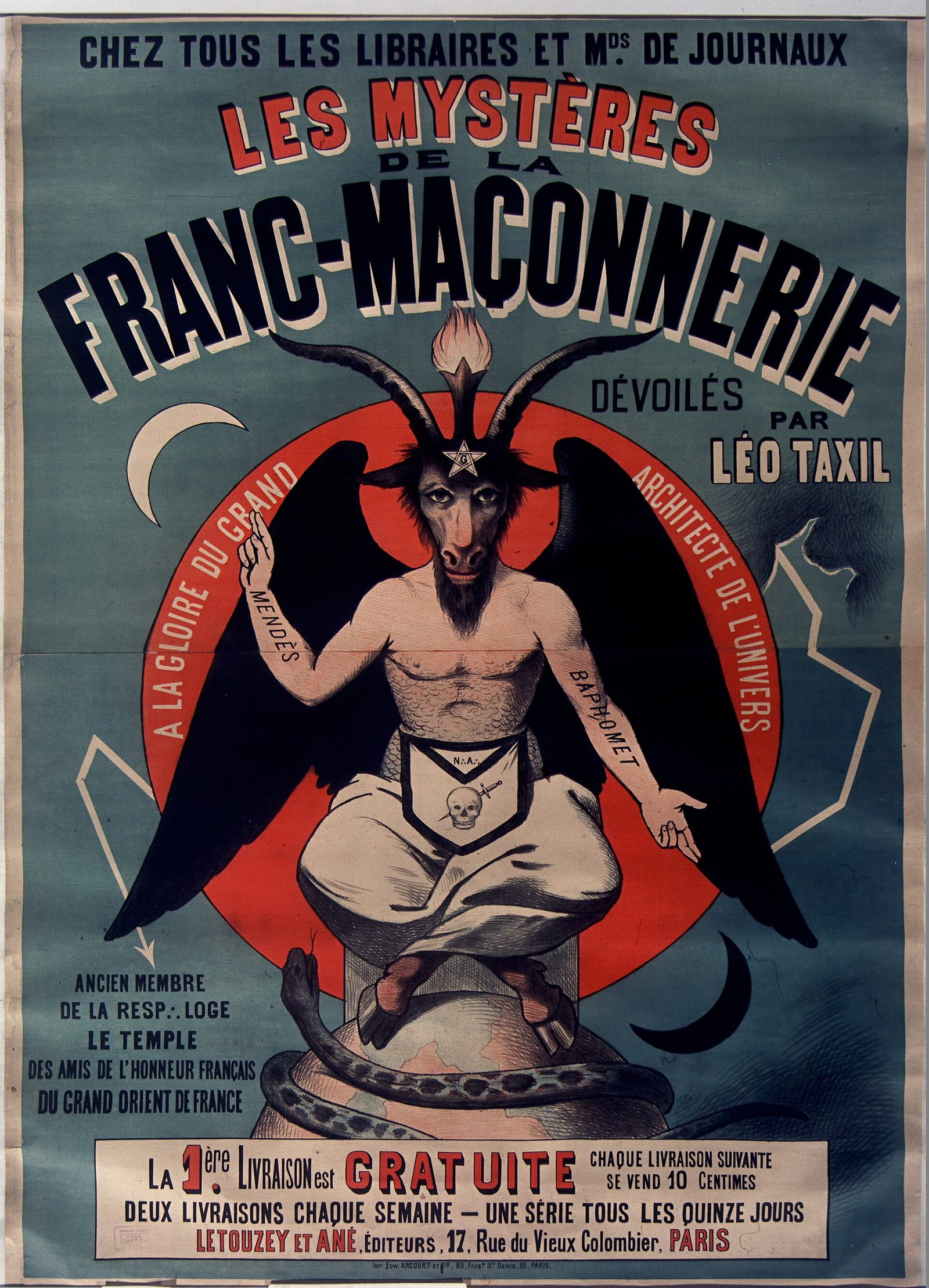
Look at the poster at the top of this page and then read the small print at the bottom of it. The horned figure, the pentagram, the Masonic apron with a skull on it, the motto around the red disc reading to the glory of the Great Architect of the Universe: this is the image that supplies most of what people think they know about Freemasonry. Underneath it, the publisher explains the terms. First instalment free. Every instalment after that, ten centimes. Two a week.
It was a part-work. Léo Taxil sold it by subscription, and twelve years later he stood up and said he had made all of it up. That is the strangest and least-told fact about the world's most famous secret society, and this page is about it, about the one lodge that really did run a conspiracy, and about the fact that a whole academic literature on this subject exists which almost nobody in the argument has opened.
01What The Record Actually Contains
Our research file's timeline, each row marked Tier 1 on the grounds that the document survives: the Regius Poem of 1390, the earliest Masonic document; the Schaw Statutes in Scotland in 1598; the Grand Lodge of England formed in 1717; Anderson's Constitutions printed in 1723; the first papal condemnation, In Eminenti, in 1738; and the Scottish Rite formalized with 33 degrees in 1801. These are our file's dates and were not independently re-checked for this article.
There is a standard scholarly reference work for this subject and our own file cites none of it. The Handbook of Freemasonry, published by Brill in 2014, has thirty-four indexed chapters, including David Stevenson on the Scottish origins, Prescott on the Old Charges, which is where the Regius Poem is properly treated, Benimeli on Freemasonry and the Catholic Church, Snoek on rituals of initiation and on Freemasonry and women, and Massimo Introvigne on Freemasonry and new religious movements. There is also a peer-reviewed Journal for Research into Freemasonry and Fraternalism, and REHMLAC in Latin America. Our file cites Mackey from 1929, Pike from 1871 and Blavatsky from 1888 as though the study of this had stopped. It has not. The same David Stevenson our file does cite wrote the Handbook chapter.
02The Hoax, Which Our Own File Never Mentions
Here is the gap in our research file, and it is a large one. The file argues carefully against Masonic conspiracy theories. It refutes the Great Seal claim, the world-government claim, and the claim that the Illuminati survived, each with specifics. It never once names Léo Taxil, and Taxil is where the most durable claim of all came from.
Gabriel Jogand-Pagès, writing as Léo Taxil, ran an anti-Masonic hoax in France that invented a Satanic inner order within Freemasonry and a fictional former member of it, a woman called Diana Vaughan, who was presented as a repentant ex-Palladist witness. He sustained it for years and then confessed publicly, in 1897, that the whole apparatus was fabricated. The scholarly treatment is Massimo Introvigne's 2004 paper in Aries, the academic journal for the study of Western esotericism, and Introvigne is also the author of the Handbook of Freemasonry's chapter on Freemasonry and new religious movements. The claim that Freemasonry worships Lucifer has a named author, a commercial motive and a confession, and our own file argues against the conspiracy literature without mentioning any of the three.
The hero image at the top of this page is Taxil's own advertising, and it disproves itself in its own small print. The figure carries the words MENDÈS and BAPHOMET on its arms and a pentagram on its forehead, and the legend around it, À LA GLOIRE DU GRAND ARCHITECTE DE L'UNIVERS, is the genuine Masonic formula turned against its owners. In the lower left Taxil advertises himself as a former member of a named lodge of the Grand Orient de France. And along the bottom: the first instalment is free, each one after that sells for ten centimes, two instalments a week, a series every fortnight, from Letouzey et Ané of 17 rue du Vieux Colombier, Paris. All of that is legible in the file reproduced here.
03And Then There Is P2, Which Was Real
It would be easy to end there, and it would be dishonest. Our research file's best section is the one that refuses the comfortable conclusion, and it deserves to be carried at full strength rather than summarised away.
Propaganda Due was an irregular Masonic lodge in Italy under Grand Master Licio Gelli. Our file gives the membership list discovered in 1981 as roughly 962 names, including cabinet ministers, the heads of all three Italian secret services, thirty generals and admirals, forty-three parliamentarians, three serving ministers, Silvio Berlusconi, heads of financial institutions and the editor of Corriere della Sera. It records a planned right-wing coup, the Piano di Rinascita Democratica; the collapse of Banco Ambrosiano, a 1.3 billion dollar scandal whose chairman Roberto Calvi was found hanged under Blackfriars Bridge in London in 1982; and links to Gladio, to the Vatican Bank, and suspected involvement in the 1980 Bologna railway bombing that killed eighty-five people. P2 was dissolved by Italian law in 1982, Gelli was convicted, and the lodge was expelled by the Grand Orient of Italy. Every figure here is our file's, drawn from the Italian parliamentary inquiry of 1981 to 1984, and none was independently verified for this article.
| The Claim | What Supports It | What It Does Not Establish |
|---|---|---|
| A Masonic lodge ran a genuine political conspiracy | P2, under Licio Gelli. A membership list of roughly 962 recovered in 1981, an Italian parliamentary inquiry from 1981 to 1984, a coup plan, a bank collapse, a body under Blackfriars Bridge, and a criminal conviction | That this is what lodges do. Our file calls P2 an aberration, rejected by mainstream Freemasonry, dissolved by Italian law and expelled by the Grand Orient of Italy |
| Freemasonry secretly controls governments, banks and media | Nothing our file could find. It notes the theory is unfalsifiable by construction: the absence of evidence is offered as proof of how well the secret is kept | Anything. Our file's counter is arithmetic rather than rhetoric: United States membership fell from 3.6 million in 1959 to under a million by 2020. An organisation that controlled everything would presumably not preside over its own collapse. Those figures carry no citation in our file |
| Freemasonry worships Lucifer | A part-work sold at ten centimes an instalment by a man who confessed in 1897 that he invented it, along with the witness who testified to it | Nothing, and the more interesting question is why a confessed hoax outlived its own confession by more than a century |
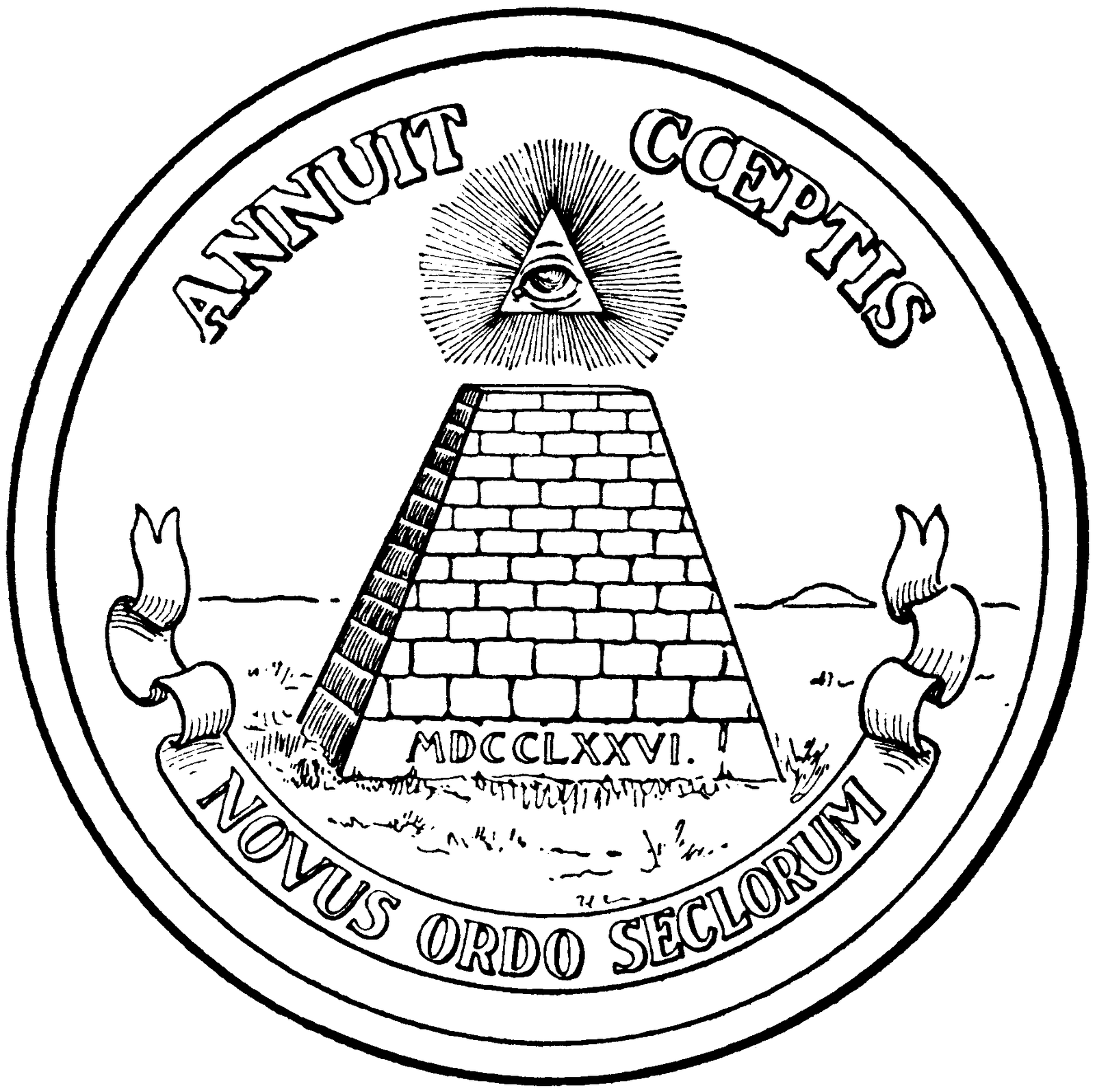
| The Eye of Providence on the Great Seal proves Masonic control of the United States | The symbol is on the Seal, and it does appear in Masonic contexts | The design history contradicts it. Our file records the eye-and-pyramid as proposed by Pierre Eugène du Simitière, not a Mason, and finalised by Charles Thomson, not a Mason. Franklin, who was a Mason, had his design rejected |
Our file separates the history from the conspiracy cleanly. As history: Adam Weishaupt founded the Illuminati on 1 May 1776 in Ingolstadt, it lasted about eight years with roughly two thousand members at its peak, it was banned by the Bavarian Elector in 1784 or 1785, and it infiltrated but did not control Masonic lodges. As conspiracy: there is no documentary basis for organisational continuity after 1785. An eight-year society with two thousand members is a real thing that really happened and is nothing like the thing named after it.
04The Rosicrucians, And What Is Fair To Say About The Royal Society
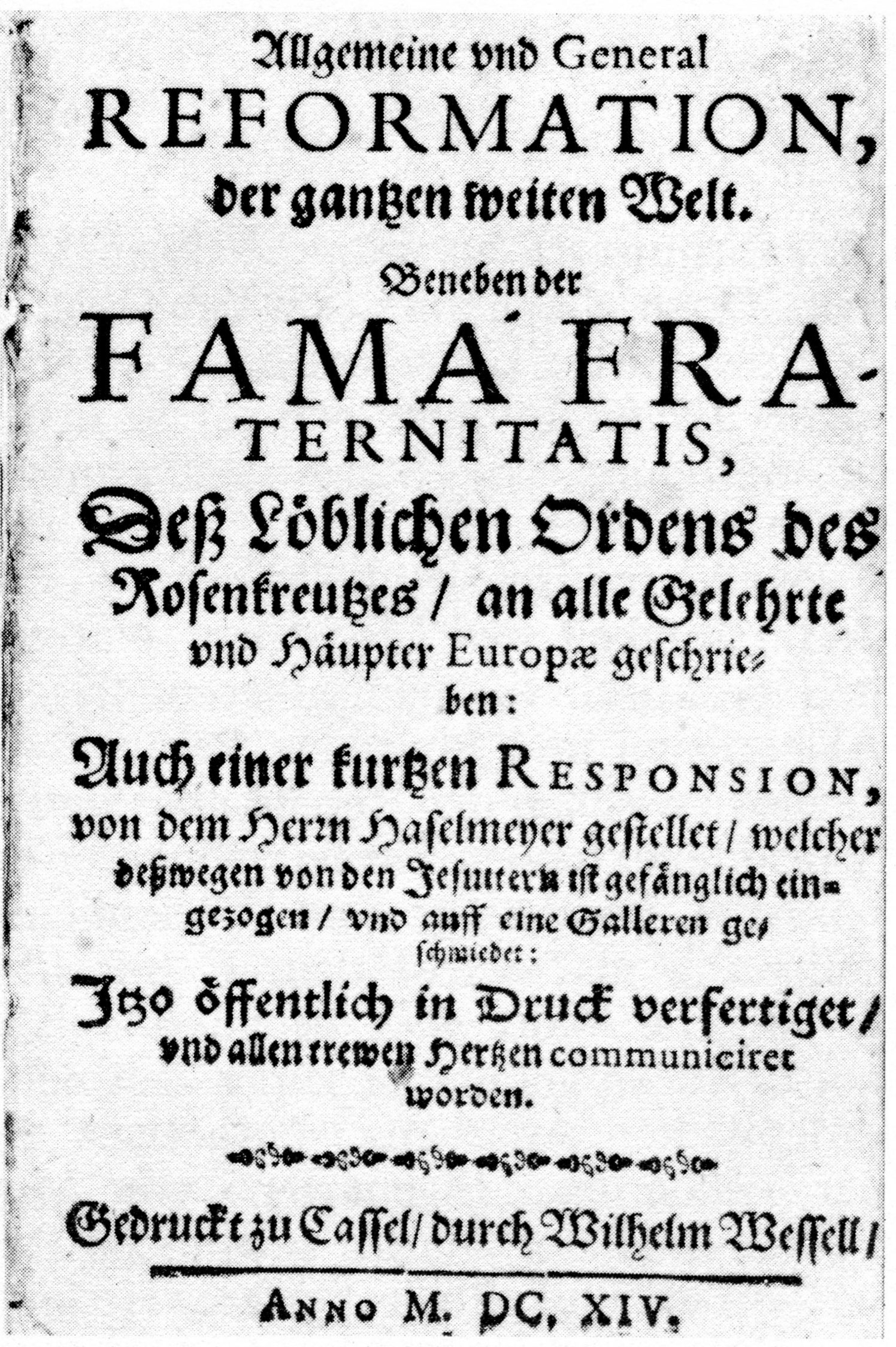
The Rosicrucian manifestos are the Fama Fraternitatis of 1614, the Confessio Fraternitatis of 1615 and the Chymical Wedding of Christian Rosenkreutz of 1616. Our file adds the detail that complicates everything after it: Johann Valentin Andreae, who lived from 1586 to 1654, admitted authorship of the Chymical Wedding and called it a ludibrium, a jest or a piece of play. Whether the Brotherhood was ever anything but a literary device is still argued.
Members of the early Royal Society, founded in 1660, used the phrase Invisible College, and Robert Boyle, Christopher Wren and Elias Ashmole had documented Masonic or Rosicrucian connections. Frances Yates argued in The Rosicrucian Enlightenment that the Scientific Revolution was partly catalysed by a Rosicrucian emphasis on investigating nature empirically. Our own file's assessment is exactly the right one and worth repeating verbatim in sense: the social connections are documented; whether Rosicrucian ideas shaped the Scientific Revolution is interpretive. Those are two different claims and the second does not follow from the first.
05Where Our Own File Comes Apart
| The Entry | The Identifier Resolves To | What Kind Of Failure |
|---|---|---|
| Stevenson, The Origins of Freemasonry, Cambridge 1988 | Stevenson, The Origins of Freemasonry, 1988 | CORRECT. Though the year column holds 1590 to 1710, which is the book's subtitle range, not its date |
| Godwin, The Theosophical Enlightenment, SUNY 1994 | Godwin, Theosophical Enlightenment, 1994 | CORRECT |
| Yates, The Rosicrucian Enlightenment, Routledge 1972 | A 1973 review of that book by Odlozilik in the American Historical Review, one page long | A review attached to the book it reviews. The record carries the book's own title, author, publisher, year and price, so a title check passes it. This is the source of our file's entire Royal Society section, and the hygiene campaign already removed its ISBN as invalid, so the entry now has no usable identifier at all |
| Pike, Morals and Dogma, 1871 | A 2023 chapter by Gregorius in an Oxford anthology titled Satanism: A Reader | A modern anthology chapter attached to the primary text it presents. The coincidence is worth noting only carefully: that anthology is a scholarly collection of primary sources in the history of Satanism, and the Taxil hoax is a large part of why Pike belongs to that history at all |
| Blavatsky, The Secret Doctrine, 1888 | A 2011 entry in Milestone Documents of World Religions excerpting the book | Same class. A modern reference work standing in for the primary source |
| SUNY Press (corporate author), FOURTEEN Enter Madame Blavatsky, 1994 | Chapter fourteen of Godwin's book, which is already a separate entry in the same bibliography | A chapter promoted to a standalone work with the publisher listed as its author |
| Rows 11 and 12, identically | Sukarieh's review of Keir Milburn's Generation Left, in Social Movement Studies | The identifier is correct. The work is a review of a 2019 book about generational politics, it has no relationship to any subject in this document, it is cited nowhere in it, and it appears TWICE. Two of twelve bibliography rows are the same irrelevant book review |
Our file closes with a section stating that no significant counter-arguments exist in the scholarly literature for its core claims, and that the topic has no active scholarly dispute. The same document contains a Tier 3 section on unverifiable Theosophical claims, a Tier 4 section refuting four separate conspiracy claims, and Tier 2 assessments it explicitly labels interpretive. This is template boilerplate colliding with real content, and it is the identical collision found in our chromosome 2 file. Two documents in two days, in two entirely unrelated sections of the library, carrying the same automatically-generated sentence that contradicts the page above it.
The same file ends with a Corrections block, and it is the most honest thing in it. Three ISBNs were removed as invalid with no replacement found, on a stated principle: supplying an unverified number would be worse than none. It also records that a batch process on 13 March 2026 wrote its own date over the header's month name, that two independent recovery routes were tried and neither existed in the file, and that rather than display a broken string or guess one of twelve months, the header now shows only the part that is actually known. That is a document telling you where it is damaged. The block is itself duplicated, which is fitting.
Fast Facts
- Oldest Document
- The Regius Poem, 1390, on our file's dating. Properly treated in Prescott's chapter on the Old Charges in the Handbook of Freemasonry
- Organised
- Schaw Statutes in Scotland 1598; Grand Lodge of England 1717; Anderson's Constitutions 1723; Scottish Rite with 33 degrees 1801
- Condemned
- In Eminenti, the first papal condemnation, 1738
- The Hoax
- Léo Taxil, pen name of Gabriel Jogand-Pagès, invented a Satanic Masonic order and a fictional ex-member called Diana Vaughan, sold it as a part-work, and confessed in 1897
- What It Cost
- First instalment free, ten centimes each thereafter, two a week. Printed on the poster
- The Real One
- P2, an irregular lodge under Licio Gelli. About 962 members found in 1981, including the heads of all three Italian secret services. Dissolved by law 1982, Gelli convicted, expelled by the Grand Orient of Italy
- The Membership Curve
- 3.6 million in the United States in 1959, under 1 million by 2020. Our file's figures, uncited
- The Illuminati
- Founded 1 May 1776 in Ingolstadt, about 2,000 members at peak, banned 1784 or 1785, lasted roughly eight years. No documentary basis for anything after that
- The Rosicrucians
- Fama Fraternitatis 1614, Confessio 1615, Chymical Wedding 1616. Andreae admitted the third and called it a jest
- Where To Actually Read
- The Handbook of Freemasonry, Brill 2014, 34 chapters. The Journal for Research into Freemasonry and Fraternalism. REHMLAC. None of them cited in our own file
What We Can Actually Stand Behind
Freemasonry has a documentary history running from the fourteenth century, organised in Scotland and England from the sixteenth and eighteenth, and it has been studied academically: the Handbook of Freemasonry runs to thirty-four chapters and there are peer-reviewed journals in the field. Léo Taxil manufactured the claim that Freemasonry worships Lucifer and confessed it in 1897; Introvigne's 2004 paper in Aries is the scholarly account, and Taxil's own poster, reproduced here, carries both the imagery and the subscription price. P2 existed, was investigated by the Italian parliament, and its Grand Master was convicted. The Rosicrucian manifestos exist and the Fama's title page reads 1614.
That early Royal Society figures had Masonic and Rosicrucian connections: documented. That Rosicrucian ideas shaped the Scientific Revolution: an interpretation, and our own file says so. That Masonic degree structure parallels ancient mystery-school initiation: the structural parallels are clear, and direct historical transmission is not established. That Masonic values influenced the American founding: allowed, with the correction that roughly nine of fifty-six signers of the Declaration were Masons, not all of them.
Blavatsky's Mahatmas and the Atlantean root races. Our file is clear that there is no independent verification of the first and no archaeological evidence for the second, while noting the historical influence of Theosophy is a separate and well-documented matter.
Freemasonry does not control world governments, banks or media. The Eye of Providence on the Great Seal does not prove Masonic control of the United States; the design came from two men who were not Masons. The Bavarian Illuminati did not survive 1785. And Freemasonry does not worship Lucifer, on the direct testimony of the man who invented the claim and sold it two instalments a week.
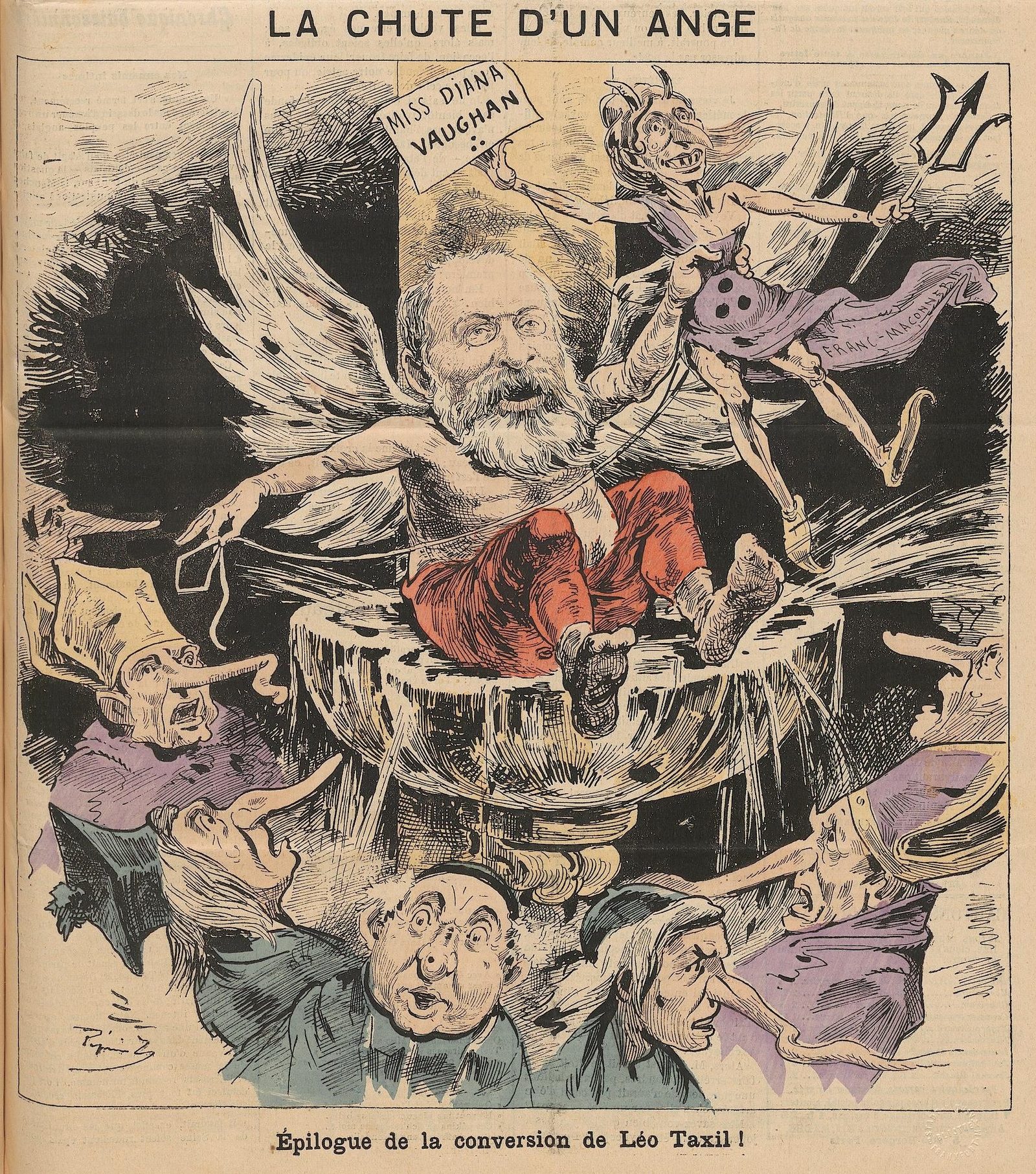
What stays with me is the cartoon. Not the poster, which is only a man selling something, but the drawing from Le Grelot with the bishops underneath. Taxil did not fool the Masons. He fooled the people who most wanted the story to be true, at length and in public, and they had every institutional resource for checking it and did not use them. The hoax outlived its own confession by more than a century and is still working. Somewhere in that is the actual lesson of this subject, and it has nothing to do with aprons.
Sources & further reading
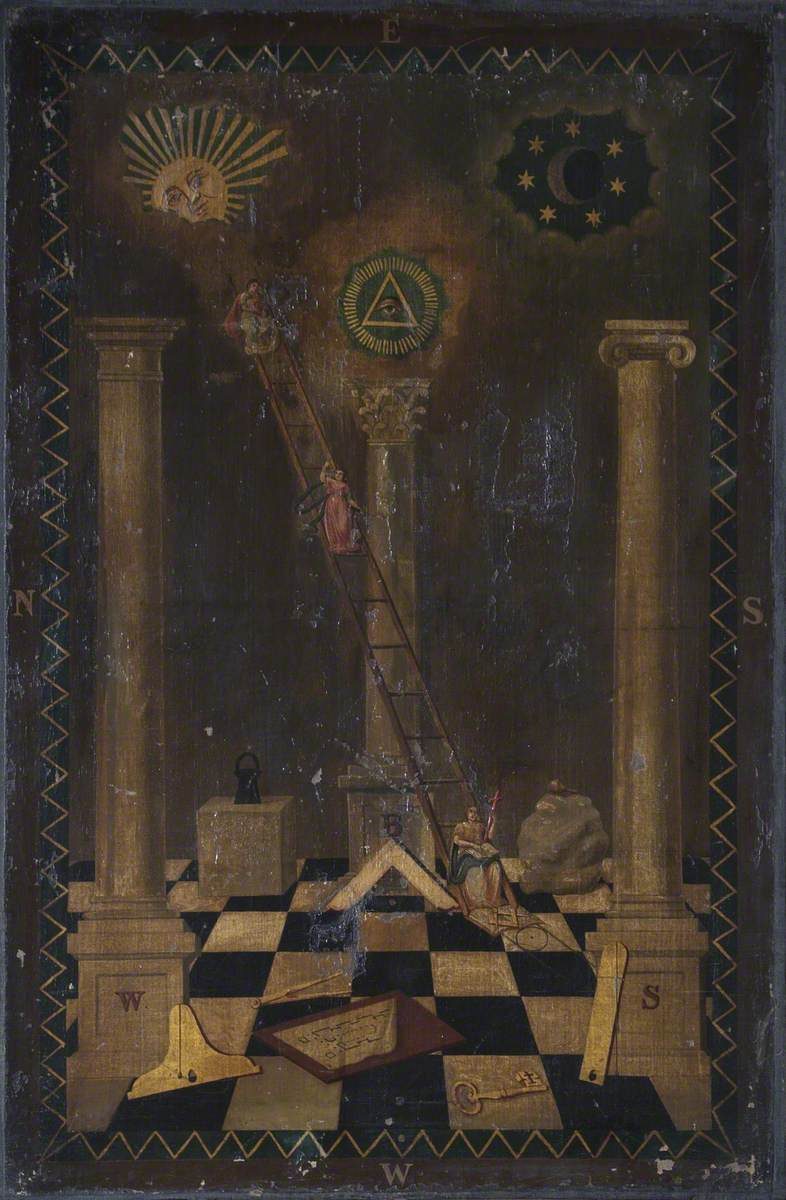
WHERE THIS WORKED FROM, AND WHERE IT CAN BE CHECKED. This article worked from one file in our own research library, N_3_01, which carries a Source Confidence of 2 out of 5. Every one of its seven DOIs was resolved live against Crossref for this article and TWO point at the work they claim to. Section 05 sets out the failures in full; the short version is one review attached to the book it reviews, two modern anthology chapters standing in for the primary texts they present, one chapter of another entry promoted to a standalone work with the publisher listed as its author, and a book review about generational politics that has nothing to do with any subject in the document, appearing TWICE among twelve rows. THE LARGEST PROBLEM IS NOT A BROKEN IDENTIFIER, IT IS AN ABSENCE. Our file argues against Masonic conspiracy theories at length without ever naming Léo Taxil, whose hoax manufactured the single most durable claim in that literature and who confessed it in 1897. It also cites nothing from the modern academic study of Freemasonry. The Handbook of Freemasonry, Brill 2014, has thirty-four chapters indexed at Crossref, several of which cover exactly the subjects our file's own GAPS list asks for, including Snoek on Freemasonry and women. There is a peer-reviewed Journal for Research into Freemasonry and Fraternalism and a Latin American journal, REHMLAC. All of the external sources listed below were found independently this session and resolved before being cited. WHAT IS CARRIED AS OUR FILE'S OWN, UNVERIFIED HERE. Every date in the timeline; every P2 figure, including the 962 members, the thirty generals, the forty-three parliamentarians, the 1.3 billion dollar collapse and the eighty-five dead at Bologna; the American membership figures of 3.6 million and under a million; the roughly nine of fifty-six signers; the Illuminati membership and dates; and the Rosicrucian chronology, with the single exception of the 1614 Fama date, which is legible as ANNO M.DC.XIV in the title page reproduced on this page. ON THE IMAGES. All five are public domain. The Taxil poster and the Le Grelot cartoon were read off the pixels and the poster's subscription terms are quoted from the reproduction itself. The tracing board is described and not interpreted, because no source on tracing-board iconography was resolved this session. A NOTE ON TONE. Two claims about a scholarly anthology are deliberately narrow. The Oxford volume that our file's Pike identifier actually resolves to is a collection of primary sources in the history of Satanism; its editors are not calling Albert Pike a Satanist, and this session did not read it. The coincidence is in our bibliography, not in their book.
Image credits
- Publisher's poster for Les Mysteres de la franc-maconnerie devoiles par Leo Taxil, Paris Unidentified artist, printed by Imp. Edw. Ancourt et Cie, Paris, via Wikimedia Commons. Public domain Source.
- La Chute d'un Ange, cartoon on Leo Taxil's confession, Le Grelot, 2 May 1897 Pepin, in Le Grelot, via Wikimedia Commons. Public domain Source.
- First Degree Tracing Board, Museum of Freemasonry Josiah Bowring (1757-1832), via Wikimedia Commons. Public domain Source.
- Reverse of the Great Seal of the United States, engraving Unknown engraver, via Wikimedia Commons. Public domain Source.
- Title page of the Fama Fraternitatis, printed at Cassel by Wilhelm Wessell, 1614 Printed by Wilhelm Wessell, Cassel, via Wikimedia Commons. Public domain Source.

.jpg)
_-_First_Degree_Tracing_Board_-_D2010-3_-_Museum_of_Freemasonry.jpg)

