
Fractals: The Geometry of Roughness
Classical geometry is built from smooth, ideal shapes: lines, circles, spheres. But almost nothing in nature is smooth. Clouds are not spheres, coastlines are not curves, and a tree is not a cylinder. Fractals are the mathematics of that roughness, shapes that repeat their own pattern at every scale, and their strangest feature is that a two-line formula can generate infinite, unrepeating detail. That same rough geometry turns up, uninvited, in coastlines and lungs and river deltas and galaxies. This is what a fractal actually is, why the Mandelbrot set may be the most complex object ever drawn from the simplest rule, and where the genuine wonder ends and the overreach begins.
For two thousand years, geometry meant the smooth, ideal shapes of Euclid: the straight line, the perfect circle, the sphere. They are beautiful, and they describe almost nothing you can actually see out a window. Clouds are not spheres. Mountains are not cones. Coastlines are not curves, tree bark is not flat, and a bolt of lightning does not travel in a straight line. The real world is rough, broken, and endlessly detailed, and for most of history mathematics simply had no language for it. Fractal geometry is that missing language. Its central idea is disarmingly simple, a shape that looks the same, or nearly the same, at every scale you examine it, and its consequences are anything but. A formula short enough to write on a fingernail can generate a shape of infinite, never-repeating complexity; and that same rough geometry turns out to describe coastlines and blood vessels and river deltas and the clustering of galaxies. This is what fractals really are, how the most famous of them is built, and, just as importantly, what they are not.
01The Geometry of Roughness
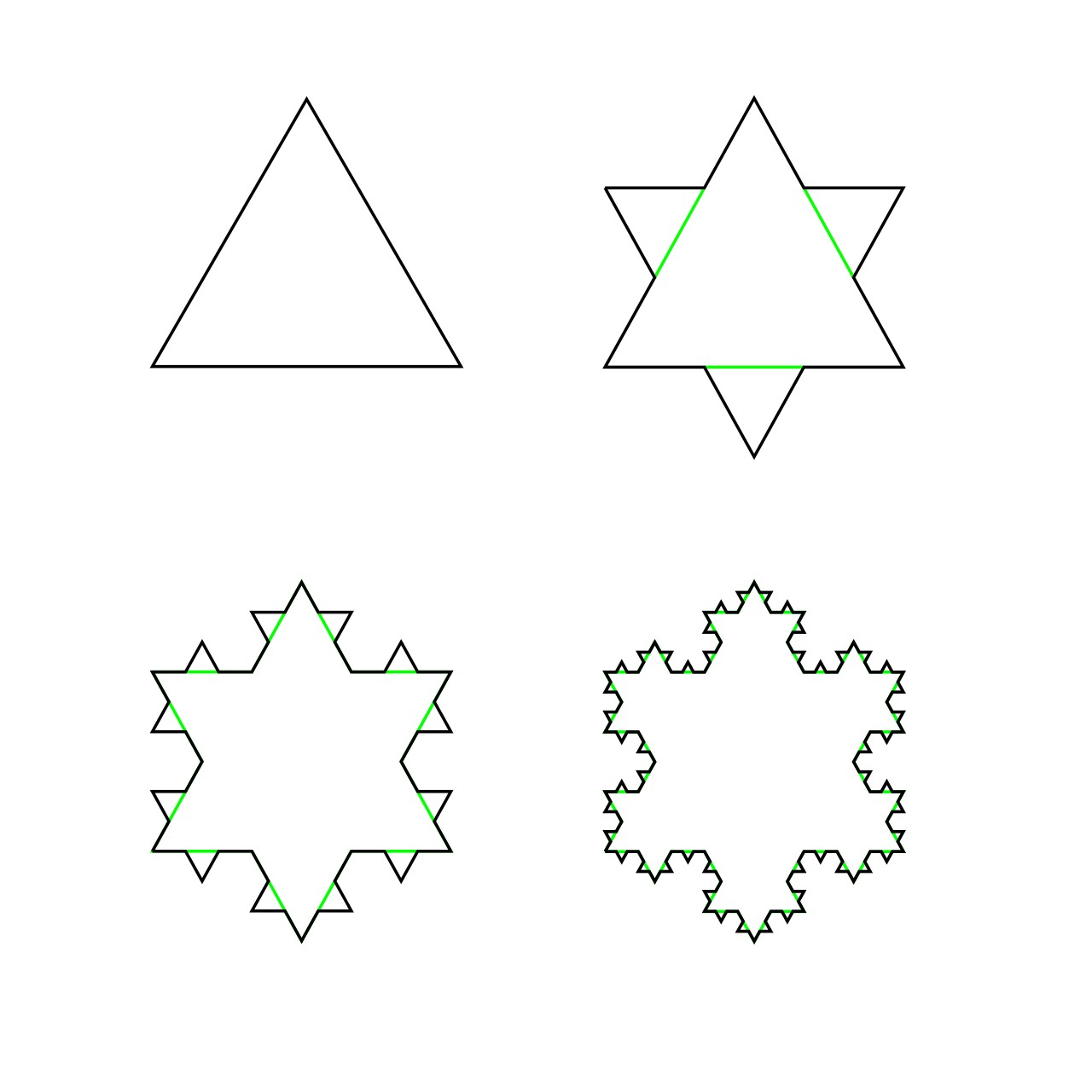
The defining feature of a fractal is self-similarity: the whole is echoed in its parts. Mathematicians distinguish three kinds. Exact self-similarity belongs to pure mathematical fractals, where a magnified piece is a perfect copy of the whole, as in the Sierpinski triangle or the Koch snowflake. Statistical self-similarity belongs to nature, where it is not the exact shape but the statistical texture, the roughness, that repeats across scales, as in a coastline. And quasi-self-similarity, the subtlest kind, belongs to the Mandelbrot set, whose smaller copies resemble but do not exactly match the whole. The tool that makes all this precise is the idea of fractal dimension. We are used to dimensions being whole numbers: a line is one-dimensional, a square two, a cube three. A fractal can have a dimension in between. Roughly, the fractal dimension measures how the detail of a shape grows as you look closer: for a shape made of N copies of itself each shrunk by a factor r, it is the logarithm of N divided by the logarithm of one over r. By this measure the Cantor set has dimension about 0.631 (less than a line, more than a point), the Koch snowflake's edge about 1.262, the Sierpinski triangle about 1.585, and the Menger sponge about 2.727 (more than a surface, less than a solid). A dimension that is not a whole number is the mathematical signature of roughness, and classical geometry has no room for it at all.
02A Two-Line Formula
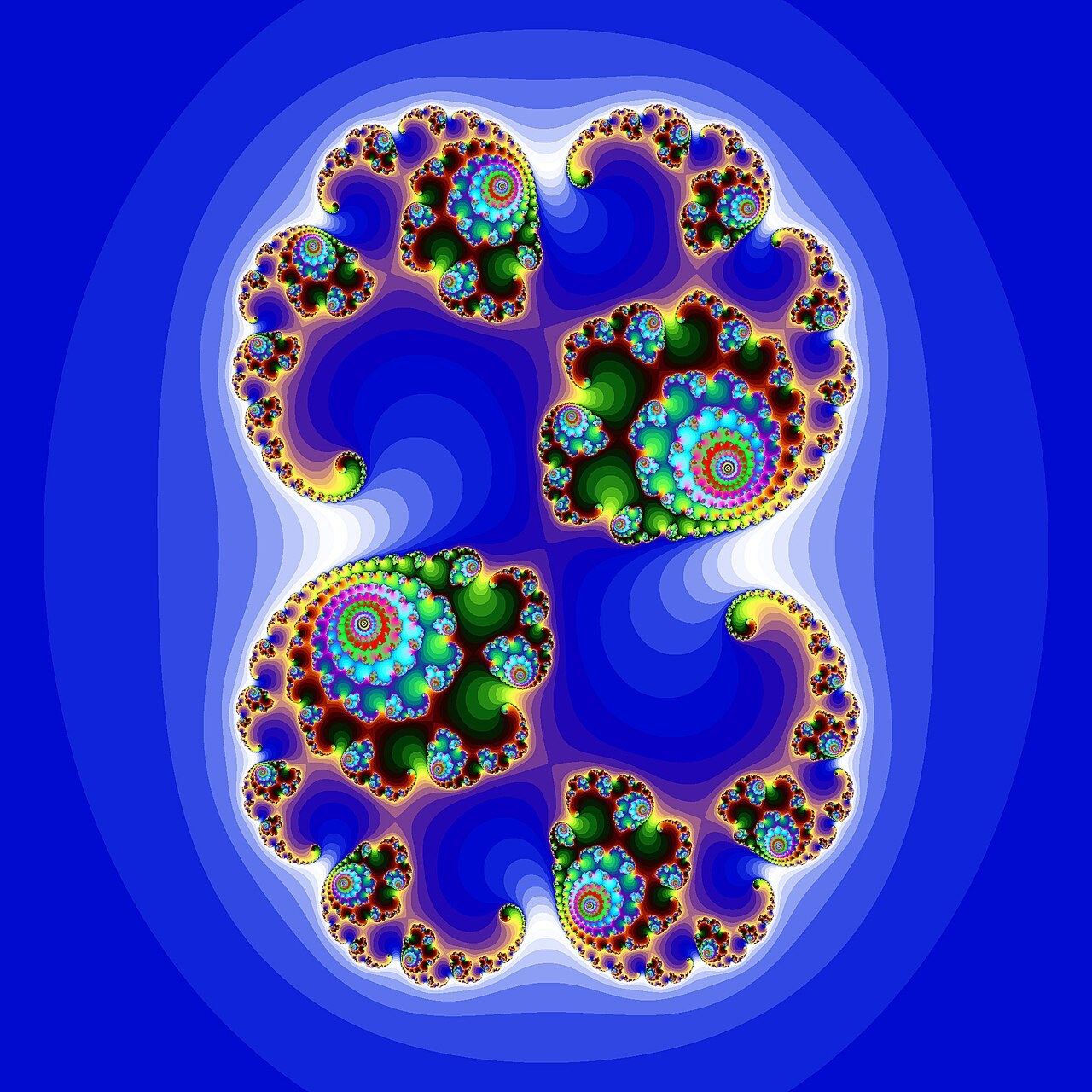
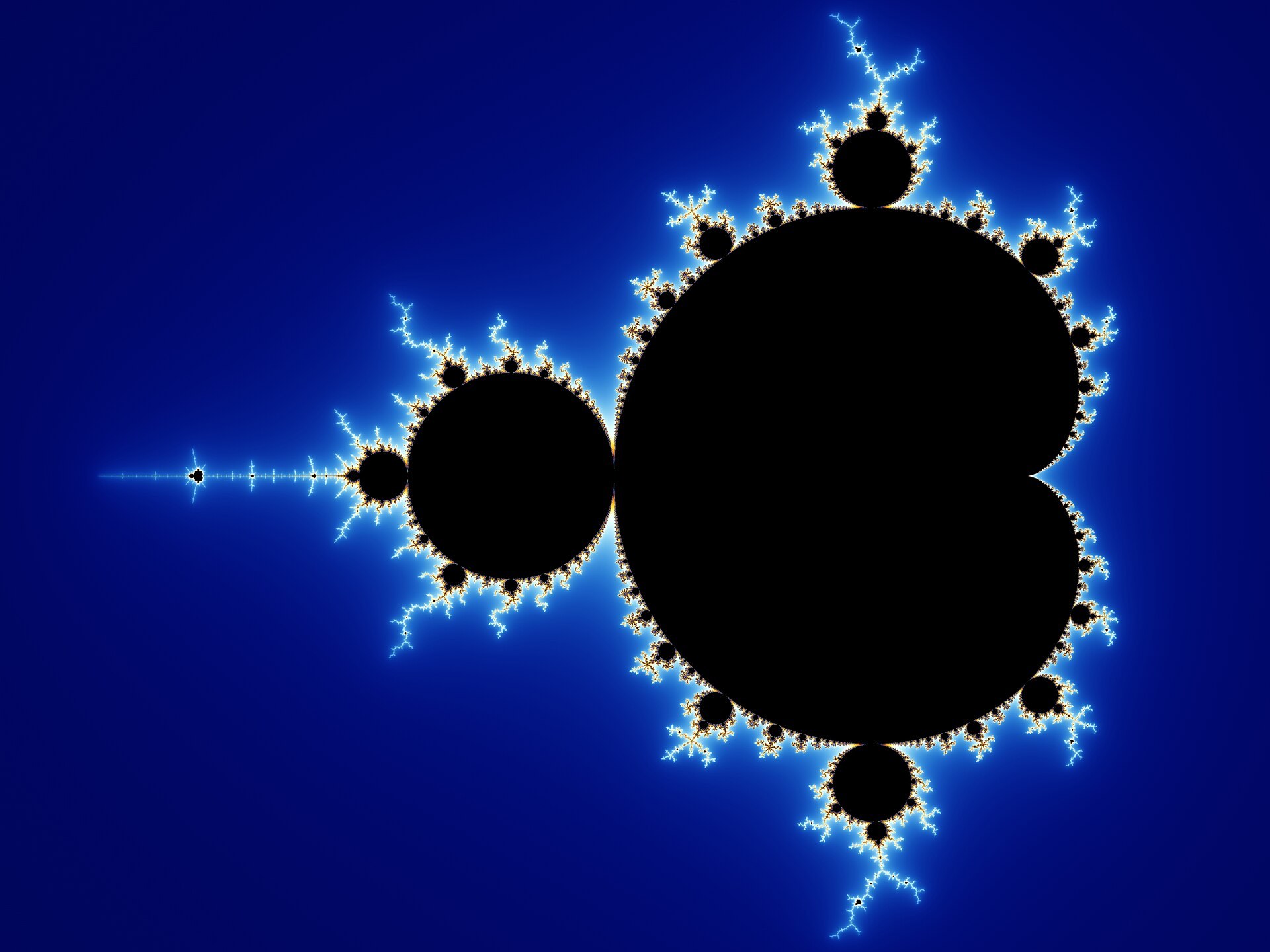
The Mandelbrot set, shown at the top of this page, is the emblem of the whole subject, and it comes from almost nothing. Take a complex number c, start with z equal to zero, and apply one rule over and over: replace z with z squared plus c. For some values of c the result stays bounded forever; for others it races off to infinity. The Mandelbrot set is simply the collection of all the c values that stay bounded. That is the entire definition, a single squaring and an addition, iterated. And yet its boundary is one of the most complex objects mathematics has ever produced: infinitely intricate, studded with miniature near-copies of itself at every scale, sprouting spirals and filaments and seahorse valleys without end. Two hard results pin down just how strange it is. In 1982 Adrien Douady and John Hubbard proved that the set is connected, a single unbroken piece rather than the scattered dust that Mandelbrot himself had first suspected. And in 1998 Mitsuhiro Shishikura proved that its boundary has a fractal dimension of exactly 2, the maximum possible for a curve in the plane, meaning the edge is so infinitely crinkled that it very nearly fills area. Each point c also has its own partner shape, its Julia set; and there is a beautiful law connecting them, that the Julia set is a single connected piece exactly when c sits inside the Mandelbrot set, and crumbles into dust when it does not. That so much structure pours out of so simple a rule is, genuinely, one of the small miracles of mathematics.
03The Coastline of Britain
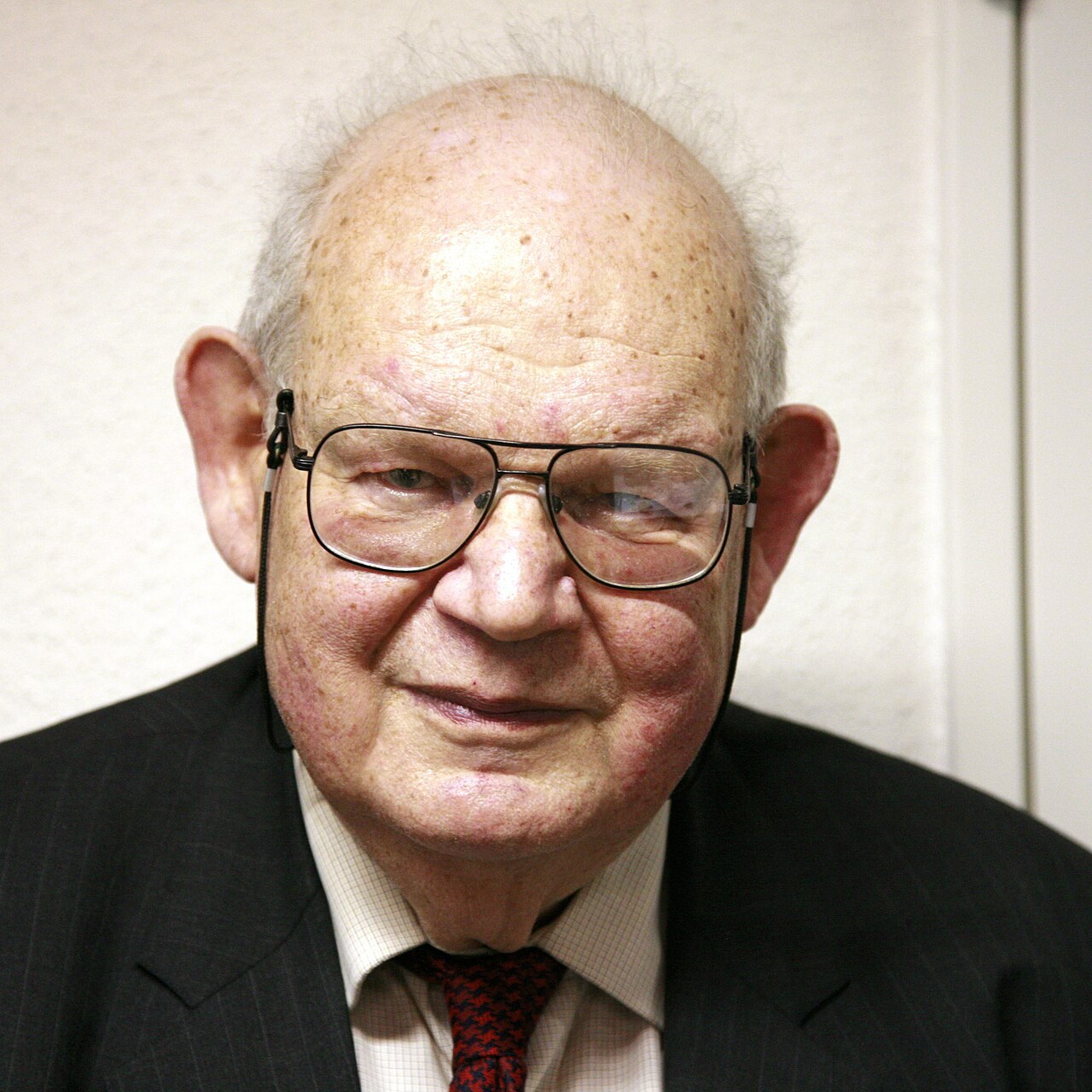
The idea that connected this abstract mathematics to the real world arrived through a deceptively simple question: how long is the coast of Britain? The puzzle was first noticed by the English scientist Lewis Fry Richardson, who observed, while studying the causes of war, that different countries reported wildly different lengths for the same shared border, Spain and Portugal, for instance, gave 987 and 1,214 kilometres. The reason is that the answer depends on the length of your ruler. Measure a coastline with a long ruler and you cut across every bay and inlet; measure it with a shorter one and you follow more of the wiggles, and the total gets longer; use a shorter ruler still, and it gets longer again, with no end in sight. In a landmark 1967 paper, 'How Long Is the Coast of Britain?', Benoit Mandelbrot took Richardson's overlooked observation and gave it a name and a number: the coastline has a fractal dimension, for Britain's about 1.25, that captures exactly how fast its measured length grows as the ruler shrinks. Mandelbrot, a mathematician at IBM with a famously visual and wide-ranging mind, spent the following years gathering such examples from every corner of science. In 1975 he coined the word 'fractal,' from the Latin for 'broken,' and in 1982 his book 'The Fractal Geometry of Nature' made the case, in words and unforgettable pictures, that roughness is not a flaw in nature to be idealized away but a deep and describable order of its own.
04The Unreasonable Effectiveness
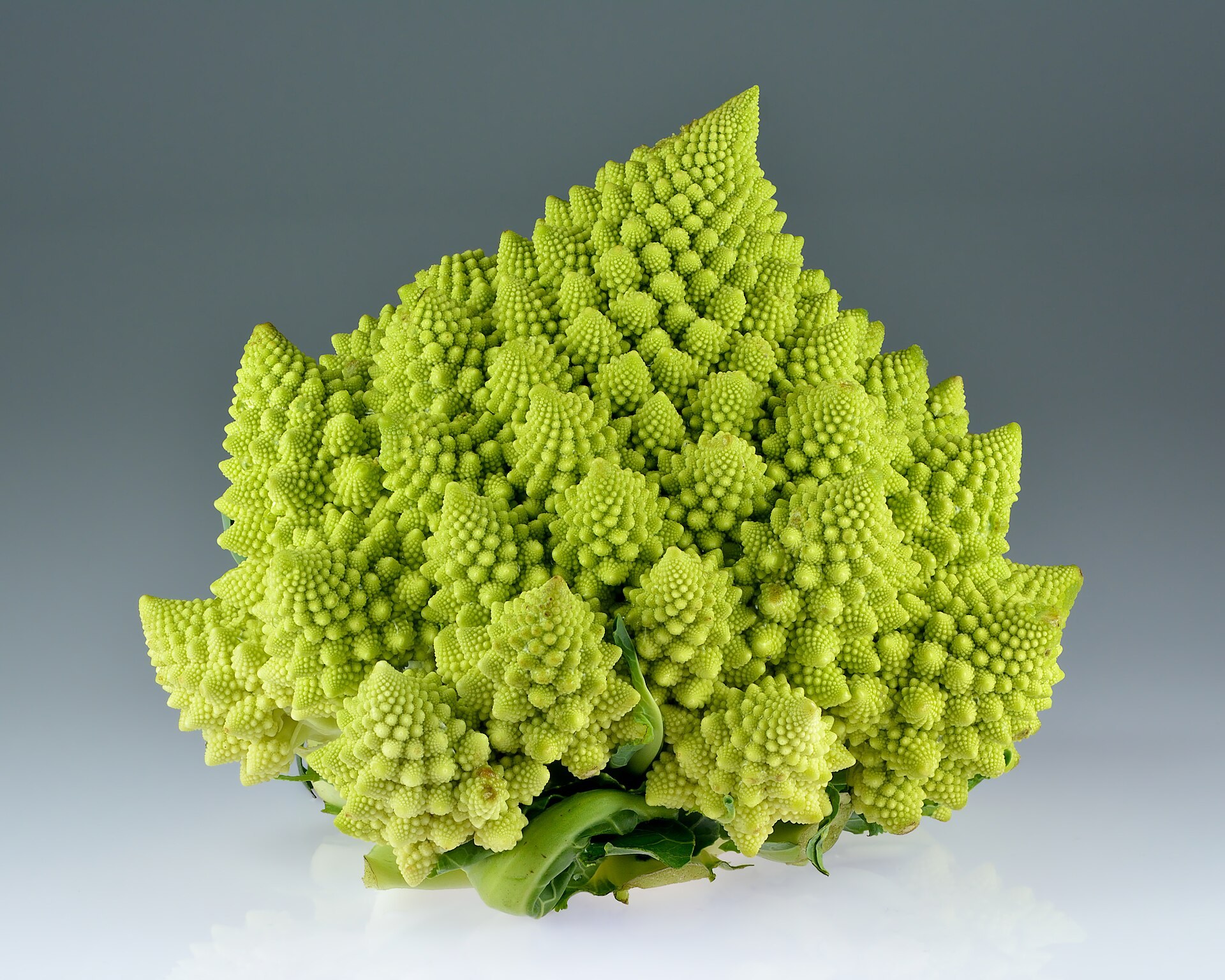
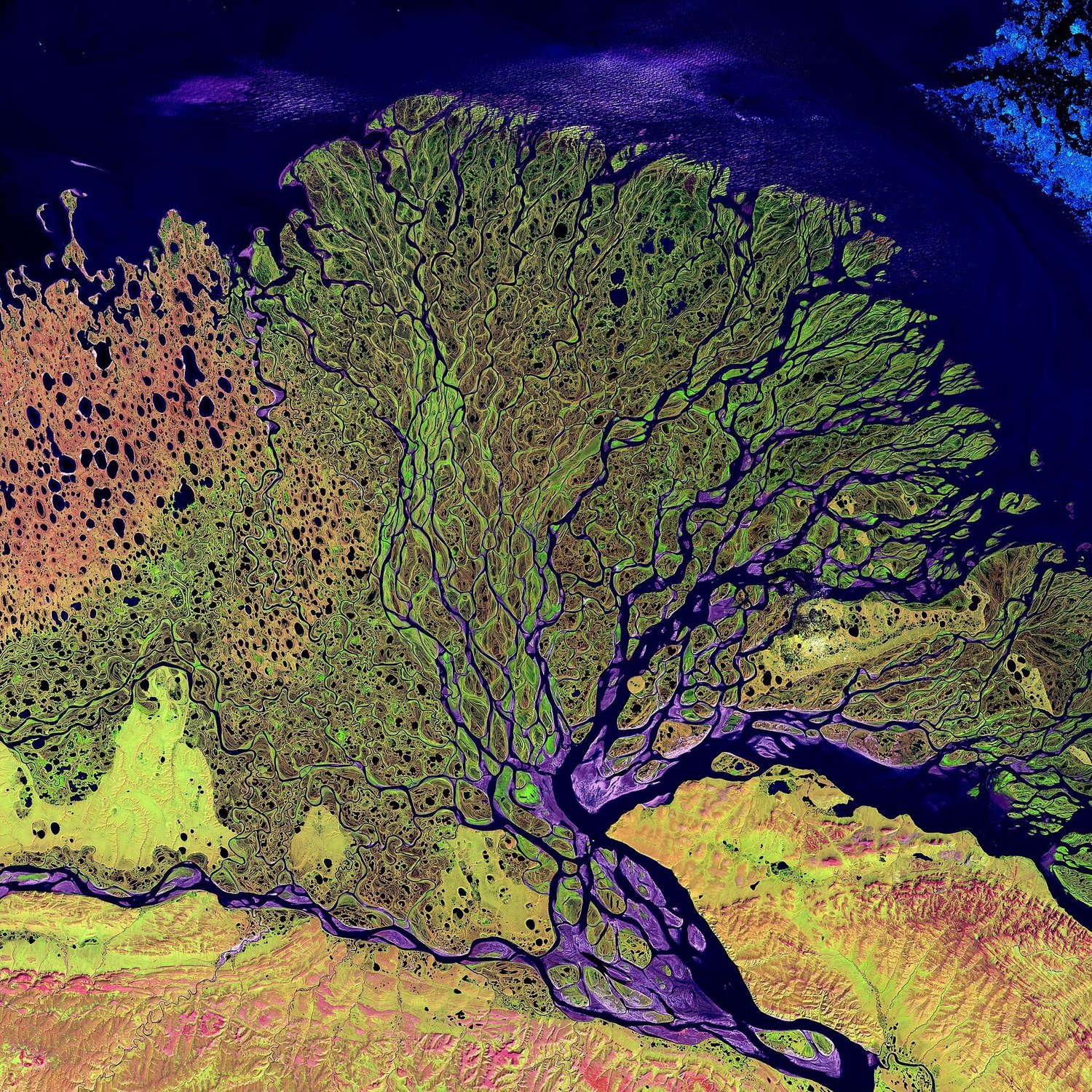
Once you know how to look, fractals are everywhere in nature, and often for good functional reasons. The lung is a fractal: its airways branch through roughly 23 generations to pack a surface area of about 70 square metres into your chest, all to exchange oxygen efficiently. The bloodstream's vessels branch the same way, as do the dendrites of neurons, the veins of a leaf, a fern frond (whose form a computer can reproduce from just four simple rules, the Barnsley fern), and the florets of Romanesco. Rivers carve fractal drainage networks; mountains, clouds, and lightning all wear fractal roughness; the path of a jiggling pollen grain in water (Brownian motion) has a fractal dimension of exactly 2; and galaxies cluster in a fractal-like web across the sky. This 'unreasonable effectiveness' of fractal geometry has made it genuinely useful. It underlies a method of image compression; the roughness of retinal blood vessels and the jaggedness of a tumour's boundary both carry diagnostic information doctors now measure; a healthy heartbeat is subtly fractal, and the loss of that complexity can warn of disease. The same mathematics of scale connects to power laws, the pattern behind city sizes, earthquake magnitudes, and word frequencies, though here a note of caution is due: a careful 2009 study by Clauset, Shalizi, and Newman showed that many confidently claimed 'power laws' do not survive rigorous statistical testing, so the label has to be earned, not assumed.
05What Fractals Are Not
The beauty of fractals, and the ease of the phrase 'self-similar at every scale,' invites a set of overclaims that the honest account has to refuse. The most important one: real natural fractals are only approximately and statistically self-similar, and only over a limited range of scales, never the infinitely-detailed ideal objects of pure mathematics. A fern has a handful of nested branchings, not infinitely many; Romanesco stops after a few levels; a coastline's ruler-dependence stops mattering once your ruler is smaller than a grain of sand. 'Everything is a fractal' is false, and so is the grander version, that the universe itself is a fractal at all scales. Galaxy clustering does look fractal-like out to about 100 megaparsecs, but on larger scales the cosmos becomes smooth and uniform, exactly as the standard model of cosmology says it should; the galaxy surveys and the microwave background both confirm this large-scale homogeneity. Mandelbrot argued for a fractal universe, and on this point the data went against him. A second overreach worth naming: fractals do not explain consciousness. Brain activity can be measured with fractal tools, and those measures correlate with mental states, but a measurement is not a mechanism, and correlation is not explanation. Fractal geometry is a genuinely profound description of roughness. It does not need to be inflated into a theory of everything to be one of the most quietly astonishing ideas in mathematics.
There is one place where fractals and fundamental physics may genuinely meet, and it is openly speculative. Some approaches to quantum gravity suggest that spacetime itself might be fractal at the very smallest scales. Laurent Nottale's 'scale relativity' proposes a spacetime whose fractal dimension changes near the Planck length; and Causal Dynamical Triangulations, a computer approach to quantum gravity, produces a spacetime that behaves as if it were four-dimensional at ordinary scales but effectively two-dimensional at the tiniest ones. These are serious, mathematically motivated ideas. They are also, as their own proponents acknowledge, entirely unconfirmed: the fractal structure of spacetime, if it exists at all, lies far below anything any experiment can currently reach. It belongs on the honest map as a real and fascinating possibility, not as a finding.
Fast Facts
- What a fractal is
- A shape that repeats its pattern (exactly or statistically) across scales, and that can have a fractional dimension, more than a line but less than a filled area
- Fractal dimension
- Measures roughness: Cantor set about 0.631, Koch snowflake about 1.262, Sierpinski triangle about 1.585, Menger sponge about 2.727
- The Mandelbrot set
- All complex numbers c for which z to z squared plus c (starting at 0) stays bounded; connected (Douady-Hubbard, 1982); its boundary has dimension exactly 2 (Shishikura, 1998)
- The coastline paradox
- A coastline's measured length grows without limit as the ruler shrinks; noticed by Lewis Fry Richardson, named and quantified by Mandelbrot (1967). Britain's coast: dimension about 1.25
- The words
- Mandelbrot coined 'fractal dimension' in 1967 and 'fractal' (from Latin 'fractus,' broken) in 1975; his book 'The Fractal Geometry of Nature' appeared in 1982
- In nature
- Lungs (about 23 branchings, roughly 70 square metres), blood vessels, ferns, Romanesco, coastlines, river deltas, Brownian motion (dimension exactly 2), galaxy clustering
- Uses
- Image compression, medical diagnosis (retinal vessels, tumour boundaries, heart-rate variability), turbulence, finance, and the study of power laws
- Refused
- That 'everything is a fractal' or that natural fractals are infinitely detailed; that the universe is fractal at all scales (it is smooth beyond about 100 Mpc); that fractals explain consciousness
What We Can Actually Stand Behind
The mathematics is established, rigorous, and genuinely beautiful. Self-similarity and fractal (Hausdorff) dimension are well-defined; the dimensions of the classic fractals are exact; the Mandelbrot set is precisely defined from z to z squared plus c, was proved connected by Douady and Hubbard (1982), and has a boundary of dimension exactly 2 (Shishikura, 1998). The coastline paradox is real, first noticed by Richardson and quantified by Mandelbrot (1967). Fractals genuinely pervade nature, from the branching lung to river deltas.
The applications are real and active. Fractal image compression, fractal measures in medical diagnosis (retinal vessels, tumour boundaries, heart-rate variability), multifractal models of turbulence and financial markets, scale-free networks, and self-organized criticality are all established, working areas. The connection between fractals and power-law statistics is genuine, with the important caveat (Clauset, Shalizi, and Newman, 2009) that many claimed power laws fail careful testing.
The frontier is open. Whether spacetime itself is fractal at the smallest scales, as scale relativity and Causal Dynamical Triangulations suggest, is a serious but entirely unconfirmed idea, beyond the reach of current experiments. It is a real possibility, not a result.
The overclaims get a no. Natural fractals are approximate and statistical, and self-similar over only a limited range of scales, not the infinitely-detailed objects of pure mathematics. 'Everything is a fractal' is false, and the universe is not fractal at all scales (it is homogeneous beyond about 100 megaparsecs, contrary to Mandelbrot's own conjecture). Fractals do not explain consciousness. The real mathematics is astonishing enough without the inflation.
Fractals open The Gold Thread, this wing's search for the patterns that keep reappearing across nature and mathematics, because they are the purest example of the wing's whole theme: a simple rule, applied without mercy, producing endless structure, and that structure turning up unbidden in the shape of a coastline, a lung, and a delta seen from space. The lesson cuts two ways at once. On one side, it is a genuine wonder that the roughness of the world, which classical geometry threw away as noise, has a hidden order precise enough to be measured in fractional dimensions. On the other, the wonder is best served by keeping it honest: nature's fractals are finite and approximate, the universe smooths out at the largest scales, and a fractal is a description, not an explanation of everything. Hold those together, the real astonishment and the real limits, and you have the geometry of roughness as it actually is, which is strange and beautiful enough to need no exaggeration. The thread runs on from here.
Sources & further reading
Everything above is drawn from our research library on Theories of Anything. Open the full file to check the sourcing and go deeper.
Image credits
- The Mandelbrot set (computer render) Wolfgang Beyer, via Wikimedia Commons. CC BY-SA 3.0 Source.
- Koch snowflake construction (diagram) Wxs, via Wikimedia Commons. CC BY-SA 3.0 Source.
- A Julia set (computer render) Solkoll, via Wikimedia Commons (public domain). Public domain Source.
- Benoit Mandelbrot, 2007 Rama, via Wikimedia Commons. CC BY-SA 2.0 FR Source.
- Romanesco broccoli Ivar Leidus, via Wikimedia Commons. CC BY-SA 4.0 Source.
- Lena River Delta, Landsat 7 (false color) NASA / USGS EROS Data Center, Landsat 7, via Wikimedia Commons. Public domain Source.
- Card crop of the Mandelbrot set render Wolfgang Beyer, via Wikimedia Commons. CC BY-SA 3.0


.jpg)

.jpg)
