
Fibonacci and the Golden Angle
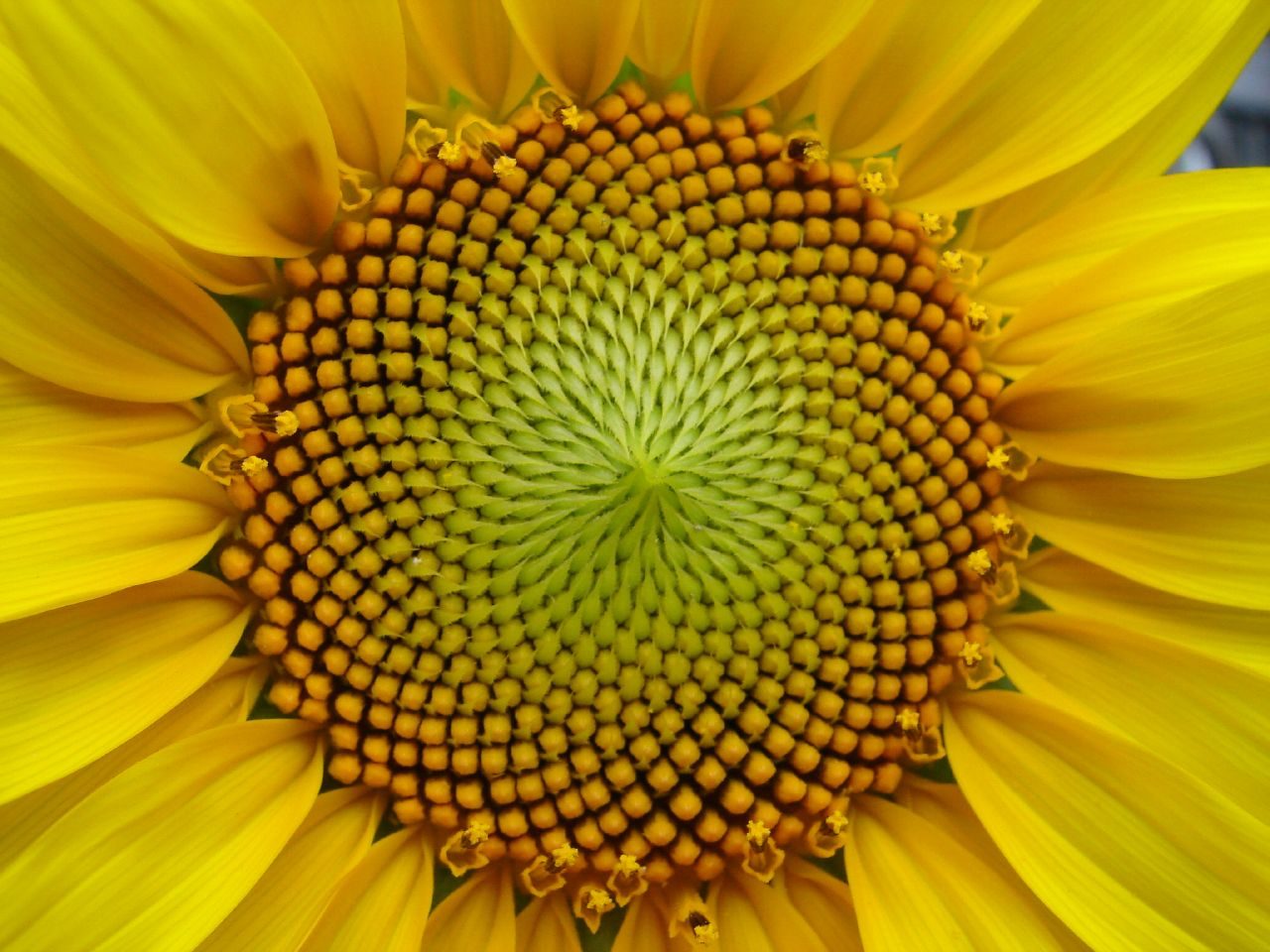
Sunflower seed heads really do tend to carry Fibonacci numbers of spirals, and the turn between one seed and the next really does sit close to 137.5 degrees. Both of those are measured rather than asserted. What is not there is arithmetic hidden inside the plant. Geometrically the numbers follow from a packing rule, each new element forming at the point furthest from the ones already there, and in 1992 that rule produced Fibonacci order in an apparatus with no biology in it at all; which mechanism carries the rule inside a living plant is still an open question. The same subject also carries a century of golden-ratio claims that do not survive measurement, from the Great Pyramid to the chambered nautilus. This page separates the two, and keeps every number attached to what it is a number of.
Count the spirals in a sunflower head and you will typically get 34 running one way and 55 running the other. Count the scales on a conifer cone and you will typically get 8 and 13. Those are Fibonacci numbers, and plants produce them often enough that the pattern has a name, a measurement history, and now a mechanism. It is also the doorway to a great deal of nonsense. The same handful of numbers that describes a real and mechanically explained arrangement of seeds has been pressed onto the Parthenon, the Great Pyramid, the human body and the shell of the chambered nautilus, in claims that come apart the moment anybody measures carefully. Both of those things are true at once, and the work of this page is to keep them apart. What follows is the mathematics that is genuinely there: the sequence, the ratio it approaches, the angle that ratio produces, and the reason a plant arrives at that angle without storing a single number.
01The Sequence and Where It Came From
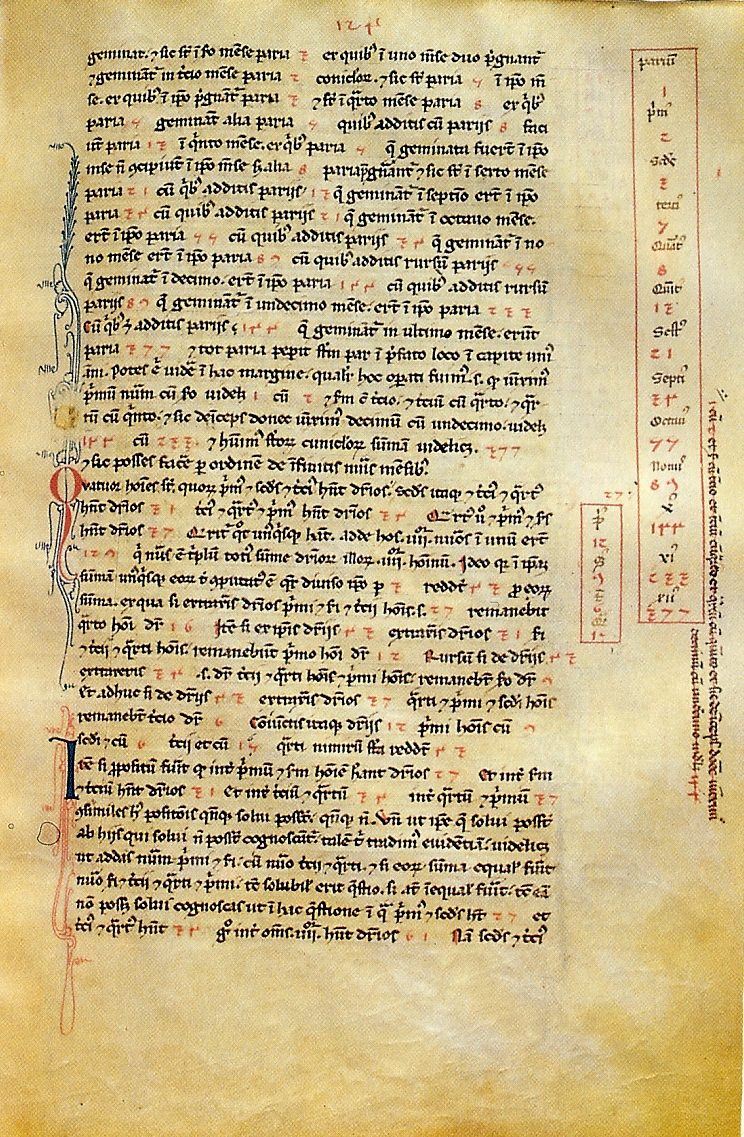
The sequence itself is the simplest object on this page. Start with 1 and 1, and make every number after that the sum of the two before it: 1, 1, 2, 3, 5, 8, 13, 21, 34, 55, 89, 144, and onward. It entered European mathematics in 1202, in a treatise called Liber Abaci by Leonardo of Pisa (1170 to 1250), the man later known as Fibonacci, who presented it as a model of rabbit population growth. The sequence was not what the book was for. Liber Abaci's purpose was to introduce Hindu-Arabic numerals and place-value arithmetic to Europe, and that is the larger thing it did. It was also not new. The same sequence had been described independently in Indian mathematics centuries earlier, in the context of counting metrical patterns in Sanskrit prosody. Our own research file names Virahanka, about 700 CE, Gopala, about 1135 CE, and Hemachandra, 1150 CE. That priority is the subject of a peer-reviewed paper in Historia Mathematica, listed below, though the paper itself could not be read for this page, so the three names and their dates rest on our own file rather than on it.
Divide each Fibonacci number by the one before it, and the answers close in on a single value: the golden ratio, phi, which is one plus the square root of five, all divided by two, or about 1.6180339887. That limit is the only property of phi this page needs. Phi as a number in its own right, standing beside pi and e, belongs to a different article in this wing. The ratio also has a much longer history than the sequence does, and the two were not connected for most of it. Euclid defined it geometrically about 300 BCE, in Book VI, Definition 3 of the Elements, with no reference to Fibonacci numbers at all: 'A straight line is said to have been cut in extreme and mean ratio when, as the whole line is to the greater segment, so is the greater to the less.' Our own research file adds that Luca Pacioli treated the ratio in De Divina Proportione in 1509. We could not confirm a 1509 edition record independently for this page, so that date is carried as our file's and nothing more.
02Phyllotaxis: The Arrangement Itself
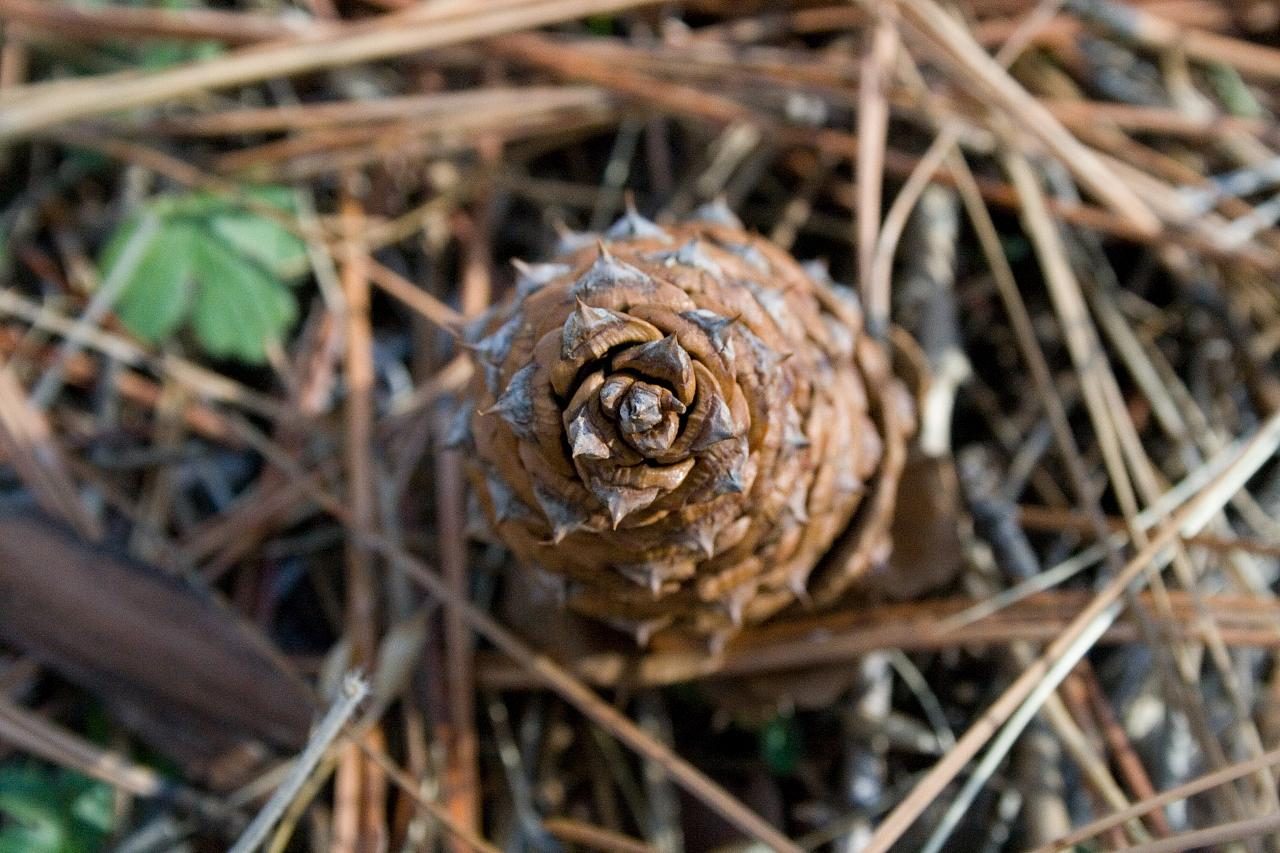
Phyllotaxis, from the Greek phullon, leaf, and taxis, arrangement, is the arrangement of leaves, bracts, petals and seeds around a stem or in a flower head. Our own research file calls it the most rigorous scientific connection between Fibonacci numbers and nature and marks that sentence as a key finding, and the next three sections are why. Two measurements define it. The first is the divergence angle: the turn between one element and the next as they are laid down around the growing tip. In spiral phyllotaxis that angle converges on about 137.5 degrees. The second is the parastichy count: the number of spiral rows visible running clockwise and the number running counterclockwise. Those two counts are characteristically adjacent numbers in the Fibonacci sequence. Sunflower seed heads typically show 34 spirals in one direction and 55 in the other; pinecone scales typically 8 and 13; a pineapple typically 8, 13 and 21. The word typically is doing real work in that sentence and it stays attached to all three. It is a statement about the common case and not a rule, and section 05 shows what a real sample of sunflowers actually produced. The cone and pineapple figures are weaker still: no source carried here measures them across a sample, and they travel as the textbook example they have always been.
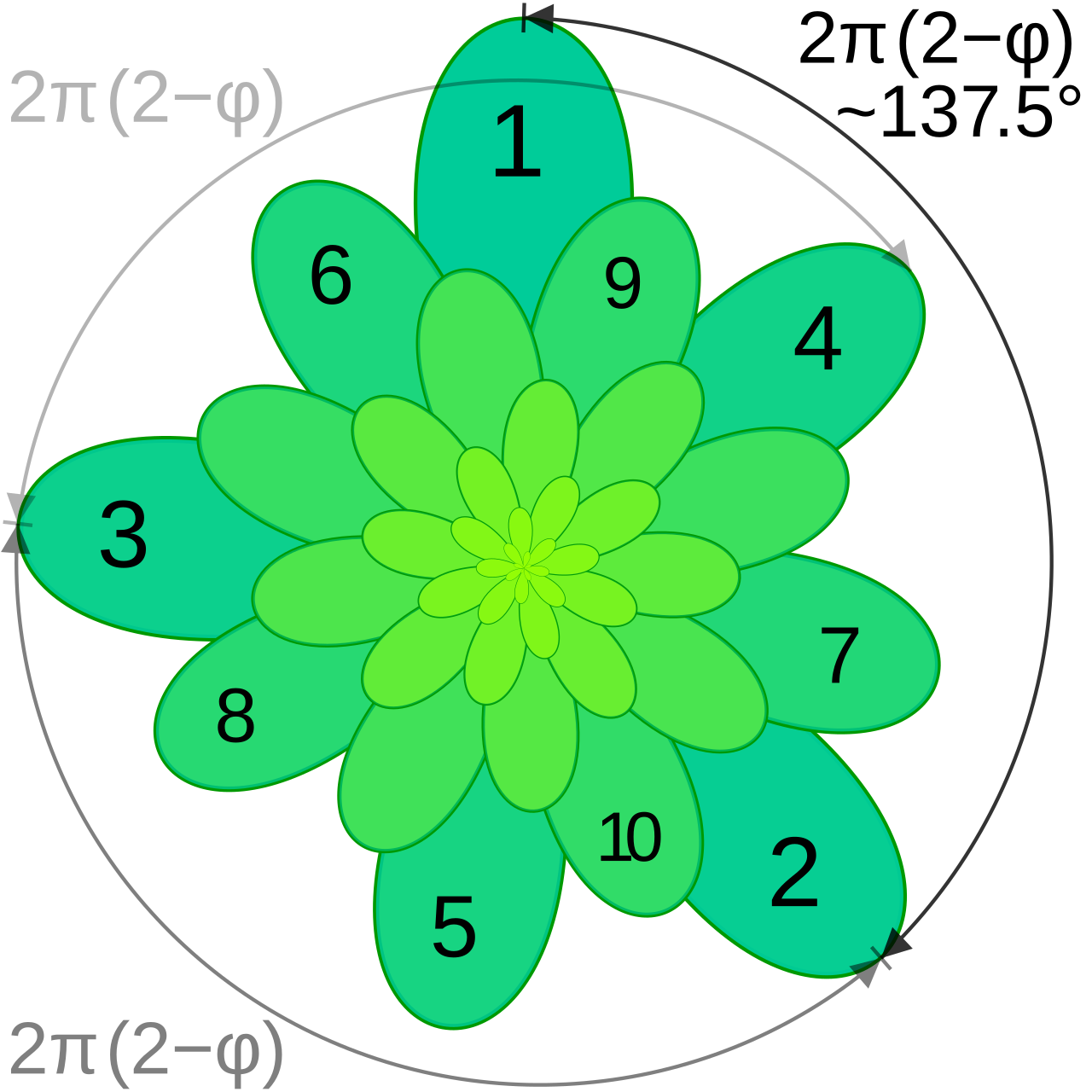
The angle is not arbitrary, and it is where phi enters. The golden angle is 360 degrees divided by phi squared, which comes to about 137.5078 degrees; our own files give it as about 137.5 and about 137.507, and about 137.5 is how it is usually written. It has one consequence worth stating precisely, because this is the point where careful writing about the subject tends to slip. Because phi is irrational, elements placed at successive golden-angle turns never line up: nothing ever comes to rest directly above anything else, however many turns are taken. That is a fact about geometry and it is not in dispute. The further claim, that a plant does this in order to catch more light or gather more nutrients, is a different kind of claim altogether, about function and about selection, and neither of our research files sources it. This page states the geometry and stops there.
03The Rule That Needs No Biology
The field did not begin with the experiment that made it famous. G. J. Mitchison's 'Phyllotaxis and the Fibonacci Series' appeared in Science in 1977, and Adler, Barabe and Jean published a history of the study of phyllotaxis in Annals of Botany in 1997, in which the subject already had a long past. But 1992 is when the question changed shape. Stephane Douady and Yves Couder, working at the Laboratoire de Physique Statistique in Paris, published 'Phyllotaxis as a Physical Self-Organized Growth Process' in Physical Review Letters, demonstrating in laboratory experiments with ferrofluid droplets that Fibonacci spiral patterns emerge from the dynamic packing of elements placed one after another. There was no biology in the apparatus at all: no genes, no hormones, no plant, just drops placed in sequence in a system where each new one had to fit around the ones already there.
The rule the pattern needs is startlingly thin. Each new element forms at the point of lowest energy, which is to say at the point furthest from the elements already present. That is the whole of it. Our own research file is careful about what this does and does not mean, and the care matters: what is not required is biological programming for Fibonacci numbers per se. Genes are doing a great deal here, as the next section shows. What genes are not doing is holding a copy of the sequence and reading it out. The numbers are a consequence of how objects pack when they are laid down one at a time around a growing point, and a plant would produce them whether or not anything inside it had ever heard of Leonardo of Pisa.
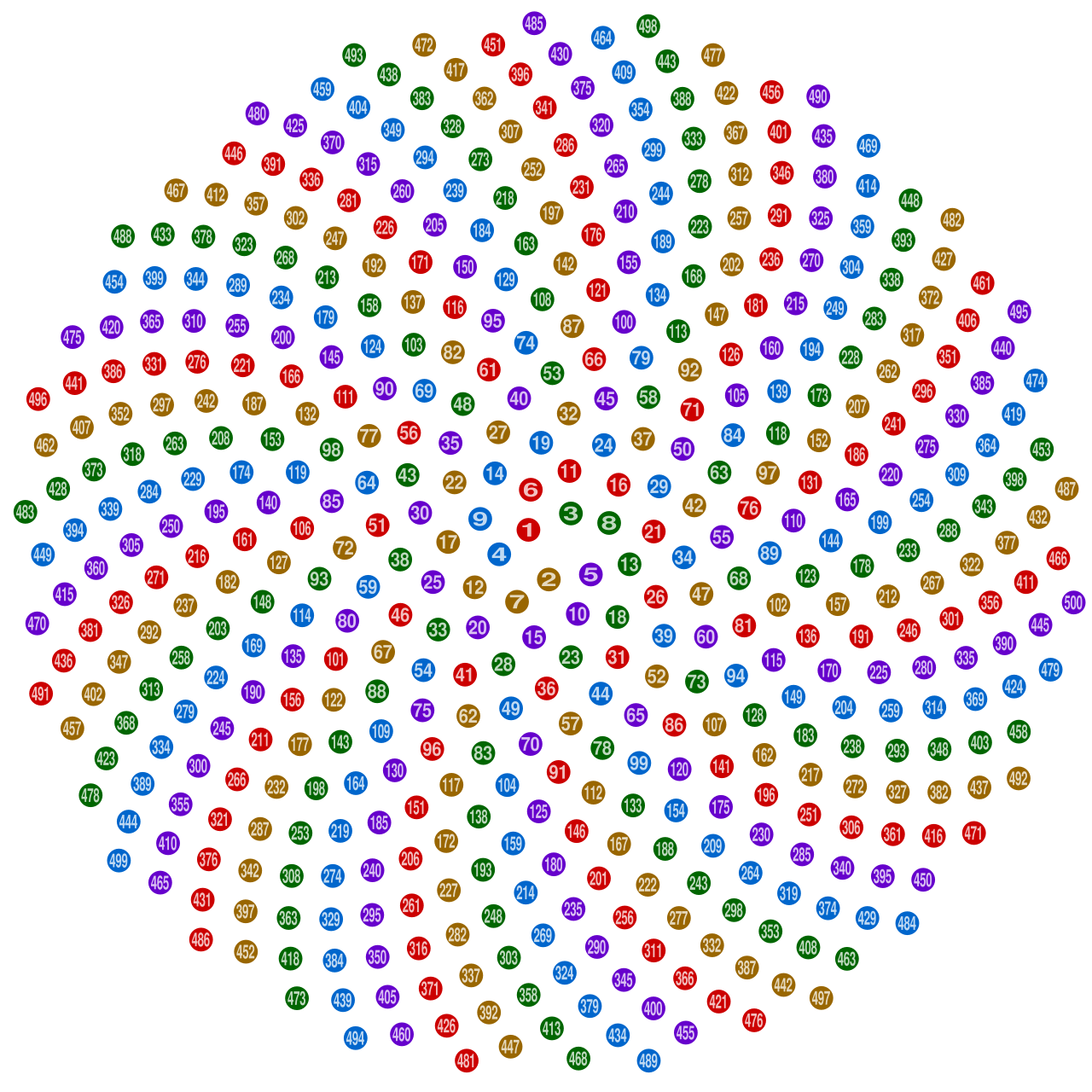
You can watch the same thing happen on paper. In 1979 Helmut Vogel, at the Technische Universitaet Muenchen, gave a model of sunflower seed arrangement that is almost embarrassingly short: place each seed at an angular increment of the golden angle from the last, with its radial distance proportional to the square root of the seed number. Run that, and the characteristic Fibonacci spiral counts appear. One point of care about what the paper claims. Its registered title is 'A better way to construct the sunflower head', which is a construction, not a proved optimality theorem, and our own research file overstates it as a demonstration that golden-angle packing produces maximum density. The packing-efficiency question was analysed in its own right by J. N. Ridley in Mathematical Biosciences in 1982, in a paper called 'Packing efficiency in sunflower heads', and taken up again as an explicit disk-packing problem by Mughal and Weaire in Physical Review E in 2017. Neither paper was read for this page, so no conclusion of theirs is stated here; what they establish is that the packing question has a literature of its own. The distinction is worth keeping, because the real claim is narrower and more interesting than the popular one: what is at stake is optimality for a particular packing problem, not optimality in general. Okabe's 2015 paper in Scientific Reports puts that in its own title, 'Biophysical optimality of the golden angle in phyllotaxis'. There is a rigorous mathematical account of the same process as well. Atela, Gole and Hotton, in the Journal of Nonlinear Science, analysed primordium placement as a dynamical system and showed the golden angle emerging as a stable attractor of it. The angle is not chosen. It is where the process settles.
04Several Accounts of One Pattern
The physics is not the end of the story, because something has to place the elements, and in plants that something is now known in molecular detail. Phyllotaxis is regulated by polar auxin transport. Reinhardt and colleagues showed in Nature in 2003 that the positioning of new organ primordia at the shoot apex is controlled by the transport of the plant hormone auxin: existing primordia deplete auxin from their surroundings, so the next primordium forms where auxin can still accumulate, which is the position furthest from the ones already there. That is the same rule the ferrofluid obeyed, implemented in chemistry. Genes build the transporters, the transporters enforce the rule, the geometry does the rest, and the Fibonacci numbers arrive at the end of that chain rather than at the start of it. Neither of our research files mentions auxin anywhere, which leaves a reader with physics doing everything and genetics doing nothing, and that is not right.
The most recent synthesis comes from one of the people who ran the 1992 experiment. Godin, Gole and Douady, writing in Development in 2020, argue that the spiral patterns are progressively canalized by local interactions between newly forming organs, and that because organogenesis works much the same way across plants, Fibonacci phyllotaxis is prevalent for that reason rather than because anything is aiming at it.
Not everybody models it the same way. Shipman and Newell, in Physical Review Letters in 2004, treat phyllotaxis as a mechanical problem rather than a chemical one. In their own words, phyllotaxis and the surface deformations that come with it 'may be understood as the energy-minimizing buckling pattern of a compressed shell (the plant's tunica) on an elastic foundation'; on that model they 'reproduce a wide spectrum of plant patterns, all with the divergence angles observed in nature', and the Fibonacci-like sequences and the golden angle arrive as natural consequences of it. This needs saying plainly because our own research file has it backwards: it describes Shipman and Newell as connecting Turing-type models to Fibonacci phyllotaxis, under a section heading about Turing's morphogenesis. Their model is elastic and mechanical. It is an alternative to the chemical picture rather than a development of it, and we correct our own file here rather than repeat it.
Turing does belong in this story, but not quite where our file puts him. He published 'The Chemical Basis of Morphogenesis' in the Philosophical Transactions of the Royal Society of London Series B in 1952, proposing reaction-diffusion systems as a mechanism for biological pattern formation, and that paper is about pattern formation in general. His work on Fibonacci phyllotaxis specifically was largely unpublished when he died in 1954. It appeared posthumously in the Morphogenesis volume of the Collected Works of A. M. Turing, edited by P. T. Saunders, in 1992, and the scholarly account of it is Jonathan Swinton's chapter 'Watching the Daisies Grow: Turing and Fibonacci Phyllotaxis', published in 2004. Attributing the Fibonacci proposal to the 1952 paper, as our file does, is a real misattribution. The true connection is better anyway, and it arrives in the next section: the largest empirical study of Fibonacci structure in sunflowers exists, and carries his name, because of that unpublished sunflower work.
| The Account | What It Proposes | Where It Comes From |
|---|---|---|
| Geometric Packing | Each new element forms at the point furthest from the existing ones. Fibonacci counts and the golden angle fall out of that placement rule alone, with no biology present | Douady and Couder, Physical Review Letters, 1992; Ridley, Mathematical Biosciences, 1982; Mughal and Weaire, Physical Review E, 2017 |
| Dynamical Attractor | The same placement process analysed rigorously as a dynamical system, in which the golden angle emerges as a stable attractor | Atela, Gole and Hotton, Journal of Nonlinear Science |
| Auxin Transport | Existing primordia deplete the hormone auxin around them, so the next primordium forms where auxin can accumulate, which is the position furthest from the others | Reinhardt and colleagues, Nature, 2003 |
| Mechanical Buckling | The pattern is the energy-minimizing buckling pattern of a compressed shell, the plant's tunica, on an elastic foundation. An alternative to the chemical account rather than a development of it | Shipman and Newell, Physical Review Letters, 2004 |
| Reaction and Diffusion | Chemicals interacting and spreading at different rates generate biological pattern. Proposed for pattern formation in general in 1952; the Fibonacci phyllotaxis work was unpublished at the author's death | Turing, Philosophical Transactions of the Royal Society of London Series B, 1952; Morphogenesis, Collected Works, 1992 |
| Geometric Canalization | The spirals are progressively canalized by local interactions of nascent organs, and the uniformity of organogenesis across plants is what makes Fibonacci phyllotaxis prevalent | Godin, Gole and Douady, Development, 2020 |
05What Happens When You Count Them
In 2012 the Museum of Science and Industry in Manchester ran a citizen science project called Turing's Sunflowers, to mark the centenary of Alan Turing's birth, and asked the public to grow sunflowers and count the spirals. The results were published in 2016, in Royal Society Open Science, by Jonathan Swinton, Erinma Ochu and the MSI Turing's Sunflower Consortium. It is the largest empirical study of Fibonacci structure in sunflowers, and its own numbers are worth reading instead of the summary that usually travels with them. In the paper's words: 'We collected data on 657 sunflowers. In our most reliable data subset, we evaluated 768 clockwise or anticlockwise parastichy numbers of which 565 were Fibonacci numbers, and a further 67 had Fibonacci structure of a predefined type.' 565 and 67 together are 632 of 768, which is about 82 percent.
That 82 percent is the number this subject repeats, and it is almost always repeated wrongly. It is not 82 percent of sunflowers. It is 82 percent of parastichy counts in the most reliable subset of one study, and the paper's own headline finding is the other side of the same coin: 'nearly 20% of parastichy numbers did not have Fibonacci structure'. Our own research file gets four separate things wrong about this study inside a single sentence, and since a reader can go and look at that file, the sentence is worth quoting whole: 'A 2012 citizen science project led by Jonathan Swinton and the Royal Society counted spirals in over 600 sunflower heads, confirming Fibonacci numbers in approximately 82% of cases, with Lucas numbers and other phyllotactic patterns in most of the remainder.' The project was run by the Museum of Science and Industry in Manchester; the Royal Society published the journal the results appeared in. The study is a 2016 publication, and 2012 is when the sunflowers were grown. The 82 percent is a proportion of 768 parastichy counts and not of the heads. And the clause about the remainder is wrong in a sharper way than the other three, which is why it gets a paragraph of its own.
Lucas numbers are not in the remainder at all. The paper counts them as a kind of Fibonacci structure, inside the 82 percent, and its Table 1 shows exactly how that total is built. Of the 768 parastichy numbers in the most reliable subset, 565 were Fibonacci numbers outright, which is 74 percent on its own. The further 67 that the abstract describes as having Fibonacci structure of a predefined type are 41 Lucas counts, 25 double Fibonacci, and a single count under a fourth heading the paper labels F4, with Lucas the more common of the first two. Those three add to the 67, and 565 plus 67 is the 632 that comes to 82 percent. What is actually left over is a different set entirely: 49 counts one less than a Fibonacci number, 17 one more, and 70 that the paper files simply as other, which is 136 counts in all, or 18 percent. The excess of one-less over one-more, 49 against 17, is reported as statistically significant. And the study found an unexpected class of quasi-regular heads to which no parastichy number could be definitively assigned at all.
The sharpest condition on the whole figure comes from the paper itself: 'It is worth pointing out the warning of Cooke [19] that numbers from these sequences make up all but three of the first 17 integers. This means that it is particularly valuable to look at specimens with large parastichy numbers, such as the sunflowers, where the prevalence of Fibonacci structure is at its most striking.' Count loosely enough to admit Lucas numbers, double Fibonacci and F4, and almost any small count qualifies as Fibonacci structure of some kind. That is exactly why the sunflower data is the part that carries weight: its parastichy numbers are large, and agreement at counts that high is not something the arithmetic hands you for free.
Beyond sunflowers, the figure people quote is 91 percent, and it also has conditions attached to it. It comes from R. V. Jean's survey of the phyllotaxis literature, covering 650 species, and Howell, Roessler and Gee restate it in Annals of Botany as: 'Today, Fibonacci spirals constitute 91 % of documented phyllotactic patterns in 650 species of angiosperms and gymnosperms.' Read that sentence closely. It is a proportion of documented phyllotactic patterns in a survey of the published literature, not a proportion of plants, and the literature is itself selected toward plants somebody thought worth counting. The figure is quoted at both 91 and 92 percent in different restatements. About 90 percent of documented spiral phyllotactic patterns in a 650-species literature survey is the honest form of it. One note for anyone chasing the citation: the Annals of Botany paper dates Jean's book to 1992, and its verified publication year is 1994.
The dominance is real and it is not universality. Todd Cooke, at the University of Maryland, made that point in the Botanical Journal of the Linnean Society in 2006, in a paper whose title is this article's central question in one line: 'Do Fibonacci numbers reveal the involvement of geometrical imperatives or biological interactions in phyllotaxis?' Fibonacci phyllotaxis is common, he notes, but many plants show non-Fibonacci patterns; bijugate, trijugate and decussate arrangements are widespread; and the dominance of Fibonacci patterns, while genuine, has been exaggerated in popular accounts. A footnote on that paper, since a reader may go looking for it: the identifier our own research file carries for it is not a registered one and returns nothing. The correct identifier is in the sources below.
| The Figure | What It Actually Measures | Where It Comes From |
|---|---|---|
| About 82 Percent | 565 Fibonacci numbers plus 67 counts with Fibonacci structure of a defined type, out of 768 clockwise or anticlockwise parastichy numbers in the most reliable subset of one study. Not 82 percent of sunflowers, and nearly a fifth of the counts had no Fibonacci structure at all | Swinton, Ochu and the MSI Turing's Sunflower Consortium, Royal Society Open Science, 2016 |
| 91 Percent | A proportion of documented spiral phyllotactic patterns in a survey of the published literature covering 650 species of angiosperms and gymnosperms. Not a proportion of plants and not a random sample of the flora. Quoted elsewhere as 92 percent | R. V. Jean's survey, restated by Howell, Roessler and Gee, Annals of Botany |
| 34 and 55 | The typical parastichy counts of a sunflower seed head, with 8 and 13 typical for a pinecone and 8, 13 and 21 for a pineapple. Typical, not universal, and no source carried here measures the cone or pineapple figures across a sample | Our own research file on mathematics in natural forms, V_4_06 |
| About 1.33 | The side ratio of a rectangle enclosing the spiral of a chambered nautilus shell, about 1.33 across shells in one museum collection over a measured range of 1.24 to 1.43, against about 1.618 for a golden rectangle | Falbo, The College Mathematics Journal, 2005, on shells at the California Academy of Sciences measured in 1999 |
| About 137.5 Degrees | The divergence angle between successive elements in spiral phyllotaxis, equal to 360 degrees divided by phi squared, or about 137.5078 degrees. This one carries no hidden denominator: it is a property of the arrangement itself | Douady and Couder, 1992; Vogel, 1979; Okabe, Scientific Reports, 2015 |
06What Does Not Survive Measurement
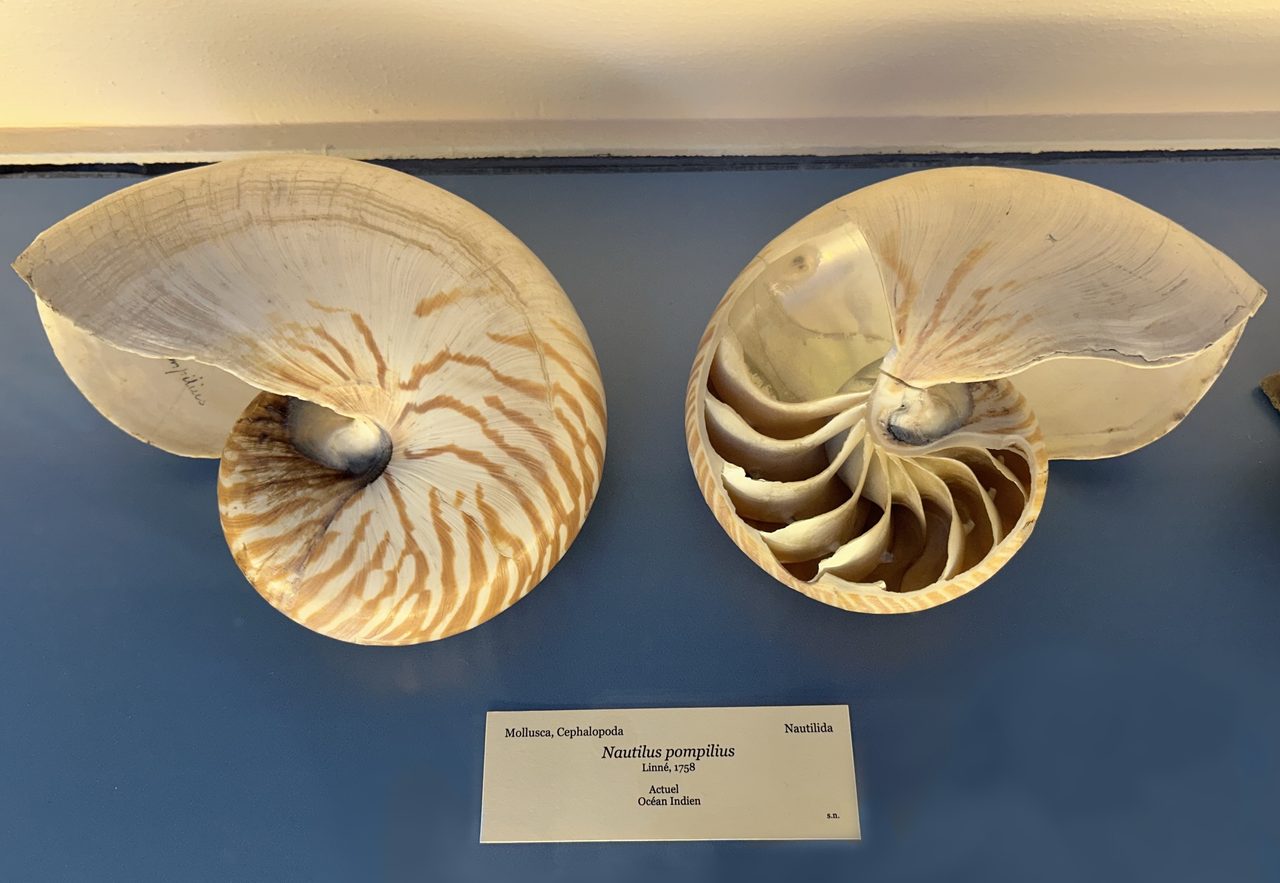
Now the other half. The claims that do not survive measurement get about a fifth of this page, which is the right proportion for them, because refuting them is not what this subject is for. Begin with the shells, because the honest version is more interesting than the famous one. Some gastropod shells do grow in logarithmic spirals, also called equiangular spirals, described in polar coordinates by r equals a times e to the power b theta. D'Arcy Wentworth Thompson discussed this at length in On Growth and Form in 1917, noting that the growth ratio can approximate phi. The shape has an elegant defining property: it keeps a constant angle with the radii drawn from its centre, and it is what growth produces whenever material is added in a fixed angular proportion. Jacob Bernoulli (1654 to 1705) admired it enough to call it spira mirabilis and to ask for it to be engraved on his tombstone, where the engraver cut an Archimedean spiral instead. This is also where the shell connection should stop, and our own research file says so: it is weaker than the phyllotaxis connection. Shell growth follows logarithmic spirals for general geometric reasons, namely constant proportional growth, and only some species produce spirals anywhere near the golden ratio. That is where the gastropods end and the shell the whole argument is really about begins. The chambered nautilus, Nautilus pompilius, has chambers each about 6 to 7 percent larger than the one before, and its cross-section approximates a logarithmic spiral but not a golden one.
The famous claim is that the chambered nautilus shell is a golden spiral, and the famous claim is false. It is the example this subject repeats most often, including in otherwise careful sources, and the shell is a logarithmic spiral rather than a golden one. Clement Falbo measured the difference and published it in The College Mathematics Journal in 2005, in a paper called 'The Golden Ratio: A Contrary Viewpoint'. He measured nautilus shells in the collection of the California Academy of Sciences in San Francisco in 1999 and found that their spirals could be inscribed in rectangles with sides in a ratio of about 1.33, over a measured range of 1.24 to 1.43, against 1.618 for a golden rectangle. Put the other way round: a nautilus roughly triples in radius over a full turn, while a golden spiral grows by a factor of about 6.85 over the same turn. Those are not close. Falbo's own conclusion, quoted by Ivars Peterson in Science News, is worth having in full: it 'seems highly unlikely that there exists any nautilus shell that is within 2 percent of the golden ratio, and even if one were to be found, I think it would be rare rather than typical.'
The Great Pyramid of Giza is the other standing example, and it fails for a different reason: not measurement error but measurement choice. The claim that the pyramid was designed using phi rests on selective measurement. Roger Herz-Fischler showed that the pyramid's proportions are consistent with several simple ratios, and there is no textual or archaeological evidence that ancient Egyptians knew or used the golden ratio at all. A note on the citation, because we had to correct our own file to make it: that file credits the finding to Herz-Fischler's A Mathematical History of the Golden Number. His dedicated treatment of the pyramid is a separate book, The Shape of the Great Pyramid, published in 2000, and that is the one listed below.
Behind both of those sits a general finding. George Markowsky documented the wider problem in 'Misconceptions about the Golden Ratio' in The College Mathematics Journal in 1992: many alleged examples of phi in art, architecture and nature result from cherry-picking which measurements to take, or from using criteria vague enough that any ratio anywhere near 1.6 will count. The Parthenon, the Great Pyramid and the human body are among the claims that literature examines. The proportions of famous paintings, the Mona Lisa above all, belong to the same family of claims and fall under the same general finding. Two limits on how this page uses Markowsky, both worth stating out loud: we could not read his paper, so we carry only the general finding that both of our own research files carry as well, and we attribute to him no specific number, no enumerated example and no result about any particular canvas. The same argument has a small literature of its own: Roger Fischler's 1981 paper in The Fibonacci Quarterly carries the point in its registered title, 'How to Find the "Golden Number" Without Really Trying'. And our own research file on mathematics in natural forms labels the umbrella claim, that the golden ratio is everywhere in nature, as exaggerated, which is the right label. Many popular examples rest on selective measurement, post-hoc pattern fitting or plain error; the human body's proportions do not consistently equal phi; and many natural spirals and proportions have no relation to the golden ratio whatsoever. That file's own closing line on the point is the one worth carrying forward: 'The genuine mathematical phenomena are remarkable enough without the exaggeration.'
One more, and it is the claim this page is most at risk of repeating, because our own research library states it as verified. Our file on mathematics in natural forms says that most flowers have Fibonacci numbers of petals, and lists 3, 5, 8, 13 and 21. No source in front of us supports that as stated. There is no sample, no counting protocol and no citation behind it anywhere in either file, and petal number is a different measurement from parastichy number, so none of the phyllotaxis evidence above transfers to it. Petal counts are the version of this claim most often repeated and the one with the least measurement behind it in our sources, and we are not going to repeat it. That it sits at Tier 1 in our own file while the same file's Tier 4 section labels golden-ratio-everywhere claims exaggerated is a defect in our library, and it has been logged as one.
Two further claims sit at Tier 3 rather than Tier 4, because they are unvalidated rather than refuted. The first is a trading system. A. J. Frost and Robert Prechter's Elliott Wave Principle, first published in 1978, holds that stock market price movements follow Fibonacci ratios. Our research file records that it is widely used in technical analysis, that it has not been validated in controlled studies, and that it lacks a credible causal mechanism, and that is as far as this page goes on the subject. The second is a research aspiration, and it is easy to mistake for the mystical version because it sounds so much like it. Some researchers propose that Fibonacci patterns represent a universal attractor in self-organizing systems, appearing wherever sequential packing or growth optimization occurs. Our own file states plainly, in the same breath, that this extends beyond the evidence, which is largely limited to phyllotaxis and a few other specific contexts. Both halves of that belong together. Detached from the second half, it becomes exactly the sentence a numerologist wants.
Two questions this page deliberately does not answer. Whether the golden rectangle is the shape people find most pleasing is a question with its own review literature in psychology, surveyed by Christopher D. Green in Perception in 1995; and whether pattern in human design carries intended meaning is the subject of a forthcoming article in this wing on sacred geometry, which is where the Parthenon, the cathedrals and the intentionality argument belong. Phi as a number in its own right belongs to a third article, on the great constants. Self-similarity in nature has already been done here, in this wing's article on fractals. When this page reaches the edge of its territory it names the neighbour and stops.
07Holding Both at Once
Two things are true at the same time, and the discipline this page has tried to keep is that neither of them touches the other.
The plant result is real. Parastichy counts in sunflower heads and cones are counted rather than asserted. The divergence angle near 137.5 degrees is measured, and it is a genuine optimum for a real packing problem. Douady and Couder produced Fibonacci order in an apparatus containing no biology at all. There is a molecular mechanism in auxin transport and a rigorous dynamical account of the placement process. And the pattern is best understood as canalized by local geometry rather than encoded anywhere as a number. The famous cultural examples are mostly false. The Great Pyramid claim is debunked. The nautilus is a logarithmic spiral and not a golden one. Claims about phi in art, architecture and the human body largely dissolve on measurement.
Debunking the second set does not touch the first, and the wonder of the first does not license the second. What is actually happening in a sunflower head is not arithmetic and it is not a message. The plants are stacking things as tightly as they can, one at a time, and Fibonacci numbers are what that looks like from above. That is a better story than the mystical one, and it has the advantage of being true.
Fast Facts
- The Sequence
- 1, 1, 2, 3, 5, 8, 13, 21, 34, 55, 89, 144 and onward, each number the sum of the two before it
- The Book
- Liber Abaci, Leonardo of Pisa, 1202, which introduced the sequence to Europe as a rabbit-breeding model while doing something larger: bringing Hindu-Arabic numerals and place-value arithmetic west
- Older Than That
- The same sequence was described independently in Indian mathematics centuries earlier, in the counting of metrical patterns in Sanskrit prosody
- The Golden Angle
- 360 degrees divided by phi squared, about 137.5078 degrees, usually written as about 137.5
- Phyllotaxis
- The arrangement of leaves, bracts, petals and seeds around a stem or in a flower head. Sunflower seed heads typically show 34 spirals one way and 55 the other; pinecones typically 8 and 13; pineapples typically 8, 13 and 21
- The Rule
- Each new element forms at the point furthest from the ones already there. No biological programming for Fibonacci numbers per se is required, though genes build the auxin transporters that implement the rule
- The Measured Sample
- Of 768 parastichy counts in the most reliable subset of a 657-sunflower study, 565 were Fibonacci numbers and 67 more had Fibonacci structure of a defined type, about 82 percent between them. Nearly a fifth had no Fibonacci structure at all
- The Wider Figure
- About 90 percent of documented spiral phyllotactic patterns in a 650-species survey of the published literature. Not 90 percent of plants
- Refused
- That the Great Pyramid was designed using phi; that the chambered nautilus is a golden spiral (measured growth ratio about 1.33 across shells in one museum collection, against 1.618); that phi governs the Parthenon, the human body or famous paintings; and that most flowers have Fibonacci numbers of petals, which our own research library states and no source carried here supports
What We Can Actually Stand Behind
The mathematics and the measurements hold. The sequence and its convergence on phi are elementary and settled. Phyllotaxis is a real, measured phenomenon: parastichy counts in sunflower heads and cones are frequently consecutive Fibonacci numbers, and the divergence angle in spiral phyllotaxis converges on the golden angle of about 137.5 degrees. Douady and Couder produced Fibonacci order from sequentially packed ferrofluid droplets in 1992, with no biology in the apparatus. Reinhardt and colleagues identified the molecular mechanism, polar auxin transport, in 2003. Atela, Gole and Hotton showed the golden angle emerging as a stable attractor of the placement process. The history is documented: 1202 for Liber Abaci, centuries earlier for the Indian sources, about 300 BCE for Euclid's definition of the ratio.
The logarithmic spiral in shells is genuine and general, and it is a consequence of growing in fixed proportion rather than of anything to do with phi. The competing mechanistic accounts are all serious work: mechanical buckling (Shipman and Newell, 2004), reaction and diffusion (Turing, 1952), auxin transport, geometric packing, and geometric canalization. Which of them is doing the most work is a genuinely open question, and this page does not pick a winner.
Whether Fibonacci order is a universal attractor in self-organizing systems generally, appearing wherever sequential packing or growth optimization occurs, is a legitimate research aspiration that currently runs beyond its evidence, which is largely limited to phyllotaxis and a few other specific contexts. The Elliott Wave claim that market prices follow Fibonacci ratios is widely used in technical analysis, has not been validated in controlled studies, and lacks a credible causal mechanism.
No to the Great Pyramid being designed using phi: the proportions are consistent with several simple ratios and there is no textual or archaeological evidence that Egyptians knew or used the golden ratio. No to the chambered nautilus being a golden spiral: across shells in one museum collection the enclosing rectangles came out at a side ratio of about 1.33, over a measured range of 1.24 to 1.43, against 1.618. No to phi governing the Parthenon, the human body or famous paintings, which is the general finding of the debunking literature. And no to the claim that most flowers have Fibonacci numbers of petals, even though our own research library states it as verified: no sample, no protocol and no source stands behind it, and petal counts are not parastichy counts.
Fibonacci and the golden angle sit in The Gold Thread, this wing's search for the patterns that keep turning up across nature and mathematics, and they are a hard case for it rather than an easy one. The pattern is genuinely there, and so is a century of people finding it where it is not. What separates the two is a single habit: keeping every number attached to what it is a number of. Keep it, and the sunflower stays astonishing, because a plant with no arithmetic anywhere in it produces the numbers regardless, simply by putting each new seed where there is the most room. Drop it, and the same numbers will agree with anything you like. The thread runs on from here.
Sources & further reading
WHERE THIS PAGE WORKED FROM, AND WHERE IT CAN BE CHECKED. Two files in our own research library stand behind it: V_3_20 on Fibonacci sequences in nature, and V_4_06 on mathematics in natural forms, which supplies the parastichy figures in section 02 and the petal claim refused in section 06. Those files are where the work started, and they are our own claims, so they cannot corroborate themselves. The thirty-one external entries below are where the claims can be checked; each one names the section it supports rather than standing as general reading. THIS PAGE CORRECTS ITS OWN FILES IN EIGHT PLACES, every one disclosed on the claim it belongs to. Four of them sit inside a single sentence about the sunflower study, which section 05 quotes whole: the experiment was run by the Museum of Science and Industry in Manchester and not by the Royal Society, which published the journal; its results are a 2016 publication, 2012 being when the sunflowers were grown; its 82 percent is a proportion of 768 parastichy counts and not of over 600 heads; and its remainder is not mostly Lucas numbers, because the paper's own Table 1 counts Lucas numbers as a kind of Fibonacci structure inside the 82 percent, where they contribute nothing to the remainder at all. The other four: Vogel's 1979 paper gives a construction and not a proof of maximum packing density; Shipman and Newell's 2004 model is mechanical rather than Turing-type and stands as an alternative to the chemical account; Turing's Fibonacci phyllotaxis work was unpublished at his death rather than part of his 1952 paper; and the Great Pyramid finding belongs to Herz-Fischler's The Shape of the Great Pyramid rather than to the book our file names. ONE IDENTIFIER FROM OUR FILES IS NOT REPRODUCED HERE: the one it carries for Cooke 2006 is not a registered identifier and returns nothing, and the correct one is listed above. WHAT THIS PAGE DELIBERATELY DOES NOT PRINT: any quotation from Markowsky, or any enumerated item from his paper, because it could not be read for this page; any apparatus detail from the 1992 Douady and Couder experiment beyond ferrofluid droplets, for the same reason; the dates for Virahanka, Gopala and Hemachandra as anything other than our own file's, because Singh's paper could not be read; and the claim that most flowers have Fibonacci numbers of petals, which our own file states as verified and which no source here supports.
Image credits
- Sunflower head, close view Esdras Calderan, via Wikimedia Commons. CC BY 2.0 Source.
- Liber Abaci, folio 124 recto, manuscript copy Biblioteca Nazionale di Firenze, Codice Magliabechiano Conv. Soppr. C.1, 2616, via Wikimedia Commons (public domain). Public domain Source.
- Conifer cone seen from above Richard Flink, via Wikimedia Commons. CC BY-SA 2.0 Source.
- Golden angle between consecutive leaves (diagram) Cmglee, via Wikimedia Commons. CC BY-SA 4.0 Source.
- Vogel's model of sunflower floret arrangement (computer-generated figure) Doron and cmglee, via Wikimedia Commons. CC BY-SA 3.0 and GFDL 1.2 or later Source.
- Nautilus pompilius shell cut in two, both halves on museum display, the right half sectioned along the coil Ins.brb, via Wikimedia Commons. CC BY-SA 4.0 Source.
- Card crop of the sunflower head Esdras Calderan, via Wikimedia Commons. CC BY 2.0


