
El Dorado and the Muisca: The Gilded King Was Real
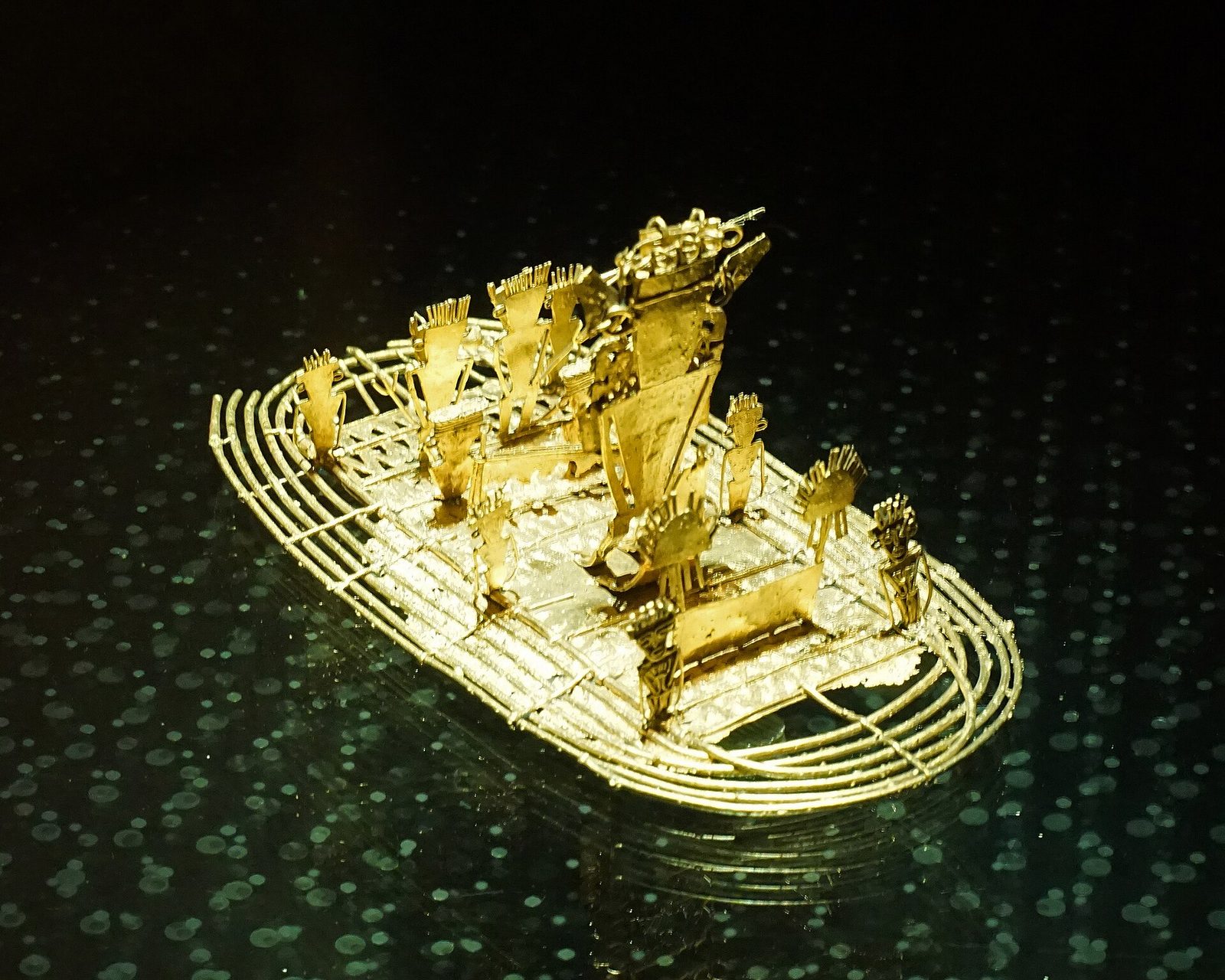
Europeans spent three centuries and a great many lives hunting a city of gold that never existed. The ceremony they had misheard did exist, and there is a small gold raft in a Bogota museum showing exactly the scene. The people who performed it had no gold of their own. They had salt, and they bought the gold with it.
El Dorado, the gilded one, was a man. Not a city, not a kingdom and not a lost civilization in the jungle: a specific person, covered in gold dust, on a raft, on a particular lake in the Colombian highlands, on the day he became a ruler. Europeans heard the phrase, decided it named a place, and spent three centuries looking for the place. Lope de Aguirre went down the Amazon after it in 1561. Walter Raleigh mounted two Guiana expeditions, in 1595 and 1617. People died in numbers for a category error.
What makes this worth an article rather than an anecdote is that the ceremony is not itself a legend. There is an object. In 1969, three farmers found a small solid gold raft inside a ceramic jar in a cave near Pasca, and it shows a central figure standing on a raft surrounded by attendants, which is precisely what the chroniclers said happened at Lake Guatavita. The city was never there. The gilded man appears to have been.
01The People Who Had No Gold
Start with the fact that gets left out of every retelling. The Muisca had no local gold sources. What the Muisca had was salt, and the most important salt sources in the northern Andes were theirs: Zipaquira, Nemocon and Tausa, worked by evaporating brine in ceramic vessels fired in open furnaces to make salt cakes. Those cakes circulated as a medium of exchange across the Eastern Cordillera and down into the lowlands, and the gold came in by trade from the Magdalena River valley, along with cotton and tropical products. Our own research file dates salt production at Zipaquira to at least 200 BCE, which is its own figure and not one this article externally verified. The gilded man was gilded in imported metal, bought with salt.
The Muisca, also called Chibcha, occupied the high plateaus of the Eastern Cordillera of Colombia at around 2,600 metres, in what are now the departments of Boyaca and Cundinamarca. At Spanish contact in 1537, when Gonzalo Jimenez de Quesada arrived, they were governed by two paramount chiefs, the Zipa of Bacata, which is modern Bogota, and the Zaque of Hunza, which is modern Tunja, with subsidiary chiefs including the Iraca of Sugamuxi. Our file gives the population as an estimated 500,000 to 1,000,000 across roughly 25,000 square kilometres, from tributary counts in the earliest Spanish censuses of the 1550s and 1560s. Those figures are our file's and are not externally verified here, and a population estimate derived from a conquering power's tax rolls is a particular kind of number.
02The Ceremony, And Who Described It
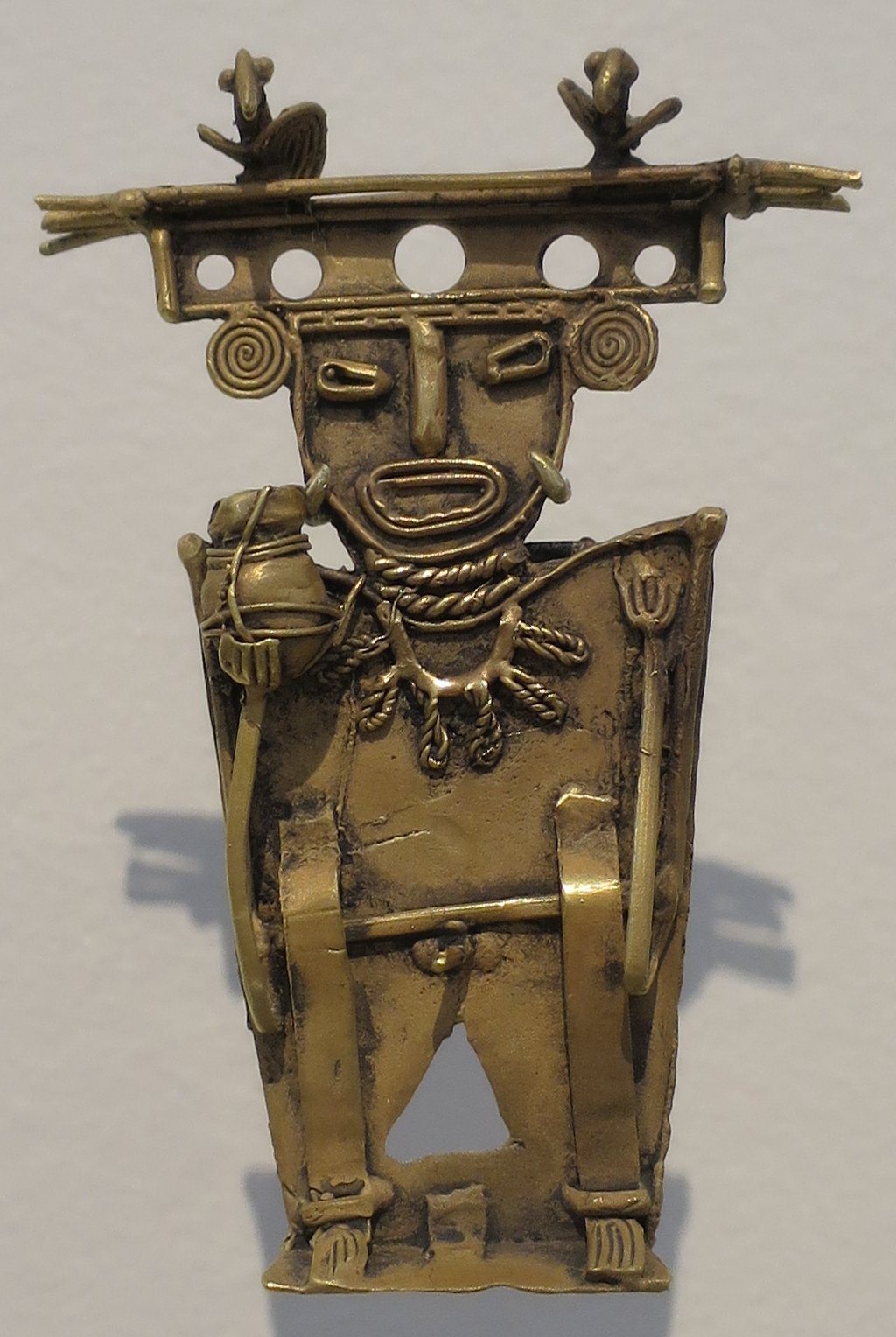
Two Spanish chroniclers describe the investiture of a new Zipa at Lake Guatavita. Juan Rodriguez Freyle, in El Carnero of 1638, and Lucas Fernandez de Piedrahita, in 1688, give the same shape: the candidate fasted in seclusion, was covered in resinous earth and blown over with gold dust until he appeared as a gilded man, el dorado, then went by raft to the middle of the lake, washed the gold off into the water and cast in offerings of tunjos, gold and emeralds. Now hold the dates next to each other. The ceremony had ended by 1537 at the latest. Rodriguez Freyle was writing in 1638. That is a century, and Piedrahita is a century and a half, and both were working from oral testimony gathered after the political structures that performed the ritual had been destroyed. Our own file says plainly that no single archaeological excavation has conclusively confirmed all the details as described.
03The Object In The Jar
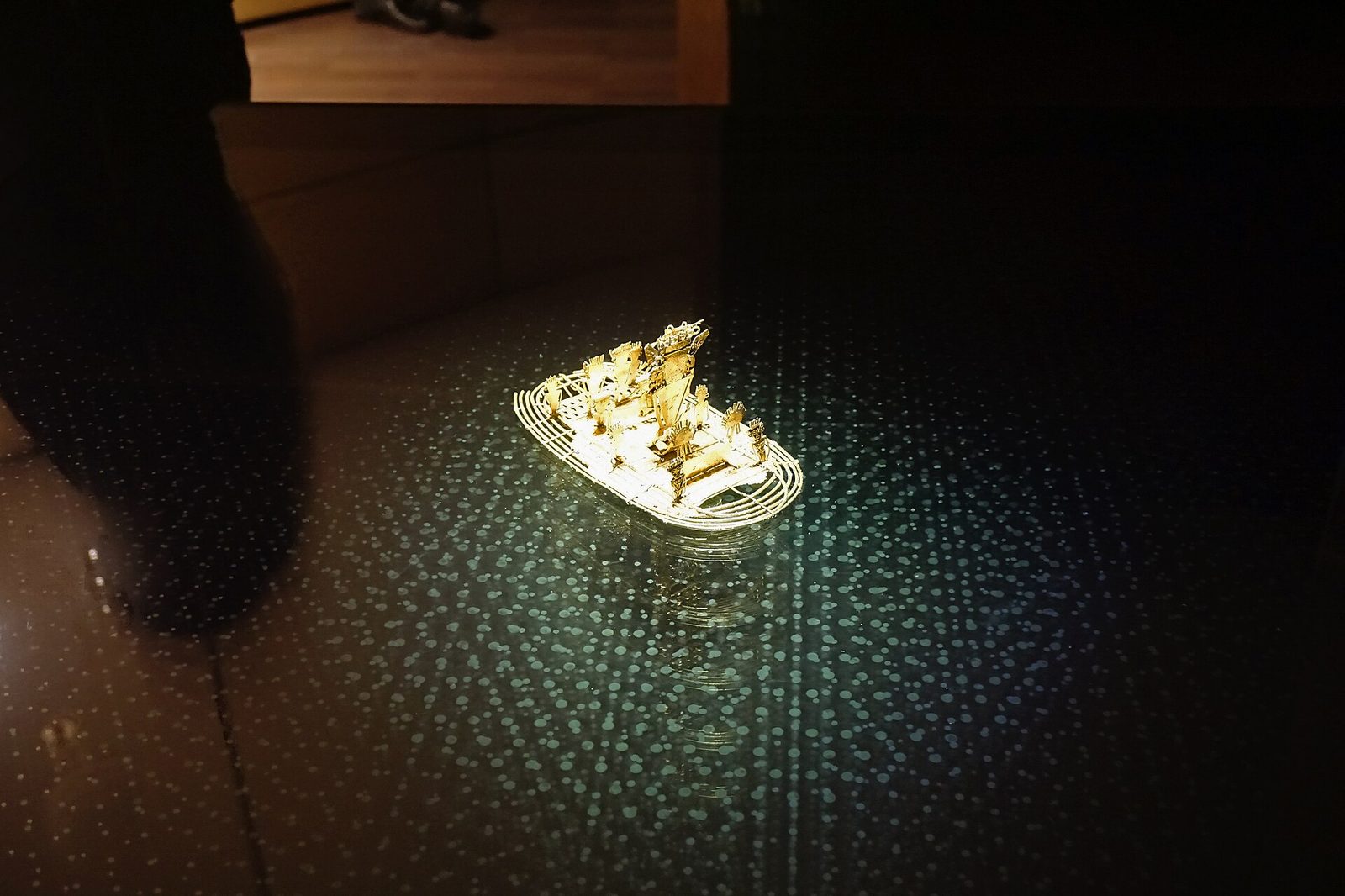
In 1969 three local farmers found a solid gold votive offering inside a ceramic jar in a cave near Pasca, in Cundinamarca. It is a raft: a woven platform of gold wire carrying a tall central figure on a raised deck, with smaller attendant figures ranged around it, cast by the lost-wax method in tumbaga, the gold-copper alloy of the region. Our file gives it as roughly 600 to 1600 CE, 19.5 by 10.1 centimetres, with twelve attendants, and records it in the Museo del Oro in Bogota under collection number O33816. Those specifics are our file's and were not externally verified for this article. What does not depend on them is the thing that matters: an object exists, in a public museum, showing a figure on a raft attended by others, made by the people the chroniclers were writing about.
It is worth being precise about what that does and does not prove. The raft is not a photograph of an event. It is a votive object, made to be given, and it depicts a scene its makers considered worth depicting. It does not confirm the gold dust, or the fasting, or the washing, or any particular detail Rodriguez Freyle supplies from a century's distance. What it does is remove the possibility that the whole thing was invented in Spanish. A raft ceremony with a central figure and attendants was a real category of thing in Muisca gold, before any Spaniard wrote it down.
04Four Centuries At The Lake
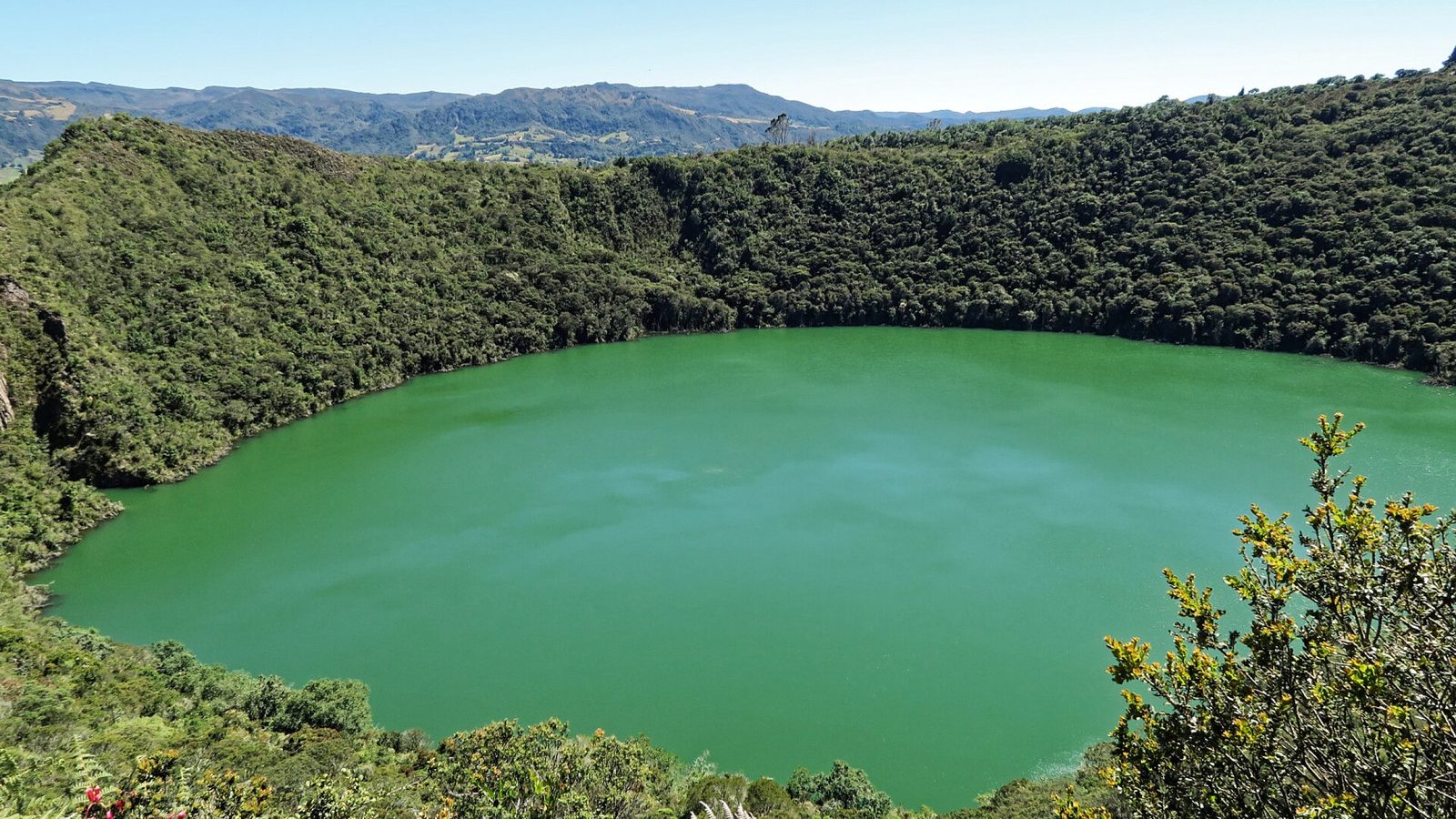
Lake Guatavita has been attacked repeatedly by people who believed there was treasure in it, which is the most honest single index of how completely the legend took hold. Our file records the sequence: Hernan Perez de Quesada in 1545, lowering the water about three metres; Antonio de Sepulveda in 1580, cutting a notch in the crater rim and lowering it about twenty metres before the channel collapsed and killed several workers; and a British company in 1911 draining it almost completely, only to find a bottom of mud too soft to excavate. The lake is now a protected reserve. All of those figures are our file's.
| When, And Who | What Was Done | What Came Of It |
|---|---|---|
| 1545, Hernan Perez de Quesada | Bailing and lowering the water level by roughly three metres, per our own research file | Our file reports gold recovered worth some three to four thousand pesos. A figure from our file, not externally verified here |
| 1580, Antonio de Sepulveda | Cutting a notch through the crater rim to drain the lake, lowering it around twenty metres | More gold recovered, then the channel collapsed and killed several of the workers. The attempt ended there |
| 1911, a British company | Draining the lake almost completely, which no earlier attempt had managed | The exposed bottom was mud too soft to stand on or excavate. Total success at the engineering problem, and nothing to show for it |
| Now | Nothing. The lake is a protected reserve | Whatever is in the sediment stays in the sediment, and the 2023 archaeological treatment of the site works from survey and ethnohistory rather than from dredging it |
The current scholarly treatment of the lake is Juan Pablo Quintero-Guzman's El Dorado Offerings in Lake Guatavita: A Muisca Ritual Archaeological Site, in Latin American Antiquity in 2023. His framing is more careful than either of the usual positions. Archaeological and ethnohistorical work suggests that before European contact Guatavita was an important Muisca chiefdom, largely because of the prestige conferred by ceremonial centres in their territories, especially around the lakes. And the fame of Lake Guatavita as the most important Muisca shrine, in his own words, was fuelled by Spanish chronicles during the sixteenth and seventeenth centuries, which described it as the core of mass offering ceremonies or of lavish rituals for the chief's investiture, which fed both the story and the myth of El Dorado.
05What Kind Of Polity, And Who Says
Our file describes the Muisca as a confederation rather than a centralised state: multiple semi-autonomous chieftainships, capitanias, under the loose authority of the Zipa in the south and the Zaque in the north, each controlling local production and contributing tribute. That model is contested by people working on the same material. Hope Henderson and Nicholas Ostler published a critical appraisal of native chiefdom models at Suta, in the Valle de Leyva, in the Journal of Anthropological Archaeology in 2005. Our own file also records Roberto Lleras Perez objecting to the compression of diverse Muisca communities into a monolithic confederation, on the evidence that settlement patterns, pottery styles and mortuary practice vary significantly between valleys, which points to more autonomy and less coordination than the Zipa-and-Zaque model implies. This page does not settle it. It notes that our file states the confederation as fact in one section and undercuts it in another.
06The Golden Kingdom Had A Sales Department
J. Michael Francis, in Invading Colombia, challenged the romantic picture of the Muisca as a lost golden civilization on a specific and uncomfortable ground: the colonial Spanish accounts had a financial motive to exaggerate. Reports of enormous wealth justified the brutality of the encomienda system and attracted further investment from the Crown. Our file records Francis documenting that the gold actually recovered during the conquest was far less than what was reported, and that tribute was increasingly paid in textiles, agricultural products and labour rather than in metal. The golden kingdom, in other words, was partly a prospectus. And the prospectus is the version that survived into every retelling since, because it was the one written down by the people with printing presses.
| The Thing | The Legend | What The Record Supports |
|---|---|---|
| El Dorado | A city of gold somewhere in the interior, findable if you went far enough | A person: a ruler covered in gold dust at his investiture. Our own file marks the city debunked. No city has been found because there was none |
| The gold | A civilization awash in it, its lake paved with offerings | A highland people with NO local gold sources, importing metal by trade from the Magdalena valley and paying for it with salt |
| The wealth reported | Vast, and worth the conquest | Francis documents that recovered gold fell far short of what was reported, and that tribute shifted to textiles, food and labour. The reports had investors to attract |
| The ceremony | Either a colourful invention or an established fact, depending on who is telling it | Described by chroniclers writing 100 to 150 years later from oral testimony, and independently supported by a gold votive raft depicting the scene |
| The lake | Full of treasure awaiting the right engineering | Drained almost completely in 1911, revealing mud too soft to excavate. Now a protected reserve and studied as an archaeological site rather than a deposit |
07What It Is Not
El Dorado as a literal city of gold is refused, and our own file marks it debunked in those terms. The Spanish conflated the gilded-man ceremony with a place, gave the place names, Manoa del Dorado and Paititi among them, and sent expeditions after it for centuries. Aguirre's descent of the Amazon in 1561 and Raleigh's two Guiana expeditions of 1595 and 1617 are the famous ones. Nothing was found because there was nothing of that kind to find. It is worth resisting the urge to make this funny. The expeditions were real, they were violent, they killed the people who went on them and a great many people who did not, and the whole enterprise rested on a mistranslation of a rite into a real-estate rumour.
08What Is Still Argued
The Jesuit Jose Domingo Duquesne claimed in 1795 to have decoded a Muisca lunar-solar calendar, working from interviews and a painted calendar board. Carl Henrik Langebaek argued in 2005 that the reconstruction is unreliable and may have imported Duquesne's own European astronomical knowledge into what he thought he was reading, which is a named failure mode and not a slur. The firmer evidence is physical: the El Infiernito stone alignments near Villa de Leyva, documented by Eliecer Silva Celis in 1945, rows of upright columns that appear oriented to solstice positions, though their exact function remains debated.
Langebaek and Robert Drennan have suggested that the Muisca were in transition toward state-level organisation when the Spanish arrived: the Zipa of Bacata, Tisquesusa, was actively subjugating rivals in 1537, and a few more centuries without contact might have produced something comparable to the Inca or the Aztec. Our own file describes this hypothesis as inherently unfalsifiable, which is the correct word and worth quoting rather than softening. It is an interesting thought about a road not taken, it is supported by a real trend toward centralisation in the archaeological record, and it is not a finding.
One last thing worth saying, because the word treasure does a lot of damage here. Muisca goldwork is not a hoard, it is a research subject with a technical literature. Marcos Martinon-Torres and Maria Alicia Uribe-Villegas published a study of it in the Journal of Archaeological Science in 2015, and an open database of the typology, technology, composition and context of Muisca metalwork was published in 2012, covering AD 600 to 1800. Note the end of that range: it runs two and a half centuries past the conquest. The metalworking did not stop in 1537, which is not what a story about a vanished golden kingdom would lead you to expect.
Fast Facts
- What El Dorado Was
- A person. The gilded man: a new Zipa covered in gold dust at his investiture on Lake Guatavita. Our own file marks the golden-city version debunked
- Where
- The high plateaus of the Eastern Cordillera of Colombia, around 2,600 metres, in modern Boyaca and Cundinamarca
- The Object
- The Muisca Raft, found in 1969 in a ceramic jar in a cave near Pasca. Lost-wax cast in tumbaga, a gold-copper alloy, and held by the Museo del Oro in Bogota. Dimensions and museum number in this article are our file's
- The Fact Everyone Omits
- The Muisca had no local gold. They controlled the northern Andes' salt sources at Zipaquira, Nemocon and Tausa, and traded salt for gold from the Magdalena valley
- Who Described The Ceremony
- Juan Rodriguez Freyle in 1638 and Lucas Fernandez de Piedrahita in 1688, both writing from oral testimony a century or more after the practice ended
- The Current Scholarship
- Quintero-Guzman, Latin American Antiquity 2023, treats Lake Guatavita as a Muisca ritual archaeological site and describes the chronicles as having fuelled the shrine's fame
- Draining The Lake
- 1545, 1580 and 1911. The 1911 attempt drained it almost completely and found mud too soft to excavate
- The Corrective
- J. Michael Francis documents that Spanish accounts exaggerated Muisca wealth to justify the encomienda and attract Crown investment, and that recovered gold fell far short of what was reported
- Still Argued
- Whether confederation is even the right word: our own file asserts it in one section and records Lleras Perez undercutting it in another
What We Can Actually Stand Behind
A gold votive raft depicting a central figure with attendants was found near Pasca and is held by the Museo del Oro in Bogota. The Muisca controlled the major salt sources of the northern Andes and had no local gold, importing it by trade. Gonzalo Jimenez de Quesada arrived in Muisca territory in 1537. Lake Guatavita is a real lake with a documented history of drainage attempts, and Quintero-Guzman published it as a Muisca ritual archaeological site in Latin American Antiquity in 2023. Muisca metalwork is a studied technical corpus with a published database covering AD 600 to 1800.
The investiture ceremony as Rodriguez Freyle and Piedrahita describe it, which rests on chroniclers writing a century or more after the practice ended and which our own file says no excavation has confirmed in all its details. Whether the Muisca polity is well described as a confederation, which our file asserts and then undercuts by way of Lleras Perez, and which Henderson and Ostler examined critically in 2005. And Francis's argument that Spanish accounts of Muisca wealth were inflated by the financial interests of the people writing them.
Whether the Muisca were on a path to state-level organisation interrupted by conquest, which our own file calls inherently unfalsifiable. Duquesne's 1795 calendar reconstruction, which Langebaek argues may reflect Duquesne's own astronomy rather than Muisca practice. And the precise function of the El Infiernito alignments, which are real and oriented and not fully explained.
There was no city of gold. El Dorado was a person and then a ceremony, never a place, and the expeditions that went looking for Manoa or Paititi were pursuing a category error at enormous human cost. And this page does not present Muisca wealth at the level the conquest accounts reported it, because the people who wrote those accounts were being paid to be believed.
The part that stays with me is the salt. A people with no gold in the ground built the most complete gold-working tradition in the northern Andes by trading a mineral that everyone needs and nobody romanticises, and then used the imported metal to make an object so specific that it survived four centuries of treasure-hunting in a jar in a cave. Meanwhile Europeans took the ceremony that object depicts, decided it must be a city, and went into the Amazon after it until the nineteenth century. The Muisca left the evidence. Everyone else went looking for the story.
Sources & further reading
WHERE THIS WORKED FROM, AND WHERE IT CAN BE CHECKED. This article was written from one file in our own research library, W_5_31, which is where it worked from rather than where it can be checked. THE IDENTIFIER RECORD IN THAT FILE IS THE WORST FOUND IN THIS RUN AND IT NEEDS STATING PLAINLY. Every DOI in its bibliography was resolved live against Crossref for this article, and FOUR OF FIVE RESOLVE TO ENTIRELY DIFFERENT WORKS. The DOI attached to Langebaek's 1995 Regional Archaeology in the Muisca Territory resolves to a 1999 review of that book by Redmond. The DOI attached to Broadbent's 1964 Los Chibchas resolves to a 2019 chapter on the teaching of political economy, with no connection to the subject at all. The DOI attached to Plazas and Falchetti 1986 resolves to a 1960 review, by Weismann, of a different work. And the DOI attached to Rodriguez Freyle's chronicle of 1638 resolves to a 1972 chapter about healers in colonial New Granada: right region, wrong century, wrong subject, wrong work. Only Drennan 1995 resolves correctly, and the ISBN for Francis had already been repaired once by our own corpus hygiene campaign. None of the four bad identifiers is reproduced below; the sources here were found by searching Crossref directly and each was resolved and its returned title read. THE FILE'S CROSS-REFERENCE LABELS ARE ALSO WRONG in three places, naming targets whose filenames are different documents entirely; that has been routed to corpus hygiene rather than corrected here. WHAT IS CARRIED AS OUR FILE'S OWN AND NOT AS SETTLED. The raft's dimensions, its museum number, its 1969 discovery and its twelve attendant figures; the population range of 500,000 to 1,000,000 and the 25,000 square kilometre territory, both derived from Spanish tributary counts; the 200 BCE date for salt production at Zipaquira; and every figure attached to the lake drainage attempts. No external source was resolved for any of these during this article's research, and each is attributed to the file in the text. ON REGISTER. The Muisca are not a vanished people and the conquest of 1537 was not an adventure. This page names the expeditions and their cost rather than their romance, and follows Francis in treating the conquest-era wealth reports as documents with a financial purpose.
Image credits
- The Muisca Raft, a lost-wax cast gold votive offering, Museo del Oro, Bogota Mariordo (Mario Roberto Duran Ortiz), via Wikimedia Commons. CC BY-SA 4.0 Source.
- Laguna de Guatavita in the Colombian Eastern Cordillera Burkhard Mucke, via Wikimedia Commons. CC BY-SA 4.0 Source.
- A cast gold Muisca votive figure, a tunjo, Honolulu Museum of Art Hiart, via Wikimedia Commons. CC0 Source.
- The Muisca Raft displayed alone in a darkened gallery, showing its scale Mariordo (Mario Roberto Duran Ortiz), via Wikimedia Commons. CC BY-SA 4.0 Source.


