
Egyptian Hieroglyphics: Cracking the God's Words
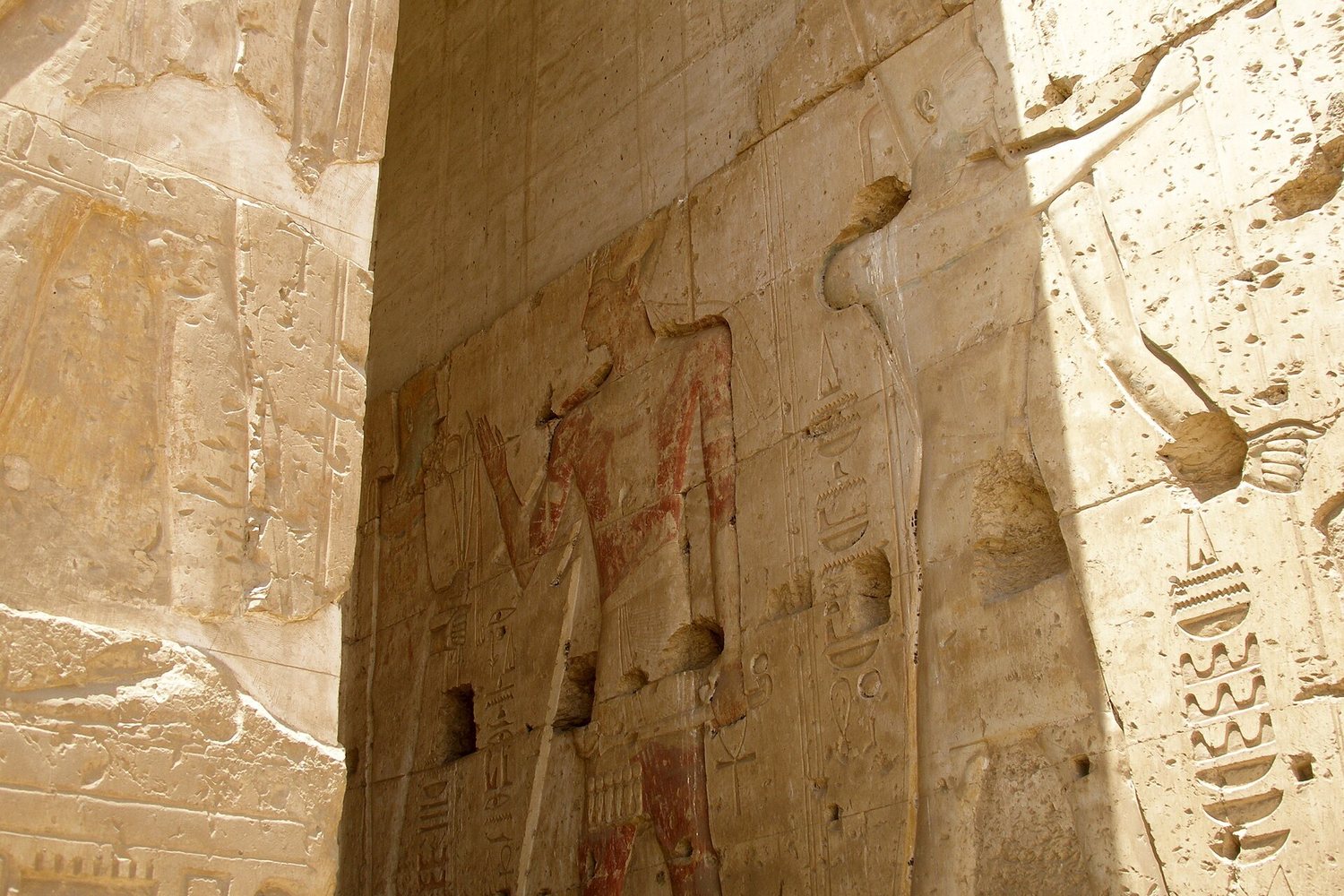
For over three thousand years the Egyptians wrote in a script they called the god's words, carved on temple walls and painted in tombs. Then it fell silent, and for fourteen centuries no one on Earth could read a single sign. Europe convinced itself the little pictures were pure mystical symbols, and stayed wrong until a broken slab pulled from the Nile mud and two rival scholars, an English polymath and a Frenchman who knew Coptic, cracked the code between them. This is what hieroglyphs actually were, how they were read again, and the honest share of credit for one of the greatest feats of decipherment in history.
For more than three thousand years, the Egyptians wrote in signs they believed a god had given them: birds and reeds and hands and suns, carved into temple walls and painted down the sides of coffins, a script they called mdw ntr, the god's words. And then it died. The last hieroglyph was cut into a wall in 394 CE, and after that the chain of people who could read the signs simply broke. For roughly fourteen centuries the walls of Egypt were covered in a language no living person could hear, and Europe, gazing at the beautiful mute pictures, told itself a comforting fiction: that each sign was a self-contained emblem of mystic wisdom, a symbol you could contemplate but not read aloud. That fiction was wrong in every particular. Hieroglyphs are writing, ordinary writing, that records the sounds of a spoken tongue, and the story of how that was proved, by a broken slab found in the mud and two brilliant, quarreling scholars, is one of the greatest recoveries of a lost human voice we have. This is what the god's words actually were, how they were made to speak again, and the honest question of who deserves the credit.
01The God's Words
Start with what the script actually was, because almost everyone starts wrong. The Egyptians called their writing 'the god's words' and believed it a gift from Thoth, the ibis-headed god of writing and magic; a sign, to them, was not a neutral mark but a thing with power, which is why dangerous figures in a tomb were sometimes carved deliberately maimed, so they could not act against the dead. But sacred is not the same as symbolic picture-writing, and this is the single most important correction to make. Hieroglyphs are a full writing system that records the sounds of a spoken language. They mix three kinds of sign. Logograms, where a picture stands for a whole word (a sun disc for ra, 'sun'). Phonograms, signs that spell sounds, including a set of roughly two dozen single-consonant signs that work almost like an alphabet, though Egyptian wrote only the consonants and left the vowels out. And determinatives, silent signs added to the end of a word to mark its category, a pair of walking legs after a verb of motion, so a reader could tell otherwise-identical spellings apart. Classical Middle Egyptian used about 750 signs; the temple inscriptions of the very late period ran to several thousand through elaborate scribal games. To read a wall was to read sound, word, and category at once. The popular idea that each little picture is a stand-alone mystic symbol is not a small misreading. It is the exact error that kept the script unreadable for fourteen hundred years.
02How Writing Began
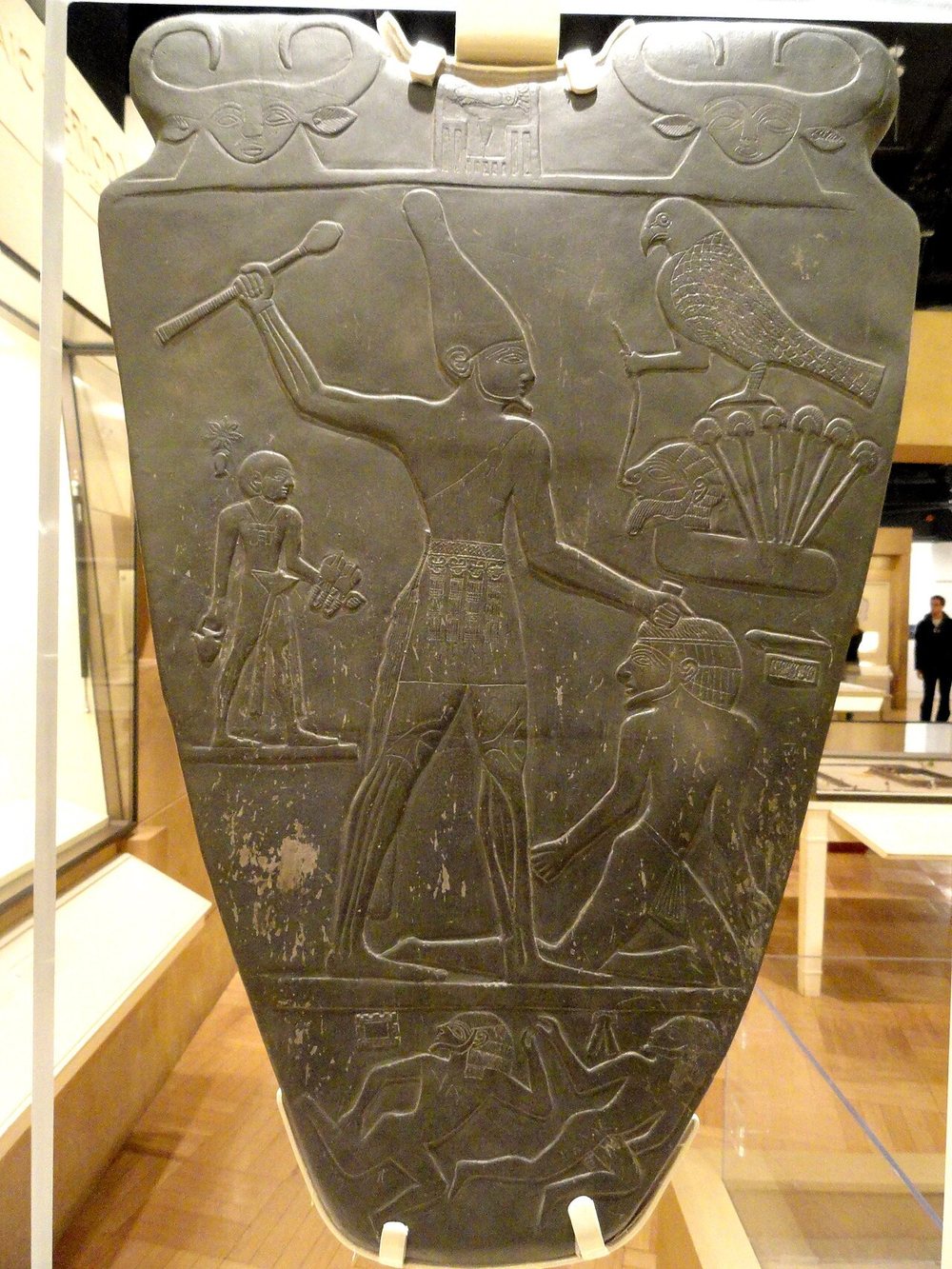
Writing in Egypt is very old, and it did not begin with poetry or prayer. The earliest Egyptian signs yet found come from Tomb U-j at Abydos, a ruler's grave of around 3250 to 3100 BCE, on roughly two hundred small bone and ivory labels recording where goods came from, who owned them, and how many there were. Tags and tallies, in other words: writing born of accounting. Not long after, around 3100 BCE, the Narmer Palette married hieroglyphic labels to a carved scene of a king in the act of conquest, and Egyptologists have long taken it as the conventional start of the dynastic age. Whether Egyptians invented writing entirely on their own or were spurred by knowing that Mesopotamia had done it first is genuinely debated. Sumerian cuneiform is a little older, Mesopotamian goods reached Predynastic Egypt, and some scholars see a nudge from that contact; but the two scripts share no actual signs and work on wholly different principles, so most land on a middle position: the idea of writing may have travelled, the system did not. The Egyptians built their own.
Over the centuries one script became three hands for three jobs, and here another myth needs puncturing: the cursive forms did not replace the carved one, they ran alongside it. Formal, pictorial hieroglyphs stayed the monumental script of temple and tomb for the whole of Egyptian history. For everyday speed, scribes wrote hieratic, a flowing shorthand of the same signs drawn with a reed brush on papyrus, used for letters, accounts, literature, and science from the Old Kingdom onward. Later, around 650 BCE, an even faster cursive called demotic took over daily business, contracts and letters and stories, and it is the middle of the three scripts on the Rosetta Stone. All three were the same language in different clothes. And reading any of them was a rare privilege: literacy in ancient Egypt is estimated at just one to five percent of the population. Scribes were a trained professional class, schooled at temple and palace, and they knew their worth; a Middle Kingdom text called the Satire of the Trades sells the profession by running down every other job in Egypt as misery by comparison. A handful of women held the title 'female scribe,' and letters by women survive, but the schools were, in practice, for men.
03The Stone in the Mud
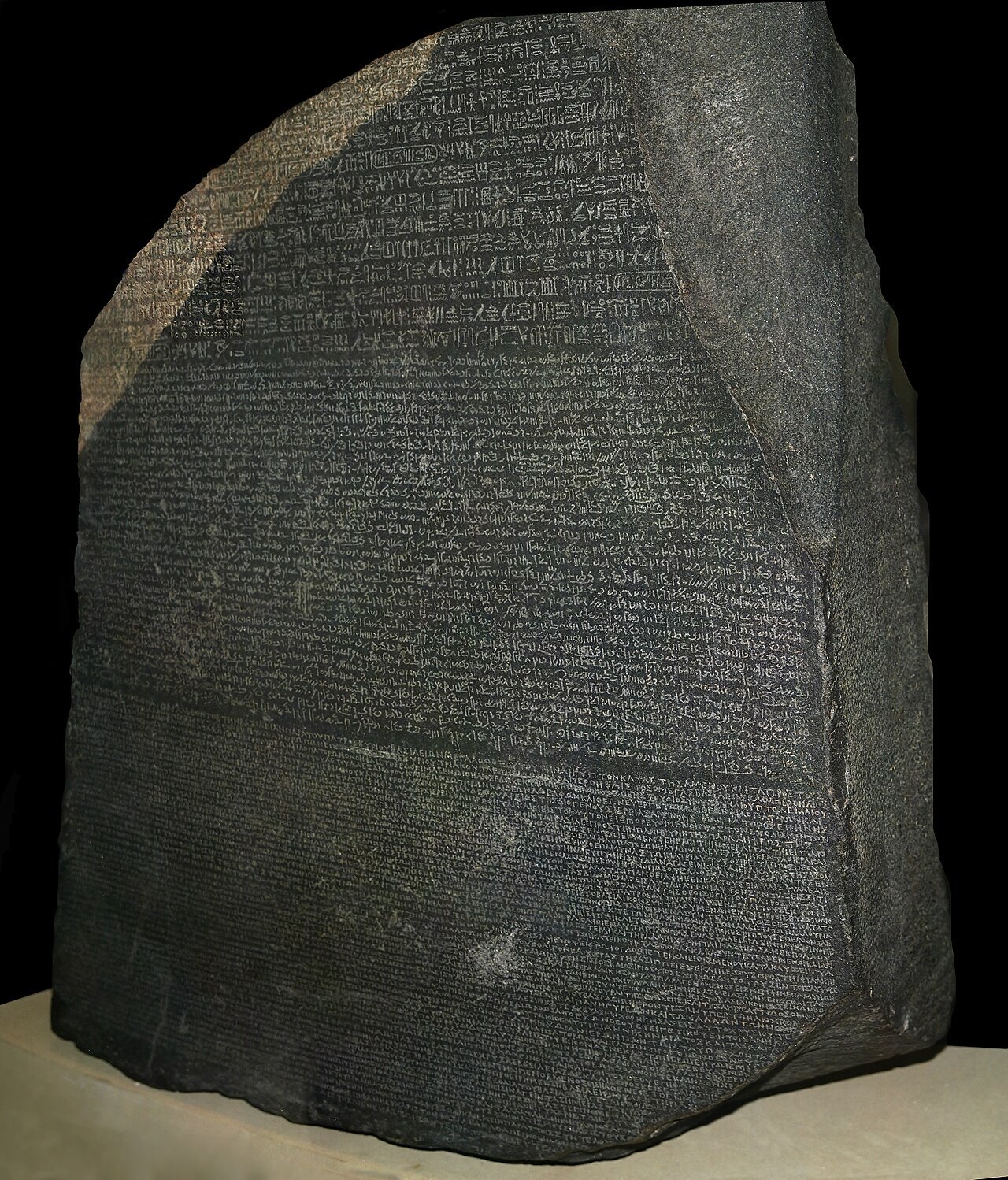
By the time Europe went looking, the god's words had been silent for well over a thousand years, and Europe had talked itself into a fantasy about them. Following a late-antique writer named Horapollo, Renaissance scholars grew certain each hieroglyph was a self-contained allegory of some sacred truth, a picture-puzzle of mystic wisdom with no connection to ordinary speech; learned men wrote whole volumes 'translating' the signs this way, and every word of it was invention. What broke the spell was a piece of political boilerplate. In 1799, soldiers in Napoleon's army rebuilding a fort near the Delta town of Rashid, which Europeans called Rosetta, turned up a broken black slab carved in 196 BCE with a decree honoring the boy-king Ptolemy V, written three times over: once in hieroglyphs, once in demotic, and once in Greek. The Greek was readable. Here at last was the same text in a known tongue set beside the lost script, and the same royal name, Ptolemy, waiting to be matched sign for sign. The race to use it was on.
04Two Men and a Cartouche
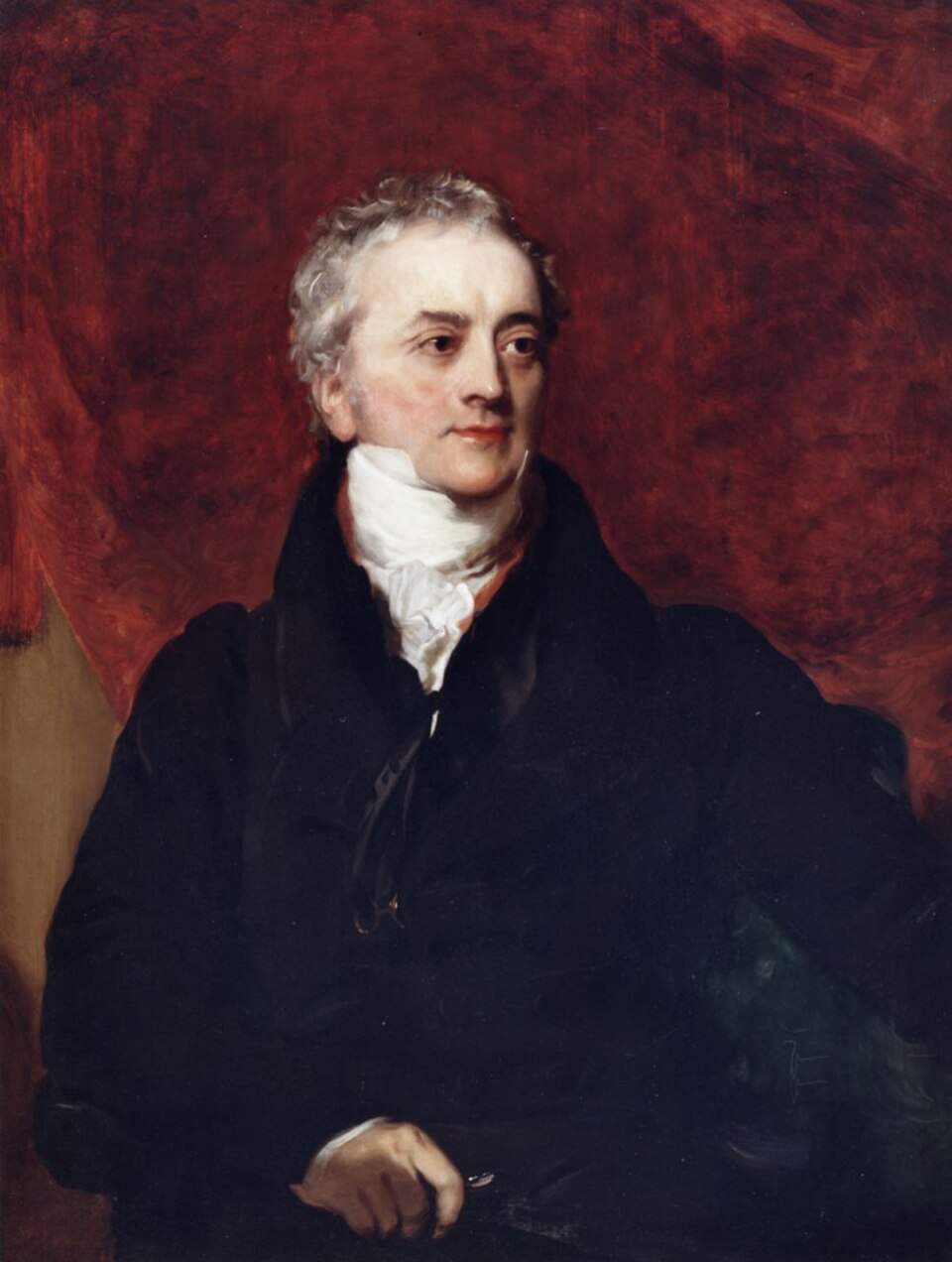
The first real progress was English. Thomas Young, a physician and polymath who had already done celebrated work on the nature of light and the elasticity of materials, took up the stone around 1814 and had the problem largely to himself for years. He made genuine, load-bearing discoveries, and they deserve to be said plainly rather than folded into a footnote. He matched the cartouche, the oval loop drawn around a royal name, on the hieroglyphic band to the name Ptolemy in the Greek, and he correctly worked out that several of its signs stood for sounds, not ideas. In his 1819 article on Egypt for the Encyclopaedia Britannica he published a tentative list of phonetic hieroglyphs and the first partially correct reading of the stone's demotic. That was real decipherment. Young's mistake was a reasonable one: he assumed the phonetic signs were a special device reserved for spelling out foreign names like Ptolemy, and that native Egyptian words must still be written some other, non-phonetic way. He had the key in his hand and turned it in only one lock.
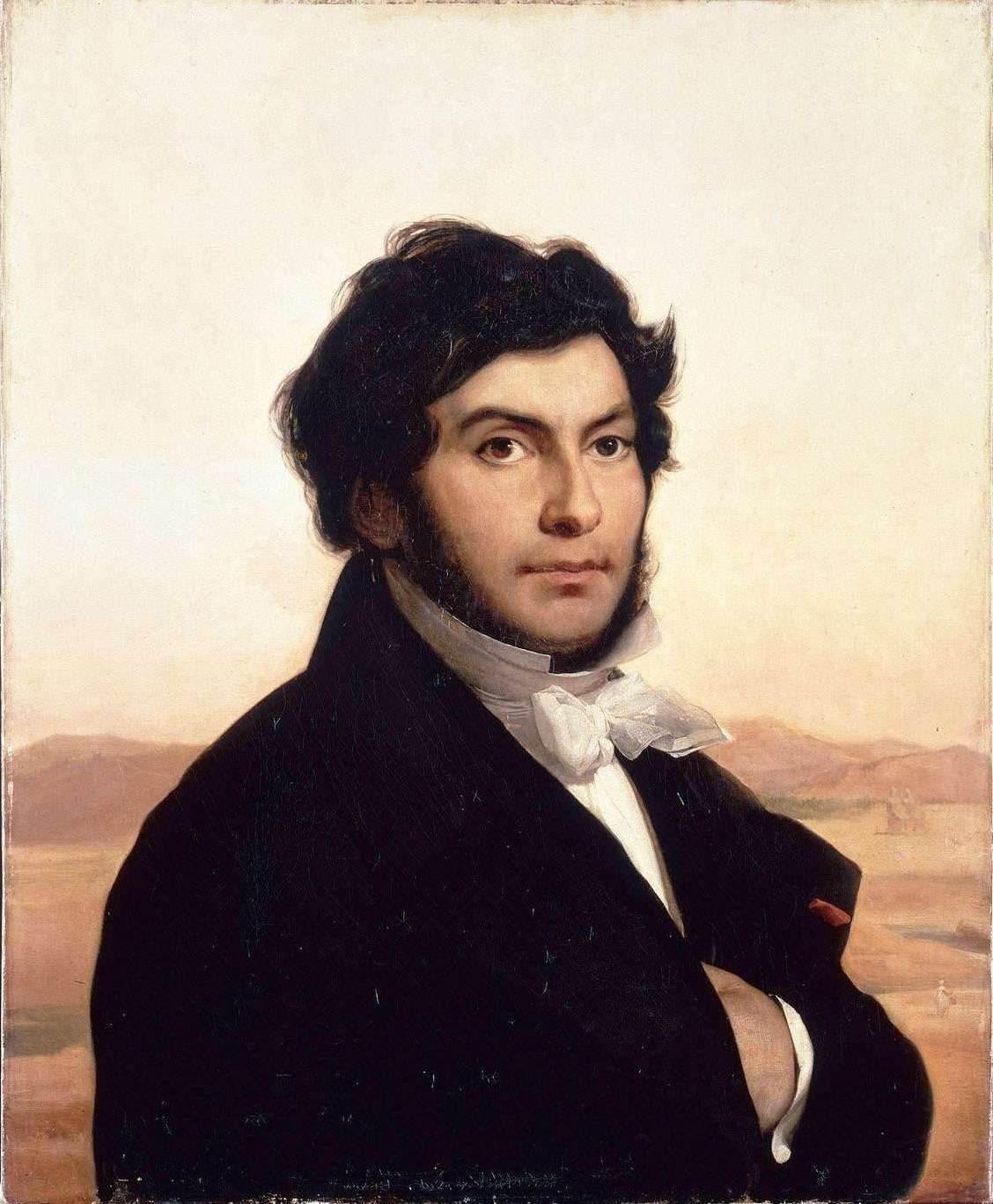
The man who walked all the way through the door Young had pushed ajar was Jean-Francois Champollion, and his decisive advantage was a language. Champollion had mastered Coptic, the final form of Egyptian, written in Greek letters and still used in the Coptic Church, which preserved the vowels and grammar the ancient script left out. Where Young saw a foreign-name trick, Champollion grasped in 1822 that the phonetic principle ran through the whole script, that Egyptian names too, Ramesses, Thutmose, were spelled out in sound, and that hieroglyphs had been a mixed system of sound-signs and word-signs all along. The breakthrough moment is dated to 14 September 1822, when he is said to have run to his brother's rooms in Paris, cried out that he had it, and collapsed from the shock. Days later, on 27 September, he read his findings to the Academie in the famous letter to Monsieur Dacier that historians mark as the birth of Egyptology, and by 1824 he had laid out the principles of the script that still underlie how it is read today.
So who cracked it? The honest answer refuses the tidy version in either direction. It is not true that Young did the real work and Champollion took the glory, and it is not true that Champollion did it alone out of nothing. Young's early study built a partial framework, the cartouche method and the first phonetic readings, that helped make the fuller breakthrough possible. Champollion supplied the decisive insight Young never reached, that the entire script was phonetic, and turned scattered clues into a working system that has held up for two centuries. The dispute between the two men was bitter and ran for years, thick with English-versus-French national pride on both sides, Young insisting Champollion had built on his discoveries, Champollion insisting the real system was his alone. But credit here is not a fixed pie to be fought over. Young opened the door partway; Champollion went through it. Both things are true, and the achievement belongs, in different measure, to both of them, and to earlier scholars like Silvestre de Sacy and Johan Akerblad whose first work on the demotic came before either.
05The Long Silence
It is worth remembering how completely the knowledge had been lost, and why. Hieroglyphs were carved for the last known time on 24 August 394 CE, when a priest named Nesmeterakhem cut a short inscription into a wall at the temple of Philae, in Egypt's far south, adding a hope that it would endure 'for all time and eternity.' The Roman closure of Egypt's pagan temples a few years earlier had severed the script's living roots; Philae, sitting just beyond the empire's southern edge, held on a little longer than the rest before it too fell quiet. After that, the line of people who could read the signs simply ran out, and stayed broken until Champollion, fourteen centuries later. Even now, what survives is skewed by chance. Egyptian scribes wrote most of their letters and literature on papyrus, and papyrus rots in damp ground; the overwhelming bulk of what we can still read comes from the dry sands of places like the Fayum and Oxyrhynchus, not because Egyptians only wrote there, but because that is where the writing lasted. What we know of Egyptian writing is a survivor's sample, shaped by climate as much as by what was ever actually set down.
06What It Was Not
Two persistent myths deserve a flat refusal, not a both-sides hearing. The first is the old mystical one already met: that hieroglyphs are pure symbolic picture-writing, each sign a wordless emblem of sacred mystery. They are not, and the whole point of Champollion's achievement was proving it; an account that treated the mystical reading as half-right would be quietly undoing its own subject. The second is newer and stranger: the online claim that certain Egyptian carvings depict advanced technology, an electric lamp in a relief at Dendera, a helicopter and other aircraft among the signs at Abydos. These are not mysteries; they are known artifacts of stone. The Abydos 'helicopter' is a documented palimpsest: one pharaoh's carved titles were plastered over and recut with another's, and the two overlapping, half-erased sets of signs happen to leave a shape a modern eye reads as an aircraft. It records nothing but the ordinary reuse of a wall. A third, gentler myth is worth naming too, that hieroglyphs are a universal language anyone can intuitively read. They are not; they record one specific language, Egyptian, and take years of training to read, which is precisely why their silence, once the readers were gone, lasted as long as it did.
Fast Facts
- What it is
- A full writing system for spoken Egyptian, mixing word-signs, sound-signs (consonants only), and silent category markers; NOT mystical picture-writing
- Oldest
- Bone and ivory labels from Tomb U-j at Abydos, c. 3250 to 3100 BCE; tags and tallies, not poetry
- Lifespan
- Roughly 3,400 years, to the last dated inscription at Philae on 24 August 394 CE
- The key
- The Rosetta Stone (196 BCE): one decree in hieroglyphic, demotic, and Greek; found 1799, now British Museum EA24
- Thomas Young
- Matched the Ptolemy cartouche and showed some signs were phonetic (1814 to 1819), but thought it a foreign-name trick
- Champollion
- Knew Coptic; saw the phonetic principle ran through the whole script; his 1822 letter to Dacier founded Egyptology
- The credit
- Additive, not either-or: Young opened the door partway, Champollion went through it
- Refused
- Mystical picture-writing; 'hidden technology' reliefs (a known palimpsest); a universal intuitive language
What We Can Actually Stand Behind
The history, structure, and decipherment are documented fact. Hieroglyphs are a mixed logographic-phonographic-determinative script recording spoken Egyptian; the earliest examples are the Abydos labels of around 3250 to 3100 BCE and the last is the Philae graffito of 394 CE. The Rosetta Stone (196 BCE, British Museum EA24) carries one decree in three scripts. Thomas Young matched the Ptolemy cartouche and identified phonetic signs; Champollion, using Coptic, recognized the phonetic principle ran through the whole script and built the working system, announced in 1822.
Several points are strong but carry normal scholarly debate. Whether Egyptian writing was wholly independent or stimulated by knowledge of Mesopotamian writing is unresolved, with most scholars favoring a 'the idea travelled, the system did not' middle position. Literacy is estimated at one to five percent. And the fair assessment of the decipherment credit is additive: Young's early framework helped make the breakthrough possible, but Champollion supplied the decisive insight and the complete system. Both men, and earlier workers on the demotic, share it.
A few questions stay genuinely open. Whether the Predynastic Naqada pottery marks (c. 3800 to 3100 BCE) are an earlier stage of proto-writing or merely potters' marks is unresolved. So is the more speculative idea that the sound-image-category fusion of hieroglyphic writing fostered a distinct mode of Egyptian cognition; it is intriguing and consistent with the art, but difficult to test. These are carried as open possibilities, not findings.
Three myths get a flat no. Hieroglyphs are not mystical picture-writing with no phonetic content; that Renaissance fantasy is exactly what Champollion disproved. The 'hidden technology' reliefs (the Dendera 'bulb,' the Abydos 'helicopter') are not evidence of lost machines; the helicopter is a documented palimpsest, one inscription recut over another. And hieroglyphs are not a universal language anyone can read on sight; they encode one specific tongue and demand years of study. The wonder here is real, and it does not need inventing.
Hieroglyphs belong at the opening of a wing about the marks human beings make, because they are the purest case of what that wing is about: a people who wanted their words to outlast them, and very nearly did not get their wish. For fourteen centuries the walls of Egypt were covered in a voice no living person could hear, beautiful and mute, a whole civilization talking into an empty room. What Young and Champollion did was less like solving a puzzle than like returning a voice to people who had lost the power to speak it, so that a priest's hope at Philae, that his words might last for all time and eternity, turned out, after a long and undeserved silence, to be very nearly true. The signs were never mystic emblems, and never secret machines. They were language, the ordinary human miracle, pressed so carefully into stone that it survived the death of everyone who could read it, and waited for someone to learn how to listen again.
Sources & further reading
Everything above is drawn from our research library on Theories of Anything. Open the full file to check the sourcing and go deeper.
Image credits
- Painted relief and hieroglyphs, Temple of Seti I, Abydos Photograph by Vyacheslav Argenberg, via Wikimedia Commons. CC BY 4.0 Source.
- The Rosetta Stone, British Museum (EA24) Photograph by Hans Hillewaert, via Wikimedia Commons. CC BY-SA 4.0 Source.
- The Narmer Palette (museum display), c. 3100 BCE Photograph by Daderot; CC0, via Wikimedia Commons. CC0 Source.
- Jean-Francois Champollion, portrait by Leon Cogniet, 1831 Leon Cogniet, 1831 (Musee du Louvre); public domain, via Wikimedia Commons. Public Domain Source.
- Thomas Young, portrait by Henry Briggs, 1822 Henry Perronet Briggs, 1822 (after Thomas Lawrence); public domain, via Wikimedia Commons. Public Domain Source.
- Card crop of the Temple of Seti I relief Photograph by Vyacheslav Argenberg, via Wikimedia Commons. CC BY 4.0


