
Coming Forth By Day
It is not called the Book of the Dead. The Egyptian name is Pert em Hru, Coming Forth by Day, and the title we use was coined by a German scholar in 1842. It is not a book either. There is no canonical version, no creed, no congregation; every copy is different, made to order with the buyer's own name written through it, and if you could not afford the full set of spells there was a cut-price chapter that summarised the lot. What it is, is a practical manual for a journey somebody expected to actually take: how to get out of the tomb, what to say at each gate, how to keep your head warm, how to avoid the fishermen. And in among the ethics, in the same scroll as the most famous moral test in antiquity, there is a spell for stopping your own heart giving evidence against you.
Start with the name, because the name is already wrong. The Egyptians called it Pert em Hru, which means Coming Forth by Day. The title we use was invented in 1842 by the German Egyptologist Karl Richard Lepsius, and it points in exactly the opposite direction from the original. Not a book about being dead. Instructions for getting back out into the light.
And it is not a book. There is no canonical version, no orthodoxy, no congregation that read it aloud. There are around a hundred and ninety-two known spells, catalogued and numbered by Lepsius, and no single copy contains all of them. Each papyrus was made to order for one person, with that person's name written into the text throughout, and the length depended on what they could pay. If you could not afford the full set, there was Chapter 64, described in our own research file as a condensed version of the entire book for people who could not afford a complete one. What we are actually looking at is a piece of commercial religious technology, sold by length.
01Who Was Allowed An Afterlife
The Book of the Dead is the third stage of a very long argument about who gets to survive. The Pyramid Texts came first, Old Kingdom, roughly 2400 to 2300 BCE, carved into the interior walls of pyramids and available to precisely one person per pyramid: exclusively royal. Then the Coffin Texts, Middle Kingdom, roughly 2100 to 1650 BCE, painted onto wooden coffins and available to nobles and officials. Then the Book of the Dead, New Kingdom onward, roughly 1550 to 30 BCE, written on papyrus scrolls and laid in the tomb, available to anyone who could afford it. Our file calls this the democratization of the afterlife and gives the phrase that marks the change: by the New Kingdom the dead person is identified with Osiris regardless of rank, written as the Osiris N, where N is their own name. What had been the pharaoh's private route to the gods became a product.
02The Test
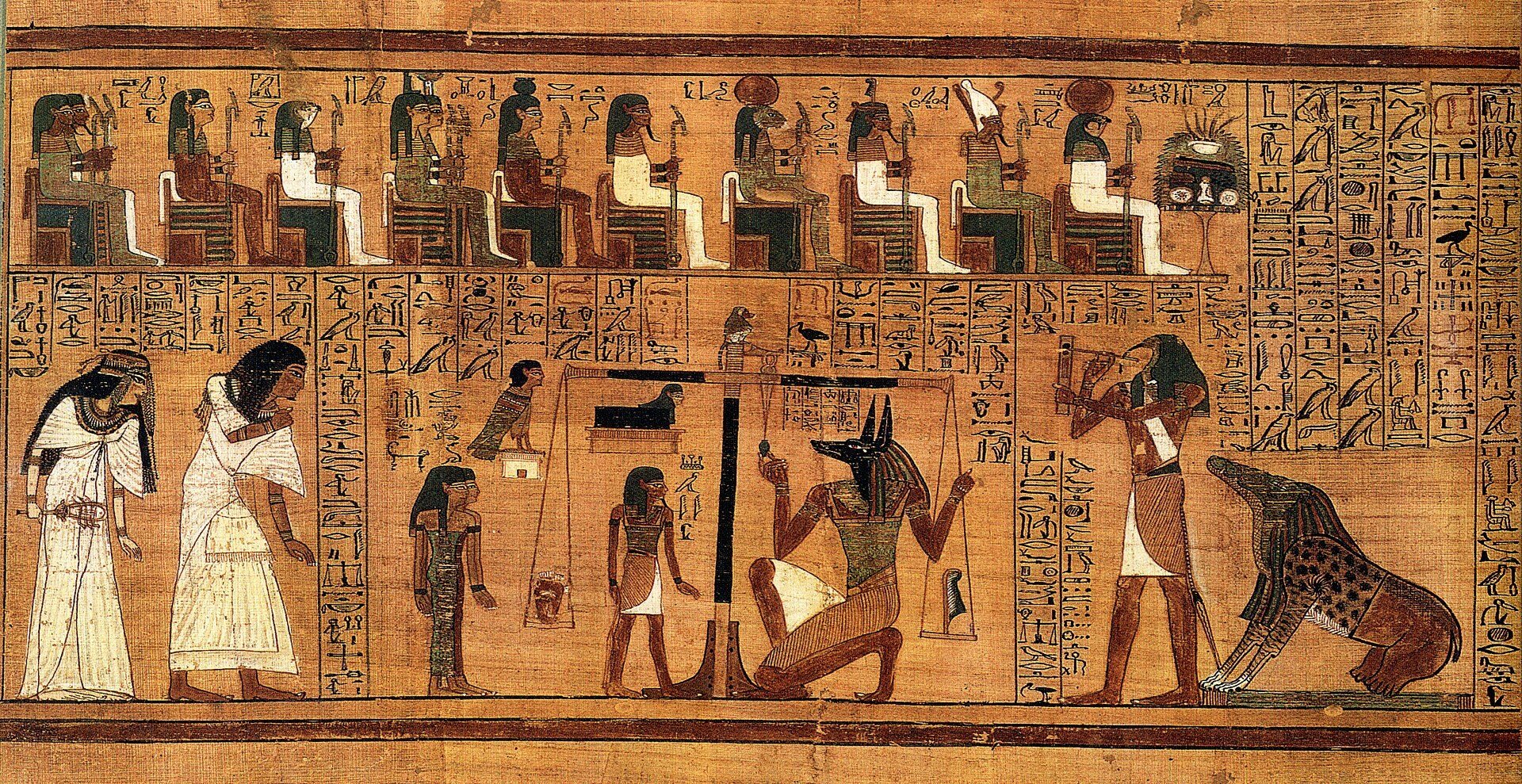
Chapter 125, and every part of it has a job. The scene is the Hall of Two Truths. Anubis, jackal-headed, works the balance. Onto one pan goes the ib, the heart, which the Egyptians held to contain the moral record of a life. Onto the other goes the feather of Ma'at, which stands for truth, justice and the order of the cosmos. Thoth, ibis-headed, writes down the verdict. Osiris presides from a throne. And forty-two assessors sit in judgement, one for each nome, each administrative district of Egypt, so that the whole country is represented in the room. Beside the scales waits Ammit, the Devourer of the Dead: crocodile head, lion body, hippopotamus hindquarters, assembled from three of the most dangerous animals in Egypt.
The worst thing that can happen to you is to stop. If the heart balances the feather, or is lighter, the dead person is declared maa kheru, true of voice, and passes into the Field of Reeds. If the heart is heavier, Ammit eats it, and our file is exact about what that means: the second death, total annihilation, not eternal torture. There is no Egyptian hell in this text. There is deletion. And the system took the possibility seriously enough to sell insurance against it: Chapter 175 is a spell titled not dying a second time. It is worth sitting with the difference. A tradition that threatens you with endless punishment is telling you that you will always exist. This one is not.
The forty-two negative confessions, and what a river civilisation decided was a sin. Before the assessors you declared innocence item by item, in the negative. I have not done iniquity. I have not robbed with violence. I have not committed murder. I have not told lies. I have not acted deceitfully. I have not been angry without cause. And then, at numbers 22 and 38: I have not polluted the water, and I have not stopped water when it should flow. Our file flags this as remarkable for a text roughly three and a half thousand years old, and it is right to. Fouling a watercourse and blocking somebody else's irrigation are entered here as moral offences, in the same list as murder, on which your continued existence depends. In a country that is a thin green line along a river, water was not an environmental issue. It was the issue.
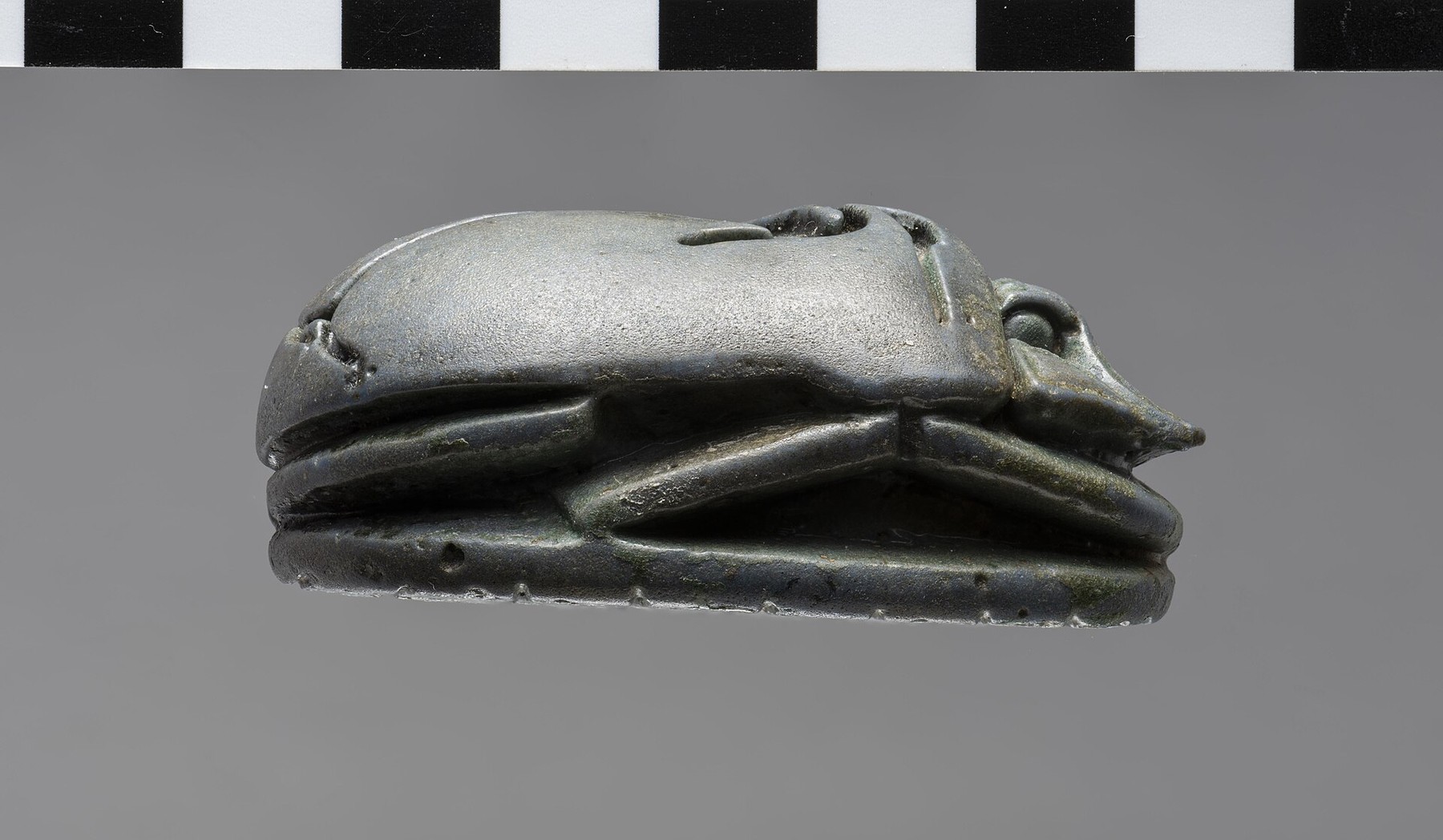
Chapter 30B is the most interesting thing in the book, because it undoes the rest of it. Our file's own counter-arguments table takes the question seriously: does the weighing of the heart amount to a precursor of ethical monotheism? On the supporting side, Ma'at is a genuine cosmic moral order and the judgement is genuinely based on conduct. On the other side, the context is thoroughly polytheistic, and there are magical spells designed to cheat the judgement, of which 30B is the clearest. The verdict the file returns is Mixed: the ethical emphasis is real, and it is magically circumventable. That is a more honest position than either enthusiasm or dismissal, and it is worth noticing that the Egyptians evidently did not experience the contradiction as fatal. Both things were true at once: the test was real, and you prepared for it.
03A Packing List For A Journey
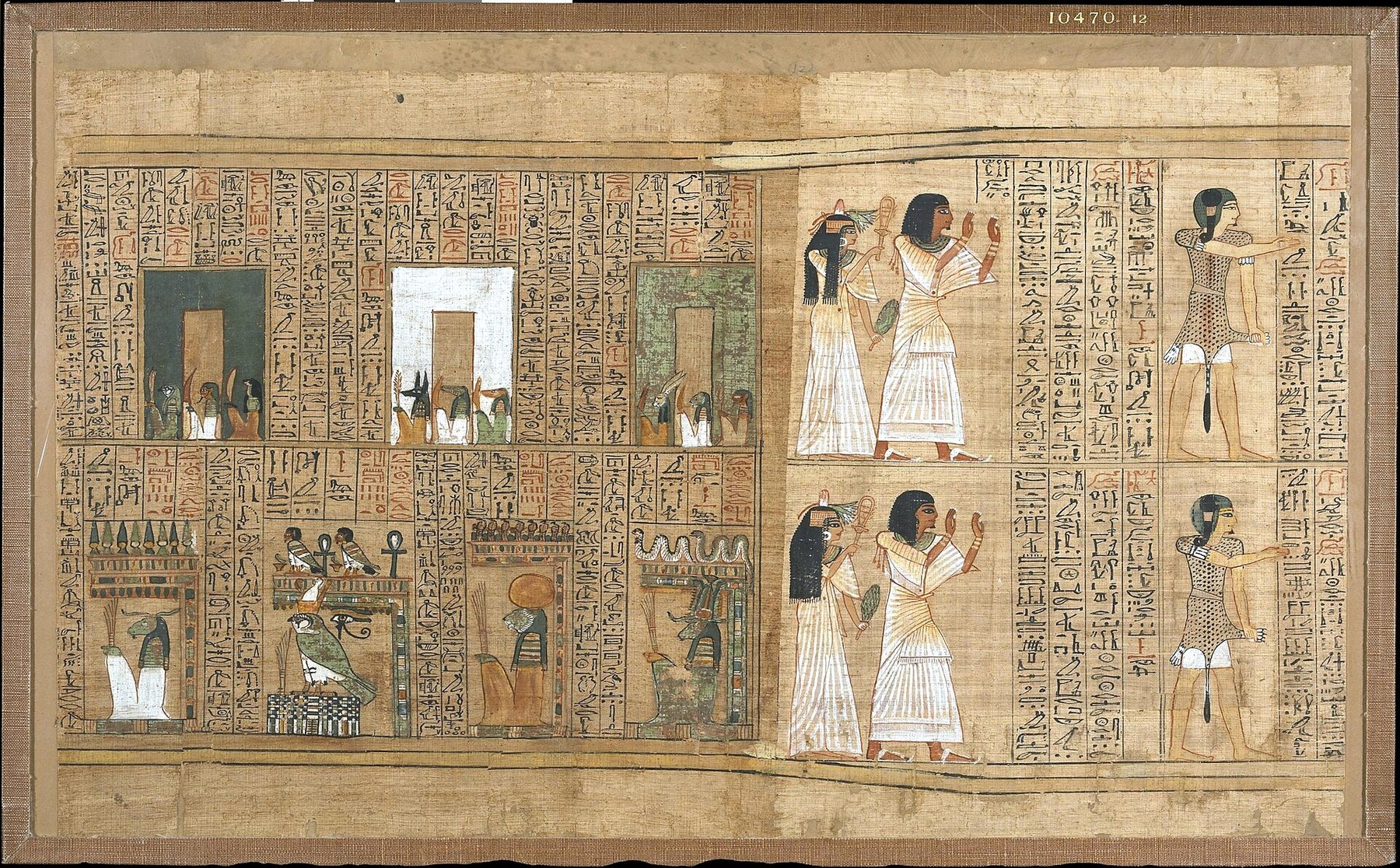
Read the spell titles and the theology falls away. Chapter 1, coming forth by day, the opening invocation as the dead person leaves the tomb. Chapter 17, a cosmological hymn. Chapter 148, providing sustenance, to make sure there is food and drink. Chapter 153, escaping the net, for avoiding capture by underworld fishermen. Chapter 154, preventing bodily decay. Chapter 162, placing a flame beneath the head, for warmth and protection. Chapter 189, a hymn to the setting sun. This is not a creed. It is a packing list, written by people who expected the journey to be difficult in specific, physical ways, and who wanted to be ready for each of them.
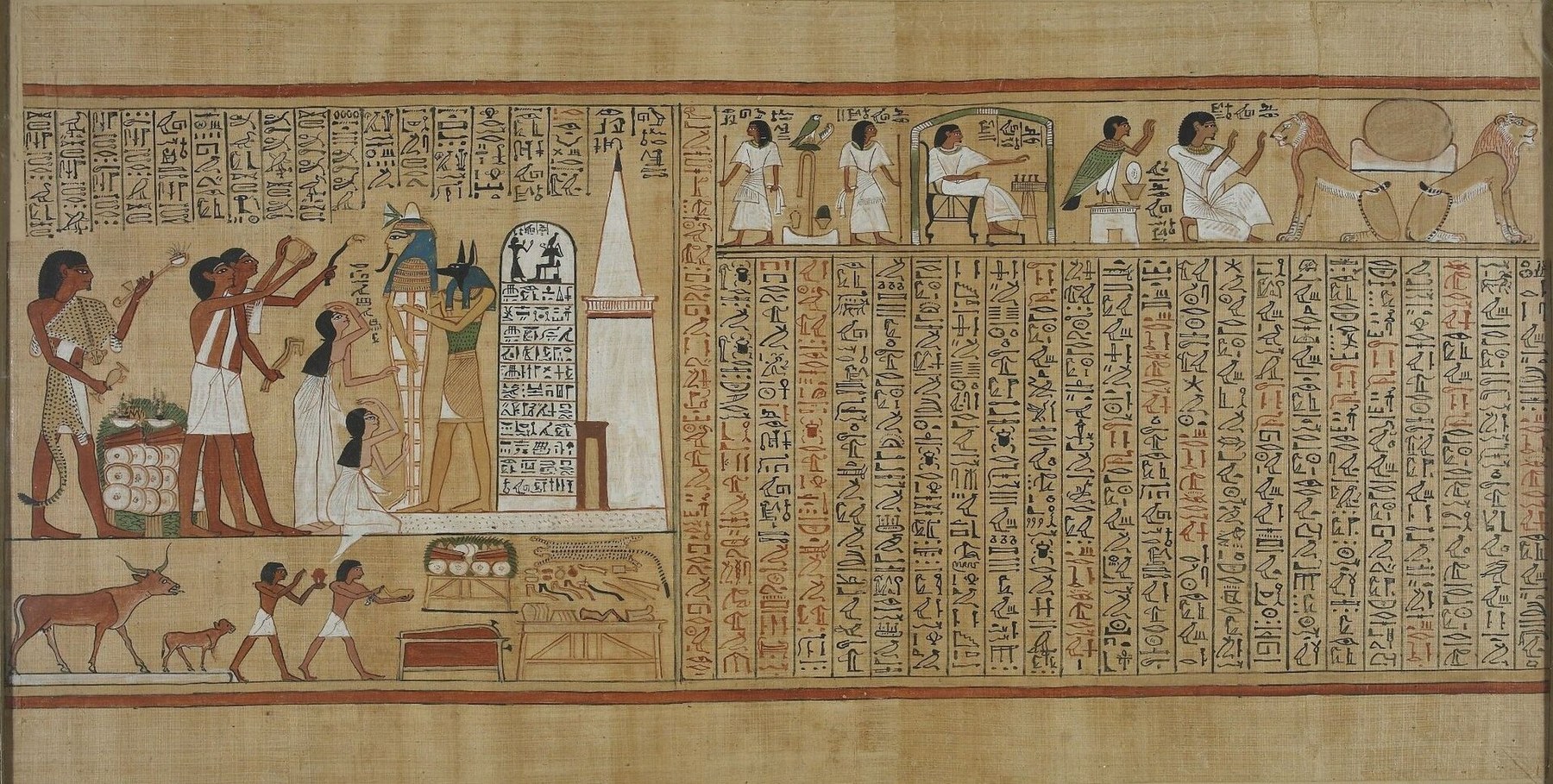
Egyptian anthropology counted at least seven parts to a person, and each one needed different care. The ka, life force, written as two raised arms, survives death and must be fed with offerings. The ba, drawn as a human-headed bird, is the mobile personality that travels between the tomb and the afterlife. The akh is the transfigured spirit, the fully realised immortal form, made when ka and ba unite. The ib is the heart, seat of intelligence, emotion and will, and the thing that gets weighed. The sheut is the shadow. The khat is the body, which has to be preserved so the ba and ka can find their way back to it. And the ren is the name, about which our file says the line worth carrying out of all this: as long as the name is spoken, the person exists. Which is, among other things, an argument for writing your name into your own funerary papyrus a few hundred times.
The Field of Reeds is Egypt, only better, and you still have to farm it. The Duat is the underworld the sun crosses at night, and the terrain the dead have to navigate. The Field of Reeds, Aaru, is the destination: an idealised Egypt with abundant harvests, and, in our file's phrasing, but you still work. Which is why tombs contain ushabti, small servant figures, sometimes by the hundred, buried to answer the call and do the labour on the owner's behalf. There is also a Lake of Fire, which purifies or consumes depending on who arrives at it, and an Isle of Flame where the sun is reborn each morning. A heaven in which the chores continue, and a workaround for the chores, sold separately.
There are other afterlife books, and the old exclusivity crept back into them. The Amduat, meaning that which is in the underworld, maps the sun's night journey hour by hour. The Book of Gates lays out twelve gates with guardian serpents, each requiring a password. The Book of Caverns carries the most detailed underworld geography of the lot. Our file notes that these are primarily royal compositions, which is the pattern the Book of the Dead had supposedly broken, quietly reasserting itself alongside it. The democratisation was real and it was not total.
04A Note On Our Own Sources, And A Sentence Printed 664 Times
Our file argues with itself properly, in a table, and it deserves saying first. Is the Book of the Dead a coherent theology? Verdict: a coherent worldview, but not systematic theology in the modern sense, because copies contradict each other and no canonical version exists. Did the forty-two confessions influence the Ten Commandments? Verdict: possible, not proven, since the structures differ, negative against positive, and independent ethical reasoning is perfectly available to two cultures at once. Was the democratization of the afterlife social progress? Verdict: partial, because it still required money to buy a papyrus and the social hierarchy was reproduced in the next world. Was the heart-weighing a precursor of ethical monotheism? Verdict: mixed. Four disputes, evidence on both sides, graded conclusions. That is exactly what this kind of section is for.
Directly beneath those four disputes, the same document states that it has none. The sentence reads: No significant counter-arguments exist in the scholarly literature for the core claims in this document. It sits on the same page as the table, below it. A reader who skims to the bottom is told the subject is settled, having just been shown four ways in which it is not. Neither statement is hidden. They are a few inches apart.
That sentence is not a judgement. It is a template, and it is printed 664 times. We wrote an instrument and ran it over all 3,632 research documents. 1,246 of them, 34.3 per cent, carry the denial. And 664 carry it verbatim, character for character, word for word. Six hundred and sixty-four separate documents do not independently arrive at an identical sentence about the state of scholarship in their subject. That is one sentence, stamped. Of those, 43 carry it in the same file as a real counter-arguments section, which is the part that can be demonstrated outright rather than inferred. This article's source file is one of the 43.
Thirty-four per cent is a count, not a defect rate, and the instrument says so in its own output. A document with no disputes section that says there are no significant disputes might be perfectly correct; some subjects genuinely are uncontested, and no automated tool can tell an accurate denial from an unexamined one. What is proven is the 43 self-contradictions and the 664 identical strings. And there is a baseline that makes the whole thing legible: 1,128 documents carry real counter-arguments and no denial at all. Nearly a third of the library documents its disputes properly. The template is a competing habit inside the same collection, not a universal condition of it, and that is a considerably more useful thing to know than a single alarming percentage.
This file's header rates its own sourcing from a count that is simply wrong. It reads: Source Count 0, Weighted Score 0, Source Confidence 1 out of 5. The bibliography has twelve entries. The rating is arithmetic performed on a false input. And the same header line contradicts itself within a few words, giving Reliability Tier 1 and Confidence High alongside that 1 out of 5. This is the second time in this series we have found a confidence score derived from a source count of zero, which suggests the two numbers are produced by different processes that never check each other.
Three of the six identifiers point at a review of the book instead of the book. The Assmann identifier returns L. H. Lesko reviewing it in the American Historical Review. The Quirke identifier returns Břetislav Vachala reviewing it in Archiv orientální, in a two-page notice. We predicted both in advance from the shape of the strings alone, before resolving anything, and this file is entirely books, which is what the pattern predicts. Four identifiers are correct: Lichtheim, Mojsov, Hare and Taylor. One of those was the interesting call, and we said so beforehand: Hare's identifier has a De Gruyter prefix on a Stanford University Press book, which looks exactly like the mismatch signature of a wrong pointer and is not one, because De Gruyter distributes Stanford's ebooks. Reading a prefix is useful. Reading it as a rule would have produced a false accusation.
We predicted a review in The Classical Review. We got a review in The Classical Review, of an entirely different book. The identifier on Milde's study of the vignettes in one particular papyrus resolves to Simon Hornblower reviewing a volume of Achaemenid History, edited by Heleen Sancisi-Weerdenburg. Persian imperial administration, not Egyptian funerary art. And the date makes it impossible on its face: the review is dated 1990 and Milde's book is 1991, so our bibliography attaches to a book a review published a year before that book existed. That is the second time in this series that a wrong identifier has been caught by nothing more than subtracting one date from another.
The failures are not landing on reviews of the cited book. They are landing in the review section. We had been saying that a bad identifier attached to a book lands on a review of that book, because a book has no neighbouring article and the only other record carrying its title is somebody's review. The Milde case says that is the small-drift case. Drift further and you land on whatever else lives in that part of the numbering, and in a journal's book-review pages the neighbours are other reviews. Which matches what an earlier article in this series found by stepping through an archive's identifier sequence one number at a time. The general rule is simply: a wrong identifier lands on whatever is next door in the namespace it uses. Sometimes next door is a review of your book. Sometimes it is a review of somebody else's.
Two different books share an ISBN in this bibliography, and that is not possible. Hornung's The Ancient Egyptian Books of the Afterlife, Cornell University Press, 1999, is given the identifier 9780714119939. So is Taylor's Journey Through the Afterlife, British Museum Press, 2010, in the entry directly above it. Different authors, different publishers, eleven years apart. The identifier returns Taylor's book, so the line above was simply copied down. Separately, Faulkner's entry is not wrong about the work but is wrong about the house: its identifier resolves to a Macmillan printing where our file says British Museum Press. Both were called in advance from the shape of the numbers, which is a low bar and worth stating plainly rather than dressing up.
Review records give themselves away in a field nobody reads. When we went looking for Milde's book and Hornung's, the only records that exist for either are reviews, and their author fields read Leonard H. Lesko, H. Milde and Leo Depuydt, Erik Hornung. That is the reviewer first and the reviewed author second. So a single record answers two different questions inconsistently: its title says it is the book, and its author list says it is somebody writing about the book. Anything that assembles a bibliography by matching titles takes the first answer and never sees the second. That disagreement is detectable automatically, across a whole library, without a human reading a single record. It is the first properly mechanical handle we have found on a defect class this series has been documenting for weeks.
| Our File's Entry | Predicted In Advance | What It Actually Returns |
|---|---|---|
| Lichtheim 1976, Ancient Egyptian Literature II (California) | CORRECT: the prefix is California's own and the suffix is its ISBN | That book, Miriam Lichtheim, University of California Press. CORRECT |
| Mojsov 2005, Osiris (Blackwell) | CORRECT: the prefix is Wiley, which owns Blackwell | Osiris, Bojana Mojsov, Wiley monograph, 2005. CORRECT |
| Hare 1999, ReMembering Osiris (Stanford) | CORRECT DESPITE a De Gruyter prefix on a Stanford book, because De Gruyter distributes Stanford ebooks. Said in advance that the mismatch heuristic would be wrong here | ReMembering Osiris, Tom Hare, Stanford University Press, 1999. CORRECT, and the advance caveat held |
| Taylor 2010, Journey through the Afterlife (British Museum) | CORRECT: 0714 is the British Museum Press stem | That book, John H. Taylor, British Museum Press, 2010. CORRECT |
| Assmann 2005, Death and Salvation (Cornell) | A review in the American Historical Review | L. H. Lesko reviewing it, American Historical Review 112(3):962. A REVIEW |
| Quirke 2013, Going Out in Daylight (Golden House) | A review in Archiv orientální; 389 to 390 is a review's length | Břetislav Vachala reviewing it, Archiv orientální 82(2):389-390. A REVIEW |
| Milde 1991, Vignettes in the Book of the Dead of Neferrenpet | A review in The Classical Review | A review in The Classical Review, BY Simon Hornblower, OF Achaemenid History I. Unrelated book, and dated 1990, a year before Milde's was published |
| Faulkner 1985, our file says British Museum Press | SUSPECT: the 0-02 stem is Macmillan | The right book, the right author, the right year, published by MACMILLAN. Our file's publisher is wrong |
| Hornung 1999 (Cornell), ISBN identical to Taylor's | Taylor is the real owner; Hornung's entry has been given a copy of the line above | Returns TAYLOR'S BOOK. Hornung's has no Crossref book record at all, only three reviews |
Fast Facts
- Real name
- Pert em Hru, Coming Forth by Day. The title Book of the Dead was coined by Karl Richard Lepsius in 1842
- Not a book
- No canonical version, no creed, not publicly read. Around 192 spells, numbered by Lepsius, and no single copy carries all of them
- Made to order
- Each papyrus was customised with the buyer's name written throughout. Length depended on price. Chapter 64 was a condensed version of the whole book for those who could not afford a full copy
- Period
- Primarily New Kingdom, about 1550 to 1070 BCE, continuing to the Ptolemaic period, about 332 to 30 BCE
- Famous copies
- The Papyrus of Ani (British Museum, about 1250 BCE), the Papyrus of Hunefer, and the Greenfield Papyrus, which is 37 metres long
- The sequence
- Pyramid Texts (about 2400 to 2300 BCE, royal only, carved in pyramids), Coffin Texts (about 2100 to 1650 BCE, nobles, on coffins), Book of the Dead (papyrus, anyone who could pay)
- The judgement
- Chapter 125, in the Hall of Two Truths. Anubis works the scale, the heart is weighed against the feather of Ma'at, Thoth records, Osiris presides, 42 assessors sit, one per nome
- Ammit
- Crocodile head, lion body, hippopotamus hindquarters. She eats the heart that fails
- The penalty
- The second death: total annihilation, not eternal torture. Chapter 175 is a spell against dying a second time
- The loophole
- Chapter 30B, the heart-scarab spell, prevents the heart from testifying against the deceased at judgement
- Two confessions about water
- Number 22, I have not polluted the water. Number 38, I have not stopped water when it should flow
- Parts of a person
- Ka (life force), ba (human-headed bird), akh (transfigured spirit), ib (heart), ren (name), sheut (shadow), khat (body). As long as the name is spoken, the person exists
- Paradise
- The Field of Reeds, an idealised Egypt with abundant harvests, where you still work. Hence ushabti, servant figures buried to do the labour
- Identifier audit
- 9 checked live 26 August 2026 against predictions recorded first. 4 correct, 3 reviews, 1 right book with the wrong publisher, 1 ISBN copied from the entry above it
- The templated denial
- 1,246 of 3,632 documents (34.3%) carry a sentence denying that any significant counter-arguments exist. 664 carry it verbatim. 43 carry it beside a real counter-arguments section
What We Can Actually Stand Behind
The Egyptian name is Pert em Hru, Coming Forth by Day, and the modern title is Lepsius's, from 1842. There is no canonical version; roughly 192 spells are known and no copy carries all of them; each was customised with the owner's name and priced by length, with Chapter 64 serving as a condensed edition for those who could not afford more. The tradition runs Pyramid Texts to Coffin Texts to Book of the Dead, royal to noble to anyone who could pay. Chapter 125 sets the judgement in the Hall of Two Truths with Anubis at the scale, the heart against the feather of Ma'at, Thoth recording, Osiris presiding and 42 assessors. Failure means the second death, annihilation rather than torment. Chapter 30B is a spell to prevent the heart testifying. The negative confessions include two on water pollution and water rights. A person comprised ka, ba, akh, ib, ren, sheut and khat, and the Field of Reeds is a paradise where the work continues.
The Book of the Dead is a coherent worldview rather than a systematic theology, since copies contradict one another. Influence of the 42 confessions on the Ten Commandments is possible and not proven. The democratization of the afterlife was partial, since it still had to be bought and the hierarchy was reproduced in the next world. And the ethical reading of the heart-weighing is mixed: the moral emphasis is genuine and it is magically circumventable, by a spell printed in the same book.
This source document carries no speculative or dubious-claims section, and none has been invented for it. The Book of the Dead is unusual among the subjects in this wing in having almost no fringe literature attached to it: the text is extensively translated, the manuscripts are in museums, and the arguments are about interpretation rather than authenticity.
Nine identifiers resolved live on 26 August 2026 against predictions recorded beforehand: four correct, three pointing at reviews rather than the books cited, one resolving to the right book under the wrong publisher, and one ISBN copied verbatim from the entry above it. One review turned out to be of an entirely unrelated book and to predate the book it is attached to by a year. Separately, the file's header computes a confidence rating from a source count of zero against a bibliography of twelve, and contradicts itself in the same line. And the file denies having counter-arguments directly beneath four of them, in a sentence that appears verbatim in 664 documents across the library. Read the 34.3 per cent carefully: it counts denials, not falsehoods, and 1,128 documents in the same collection document their disputes properly.
Sources & further reading
The Egyptological material above is drawn from our research library on Theories of Anything. Every identifier below was checked live on 26 August 2026 against a prediction recorded in advance. Where our file's identifier points at a review rather than the book, the review is listed for what it is; where no correct identifier exists, none is offered, and that absence is part of the finding. Open the full research file to check the sourcing and go deeper.
Image credits
- The weighing of the heart, from the Papyrus of Ani Photographed by the British Museum, via Wikimedia Commons (public domain). Public domain Source.
- Papyrus of Ani, sheet 12 (British Museum EA 10470) Via Wikimedia Commons (public domain). Public domain Source.
- Heart scarab amulet, steatite, Museo Egizio, Turin (Cat. 5988) Museo Egizio, Turin, via Wikimedia Commons (CC0). CC0 Source.
- The Opening of the Mouth ceremony, from the Book of the Dead of Hunefer, sheet 5 Via Wikimedia Commons (public domain). Public domain Source.


