
Ego Dissolution: The Self Switched Off
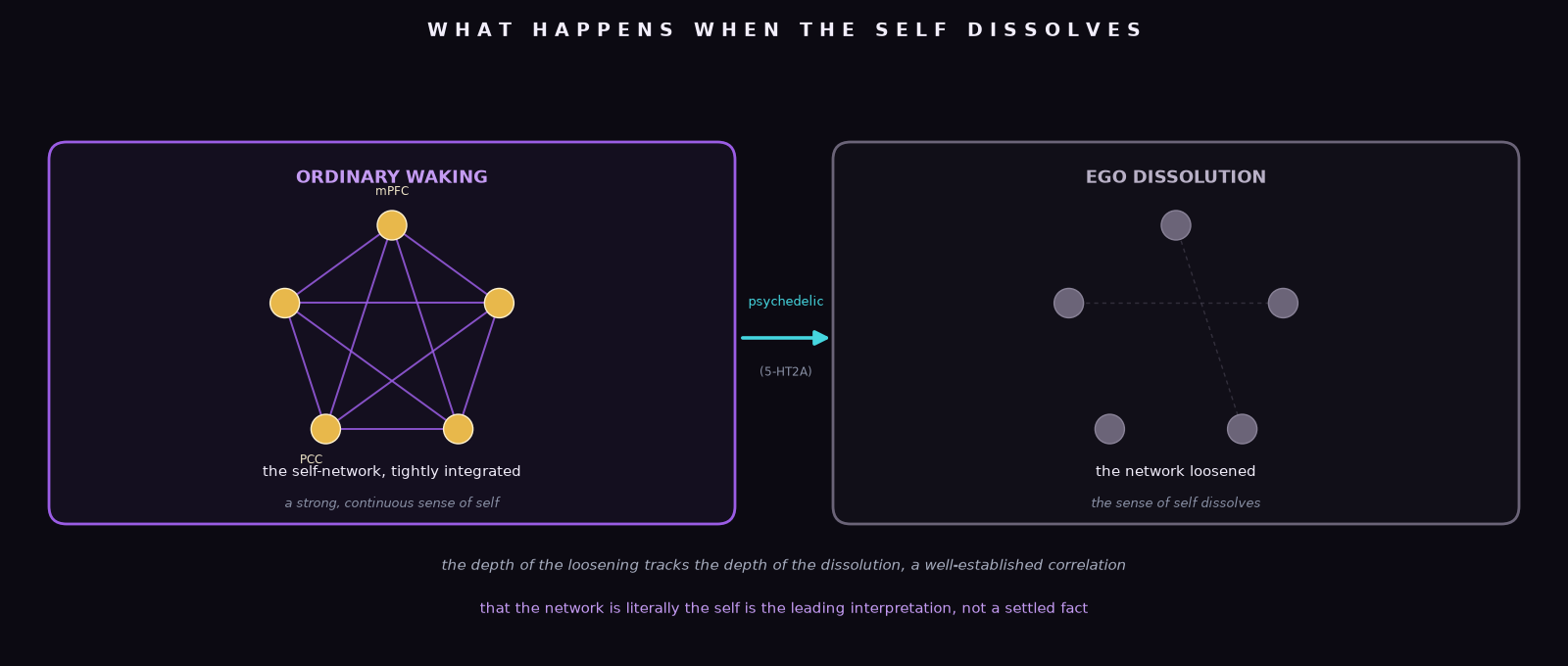
There is a particular experience, reported for millennia by mystics and now reliably produced in laboratories, in which the boundary between you and everything else simply dissolves. The separate self, the narrator in your head, goes quiet, and what remains is described as unity, or oceanic boundlessness, or sometimes sheer terror. This is ego dissolution, and unlike most reports of the sacred, it has a measurable fingerprint in the brain: it tracks the quieting of a specific network that normally builds your sense of being a self. The phenomenon is real and the correlation is solid. What the correlation means, and the grander things people claim it reveals, is where the discipline has to hold.
The sense that you are a single, continuous self, located behind your eyes, separate from the world, feels like the most basic fact there is. It is also, on the evidence, something the brain actively builds, moment to moment, and therefore something that can be switched off. When it goes, the experience is unmistakable and hard to put into words: the line between self and everything else dissolves, thought loses its owner, and people reach for the same vocabulary the mystics always used. What makes this a science story rather than only a spiritual one is that the switch has been found, or at least a large part of it. Ego dissolution is not just a feeling reported after the fact; it correlates, in real time, with a measurable change in a specific brain network. Let us look at exactly what is known, and hold a firm line at the point where knowledge stops.
01The Network of the Self
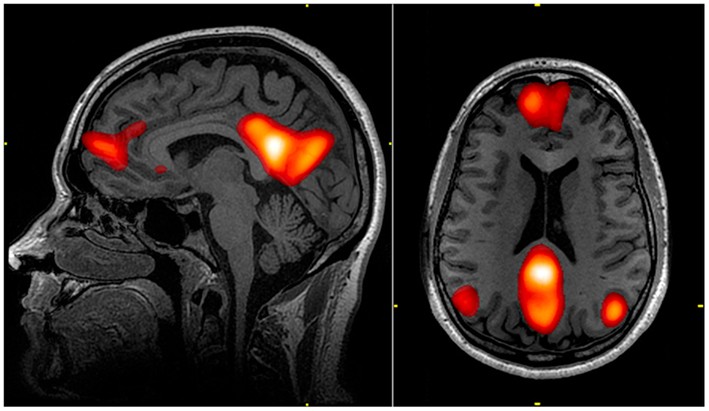
The starting point is a real, well-mapped brain system called the default mode network, or DMN: a set of midline structures, chiefly the medial prefrontal cortex and the posterior cingulate cortex, that becomes most active when you are not focused on the outside world, when you are remembering your past, planning, mind-wandering, or thinking about yourself and others. Its activity is closely tied to the sense of a narrative self, the ongoing story of 'me.' It is, in a real sense, the brain's storyteller, and it runs almost constantly in the background of ordinary waking life.
Now the key finding. When Robin Carhart-Harris and colleagues scanned people on intravenous psilocybin (2012) and later on LSD (2016), they expected the drugs to ramp brain activity up. Instead, the most striking effect was a quieting. Under psilocybin, blood flow and connectivity fell in exactly those DMN hubs, the medial prefrontal and posterior cingulate cortices. Under LSD the network's integrity was likewise reduced, even as the whole brain became more globally interconnected, its normally separate networks blurring together. And crucially, the degree to which the default mode network came apart predicted the intensity of the reported ego dissolution. The self-network going quiet and the self-experience dissolving were measured together, in the same people, at the same time. A DMT study in 2019 found the same DMN disruption arriving within minutes on a far faster timecourse.
02The Key and the Lock
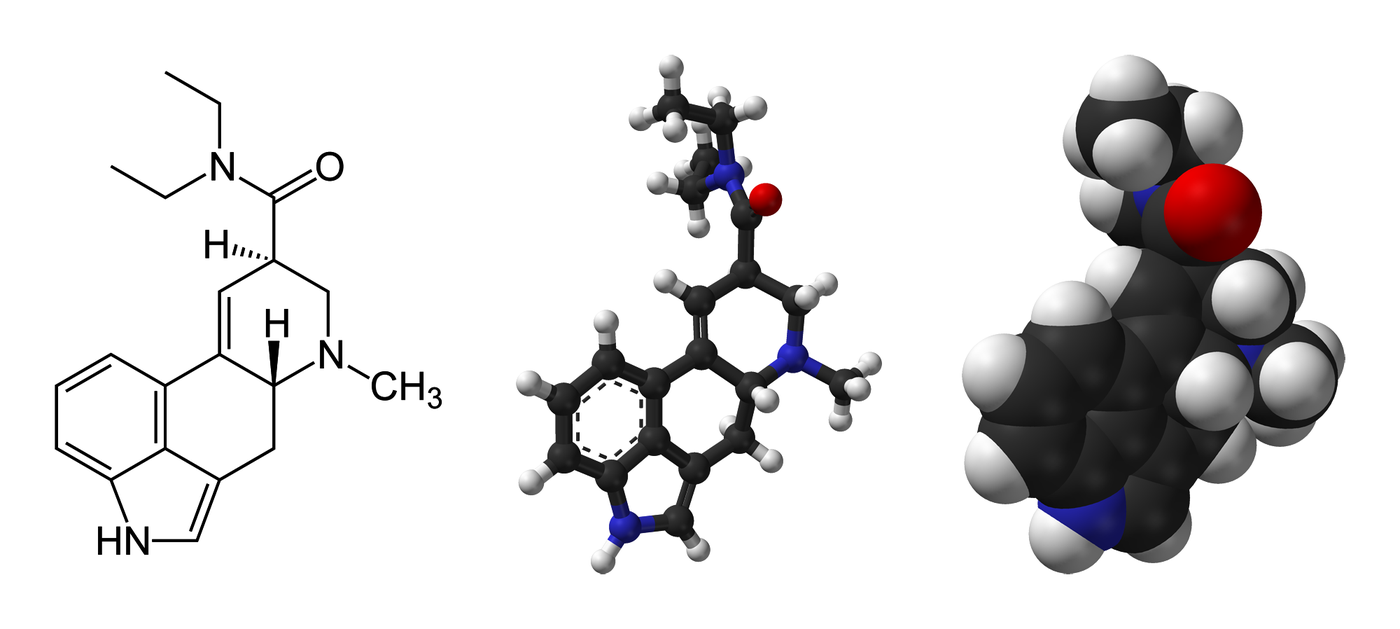
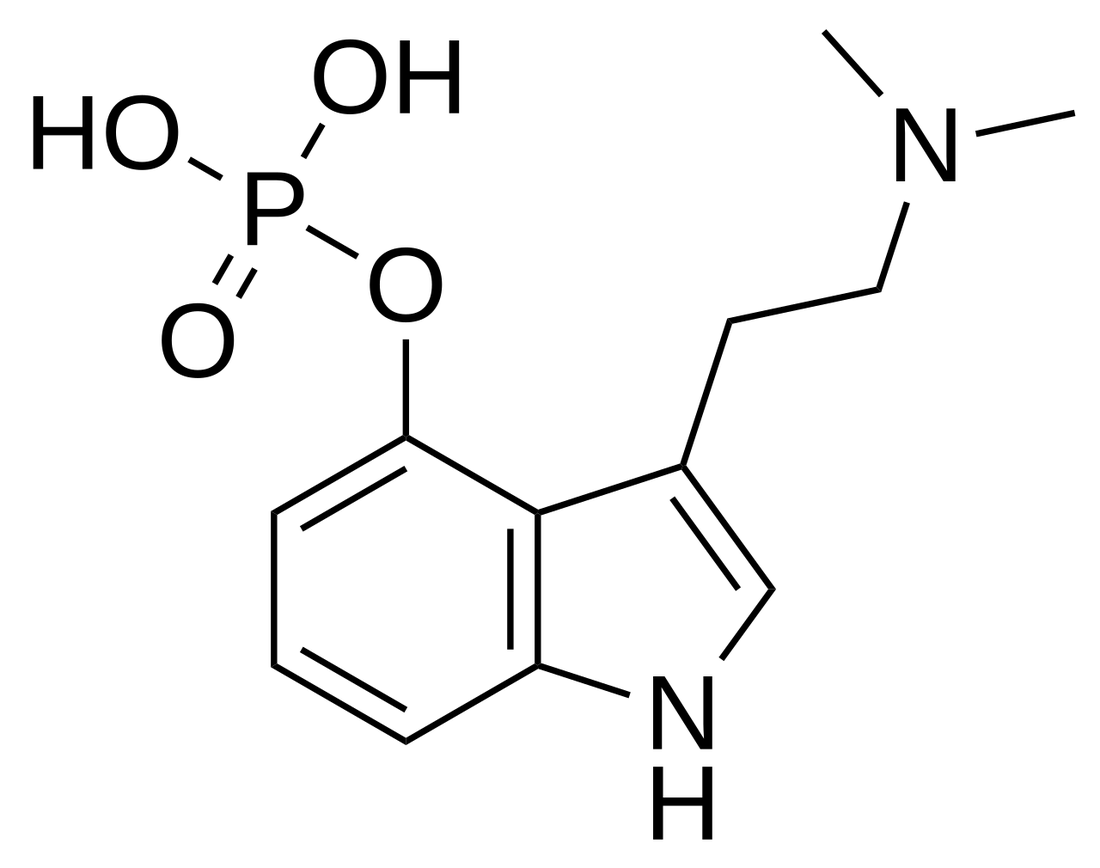
Why do such different-looking molecules do the same thing? Because they are all keys cut for the same lock. Every classical serotonergic psychedelic, psilocybin, LSD, DMT, and mescaline, works chiefly by activating one receptor, the serotonin 5-HT2A receptor. The proof is clean: give a person a drug that blocks that receptor first, and the psychedelic effect is abolished. This is not correlation; it is a demonstrated on-off switch, established in controlled human studies. The experience runs through the 5-HT2A receptor or it does not run at all.
And the anatomy lines up beautifully. These 5-HT2A receptors are packed most densely onto particular neurons in the association cortices, the prefrontal, cingulate, and temporal regions, which are the very areas that make up the default mode network. So the drug preferentially disrupts the self-network not by magic but because that is where its molecular targets are concentrated. Downstream, the receptor activation raises cortical excitability and desynchronizes the slow alpha rhythms that normally impose orderly top-down control, letting brain activity become more varied and less predictable. The orderly, self-modeling machine is, briefly, turned loose.
03Relaxed Beliefs: The Leading Theory
So the drug quiets the self-network through a known receptor. But why should quieting that network dissolve the sense of self, rather than just, say, making you sleepy? Here we move from established fact to the leading explanatory model, and the honest word is model.
The most influential account is called REBUS, for 'relaxed beliefs under psychedelics,' proposed by Carhart-Harris and Karl Friston in 2019. It rests on the well-supported idea that the brain is a prediction machine: it constantly models the world and itself using high-level expectations, or priors, and the most deeply held prior of all is the model of you, the self. In this view, the default mode network is where the self-model is maintained with high confidence. Psychedelics, by disrupting that network, relax the grip of these top-level priors, so that the raw, bottom-up flow of sensation and information is no longer tightly organized around a central self. The related 'entropic brain' idea frames the psychedelic state as one of higher disorder and richer, less constrained activity. Together they give an elegant story: loosen the self-model's certainty, and the self loosens with it.
Elegant is not the same as settled, and intellectual honesty requires the next sentence. The default-mode story is the leading hypothesis, well evidenced and productive, but it is under active refinement, not closed. A 2023 systematic review of the imaging literature confirmed that psychedelics do consistently disrupt the DMN, and then stated plainly that it remains unclear how central that DMN disruption actually is to the drugs' effects. Rival and complementary accounts point to other structures and mechanisms. Even the entropic-brain hypothesis was substantially revised by its own originator a few years after he proposed it. The correlation between DMN disruption and ego dissolution is real and robust; the claim that the DMN is simply and completely 'where the ego lives' is a strong lead, not a verdict.
04When It Heals
One of the most striking findings is that ego dissolution is not merely dramatic; it appears to be therapeutic, and the depth of the dissolution predicts the benefit. In a trial of psilocybin for treatment-resistant depression, the degree of ego dissolution a patient experienced during their session predicted how much their depression improved weeks later. In a study of psilocybin-assisted smoking cessation, participants who had the most complete unitive, self-transcendent experiences were the most likely to still be abstinent at six months, with a strikingly high success rate for so hard a habit. And in two 2016 trials treating the anxiety and depression of people with life-threatening cancer, it was specifically the patients who had full mystical-type experiences, ego dissolution included, who showed the most sustained relief, with roughly four in five still responding half a year on. The experience is not incidental to the healing; it seems to be part of the mechanism.
05The Same Door, Reached Other Ways
Psychedelics did not invent ego dissolution; they made it fast and reliable. The same loss of a bounded self sits at the center of contemplative traditions worldwide: the Buddhist teaching of anatta, or no-self, holds that the unified self is a construction to be seen through; and the nondual reports of Advaita Vedanta, of Sufism's fana, and of Christian mysticism converge on the same dissolving of the separate 'I.' This is more than a poetic parallel. Experienced meditators show reduced activity in the same default-network hubs that psychedelics quiet, which points at a shared underlying mechanism, and researchers have even built a validated questionnaire, the Ego-Dissolution Inventory, to measure the experience across both. One difference must not be flattened, though: meditation tends to produce a gradual, controlled, and reversible dissolution, while psychedelics produce a rapid and involuntary one. Same door, very different ways of walking through it.
06The Dark Side of the Door
None of this should be read as an advertisement. The dissolution of the self is not always experienced as liberation; it can arrive as annihilation, and be terrifying. Depending on the person, the dose, and the setting, ego dissolution can bring paranoia, panic, confusion, and a genuine ontological terror that sometimes lingers after the drug has worn off. A rare condition, Hallucinogen Persisting Perception Disorder, leaves some users with lasting visual disturbances by a mechanism that is still unclear. And in people carrying a predisposition to psychosis, these drugs can help precipitate a lasting episode, which is why serious clinical trials screen carefully for that risk. The same loosening of the self-model that can heal a rigidly depressed mind can, in a vulnerable one, fail to snap back. This is powerful neuropharmacology, not a recreational shortcut to enlightenment.
07Where the Claims Outrun the Evidence
Two ideas sit honestly at the speculative edge. One is anatomical: the neuroscientist Francis Crick proposed that a thin, deep, richly connected sheet of neurons called the claustrum might act as a conductor of consciousness, binding experience together, and it happens to carry a very high density of the same 5-HT2A receptors, so its disruption could contribute to ego dissolution. The evidence is thin and the structure is hard to study, so this remains an intriguing proposal, not an established mechanism. The other is about aftereffects: psychedelics may open a window of heightened brain plasticity lasting days to weeks after a single dose, which would reframe the therapy as much about rewiring as about the trip itself. Promising, and still to be confirmed at the timescales that matter in humans.
And two claims have to be refused outright. The first is that ego dissolution, especially the vivid entity encounters some people report on DMT, is literally a doorway into other dimensions or contact with autonomous beings that exist outside the mind. However compelling the experience, there is no empirical support for it, and everything the neuroscience shows points to these experiences being constructed by a disinhibited brain: unbound pattern recognition and released predictive constraints generating a world that feels external but is not. The second is that a single ego death permanently enlightens you. Powerful and lasting positive changes are real and documented, but the benefits fade without integration and effort, repeated use does not stack up into permanent awakening, and the traditions that take these states most seriously have always called them milestones, not finish lines.
Fast Facts
- What it is
- The experience of the separate self dissolving, from unity to sheer terror
- The brain correlate
- Quieting of the default mode network, the brain's self-referential hub
- The measure
- The degree of DMN disruption predicts the intensity of ego dissolution
- The mechanism
- All classical psychedelics act through the serotonin 5-HT2A receptor
- The proof
- Block the 5-HT2A receptor and the experience does not occur
- The leading theory
- REBUS: psychedelics relax the brain's high-level priors, including the self-model
- Why it matters
- Deeper ego dissolution predicts better outcomes in depression and addiction trials
- The hard limits
- Not a portal to other dimensions; not a shortcut to permanent enlightenment
What We Can Actually Stand Behind
Ego dissolution is real, and it has a measurable brain signature. Psychedelics reliably produce it, it correlates in real time with the quieting of the default mode network, its depth predicts its intensity, the whole effect runs through the 5-HT2A serotonin receptor (block the receptor and it vanishes), and in clinical trials the depth of the experience predicts the therapeutic benefit. This is solid, replicated neuroscience, not speculation.
How the quieting produces the dissolution is the leading hypothesis, not closed science. The REBUS and entropic-brain models, that psychedelics relax the self-model's grip, are elegant and well evidenced, but a 2023 review found it still unclear how central the DMN really is, and the theory's own authors keep revising it. The meditation parallel, the same self dissolving through contemplative practice with overlapping brain changes, is genuine and important. Treat the mechanism as a strong, developing account, not a verdict.
Some pieces are still at the frontier. The claustrum's role as a possible conductor of consciousness, and the idea of a prolonged post-dose plasticity window that would recast the therapy as rewiring, are both intriguing and both unproven at the level that would settle them. Hold these as live hypotheses, not findings.
No, ego dissolution is not a doorway to other dimensions, and no, one ego death does not permanently enlighten anyone. The entities and other worlds people encounter, however real they feel, show every sign of being constructed by a disinhibited brain, with no empirical support for their external existence. And lasting change is real but requires integration and effort; there is no evidence for cumulative, permanent enlightenment from repeated dosing. The experience is profound. It is still your own brain.
What ego dissolution offers, stripped of both the hype and the reflexive dismissal, is a rare and disciplined kind of wonder. Here is direct, first-hand evidence that the self, the thing you are most certain you are, is not a fixed object but an ongoing construction, one the brain assembles from a particular network and a particular rhythm, and one that can be taken apart and put back together. That is a genuinely vertiginous fact, and it does not need any other dimensions to be astonishing. The dissolving of the self is real, its brain signature is measurable, and its therapeutic power is beginning to be understood. Whether losing the self for an hour tells us anything true about what the self ultimately is, philosophy and each person's own experience will have to weigh. Neuroscience can now tell you, with some precision, what happens when the storyteller goes quiet. It cannot yet tell you who, if anyone, is left listening.
Sources & further reading
Everything above is drawn from our research library on Theories of Anything. Open the full file to check the sourcing and go deeper.
Image credits
- Original diagram contrasting the default mode network in ordinary waking versus ego dissolution (loosened connectivity) Original diagram by Theories of Anything. CC BY-SA 4.0 Source.
- An MRI image of the brain with the default mode network regions highlighted John Graner, Walter Reed National Military Medical Center, via Wikimedia Commons. Public Domain (US federal government work) Source.
- The chemical structure of LSD (skeletal formula and ball-and-stick and space-filling models) Ben Mills (Benjah-bmm27), via Wikimedia Commons. Public Domain Source.
- The chemical structure of psilocybin (skeletal formula) Cburnett, via Wikimedia Commons. CC BY-SA 3.0 / GNU Free Documentation License Source.
- Card crop of the original default-mode-network ego-dissolution diagram Original diagram by Theories of Anything. CC BY-SA 4.0


