
Read Before They Were Seen
Every other kind of extinct human was found the same way: somebody dug up a skull and argued about it. The Denisovans were found by reading. In 2010 a fragment of finger bone from a Siberian cave was sequenced, and the DNA came back as neither us nor Neanderthal, twice as far from modern humans as Neanderthal DNA is. There was no face, no skeleton, no name for them. There was a population, announced from a sequence. Sixteen years later we still have almost no bones, we know their genome better than we know most living species, and one of their genes is the reason people can live on the Tibetan Plateau. And when we audited our own sources on all this, every identifier the file carried was correct, which is now the second time running, and it finally showed us where in our library the errors actually live.
Here is how a new kind of extinct human normally enters the record. Somebody digs up a skull. There is an argument about the skull. Eventually the argument settles, the thing gets a name, and a reconstruction with careful hair appears in a museum. Neanderthals arrived that way. Homo erectus arrived that way.
The Denisovans did not arrive that way. In 2010 a team led by Svante Pääbo sequenced DNA from a scrap of finger bone that had come out of a cave in the Altai Mountains of Siberia, and the result was neither modern human nor Neanderthal. It was further from us than Neanderthal DNA is, by a factor of about two. There was no skull to argue about. There was no face, no skeleton, no idea what they looked like, and for a while no name. There was a population, and it had been announced from a sequence. Sixteen years later we still have barely any bones, and we know their genome better than we know the genome of most species currently alive.
01A Population From A Fingertip
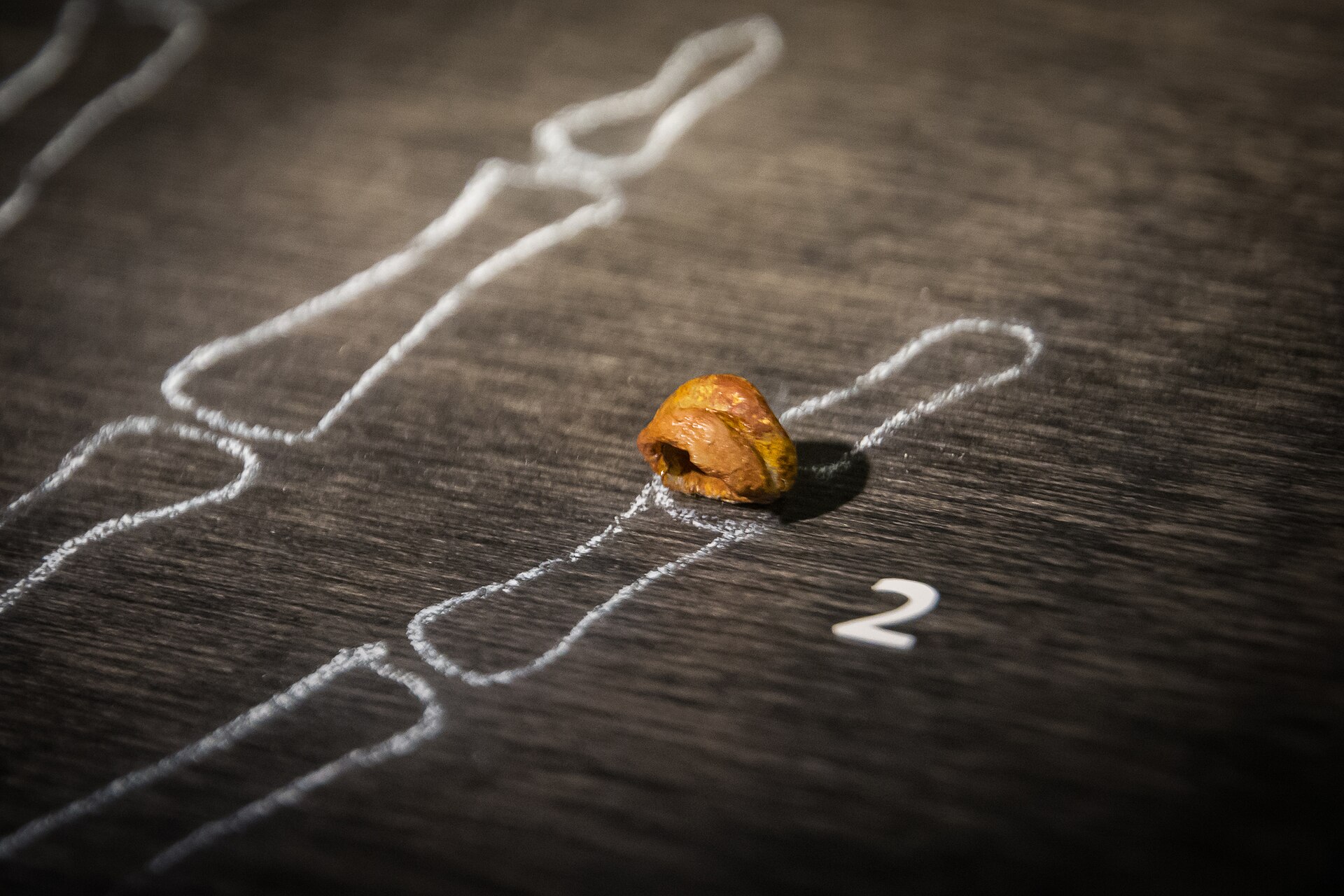
The entire physical record is a fingertip and some teeth. Denisova 3, the finger bone, is a distal phalanx from a juvenile female, found in 2008 and published in 2010; its mitochondrial DNA turned out to be twice as divergent from modern humans as Neanderthal mitochondrial DNA is. Denisova 4 is an upper third molar, larger than any Neanderthal or modern human molar. Denisova 8 is another molar, larger still, from a layer more than 100,000 years old. And Denisova 2 is a baby tooth that had been sitting in a collection since 1984 and was only identified as Denisovan in 2017, from a layer over 200,000 years old. That is the fossil record of a species that occupied half a continent.
Thirty-fold coverage, from one finger bone. In 2012 Matthias Meyer and colleagues published a nuclear Denisovan genome at 30x coverage, which is to say comparable in quality to sequencing a living person, from that single fragment. Our file names the reason it was possible: a single-stranded library preparation technique developed in Pääbo's laboratory, which recovers damaged ancient DNA that older methods threw away. Pääbo received the Nobel Prize in 2022. The situation is genuinely strange when you hold both halves of it: we can read this population's genes at a resolution we cannot match for most living mammals, and we have never seen one of their faces.
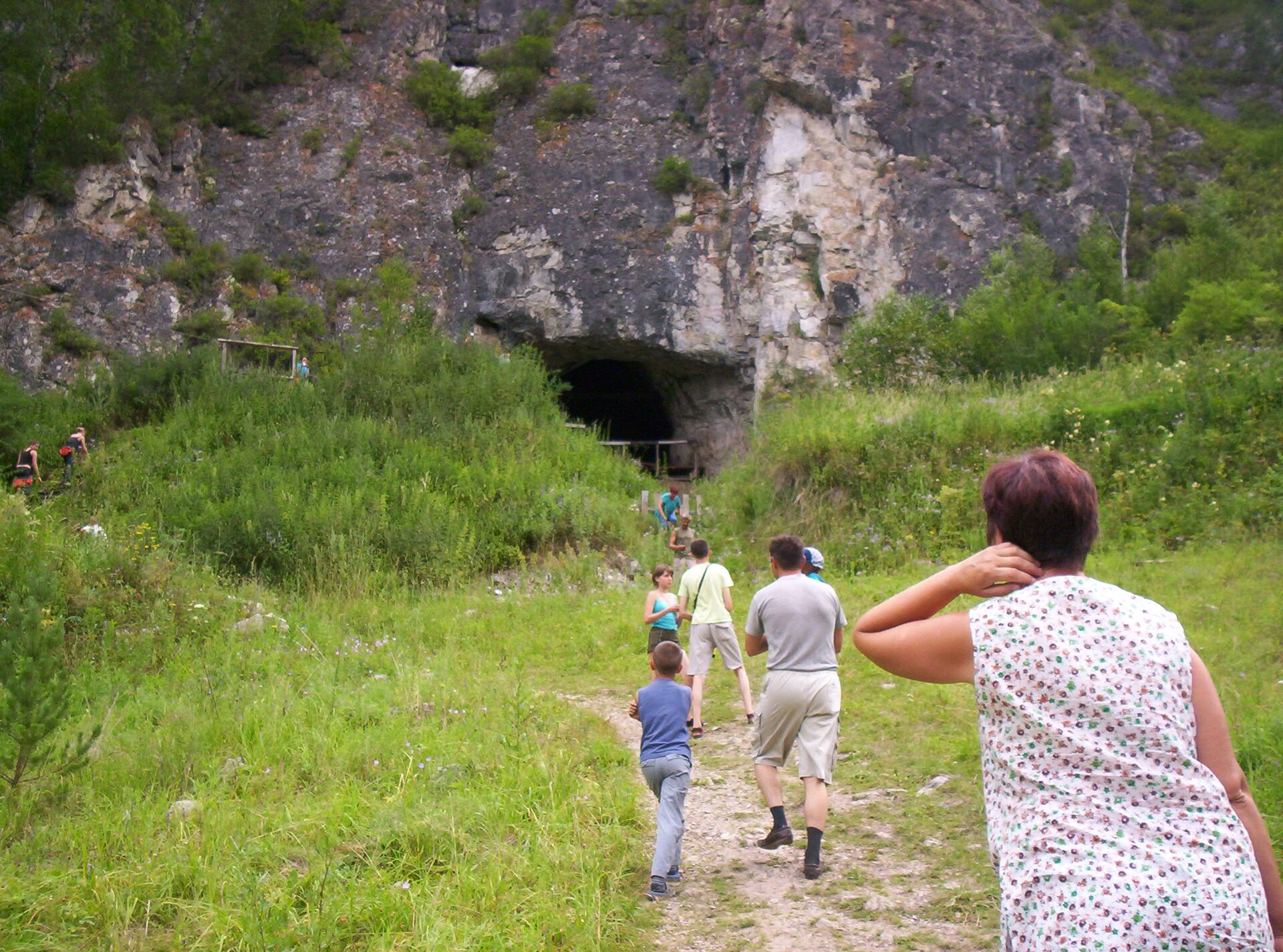
Where they sit on the tree, and how thin on the ground they were. Denisovans are a sister group to Neanderthals. Our lineage split from the shared Denisovan and Neanderthal lineage somewhere between 550,000 and 765,000 years ago; Denisovans and Neanderthals then split from each other between 390,000 and 440,000 years ago. And the 2012 genome shows very low genetic diversity, which points to a small effective population. They were never numerous. There is also a detail about the cave itself that is easy to skate past: Denisova Cave contains remains of three different kinds of human, Denisovans, Neanderthals and Homo sapiens, across more than 300,000 years of occupation, sometimes overlapping. One address in Siberia, three species through the door.
02The Girl Whose Parents Were Different Species
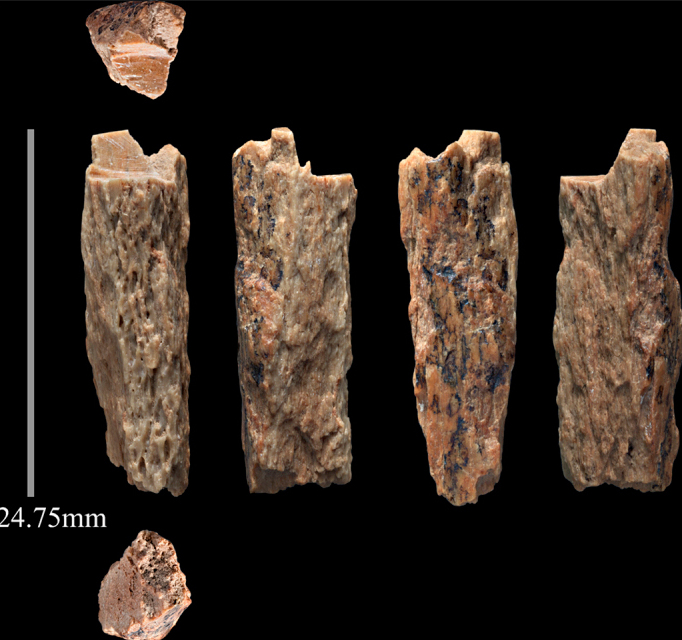
Her mother was a Neanderthal. Her father was a Denisovan. In 2018 Viviane Slon and colleagues published the genome of Denisova 11 in Nature: a girl of about thirteen whose mitochondrial DNA was Neanderthal, whose X chromosomes were Neanderthal, and whose remaining genome was half Denisovan. She is the only known first-generation hybrid between two archaic human species, which turns a statistical inference about interbreeding into a specific person with a specific pair of parents. And our file adds the detail that makes it stranger still: her father's own genome carried traces of earlier Neanderthal admixture. It had happened in his family too, further back.
Finding her at all suggests it was ordinary. There are only a handful of archaic hominin fragments anywhere in the world with DNA good enough to sequence. That a first-generation hybrid turned up inside that tiny sample is the basis for a claim our file makes carefully: interbreeding was probably common rather than rare wherever the two populations overlapped. The reasoning is the same as noticing that if you draw three cards from a deck and one is the ace of spades, either you were lucky or the deck is mostly aces. It is an inference from sample size, not a direct observation, and it is a good one.
03Then A Jaw Turned Up On The Roof Of The World
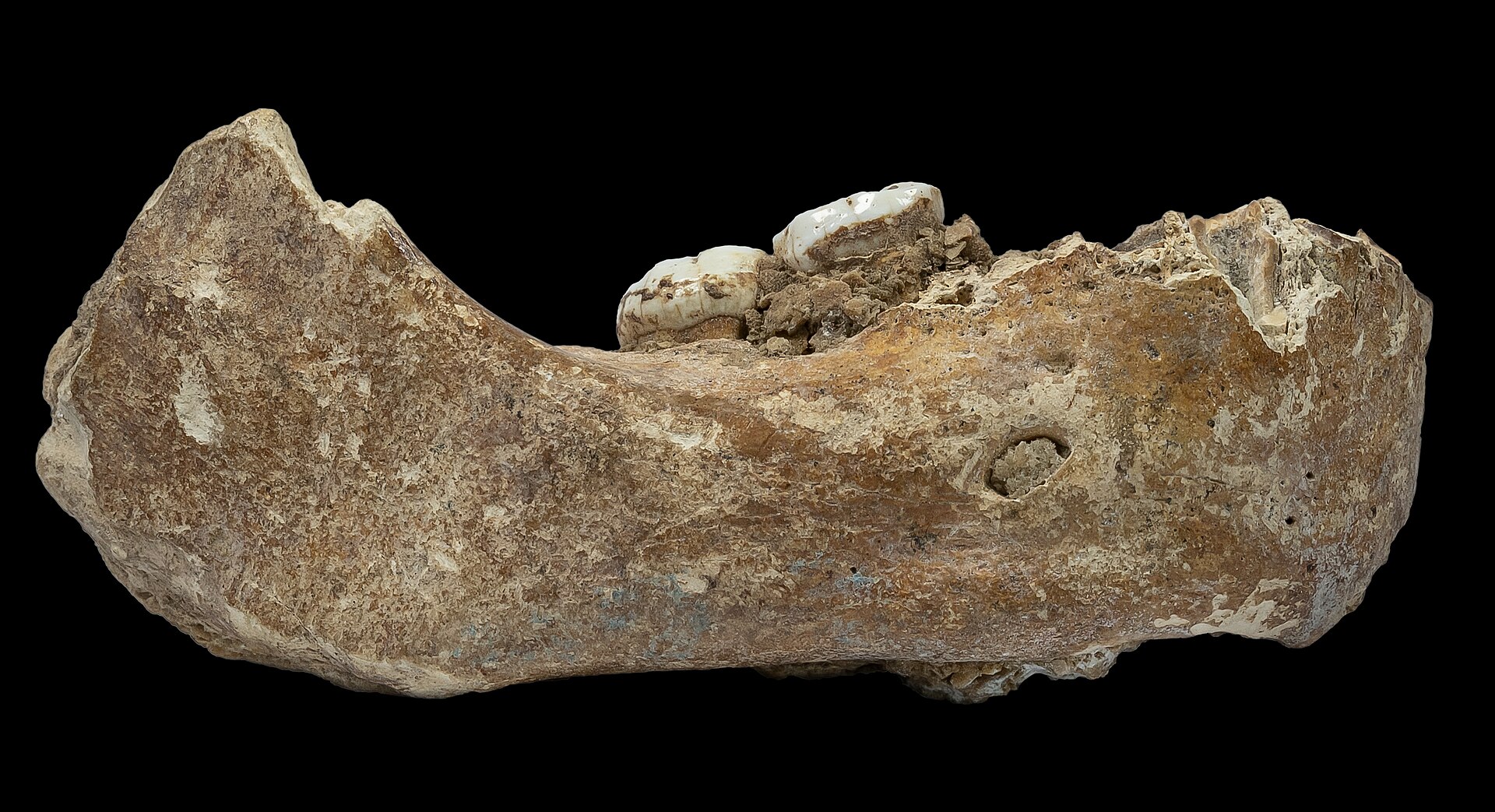
The Xiahe mandible was read from its proteins. Published in 2019, it is the first Denisovan fossil found outside Denisova Cave, and it came from Baishiya Karst Cave in Gansu, roughly two thousand kilometres away. There was no usable DNA left in it. It was identified by ancient protein analysis, proteomics, which reads the amino acid sequences that survive after DNA has degraded past recovery. And the altitude is the point: 3,280 metres. Denisovans were living on the Tibetan Plateau about 160,000 years ago, which is long before any modern human is known to have managed it.
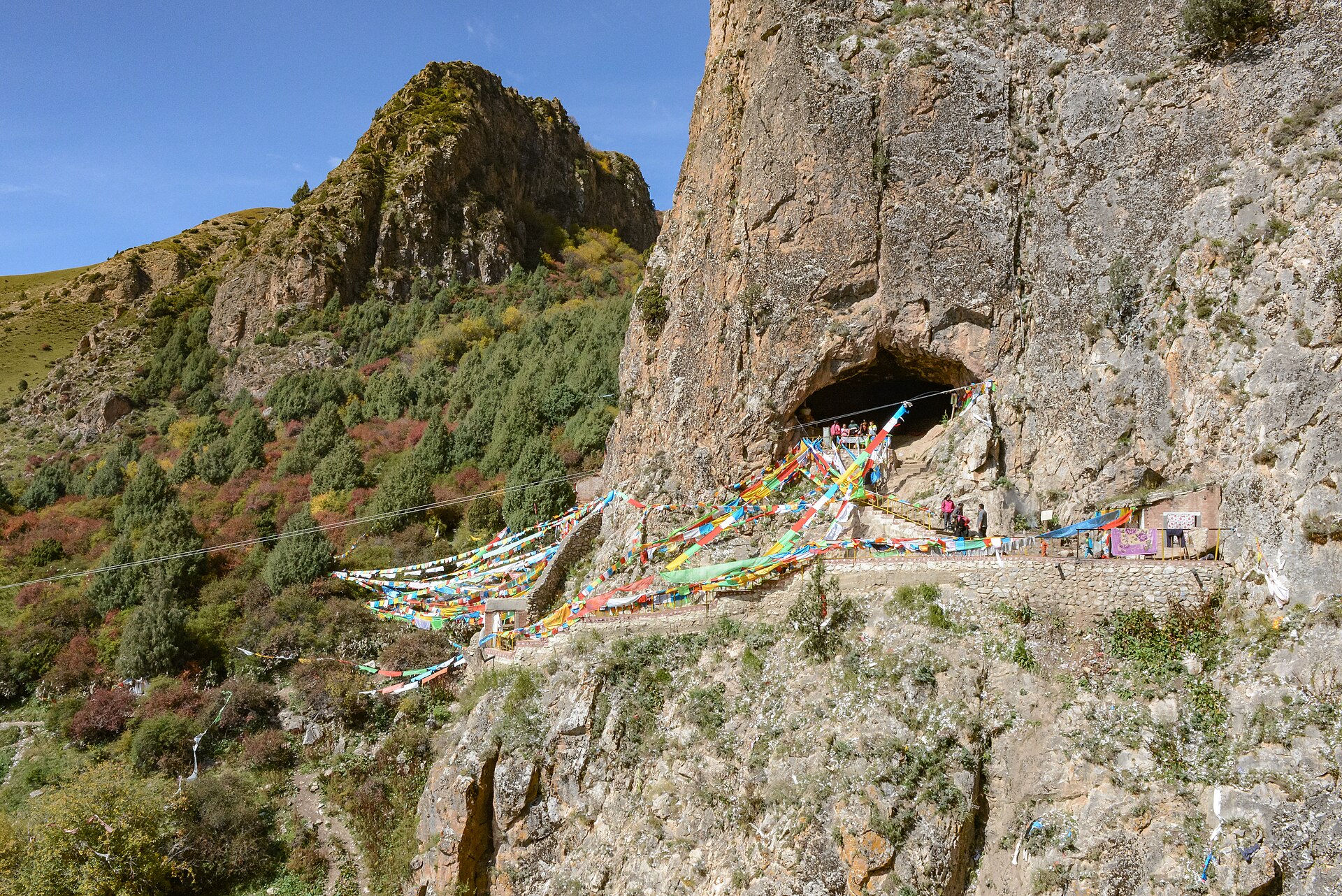
You no longer need a bone at all. In 2020, Denisovan mitochondrial DNA was recovered from the sediment of Baishiya Karst Cave, dating to roughly 100,000 to 60,000 years ago. Not from a fossil. From the cave floor. Our file also records a molar from Tam Ngu Hao 2, Cobra Cave, in Laos, published 2022 and dated to roughly 164,000 to 131,000 years ago, and the Salkhit skull cap from Mongolia, analysed in 2021, which shows mixed Denisovan and modern human ancestry. Siberia, Tibet, Laos, Mongolia. An enormous range, for a species we still cannot picture.
04What They Left In Us
They are still here, in percentages. Melanesians in Papua New Guinea and the Solomon Islands carry 4 to 6 per cent Denisovan DNA. Aboriginal Australians the same. The Ayta Magbukon of the Philippines carry about 5 per cent, the highest proportion recorded anywhere. Mainland Southeast Asians carry 0.5 to 2 per cent, South Asians 0.5 to 1, East Asians 0.2 to 0.5, and Europeans essentially none. And it did not happen once: genomic analysis shows at least two, possibly three, separate introgression events into different populations. Which forces a conclusion about the Denisovans themselves, and our file draws it: they were genetically diverse, several distinct populations across their range rather than one people.
EPAS1, and why Tibetans can live where the air will not support the rest of us. EPAS1 regulates the body's response to hypoxia, low oxygen. The obvious response to thin air is to make more red blood cells, and it is the wrong one: sustained, it thickens the blood and produces chronic mountain sickness, stroke risk and pregnancy complications. Tibetans carry a distinctive EPAS1 haplotype that prevents that overproduction. It was inherited from Denisovans, it appears at meaningful frequency in no other modern population, and it is present in the Denisovan genome. Our file calls it the strongest known case of adaptive introgression in human evolution, and the geography makes the case for it: the Tibetan Plateau averages around 4,500 metres. A population that vanished tens of thousands of years ago is the reason a living population can be there at all.
Two more candidates, marked probable rather than settled. TBX15 and WARS2, which are involved in body fat distribution and the response to cold, appear as probable adaptive Denisovan inheritance in Inuit and East Asian populations. Immune genes in the HLA system appear as probable adaptive inheritance across various Asian and Oceanian populations. Our file marks both probable, and that is the right weight. EPAS1 is the one that is confirmed and replicated; these are strong candidates that have not yet been nailed down to the same standard, and the distinction is worth keeping.
Denisovan genomes contain somebody nobody has ever found. There is evidence in their DNA of admixture from an unknown superarchaic population, a lineage that split from the common ancestor of modern humans, Neanderthals and Denisovans roughly one million years ago. It might be Homo erectus. It might be a species with no name and no fossils. The DNA is simply too divergent to be any of the three lineages we can identify. The estimated contribution is 1 to 4 per cent, and our file marks the whole thing Tier 2: a statistical inference from genomes, with no fossils directly identified. A population we found by reading turns out to contain traces of a population we have not found at all.
05What They Looked Like, And What They Were Not
Their anatomy was predicted before a jaw existed to check it against. In 2019 David Gokhman and colleagues used DNA methylation maps, the chemical marks that regulate which genes are switched on without altering the sequence itself, to predict Denisovan skeletal form. The predictions: a wider skull than either modern humans or Neanderthals, a longer dental arch, a wider face, a larger jaw. Our file marks the method Tier 2 and methodologically novel, which it is. And then the Xiahe mandible arrived and matched several of them: robust, very large molars, no chin like a Neanderthal, archaic throughout, and unlike any Neanderthal mandible known. That is the shape of a good result. A prediction from chemistry, and then a bone.
They were not giants and they were not the Nephilim. Our file refuses this flatly and gives four reasons rather than an assertion. There is no evidence of abnormal height. The finger bone is within normal human size range, and it is from a juvenile. The large molars indicate a robust jaw, not gigantism. And there are no Denisovan artefacts indicating technology beyond what contemporaneous species were using. Connecting them to the biblical Nephilim or to lost advanced civilisations has, in the file's phrase, zero evidential basis. It is worth noticing why this particular claim attaches to this particular species: we have no bodies, and an absence is easy to fill.
Denisovans do not overturn the out-of-Africa model. They complicate it. The claim gets sold the other way round regularly, so the correction is worth stating precisely. Denisovan research confirms and enriches the model: modern humans originated in Africa and then interbred with archaic populations during their expansion, Neanderthals in Europe and West Asia, Denisovans across Asia and Oceania. What changes is that a simple replacement picture becomes a leaky replacement, or assimilation. Our file's own words for this are a refinement, not a refutation, and the difference between those two words is the whole argument.
The open questions are open, and the file says so in a table rather than glossing them. How many Denisovan populations existed? At least two, possibly geographically separated. What did they look like? Limited data; methylation modelling supplies predictions. What was their range? Siberia to Tibet to Southeast Asia confirmed, possibly wider. Did they have language, art, complex behaviour? No direct evidence, though their closeness to Neanderthals, who did have symbolic behaviour, makes it plausible. When did they go extinct? Latest evidence puts it 30,000 to 50,000 years ago at Denisova Cave, though lineages may have persisted later in Southeast Asia. And the largest one: were they even a single species? The genomic diversity suggests multiple deeply divergent populations, possibly more than one species wearing a single name.
06A Note On Our Own Sources, And Where The Errors Actually Live
Second file running with no wrong pointer in it. Eleven of this file's entries carry a paper identifier and all eleven resolve exactly: title, journal, volume, pages, year, first author. The one book identifier is right as well. And not one is a review, which is what the pattern this series has been testing predicts of a bibliography made mostly of journal articles. Three further entries carried no identifier at all, in Nature, Cell and Science, and all three were found and verified against this file's own claimed details. We wrote the predictions down before checking, and we also wrote down that the identifier half was a weak test, because every string looked canonical on its face and nothing could fail in an informative way.
Twenty-three documents, a hundred and eighty identifiers, sorted by which part of the library they came from. Genetics: 100 per cent correct. Molecular biology: 90. Oceanography: 77. Ecology and biology: 75. Biology and evolution: 56. Then the other half of the shelf. Lost connections: 50. World civilizations: 38. Foundations, meaning scripture and ancient texts: 23. Secret societies: 16. Grouped: the science sections come out at 80 per cent correct and the humanities sections at 31 per cent. The ordering is almost perfectly monotonic, and it is not subtle.
It is not that one half of the library was researched more carefully. It is what each half cites. The sciences cite journal articles, and a journal article has exactly one registered identifier, which resolves to itself. The humanities cite books, and most scholarly books, particularly older ones, have no registered identifier at all. So when something fills that field for a book, there is nothing correct available for it to point at, and the nearest record in the world carrying that book's title is somebody's review of it. That is why a bibliography of Nature papers comes out clean and a bibliography of older monographs comes out at one in six. The error rate tracks the citation format, and the citation format tracks the discipline. Nobody chose it.
The obvious story was that our sourcing has been improving over time. The two cleanest files were also the two most recently updated, which is exactly the shape of a reassuring conclusion. So we checked it against every audited document, sorted by the date each was last revised. Files last updated before 2026: 65 per cent correct. Files last updated during 2026: 47 per cent. If anything the older ones are slightly better, on a small sample. The recency hypothesis is dead, and it is worth reporting precisely because it was the flattering one and it did not survive contact with the data.
Twenty-three files is not three thousand six hundred and thirty-two. These documents were chosen by which articles this series happened to build, not sampled at random, and the correct-versus-wrong counts come from our own audit packets, which is one consistent method rather than an independent check on itself. A gap between 80 per cent and 31 per cent is wide enough to survive a great deal of sampling noise, and we would be surprised to see it disappear. But it is not a census, and the honest use of it is as a strong signal about where a repair pass should start, rather than as a measurement of the library.
It is worth naming a good document as precisely as a bad one. The previous article in this series found a sentence denying that any scholarly counter-arguments exist, printed verbatim in 664 documents across our library, including one that printed it directly beneath four of its own counter-arguments. This file carries none of that. It has a real disputes section, with two firmly stated refusals that give their reasons, and a six-row table of genuinely open questions it does not pretend to have closed. It is one of the 1,128 documents that handle this properly. The one mechanical fault we did find is small and typical: every filename in its own images table is prefixed with the wrong document identifier, L_3_05 instead of L_1_08. Generated metadata that never checks itself against the file it is sitting in.
| Section Of The Library | Files | Correct | Wrong | Correct |
|---|---|---|---|---|
| Genetics and Origins | 1 | 15 | 0 | 100% |
| Molecular Biology | 2 | 9 | 1 | 90% |
| Oceanography | 1 | 10 | 3 | 77% |
| Ecology and Biology | 2 | 18 | 6 | 75% |
| Biology and Evolution | 1 | 5 | 4 | 56% |
| Lost Connections | 2 | 4 | 4 | 50% |
| World Civilizations | 8 | 21 | 35 | 38% |
| Foundations (scripture and ancient texts) | 3 | 6 | 20 | 23% |
| Secret Societies | 3 | 3 | 16 | 16% |
| SCIENCE SECTIONS TOGETHER | 7 | 57 | 14 | 80% |
| HUMANITIES SECTIONS TOGETHER | 16 | 34 | 75 | 31% |
Fast Facts
- First identified
- 2010, from mitochondrial DNA in a finger bone from Denisova Cave, Altai Mountains, Siberia. The first hominin population discovered by genetics rather than morphology
- How divergent
- Denisova 3's mitochondrial DNA is about twice as far from modern humans as Neanderthal mitochondrial DNA is
- The genome
- 30x coverage from a single finger bone, published 2012, using single-stranded library preparation developed in Pääbo's laboratory. Pääbo took the 2022 Nobel Prize
- Position on the tree
- Sister group to Neanderthals. Our lineage split from theirs 550,000 to 765,000 years ago; Denisovans and Neanderthals split 390,000 to 440,000 years ago
- Total fossils
- A finger bone, several teeth, a jawbone, a skull fragment. Denisova Cave also holds Neanderthal and Homo sapiens remains across 300,000 years
- Denny
- Denisova 11, a girl of about 13, published 2018: Neanderthal mother, Denisovan father, and her father's line carried earlier Neanderthal admixture. The only known first-generation hybrid of two archaic human species. The bone is under 25 mm
- Xiahe mandible
- Baishiya Karst Cave, Gansu, published 2019. Identified by ancient proteins, not DNA. At 3,280 metres, putting Denisovans on the Tibetan Plateau about 160,000 years ago
- Range
- Siberia, Tibet, Laos (a molar dated 164,000 to 131,000 years ago), Mongolia. Denisovan DNA has also been recovered from cave sediment
- Living inheritance
- Melanesians and Aboriginal Australians 4 to 6 per cent; Ayta Magbukon of the Philippines about 5 per cent, the highest recorded; mainland Southeast Asians 0.5 to 2; East Asians 0.2 to 0.5; Europeans essentially none
- EPAS1
- A Denisovan haplotype that prevents overproduction of red blood cells at altitude, protecting against chronic mountain sickness. The strongest known case of adaptive introgression. The Tibetan Plateau averages around 4,500 metres
- A ghost inside the ghost
- Denisovan genomes carry 1 to 4 per cent from an unknown superarchaic population that split about a million years ago. No fossils identified
- Refused
- That they were giants or the Nephilim, and that they overturn out-of-Africa. The finger bone is normal-sized and juvenile; large molars mean a robust jaw; and the model becomes leaky replacement, which is a refinement rather than a refutation
- Identifier audit
- 12 identifiers checked live 26 August 2026, all 12 correct; 3 more carried none and all 3 were recovered. Second consecutive file with no wrong pointer
What We Can Actually Stand Behind
Denisovans were identified in 2010 from mitochondrial DNA in a finger bone, the first hominin population found by genetics rather than by fossils. A 30x nuclear genome followed in 2012 from that same bone. They are a sister group to Neanderthals, with the splits dated to 550,000 to 765,000 and 390,000 to 440,000 years ago, and they had low genetic diversity. Denisova 11 had a Neanderthal mother and a Denisovan father and is the only known first-generation hybrid of two archaic human species. The Xiahe mandible, identified by proteomics rather than DNA, puts them at 3,280 metres on the Tibetan Plateau about 160,000 years ago, and further remains and sediment DNA extend the range to Laos and Mongolia. Living Melanesians and Aboriginal Australians carry 4 to 6 per cent Denisovan DNA and the Ayta Magbukon about 5 per cent. The Tibetan EPAS1 haplotype is Denisovan and is the strongest documented case of adaptive introgression in our species. Every one of the twelve identifiers our file carries for this material resolves correctly.
That interbreeding was common rather than rare where the populations overlapped is a sound inference from the improbability of finding a first-generation hybrid in so small a sample, but it is an inference. TBX15, WARS2 and the HLA immune genes are probable adaptive Denisovan inheritance rather than confirmed. Superarchaic admixture at 1 to 4 per cent is a statistical signal in the genomes with no fossil attached to it. And the methylation-based anatomical reconstruction is methodologically novel, partially corroborated by the Xiahe mandible, and not the same kind of evidence as a skeleton.
How many Denisovan populations existed, whether they should be counted as one species or several, whether they had language, art or symbolic behaviour, and exactly when and where they disappeared. Our file lists all of these as open and does not resolve them, which is correct. The extinction estimate of 30,000 to 50,000 years ago applies to Denisova Cave, and lineages may have persisted longer elsewhere.
They were not giants and they have nothing to do with the Nephilim: the finger bone is normal-sized and juvenile, the large molars indicate a robust jaw rather than gigantism, and no artefacts suggest unusual technology. And they do not refute the out-of-Africa model; they turn simple replacement into leaky replacement, which our file correctly calls a refinement rather than a refutation.
Twelve identifiers checked live on 26 August 2026 against predictions recorded beforehand, and all twelve are correct; three further entries carried none and all three were recovered and verified. The identifier half of that prediction was declared weak in advance. Setting all twenty-three audited documents side by side gives the run's clearest result: the science sections of our library are 80 per cent correct on identifiers and the humanities sections are 31 per cent, because the sciences cite journal articles that are registered and the humanities cite books that mostly are not. We also tested and rejected the flattering alternative that our sourcing has simply improved with time; it has not. Twenty-three files chosen by a build programme is a strong signal and not a census.
Sources & further reading
The genomics above is drawn from our research library on Theories of Anything. Every identifier below was checked live against Crossref or Open Library on 26 August 2026, against predictions recorded in advance. Twelve were carried by our file and all twelve proved correct; three further papers had no identifier at all in our bibliography and were recovered and then verified field by field. Open the full research file to check the sourcing and go deeper.
Image credits
- The Xiahe mandible, lateral view, showing two attached molars Dongju Zhang, via Wikimedia Commons (CC BY-SA 4.0). CC BY-SA 4.0 Source.
- Replica of the Denisova 3 finger bone, Museum of Natural Sciences, Brussels Thilo Parg, via Wikimedia Commons (CC BY-SA 3.0). CC BY-SA 3.0 Source.
- Denisova 11 (Denny), six views with scale bar Buckley, Derevianko, Shunkov and colleagues, published in Scientific Reports, via Wikimedia Commons (CC BY-SA 4.0). CC BY-SA 4.0 Source.
- Baishiya Karst Cave entrance, Gansu, with prayer flags Dongju Zhang, via Wikimedia Commons (CC BY-SA 4.0). CC BY-SA 4.0 Source.
- Visitors at the entrance to Denisova Cave, Altai Mountains ChuvaevNikolay, via Wikimedia Commons (CC BY-SA 3.0). CC BY-SA 3.0 Source.


