
Death Masks: Four Different Things We Call By One Name
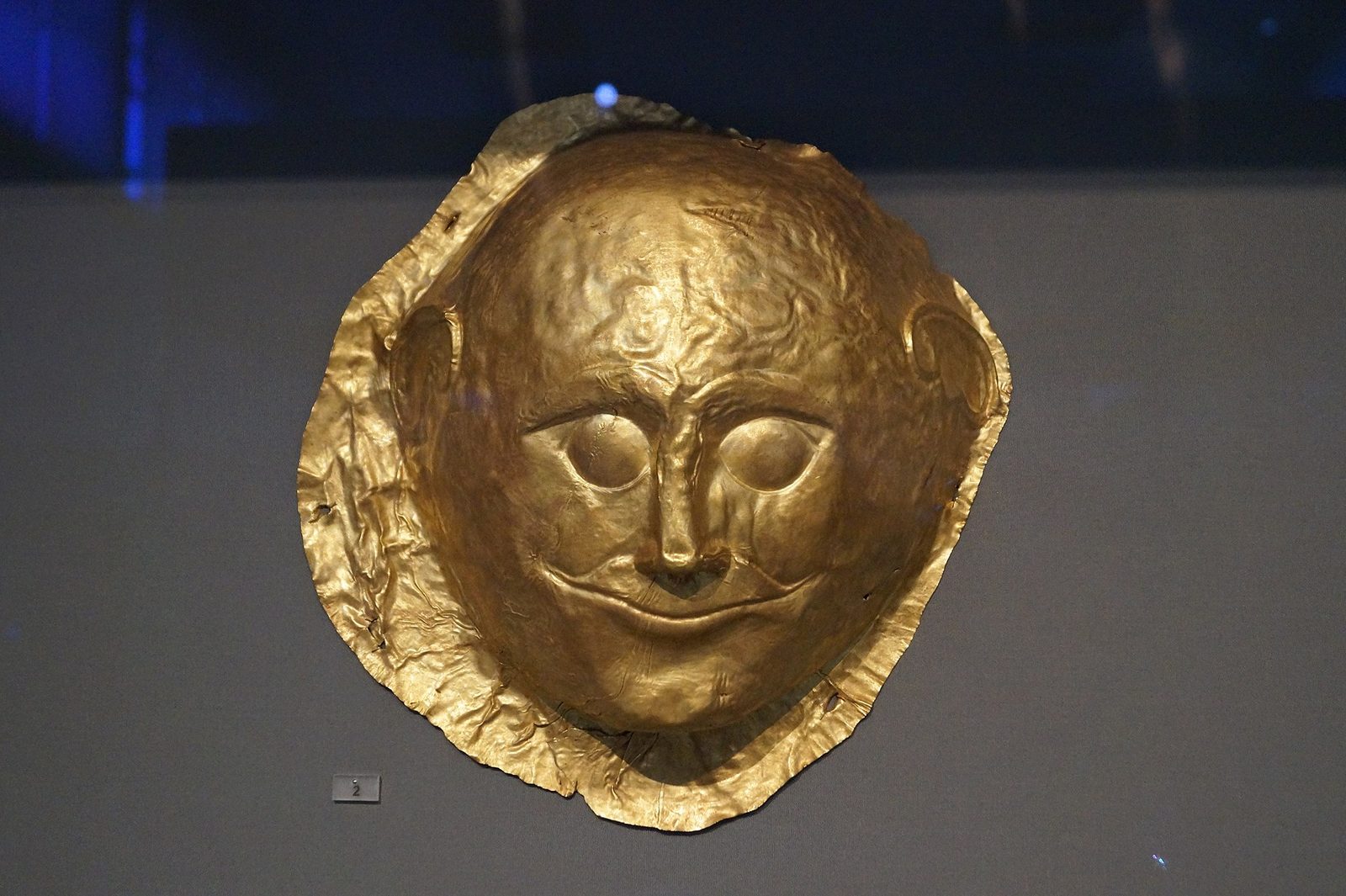
A cast taken from a corpse, a gold mask made for a king who never touched it, plaster modelled onto a real skull, and a painting bound into the wrappings. These are not variations on one practice. Almost every account of death masks, including our own research file, files all four under a definition that fits only the first.
A death mask, strictly, is a cast taken from the features of a specific dead person, usually within hours of death, while the face still holds its shape. That is a narrow technical definition and it is the one almost everybody uses in their opening sentence, including our own research file. The trouble starts immediately afterward, because the objects that get listed next mostly do not meet it.
Tutankhamun's gold mask was not moulded from Tutankhamun. The Mycenaean gold was not pressed onto anyone's face. The plastered skulls of Jericho are not casts of anything, they are plaster built up on real human craniums. The Fayum portraits are paintings on wooden boards. Four separate technologies, doing four separate jobs, get flattened into one category by the word mask, and once flattened they invite a story that is not true: that this is all one human impulse, recurring, to keep a face. The differences are the interesting part, and this page is organised around them.
| Category | What It Physically Is | The Objects |
|---|---|---|
| A. Cast from a real face, after death | A mould taken from the actual features of a specific dead person. This is the only category that meets the strict definition of a death mask | Oliver Cromwell (1658, per our own file, not re-verified here). Isaac Newton (1727). Napoleon (7 May 1821). Beethoven (27 March 1827). L'Inconnue de la Seine, whose subject and circumstances are not established |
| B. Made FOR the dead, not cast from them | An object manufactured to cover or stand for a face, worked to an idealised or conventional likeness. Nothing is moulded from anybody | Tutankhamun's gold mask. The five Mycenaean gold masks including the one called Agamemnon. The Sican gold funerary masks of northern Peru |
| C. Modelled directly onto human remains | Plaster built up on a defleshed human cranium, with shell for eyes. Neither a cast nor a mask that was ever worn or laid on anything. These objects ARE human remains | The Pre-Pottery Neolithic B plastered skulls of Jericho and Ain Ghazal, about 8200 to 7500 BCE |
| D. A painted panel bound into a burial | Encaustic or tempera on a thin wooden board, two-dimensional, tied into the wrappings over the face. Not a mask in any sense | The Fayum mummy portraits, Roman Egypt, first to third centuries CE |
| E. Probably LIFE casts, and contested | Wax images kept in the house and worn at family funerals. The ancient sources describe fidelity of likeness, never method or timing | The Roman imagines maiorum. No example survives |
| F. Life masks routinely misfiled as death masks | Cast from a living face. Included because the misfiling is common and specific | Abraham Lincoln by Leonard Volk (1860) and by Clark Mills (11 February 1865). There is no Lincoln death mask. Beethoven by Franz Klein (1812), the counterpart to the 1827 death cast |
| G. Neither, and should not be on the list at all | No documentary basis for the belief that it is a cast of the person named | The head displayed at the Palazzo Vecchio as Dante's death mask |
01Plaster On A Real Skull
The plastered skulls of Pre-Pottery Neolithic B Jericho, at Tell es-Sultan, are the earliest known three-dimensional treatment of a specific dead face. Real human skulls were covered with modelled plaster, painted, and fitted with shell eyes. Kathleen Kenyon excavated a cache of seven in 1953; our own research file says only that it happened in the 1950s. The British Museum's example, registration 1954,0215.1, is dated to roughly 8,500 to 9,300 years old.
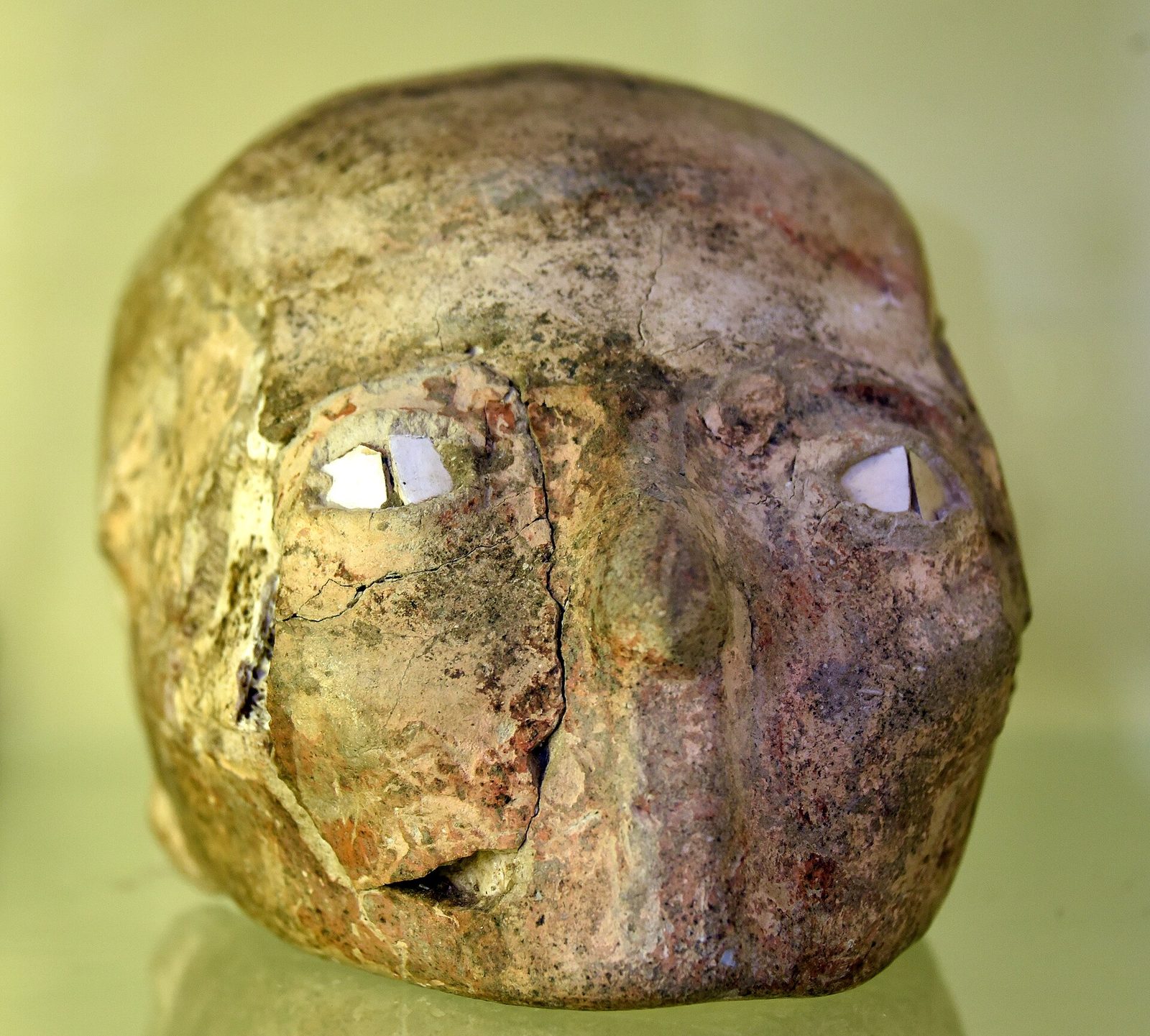
A Jericho skull is not a cast taken from a face and not a mask that was ever worn or laid over anything. It is plaster built up directly onto a defleshed human cranium. Micro-CT of the British Museum specimen showed the skull had been cut open and packed with soil to support the plaster, that it lacks its lower jaw, and that the man's head had been bound and reshaped in childhood. His teeth were broken and decayed, and he had healed a broken nose in adult life. That is not a portrait tradition. It is something else, done to a person, whose injuries are still legible in the object.
Scholars have proposed that the plastered skulls are the earliest evidence for an organised ancestor cult, on the grounds that the modelled faces are deliberately individualised, which suggests a community maintaining a bond with specific named dead and therefore beliefs about the continuity of identity after death. That reading has itself been challenged. They may instead be ritual objects, trophies taken from enemies, or apotropaic devices meant to avert harm, none of which is commemorative portraiture. The counter-reading matters because it undercuts the tidy evolutionary story that puts Jericho at the head of a single line running all the way to Napoleon.
02Made For The Dead
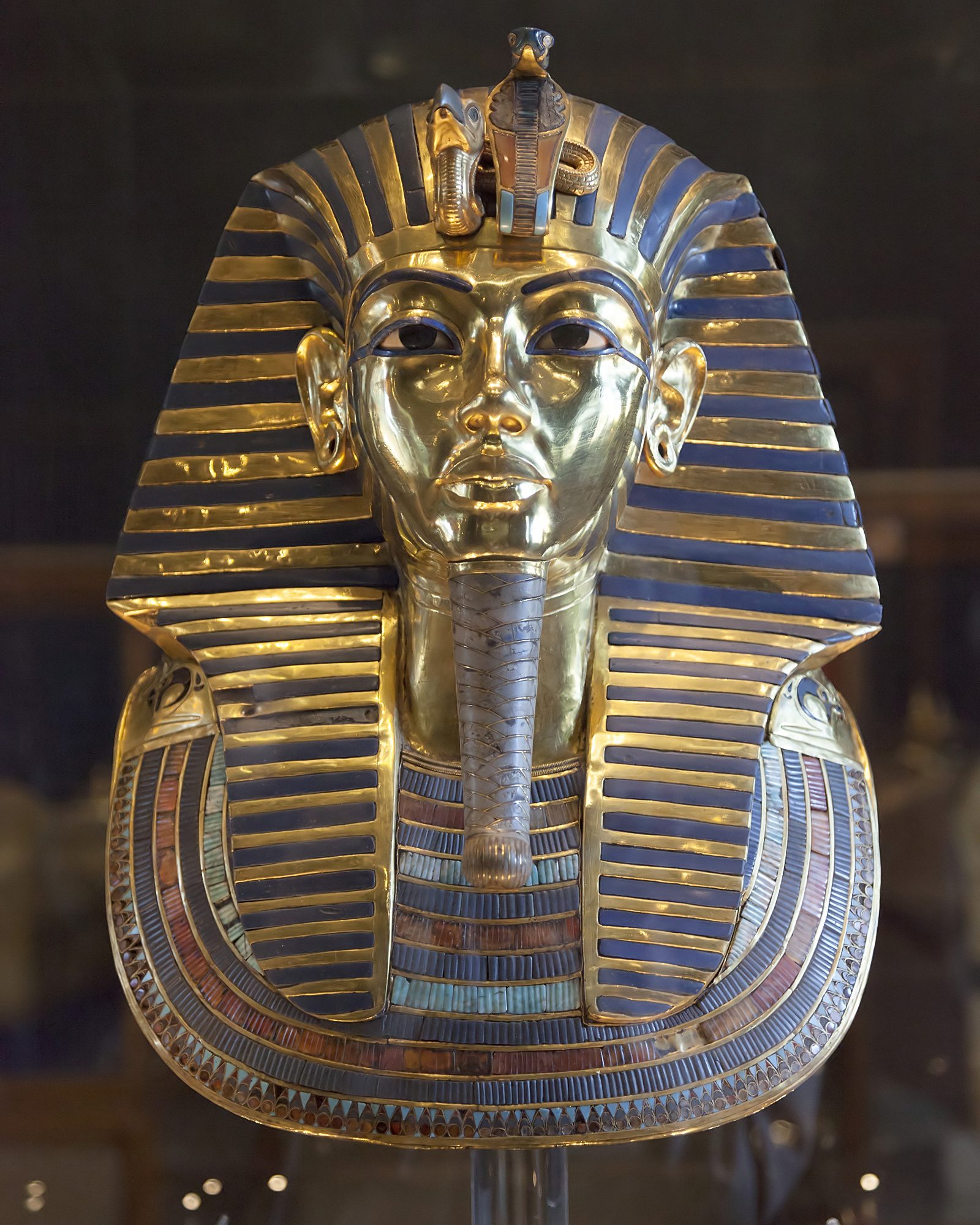
The funerary mask of Tutankhamun, Journal d'Entree 60672, is gold with inlays of obsidian, lapis lazuli, quartzite and coloured glass, 54 cm high by 39.3 cm wide, placed over the head and shoulders of the mummy inside the innermost coffin. It is two sheets of gold, joined by heating and hammering, worked into the conventional royal image with the nemes headdress, the vulture and the uraeus. The face it renders follows workshop convention rather than individual likeness. Nothing was moulded from the king. The Global Egyptian Museum's record describes its purpose as protective, and as allowing the dead king's soul to identify and rejoin his body, which is a job that requires a recognisable royal face rather than an accurate one.
Two figures in our research file do not survive checking. It gives the mask's mass as 11.34 kg; the figure published across museum and reference sources is 10.23 kg, and 11.34 kg is exactly 25.0 pounds, which has the shape of a rounded back-conversion rather than a measurement. No primary or museum source stating any weight was reached for this article, so this page says about ten kilograms of gold and gives no precise figure. The file also dates the mask's discovery to 28 November 1925. Carter's excavation record has the innermost coffin lid raised and the mask first exposed on 28 OCTOBER 1925. The tomb itself was found on 4 November 1922; the mask came three years later, at the end of the unwrapping.
Nicholas Reeves has argued that the mask was not originally made for Tutankhamun at all, reading the cartouche as altered, with the present inscription cut over an earlier and longer Ankhkheperure Neferneferuaten oval, and pointing to the pierced ears as evidence of an original female owner. Published in the Bulletin of the Egyptological Seminar in 2015. This is a live minority argument and not consensus, and it is carried here at that strength, because it is the kind of claim that gets repeated as settled once it has been repeated a few times.
Our research file credits the Andean gold funerary masks to the Chimu. The masks it describes, sheet gold worked into a broad flat face with winged eyes and faced with red cinnabar, are the type object of the SICAN, also called Lambayeque, culture of Peru's north coast, roughly 750 to 1375 CE. The Metropolitan Museum's own record for its example reads Lambayeque (Sican). Separately, the Lord of Sipan, which the file also mentions, is a MOCHE burial of about AD 250, excavated in 1987 by Walter Alva at Huaca Rajada after police tipped him off that looters had struck the site. Three cultures, three corrections.
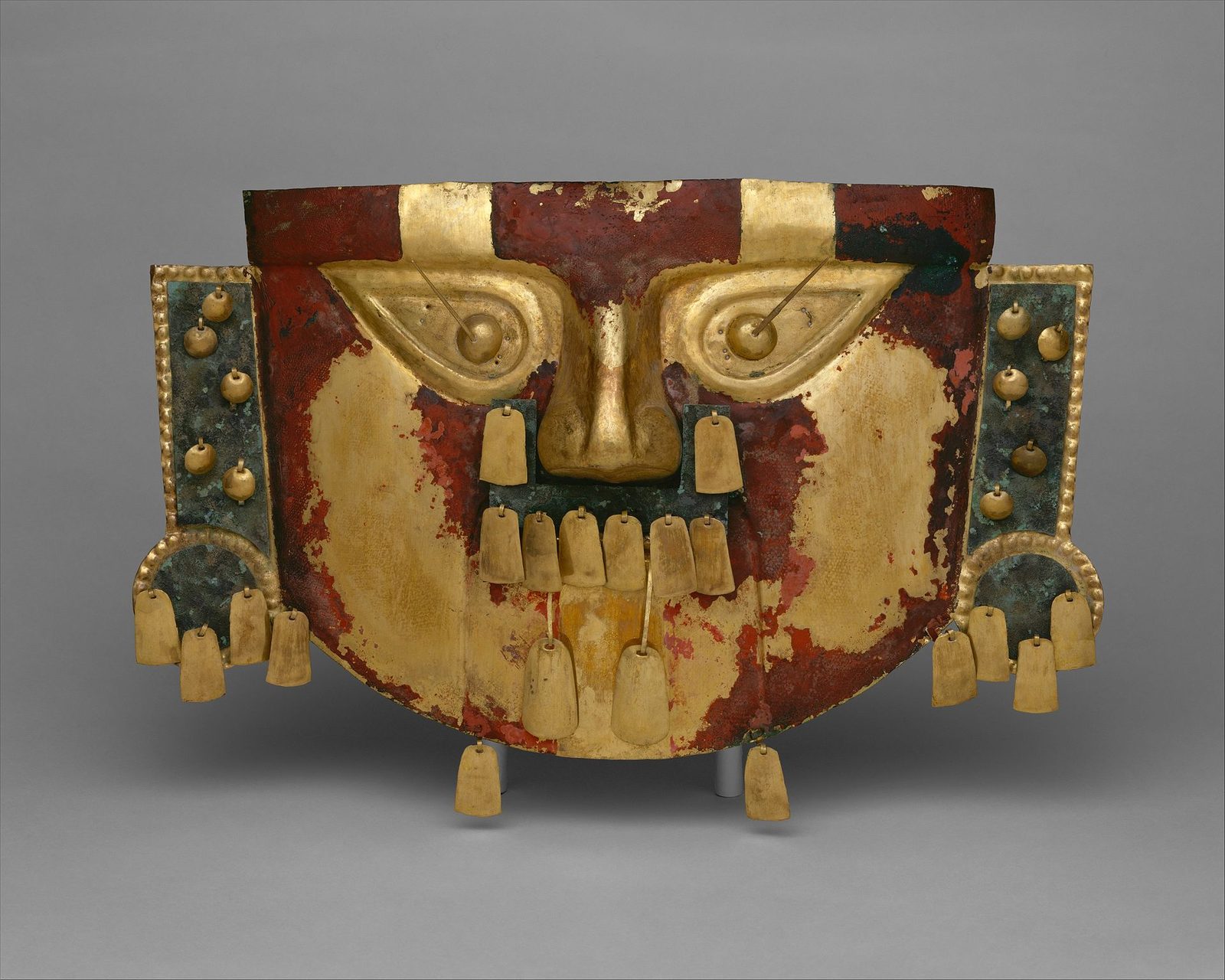
The red paint on a Sican gold funerary mask about a thousand years old was analysed by proteomics and found to contain human blood proteins together with proteins from bird egg white, mixed with the cinnabar. The finding was published in the Journal of Proteome Research in 2021 by a team including Izumi Shimada, the leading excavator of Sican sites. The red face on the mask is partly made of a person. It is also, note, still category B: made for the dead, not cast from them.
The Andean gold masks demonstrate independent invention of the funerary mask, with no plausible contact with the Mediterranean or Egyptian traditions. They belong squarely with Tutankhamun and Mycenae: hammered metal, worked to a cultural face rather than an individual one, laid over a wrapped body. Saying so in the same breath as the others is the point, because the temptation with three unconnected gold traditions is to treat the resemblance as evidence of contact rather than as evidence that gold, faces and burial are a combination several societies arrive at separately.
03The Gold That Is Not Agamemnon
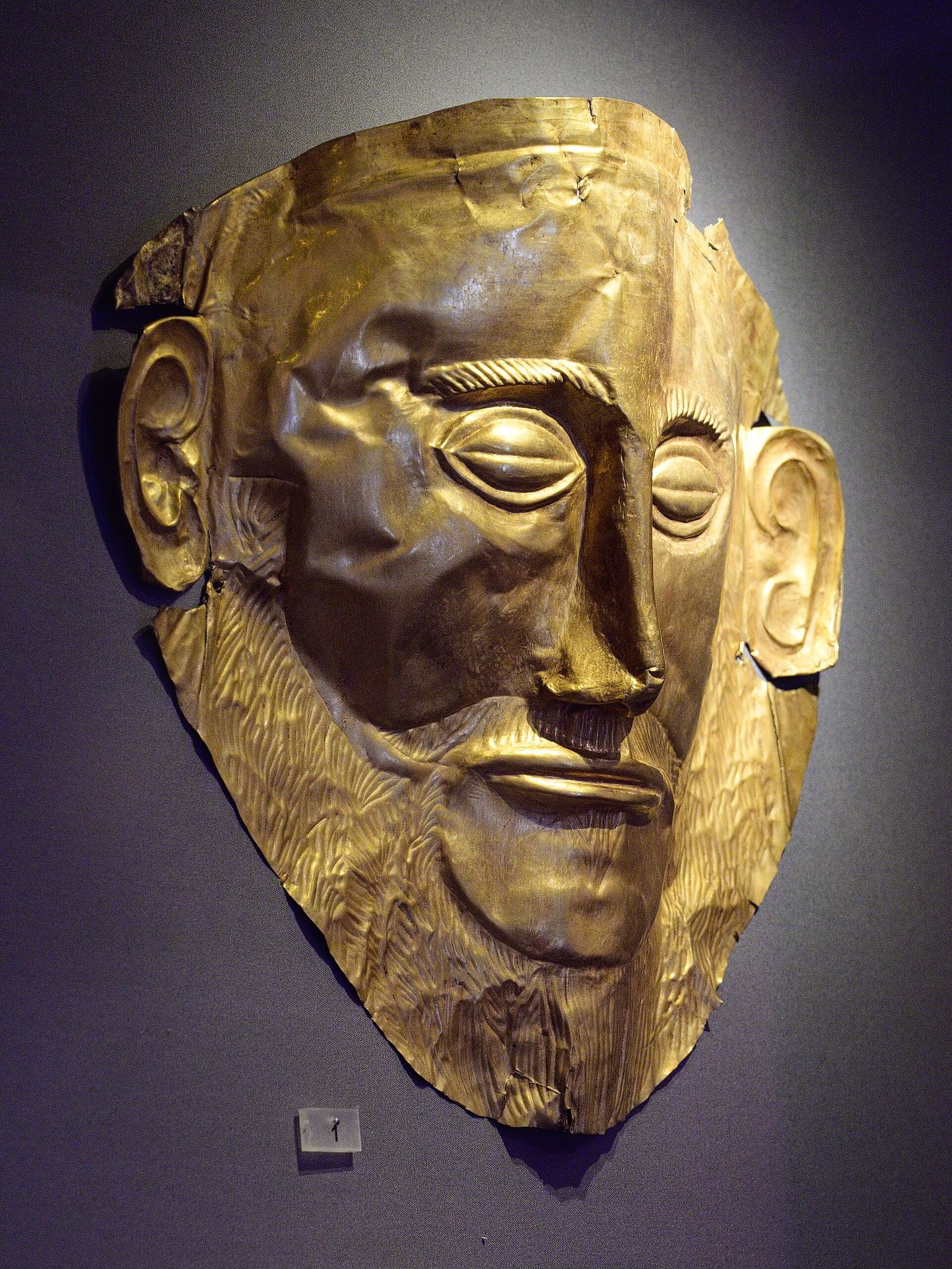
The gold funerary mask catalogued by the National Archaeological Museum in Athens as NM 624, and known as the Mask of Agamemnon, was found by Heinrich Schliemann in 1876 in Shaft Grave V of Grave Circle A at Mycenae. It is worked from a single sheet of gold and dates to about 1550 to 1500 BCE. Two small holes near the ears indicate it was tied over the face of the dead man with twine. Five gold masks came from the shaft graves of Grave Circle A, distributed between Graves IV and V; sources consulted for this article disagree on how the five split between the two, so no count is assigned to either.
The mask cannot be Agamemnon's. It dates to roughly three hundred years before the traditional date of the Trojan War, and the historicity of Agamemnon is undemonstrated in any case. The name is a nineteenth-century label that stuck, and the museum itself uses known-as language. Our own file carries this correctly as a debunked item, which is worth saying because the file gets several other things about this object wrong.
Our research file puts the sentence I have gazed upon the face of Agamemnon in quotation marks, as Schliemann's own words. No telegram or writing of Schliemann's containing that sentence is known. It is a later invention and is recorded as apocryphal in the scholarly literature. What Schliemann did telegraph to the King of Greece announced that he had discovered the tombs which tradition, as reported by Pausanias, assigned to Agamemnon and his companions. That is a claim about tombs, made by a man who wanted it to be true, and it is not the quotation.
Oliver Dickinson argued in Hesperia in 2005 that the mask Schliemann himself associated with Agamemnon was probably not NM 624 at all. Schliemann's own contemporary wording describes a round-faced man, which fits a different mask from the same excavation. So the object the whole world calls the Mask of Agamemnon may not be the one its excavator meant by the name.
The authenticity of NM 624 has been intermittently disputed. William Calder raised the possibility of forgery, noting Schliemann's documented appetite for self-mythologising, and David Traill catalogued stylistic anomalies suggesting later intervention, in particular that this mask alone among the group has facial hair and ears cut free of the body of the mask. The dispute is not settled and the mask is not generally regarded as a forgery; Dickinson, in the same paper that questions the identification, argues that the practical difficulty of carrying out the alleged forgery counts strongly against it. Two separate questions, and only the first one is close to answered: it is not Agamemnon, and it is probably genuine.
04A Painting, Not A Mask
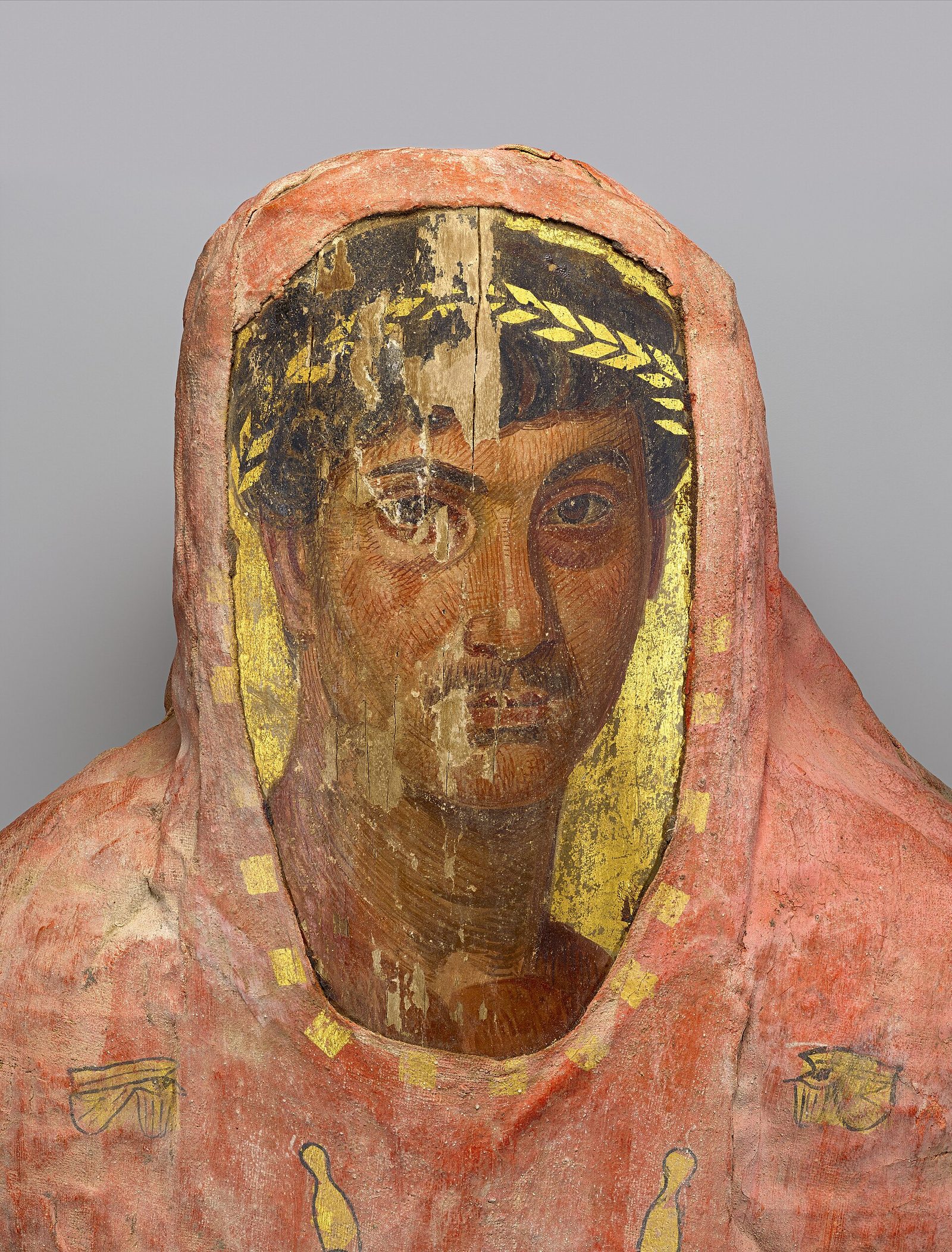
About a thousand Romano-Egyptian mummy portraits survive: encaustic, which is hot pigmented wax, or tempera, painted on thin wooden panels, produced in Roman Egypt in the first to third centuries CE and best known from the Fayum. The Getty's APPEAR project publishes approximately 1,000; our own two research files disagree with each other, one saying over 1,000 and the other about 900, which is why this page uses the Getty's figure and calls it about a thousand. A Fayum portrait is a flat painted board bound into the linen wrappings over the face. Nothing about it is moulded, and putting it in a death-mask category, as our file's opening definition does, is a category error rather than a loose usage.
Our research file says that CT and X-ray work has confirmed the portraits were painted during the subject's lifetime and attached to the wrappings after death, and files it as a Tier 1 key finding. It has not confirmed that, and the evidence points the other way. Where skeletal age at death has been compared with the age depicted, the two broadly agree, which points toward a portrait made at or near death rather than years earlier. The best-documented single case is a wholly wrapped Romano-Egyptian infant mummy in Munich, examined by CT and published in 2020. The correction matters because the lifetime-portrait version makes the Fayum panels sound like framed pictures that happened to be reused, and the evidence suggests something closer to a commission made when someone died.
Roman Egypt also produced moulded plaster and stucco mummy masks, a separate tradition running alongside the painted panels: a three-dimensional face modelled in plaster, often painted and gilded, laid over the head of the wrapped body. This matters for the scheme on this page because it is the one Egyptian object in the family that is genuinely three-dimensional and genuinely laid over a face, and it is still not a cast. It was modelled, not moulded from anybody. Our own file does not mention this tradition at all, which means a reader working from the file would meet only the flat paintings and the royal gold and never learn that the obvious middle case existed.
One Romano-Egyptian mummy portrait subjected to combined material analysis and radiocarbon dating returned a date later than the accepted window: its canvas fragment calibrated to 435 to 570 CE at 68 percent probability, which the authors read as a portrait made in the fifth to sixth century, roughly two centuries after the production period previously assigned to the corpus. This is a single object and it is carried here as a single object. It is not evidence that the Fayum dating is wrong; it is evidence that the practice may have a longer tail than the standard window allows.
05The Roman Case, Which Is Genuinely Open
Polybius, writing in the second century BCE, describes the Roman practice in Book 6 of the Histories. The image of the departed is placed in the most conspicuous position in the house, enclosed in a wooden shrine, and it is a mask reproducing with remarkable fidelity both the features and complexion of the deceased. At later family funerals the masks are worn by men chosen for their physical resemblance to the dead, dressed in the office the dead man held. No Roman wax imago survives. Everything known about them comes from literary testimony, chiefly Polybius and the elder Pliny, together with law, epigraphy, coins and a small number of artistic representations.
Our research file states that the imagines were wax masks moulded from the faces of deceased family members. The ancient sources do not say that. Polybius describes fidelity of likeness, not method and not timing, and fidelity is exactly what you would expect a Roman writer to praise whether the cast was taken before death or after. Toynbee's standing point is that neither Polybius nor Pliny supports treating these as death masks proper; Valerie Hope holds that a lifetime casting is more likely while allowing that the question is open. The weight of scholarship favours casting in life, which would move the imagines out of this article's subject entirely, and that is worth saying plainly rather than keeping them in the story because they are the most famous Roman thing in it.
06Cast From A Face
This is the only category that meets the strict definition, and it is a European practice running from roughly the fourteenth to the nineteenth century. It is also, in its origins, less sentimental than it sounds. The death mask was a working tool before it was a relic: a cast taken within hours of death gave sculptors, engravers and medallists an exact three-dimensional record of a face at a moment when no other exact record existed. Roubiliac worked from Newton's cast. Danhauser, who took Beethoven's, was a painter. The mask was the reference photograph of a world that had no photographs, and it stopped being made in bulk at roughly the point that photography arrived.
| Who | When, And By Whom | What Our Own File Gets Wrong |
|---|---|---|
| Oliver Cromwell | 1658 | Nothing established. Carried from our file and not independently re-verified for this article, so treat the attribution as our file's rather than as checked |
| Isaac Newton | Died 31 March 1727; several casts made shortly after, possibly by Michael Rysbrack. The Royal Society's cast was owned by Louis-Francois Roubiliac, who worked from it for his marble bust and the Trinity College statue | Nothing. The maker of the Royal Society's cast is not certainly known and this page does not name one |
| Napoleon Bonaparte | Died 5 May 1821. The original cast was taken on the evening of 7 May by Dr Francis Burton, a British army surgeon of the Saint Helena garrison, in several pieces, with Napoleon's own physician Antommarchi assisting | Our file credits the cast to Antommarchi, twice. Burton took it. Overnight the central section carrying the eyes, nose and mouth left Burton's possession, which is the origin of a long dispute over whose mask is whose |
| Ludwig van Beethoven | Died 26 March 1827; autopsy on the morning of the 27th; the mask taken within hours by the painter Josef Danhauser | Nothing, but the object needs its context: the mask is disfigured because the autopsy had removed Beethoven's temporal bones to examine his hearing apparatus, and the gaps in the skull were packed before casting |
| Abraham Lincoln | No death mask exists. Leonard Volk cast him from life in 1860; Clark Mills cast him from life on 11 February 1865, about two months before the assassination | Our file calls the Mills cast a death mask of April 1865. The Smithsonian's own record titles it a LIFE mask. There is no Lincoln death mask |
| Dante Alighieri | Died 1321. The head at the Palazzo Vecchio is not a cast taken from his face | Our file hedges it as disputed, which is not enough when it sits in a list of genuine casts. There is no documentary basis for the belief, and scholars note the facial muscles and eyelids read as animated rather than slack |
07The Woman From The Seine
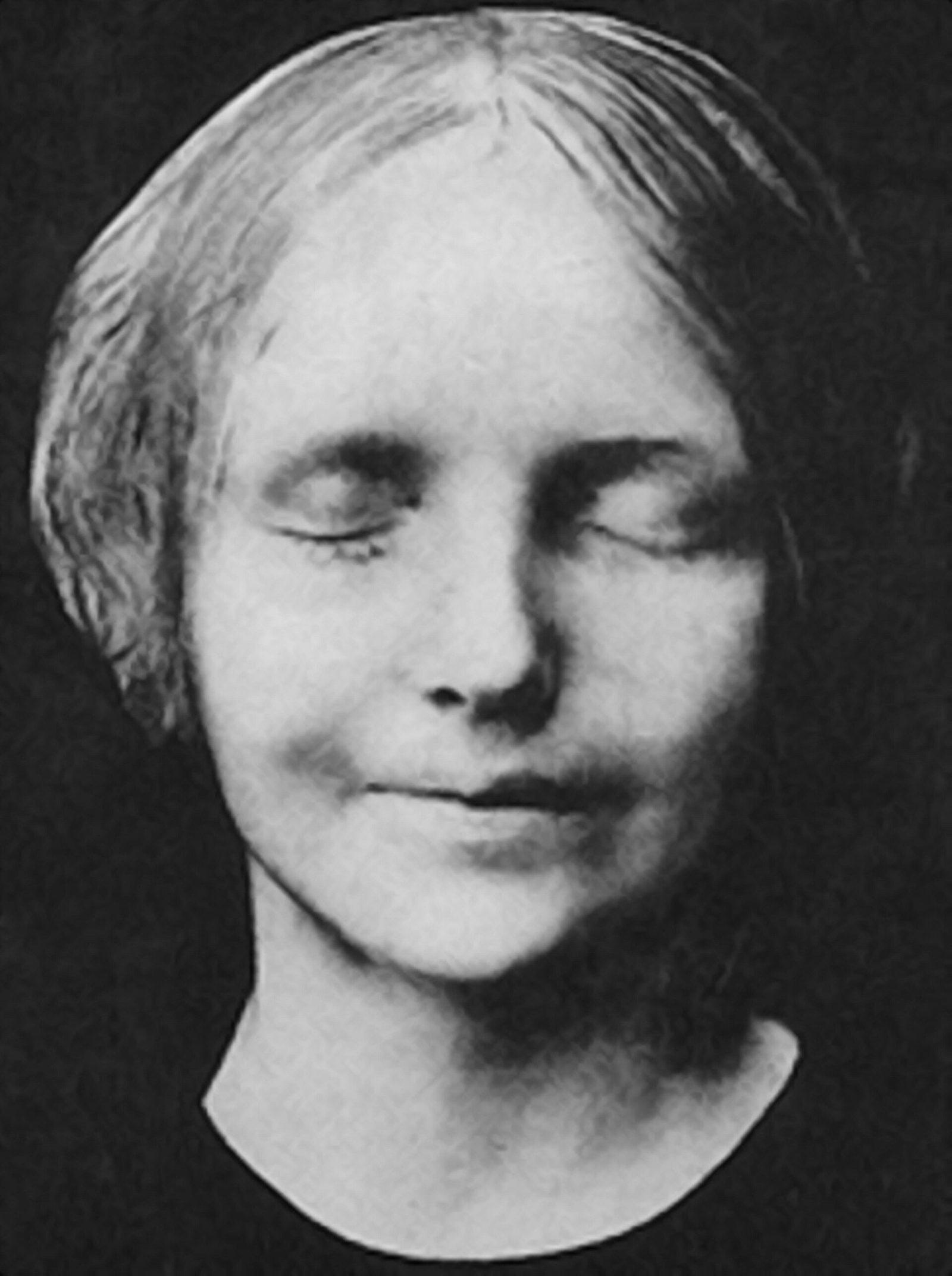
L'Inconnue de la Seine is a plaster mask of a young woman's face, serene and faintly smiling, which became one of the most reproduced faces in European art and literature from about 1900. Copies hung in artists' and writers' studios across Europe; Rilke, Nabokov and Camus all wrote about her, and reproductions were still being sold from the Lorenzi casting workshop outside Paris in the twenty-first century.
The story is that the face belongs to an unidentified young woman pulled from the Seine in the late 1880s, probably a suicide, whose beauty moved a morgue attendant to have a cast made. None of that is established. Our own file's counter-arguments section says the narrative may be partly mythologised, that historians doubt the suicide story, and that the mask may have been cast from a living model, which would move it out of this article's strict category altogether. The honest position is that the most famous death mask in the world may not be a death mask, and that nobody can say whose face it is.
One thing about her is not legend. The Norwegian toymaker Asmund Laerdal, whose firm worked in soft plastics, collaborated with the anaesthesiologist Peter Safar, who pioneered modern resuscitation, to build a realistic training manikin, and took its face from the L'Inconnue mask, which he had seen hanging in his wife's family's home. The prototype appeared at the end of the 1950s. Resusci Anne has since been the face that millions of people have practised breathing into. Whoever she was, and whether or not she was ever dead when the cast was taken, her face is the one most often used to teach people how to keep someone alive.
08The Casts Nobody Puts In The Story
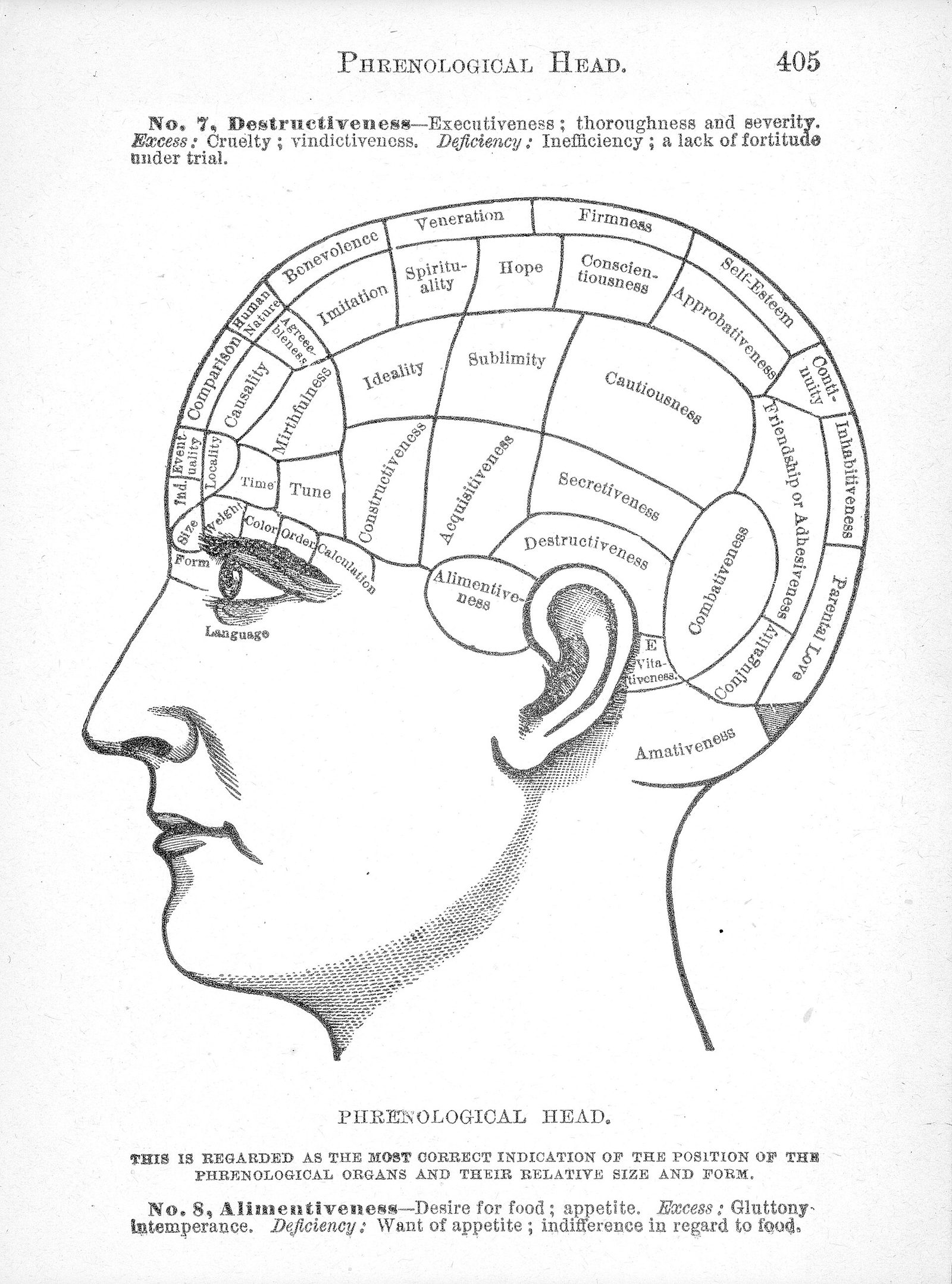
Through the nineteenth century, casting the faces of executed prisoners was routine in Britain, Australia, France, Italy and Scotland, and the casts went into police archives, medical museums and the cabinets of phrenologists, who believed that comparing the heads of criminals would establish the existence of a criminal type. Life casting had emerged in the late eighteenth century partly in response to phrenology, because plaster gave the exact head shapes the theory required. This is by volume the largest body of European face casts, the science behind it is discredited, and our own research file does not mention it at all. Leaving it out is what makes the European section of this story read as a gallery of great men.
09Whose Faces These Are
Plaster face casts taken from colonised peoples are a live repatriation issue, and the scholarship is specific about why rather than gestural. Casts were made under unequal power relations; the process was physically invasive and intimate and in conflict with cultural custom, and consent cannot be assumed. One collector, Finsch, recorded that the casting caused him more than enough trouble and difficulty, and wondered how he had made people willing to submit to it, which is a sentence that answers its own question. Two peer-reviewed treatments are cited on this page, and both are about the ethics of the casts specifically rather than about museum ethics in general.
The ethics of displaying death masks and human remains in museums is contested, and indigenous communities, descendant populations and postcolonial scholars argue that many funerary objects were acquired through colonial violence and should be returned. This page names holding institutions throughout, and it should be read with the qualifier attached rather than as a neutral inventory. Note in particular that a Jericho plastered skull is not a representation of a person: it is a person's skull, with plaster on it, in a museum case.
10What They Are Not
The claim that death masks possess supernatural properties, or capture the soul of the deceased, is refused. The psychological and cultural significance of the practice is real and substantial; the attribution of metaphysical properties to the physical object is unsupported. This deserves saying without condescension, because the Egyptian and Sican objects were made by people who believed something close to it, and the refusal here is of the modern claim that the objects do something, not of the beliefs of the people who made them. Tutankhamun's mask was made to let a soul find a body. That is what it was for. It is not what it does.
The claim, implied by any humans-have-always-wanted-to-keep-a-face arc, that the Jericho skulls, the Egyptian and Mycenaean gold, the Roman imagines, the Fayum panels, the Sican masks, the European plaster casts and the phrenological casts of executed prisoners are all expressions of one impulse. They are not. They use different materials, different methods, different moments in the process of death, and they serve incompatible purposes: protection, identification, commemoration, sculptural reference, ancestral authority, and the classification of criminals. The resemblance is in the word we use for them.
Fast Facts
- The Strict Definition
- A cast taken from the features of a specific dead person, usually within hours of death. Most objects commonly called death masks do not meet it
- The Oldest
- The plastered skulls of Pre-Pottery Neolithic B Jericho, about 8200 to 7500 BCE. Plaster modelled onto real human craniums with shell eyes, not casts and not masks
- Tutankhamun, Stated Correctly
- Gold, JE 60672, 54 cm by 39.3 cm, about ten kilograms, an idealised royal face with nothing moulded from the king. First exposed on 28 October 1925, three years after the tomb was found
- The Mask Of Agamemnon
- Is not Agamemnon. About 1550 to 1500 BCE, roughly three centuries too early, and Agamemnon's historicity is undemonstrated. The famous quotation attributed to Schliemann is apocryphal
- Fayum Portraits
- About a thousand survive. They are paintings on wooden panels bound into the wrappings, not masks. The evidence points toward portraits made at or near death, which is the opposite of what our own file says
- The Roman Imagines
- None survives. Polybius describes fidelity of likeness, never method or timing, and the weight of scholarship favours casting in LIFE
- Lincoln
- Has no death mask. Both surviving masks were cast from the living man, in 1860 and on 11 February 1865
- Napoleon
- Cast on the evening of 7 May 1821 by Dr Francis Burton, not by Antommarchi, who assisted
- The Sican Red
- Proteomic analysis of the red cinnabar facing on a thousand-year-old Sican gold mask found human blood proteins and bird egg white mixed into the paint
- What Is Missing From Most Accounts
- The nineteenth-century casting of executed prisoners for phrenology and criminal anthropology, which is the largest body of European face casts by volume
What We Can Actually Stand Behind
The four categories are real and physically distinct: cast from a face, made for the dead, modelled onto human remains, and painted panel. The Jericho skulls are plaster on real craniums and the British Museum's specimen has been micro-CT scanned. Tutankhamun's mask is hammered sheet gold worked to convention and was first exposed on 28 October 1925. NM 624 dates to about 1550 to 1500 BCE. About a thousand Fayum portraits survive and they are paintings. No Roman imago survives. There is no death mask of Abraham Lincoln. Napoleon's original cast was taken by Francis Burton. The red on a Sican gold mask contains human blood proteins. The nineteenth-century casting of prisoners for phrenology happened at scale.
Whether the Roman imagines were cast in life or after death: the sources describe fidelity and never method, and the weight of scholarship favours life. Whether NM 624 is even the mask Schliemann meant by the name, which Dickinson argues it is not. When Fayum portraits were painted relative to death, where the evidence points at or near death and our own file says the opposite. And the Cromwell attribution, which this page carries from our file without independent verification and labels as such.
What the Jericho skulls were for: ancestor cult, trophy, or apotropaic device, with the ancestor reading challenged and the challenge mattering because it breaks the single-line story. Whether NM 624 is authentic, which has been questioned by Calder and Traill and defended on the practical difficulty of the forgery. Whether Tutankhamun's mask was originally made for someone else, which is Reeves's live minority argument. And who L'Inconnue was, or whether she was dead when the cast was taken.
The mask in Athens is not Agamemnon's face. Schliemann never wrote the sentence everybody quotes. Death masks do not capture souls or possess supernatural properties, which is a modern claim about objects and not a dismissal of the beliefs of the people who made them. The Palazzo Vecchio head is not a cast of Dante. And these traditions are not one impulse recurring across history; the only thing they reliably share is the English word we file them under.
The category error is not a pedantic complaint, and it is worth saying why. Collapsing these objects into one class produces a story in which humanity keeps reaching for the same comfort, and that story is warm and false. What the record actually shows is stranger and better: a Neolithic community building faces onto the skulls of specific people whose old injuries are still legible; Egyptian workshops making a face conventional enough for a soul to recognise; Andean goldsmiths mixing human blood into the red of a mask; Roman families keeping wax likenesses to be worn by living men at funerals; and European sculptors taking casts because they needed accurate reference and had no cameras. Five different answers to five different questions. Only one of them is a death mask.
Sources & further reading
WHERE THIS WORKED FROM, AND WHERE IT CAN BE CHECKED. This article was written from one file in our own research library, U_2_17, which is where it worked from rather than where it can be checked. The 30 external entries below are what stands behind the claims. THIS PAGE CORRECTS OUR OWN FILE IN NINE PLACES, in the open, and the first correction is structural rather than factual. THE CATEGORY ERROR: the file's opening definition describes a death mask as an object moulded directly over a corpse's features, and then lists Jericho, Tutankhamun, the Mycenaean masks, the Roman imagines and the Fayum portraits as instances. Only one of those five could possibly meet the definition, and it is the one the file is least sure about. The whole structure of this page exists to undo that. THE OTHER EIGHT. Lincoln has no death mask: both surviving masks were cast from the living man, and the Smithsonian's own record titles the 1865 Mills cast a LIFE mask, where our file calls it a death mask of April 1865. The Fayum evidence is stated backwards and filed as a Tier 1 key finding: CT work argues toward portraits made at or near death, not during life years earlier. The Roman imagines are asserted to have been moulded from the faces of the dead, a mechanism no ancient source states; Polybius describes fidelity of likeness and says nothing about method or timing. The Schliemann quotation is presented as his words and is apocryphal. Tutankhamun's mask is given as 11.34 kg, which is exactly 25.0 pounds and looks like a rounded back-conversion, where the published figure is 10.23 kg; and its discovery is dated to 28 November 1925, where Carter's record has 28 October. The Andean gold masks are credited to the Chimu; they are Sican, also called Lambayeque, and the Lord of Sipan is separately Moche. Napoleon's cast is credited to Antommarchi twice; it was taken by Francis Burton, with Antommarchi assisting. And Dante is listed among genuine casts, when the Palazzo Vecchio head has no documentary basis as a cast of Dante at all. TWO THINGS OUR FILE OMITS ENTIRELY, both added here. The moulded plaster and stucco mummy masks of Roman Egypt, which are the genuinely three-dimensional Egyptian case and sit between the painted panels and the royal gold. And the nineteenth-century casting of executed prisoners for phrenology and criminal anthropology, which is the largest body of European face casts by volume, is scientifically discredited, and is ethically loaded; without it the European section reads as a gallery of great men. WHAT THIS PAGE DELIBERATELY DOES NOT PRINT. No precise weight for Tutankhamun's mask, because no primary or museum source stating one was reached. No split of the five Mycenaean masks between Graves IV and V, because sources disagree. No exact survivor count for the Fayum portraits beyond the Getty's approximately 1,000, because our own two files contradict each other at over 1,000 and about 900. And no claim that the Cromwell mask has been verified, because it has not been, here. ON HUMAN REMAINS. Several objects named on this page are or contain human remains, and several nineteenth-century casts were taken from named people under colonial or carceral power. Holding institutions are named throughout and should be read with that qualifier attached rather than as a neutral inventory. ONE SOURCE IS NAMED HERE WITHOUT A LINK. The National Portrait Gallery's teaching resource on the two Lincoln life masks was carried by the Phase 2 research on 13 August 2026 and its entire exhibit path has since gone: both the PDF and the exhibit page above it return 404, while the gallery's own site root is fine. No replacement was invented. The Lincoln correction on this page does not depend on it, because the Smithsonian's National Museum of American History object record, linked above, titles the 1865 Mills cast a LIFE mask in the museum's own words.
Image credits
- A gold funerary mask from Grave IV, Grave Circle A, Mycenae Schuppi, via Wikimedia Commons. CC BY-SA 3.0 Unported (multi-licensed 3.0 / 2.5 / 2.0 / 1.0) / GFDL 1.2+ Source.
- A Pre-Pottery Neolithic B plastered human skull from Jericho, Jordan Archaeological Museum Osama Shukir Muhammed Amin FRCP(Glasg), via Wikimedia Commons. CC BY-SA 4.0 Source.
- The gold funerary mask of Tutankhamun, JE 60672, Egyptian Museum, Cairo Roland Unger, via Wikimedia Commons. CC BY-SA 3.0 Unported (multi-licensed 3.0 / 2.5 / 2.0 / 1.0) / GFDL 1.2+ Source.
- A Lambayeque (Sican) gold funerary mask with cinnabar facing, Metropolitan Museum of Art Metropolitan Museum of Art, via Wikimedia Commons. CC0 1.0 Universal Public Domain Dedication Source.
- The gold funerary mask NM 624 from Grave V, Mycenae, known as the Mask of Agamemnon Zde, via Wikimedia Commons. CC BY-SA 4.0 Source.
- The painted portrait panel of the Mummy of Herakleides, in place in the wrappings, J. Paul Getty Museum J. Paul Getty Museum, via Wikimedia Commons. CC0 1.0 Universal Public Domain Dedication Source.
- The plaster mask known as L'Inconnue de la Seine Unknown author, via Wikimedia Commons. Public Domain (Commons page carries PD-US, published before 1 January 1931, plus Creative Commons Public Domain Mark 1.0 on grounds of age over 120 years) Source.
- A printed phrenological head chart, 1882, Wellcome Collection Wellcome Library, London, via Wikimedia Commons. CC BY 4.0 Source.
_2.JPG)


.jpg)
.jpg)
