
Cuneiform: The Oldest Writing We Can Read, Pressed in Clay
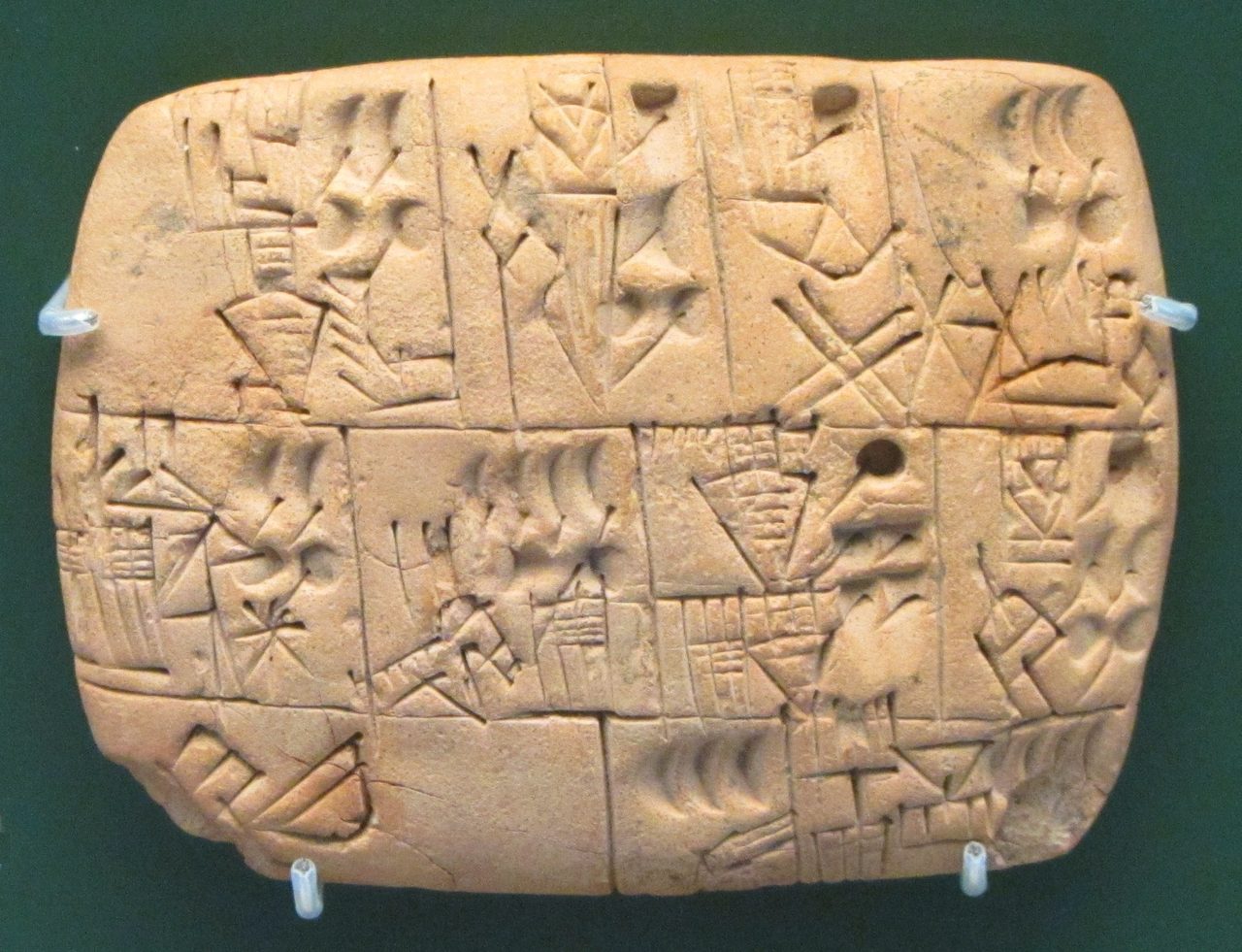
Writing, in Mesopotamia, does not begin with poetry. It begins with a warehouse: grain, livestock and beer rations, pressed into wet clay with the cut end of a reed by people whose job was to remember what had gone in and what had gone out. The script that grew out of those lists ran for roughly three thousand years and was bent to carry at least 15 languages. Here is where the wedges came from, how far they went, why so much of the clay survived, and what is still genuinely argued about the moment writing began.
Writing, in Mesopotamia, does not begin with poetry. It begins with a warehouse. The earliest tablets from Uruk are lists: grain, livestock, beer rations, land measurements and labour quotients, pressed into lumps of wet clay with the cut end of a reed by people whose job was to remember what had gone in and what had gone out. Nobody signed them. Nobody meant them to last. They lasted anyway, in numbers that run into the hundreds of thousands, and the script that grew out of them ran for roughly three thousand years and was bent to carry at least 15 different languages before it went quiet. This is the story of the wedges: where they came from, what they could and could not do at the start, how far they travelled, why so much of the clay survived, and how a small and quarrelsome group of nineteenth-century scholars worked out how to read them again.
Two things in that story are genuinely contested, and this page carries both rather than settling them. One is chronological: the earliest Egyptian signs and the earliest Mesopotamian ones sit close enough together that the order is not fixed by the dates. The other is definitional: whether the oldest Uruk tablets count as writing at all depends on what the word is taken to mean, and specialists in good standing answer it both ways. Neither argument makes the clay less astonishing. Both are more interesting than the race they usually get flattened into.
01Beer Rations At Uruk
The earliest cuneiform tablets come from Level IV at Uruk, in the Eanna precinct of a city in southern Mesopotamia, in what is now Iraq. German excavations recovered them between 1928 and 1976, and the traditional figure for those archaic texts from Uruk itself is about 5,000 tablets. That number needs its label attached, because it is not the size of the known proto-cuneiform corpus. A quantitative study published in the Cuneiform Digital Library Bulletin by Born and Kelley worked from a catalogue of 6,726 proto-cuneiform artefacts spanning the Uruk IV and Uruk III periods, of which 5,274 carry at least one readable sign. The 5,000 counts the archaic texts from one site; the 6,726 counts every findspot in the current catalogue. Both are true, and they are not the same measurement. What the tablets record is uniform and unromantic: administrative transactions. Grain. Livestock. Beer rations. Land measurements. Labour quotients.
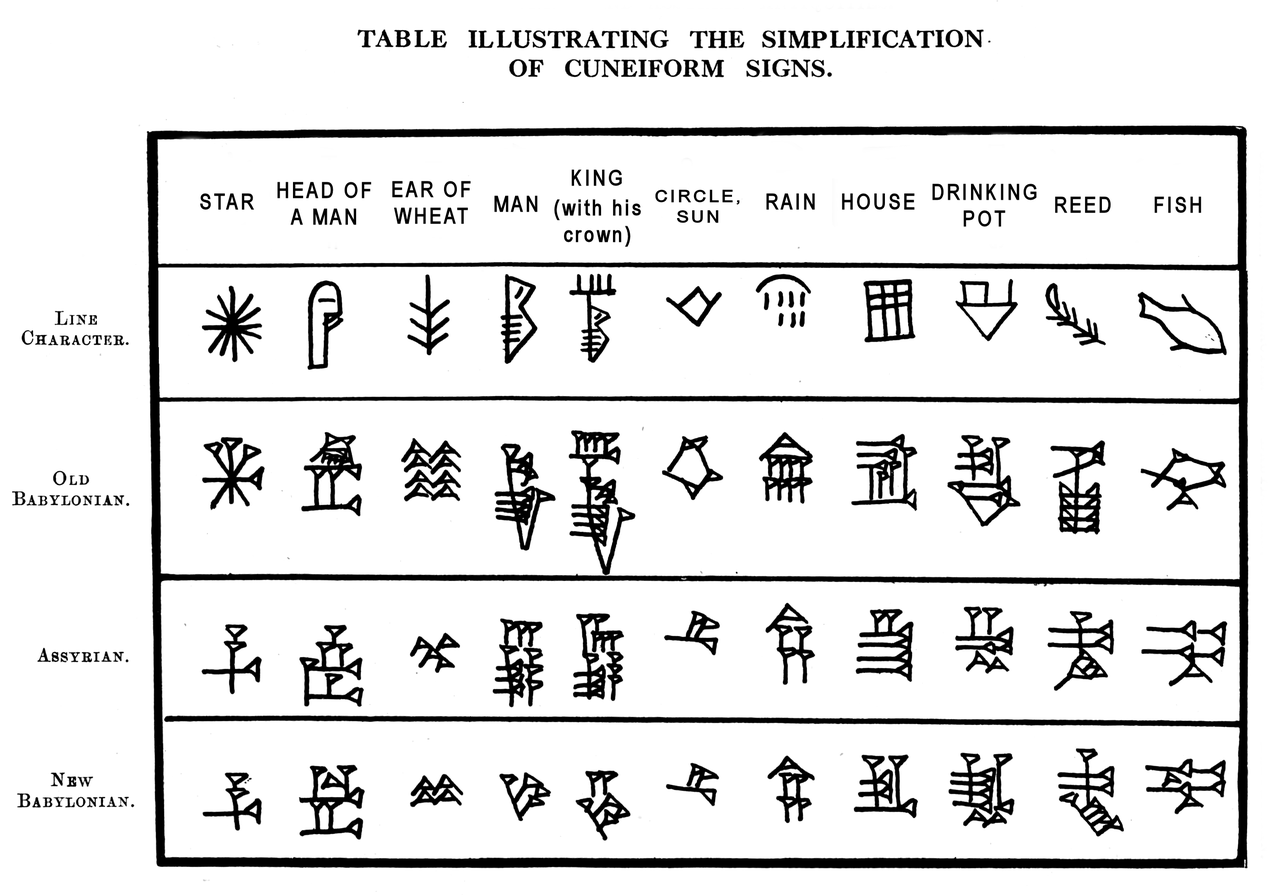
The signs on those tablets are mostly pictures, combined with separate systems of numerical notation: a head of grain for barley, a bowl for food or eating, a quantity marked in whichever notation suited what was being counted. Proto-cuneiform is not yet phonetic. It cannot be read aloud as a specific language, because it does not encode one; it records what, how many, and for whom. The sign inventory is usually given as about 1,200 distinct signs, and that figure moves with the method used to reach it. Counting every variant and compound in the catalogued corpus gives about 1,990 sign names; merging variants and compounds brings it down to 1,299. Our own research file's 1,200 sits close to the merged figure, which is a point in the file's favour, but the two are not the same measurement and the honest range is 1,299 to 1,990. A sign count in this subject is a decision about when two marks are ruled to be the same mark.
02Is This Writing Yet?
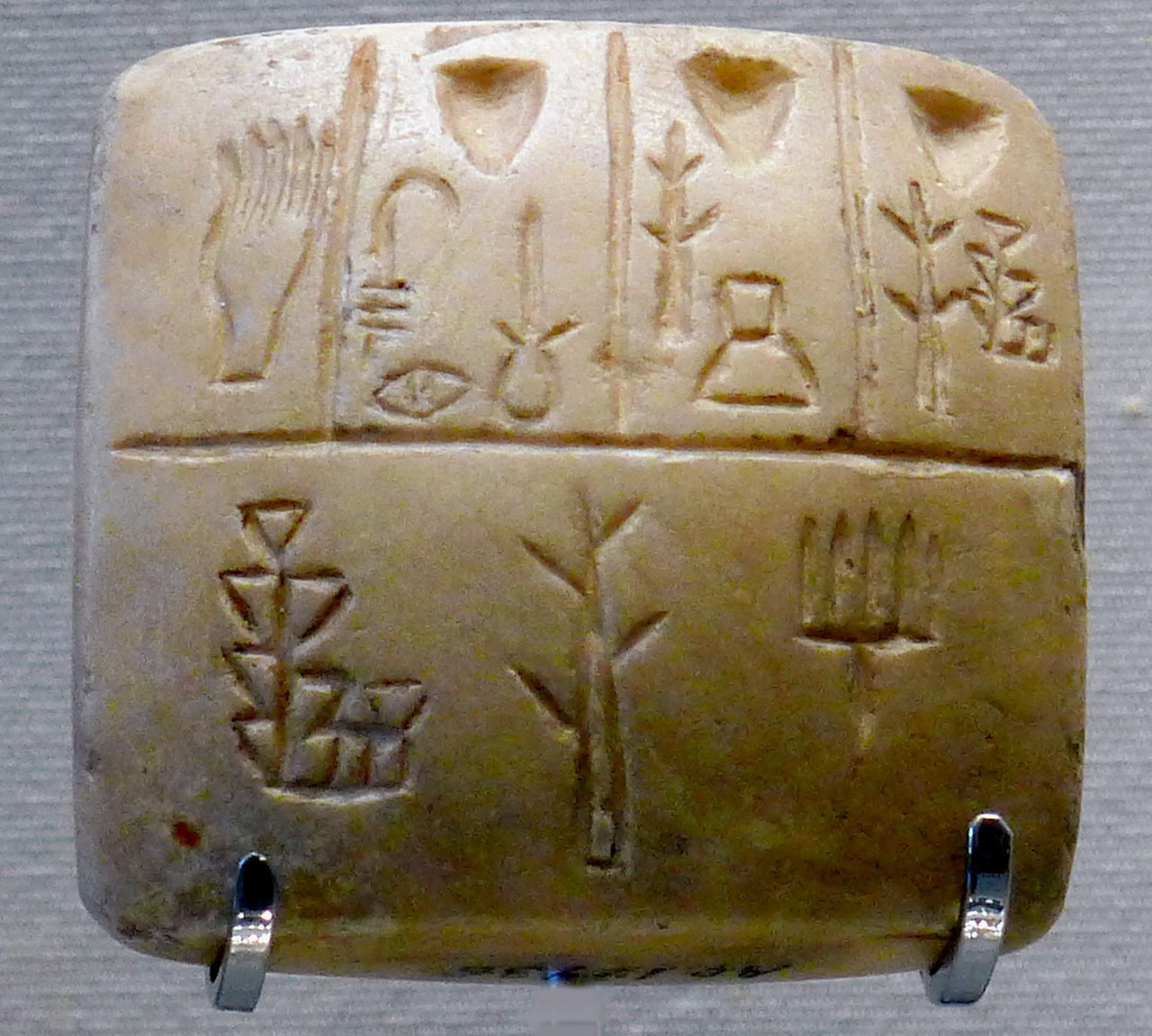
Whether the Uruk tablets count as writing is openly argued among specialists, and the argument is about a word rather than about the tablets. On the strict definition, sometimes called glottographic, a script is writing only if it encodes language, so that a competent reader recovers an utterance. Proto-cuneiform fails that test, for the reason given above: it records commodities, quantities and officials in a notation nobody can read out as Sumerian or as anything else. On the looser definition, sometimes called semasiographic, a system of conventional signs that reliably conveys meaning is writing, and proto-cuneiform qualifies from its first appearance. Both positions have serious defenders, and neither is a mistake. The consequence is not decorative, either. On the strict definition cuneiform's claim to be writing starts around 2600 BCE rather than around 3300 BCE, and by 2600 BCE the Egyptian script is unambiguously writing too. That is the hinge, and this page would rather show it than pick a side quietly.
The chronological argument is narrower and sharper. The mainstream position, and the one standard institutional treatments still present, is that the Uruk tablets are the earliest writing yet found, one of four independent inventions of writing alongside Egypt, China and Mesoamerica. The difficulty is that the Egyptian and Mesopotamian horizons overlap once both sets of error bars are stated out loud. On the Egyptian side, Tomb U-j at Abydos, excavated by Gunter Dreyer and published in 1998, produced roughly 150 to 200 small bone and ivory labels bearing signs; Dreyer dated the tomb to about 3320 BCE, while other assessments place the labels at about 3200 to 3150 BCE on radiocarbon and ceramic grounds. On the Mesopotamian side, the Uruk IV tablets are placed at about 3350 to 3200 BCE by some authorities and about 3200 to 3000 BCE by others, and the absolute chronology of the Uruk and Jemdet Nasr periods is itself an active radiocarbon question. Set those ranges beside each other and the ordering is not established by the dates. The dating has also moved more than once, on both sides.
The fairest statement of the problem is in our own research file, in a section that contradicts the file's own header. Its counter-arguments observe that the priority debate may be moot if both systems were independently invented, and that the discoveries at Abydos push Egyptian writing closer to Sumerian dates, while its title and summary assert the earliest-writing claim flatly. This page follows the counter-arguments, which are the more careful statement. The underlying relationship is a live debate in its own right. The file dates Sumerian cuneiform to about 3400 BCE and Egyptian hieroglyphics to about 3200 BCE, and scholars divide between independent invention on the Egyptian side and stimulus diffusion, in which the idea of writing travelled through trade contact but the Egyptians then built an entirely different system of their own. The file reads the balance of current opinion as favouring limited stimulus diffusion: the concept may have spread, the sign systems are independent inventions. That is its reading of the field, offered here as such, not as a survey we conducted.
There is a date at which the definitional argument runs out of room. By about 2600 BCE, in the Early Dynastic IIIa period, cuneiform had become a mixed logographic and syllabic system fully capable of recording the Sumerian language, and it starts being used for something other than accounts. The corpus from Abu Salabikh holds the earliest literary compositions we have, among them the Instructions of Shuruppak. From that point cuneiform is writing on every definition anyone has proposed, including the strictest one, which is exactly why 2600 BCE is the load-bearing date in the argument above rather than 3300 BCE.
03Where The Wedges Came From
The most influential account of where the signs came from is Denise Schmandt-Besserat's, set out in Before Writing in 1992, and it is a model with a name attached rather than an established fact. The argument runs like this. From about 8000 BCE, communities across the ancient Near East used small clay tokens as counters: spheres, cones, discs, tetrahedra, each shape standing for a particular commodity. To record a transaction, tokens were sealed inside a hollow clay envelope called a bulla. Because a sealed envelope hides its own contents, the token shapes were impressed on the outside as a check on what was within; and once the outside carried the information, the tokens inside became redundant, and the impressions became notation. Notation became signs. Our own research file places this under its Verified tier. This page places it one tier lower and says so out loud, because the same section of that file records named scholars publishing against it.
There is real physical evidence for part of the model, and it is worth stating concretely rather than gesturing at. Bullae have been excavated with tokens still sealed inside them, and the impressions on the outer surface match the tokens within: at Susa, at Uruk, at Habuba Kabira and at other sites. That is the strongest single piece of archaeology in the model's favour, and it puts the accounting envelope and its external notation beyond argument. What it does not by itself establish is the step after that, the claim that those external impressions evolved into the specific signs of proto-cuneiform.
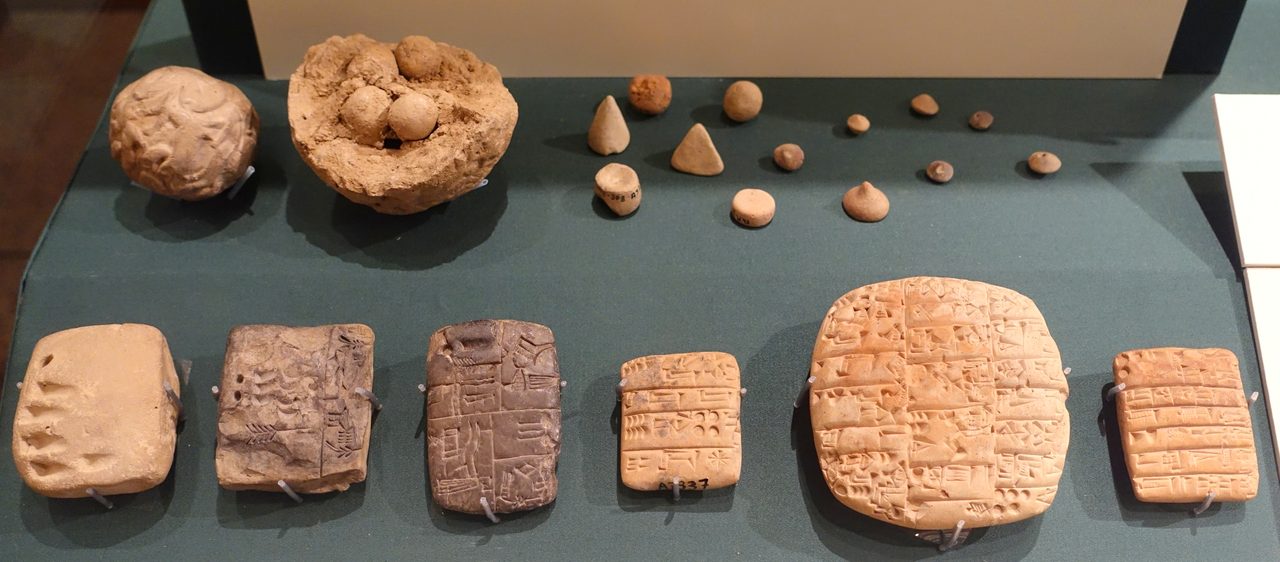
That next step is exactly where the published criticism falls. Michalowski, in a 1993 article in American Anthropologist bluntly titled Tokenism, and Englund in 1998 both questioned the one-to-one correspondence between token shapes and proto-cuneiform signs, arguing that the relationship may be a good deal more complex than a direct evolutionary sequence; Zimansky made the same objection in a 1993 review in the Journal of Field Archaeology. Our own file names all three, in the very section that files the theory as verified and again in its counter-arguments. Two more recent critiques press at the other end of the story. Bennison-Chapman, writing in 2019, argues from the excavated distribution of the small geometric clay objects that they had no single universal accounting role and were plausibly multifunctional utilitarian tools. Palka, in 2020, argues that they carried a ritual dimension as well as an accounting one. None of this makes the token model wrong. It makes it a model.
The origin question is also not closed history; it is current research. A 2024 study in Antiquity by Kelley, Cartolano and Ferrara argues that pre-literate cylinder-seal imagery fed directly into proto-cuneiform, identifying seal motifs that depict the transport of vessels and textiles and that appear to be the symbolic precursors of specific proto-cuneiform signs. It is one recent paper rather than a consensus overturning, and it complements the token account rather than replacing it. It is also the best available evidence that the honest answer here is neither that Schmandt-Besserat was right nor that she was wrong, but that people are still working on it, with new material, decades after the book that framed the question.
Push further back than that and the ground gives way. Scholars have proposed that tally marks and geometric signs on artefacts from sites older than Uruk represent proto-writing systems that may have contributed to cuneiform's development: the tokens from Jarmo at roughly 7000 BCE, the Tartaria tablets from Romania at around 5300 BCE. Continuity between any of these and cuneiform is undemonstrated. In the Tartaria case in particular, the resemblance between its signs and Sumerian ones looked striking at first and is now considered coincidental by most specialists. These proposals belong in a section on origins because people keep making them. They do not belong in the argument about who wrote first.
04A Reed, A Wedge, And The Fires That Saved Everything
The technique is the whole reason the script looks the way it does. A scribe wrote by pressing the cut end of a reed stylus, a calamus, into wet clay, holding it at an angle. A cut reed has a triangular cross-section, and that triangle is what makes the mark: every press leaves a wedge rather than a line. The script is named for it and for nothing else. Cuneiform is from the Latin cuneus, a wedge. What began as recognisable pictures ended as arrangements of these impressions, abstract enough that a head of grain no longer looks like a head of grain. The appearance of cuneiform is not a style anybody chose. It is the shape of one tool meeting one material, repeated for three thousand years.
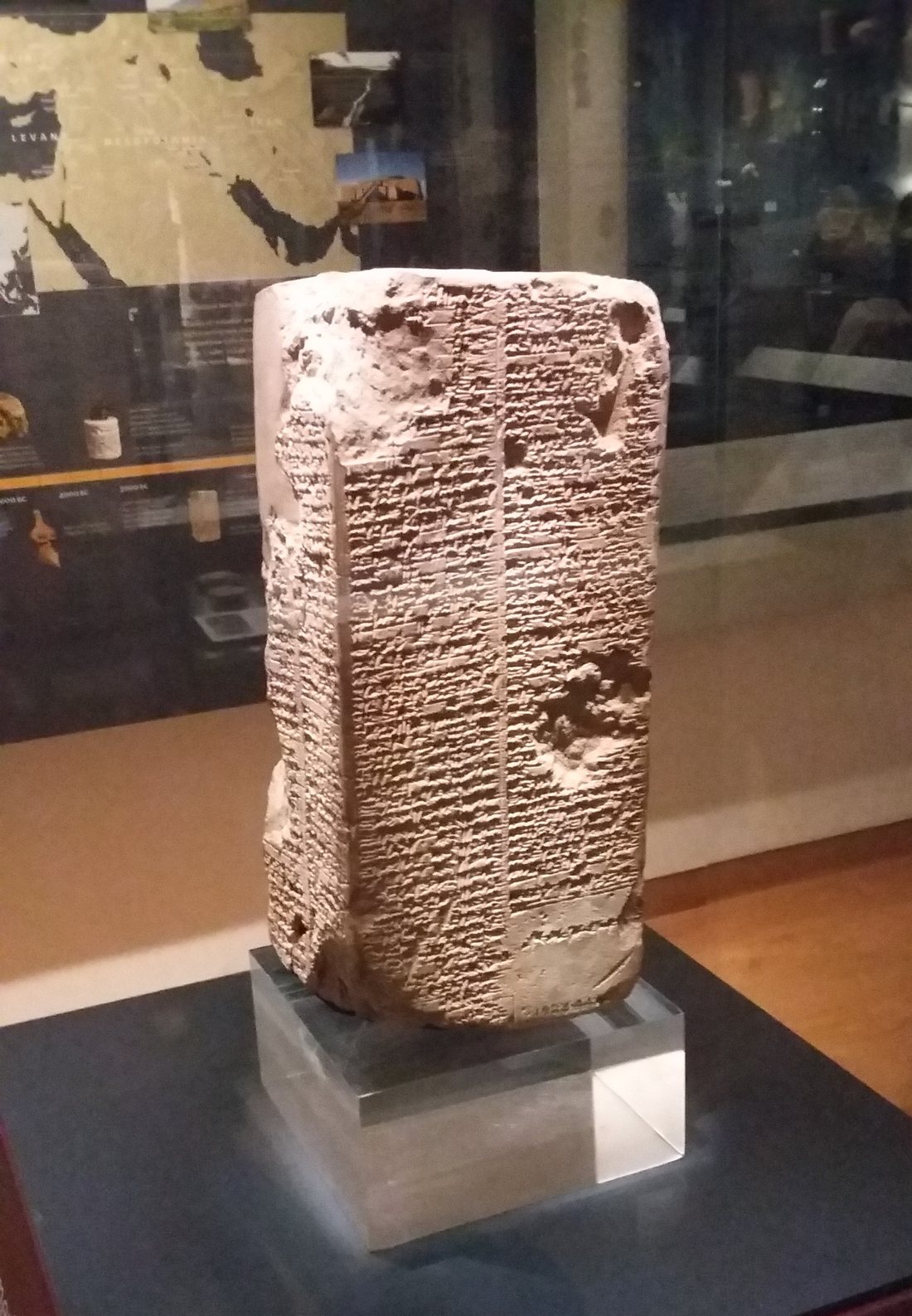
Tablets come in whatever size the job required, from about 2 cm for a small receipt to more than 30 cm for a literary, legal or scholarly text, with some multicolumn tablets larger still. Our own file offers the Weld-Blundell Prism in Oxford as its example and describes it as 20 cm tall with four columns across eight faces. That description is wrong, and the correction is worth making because the object is famous. The Ashmolean Museum's own record for accession AN1923.444 gives a clay prism of about 20 by 9 cm, dated to about 1800 BCE, probably from Larsa in Iraq, presented to the museum by Herbert Weld-Blundell in 1923, and states that each of its four sides is inscribed with two columns of cuneiform. Four sides, eight columns; the file has the two numbers swapped and four faces the object does not have. What the prism carries is the Sumerian King List, the most complete copy that survives, running from mythological rulers with enormous reign lengths, through the single line recording that the Flood swept over, down to King Sin-magir of the Isin dynasty.
Then the paradox that explains why any of this is readable at all. Clay is durable, but sun-dried clay is not: it softens, crumbles and goes back to being mud. Fired clay lasts almost indefinitely. The archives at Ebla, at Nineveh and at Hattusa were all destroyed by fire, and the fire baked them. The catastrophes that ended those libraries are the reason their contents survived to be dug out of the ground millennia later. Hundreds of thousands of cuneiform tablets now sit in museum collections around the world, and a great many of them are there because a building burned down on top of them.
| The Figure | What Our Own File Says | The Better-Sourced Version | Why The Two Differ |
|---|---|---|---|
| Proto-cuneiform tablets | About 5,000, from Uruk itself | About 6,726 catalogued proto-cuneiform artefacts, of which 5,274 carry at least one readable sign | The first counts the archaic texts from one site; the second counts every findspot in the current catalogue |
| Proto-cuneiform signs | About 1,200 distinct signs | About 1,990 sign names, reducing to about 1,299 when variants and compounds are merged | A sign count depends entirely on when two marks are ruled to be the same mark |
| Signs in Sumerian cuneiform | Roughly 600 | Roughly 600, understood as an order-of-magnitude figure | The same problem as the row above; no sign count in this subject is a fixed number |
| Tablets in the Ebla archive | About 1,800 | About 1,800 complete tablets, plus about 4,700 fragments and many thousands of smaller chips, aggregated by some counts as roughly 17,000 | Three figures, one archive, three different units of counting |
| Tablets from the library at Nineveh | About 30,000 tablets and fragments | Around 32,000 tablets and fragments on the British Museum's own current figure, with joins suggesting on the order of 10,000 distinct texts | A fragment is not a text, and the round 30,000 is an older number |
| Cuneiform objects excavated worldwide | Hundreds of thousands | About 500,000 as a widely repeated working estimate, a large but unquantified share of it never read | Nobody holds a register of every tablet in every collection, and private holdings are unknown |
| Languages written in cuneiform | At least 15 | At least 15, where the phrase is a floor and not a total | The file deliberately declined to claim exhaustiveness, and this page declines too |
05What The Clay Carried
Over roughly three thousand years cuneiform was picked up, modified and made to write at least 15 languages drawn from several unrelated families. Sumerian, a language isolate. Akkadian, Semitic, with its Babylonian and Assyrian dialects. Elamite, another isolate, or possibly Elamo-Dravidian. Hittite and Luwian, Indo-European. Hurrian and Urartian, Hurro-Urartian. Old Persian, Indo-European again, in a heavily simplified cuneiform of its own. And others: at least 15 is a floor, not a count of everything. Every adaptation meant surgery on the sign inventory. Sumerian cuneiform ran on roughly 600 signs, mixing logograms that stand for whole words with syllabograms that spell sounds, and each new language kept, dropped or repurposed whatever suited it. Old Persian is the extreme case, cut down to a near-alphabetic set.
The spread is visible in the ground. At Tell Mardikh in Syria, Paolo Matthiae's Italian team uncovered in 1974 and 1975 the archive of Ebla, dated to about 2400 BCE, in which cuneiform had been adapted to write Eblaite, a Semitic language, for a sophisticated bureaucratic state well outside Sumer. The size of that archive is quoted three different ways, and it is worth knowing which one you are being handed: about 1,800 complete tablets, about 4,700 fragments with many thousands of smaller chips beyond them, and an aggregate often given as roughly 17,000 tablets and fragments. Our own file gives 1,800, which is the count of complete tablets.
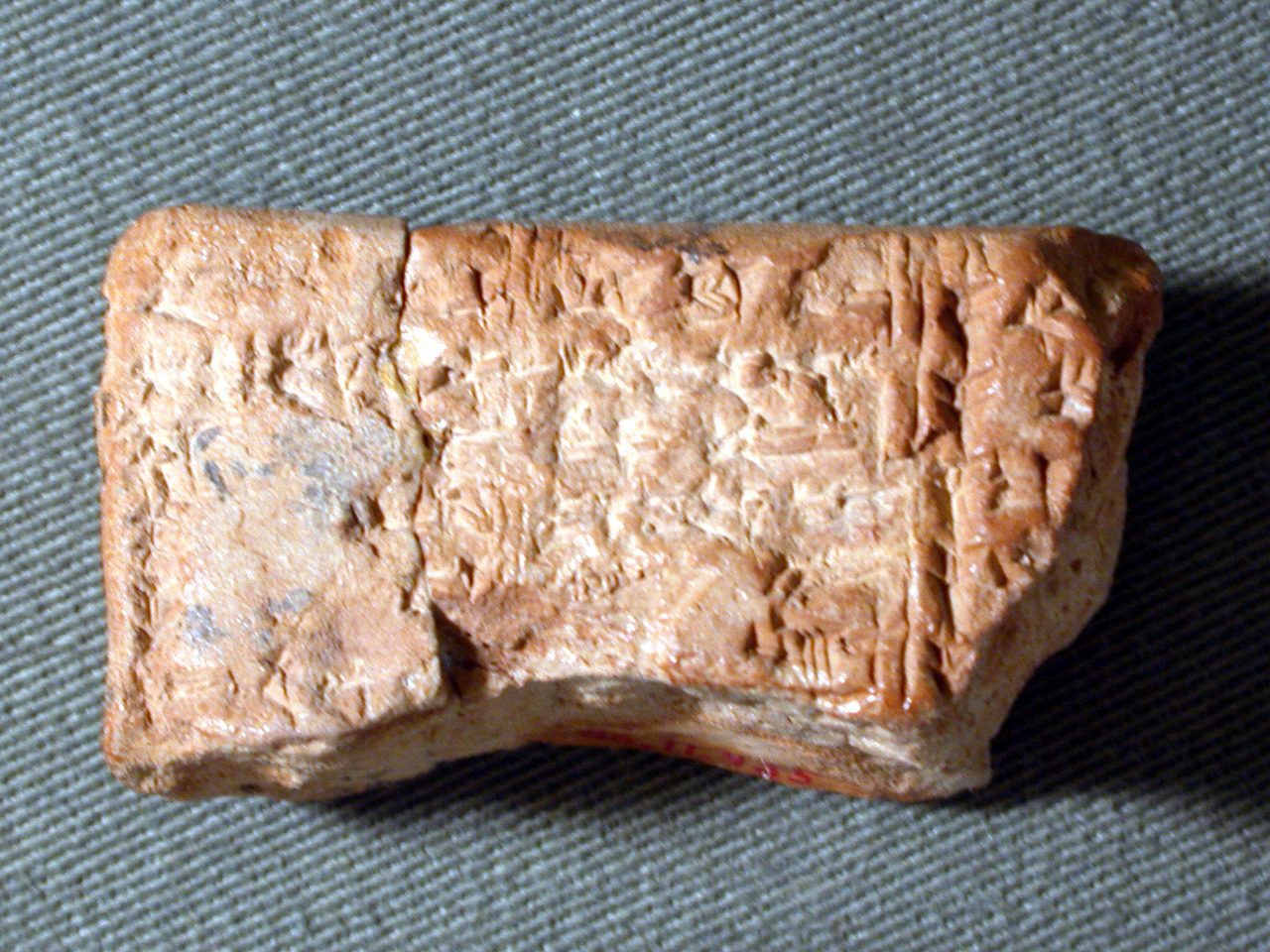
Learning to do this was a profession with a school attached. The Sumerian name is e-dub-ba-a, the tablet house, and its curriculum is unusually well attested because the students' own work survives: thousands of exercise tablets carrying sign lists, vocabulary drills, mathematical problems and copied literature. Robson's study of one such house at Nippur, conventionally dated to about 1800 BCE, and Veldhuis's thesis on elementary education there both reconstruct the sequence a student went through out of those exercise tablets. Two notes on the citation, in the open. Our own file gives Robson's article in volume 95 of Revue d'Assyriologie; it is in volume 93, at the same pages, which means a reader following the file lands in the wrong volume at the right page numbers and finds something else. And the date above says conventionally on purpose: early second millennium Mesopotamian dates shift by up to about 150 years between the competing chronologies in use, which is a genuine problem for this period specifically and not for the fourth-millennium or first-millennium dates elsewhere on this page.
How many people could read is genuinely unsettled, and our own file gets this one wrong in an instructive way. The traditional estimate, and the figure the file gives, is that 1 to 5 per cent of the Mesopotamian population was literate at any one time, with writing confined to a small professional class. The file attributes that figure to Civil and to Charpin. Charpin argues the opposite. His Reading and Writing in Babylon, published by Harvard University Press in 2010, is a sustained case that literacy in Babylonia was considerably more widespread than the narrow-elite picture allows, built on the Mari archives and on his rereading of a building at Ur, long taken for a school, as a residence where clergy taught their own children and apprentices to read and write at home. Citing him in support of the low figure inverts his position, so he appears here as the named dissent from it. The file's own counter-arguments already concede the deeper problem: every estimate depends on where the threshold is set. Reading and writing are separable skills, functional literacy and full scholarly competence are different things, and the same population can be described very differently depending on which is being counted. The honest answer is that nobody knows, and that a leading specialist thinks the standard answer is too low.
06The Library At Nineveh
The library at Nineveh was assembled by Ashurbanipal, whose reign of 668 to 627 BCE is fixed independently by Assyrian eponym lists and dated astronomical records and sits outside the chronology disputes that trouble earlier centuries. Excavators working there between 1851 and 1932 brought the collection out of the ground, and the British Museum's own Ashurbanipal Library Project puts the surviving material at around 32,000 cuneiform tablets and fragments. Our own file gives about 30,000, which is not so much wrong as rounder and older. The more interesting figure is the one underneath it. Because many of the smaller fragments belong to the same texts, joining them up suggests a library holding something on the order of 10,000 distinct texts rather than 30,000-odd separate works.
It is the largest known cuneiform library, and what it held was a working reference collection: literature, science, medicine, divination, lexicography and correspondence. It is also the primary source for the standard Babylonian version of the Epic of Gilgamesh. That characterisation is our own file's, and it sits a tier below the counts above it, which are the holding museum's. Ashurbanipal's collecting looks like a deliberate programme of knowledge preservation, and his tablets say as much: colophons in his name state that he could personally read both Sumerian and Akkadian, an unusual claim for a king to make. It is worth being precise about what that evidence is. It is a royal self-description, written on the king's own tablets, in a genre built to impress. It is strong evidence that he wanted to be seen as a literate king, and reasonable evidence that he was one. It is not a biography, and this page will not treat it as one.
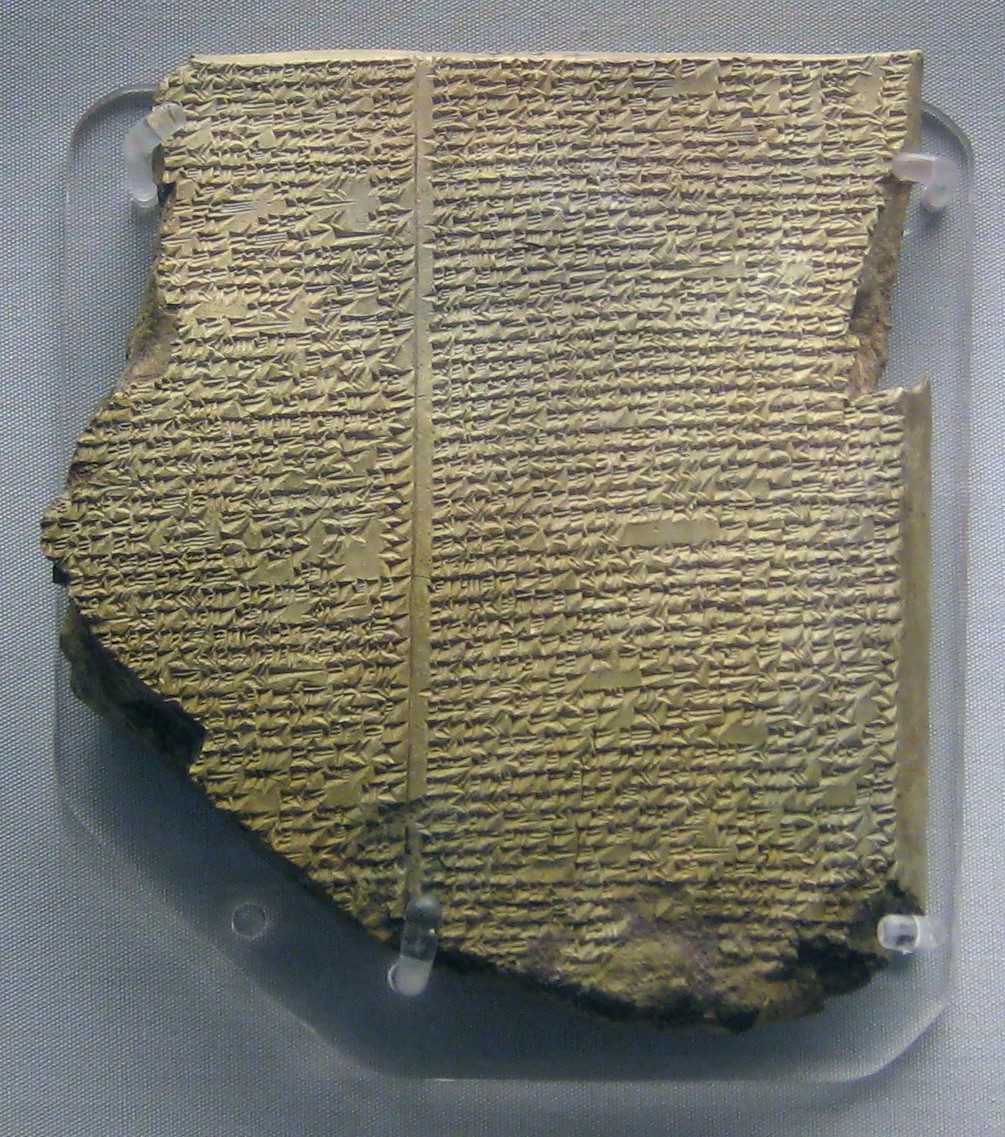
The most famous single object to come out of that library is the Flood Tablet, the eleventh tablet of the standard Babylonian Epic of Gilgamesh, a Neo-Assyrian clay tablet of the seventh century BCE now in the British Museum. It carries a Mesopotamian flood narrative, and its recognition in 1872 caused a public sensation. What that narrative's relationship is to the flood story in Genesis is a large subject with a literature of its own, and it is not this article's; here the tablet stands as an example of what a cuneiform library actually contained, which was more or less everything the state thought worth keeping.
Cuneiform carried stranger cargo too. Hurrian Hymn No. 6, from Ugarit and dated to about 1400 BCE, is inscribed in cuneiform and is the oldest known substantially complete notated musical composition: alongside its words it uses Akkadian interval names to specify tuning and melodic structure, as Kilmer set out in 1974 and West analysed in 1994. Two things there have to be kept apart. That the tablet exists and carries musical terminology is not in dispute. What it sounded like is. Multiple competing transcriptions exist, and whether the notation prescribes specific pitches or only intervals is unresolved, which means every recording of the Hurrian hymn anyone has ever heard is one scholar's reading of it rather than the piece.
07The Long Fade
Cuneiform did not end; it thinned out. Our own file says the script went extinct around the first century CE, which is vague where a precise answer exists. The latest datable cuneiform tablet known is an astronomical almanac from Uruk, excavation number W22340a, dated to year 326 of the Arsacid Era, which is 79 or 80 CE. Hunger and de Jong published it in 2014 under exactly that description. The hedge in their title is theirs as much as ours, and it matters: latest datable is not last ever written. It is the latest one carrying a date anyone can read. Undated tablets may well be later, and the death of a three-thousand-year-old script was a fade rather than an event, with fewer scribes, narrower and narrower uses, and then nobody.
08Reading It Again
The recovery started with a formula and a dismissal. In 1802 Georg Friedrich Grotefend, working not from the monuments themselves but from Carsten Niebuhr's published copies of the inscriptions at Persepolis, recognised that three different scripts stood side by side on the same surfaces, and went after the simplest of them. He isolated a repeating sequence and read it as a royal formula: King, son of somebody, King, King of Kings. Matching that pattern against the known royal succession, he identified the names Darius and Xerxes, and from those names he could begin assigning sound values to signs. He is credited with identifying roughly a quarter of the Old Persian signs. He communicated the result to the Royal Society of Gottingen in 1802, where it was dismissed.
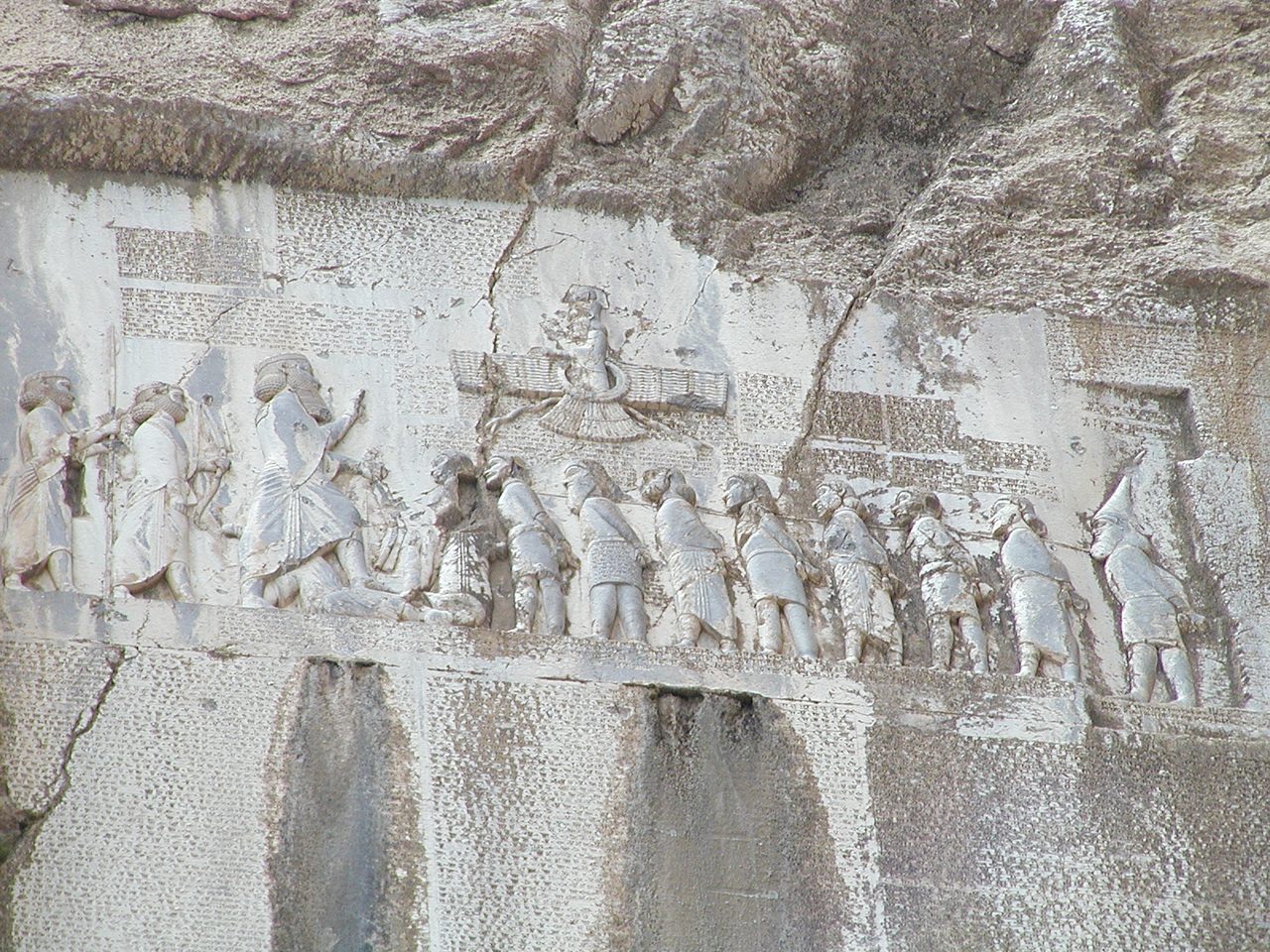
The document that made everything after it possible is cut into a cliff. At Bisotun in Kermanshah Province, in western Iran, roughly 100 metres up a limestone face, Darius I had a relief carved with his account of defeating the rival claimants who contested his taking of the throne in 522 BCE, and had the text repeated in three languages and three cuneiform scripts: Old Persian, Elamite and Babylonian. That arrangement made Behistun the functional equivalent of the Rosetta Stone for cuneiform, an almost-known language set beside two unknown ones with the same content in all three. The site went onto the UNESCO World Heritage List in 2006 as Bisotun, reference 1222. Between 1835 and 1846, Henry Creswicke Rawlinson copied the inscription. One necessary disambiguation, because the confusion is common: this is Sir Henry Creswicke Rawlinson, 1810 to 1895, the Assyriologist, and not Henry Seymour Rawlinson, the First World War general of nearly the same name, who dominates the picture archives under that surname.
What happened next is usually told as one man's triumph, and it was not. By 1857 four scholars had independently arrived at readings of Babylonian cuneiform: Rawlinson, the Irish clergyman Edward Hincks, the French orientalist Jules Oppert, and William Henry Fox Talbot. Public confidence in the whole enterprise was low, and the test that settled it was Talbot's idea. He had received a prepublication lithograph of an inscription of the Assyrian king Tiglath-Pileser I; he submitted a sealed translation of it to the Royal Asiatic Society and proposed that Rawlinson and Hincks be invited to do the same. Edwin Norris, the Society's secretary, distributed the copies. The conditions were not equal: Hincks received his text too late to render all of it, and Oppert, then in London, worked from his own incomplete copy. On 29 May 1857 the jury reported in detail on where the four versions agreed, found Rawlinson's and Hincks's closest to each other, and pronounced the decipherment a success. Talbot, the least experienced of the four, made a number of errors; Oppert's version had doubtful passages that the jury politely attributed to his unfamiliarity with English.
The share-out of credit deserves saying plainly, because the popular version has flattened it down to one name. Edward Hincks is the most consistently under-credited figure in this story, and a substantial strand of the scholarship holds that the greatest single share of the Akkadian decipherment belongs to him. Among his specific results: the recognition that Old Persian cuneiform is in part a syllabary rather than a pure alphabet, and much of the structural analysis of the Akkadian syllabary itself. That assessment is a historiographical judgement and not an arithmetic one, and it is offered here as what a great many historians of Assyriology think rather than as a measurement. There is one more piece usually left out. The relationship between Hincks and Rawlinson was competitive and often acrimonious, and it was partly because the two of them kept publicly disagreeing that confidence in the decipherment had sunk far enough to need a sealed-envelope test at all. The quarrel produced the proof.
The fuller history of decipherment as a discipline, its methods, its failures and the scripts still unread, belongs to its own article in this library and is not told here. What matters for cuneiform is the shape of the thing: the reading was collaborative, it was contested, and it was confirmed under sealed cover by a test its own participants designed.
09What Cuneiform Is Not
Two claims about cuneiform get a flat no here rather than a hearing. The first is that writing appeared suddenly, with no antecedents at all. It did not, and the evidence against it does not depend on the token model being correct: quite independently of tokens, the complexity of proto-cuneiform signs at Uruk itself increases gradually over several centuries, which is what an invention under development looks like and is not what a delivered finished system looks like. The second claim follows from the first and falls with it. Sitchin's proposal, in The 12th Planet in 1976, that cuneiform was a gift to humanity from extraterrestrial beings requires a discontinuity in the record for the gift to sit inside, and there is no discontinuity. There is a long, visible, unglamorous development from counters through pictographs to abstract signs, spread over millennia and excavated in sequence. Nothing in it needs an explanation from outside.
The third is the claim that cuneiform tablets record knowledge of advanced technology: nuclear weapons, space travel, genetic engineering. These readings rest on mistranslation and on selective quotation, and professional Assyriologists reject them as linguistically unsupported. It is worth being exact about why, because the refusal is stronger than an appeal to authority. Cuneiform is not a mystery script. It is read by a discipline that has been checking itself continuously since the sealed-envelope test of 1857, against trilingual inscriptions where the same text stands in three languages, against thousands of school exercise tablets that record how the signs were actually taught, and against sign lists the scribes themselves compiled. A reading that only works if all of that apparatus is set aside is not a translation of anything. One note in the open: our own file names two authorities for this refusal and neither citation resolves to an entry in its own bibliography, so this page argues the refusal on the evidence instead of on those names.
10What The Wedges Did To Us
One last claim, carried open. Lambros Malafouris, in How Things Shape the Mind in 2013, and other material engagement theorists argue that inventing writing did not merely give people a way to record thoughts they were already having, but altered the thinking itself: that externalised memory made possible kinds of reasoning, abstraction and social complexity that were cognitively out of reach without material inscription. It is plausible, and cognitive archaeology increasingly supports it. It is also difficult to test empirically, and our own file says so in the same breath as it makes the case. This page files it as an open possibility rather than a finding, which is where it currently belongs.
Fast Facts
- What It Is
- A script pressed into wet clay with the cut end of a reed; the wedge, Latin cuneus, gives it its modern name
- Where It Starts
- Level IV at Uruk, in the Eanna precinct, southern Iraq; German excavations, 1928 to 1976
- What The First Tablets Say
- Grain, livestock, beer rations, land measurements, labour quotients. Administration, not literature
- Writing On Every Definition By
- About 2600 BCE, when the script records Sumerian in full; the Abu Salabikh literary texts belong to that horizon
- The Two Live Arguments
- Whether the oldest Uruk tablets count as writing at all (a question about the definition), and whether the Egyptian and Mesopotamian horizons can be ordered at all (their date ranges overlap)
- Where The Signs Came From
- Schmandt-Besserat's clay-token model is the leading account and carries named published critics; a 2024 Antiquity paper adds cylinder-seal imagery to the picture
- Reach
- Roughly three thousand years and at least 15 languages, from Sumerian and Akkadian to Hittite and Old Persian
- Why So Much Survived
- Fire. The archives at Ebla, Nineveh and Hattusa burned, and the burning baked the clay
- Latest Datable Tablet
- An astronomical almanac from Uruk, W22340a, Arsacid year 326, that is 79 or 80 CE. Latest datable, not last written
- Read Again By
- Grotefend in 1802 for Old Persian, then Rawlinson, Hincks, Oppert and Talbot, confirmed by sealed translations on 29 May 1857
- Refused
- Sudden invention with no antecedents; Sitchin's extraterrestrial gift; tablets encoding advanced technology
What We Can Actually Stand Behind
The objects and the technique are not in doubt. Proto-cuneiform tablets exist at Level IV at Uruk, recovered by German excavations between 1928 and 1976, and they record administration: grain, livestock, beer rations, land measurements, labour quotients. The medium is wet clay impressed with a cut reed, which is where the name comes from. By about 2600 BCE the script records Sumerian in full, literature included. The archives at Ebla, Nineveh and Hattusa were preserved by the fire that destroyed them. The Ashmolean's Weld-Blundell Prism has four sides carrying two columns each. The latest datable tablet is the Uruk almanac W22340a of 79 or 80 CE. And the nineteenth-century decipherment happened as described, confirmed by sealed translations judged on 29 May 1857.
Several things on this page are well supported and still argued. Where the signs came from is the biggest: the clay-token model is the leading account, with real archaeology behind the bulla evidence and named published critics against the step from impressions to signs, and a 2024 paper putting cylinder-seal imagery into the same question. Whether the Uruk tablets count as writing depends on the definition chosen, and both definitions have serious defenders. Whether the Egyptian or the Mesopotamian horizon came first is not settled by dates whose ranges overlap. Literacy is quoted at 1 to 5 per cent as the traditional estimate, and a leading specialist argues that figure is too low. Every count in the subject is an estimate that moves as catalogues grow, which is why this page prints them in pairs.
Three things are carried as possibilities rather than findings. That pre-Uruk marks such as the Jarmo tokens or the Tartaria tablets fed into cuneiform is undemonstrated, and in the Tartaria case the resemblance is now generally read as coincidence. That writing restructured human cognition, rather than only recording it, is plausible and increasingly supported by cognitive archaeology, and it remains difficult to test. And the Hurrian hymn's notation is genuinely readable as more than one melody: the tablet is certain, the tune is not.
Three claims get a flat refusal. Writing did not appear suddenly out of nothing: proto-cuneiform sign complexity increases gradually over centuries at Uruk itself, independently of any argument about tokens. Cuneiform was not given to humanity by extraterrestrials; that proposal needs a gap in the record to sit in, and the record does not have one. And cuneiform tablets do not encode nuclear weapons, space travel or genetic engineering; those readings rest on mistranslation and selective quotation, and they only work if the trilinguals, the school tablets and the scribes' own sign lists are all set aside at once. The wonder in this subject is real, and none of it requires inventing.
What is genuinely astonishing about cuneiform is not that it was first at anything. It is that it was ordinary. Nobody at Uruk set out to invent literature, or history, or law, or the means by which a long-dead stranger could still tell you what he thought worth writing down. They set out to keep track of barley and beer, and the tool they built for that job turned out to be general-purpose in a way nobody could have predicted, and stayed in use for three thousand years, and outlived every language it was ever asked to write. It survived by accident, in fires meant to destroy it. It went silent for centuries, and then a handful of arguing scholars pulled it back. The marks are still there in the clay, sharp as the day the reed came out, waiting for the next person who learns what they say.
Sources & further reading
WHERE THIS PAGE WORKED FROM, AND WHERE IT CAN BE CHECKED. It was written from one file in our own research library, ZG_1_02, which is where the work started and not where it can be verified. The eighteen external entries below are what the claims rest on, and each names the section it supports. THIS PAGE CORRECTS ITS OWN SOURCE FILE, IN THE OPEN, IN SIX PLACES. Four of the five DOIs in that file's bibliography resolve to reviews of the cited work rather than to the work itself, so none of the four is reproduced here, and where a real edition could be resolved it is cited instead. For two of them, Englund 1998 and Cooper 2004, no replacement identifier was found, which is why Englund is named in the text without a link. The file describes the Weld-Blundell Prism as four columns across eight faces, while the Ashmolean's own record for AN1923.444 says four sides carrying two columns each. The file cites Charpin 2010 in support of a 1 to 5 per cent literacy estimate, and Charpin argues the opposite, so he appears here as the named dissent. The file gives Robson 2001 in volume 95 of Revue d'Assyriologie; the article is in volume 93 at the same pages, so a reader following the file lands in the wrong volume at the right page numbers. The file's own corrections block deleted the ISBN of Charpin's book as invalid; that ISBN is valid and is the one Harvard University Press prints, and it is restored below. And the file places the clay-token model under its Verified tier while the same section names published critics of it, so this page carries that claim one tier lower and says so on the claim itself. WHAT THIS PAGE DELIBERATELY DOES NOT PRINT. No precise count of untranslated tablets, because the widely circulated versions of that number are not traceable to a source that counted anything. The page does print the widely repeated working estimate of about 500,000 excavated objects, labelled as an estimate, and says that a large but unquantified share of them has never been read. And no citation for the refusal of the advanced-technology readings, because our file names two authorities there and neither appears in its own bibliography, so the refusal is argued on the evidence instead. SCOPE. The fuller history of decipherment as a discipline, the Egyptian story, and the relationship between the Flood Tablet and Genesis each belong to their own articles in this library and are named here rather than told.
Image credits
- Early writing tablet recording the allocation of beer, British Museum ME 140855 BabelStone, via Wikimedia Commons (CC BY-SA 3.0). CC BY-SA 3.0 Source.
- Tablet with pre-cuneiform writing, Uruk III era, Musee du Louvre AO 19936 Mbzt, via Wikimedia Commons (CC BY 3.0, dual-licensed GFDL 1.2 or later). CC BY 3.0 / GFDL 1.2 or later Source.
- Display case of clay accounting objects and early inscribed tablets, Institute for the Study of Ancient Cultures, University of Chicago Daderot, via Wikimedia Commons (CC0). CC0 Source.
- The Weld-Blundell Prism, Sumerian King List, Ashmolean Museum AN1923.444 M.atkinsonross, via Wikimedia Commons (CC BY-SA 4.0). CC BY-SA 4.0 Source.
- School exercise tablet, lexical series Urra=hubullu tablet 1, Metropolitan Museum of Art 86.11.435 Metropolitan Museum of Art, via Wikimedia Commons (CC0). CC0 Source.
- The Flood Tablet, Epic of Gilgamesh tablet 11, Library of Ashurbanipal, British Museum BabelStone, via Wikimedia Commons (CC0). CC0 Source.
- The Behistun relief and trilingual inscription in the cliff at Bisotun, Kermanshah Province, Iran Photograph by Hara1603, via Wikimedia Commons (released by the photographer into the public domain; the carving itself is public domain by age). Public domain Source.
- Table illustrating the simplification of cuneiform signs, from the British Museum guide of 1922 E. A. Wallis Budge and L. W. King, A Guide to the Babylonian and Assyrian Antiquities (British Museum, 1922), via Wikimedia Commons (public domain). Public domain Source.
- Card crop of Early writing tablet recording the allocation of beer, British Museum ME 140855 BabelStone, via Wikimedia Commons (CC BY-SA 3.0). CC BY-SA 3.0 Source.


