
Four Hundred Caves And Not One Sentence
For roughly three centuries, men across the Roman Empire went down steps into small windowless rooms, reclined on stone benches facing each other, ate a meal, and looked at a picture of a god killing a bull. Over four hundred and twenty of those rooms have been dug up, from Hadrian's Wall to the Syrian desert, and more than a thousand inscriptions survive. Not one line of what they said in there has come down to us. Everything anyone knows about what these people believed has been reconstructed from architecture, from that one endlessly repeated image, and from the writings of Christians who despised them. And when we checked our own sources, the pattern we published this morning predicted exactly which of them would be wrong, before we looked.
Consider the ratio. More than four hundred and twenty underground temples excavated, from the north of Britain to the Syrian frontier. Over a thousand surviving inscriptions. Hundreds of sculpted and painted versions of a single scene, repeated with a consistency that would satisfy a modern brand manual. Three centuries of continuous practice across an empire, by men who built these rooms at their own expense and cut their names into the stone.
And not one sentence of what they said down there. No scripture, no liturgy, no creed, no hymn, no order of service. Nothing written from inside. The entire reconstruction of what Mithraism meant rests on three things: the shape of the buildings, the picture on the wall, and the testimony of Christian authors who were arguing against it. That is the situation, and it is worth sitting with before anything else, because almost every confident sentence written about this religion is an inference from a photograph of a room.
01The Room
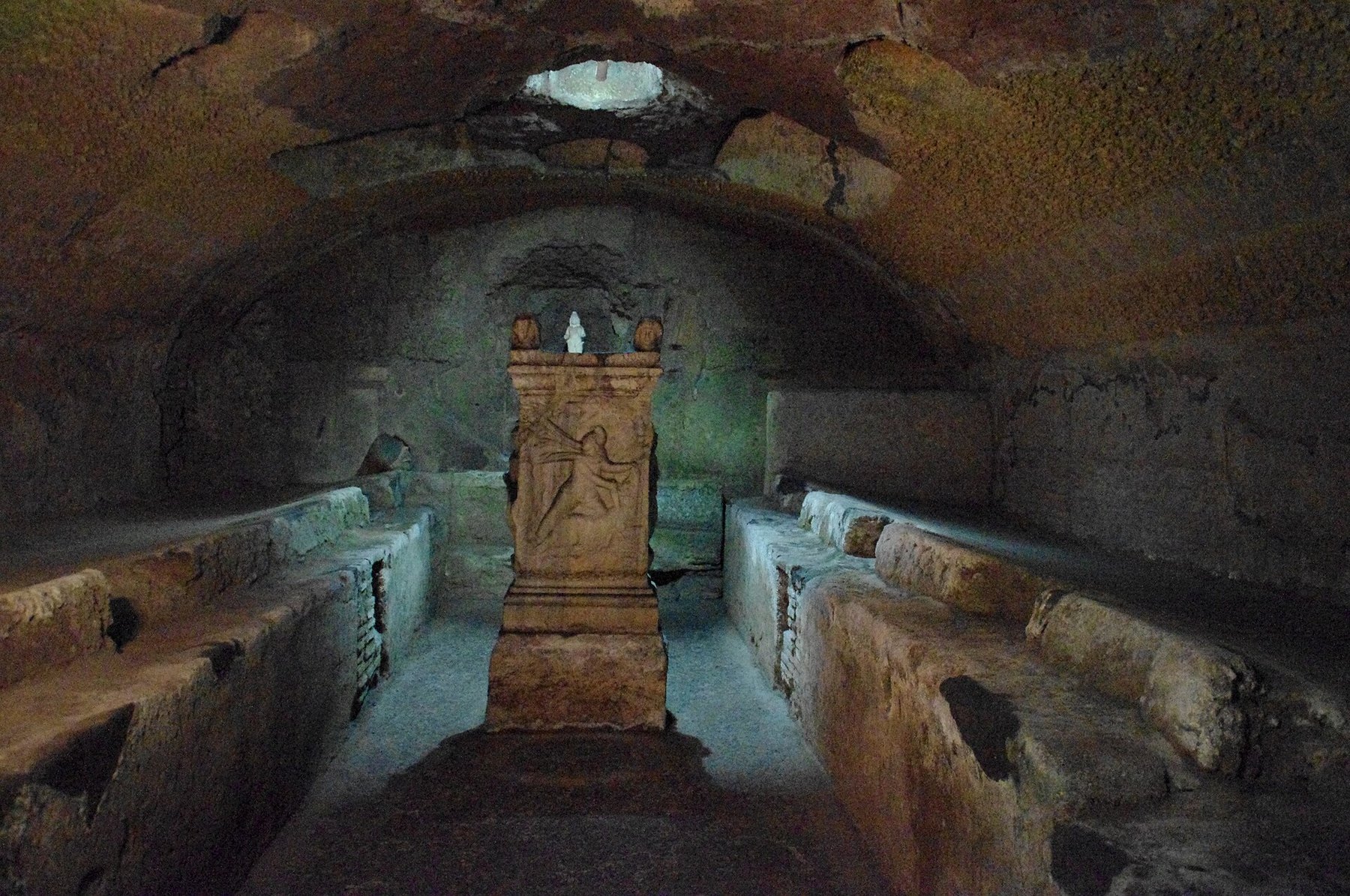
A mithraeum is a cave, built on purpose. The word used for it is spelaeum, which means cave, and that is what these rooms imitate: a purpose-built underground or semi-subterranean chamber, long and narrow, with raised benches, podia, running the length of both side walls, and the cult image at one end. Members reclined on the benches, facing each other across a narrow aisle, and ate. And the scale is the thing people get wrong: most mithraea hold twenty to forty people. This was not a mass religion with great halls. It was a network of small cells, each the size of a modest dining room, repeated hundreds of times across a continent. Construction clusters between the late first century and the middle of the third.
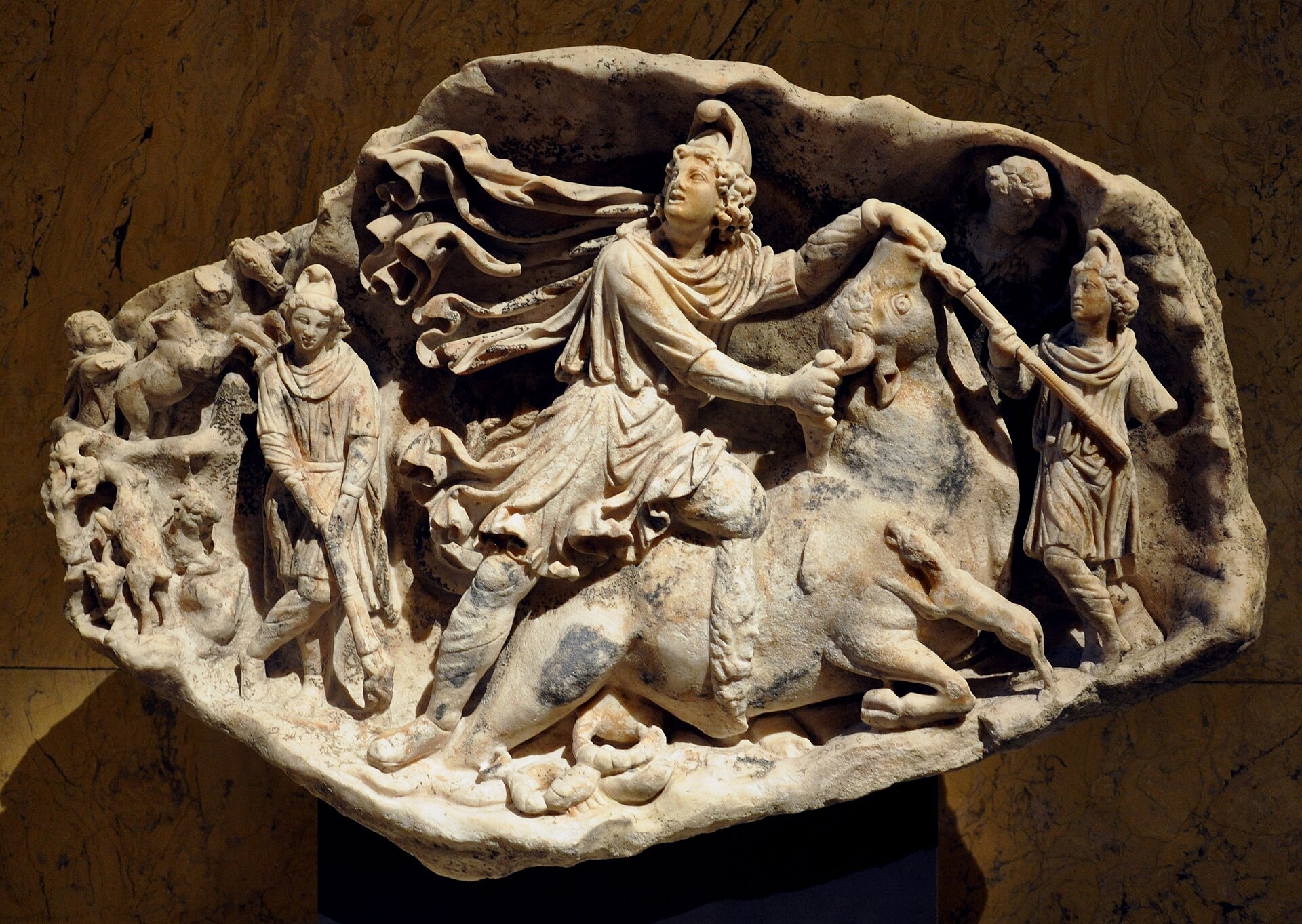
Every mithraeum contained the same picture. The tauroctony: Mithras in a Phrygian cap and Persian dress, kneeling on a bull, driving a dagger into its shoulder or neck. And the supporting cast recurs with the same insistence. A dog and a snake lapping the blood. A scorpion at the bull's genitals. A raven nearby. Two torchbearers, Cautes and Cautopates, flanking the scene, one torch raised and one lowered. Often wheat sprouting from the bull's tail or wound. Our file draws the inference that follows: this consistency, across hundreds of examples from Dura-Europos to Hadrian's Wall, indicates a standardised liturgical programme, which is unusual among Roman cults and tells you something real even though nobody can read it.
02Seven Grades, All Male, Mostly Soldiers
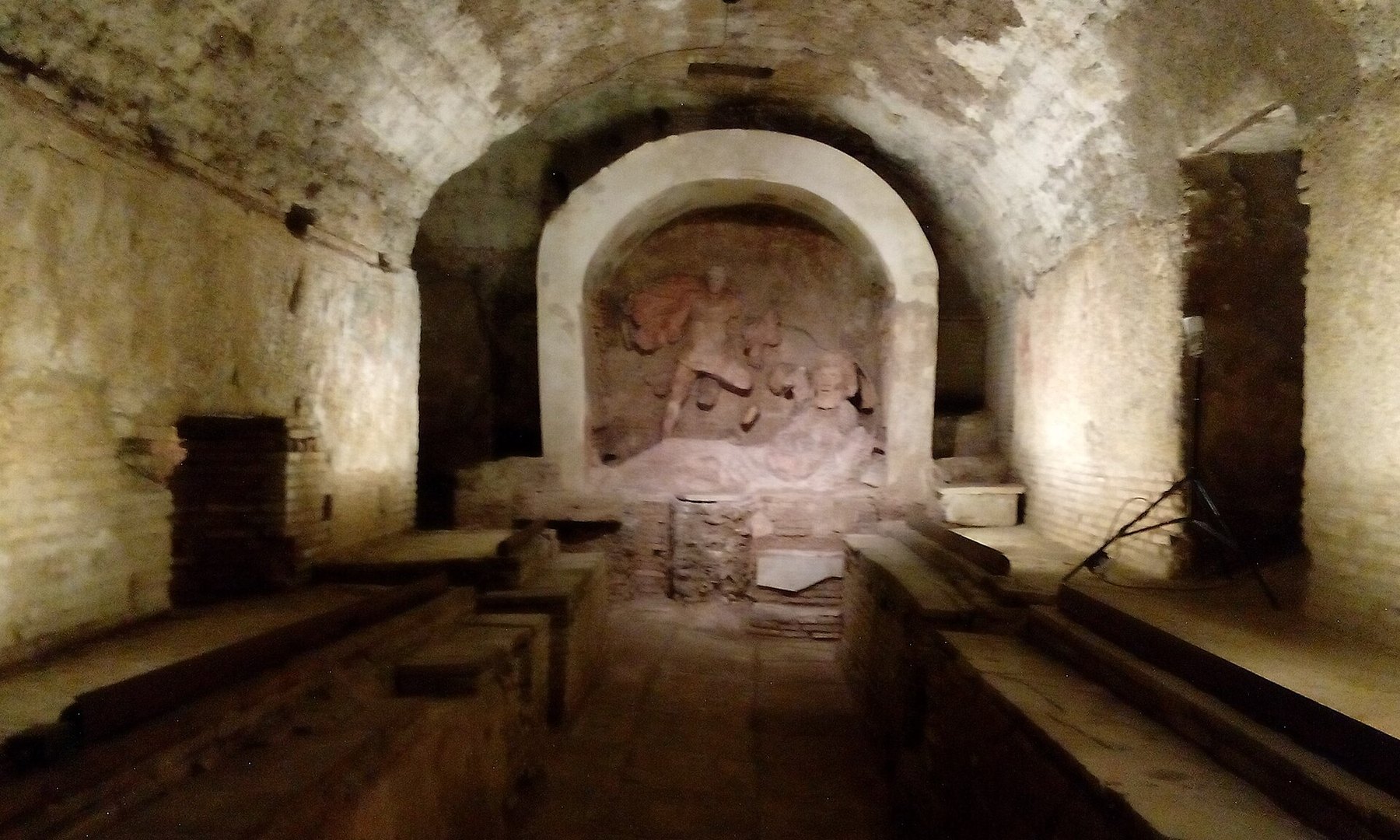
Corax, Nymphus, Miles, Leo, Perses, Heliodromus, Pater. Raven under Mercury; Bridegroom under Venus; Soldier under Mars; Lion under Jupiter; Persian under the Moon; Sun-Runner under the Sun; and Father under Saturn. Seven grades, seven classical planets, confirmed by both inscriptions and images, and preserved most vividly in the painted processions at Santa Prisca. And then our file adds the deflating and probably more accurate detail: not all members advanced through all seven, and most inscriptions record people at Pater or Leo. Which suggests those two were the working ranks that actually ran a congregation, rather than the top of a ladder everybody was climbing.
It was, overwhelmingly, a religion of the army. Soldiers, officers and veterans on the frontiers, with freedmen, merchants and minor officials also appearing in dedications. The cult travelled along military supply routes and was densest wherever legions sat for years at a time: the limes Germanicus, Britain and Dacia. And women do not appear. Our file states the exclusion plainly and then does the useful thing, which is to put it beside an alternative that existed at the same time in the same cities: the cult of Isis, which welcomed women and all social classes. A Roman had choices. Mithraism's profile, male and military and hierarchical, with an emphasis on discipline and loyalty, was one of them, and it was not the only one on offer.
They ate together, and we can tell what. The benches imply reclining and dining, and the archaeology confirms it: animal bones, chicken and pig, ceramic vessels, storage jars, in the rooms themselves. Our file suggests the meal may have re-enacted the banquet between Mithras and Sol that follows the bull-slaying in many reliefs, where the two gods recline together on the skin of the slain bull. That is an interpretation and it is marked as one. What is not interpretation is the bones. Whatever else was happening in these rooms, dinner was.
03Three Answers To One Question
The first answer: it came from Persia. Franz Cumont argued, in work published between 1896 and 1899, that Roman Mithraism was a direct transplantation of the Iranian god Mithra, the Zoroastrian divinity of covenant, light and justice, carried west by Cilician pirates, Anatolian magi and Eastern soldiers. He had Avestan and Middle Persian parallels to work with, and the name itself is undeniably Iranian. Our file records what happened next without softening it: this view dominated scholarship for nearly a century and has been substantially revised since the 1970s.
The second answer: the Romans invented it. Roger Beck, Manfred Clauss and Reinhold Merkelbach argued independently that while the name is Iranian, the cult is a Roman creation of the first century CE with only surface Persian borrowing. The evidence our file lists is hard to argue with. No mithraea have ever been found in Iran or Mesopotamia. The tauroctony has no known Iranian prototype. And the seven-grade system maps onto Greco-Roman planetary cosmology, not Zoroastrian theology. Clauss's summary, quoted in our file, is the sharpest form of it: Mithraism was the product of the Roman religious market, not an import from the East. The Persian dress, on this reading, is costume: an exotic register that made a Roman invention feel ancient.
The third answer: the picture is a star chart. David Ulansey proposed in 1989 that the tauroctony encodes the precession of the equinoxes, specifically the spring equinox moving out of the constellation Taurus, and that Mithras is therefore a hypercosmic deity, one able to move the celestial sphere itself, a notion at home in Platonic and Stoic thought. On his reading the animals become constellations lying on the celestial equator during the Age of Taurus: Canis Minor the dog, Hydra the snake, Scorpius the scorpion, Corvus the raven. Our file records the reception exactly as it should: praised as elegant, and criticised as overly schematic by scholars including Beck, who holds that an astronomical code is genuinely present but is more complex than a single precession story. Three answers, none of them retired, and our file does not pick one.
04How It Ended, And What It Did Not Become
The decline is sharp and it is legislated. Mithraism fell away after the Edict of Thessalonica in 380 CE made Nicene Christianity the state religion, and under the anti-pagan laws of Theodosius I. And the archaeology is not ambiguous about the manner of it: many mithraea show deliberate destruction, with cult images smashed, ritual objects scattered, and the rooms demolished or filled in and built over with Christian structures. The last datable Mithraic inscription is around 400 CE. By 450 the cult had effectively ceased to exist as an organised religion. It did not fade out of fashion. It was ended.
Mithras and Sol Invictus are neither the same god nor cleanly separate ones. In some reliefs the two dine together after the bull-slaying; in some Mithras is subordinate; in some they look identical. They clasp right hands, they ride together in Sol's chariot, and some inscriptions identify them outright. The sixth grade is called Heliodromus, Sun-Runner. Emperor Aurelian made Sol Invictus a state cult in 274 CE and a Mithraic influence has been proposed, though our file says the direct evidence is thin. And here is the detail that keeps the question open: in the tauroctony itself, Sol and Mithras remain consistently distinct figures. Whatever the relationship was, the cult's own central image declined to collapse them into one.
What initiation involved is mostly literary, and mostly written by opponents. Porphyry and the Church Fathers describe tests of endurance: cold, heat, fasting, branding, symbolic death and rebirth. The Miles grade reportedly involved being offered a sword and a crown, and refusing the crown, with the words Mithras is my crown. The Leo grade may have involved purification with honey instead of water, and the wearing of animal masks. These are memorable and they may well be true. Our file's assessment is the one to keep: direct archaeological confirmation of these ordeals is limited. Separately, Porphyry reads the mithraeum allegorically as a model of the cosmos, with the cave as the material world and the solstitial gates of Cancer and Capricorn as the routes by which souls descend and return, which may be late antique philosophy applied from outside rather than what a second-century soldier on the Rhine thought he was doing.
Christianity was not stolen from Mithraism. Our file marks the claim, which has circulated online since the early 2000s, as a dramatic oversimplification. The two cults did share features: sacred meals, birth symbolism, salvation theology. The file's assessment is that those parallels arise from a common Hellenistic religious vocabulary rather than from plagiarism in either direction. And the specific December 25 argument conflates Mithras with Sol Invictus and backdates a link to Christmas that only becomes relevant centuries after the cult began. It is worth noting that our file is equally careful about the reverse claim: where it discusses Mithraic symbolism being absorbed into Christianity, the halo, the birth date, salvation through sacrifice, it says the direction and degree of influence remain contested. Refusing a bad version of a claim is not the same as settling the question, and the file does not pretend otherwise.
05A Note On Our Own Sources, And A Correction To This Morning
This morning we published a measurement across our whole library, and this file was its first test. That finding was that identifier accuracy tracks what a section cites: parts of our library that cite journal articles come out around eighty per cent correct, parts that cite books around a third, and the section this document sits in came last at sixteen. So before resolving anything, we wrote down entry by entry what should happen here. The three books should fail as reviews. The journal articles should resolve correctly. Beck's Oxford monograph returns a review in Studies in Religion, in a part of the journal literally headed Reviews of Books. Clauss's Edinburgh monograph returns Christopher Beall reviewing it in the Journal of Roman Studies. Hinnells's Manchester volumes return R. M. Ogilvie reviewing them in The Classical Review. Both journal articles resolve exactly. Five for five.
Our bibliography credits a paper to two men who never wrote one together. The entry reads Showerman, Grant, and Franz Cumont, as co-authors of a piece in the American Journal of Philology in 1901. What actually happened in 1901 is that Grant Showerman reviewed Franz Cumont's book. In the previous article in this series we noted that citation registries frequently record a review with the reviewer first and the reviewed author second in the author field, so that anything reading that field mechanically produces a two-author list for a single-author piece. That was a description of a process. This is a line in our own library produced by it. And the same fault sits one entry above, wearing a disguise: Shepherd, Robert, and Robert Shepherd. The same name twice, which looks like a typing slip and is not one.
Two sentences from the same document. The closing block: No significant counter-arguments exist in the scholarly literature for the core claims presented here. The topic represents established knowledge with no active scholarly dispute. The opening summary, a few screens above: the question of whether Mithraism is Persian or Roman remains one of the defining controversies in the study of ancient religion. Between those two statements lie three sections setting out three competing origin theories, a note that Ulansey has been criticised by name, and another saying the Christian-influence question remains hotly debated. Separately, the header rates this file's own sourcing at one out of five, computed from a stated source count of zero, against a bibliography of twenty entries. That is the third such case we have found.
The tool we built and published this morning to find exactly this did not flag this document. The reason is mechanical and slightly embarrassing. It looked for disputes filed under a heading containing the words counter-arguments, and this file's disputes are in its summary and in ordinary numbered sections. A detector that only looks under one heading is measuring the heading, not the document. So we broadened it: it now also flags any file that carries the denial while its own prose says a dispute exists, using phrases like remains debated or defining controversies. Then we re-ran it across all 3,632 documents.
This morning's figure was a floor, and we did not say so at the time. The structural count stands where it was: 43 documents that list counter-arguments under a heading and then deny having any. To those the corrected tool adds 599 more that carry the denial while their own text states a dispute. Together that is 642 of the 1,246 denials in our library, which is more than half of them. We reported 43 as the proven number this morning. That was true of what the instrument could then see. What we failed to say was that the instrument could only see one shape of the problem, and the shape it could not see turned out to be fourteen times more common.
Which has to be said in the same breath, or the correction becomes its own overreach. The 43 are provable by structure: here is a section listing disputes, and here beneath it is a denial. The 599 are found by wording, and wording can mislead. A document might note in passing that some peripheral point is debated while its central claims genuinely are uncontested, and no automated tool can tell those apart. So the honest presentation is two numbers carrying different weights: 43 that can be demonstrated to anyone at a glance, and 599 that mark files worth a human's attention. The instrument prints that caveat in its own output now, which is the least it owes after being wrong once already today.
| Our File's Entry | Kind | Predicted First | What It Actually Returns |
|---|---|---|---|
| Beck 2006, The Religion of the Mithras Cult (Oxford UP) | book | A review, in Studies in Religion | Richard S. Ascough, under the heading Reviews of Books, Studies in Religion 40(2):237. A REVIEW |
| Clauss 2000, The Roman Cult of Mithras (Edinburgh UP) | book | A review | Christopher Beall reviewing it, Journal of Roman Studies 93:314. A REVIEW |
| Hinnells 1975, Mithraic Studies (Manchester UP) | book | A review, in The Classical Review | R. M. Ogilvie reviewing it, The Classical Review 27(1):48. A REVIEW, and of the right book |
| Beck 1998, Journal of Roman Studies 88:115-128 | article | CORRECT | Roger Beck, that paper, exactly. CORRECT |
| Gordon 1994, Journal of Roman Archaeology 7:459-474 | article | CORRECT | Richard Gordon, that paper, exactly. CORRECT |
| Showerman and Cumont 1901, American Journal of Philology 22.4:443 | article | not predicted; found after sealing | The identifier is CORRECT. But the record is a REVIEW, and its author field reads reviewer then reviewed author, which our file has copied into a co-author list |
Fast Facts
- Scale
- Over 420 mithraea identified, from Hadrian's Wall to Syria, with more than a thousand inscriptions. Densest on the Rhine and Danube frontier, in Rome and Ostia, and in Britain
- The silence
- No internal liturgical text has survived. Everything is reconstructed from architecture, iconography and hostile Christian commentary
- The room
- A spelaeum, meaning cave: underground or semi-subterranean, long and narrow, with raised benches down both walls for reclining. Capacity typically 20 to 40
- Dates
- Construction clusters from the late 1st to the mid-3rd century CE
- The image
- The tauroctony, in every mithraeum. Mithras in Phrygian cap kneeling on a bull with a dagger; a dog and snake at the blood; a scorpion at the genitals; a raven; and the torchbearers Cautes and Cautopates, one torch up and one down
- Seven grades
- Corax (Mercury), Nymphus (Venus), Miles (Mars), Leo (Jupiter), Perses (Moon), Heliodromus (Sun), Pater (Saturn). Most inscriptions record Pater or Leo
- Membership
- Overwhelmingly military, plus freedmen, merchants and minor officials. Women were excluded, unlike the contemporary cult of Isis
- Three theories of origin
- Cumont's Persian transplantation, dominant for a century and revised since the 1970s; the Roman invention thesis of Beck, Clauss and Merkelbach; and Ulansey's precession-of-the-equinoxes reading, praised and criticised as overly schematic
- The argument against Persia
- No mithraea in Iran or Mesopotamia; no Iranian prototype for the tauroctony; the seven grades map onto Greco-Roman planetary cosmology, not Zoroastrianism
- The end
- Sharp decline after the Edict of Thessalonica in 380 CE. Many mithraea show deliberate destruction. Last datable inscription around 400 CE; effectively gone by 450
- Refused
- That Christianity was stolen from Mithraism. Shared features reflect a common Hellenistic vocabulary, and the December 25 argument conflates Mithras with Sol Invictus
- Identifier audit
- 6 checked live 26 August 2026 against a per-entry prediction recorded first. 3 books, 3 reviews. 3 articles, 3 correct. Five of five predicted, plus one co-author listing traced to a registry artefact
- Correction issued
- The boilerplate-denial count published earlier the same day rose from 43 to 43 structural plus 599 prose conflicts, after this document exposed a blind spot in the detector
What We Can Actually Stand Behind
Over 420 mithraea have been excavated across the Roman Empire, and they share a single plan: an underground cave-like chamber with facing benches, holding twenty to forty people, with a tauroctony at one end. That image is standardised to a remarkable degree across the whole empire, and its elements recur: the Phrygian cap, the dagger, the dog, the snake, the scorpion, the raven, and the two torchbearers with one torch raised and one lowered. There were seven grades, each with a planetary patron, preserved in inscriptions and in the painted processions at Santa Prisca. Membership was overwhelmingly military and excluded women. The cult declined sharply after 380 CE, many of its temples were deliberately destroyed, and the last datable inscription is around 400. And no liturgical text from inside the cult has survived at all.
Three explanations of where the cult came from remain live, and our file presents all three without choosing. Cumont's Persian transplantation held the field for a century and has been substantially revised. The Roman invention thesis has strong negative evidence behind it: no mithraea in Iran, no Iranian prototype for the tauroctony, and a grade system that maps onto Greco-Roman planetary cosmology. Ulansey's astronomical reading is elegant and has been criticised as too schematic even by scholars who accept that an astronomical code is present. Communal dining is well evidenced by bone and vessels; the interpretation of it as re-enacting the banquet of Mithras and Sol is an inference.
The relationship between Mithras and Sol Invictus, and any Mithraic influence on Aurelian's state cult of 274 CE, where the direct evidence is thin and the tauroctony keeps the two figures distinct. The initiation ordeals, which come from Porphyry and the Church Fathers and have limited archaeological confirmation. And the Neoplatonic reading of the mithraeum as a model of the cosmos, which may be late antique philosophy applied from outside rather than the theology of practising members.
Christianity was not stolen from Mithraism. The shared features reflect a common Hellenistic religious vocabulary rather than plagiarism, and the December 25 argument, on our file's assessment, conflates Mithras with Sol Invictus and backdates a connection by centuries. Our file is equally careful in the other direction: where Mithraic symbolism may have been absorbed into Christianity, it says the direction and degree of influence remain contested rather than claiming a result.
Six identifiers checked live on 26 August 2026 against a per-entry prediction recorded beforehand, derived from a corpus-wide measurement published the same morning: all three books point at reviews rather than the books, and all three journal articles resolve exactly. Five of five. One further entry credits a reviewer and the author he reviewed as co-authors, which is a registry artefact we described in the previous article and have now caught producing a line in our own library. The file's header rates its sourcing from a source count of zero against twenty entries, and its closing block denies having scholarly disputes while its own summary calls one a defining controversy. Our own instrument missed that, and correcting it raised the count from 43 to 43 structural plus 599 found by wording. Treat the 43 as demonstrated and the 599 as a list to check.
Sources & further reading
The archaeology and history above are drawn from our research library on Theories of Anything. Every identifier below was checked live against Crossref on 26 August 2026, against a per-entry prediction recorded in advance. Where our file's identifier points at a review rather than the book, the review is listed for what it is; three university-press monographs from 1975, 2000 and 2006 have no registered identifier at all, so no corrected link can be offered for them. Open the full research file to check the sourcing and go deeper.
Image credits
- Mithras relief (tauroctony) from Aquileia, second half of the 2nd century AD, Kunsthistorisches Museum, Vienna Photograph by Andreas Praefcke, via Wikimedia Commons (public domain). Public domain Source.
- The mithraeum beneath the basilica of San Clemente, Rome Ice Boy Tell, via Wikimedia Commons (CC BY-SA 3.0). CC BY-SA 3.0 Source.
- Interior of the mithraeum of Santa Prisca, Rome Desyman, via Wikimedia Commons (CC BY-SA 4.0). CC BY-SA 4.0 Source.


