
Chachapoya: What the Genomes Said About the Deportations
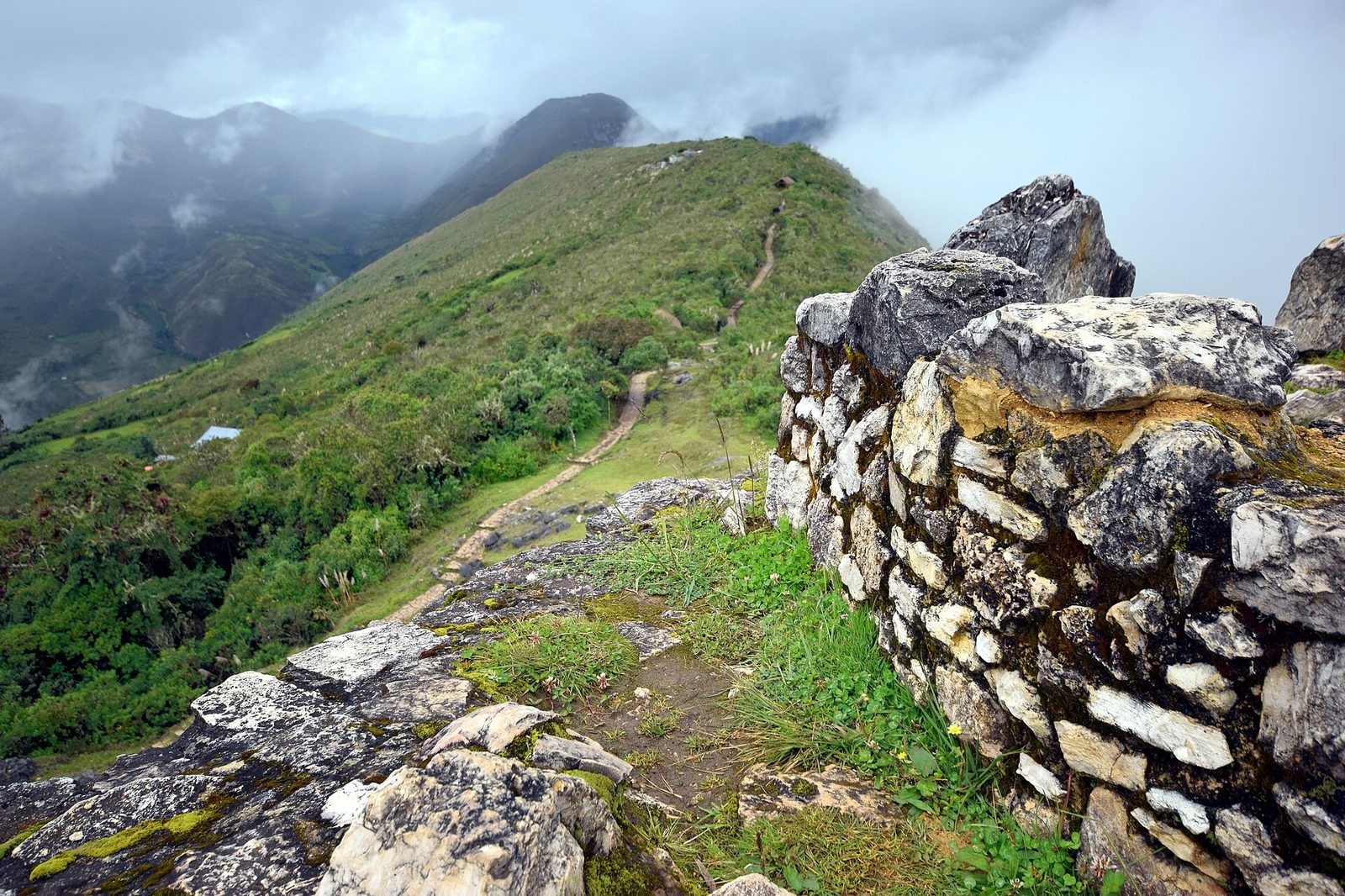
The Inca conquered the cloud-forest people around 1470 and, the histories say, deported them across the empire. In 2017 a genetic survey of the same valleys found a population that had barely moved. The chronicles are not wrong, but the number of people they imply is now in question.
There is a standard shape to this story and it goes like this. A people build a fortress in the clouds, hold out longer than anyone else against the Inca, lose, and are then scattered deliberately across the empire so that they cannot reassemble. It is in the chronicles. It is in our own research file, filed under verified.
In 2017 a team sampled a hundred and nineteen people in the same valleys and read their mitochondrial genomes and Y chromosomes. What they found was a population that looks like nowhere else, that has not mixed much with the Andean heartland, and that does not look like the remnant of a mass deportation. Their own sentence about it is the reason this page exists.
01What Is On The Mountain
Kuelap stands at 3,000 metres near the Utcubamba River in the Amazonas region of northern Peru. Our research file gives it as a walled settlement enclosing approximately 6 hectares, with limestone walls reaching 19 metres in height and running 600 metres in length, holding over 400 circular stone structures. It was first documented by Juan Crisóstomo Nieto in 1843 and systematically excavated by Alfredo Narváez between 1987 and 2000. Radiocarbon puts earliest construction at about 500 to 800 CE, with major occupation from about 900 to 1470. Our file also states the site contains more stone by volume than the Great Pyramid of Giza. THAT COMPARISON CARRIES NO CITATION IN OUR FILE and is repeated here as its claim, not as a checked fact.
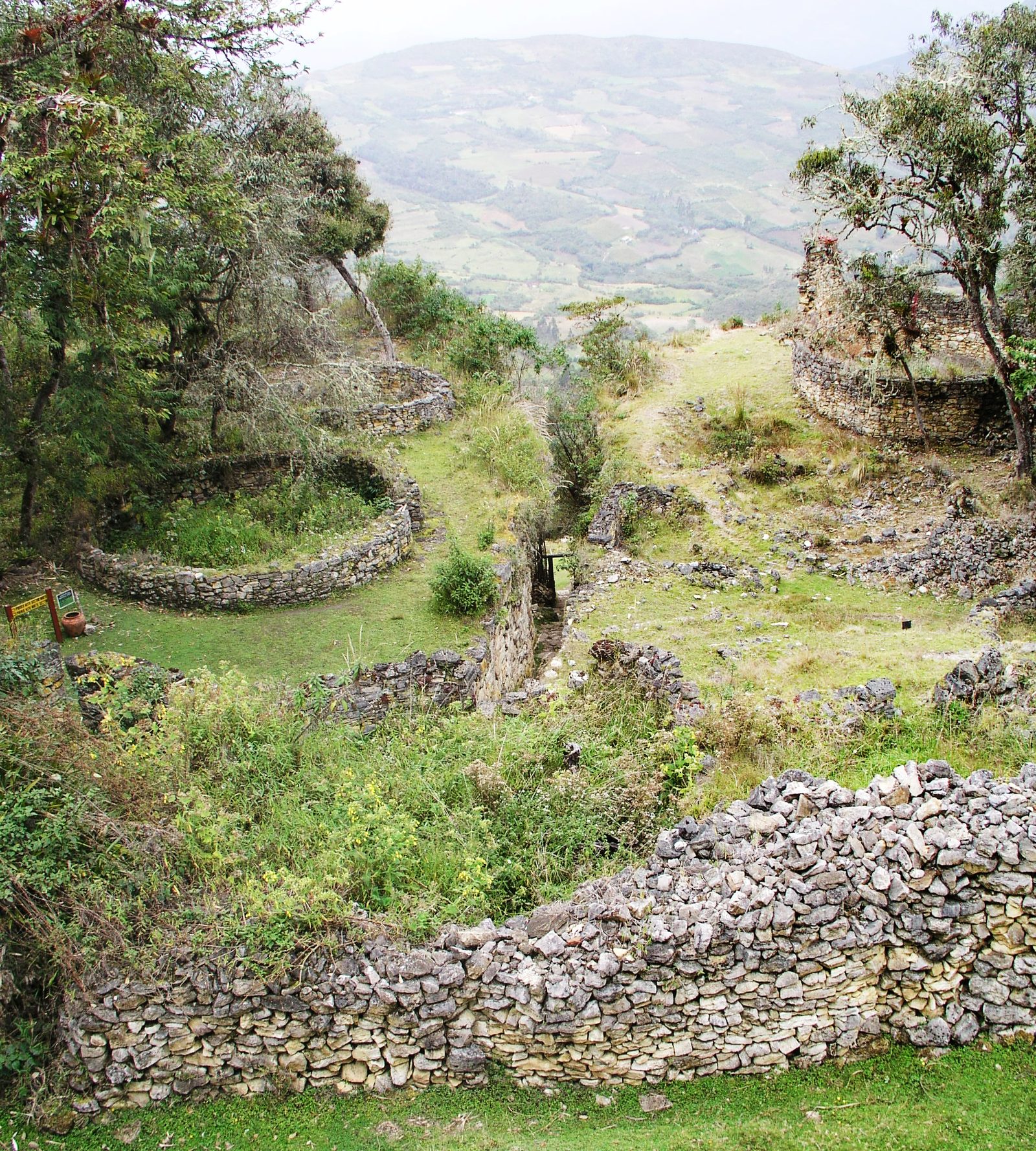
Chachapoya domestic architecture is overwhelmingly circular, against the rectangular traditions of both the Inca and the coastal Andean cultures, with exterior stone friezes in zigzag, rhombus and serpent motifs at Kuelap, Gran Pajatén and La Congona. Keith Muscutt read this as cultural autonomy with possible eastern lowland influence. Against him, our file records Inge Schjellerup cautioning that Chachapoya may not name a single people at all, but a loose confederation that the Inca grouped under one administrative label: the word appears in Inca sources as a provincial designation rather than as anything these people called themselves. Warren Church accepted the point and argued that shared architecture and shared burial practice still constitute a real cultural tradition even without political unity.
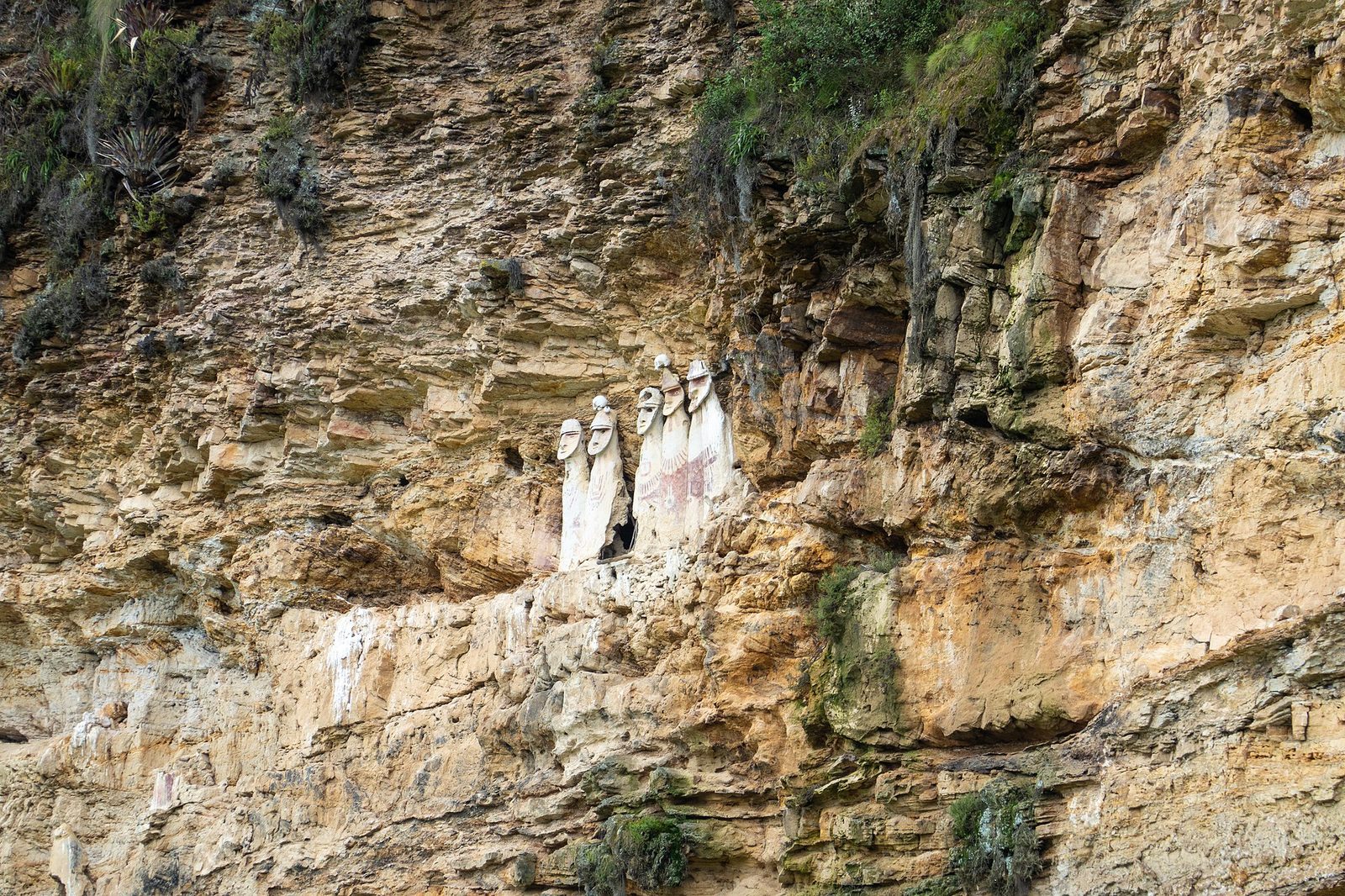
The Chachapoya made anthropomorphic clay sarcophagi, purunmachu, and set them on cliff ledges, alongside communal cliff-face mausolea. Our file dates some of the Karajía group to 1200 to 1400 CE. It also gives Laguna de los Cóndores, found in 1996, as yielding over 200 mummy bundles and more than 2,000 artefacts from a cliffside complex, now held at the Museo Leymebamba. The scholarship on what all this meant is more careful than the photographs suggest: Nystrom, Buikstra and Muscutt open their 2010 paper by saying the region's mortuary customs are of a nature that is incompletely defined and interpreted, and read mummified and skeletal remains at one site as stages in a single ritual landscape structured by continued kin-based access.
02The Conquest, And Then The Genomes
Our file records the Inca ruler Túpac Inca Yupanqui campaigning against the Chachapoya around 1470 CE, documented by Pedro Cieza de León in 1553 and Inca Garcilaso de la Vega in 1609, with Cieza describing protracted fighting and Chachapoya warriors throwing themselves from cliffs rather than surrender. And then the part that matters here: our file states, as a verified claim, that following the conquest the Inca implemented forced resettlement, the mitmaq system, relocating Chachapoya populations as far as Cusco territory.
In 2017 Chiara Barbieri, José Sandoval, Jairo Valqui, Aviva Shimelman, Stefan Ziemendorff and colleagues published a study in Scientific Reports built on 119 samples from the Chachapoyas region, analysed for full mitochondrial genomes and Y-chromosome short tandem repeats, with the sampling strategy guided by linguistic data. Their own framing names the region as a test case, reported as a focal point of Inca population displacements. What they report is a high indigenous component that stands apart from the network of intense genetic exchange in the core central zone of Andean civilization, and that is also distinct from neighbouring populations.
The same study found something sharper still. Speakers of Chachapoyas Quechua share no particular genetic similarity or gene flow with Quechua speakers elsewhere, which the authors read as the language having spread there primarily by cultural diffusion rather than migration. A language arriving without the population that speaks it elsewhere is exactly the pattern you would NOT expect if the Inca had emptied and refilled a province. It is what you would expect if an administrative language was adopted by people who stayed where they were.
| Source | What It Says | What It Can And Cannot Establish |
|---|---|---|
| Cieza de León 1553, Garcilaso 1609, via our file | The Inca campaigned against the Chachapoya around 1470, met protracted resistance, and afterwards used the mitmaq resettlement system on them | CAN establish that the campaign happened, that resettlement was policy, and how it was described. CANNOT establish how many people were actually moved. Chroniclers writing decades later, about imperial policy, are not a census |
| Barbieri and colleagues 2017, 119 samples, mtDNA and Y-STR | A high indigenous component, distinct from the Andean core and from neighbours, which challenges the routine assumption of large-scale relocation here | CAN establish what the region's present gene pool looks like and how much exchange it shows. CANNOT establish that no deportation occurred. A policy applied to thousands can leave a population of hundreds of thousands genetically intact |
| Barbieri and colleagues, on language | Chachapoyas Quechua speakers share no particular genetic similarity or gene flow with Quechua speakers elsewhere | Strong evidence that the language arrived by cultural diffusion rather than by moving its speakers in. This is the single hardest thing in the study to explain under a mass-population-replacement model |
| Guevara and colleagues 2020, mtDNA, Y and autosomal | No significant evidence for past or current population substructure, despite documented cultural differences across the region, with an Amazonian gene flow dynamic suggested in the north | Speaks directly to Schjellerup's question about whether Chachapoya was one people or an administrative label, and finds the genetics does not divide. Note it constrains rather than settles: cultural boundaries need not be genetic ones |
| Guevara and colleagues 2020, on the collapse | A bottleneck about 25 generations ago, more severe among males than females | The demographic catastrophe our file describes from documents, showing up independently as a shape in living genomes, with a sex asymmetry the documents alone would not give you |
03How Many Died, And Why The Number Wobbles
Our file cites Noble David Cook estimating the Chachapoya population falling from roughly 300,000 to 400,000 at contact to fewer than 10,000 by the early seventeenth century, and calls that a collapse of over 97 per cent, driven by epidemic disease, forced labour and displacement. Check it against our file's own range: 10,000 out of 400,000 is a fall of 97.5 per cent, but 10,000 out of 300,000 is 96.7 per cent, which is not over 97. The catastrophe is not in doubt. The rounded headline figure only follows from the top of the estimate, and a page that quotes it without the range is quoting the most dramatic version available.
Warren Church and Adriana von Hagen documented Chachapoya terracing between 2,000 and 3,500 metres, a band rarely used by other Andean civilizations, which favoured open highland puna or coastal irrigation. Our file describes an agriculture combining highland root crops, potato, oca and ulluco, with tropical products from lower eastern slopes including coca, cotton and fruit, exploiting the vertical range of the eastern escarpment, with raised fields and drainage at Gran Pajatén suited to more than 2,000 millimetres of rain a year. Its own counter-argument is the honest one and applies to most of this subject: the extent and intensity of that agriculture is debated because almost all the research has gone to monumental architecture rather than to how anybody ate.
04The Light-Haired Mummies
Spanish chroniclers including Cieza de León described the Chachapoya as notably white and good-looking compared with their neighbours, and some Laguna de los Cóndores mummies have light brown hair. This is where the trans-oceanic theories come from, and our file dismantles them itself: hair colour in preserved bodies is altered by chemical degradation, ultraviolet exposure and burial conditions, and lightening in mummies is a well documented taphonomic artefact. It attributes the chronicler descriptions to altitude-related pigmentation and to European writers projecting their own standards of beauty. What our file then says, in April 2026, is that no systematic ancient-DNA study of Chachapoya populations has confirmed unusual genetic ancestry.
That sentence is still literally true and is also a decade behind the work, and the distinction is worth being precise about. Ancient DNA from the mummies themselves: this article found none, so our file's statement stands. Population genetics of the living Chachapoyas: there is a great deal of it. Barbieri and colleagues in 2017, Guevara and colleagues in PLoS ONE in 2020, and Guevara and colleagues again in Forensic Science International: Genetics in 2021, where Chachapoyas is the largest sampled population at 172 individuals. The 2020 study explicitly asked whether different patterns of European gene flow could be detected in the region, which is a question about admixture after the conquest, not about anybody crossing an ocean beforehand. What all of it finds is a high indigenous component distinct from its neighbours. Nothing exotic has turned up, which is not the same as nobody having looked.
05What It Is Not
Claims linking the Chachapoya to European, Viking or Middle Eastern migrations are refused and marked debunked in our own file. No archaeological evidence in ceramics, tools, architecture, metallurgy or skeletal morphology supports any Old World connection, and the material culture is consistent throughout with Andean development. It is worth adding what the genetics now contributes to that refusal, which is not proof of a negative but is the next best thing: three separate studies have characterised these populations in detail and reported a high indigenous component distinct from their neighbours. The people who built cliff tombs in the cloud forest were from there.
06A Correction That Corrected Nothing
Our research file ends with a Corrections block, added by the campaign that has been repairing this library's bibliographies. It reads: the ISBN for Cook's Born to Die was corrected from 9780521627306 to 9780521627306, verified against Open Library, because the previous number failed its check digit. The two numbers are the same string. And the reason given is false: run the EAN-13 check on 9780521627306 and the computed digit is 6, which is what it prints, so it was valid all along, and Open Library resolves it to Born to Die, Cambridge University Press, 1998, which is the correct book. A correction log recorded a change that was never made, and justified it with a test the number passes. Everything else on this page is a defect in a research document. This one is a defect in the thing that checks research documents, and it took three lines of arithmetic to find.
Fast Facts
- Who
- The Chachapoya, people of the cloud forests of northeastern Peru's Amazonas region, roughly 800 to 1470 CE on our file's dating
- The Name
- A provincial designation in Inca sources, not necessarily anything these people called themselves. Schjellerup's caution, recorded in our own file
- Kuelap
- At 3,000 m. Limestone walls up to 19 m high and 600 m long, over 400 circular structures, construction from about 500 to 800 CE. Our file's figures
- Karajía
- Six clay sarcophagi 2.5 m tall on a ledge 200 m above the valley floor, some dated 1200 to 1400 CE
- Laguna de los Cóndores
- Found 1996. Over 200 mummy bundles and 2,000-plus artefacts, now at the Museo Leymebamba
- Conquered
- By Túpac Inca Yupanqui, around 1470, after protracted resistance
- The Collapse
- CONTESTED, Tier 2, and every figure here is our file's estimate rather than a count. It gives an estimated 300,000 to 400,000 at contact and an estimated fewer than 10,000 by the early 1600s, per Cook. On those estimates the fall is roughly 96.7 per cent at one end of the range and roughly 97.5 per cent at the other
- The Genetics
- 119 samples, mtDNA and Y-STR, 2017: a profile that challenges the routine assumption of large-scale Inca relocation here. 2020: no significant population substructure, and a bottleneck about 25 generations back, worse for males
- Still Missing
- Ancient DNA from the mummies. Our file asks for it and this article did not find it
What We Can Actually Stand Behind
Kuelap exists at 3,000 m with monumental limestone walls and hundreds of circular structures, documented from 1843 and excavated from 1987. The Karajía sarcophagi stand on their ledge and there are six of them. Laguna de los Cóndores produced hundreds of mummy bundles. The Inca campaign of about 1470 is in the chronicles. Barbieri and colleagues published their Chachapoyas genetic survey in Scientific Reports in 2017, and Guevara and colleagues theirs in PLoS ONE in 2020 and in Forensic Science International: Genetics in 2021. Nystrom, Buikstra and Muscutt published on the mortuary behaviour in Chungará in 2010.
How much of the population the Inca actually moved. The chronicles say resettlement was policy; the 2017 genetics challenges the routine assumption that it was large-scale here. Both can be true and the reconciliation is not settled. Whether Chachapoya names one people or an administrative convenience: Schjellerup's question, with the 2020 genetics finding no significant substructure, which constrains the answer without closing it. The population collapse, where our file's own range gives two different answers to its own headline percentage. And the agriculture, which almost nobody has surveyed.
The light-haired mummies and the white-and-good-looking chroniclers. Hair lightening in preserved bodies is a known taphonomic artefact, and sixteenth-century Spaniards comparing populations for beauty are describing themselves as much as anyone else.
No Viking, Phoenician or other Old World origin. Nothing in the ceramics, tools, architecture, metallurgy or skeletal morphology, and three separate genetic studies of these populations report a high indigenous component distinct from their neighbours. And this page does not claim the deportations never happened, because the study everyone will quote for that does not claim it either.
The thing I did not expect from this one was how well the two kinds of evidence behave when you leave them alone. A chronicler can tell you that an empire had a policy of moving conquered peoples and that it applied that policy here. A genome can tell you what a valley's gene pool looks like five centuries later. Neither can do the other's job, and the temptation in both directions is enormous: to read the chronicle as a headcount, or to read the genomes as calling the chronicler a liar. What is actually in front of us is a region that stayed itself, in a way the standard story did not predict, and a language that arrived there without its speakers.
Sources & further reading
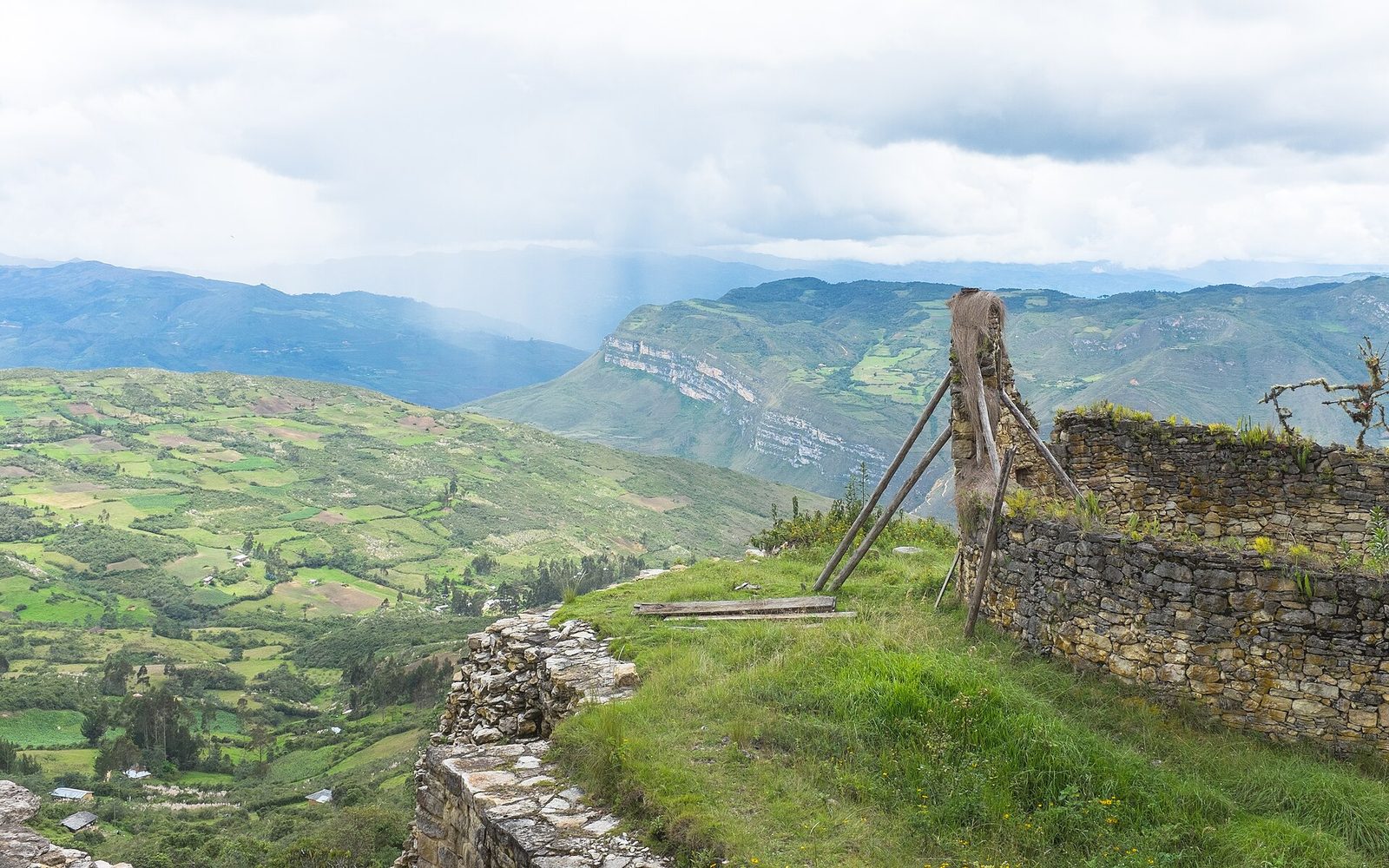
WHERE THIS WORKED FROM, AND WHERE IT CAN BE CHECKED. This article worked from one file in our own research library, W_5_26, at Source Confidence 2 out of 5. All five of its DOIs were resolved live against Crossref for this article. ONE IS CORRECT: Church and von Hagen's chapter in the Handbook of South American Archaeology. Of the rest, the identifier attached to Keith Muscutt's Warriors of the Clouds, the book our file takes its own subtitle from, resolves to DeBoer's one-page 1999 review of it in Latin American Antiquity; the identifier attached to Kauffmann-Doig resolves to a genuine but entirely different paper by Adriana von Hagen, cited here under its own name; the identifier attached to Nystrom and colleagues is TWO DIGITS OFF at the end of its suffix and points instead at an isotope study of the immigrants of Machu Picchu, which is itself relevant enough that this page cites it too; and the identifier for Guengerich 2014 returns a flat 404, the first genuinely dead link in nine articles. Every other identifier failure in this run resolved with an HTTP 200 to the wrong work. THE MOST IMPORTANT FINDING IS NOT IN THE BIBLIOGRAPHY. Our file's Corrections block, written by the campaign that repairs this library, records an ISBN corrected from 9780521627306 to 9780521627306, on the stated ground that the previous number failed its check digit. The values are identical and the reason is false: the EAN-13 check digit computes to 6 and the number prints 6, and Open Library resolves it to the correct book. That is a defect in the checking layer rather than in the corpus, and section 06 sets it out. WHERE THIS PAGE DEPARTS FROM OUR FILE. W_5_26 states as a Tier 1 verified claim that the Inca relocated Chachapoya populations as far as Cusco territory. Barbieri and colleagues, sampling 119 individuals in the region for full mitochondrial genomes and Y-chromosome markers, reported in 2017 that the resulting profile challenges the routine assumption of large-scale population relocations by the Incas, and that Chachapoyas Quechua speakers share no gene flow with Quechua speakers elsewhere. This page carries the chronicles and the genetics side by side and reconciles neither, because the literature has not. Our file's Tier 3 statement that no systematic ancient-DNA study has confirmed unusual ancestry is also split in two here: aDNA from the mummies was not found this session and that statement stands, while population genetics of the living Chachapoyas now runs to at least three studies. WHAT IS CARRIED AS OUR FILE'S OWN, UNVERIFIED HERE. Every Kuelap measurement, the Great Pyramid comparison, which carries no citation anywhere in our file, the Karajía dimensions and the 200 metre ledge, the Laguna de los Cóndores counts, the conquest chronology, the Cook population estimates, and the agricultural range. ON THE IMAGES. The Commons file used for the circular houses is titled as a doorway and is not one; it was renamed locally after being opened. The thatched round structure in the fourth image is a modern reconstruction held up by timber props, and its caption says so.
Image credits
- The wall at Kuelap, Amazonas, Peru BrunoLocatelli, via Wikimedia Commons. CC BY-SA 4.0 Source.
- The sarcophagi at Karajia, Utcubamba valley, Peru PsamatheM, via Wikimedia Commons. CC BY-SA 4.0 Source.
- Circular house foundations inside the walls at Kuelap JYB Devot, via Wikimedia Commons. CC BY-SA 4.0 Source.
- View from Kuelap over the Utcubamba valley Christopher Crouzet, via Wikimedia Commons. CC BY-SA 3.0 Source.


