
Cave Art: The First Images We Ever Made
More than fifty thousand years ago, in a cave on a Sulawesi hillside, someone painted a wild pig and a cluster of figures gathered around it, and left the oldest story humans have yet been found to tell. The same impulse marks cave walls from Spain to Borneo to the Kimberley: red hands blown in outline, herds of bison, prides of lions drawn with a confidence that stunned the scholars who assumed early art must be crude. This is what the world's oldest images actually are, how we know their ages and where that knowledge runs thin, and the two honest mysteries at the heart of them: who made some of the earliest, and why any of it was made at all.
Deep inside a cave, by the light of a burning brand, someone pressed a hand to cold rock and blew red powder around it, leaving a silhouette that has waited tens of thousands of years for us to find it. Elsewhere on the same walls: mammoths and lions and bison, drawn with a sureness that would not shame a modern studio. For a long time the story of these images was a European one, and a tidy one: art began crude somewhere in France or Spain and slowly improved. Almost none of that survives contact with the evidence. The oldest known figurative painting is not in Europe at all but in Indonesia, the oldest known cave lions were drawn with breathtaking skill at the very dawn of the tradition, and the two biggest questions about the whole phenomenon, who made some of the earliest of it and why anyone made it, remain genuinely and honestly open. This is what the first images really are, how we date them and where that dating runs thin, and how to hold their wonder without either debunking it or dressing it up as something solved.
01Older Than Anyone Thought
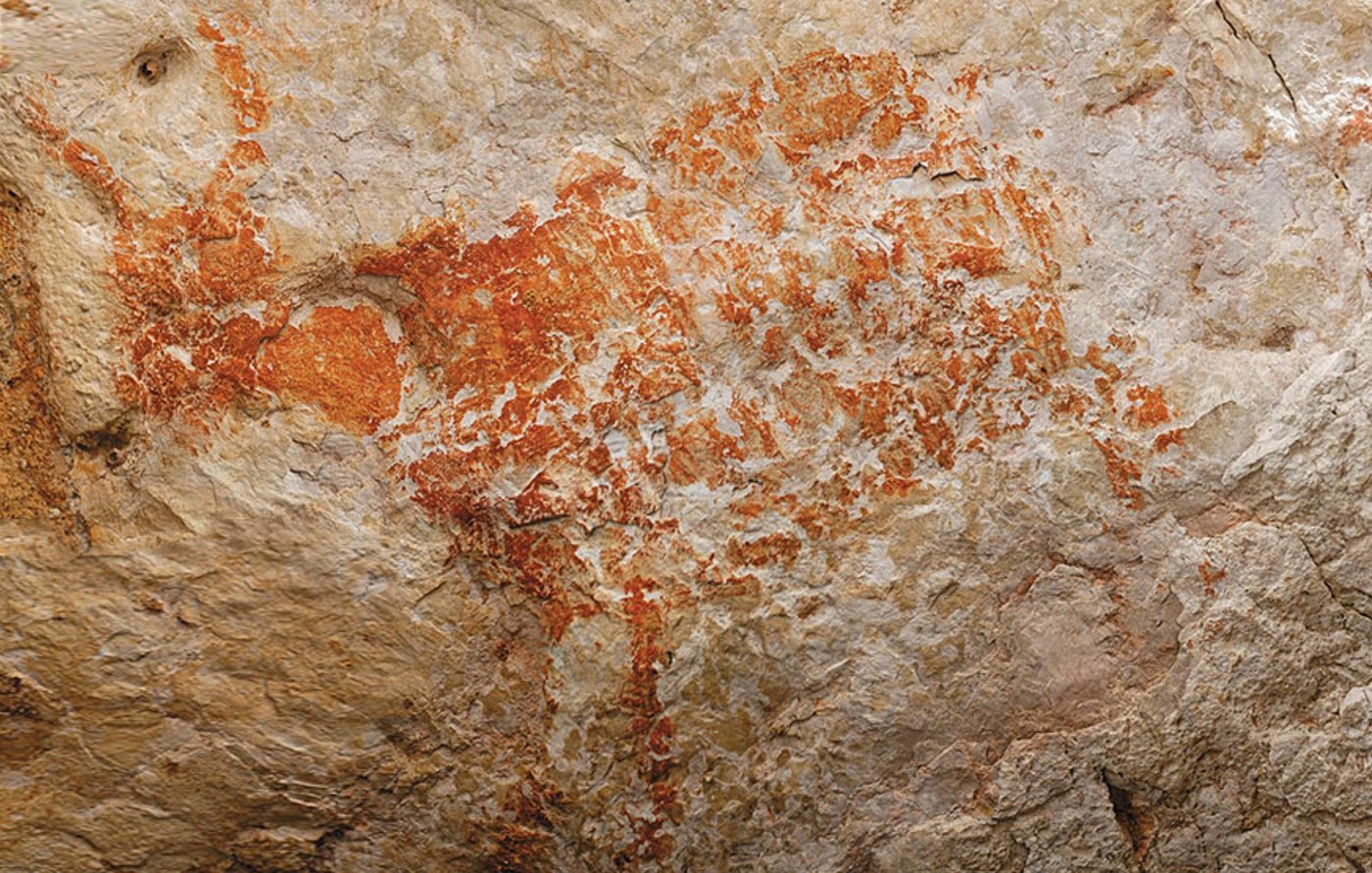
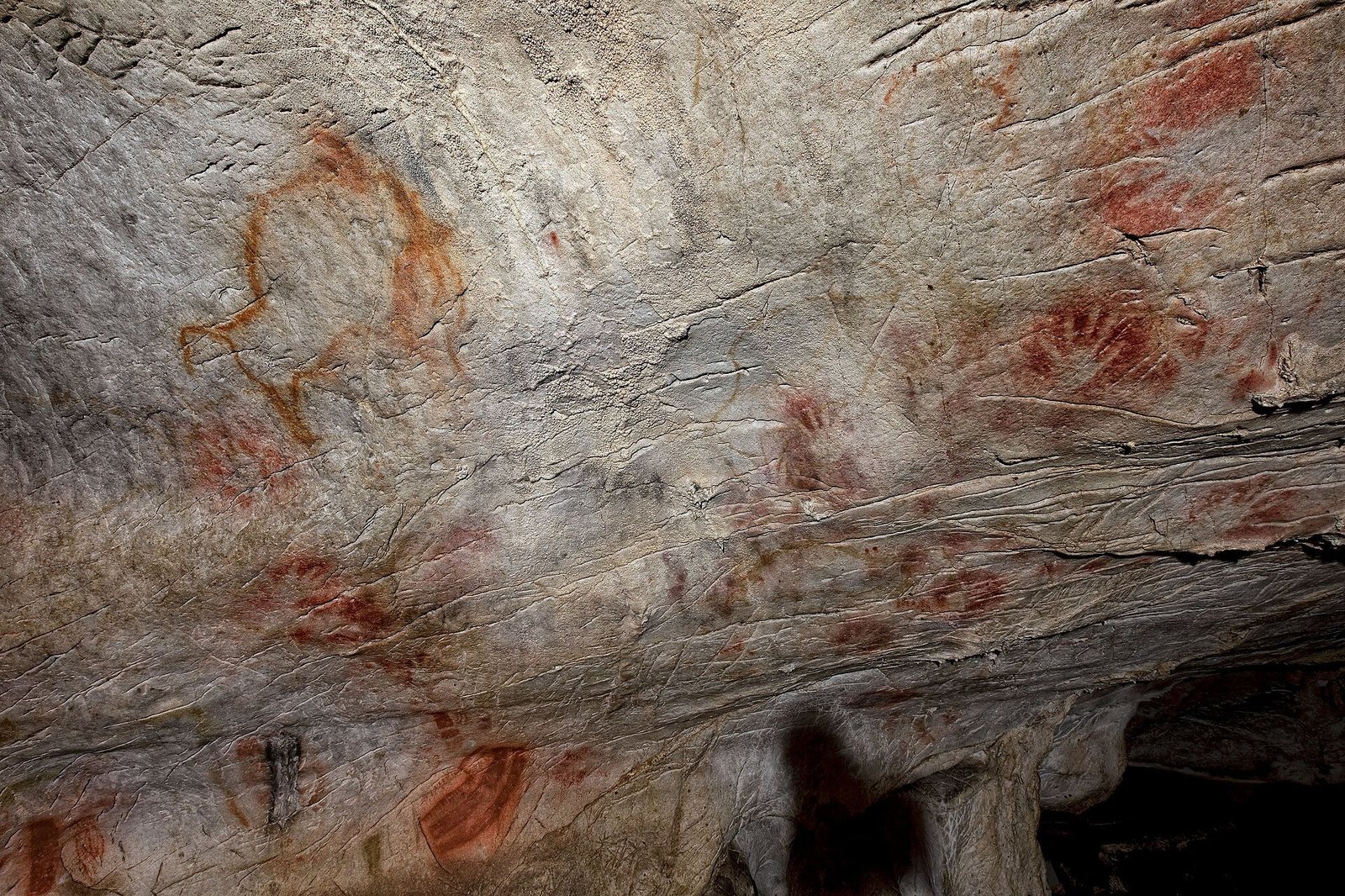
The record now begins in Southeast Asia. In 2021, a painting of a wild warty pig on a cave wall at Leang Tedongnge, Sulawesi, was dated to at least 45,500 years old, the oldest figurative image then known. Three years later a neighbor beat it: in 2024, a scene at nearby Leang Karampuang, three small human-like figures gathered around a wild pig, was dated to at least 51,200 years, making it not only the oldest known figurative painting but the oldest known story told in pictures anywhere on Earth. Art nearly as old turns up far from Europe and far from itself: a wild-cattle figure in a Borneo cave at roughly 40,000 years, red hand stencils and a painted disc at El Castillo in Spain at minimums of 37,300 and 40,800. A word about those dates is essential, because it is where confidence meets caution. Most cave pigment, being mineral, cannot be carbon-dated at all. The headline ages instead come from uranium-series dating of the thin calcite crust that slowly forms over a painting, and that gives a minimum age: the art is at least as old as the crust on top of it, and may well be older. These numbers are floors, not exact readings, and the honest ones always travel with their method attached. What they establish beyond doubt is that skilled, deliberate image-making is neither a European invention nor a late flourish. It is a capacity our species carried out of Africa and switched on, independently, wherever it went.
The background runs deeper still. At Blombos Cave in South Africa, a piece of ochre cross-hatched with a deliberate geometric design has been dated to around 73,000 years, long before any painted animal, though whether a patterned scratch is 'art' in the full symbolic sense is itself a question the evidence does not settle. What the whole global picture overturns is the old assumption that art began in Europe and peaked there. It did not. The capacity to make deliberate, skilled, symbolic images shows up across the range of early Homo sapiens, part of the standard equipment of the modern mind rather than a local genius, present at the dawn of our behavioral modernity and carried everywhere the species walked.
02The Oldest Is Not the Crudest
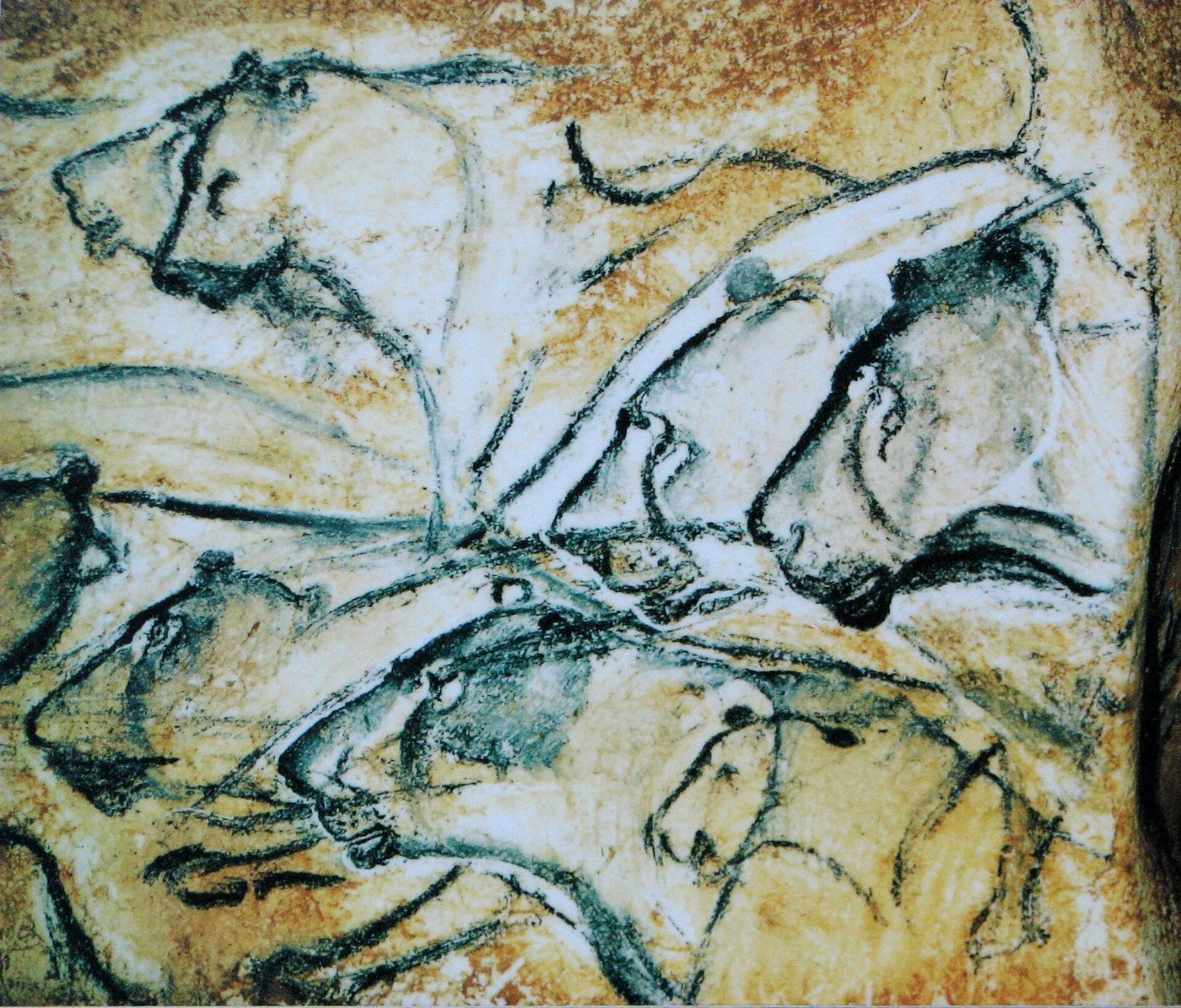
Nowhere is the old assumption more thoroughly demolished than at Chauvet, in the Ardeche gorges of southern France. Discovered in 1994 behind a rockfall that had sealed its entrance for some 21,500 years, Chauvet preserves around 420 painted animals and some 190 engraved, radiocarbon-dated across more than eighty charcoal samples to about 36,000 years ago, roughly twice the age of Lascaux. And here is the shock: the paintings are magnificent. The artists scraped the rock pale to make their figures stand out, smudged charcoal with their fingers to shade a lion's muzzle into three dimensions, used overlap and shifting scale to suggest depth, and drew multiple heads and legs on single bodies in a way that flickers into motion under a moving flame. Their subjects are not the placid horses and reindeer of later caves but dangerous megafauna, cave lions above all, woolly rhinos, mammoths, bears. This single cave dismantled a comfortable idea that had organized the field for a century: that art must have begun crude and slowly climbed toward a climax at Lascaux and Altamira. The oldest known European paintings are among the most accomplished ever found underground. There was no clumsy childhood. Whatever the deep origins of image-making were, by Chauvet's day they were already the work of masters.
03The Painted Herds
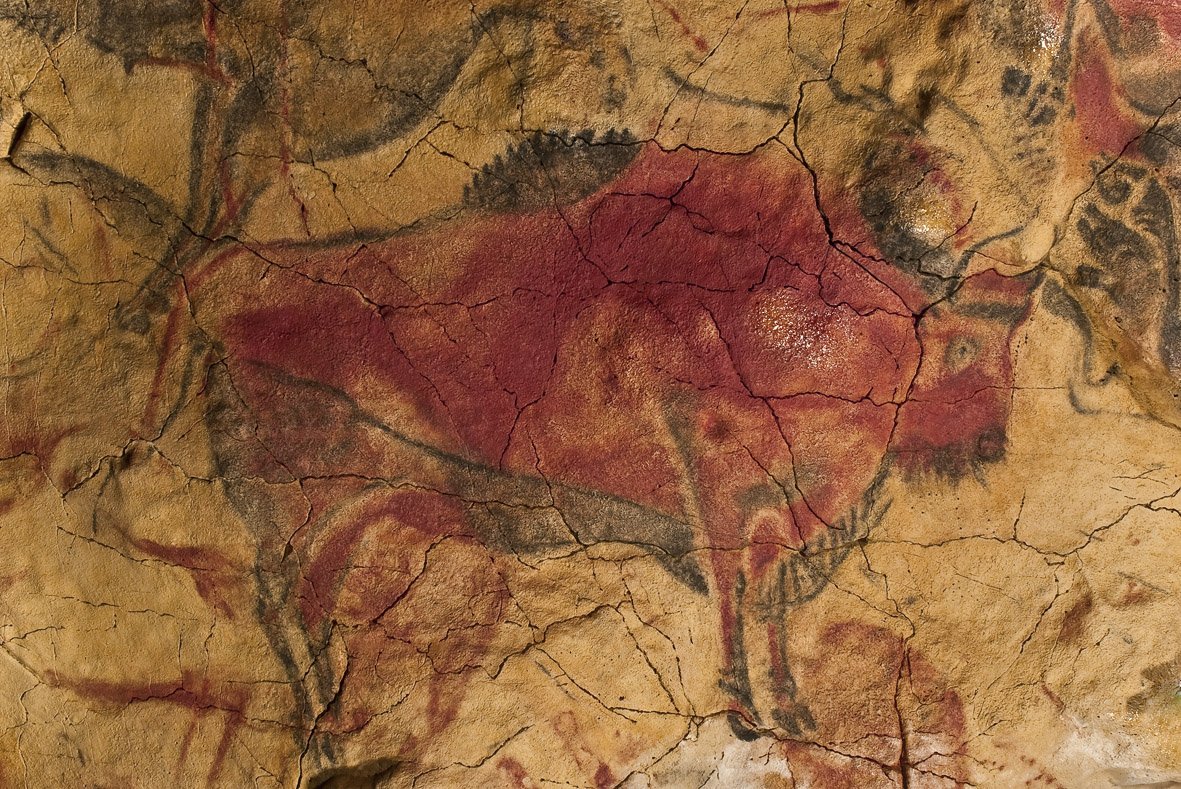
The famous painted caves most people picture are, in fact, far younger than Chauvet. Lascaux, in the Dordogne, was found by four teenagers in 1940 and dates to roughly 17,000 years ago; its Hall of the Bulls includes an aurochs over five meters long, the largest known cave-art figure. Altamira, in northern Spain, is younger still, around 15,000 to 14,000 years, and its ceiling of bison is the most celebrated painted surface in prehistory, the animals modeled in red and black over the rock's own bulges so they seem to swell out of the stone. The technology behind them was no accident. Paleolithic painters mined and ground iron oxides for red and yellow, heated yellow ochre to turn it red, used manganese for black, and bound their pigments with fat and plant juice; chemical analysis at Lascaux found different recipes matched to different surfaces. They applied paint with brushes of fur and fiber, with fingers, and by blowing it through hollow bone. This is knowledge-intensive, transmitted craft, not idle smearing, and it held remarkably stable across thousands of years and thousands of miles.
04I Was Here
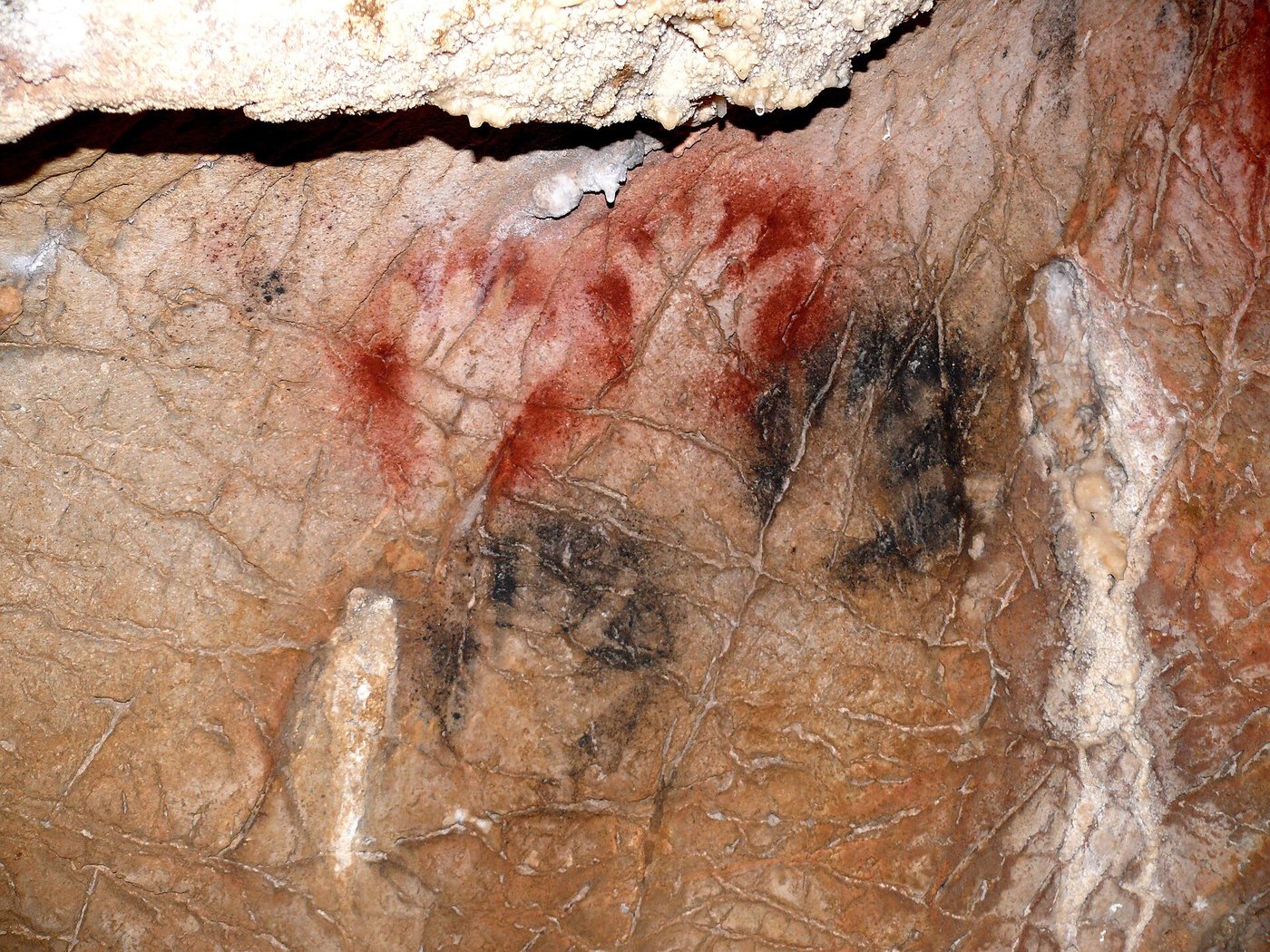
Amid the animals, one mark recurs more widely than any other, and it is the most human of all: the print of a hand. Negative hand stencils, made by placing a hand flat to the rock and blowing pigment around it to leave its silhouette, appear independently across the world, in Europe, in Sulawesi (where one is dated to at least 39,900 years, the oldest known), in the Kimberley of Australia, in Africa, in the Americas. Across cultures with no possible contact, the same gesture: I was here, this hand, pressed to this stone. Some of the hands deepen the mystery rather than solve it. At Gargas, in the French Pyrenees, dozens of the stencilled hands are missing finger segments, and no one is sure why; the guesses run from ritual amputation to frostbite to a deliberate folding of the fingers, perhaps a gestural sign language, and the honest answer is that we do not know. It is worth adding that the painted caves are only a sliver of the whole record. The overwhelming majority of the world's rock art is out in the open, carved and painted on exposed rock in at least 150 countries, from the hundreds of thousands of figures at Val Camonica in Italy to the drying-Sahara sequences of Tassili n'Ajjer to the more than seven hundred rockshelters of Bhimbetka in India. Caves preserve; open rock mostly does not, and so what survives is skewed toward the deep and the dark, and we should be careful not to mistake the surviving sample for the whole of what was made.
05Who, and Why
Two questions hang over the oldest art, and both are genuinely unresolved. The first is startling: not when, but who. In 2018, a team dated the calcite over red marks in three Spanish caves, a linear motif at La Pasiega, a hand stencil at Maltravieso, red-painted rock at Ardales, and reported minimum ages above 64,800 years. If those dates hold, the art predates the arrival of modern humans in Iberia by some twenty thousand years, which would mean it was made by Neanderthals, evidence that symbolic image-making was not unique to our species. But it is disputed, and seriously. Critics point out that a uranium-series date on an overlying crust is a minimum age for the crust, not for the art beneath it, that the flagship La Pasiega date was the single oldest of twenty results, and that uranium can leach in wet caves and inflate the calculated age. As of now the Neanderthal claim is neither proven nor refuted; it sits right on the live edge of the method's reliability, and the honest position is to hold it open rather than bank it or dismiss it.
The second question is the oldest one of all: why. Why did people crawl deep into lightless caves, sometimes hundreds of meters underground, to paint animals by the light of a burning brand? There are several serious answers and, at present, no way to choose among them. One influential model reads the art as the residue of altered states of consciousness: the geometric signs match the patterns the human nervous system generates in trance, and the animals emerge as a shaman crosses into a spirit world through the permeable cave wall. It is powerful, and it is also criticized as nearly unfalsifiable, since almost any image can be fitted to one of its stages. An older idea, hunting magic, that painting an animal helped to capture it, has largely collapsed, because the most-painted species (lions, rhinos) were rarely eaten while the most-eaten (reindeer) is barely painted. A structuralist reading finds a deliberate, non-random syntax in where animals are placed within a cave, and that placement does look meaningful even where the specific scheme is doubted. Others read the recurring signs as a possible proto-notation, and the 2024 Sulawesi scene, with its cluster of figures around a pig, as direct evidence that some of this art was narrative, telling a story, from the very beginning. And simple delight in making an image is never ruled out. Each of these has evidence behind it; none has enough to defeat the others. The most honest thing to say about the meaning of the oldest art is that we have good questions and no settled answer, and that the pull toward collapsing all of it into one tidy purpose, especially 'religion,' is a pull to resist.
06What It Was Not
A few claims can be set aside cleanly. Cave paintings do not depict dinosaurs, aliens, or flying machines; every identified animal in the world's dated cave art is a real creature that lived alongside the humans who painted it, and the supposed anomalies dissolve on inspection into misreadings of ordinary figures. Nor did the work require instruction from some vanished advanced civilization: experimental archaeologists have reproduced every technique, ochre-firing, blown stencils, charcoal shading, perspective, with ordinary materials and ordinary hands, and Chauvet shows that fully modern skill was present from the early Upper Paleolithic with no outside help needed. Two subtler overclaims deserve refusing too, and in opposite directions. The art does not, by itself, prove that its makers had a religion or practiced shamanism; that is one interpretation among several, and a contested one, not an established fact about what Paleolithic people believed. And no single meaning for cave art is settled, not shamanism, not hunting magic, not storytelling; even the most basic question, who made some of the earliest of it, remains open. The wonder of this art does not depend on solving it, and it is not improved by pretending it is solved.
Fast Facts
- Oldest known
- A narrative scene at Leang Karampuang, Sulawesi, dated to at least 51,200 years (2024): the oldest figurative art and the oldest known story told in pictures
- How we date it
- Mostly uranium-series on the calcite crust that formed OVER the paint, which gives a MINIMUM age, not an exact one
- Chauvet (France)
- ~36,000 years, ~420 painted animals plus ~190 engraved, technically masterful; it killed the idea that old art must be crude
- The famous caves
- Lascaux ~17,000 years, Altamira ~15,000 to 14,000: the painted herds most people picture, far younger than the oldest art
- Hand stencils
- The most universal motif, found independently worldwide; the oldest (Sulawesi) at least 39,900 years
- Who made some of it
- Unresolved: 64,800-year dates at three Spanish caves suggest Neanderthals, but the dating is seriously disputed
- Why
- Five rival theories (trance/shamanic, hunting magic, structural syntax, proto-notation, storytelling); none proven over the rest
- Refused
- Dinosaurs, aliens, lost-civilization instruction; and any claim that a single meaning is settled
What We Can Actually Stand Behind
The paintings and their measured ages are documented, stated with their methods. Leang Karampuang (~51,200 years) is the oldest known figurative and narrative art; the Sulawesi pig is ~45,500, the Borneo bovid ~40,000, El Castillo's oldest marks ~40,800 (minimum), Chauvet ~36,000, Lascaux ~17,000, Altamira ~15,000 to 14,000, and Blombos ochre ~73,000. Chauvet's technical mastery at such an early date is real and it falsified the old crude-to-refined model. Negative hand stencils recur independently worldwide.
Several broader points are strong. The discovery of art this old outside Europe overturned the Eurocentric origin story and established skilled image-making as a pan-human capacity. The pigment technology was systematic, transmitted craft. Hunting magic fails as a universal explanation (the most-painted animals were rarely eaten), and cave-art placement is non-random and topographically structured even where specific 'syntax' schemes are doubted. The dating methods are sound but deliver minimum ages, which is why the honest numbers always name the method.
The two deepest questions are open. Neanderthal authorship of the >64,800-year Spanish marks is a live, unresolved methodological dispute (minimum-age crusts, a single retained date, uranium leaching), not a settled finding either way. And no single explanation for why humans began to paint is established: the shamanic/trance model, hunting magic, structural syntax, proto-notation, and storytelling all have evidence and none defeats the others. Astronomical and 'proto-cinema' readings are intriguing but unproven.
The fringe readings get a flat no. No dated cave art depicts dinosaurs, aliens, or machines; every animal is real Pleistocene fauna. No lost civilization was needed to teach the techniques, which have all been reproduced experimentally. And two subtler overclaims fail in opposite directions: the art does not by itself prove prehistoric religion or shamanism, and no single meaning for it is settled. The honest stance keeps the wonder and refuses the false certainty, in both directions.
Cave art belongs at the head of a wing about the marks human beings make, because it is, quite literally, the beginning of the record: the first time our species reached for a surface and left an image meant to be seen. Everything else in this wing, the scripts and the songs and the woven codes, descends from the impulse on those walls. And the most moving thing about the oldest of it is not the mammoths or the lions but the hands: a person, fifty thousand years ago, and again ten thousand years ago, and again on the far side of the world, pressing a palm to cold rock and blowing red powder around it to leave the one message that needs no decipherment at all. I was here. We still do not know for certain who all of them were, or what they believed they were doing. We know that they wanted to be seen, and that across an almost unimaginable gulf of time, they still are.
Sources & further reading
Everything above is drawn from our research library on Theories of Anything. Open the full file to check the sourcing and go deeper.
Image credits
- Panel of Hands, El Castillo Cave, Cantabria Photograph by Miguel Angel de Arriba, via Wikimedia Commons. CC BY 3.0 Source.
- Bovid painting, Lubang Jeriji Saleh, Borneo (~40,000 years) Photograph by Luc-Henri Fage; public domain, via Wikimedia Commons. Public Domain Source.
- Chauvet lion panel (museum facsimile, Brno) Photograph by Wikimedia Commons user HTO; public domain, via Wikimedia Commons. Public Domain Source.
- Polychrome bison, Altamira ceiling Museo de Altamira and D. Rodriguez, via Wikimedia Commons. CC BY-SA 3.0 Source.
- Hand stencils with incomplete fingers, Gargas Cave Photograph by Yoan Rumeau, via Wikimedia Commons. CC BY-SA 4.0 Source.
- Card crop of the El Castillo Panel of Hands Photograph by Miguel Angel de Arriba, via Wikimedia Commons. CC BY 3.0


.jpg)

