
The Plant That Counts To Five
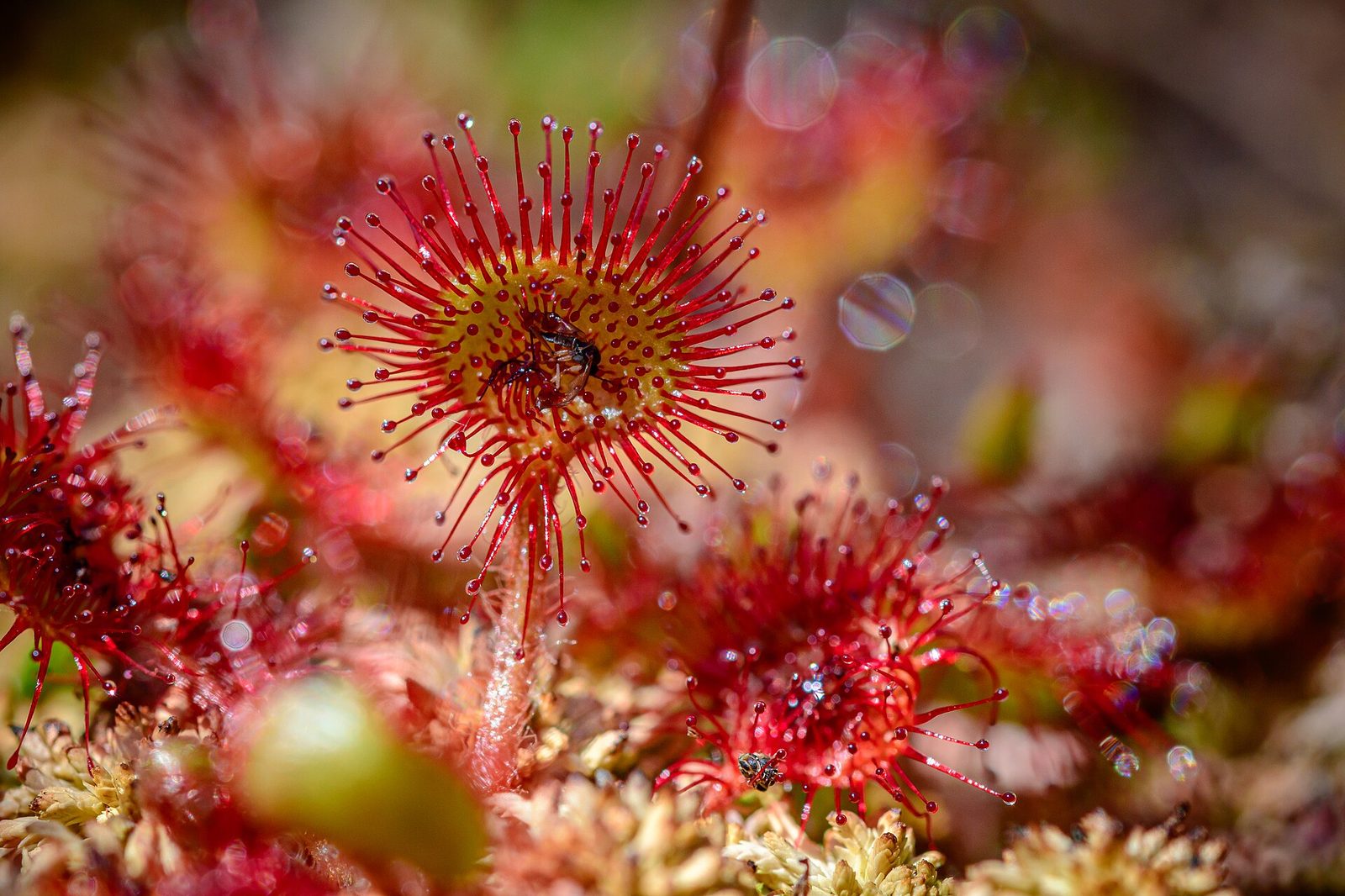
About eight hundred plants on this planet eat animals, and they arrived at the habit at least twelve separate times, in orders that are not close relatives. The Venus flytrap does not pull its lobes shut; it holds them under tension and releases a stored shape, the way a tennis ball pops inside out, in about a tenth of a second. It counts the touches on its trigger hairs: two to close, three to seal, five or more to start secreting acid. Bladderworts are faster still, firing an underwater suction trap in half a millisecond. And when we resolved the eleven identifiers in our own research file on all this, six were exact and five landed on the wrong paper, in a pattern that turns out to be the mirror image of every other file we have audited this month.
Every plant you have ever met makes its own food out of light, water and air, and takes everything else it needs out of the ground. That is the arrangement. It is so nearly universal that the exceptions have to be explained rather than simply noted. About eight hundred species have broken it. They still photosynthesise, but they get their nitrogen and phosphorus by catching animals, mostly insects, and digesting them. And the striking thing is not that it happened. It is that it happened again and again, in plants that are not closely related, in at least twelve separate lineages spread across five different orders, arriving each time at the same small set of solutions.
The reason is not mysterious once you see where these plants live. Bogs, fens, wet acid sands, seepage slopes, the tops of nutrient-poor mountains: places with plenty of light and water and almost no usable nitrogen in the soil. Under those conditions a leaf that can catch a fly is worth more than a leaf that cannot, and evolution has found that out over and over. What follows is what is actually settled about how the traps work, what is still argued, what is folklore, and, at the end, what happened when we checked our own research file's sources one by one.
01The Same Invention, At Least Twelve Times
About eight hundred species, and carnivory was invented at least twelve separate times. A carnivorous plant is defined by doing four things: attracting prey, capturing it, digesting it, and absorbing the nutrients. Roughly eight hundred species qualify, and they are scattered across the flowering plants in a way no single origin could produce. Caryophyllales gives us Drosera the sundews, Dionaea the Venus flytrap, Nepenthes the pitcher plants, and Drosophyllum. Ericales gives us Sarracenia and Darlingtonia. Lamiales gives us Pinguicula, Utricularia the bladderworts, and Genlisea. Poales gives us Brocchinia. Oxalidales gives us Cephalotus, on its own. These groups are not close relatives, and the traps they built are the same four designs: pitfall, snap, adhesive and suction.
Darwin gave them a whole volume. Insectivorous Plants, John Murray, 1875. He fed sundews fragments of meat and egg white and hair and glass, timed how long the tentacles took to bend, and worked out that the plant could distinguish nourishment from debris. Of the Venus flytrap he wrote that it was one of the most wonderful plants in the world. It is worth noting a small thing about how our own file cites this: the entry carries no digital identifier at all, which is exactly right for an 1875 book, and it does not reach for the identifier of some later reprint to fill the space. We will come back to why that is worth remarking on.
02How A Leaf Snaps Shut In A Tenth Of A Second
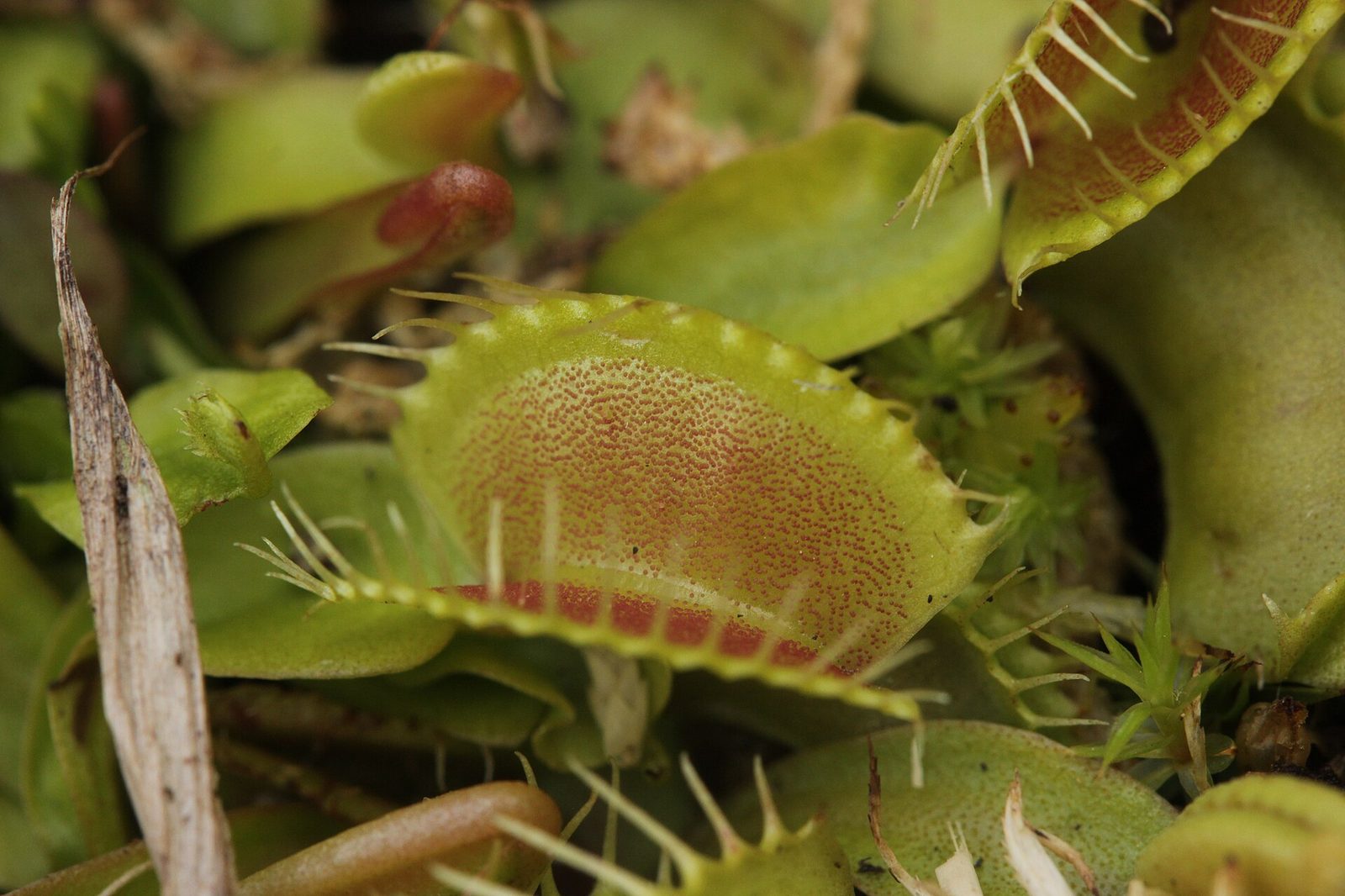
The snap is elastic buckling, not muscle. A Venus flytrap closes in about a hundred milliseconds, which is faster than anything a plant should be able to do by growing or by moving water around. In 2005, Yoel Forterre, Jan Skotheim, Jacques Dumais and L. Mahadevan published the mechanism in Nature, and it turns out the plant is not pulling the lobes together at all. Each open lobe is held in a curved, doubly-stressed configuration that stores elastic energy. Triggering it changes the internal pressure just enough to make that shape unstable, and the lobe snaps through to a convex one. Our file has the right analogy for it: it is like popping a tennis ball inside out. The energy was already there. All the plant supplies is the release.
And the trap counts. Closure is set off by trigger hairs, typically three on each lobe. One touch does nothing. Two touches within about twenty seconds produce the electrical signals that fire the snap, which is a straightforward filter against raindrops and falling debris. But a 2016 paper in Current Biology showed the counting goes further than that. Two touches close the trap. Three activate the sealing response. Five or more start the secretion of digestive enzymes. The plant is tallying prey-induced action potentials and changing its behaviour at each threshold, so that it only pays for digestion once something has struggled enough to be worth digesting. Our file's phrase for this is that Darwin's plant counts to five. One correction to the record: our file's bibliography gives the first author's given name as Jörg. It is Jennifer.
And the whole species lives in one small place. Dionaea muscipula occurs naturally within roughly a hundred and twenty kilometres of Wilmington, North Carolina, and nowhere else. The most recognisable plant in the world, the one every child can draw from memory, has a native range you could drive across in an afternoon.
03And The Flytrap Is Not Even The Fast One
Bladderworts fire in about half a millisecond. That is roughly two hundred times faster than the flytrap, the fastest known movement in the plant kingdom, and among the fastest movements in any organism at all. Utricularia grows tiny underwater bladders, each with a hinged door. The bladder pumps water out through specialised glands until its walls are held inward under a pressure difference of something like 1.5 megapascals. Trigger hairs on the door are disturbed, the door buckles open, and the wall springs back to its resting shape, drawing prey and water in before the animal can react. Philippe Marmottant, Olivier Vincent and colleagues filmed the whole sequence at fifteen thousand frames per second and published the analysis in 2011. There are about two hundred and thirty Utricularia species, which makes it the largest genus of carnivorous plants and, by a wide margin, the least famous.
04What Is Actually In The Fluid
Proteases, phosphatases, esterases, ribonucleases and chitinases. The chitinases matter especially, because an insect's exoskeleton is chitin and something has to open it. A 2012 proteomics study identified more than thirty proteins in the fluid, including aspartyl proteases, glucanases and peroxidases. One correction to our own file here, and it is a real one: the body of the file says that study characterised the fluid of Nepenthes pitcher plants. It did not. The paper is titled after the digestive fluid of the Venus flytrap, and the flytrap is what it examined. Our file's own bibliography entry has the title right, which means the error is in the body and the bibliography is the half that is correct. The nepenthesins that the same passage attributes to that paper are indeed Nepenthes enzymes, from a different body of work altogether. Two literatures ran together in one sentence.
And the prey really does become the plant. Feed a carnivorous plant insects labelled with nitrogen-15 and then measure where that isotope ends up, and you find that prey-derived nitrogen accounts for somewhere between twenty-five and seventy-five percent of the total nitrogen in the leaves, depending on the species and how much prey is available. Absorption happens through specialised glandular hairs on the trap surface. This is not a supplement at the margins. In some species, most of the plant's nitrogen walked in on its own legs.
The signalling is electrical, and the resemblance to animal nerves is not a metaphor. Venus flytraps and sundews generate action potentials that look remarkably like the ones in animal neurons, propagated along cell membranes by voltage-gated ion channels. Rainer Hedrich and Erwin Neher set out the machinery in Trends in Plant Science in 2018: mechanosensitive channels at the trigger hairs convert a physical bend into a voltage change, anion channels carry the signal, and glutamate receptor-like channels are involved in propagating it. Then there is the detail that makes the whole thing feel less like an invention and more like a repurposing: the digestive enzymes are switched on by jasmonic acid signalling, which is the same hormone pathway plants everywhere use to defend themselves against being eaten. The plant did not build a new system for eating animals. It turned the anti-herbivore alarm around. Alexander Volkov's name for the trap is a green muscle, an electrically controlled actuator with no muscle in it anywhere.
05The Pitcher Is A Pond
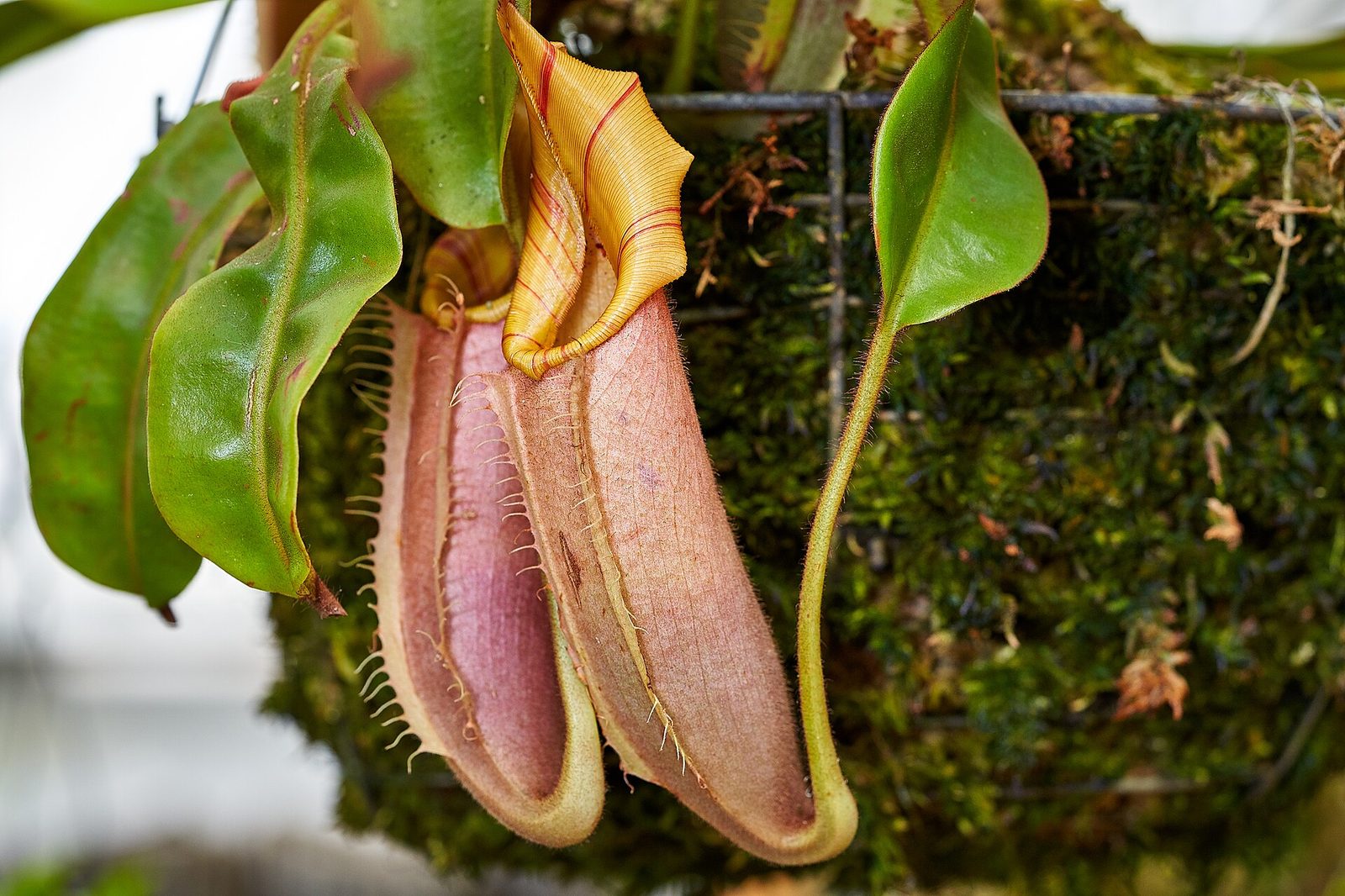
The fluid in a pitcher is a whole ecosystem, and the plant is not doing all the digesting. Sarracenia and Nepenthes pitchers hold standing communities: bacteria, protozoa, rotifers, midge larvae, mosquito larvae, sometimes small crustaceans, arranged into a genuine detrital food web that breaks the drowned prey down and makes its nitrogen available. Leonora Bittleston's work has documented structured bacterial succession in these fluids after a capture, with the community shifting predictably as the corpse is processed. Which reframes the whole arrangement. The plant is not simply a stomach. It is closer to a farmer who has built a pond, stocked it, and lives off what the tenants release.
06Why Only Here: The Economics Of Eating Animals
A trap is an expensive leaf, so it only pays in poor soil. Aaron Ellison and Nicholas Gotelli formalised carnivory as a cost-benefit calculation, and it is the framework most of the field now uses. A trap is a poor photosynthesiser compared with an ordinary leaf: the surface is given over to glands and glue and hinges rather than to catching light. So a plant will only build one where the nutrient return exceeds the photosynthetic cost, which happens precisely where soil nutrients are scarce and light is not. That predicts the habitats these plants actually occupy: bogs, fens, sandy wetlands, seepage slopes, exposed mountaintops. And it predicts an experiment that works. Fertilise a carnivorous plant with nitrogen and phosphorus and many species respond by building fewer traps and more conventional leaves. Given a cheaper source of nitrogen, the plant stops paying for the expensive one.
And the objection is in our own file, stated fairly. Méndez and Karlsson argued in 2005 that the cost-benefit framework oversimplifies, because it treats traps as photosynthetically wasteful when in genera like Drosera and Pinguicula the traps are the photosynthetic leaves. There is no separate ordinary foliage to compare them against, so the cost side of the ledger is harder to price than the model assumes. Our file records this objection in its own counter-arguments section rather than leaving it out, which is the behaviour you want from a source. We should say plainly that we did not chase down the Méndez and Karlsson paper ourselves; it has no bibliography entry in the file, and we did not verify it.
07Where The Line Blurs, And Where It Does Not
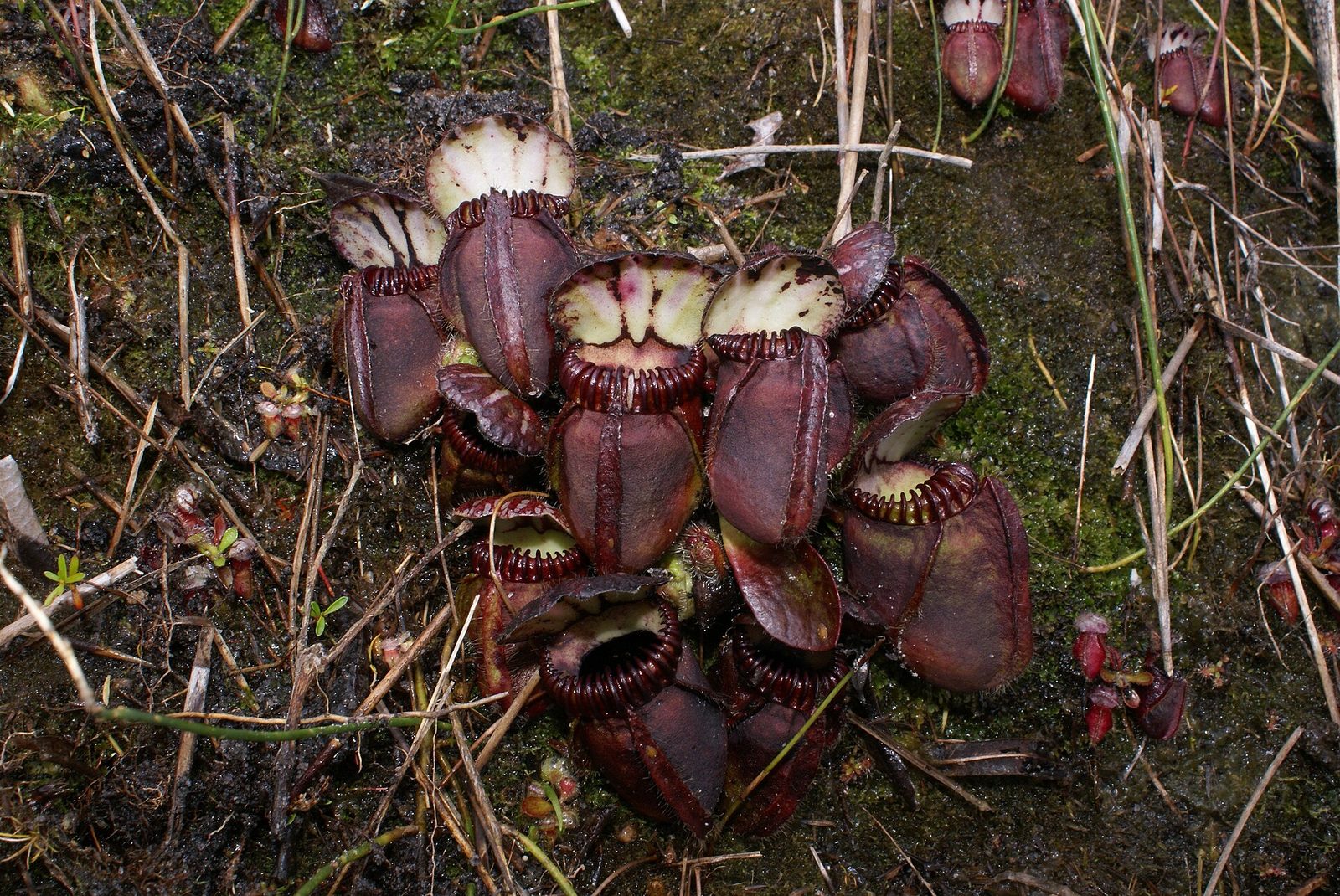
The boundary is genuinely blurry, and our file says so from both sides. Sticky trichomes on ordinary plants, including tobacco and potato, trap and kill small insects, and there is some evidence of nutrient absorption from the corpses that end up on the leaf. Mark Chase and colleagues proposed in 2009 a continuum running from what they called murderous plants, which kill on sticky surfaces without obvious enzyme secretion, through to full carnivores. Our file also states the objection in the same breath: a strict definition requires attraction and capture and digestion and absorption together, and on that reading sticky trichomes on a potato are purely defensive and the killing is incidental. Both positions are in the document. Neither is presented as settled. And the convergence goes down to the parts list. Fukushima and colleagues showed in that 2017 genome paper that distantly related carnivorous plants independently co-opted the same ancestral genes to make their digestive enzymes, and in particular stress-response and pathogen-defence genes. Which is the jasmonic acid story again at a lower level. Twelve separate lineages did not each invent a way to digest an animal. Each of them reached for the machinery the plant already had for being attacked, and turned it outward.
They may work as a gauge for the health of a wetland. The argument runs like this: because carnivorous plants occupy such narrow conditions, wet, acid and nutrient-poor, they should be unusually sensitive to the things that change those conditions, which are climate shift, atmospheric nitrogen deposition and drainage. That would make them useful early indicators of wetland degradation. The habitat pressure is not in doubt: Dionaea muscipula is listed as Vulnerable on the IUCN Red List, and its native habitat is estimated to have shrunk by ninety-three percent since European settlement through fire suppression, drainage and building. In 2014 North Carolina made poaching wild Venus flytraps a felony. What has not been done at scale is the monitoring itself, so the bioindicator idea remains a proposal with good reasoning behind it rather than a demonstrated method.
No plant has ever eaten anybody, and we know exactly where the story started. The man-eating tree of Madagascar was invented in 1874 by Edmund Spencer, writing in the New York World. It was fiction presented as a traveller's report, and it has been recirculating ever since, eventually producing Audrey II. The real ceiling is much lower and much less dramatic. The largest traps in the world belong to Nepenthes rajah, whose pitchers reach about thirty-five centimetres, and they do occasionally catch small vertebrates: frogs, lizards, the odd shrew or mouse. That is the maximum. Nothing about the structure or the energetics of a plant supports anything beyond it. There is no mechanism by which a plant could hold and process an animal of any size, and there is no organism that has ever tried.
08A Note On Our Own Sources
We resolved every identifier in this file live, and six of the eleven are exact. Forterre on the snap, the Current Biology paper on the counting, Vincent on the suction traps, Ellison on nutrient stoichiometry, Chase on murderous plants, and Hedrich and Neher on how the flytrap works all resolve to precisely the works our file names, with the right journal, volume, issue and pages. That is a real majority, and it is worth saying before the rest of this section, because the rest of this section is about the other five.
Every failure in this file has the same shape: the right journal, the wrong article. The Phytochemistry pointer lands on a paper about geraniol synthase in Madagascar periwinkle, at pages 36 to 43, immediately before the 44 to 58 our file claims. The Trends in Ecology and Evolution pointer lands on a paper about recombination in sex chromosomes, in the same volume, the same issue, with an overlapping page range. The Journal of Experimental Botany pointer lands on a paper about the construction costs of leaves. The Frontiers in Microbiology pointer lands on a paper about yeast. And the Nature Ecology and Evolution pointer lands nowhere at all.
That last one is off by a single character. Our file gives the Cephalotus genome paper the identifier 10.1038/s41559-017-0059. That is a flat 404; nothing is registered there. The real identifier is 10.1038/s41559-016-0059, and it resolves to exactly the paper our file names, by Kenji Fukushima and colleagues. One digit. This is the second single-character identifier error we have found this month, after a reference in our hadal zone file where the same slip appeared in both the identifier and the volume number. And in both cases the wrong character killed the pointer outright rather than redirecting it, which is by some distance the better failure: a dead link tells you something is wrong, and a working link to the wrong paper does not.
One entry is a chimera, and the file's own body knows better. The single Ellison and Gotelli entry in the bibliography carries the title of their 2001 paper in Trends in Ecology and Evolution, the year of their 2009 paper in the Journal of Experimental Botany, and a volume and page range belonging to neither. Both papers are real; we found and verified both. And here is the part worth pausing on: the file's own prose cites them correctly and separately, quoting Ellison and Gotelli 2001 for the nitrogen isotope figure and Ellison and Gotelli 2009 for the energetics argument. The body of the document knows there are two papers. The bibliography collapsed them into one.
Four of the five were recovered, and the fifth we will not pronounce on. The Fukushima genome paper, the digestive fluid proteomics paper, both Ellison and Gotelli papers and the bladderwort paper all exist and were found; the correct identifiers for all of them are in the source list at the foot of this article. The proteomics recovery is the largest single correction, because it moves the paper out of Phytochemistry entirely and into Molecular and Cellular Proteomics, changes the volume and pages, and gives the first author's given name as Waltraud X. where our file says Wolf B. The one we could not resolve is a paper attributed to Leonora Bittleston in Frontiers in Microbiology. A title search returns nothing matching, and an author search across five years returns her real output on exactly this subject but no paper of that title in that journal. We record it as not found. That is not the same statement as does not exist, and we are not making the stronger one.
And this file's failure profile is the mirror image of the others. Over the past month we have resolved the identifiers in eight research files one at a time. In the files whose sources are mostly books, every single bad identifier turned out to point at a published review of the book rather than the book: five of five in the Nizari Ismaili file, five of five in the Book of Enoch file, three of three among the Olmec volumes. In the files whose sources are mostly journal articles, not one bad identifier is a review; every one lands on a neighbouring paper. The hadal zone file, the Hittite file, and now this one at five out of five. The explanation is mechanical rather than mysterious. A book has no neighbouring article, so a pointer that drifts from a book has nowhere to land except on something else bearing its title, and the only thing that bears a book's title is a review of it. A journal article's nearest neighbour is the paper printed beside it in the issue. Whatever process produces these errors, the shape of the wreckage is decided by the shelf.
This file is also the best-behaved one we have audited, in three specific ways. Its bibliography is properly fielded: no author list is cut in half at a middle initial, where three other files this month carried eleven entries between them shattered that way. Its cross-references pass the label audit: no link in it is labelled with the name of one document while opening another, which is a defect we measured at up to sixteen percent across the library as a whole. And its Darwin entry carries no identifier, where another file put a 1988 reprint's identifier on an 1875 book. One detail may explain all three at once, or may not: this file was last updated on the twenty-fifth of June 2025, which makes it the oldest document in the whole audit. Whatever produced the split author names and the borrowed reprint identifiers in the 2026 files is not present in this one.
| Our File's Entry | Identifier As Given | What It Actually Returns |
|---|---|---|
| 2. Forterre et al 2005, How the Venus Flytrap Snaps | 10.1038/nature03185 | That paper, Nature 433(7024):421-425. CORRECT |
| 3. Böhm et al 2016, The Venus Flytrap Counts Prey-Induced Action Potentials | 10.1016/j.cub.2015.11.057 | That paper, Current Biology 26(3):286-295. CORRECT on the work, and it gives the first author as Jennifer where our file says Jörg |
| 4. Fukushima et al 2017, Genome of the Pitcher Plant Cephalotus | 10.1038/s41559-017-0059 | Nothing. A flat 404. The real identifier is 10.1038/s41559-016-0059, one character away, and it resolves to exactly this paper |
| 5. Vincent et al 2011, Ultra-Fast Underwater Suction Traps | 10.1098/rspb.2010.2292 | That paper, Proceedings of the Royal Society B 278(1720):2909-2914. CORRECT |
| 6. Schulze et al 2012, The Protein Composition of the Digestive Fluid | 10.1016/j.phytochem.2012.09.014 | A paper on geraniol synthase in Madagascar periwinkle, Phytochemistry 85:36-43, immediately before the pages claimed. The real paper is in Molecular and Cellular Proteomics 11(11):1306-1319, and the first author is Waltraud X. Schulze |
| 7. Ellison and Gotelli 2009, Evolutionary Ecology of Carnivorous Plants | 10.1016/j.tree.2008.09.010 | A paper on recombination in sex chromosomes, same journal, same volume, same issue. And the entry itself is two real papers merged: the 2001 title with the 2009 year |
| 8. Ellison 2006, Nutrient Limitation and Stoichiometry of Carnivorous Plants | 10.1055/s-2006-923956 | That paper, Plant Biology 8(6):740-747. CORRECT |
| 9. Chase et al 2009, Murderous Plants | 10.1111/j.1095-8339.2009.01014.x | That paper, Botanical Journal of the Linnean Society 161(4):329-356. CORRECT |
| 10. Albert et al 2006, The Carnivorous Bladderwort: A System Inflates | 10.1093/jxb/erj002 | A paper on the construction costs of leaves, Journal of Experimental Botany 57(2):355-371. The real paper is 10.1093/jxb/erp349, same journal, volume 61(1):5-9 |
| 11. Bittleston et al 2018, Carnivorous Plants as a Model for Microbiome Assembly | 10.3389/fmicb.2018.02005 | A paper on yeast gene deletion, same journal and year. The cited paper was NOT FOUND by title or by author search, which is not the same as saying it does not exist |
| 12. Hedrich and Neher 2018, Venus Flytrap: How an Excitable, Carnivorous Plant Works | 10.1016/j.tplants.2017.12.004 | That paper, Trends in Plant Science 23(3):220-234. CORRECT |
Fast Facts
- Species
- About 800, arising in at least 12 independent lineages across five orders: Caryophyllales, Ericales, Lamiales, Poales and Oxalidales
- Trap types
- Four, each convergently evolved more than once: pitfall (Nepenthes, Sarracenia, Cephalotus), snap (Dionaea), adhesive (Drosera, Pinguicula, Drosophyllum), suction (Utricularia)
- Flytrap closure
- About 100 milliseconds, by elastic snap-buckling of a pre-stressed lobe rather than by muscle or growth (Forterre et al. 2005)
- The counting
- Typically 3 trigger hairs per lobe. Two touches within about 20 seconds close the trap, three activate sealing, five or more start enzyme secretion (Böhm et al. 2016)
- Fastest trap
- Utricularia bladders fire in about 0.5 milliseconds under a pressure difference near 1.5 MPa, filmed at 15,000 frames per second. Around 230 species, the largest carnivorous genus
- Digestive fluid
- Proteases, phosphatases, esterases, ribonucleases and chitinases. Over 30 proteins identified by proteomics in Venus flytrap fluid
- Prey nitrogen
- 25 to 75 percent of total leaf nitrogen comes from prey, traced with nitrogen-15 labelling
- Venus flytrap range
- A radius of about 120 km around Wilmington, North Carolina, and nowhere else. IUCN Vulnerable; habitat reduced an estimated 93 percent since European settlement. Poaching became a felony in North Carolina in 2014
- Largest trap
- Nepenthes rajah, pitchers to about 35 cm, occasionally catching frogs, lizards and small mammals. That is the ceiling
- Identifier audit
- 11 DOIs checked live 26 August 2026. Six exact, five wrong, four recovered, one not found. Not one of the five failures is a review, which is the opposite of every book-heavy file audited this month
What We Can Actually Stand Behind
The mechanisms are settled. About 800 carnivorous species from at least twelve independent origins. The Venus flytrap's roughly 100 millisecond closure by elastic buckling of a pre-stressed lobe (Forterre et al. 2005). The counting of prey-induced action potentials at thresholds of two, three and five (Böhm et al. 2016). The bladderwort's 0.5 millisecond suction trap under about 1.5 MPa, filmed at 15,000 frames per second (Vincent et al. 2011). The digestive enzyme inventory, including chitinases for the exoskeleton. Prey supplying 25 to 75 percent of leaf nitrogen, traced isotopically. Dionaea's tiny native range and its Vulnerable listing. These are facts, and all six of the identifiers backing them resolve correctly.
The cost-benefit framework explains where carnivorous plants live and predicts an experiment that works, and it is the standard reading. It is not unopposed: Méndez and Karlsson objected in 2005 that in sundews and butterworts the traps are themselves the photosynthetic leaves, so the cost side is harder to price than the model assumes. The electrical-signalling account, including the repurposing of the jasmonic acid anti-herbivore pathway to switch on digestion, is well supported and still being worked out. The pitcher microbiome as a genuine food web that the plant farms is credible and increasingly documented.
Proto-carnivory as a continuum, with sticky-leaved tobacco and potato at one end, is a reasonable proposal with a reasonable objection against it: strict definitions require digestion and absorption, not merely killing. The bioindicator idea has good reasoning behind it and very little systematic monitoring to support it yet.
No plant eats people, and the story has a documented origin: a fabricated newspaper report of a Madagascan man-eating tree, written by Edmund Spencer for the New York World in 1874. The genuine upper limit is a Nepenthes rajah pitcher of about thirty-five centimetres taking the occasional frog or shrew.
Eleven identifiers checked live on 26 August 2026, six exact and five wrong. Four of the five were recovered and are given correctly below. One paper attributed to Leonora Bittleston could not be found and is recorded as not found rather than as nonexistent. Two author given names in the bibliography are wrong, one entry merges two separate real papers, and one body passage attributes a Venus flytrap study to Nepenthes when the file's own bibliography has it right. Against that: this file's author fields are intact, its cross-reference labels pass the label audit, and it does not put a modern reprint's identifier on an 1875 book. It is the oldest document in this audit and the cleanest in those three respects.
Sources & further reading
Everything above is drawn from our research library on Theories of Anything, with the specific studies below. Every identifier here was resolved live against Crossref on 26 August 2026, and where our file's identifier was wrong the corrected one is given. Open the full research file to check the sourcing and go deeper.
Image credits
- Round-leaved sundew (Drosera rotundifolia) with prey Stephan Sprinz, via Wikimedia Commons (CC BY 4.0). CC BY 4.0 Source.
- Venus flytrap (Dionaea muscipula), open trap Björn S., via Wikimedia Commons (CC BY-SA 3.0). CC BY-SA 3.0 Source.
- Tropical pitcher plant (Nepenthes veitchii), cultivated geoff mckay, via Wikimedia Commons (CC BY 2.0). CC BY 2.0 Source.
- Cephalotus follicularis in the wild Holger Hennern, via Wikimedia Commons (CC BY-SA 3.0). CC BY-SA 3.0 Source.
_mit_Beute_4.jpg)

_Nepenthes_Veitchii_Pink_(49359429783).jpg)
