
Three Billion Years Of Nothing With A Body
For roughly three billion years, life on Earth was single cells and nothing else. Then, in a window of about twenty million years, almost every animal body plan that has ever existed showed up at once. Here is what the rock actually holds, which of the explanations survive contact with it, and why the research file this article is built from calls its own subject one of the most profound puzzles in biology and then states that nobody disagrees about it.
For about three billion years, everything alive on Earth was a single cell. Not small animals. Not simple animals. No animals. Nothing with a front and a back, nothing with a gut running through it, nothing with legs or eyes or a shell. Three billion years is not a preamble to the story of animal life, it is most of the history of life on this planet, and for all of it the seafloor was a film of slime.
Then, in a window of roughly twenty million years, it ended. Arthropods, chordates, molluscs, echinoderms and around twenty other phyla appear in the rock, many of them already equipped with armour, claws and image-forming eyes. Our own group is in there, as a two-inch swimmer with a stiffening rod down its back. This article is about what the fossils actually show, which explanations survive contact with them, and one more thing: the research file it is built from calls this one of the most profound puzzles in biology and then, in the same file, states that no significant counter-arguments exist and there is no active scholarly dispute. Both sentences are in the same document. We went and checked every citation in it.
01The Ratio That Makes The Puzzle
Three billion years of single cells, then about twenty million years in which almost everything with a body arrives. The base of the Cambrian sits at roughly 541 million years ago, and the peak of diversification at roughly 530 to 520 million years ago. Inside that window, representatives of virtually all modern animal phyla enter the fossil record. At least twenty-plus phyla appear; about thirty-five survive today. The ratio between the wait and the event is roughly a hundred and fifty to one.
Twenty million years is not an instant, and the file that calls it an explosion says so itself. Our own research document files the claim that all animal phyla appeared in a single moment under dubious and marks it misleading. Its correction is the best sentence in the file: the explosion lasted about twenty million years, which is geologically rapid and is also thousands of times longer than all of recorded human history.
02What The Rock Actually Holds
Four places do most of the work. The Burgess Shale in British Columbia, about 508 million years old, found by Walcott in 1909 and reinterpreted by Whittington, Briggs and Conway Morris in the 1970s, preserves soft tissue in extraordinary detail. Chengjiang in Yunnan, about 518 million years old and discovered in 1984, is arguably more important in our file's own words, being older and more diverse. Sirius Passet in Greenland is about 518 million years old and the Emu Bay Shale in Australia about 514 million.
And the animals in them are strange in a specific way: they are not primitive. Anomalocaris, the apex predator, reached about one metre. Hallucigenia, Opabinia, Marrella and Wiwaxia are all fully realised body plans, not sketches. Pikaia is an early chordate, which our file describes as our distant ancestor, and Haikouichthys is the earliest fish-like vertebrate. Underneath them all, at the very base of the Cambrian, sits the Small Shelly Fauna: tiny teeth, shells and spines showing that many separate lineages started building hard parts at about the same time.
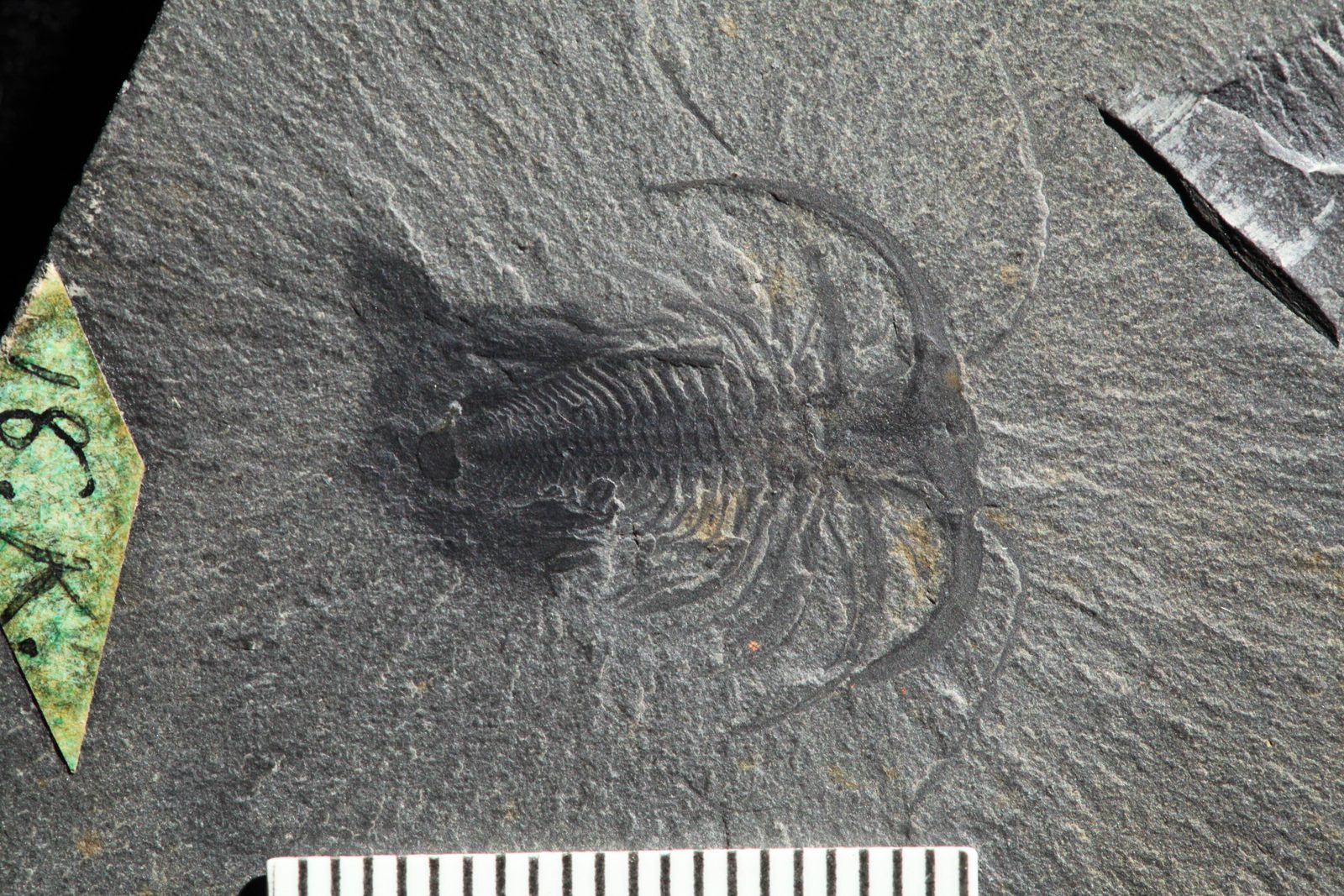
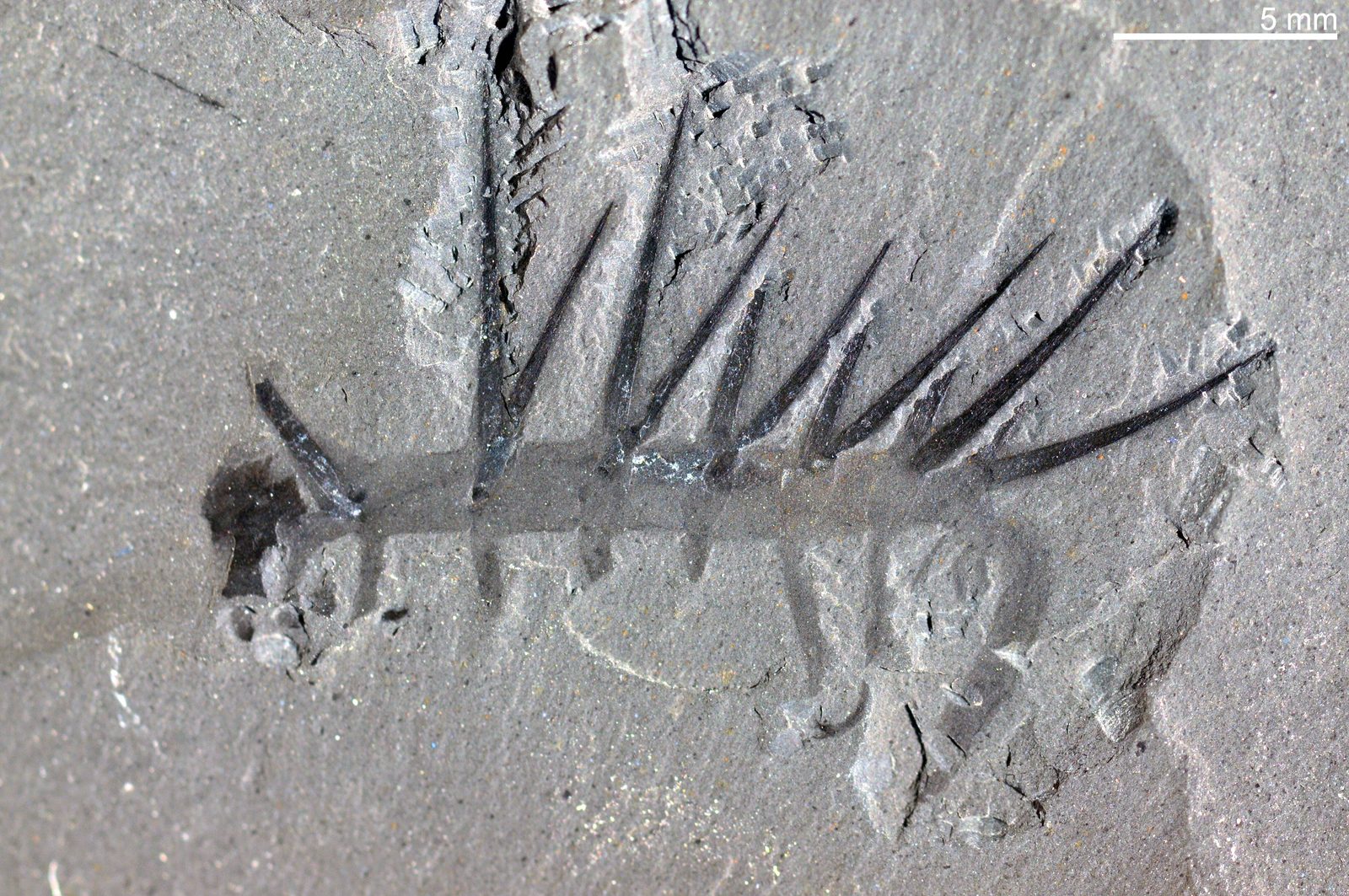
The next one is stranger, and the photograph is the argument. A great deal of writing about the Cambrian leans on painted reconstructions, which is how invented colour and invented behaviour get into a reader's head as though they were findings. Everything below is a specimen with a ruler beside it.
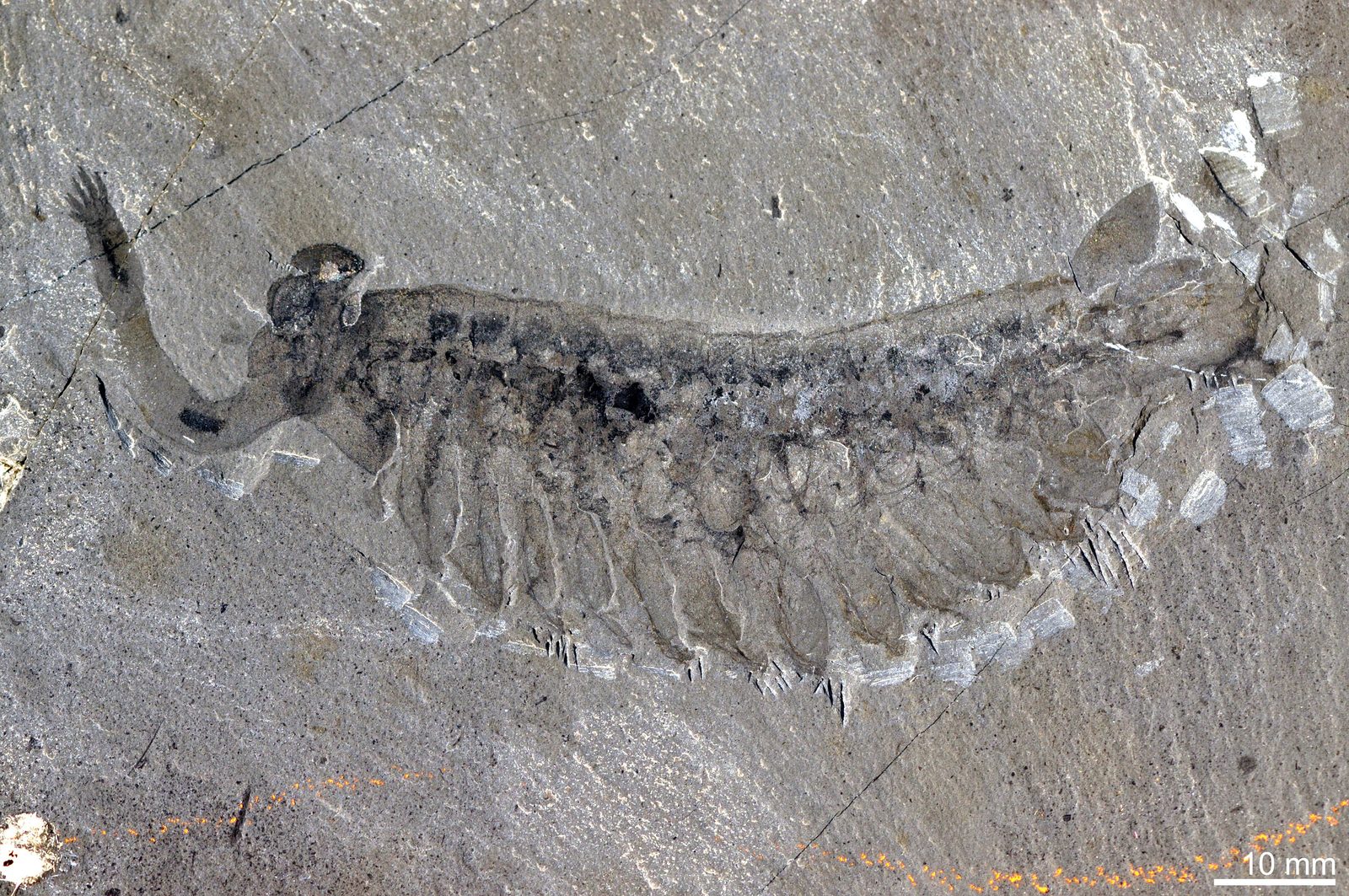
One of them was reconstructed upside down for fourteen years. Hallucigenia was described from the Burgess Shale with its spines taken for legs and its legs taken for tentacles waving on its back; the name records how the reconstruction felt to the people making it. Ramskold and Hou turned it over in Nature in 1991. Later work by Smith and Caron in Nature in 2015 reported the animal's head and showed that the dark blob long read as one was not. The point is not that palaeontologists were careless. It is that these body plans were unlike anything alive, and reading them took decades of argument.
03Was It An Explosion Or Just The Moment Things Started Fossilising
Molecular clocks say the animal phyla split apart long before the Cambrian. Estimates put the divergences somewhere around 700 to 600 million years ago, well back in the Ediacaran. On the fuse model, that long molecular divergence was the fuse and the Cambrian was the detonation: the moment mineralised skeletons evolved and animals began leaving fossils at all. On this reading the explosion is partly an artefact of what preserves. Our file refuses to stop there, and it is right to. Trace fossils, the burrows and tracks made by soft animals with no hard parts to fossilise, also explode at the base of the Cambrian. Whatever else changed, behaviour changed, and burrows do not need shells to be recorded.
04Four Things That Had To Be True First
Oxygen was necessary and not sufficient. The Neoproterozoic Oxygenation Event, roughly 800 to 540 million years ago, raised atmospheric oxygen from about 1 to 4 per cent of modern levels to about 12 to 15 per cent of modern levels by the early Cambrian. The requirement is physical, not vague: diffusion alone cannot supply a body bigger than about one millimetre without high atmospheric oxygen, and collagen, the structural protein that animal tissue is built from, cannot be made without it. What is worth keeping is the file's own verdict, because most popular accounts drop it: oxygen enabled but did not cause the diversification. It removed a ceiling. It did not push anything through it.
The genetic toolkit was already in the drawer. Hox genes lay out a body plan, the order of the segments, where limbs attach, where organs sit, and every bilaterian animal shares the same set. That duplication happened in the Ediacaran or earlier, before the explosion. So the Cambrian was not the invention of the genes; it was their deployment. The evo-devo point is that changing how a gene is expressed, rather than which genes exist, is enough to redraw an animal, which is why a fly can be made to grow legs where antennae belong. Our file's summary is exact: the genetic innovation preceded the morphological explosion.
Before any of it, the planet froze twice. The Sturtian glaciation ran roughly 717 to 660 million years ago and the Marinoan roughly 650 to 635, and the evidence for how total they were is that glacial deposits were laid down at tropical latitudes, with cap carbonates recording sudden deglaciation afterwards. The proposed consequences run in several directions at once: near-extermination of surface life clearing ecological space, refugia acting as crucibles, and phosphorus released by melting ice fertilising the oceans, feeding blooms, raising oxygen. Our file supplies its own check rather than just asserting a link: the Ediacaran fauna appear after the Marinoan, which is at least consistent with a post-catastrophe radiation.
And the seawater itself may have opened the door. Early Cambrian oceans became supersaturated in calcium carbonate, which made shell-building metabolically affordable rather than merely possible. The Small Shelly Fauna show mineralised structures appearing almost simultaneously across many separate lineages. Our file draws the inference carefully, and the care is the point: biomineralization evolving independently in dozens of lineages at once points at environmental chemistry rather than genetics as the trigger. Nobody invented shells. The water started letting everyone make them.
05The Light Switch
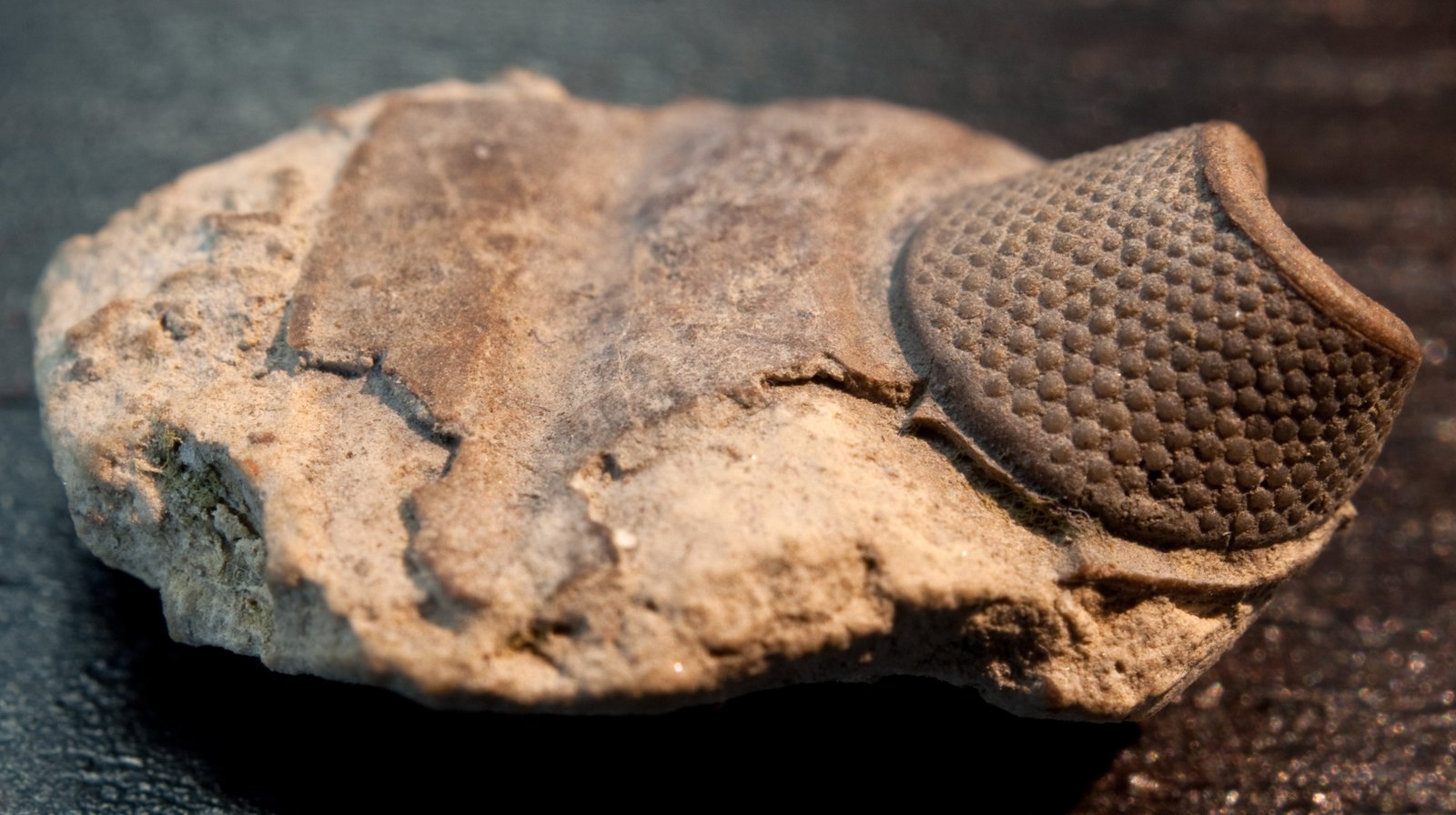
Andrew Parker's proposal is that the first image-forming eye started an arms race. Before eyes, animals met each other by touch and by chemistry, and predation was limited to what you could bump into. Once a predator could see prey at a distance, prey needed armour; armour needed better eyes to defeat; and the loop tightens from there. Trilobite eyes, built of calcite lenses, appear very early in the Cambrian, some with optics sophisticated enough to include doublet lenses that correct for aberration. Our file attaches the objection itself: molecular evidence indicates eyes evolved several times independently, so the timing is about right and the causation is debated.
The predator's eyes survived to be measured. Paterson and colleagues, publishing in Nature in 2011, described Anomalocaris compound eyes carrying about sixteen thousand lenses, among the most complex eyes present at the base of the Cambrian. This is not an inference that eyes must have existed. The lenses are in the rock and somebody counted them.
And the animals rebuilt the floor they were standing on. Before the Cambrian the seabed was a microbial mat, a sealed skin over the sediment. Then animals began burrowing through it, in what is called the substrate revolution. Digging changed nutrient cycling and oxygen distribution and created habitats that had not previously existed. Droser and Gehling's framing, in PNAS in 2015, is that the Ediacaran to Cambrian transition was an environmental transformation and not simply one fauna replacing another. Ecosystem engineers make niches, and niches get filled by whatever is around to fill them.
06The Arguments Our Own File Says Do Not Exist
Gould and Conway Morris disagreed about what the quarry means, and both wrote a book about it. Gould's Wonderful Life (1989) argued that the Cambrian produced more body-plan diversity than exists today, that most experiments died, and that evolution is not a march of improvement but a wild branching later pruned. That is the disparity before diversity model: the big structural innovations happen early, and later evolution mostly varies within plans already fixed. Conway Morris answered in The Crucible of Creation (1998) that convergent evolution shows similar solutions arising again and again, so the Cambrian experiments were not truly random but constrained by physics and engineering. Whether the tape of life would replay the same way is the question underneath it, and it is not settled.
The cosmic proposal exists and does not survive the evidence. Various external triggers have been suggested for the Cambrian: a nearby supernova, impacts, ozone loss raising mutation rates. The most-cited modern version argues for retroviruses arriving from space. Our file attributes it to Wickramasinghe et al. (2018). That is not the paper's lead author. It is Steele et al., Cause of Cambrian Explosion, Terrestrial or Cosmic?, in Progress in Biophysics and Molecular Biology, and it carries thirty-three authors. The file's verdict on the substance stands unchanged and we agree with it: there is no clear evidence for anomalous cosmic events at 541 million years ago, and the endogenous explanations are more parsimonious.
The design argument, and the reply our file never cites. Stephen Meyer's Darwin's Doubt (2013) claims new body plans require new genetic information faster than mutation and selection can supply it. Our file answers at length and answers well: twenty million years is enough under strong selection with large populations; Hox deployment explains new body plans without new genes; small regulatory changes produce large morphological ones; several triggers acted together; and the explosion is less abrupt than it looks because molecular divergence came first. It closes on the strongest point available, that no peer-reviewed paper has needed design to explain the Cambrian data. What it never mentions is that Charles R. Marshall, the first author of two entries in its own bibliography, reviewed Meyer's book in Science under the title When Prior Belief Trumps Scholarship. That review sits at page 1344 of volume 341. Our file cites another paper from the same issue, at page 1355.
And Darwin's own objection has been answered in the only way that counts. Darwin raised the Cambrian as a challenge to his theory and proposed that the Precambrian record was simply unknown. It is not unknown any more: there are Ediacaran fossils, molecular clocks and developmental genetics. Our file's judgement is exact and worth quoting as it stands, because the distinction is the whole thing. The Cambrian explosion is a challenge to gradualism, not to evolution.
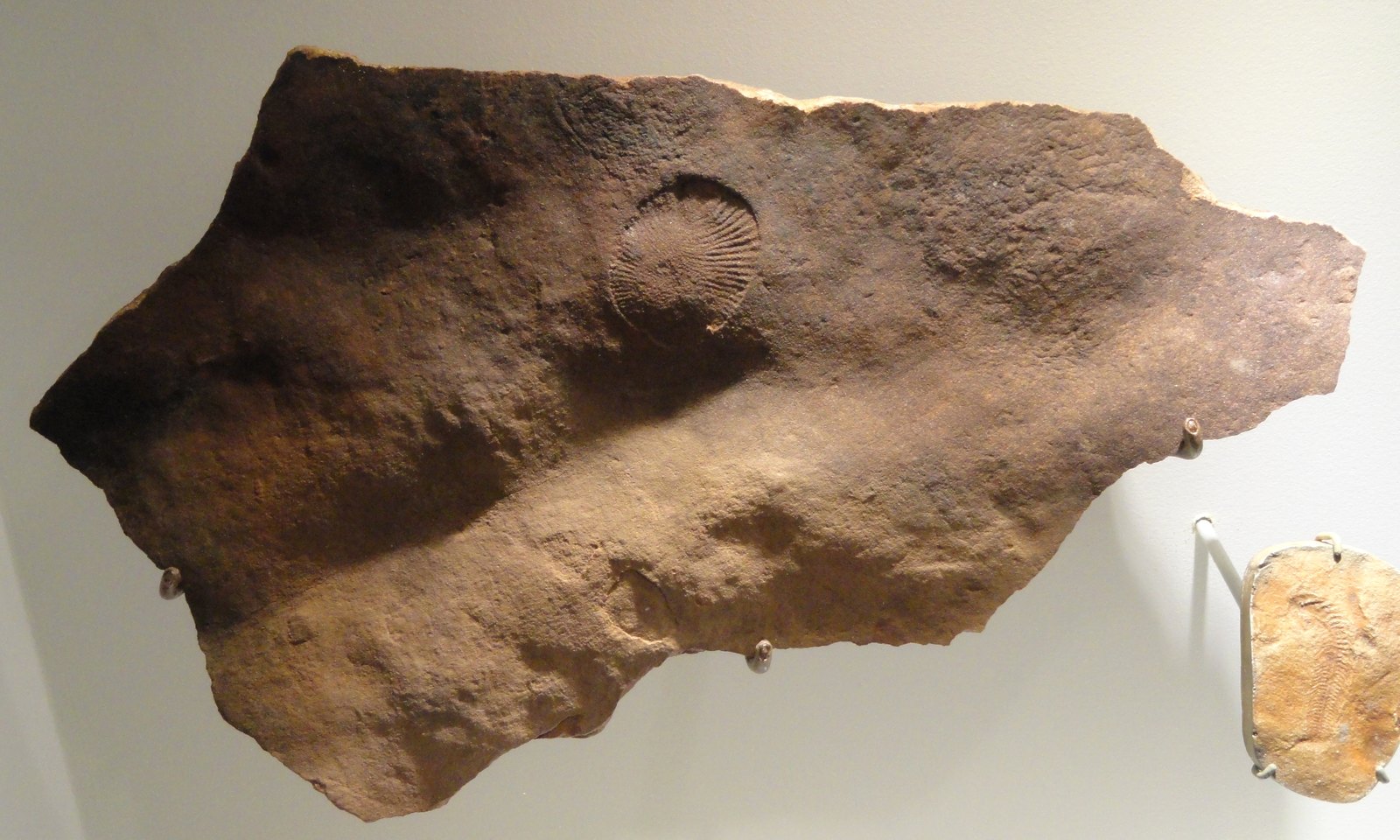
The claim that Cambrian animals have no Precambrian ancestors is out of date. Ediacaran fauna from 575 to 541 million years ago likely include ancestors or close relatives, Kimberella looks like a proto-mollusc, and stem-group bilaterian trace fossils go back to about 555 million years ago. Our file does not overclaim on its own side either. Its wording is that the record is sparse but not absent, which is the honest description of it.
07What We Found Auditing Our Own Citations
This document's citations are the cleanest of the thirty we have audited in this series. All thirteen identifiers were resolved live on 26 August 2026. Nine journal DOIs matched exactly on title, journal, volume, pages, year and first author. All four ISBNs reach the right book. No reviews, no dead links, no drifted targets. The single flaw is a printing: the Gould ISBN is the 1990 Norton paperback attached to the 1989 first-edition date, the eighth wrong-edition ISBN we have found. A reader following it still arrives at Wonderful Life.
That result was written down in advance, from the shape of the bibliography alone. The rule this series has been testing is that a wrong identifier lands on whatever is adjacent in the namespace the identifier itself uses. Journal articles are registered and resolve to themselves. Books mostly are not registered, so whatever fills that field points at something else, most often a review of the book, which is the only other record carrying its title. Nine of this file's thirteen entries are journal articles, so the sealed prediction was nine clean DOIs. The result was nine clean DOIs. The error rate tracks the citation format, and the citation format tracks the discipline. That is why the table below is nearly monotonic.
| Section Of The Library | Files | Correct | Wrong | Correct |
|---|---|---|---|---|
| Genetics and Origins | 1 | 15 | 0 | 100% |
| Molecular Biology | 2 | 9 | 1 | 90% |
| Biology and Evolution | 2 | 18 | 4 | 82% |
| Oceanography | 1 | 10 | 3 | 77% |
| Ecology and Biology | 2 | 18 | 6 | 75% |
| Lost Connections | 2 | 4 | 4 | 50% |
| World Civilizations | 8 | 21 | 35 | 38% |
| Foundations and Scripture | 3 | 6 | 20 | 23% |
| Secret Societies | 4 | 5 | 19 | 21% |
| The sciences together | 8 | 70 | 14 | 83% |
| The humanities together | 17 | 36 | 78 | 32% |
Biology and Evolution was on 56 per cent before today and is on 82 per cent after it. The first file we audited from that section was book-heavy and failed accordingly. This one is article-heavy and passed accordingly. The section did not get better. The citation format changed. That is the strongest evidence yet that the pattern is mechanical rather than a judgement about which parts of our library were written carefully, and it is worth saying plainly because the flattering explanation, that our sourcing has improved over time, was tested against the dates and killed: files updated before 2026 are 65 per cent correct, files updated during 2026 are 47 per cent.
The worst field damage in the entire run sits inside the cleanest file. Ten of the thirteen entries have shattered author lists, and the break is always at an initial. W. W. Norton became a publisher field reading New York: W with W; Norton stranded in a different column. James W. Valentine was cut in half and his surname filed as a publisher. One entry reads Smith, M plus Paul and David A plus T; Harper, which is M. Paul Smith and David A. T. Harper destroyed in a single row. And in the Snowball Earth entry the article number itself, e1600983, has come to rest among the authors, because Science Advances numbers its articles instead of paginating them and the parser had nowhere else to put it. The pointers are perfect and the names around them are wrecked. Only one of those two failures is visible to a link checker.
The rule demonstrated itself while we were not testing it. Looking for a citable record of Meyer's Darwin's Doubt, a book named in our file's section on the design argument and absent from its bibliography, the top result returned was a review of the book, in a journal, with its own DOI. Nobody arranged that. It is simply what the namespace contains when a book has no record of its own: the nearest thing wearing its title.
And then there is the sentence at the bottom of this file. 1,246 of our 3,632 documents carry a verbatim identical line stating that no significant counter-arguments exist in the scholarly literature. Two shapes of contradiction are provable by structure alone. 43 documents place that denial directly beneath their own populated list of disputes. 224 more have a counter-arguments heading whose entire body is the denial, while the file's own reliability field says the subject is debated. Five files manage both. The hard total is 262. A weaker class, judged by wording rather than structure and therefore quoted with less confidence, adds 479 more whose prose states a dispute somewhere. 741 of 1,246 denials are contradicted by their own file.
This file is an instance of both hard shapes at once. Its header reads Tier 1-2 (established with some scholarly debate), and says it twice. Its summary calls the subject one of the most profound puzzles in biology and notes that Darwin himself treated it as a major challenge to his theory. Its section on eyes ends the causation is debated. Its section on Gould and Conway Morris is built entirely on a disagreement. And its counter-arguments section reads, in full, that no significant counter-arguments exist and there is no active scholarly dispute over the fundamental claims presented in this document. A document that calls its own subject one of the most profound puzzles in biology, and then says nobody disagrees about it.
That number has moved twice in two days, both times upward, and that is the finding worth keeping. We first published it as 43. Then a file whose disputes were not filed under a counter-arguments heading showed the detector was measuring the heading rather than the document, and it became 43 plus a weaker 599. Then this file showed that a hollow section plus a header field admitting debate is a harder contradiction than either, and the structural count went from 43 to 262, six times what we first reported. Each time we looked at the instrument harder, the count grew. That makes the current number a floor rather than an estimate, and we are reporting it as one.
Fast Facts
- The wait
- Roughly three billion years in which all life on Earth was single-celled
- The window
- About 541 to 520 million years ago, with peak diversification around 530 to 520. Roughly twenty million years
- What appears
- At least twenty-plus animal phyla, out of about thirty-five alive today, including chordates
- The oxygen change
- From about 1 to 4 per cent of modern levels to about 12 to 15 per cent by the early Cambrian
- The physical limit it lifted
- Without high atmospheric oxygen, diffusion alone cannot supply a body larger than about one millimetre
- The largest predator
- Anomalocaris, about one metre, with compound eyes carrying about sixteen thousand lenses
- The main sites
- Burgess Shale, Canada, about 508 Mya. Chengjiang, China, about 518 Mya. Sirius Passet, Greenland, about 518 Mya. Emu Bay Shale, Australia, about 514 Mya
- What was already in place
- The Hox gene toolkit, duplicated in the Ediacaran or earlier. The Cambrian deployed it rather than inventing it
- The unresolved argument
- Gould's disparity-before-diversity against Conway Morris's convergence. Whether replaying the tape would give the same animals
- Citations in the source file
- 13 of 13 identifiers resolve to the right work. Nine DOIs exact, four ISBNs on the right book, one of those a reprint printing dated to the first edition
- Citations we added
- Four, for works the file names in prose and never cites, including the Science review of Darwin's Doubt by an author already in its own bibliography
What We Can Actually Stand Behind
Three billion years of single-celled life, then about twenty million years in which at least twenty-plus animal phyla enter the fossil record. The sites, the dates and the animals are established. Oxygen rose to about 12 to 15 per cent of modern levels beforehand, and without it bodies larger than a millimetre are not physically supportable.
The Hox toolkit predates the explosion. The genetic innovation came first and the Cambrian deployed it. This is why new body plans do not require new genes, and it is the direct answer to the argument that they do.
Rising oxygen, the first image-forming eyes, the burrowing revolution and carbonate chemistry are all supported and none of them is sufficient alone. The honest reading is that they are conditions that arrived together, not a single cause with three impostors. Parker's Light Switch has the weakest causal claim, by our own file's admission, because eyes evolved several times independently.
How much of the explosion is a preservation artefact. Molecular clocks push the divergences back to 700 to 600 million years ago, but trace fossils made by soft-bodied animals also explode at the Cambrian boundary, and those need no shells to be recorded. Something real happened in behaviour and ecology. How much is still argued.
Whether the Cambrian was wild experimentation later pruned, as Gould held, or a constrained search converging on solutions physics allows, as Conway Morris held. This is the field's central argument and it has not been settled, which is precisely what our source document denies.
That the Cambrian explosion disproves evolution. It is a challenge to gradualism, and Darwin's own version of the objection rested on a Precambrian record we no longer lack. That it happened in a moment: it took about twenty million years, thousands of times longer than recorded human history. That Cambrian animals have no ancestors: the Ediacaran record is sparse, not absent, and Kimberella looks like a proto-mollusc.
That retroviruses arrived from space and triggered the radiation. There is no clear evidence of anomalous cosmic events at 541 million years ago, and the paper making the case is not by the author our own file credits it to.
Sources & further reading
The palaeontology above is drawn from our research library on Theories of Anything. Every identifier below was resolved live against Crossref or OpenLibrary on 26 August 2026, and the four marked as added are works our own file names in its prose without ever citing them.
Image credits
- A trilobite compound eye, the individual lenses visible as separate raised beads Lukas Large, via Wikimedia Commons (CC BY-SA 2.0). CC BY-SA 2.0 Source.
- Dickinsonia costata from the Ediacara Hills, South Australia, on display at the Houston Museum of Natural Science Daderot, via Wikimedia Commons (CC0). CC0 Source.
- Opabinia regalis, Smithsonian specimen USNM PAL 57683, with a 10 mm scale bar Han Zeng, via Wikimedia Commons (CC0). CC0 Source.
- Hallucigenia sparsa, Smithsonian specimen USNM PAL 83935, with a 5 mm scale bar Han Zeng, via Wikimedia Commons (CC0). CC0 Source.
- Marrella splendens, Smithsonian specimen USNM PAL 57674, with a millimetre scale and its hand-written museum label Jean-Bernard Caron, via Wikimedia Commons (CC0). CC0 Source.
.jpg)


