
The Book Of Enoch: Quoted By Scripture, Left Out Of It

The Epistle of Jude quotes it as prophecy. The Church excluded it by the fourth century. Ethiopia kept it as canonical scripture and the West lost it entirely until the eighteenth century. Then eleven Aramaic copies turned up in the caves at Qumran.
There is a short passage in Genesis, four verses, about the sons of God taking the daughters of men and producing the Nephilim. It arrives without warning, explains nothing, and stops. It reads exactly like a summary of something longer that the reader is assumed to know already.
The longer thing survives. It is called 1 Enoch, the Epistle of Jude quotes it as prophecy, and it is not in most Bibles.
01What The Text Says
1 Enoch is a composite ancient Jewish text in five parts: the Book of Watchers, the Book of Parables or Similitudes, the Astronomical Book, the Book of Dream Visions, and the Epistle of Enoch. Our research file gives the Watchers narrative in detail. Two hundred beings called Watchers, in Aramaic irin, the wakeful ones, also called the Grigori, come down to Earth. They take wives. Each named Watcher teaches something: metallurgy and weapons, cosmetics, astrology, and in one case writing itself. The offspring are the Nephilim, and when those die, the text says their spirits stay on as the evil spirits that roam the earth. THAT IS A DIRECT ORIGIN STORY FOR DEMONOLOGY, and it is not in Genesis.

This is the part worth noticing. In the same section that lays out the Nephilim, our research file prints the counter-argument, verbatim: "The phrase 'corruption of all flesh' in Jewish Second Temple literature more likely refers to moral/ritual corruption than biological hybridization. The Nephilim narrative functions as an etiology for the pre-Flood world's wickedness, not as a literal genetic account." It attributes that to Stuckenbruck and puts it directly under the material it undercuts. A file that hands you the deflation of its own most sensational passage, in the same paragraph, is doing the job properly.
The Astronomical Book, chapters 72 to 82, sets out a 364-day solar calendar and detailed celestial mechanics. Our file gives two readings and labels them: MAINSTREAM, that this reflects a priestly calendar tradition competing with lunar calendars, careful observation rather than anything supernatural; and ALTERNATIVE, that the specificity indicates knowledge not expected for the period. It does not blend them into one hedged sentence, which is the failure mode this subject usually produces.
02Quoted By Scripture, Left Out Of Scripture
Jude 1:14-15 directly quotes 1 Enoch 1:9, and names its source: "Enoch, the seventh from Adam, prophesied...". Jude 1:6 refers to the Watchers as angels who did not keep their positions of authority. 2 Peter 2:4 has God casting angels into Tartarus, echoing Enoch's punishment narrative. Hebrews 11:5 and Genesis 5:24 both have Enoch taken by God rather than dying. A BOOK OUTSIDE THE CANON IS QUOTED AS PROPHECY BY A BOOK INSIDE IT.
Our file lists why it was excluded, and the list is more interesting than a conspiracy. The level of detail about non-human beings teaching humanity. The 364-day calendar competing with the established liturgical one. Organised angelic rebellion sitting badly with divine sovereignty. The theological problem of hybrid offspring, which raises questions nobody wanted to answer. The pseudepigrapha objection that Enoch did not write it, which our file notes applies equally to other accepted texts. Being too rooted in Jewish apocalypticism as Christianity separated from Judaism. And the risk that non-human knowledge transmission posed to authority over what is knowable.
03Ethiopia Kept It

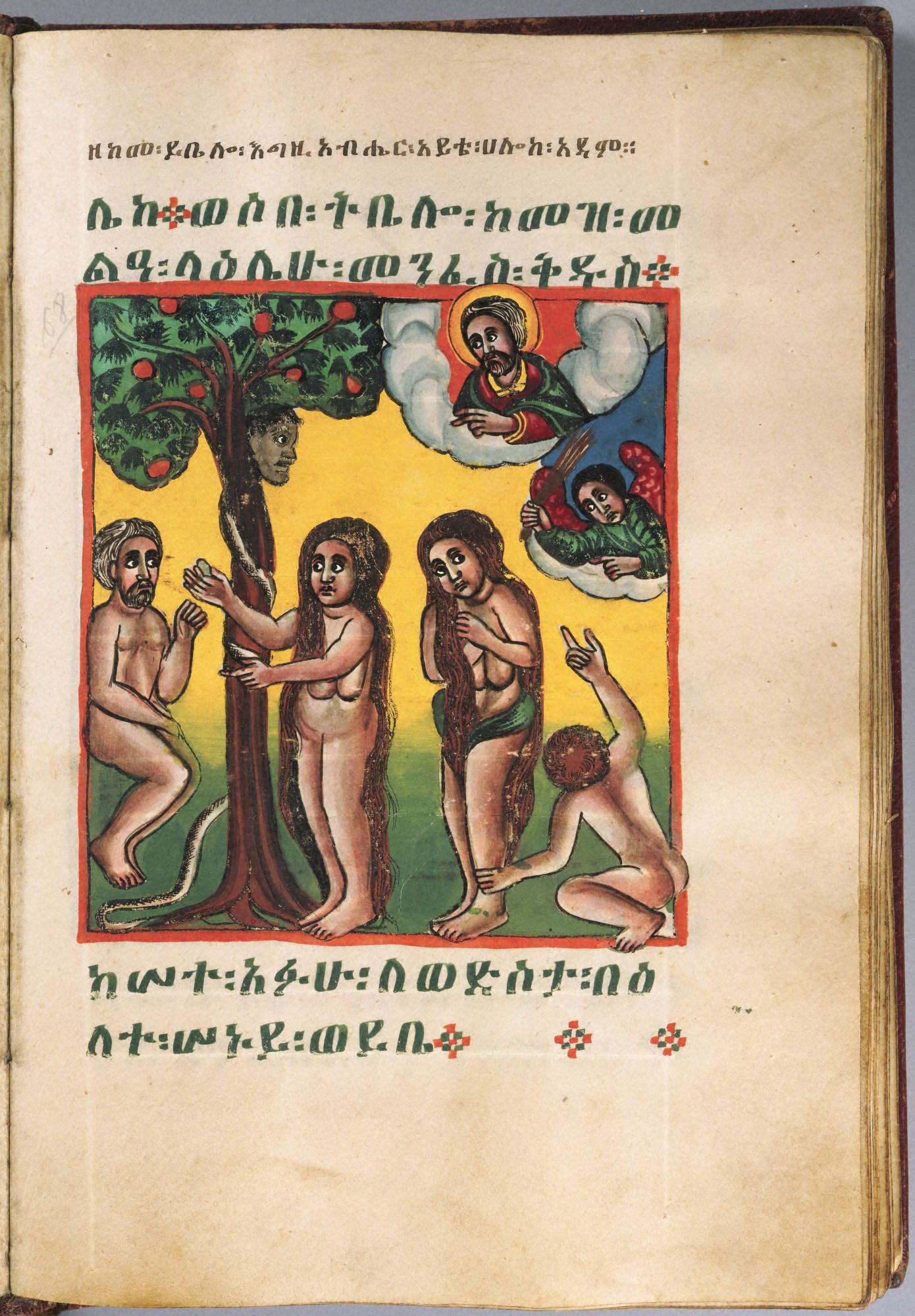
The Ethiopian Orthodox Tewahedo Church, whose name means unified in Ge'ez, holds 1 Enoch as canonical scripture. So is Jubilees. So are 1 and 2 Meqabyan, which are not canon anywhere else and were largely unknown outside Ethiopia. The Kebra Nagast, the Glory of Kings, is the national epic. The West did not lose interest in 1 Enoch. IT LOST THE TEXT ENTIRELY, until the 18th century, and had to go to Ethiopia to get it back.
Eleven fragmentary Aramaic copies of 1 Enoch were found at Qumran, in Caves 1, 2, 4 and 7. That establishes the text as genuinely ancient rather than a medieval Ethiopian composition. AND OUR FILE FLAGS WHAT IS MISSING FROM THEM, which is the more careful move: the Parables, chapters 37 to 71, are absent from Qumran entirely. That absence is the single most argued question in Enoch studies. Our file raises it and does not settle it, which is correct, because it is not settled.
Our file sets the Watchers beside the Mesopotamian Apkallu, the Seven Sages who brought the arts of civilisation to humanity before the Flood, and notes the same narrative arc in the Mesopotamian flood tradition: divine beings teach humanity, then a flood comes as correction. It also notes Zoroastrian dualism between good and evil angelic beings. THE PARALLEL IS OFFERED AS A LITERARY PATTERN, not as evidence that any of it happened, and the difference matters.
04A Note On Our Own Sources, Which Are Rated Five Out Of Five
Every article in this series resolves the identifiers in the research file behind it and reports what comes back. Five previous articles have also quoted a measured signal: each file carries a Source Confidence rating out of five, and files rated four or five have historically carried far better identifiers than files rated two or three. This file is rated five. It is the top of the scale.
Every DOI in this file resolves to a book review rather than to the book it is attached to. Jonathan Ben-Dov in Dead Sea Discoveries, 2013, for Nickelsburg. Joseph Fitzmyer in the Journal of Biblical Literature, 1980, for Knibb. John Gammie in the same journal, 1987, for VanderKam. Hindy Najman in the AJS Review, 2002, for Boccaccini. Sebastian Brock in the Journal of Jewish Studies, 1978, for Milik. Every one is a real, correctly registered review of the right book. Not one of them is the book. THIS IS THE JOINT-WORST IDENTIFIER RESULT IN THE SERIES, from the highest-rated file in it.
The identifier attached to Nickelsburg's 2001 commentary does not resolve to a review of that book. It resolves to Ben-Dov's review of 1 ENOCH 2, the second volume covering chapters 37 to 82, published in 2012. THAT SECOND VOLUME IS ENTRY 11 OF THE SAME BIBLIOGRAPHY, nine rows further down. Same lead author, different book. Whatever attached this identifier found a real review of a real book by the right author and put it on the wrong row, which tells you it was matching an author and a subject rather than a work.
All four ISBNs in this file have valid check digits and all four resolve to the right work. But three of them point at a later printing than the citation describes. Entry 1 cites Charles, 1912, Clarendon Press, and the number resolves to an Abingdon Press reprint of 1988. Entry 7 cites Budge, 1922, and resolves to a Silk Pagoda edition of 2007. Entry 2 cites Nickelsburg, 2001, Fortress Press, and resolves to a Fortress printing of 2011. ONLY ONE IDENTIFIER IN THIS ENTIRE FILE IS EXACT ON EVERY FIELD: the ISBN on VanderKam's 1984 volume, Catholic Biblical Association of America.
ISBNs did not exist before 1970. A book published in 1912 cannot have one. Neither can a book published in 1922. ANY BIBLIOGRAPHY ENTRY WITH A PRE-1970 PUBLICATION YEAR AND AN ISBN IS NECESSARILY DESCRIBING A DIFFERENT PHYSICAL OBJECT FROM THE ONE IT NAMES. The number can be perfectly valid, point at the right text, and still not be the edition cited. That test needs no registry, no network and no judgement, and it can be run across an entire library in one pass.
The identifier on the Boccaccini entry resolves in the registry to exactly what it should, Hindy Najman's review in the AJS Review, with the right title, journal, volume and pages. Its stored target address is on a Cambridge domain that has since been retired. FOLLOWING IT RETURNS A 404, checked twice. That is a fourth state, and it is different from the three this series keeps finding: not a correct pointer, not a pointer at the wrong work, and not an unregistered number. A DOI CAN CARRY PERFECT METADATA AND STILL TAKE A READER NOWHERE, because what the registry actually stores is a web address, and web addresses rot.
The research file audited for this series yesterday, on deep-sea vents, had five bibliography entries whose author lists had been cut at the full stop after a middle initial and scattered into the wrong columns. Here is entry 7 of this file, field by field: "Budge, E.A" then the year, then the title, then "Wallis (trans.)", then the ISBN, then "Oxford University Press". THE AUTHOR IS E. A. WALLIS BUDGE. The parser cut at "E.A." and dropped "Wallis" into a field that now reads like a translator credit. Entry 11 does the same thing to James C. VanderKam. TWO DOCUMENTS, TWO DIFFERENT SECTIONS OF THE LIBRARY, ONE MECHANISM. It is not one file's accident.
| Research File | Rated | Identifiers |
|---|---|---|
| N_2_04, the Nizari Ismailis | 3 of 5 | 0 of 5. Four reviews standing in for the books they review, and a modern extract standing in for Marco Polo |
| W_1_16, the Hittites | 3 of 5 | 6 of 9. Two review-DOIs and one citation whose every locator had drifted |
| ZF_2_22, the hadal zone | 4 of 5 | 10 of 13. Three landing in the right journal and the wrong article |
| F_4_07, Sundaland | 1 of 5, from a source count recorded as zero | 4 of 5, on a bibliography of twenty |
| R_1_19, deep-sea vents | 4 of 5 | 5 of 5 correct and 8 more recovered. 13 of 14 verified |
| A_2_03, this file | 5 of 5, the top of the scale | 0 of 5. Every DOI is a review, and one is a review of a different entry in the same bibliography |
Three works published before this file's last update are not in its bibliography and bear directly on it. Ralph Lee on the reception and function of 1 Enoch in the Ethiopian Orthodox tradition, in Rediscovering Enoch?, Brill, 2023, which is precisely the subject of our file's section on Ethiopian preservation. Alexander McCarron on the Enochic theophany across the Aramaic, Greek and Ethiopic manuscripts, Brill, 2024. And Loren Stuckenbruck asking whether Christian tradition influenced the Ge'ez and Greek versions, in Beyond Canon, 2021, BY AN AUTHOR OUR FILE ALREADY CITES FOR SOMETHING ELSE. NO ABSTRACT IS RETRIEVABLE FOR ANY OF THE THREE and nothing is claimed here about what they conclude.
Fast Facts
- What It Is
- 1 Enoch, a composite ancient Jewish text in five books
- The Watchers
- Two hundred beings, in Aramaic irin, the wakeful ones. Also called the Grigori
- The Calendar
- The Astronomical Book sets out a 364-day solar year
- Quoted By
- Jude 1:14-15, which quotes 1 Enoch 1:9 and names Enoch as its source
- Excluded By
- The fourth century CE, from most canons
- Kept By
- The Ethiopian Orthodox Tewahedo Church, where it is canonical scripture today
- Recovered By
- The West, in the 18th century, from Ethiopia
- Confirmed By
- Eleven fragmentary Aramaic copies from Qumran, Caves 1, 2, 4 and 7
- The Open Question
- The Parables, chapters 37 to 71, are absent from Qumran entirely
- Our File's Identifiers
- Five DOIs, five reviews, zero correct. Four ISBNs, all valid, three pointing at later reprints. One identifier exact
What We Can Actually Stand Behind
1 Enoch exists, is ancient, and is a composite work in five parts. Jude quotes it and names Enoch as the source. It was excluded from most canons by the fourth century. The Ethiopian Orthodox Tewahedo Church holds it as canonical scripture and preserved it when the West lost it. Eleven fragmentary Aramaic copies were found at Qumran in Caves 1, 2, 4 and 7, and the Parables are not among them. And in our own file, all five DOIs resolve to reviews, three of four ISBNs point at later reprints, and one identifier is exact.
The seven reasons our file gives for the exclusion, which are institutional and theological rather than conspiratorial. The reading of the Nephilim narrative as an etiology of pre-Flood wickedness rather than a literal account of hybridisation, which our file itself supplies against its own material. And the Apkallu parallel as a literary pattern in the region rather than as corroboration.
The dating of the Parables. Their absence from Qumran is a fact; what that absence means, whether a later addition or an accident of preservation, is genuinely open and this page does not settle it. And the alternative reading of the Astronomical Book, which our file labels as alternative rather than presenting as established.
Nothing on this page should be read as evidence that non-human beings came down a mountain and taught metallurgy to anyone. The text says that. The text existing and being old is a fact about the text.
The story that gets told about this book is usually one of suppression, and there is something in that. But the shape of what actually happened is stranger and better. A text was quoted as prophecy by a letter that made it into the New Testament, then dropped out of the canon that letter belongs to, then vanished from the West until the eighteenth century, then survived in Ge'ez in the highlands of Ethiopia as ordinary scripture that ordinary people read, then turned up again in Aramaic scraps in a cave above the Dead Sea. Nobody planned any of that. It is just what happens to writing over two thousand years, and the surprising part is how much of it comes back.
Sources & further reading
WHERE THIS WORKED FROM. One file in our own research library, A_2_03, at Source Confidence 5 out of 5, last updated 8 March 2026, plus nine external records resolved live on 26 August 2026. THE SUBSTANCE IS OUR FILE'S AND IT IS GOOD. The five-book structure, the Watchers narrative and the named teachings, the Nephilim, the 364-day calendar, the New Testament quotations, the seven exclusion reasons, the Ethiopian canon, the Qumran count and the Apkallu parallel all come from it. Two things it does are worth naming: it prints the scholarly counter-argument on the Nephilim in the same section as the Nephilim material, and it labels the mainstream and alternative readings of the Astronomical Book as such instead of blending them. THE IDENTIFIER AUDIT IS IN SECTION 04 with a table. ALL FIVE DOIs IN THIS FILE RESOLVE TO BOOK REVIEWS rather than to the books they are attached to, which is the joint-worst result in this series and comes from the highest-rated file in it. One of the five is a review of a DIFFERENT ENTRY in the same bibliography, nine rows further down, which is the clearest evidence yet that these identifiers were attached by matching an author and a subject rather than a work. All four ISBNs are valid and point at the right work, but three point at a later reprint than the citation names, and two of those are detectable with no lookup at all because ISBNs did not exist before 1970 and those entries are dated 1912 and 1922. One identifier in the whole file is exact on every field. AND THE FIELD PARSER FOUND IN YESTERDAY'S AUDIT IS HERE TOO, cutting E. A. Wallis Budge at the initial and stranding Wallis in a translator field, and doing the same to James C. VanderKam. Two documents, two sections of the library, one mechanism. WHAT IS NOT CLAIMED. Twelve bibliography entries carry no identifier; they were not searched and are recorded as unchecked, not clean and not wrong. The Qumran count of eleven copies rests on those unchecked sources. None of the three recovered modern works has a retrievable abstract, so they are cited for their records only. And the dating of the Parables is not settled here, because it is not settled. ON THE IMAGES. Five were fetched and opened and one was dropped for redundancy. Two carry warnings in their captions: the Qumran photograph's own file record does not say which cave it shows, and the illuminated manuscript page is a Genesis scene, NOT a page of 1 Enoch, used to show the Ge'ez script and the tradition that preserved the text.
Image credits
- The Mount Hermon range under snow, near Qalaat al-Jandal Nunusandio, via Wikimedia Commons (CC BY-SA 4.0). CC BY-SA 4.0 Source.
- A cave in the marl cliffs at Qumran Peter van der Sluijs, via Wikimedia Commons (CC BY-SA 4.0). CC BY-SA 4.0 Source.
- Interior of the rock-hewn church of Bet Gabriel-Rufael, Lalibela, Ethiopia A. Davey, via Wikimedia Commons (CC BY 2.0). CC BY 2.0 Source.
- An 18th-century Ethiopian illuminated manuscript page in Ge'ez (a Genesis scene, not 1 Enoch) Unknown Ethiopian illuminator, via Wikimedia Commons (public domain). Public domain Source.


.jpg)
