
Nine Years, And Then Two Centuries Of Rumour
The Illuminati were real. They lasted nine years. A canon law professor at a provincial Bavarian university founded the order on the first of May 1776 with five of his students, a Freemason named Knigge built it up to a membership estimated at between 650 and 2,500, the two men fell out, a handful of ex-members went to the authorities, and in 1785 the Elector of Bavaria banned it out of existence. It killed nobody. It overthrew nothing. Its most famous member joined at the bottom grade and lost interest. Then in 1797 two books claimed it had survived and caused the French Revolution, and it has been running the world in people's imaginations ever since. And when we checked our own file's sources on all this, we predicted in writing what we would find before we looked, and got six out of six.
There is a version of this subject where you already know the ending, and it is the wrong ending. So here is the whole thing in one breath, before the myth gets a word in. A professor of canon law at a small Bavarian university founded a society on the first of May 1776 with five of his own students. A well-connected Freemason joined four years later and built it into something with a few hundred to a few thousand members across the German-speaking lands. The two men quarrelled about what the society was for, and the Freemason walked out. Some men who had already left went to the government and told it everything. The Elector of Bavaria issued edicts, the professor lost his job and left the country, and the society was gone. From founding to suppression: nine years.
In those nine years it killed nobody, overthrew nothing, and fought no one. Its documented activities were recruiting members, giving them reading programmes, helping them into administrative and teaching jobs, and writing each other letters in code. Then, twelve years after it had ceased to exist, two men published two books saying it had secretly survived and caused the French Revolution. Everything you have ever heard about the Illuminati descends from those two books. This article is about the nine years, about the two books, and at the end about something we found when we turned the same scrutiny on our own sources.
01Five Students And A Borrowed Blueprint
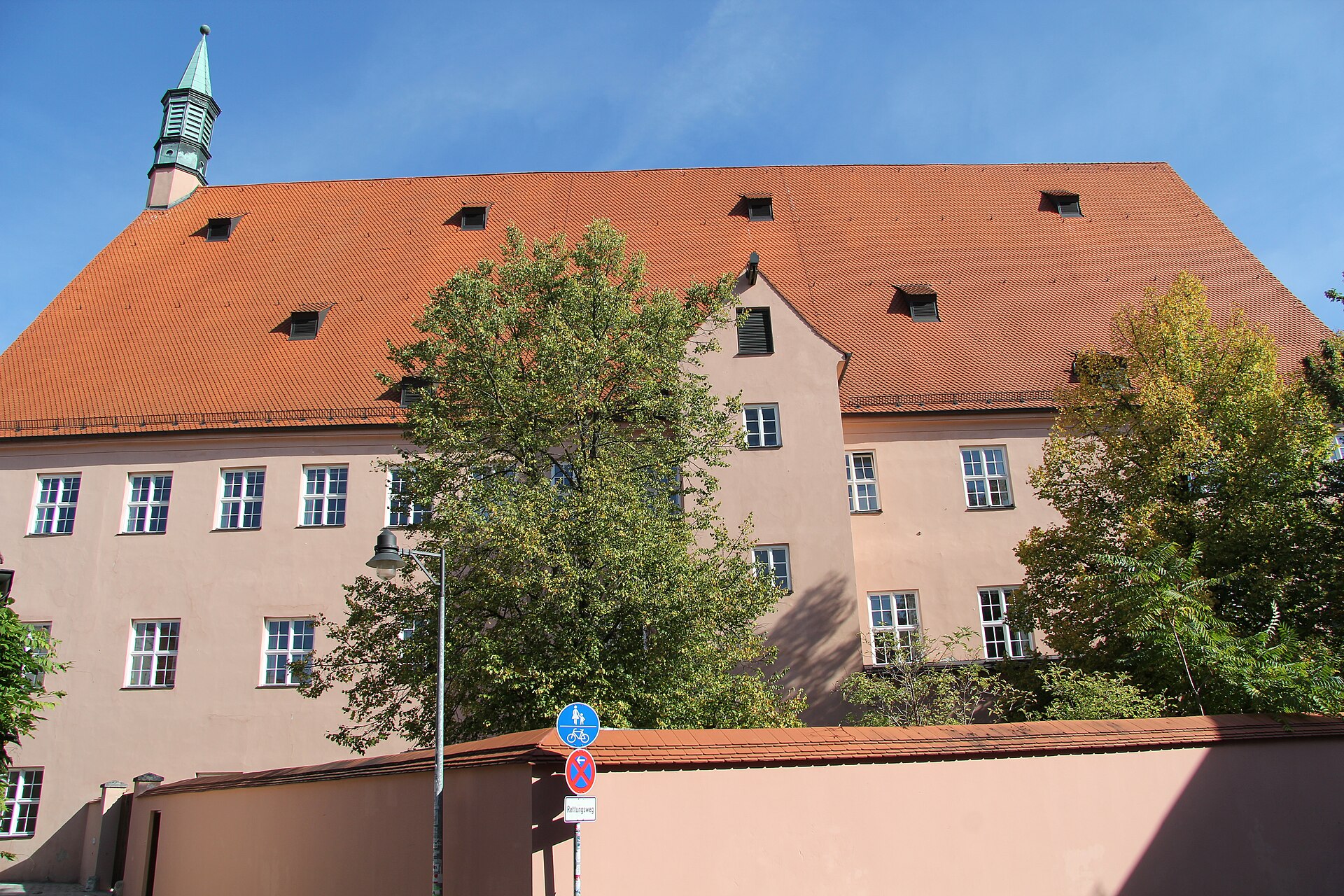
The whole documented history fits between 1776 and 1785. The Order of the Illuminati, the Illuminatenorden, was founded on 1 May 1776 by Adam Weishaupt, professor of canon law at the University of Ingolstadt, with five members, all of them his students, under the name Perfectibilists. It was suppressed by the Bavarian government in 1785, and after that the documented organisation ceased to exist. Nine years of actual existence, set against two and a half centuries of afterlife. Almost everything ever said about the Illuminati concerns a period during which there were no Illuminati.
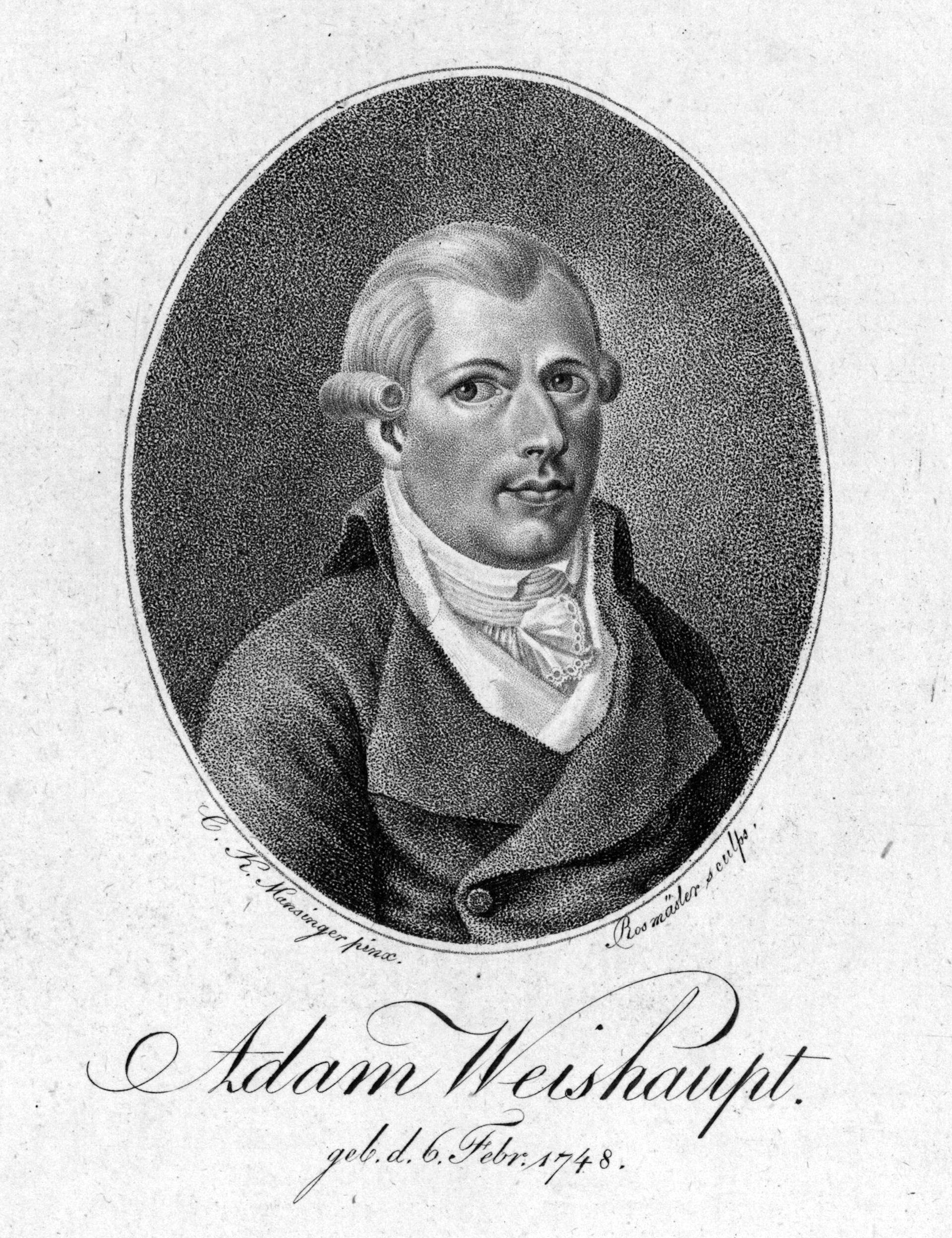
He built his anti-clerical society on a clerical design. Weishaupt was a lapsed Catholic who had been educated by the Jesuits, and our file records that he modelled the order's system of hierarchical obedience partly on the Jesuit order itself. His stated aims were the promotion of rational Enlightenment values, opposition to superstition, religious authority and the abuse of state power, the moral improvement of members through a structured educational programme, and the diffusion of Enlightenment ideas into positions of social influence. He was reading Voltaire, Rousseau and d'Holbach. The content came from the philosophes and the machinery came from the Church.
Before Knigge there were about sixty members. After Knigge, hundreds or thousands. Then he resigned. Adolph Freiherr von Knigge was an experienced and well-connected Freemason. Between 1780 and 1784 he redesigned the grade system, recruited hard out of existing Masonic lodges, and extended the order's reach across Bavaria, Thuringia, Saxony and beyond; estimates of the 1784 peak run from 650 to 2,500. And then the two men fell out, over authority and over doctrine. Knigge wanted more of the mystical and Masonic material that made recruitment easy; Weishaupt insisted on rationalist Enlightenment goals. Knigge resigned in 1784, the year before the suppression, so the order went into its crisis having just lost the person who had built it.
Nine grades, and it is doubtful anyone but Weishaupt reached the top of them. Knigge's ladder ran Novice, Minerval, Illuminatus Minor, Illuminatus Major or Scotch Knight, Illuminatus Dirigens or Scotch Director, Presbyter, Regent, Magus, and finally Rex. Our file supplies the deflating detail itself: it is doubtful that anyone other than Weishaupt ever reached the highest theoretical grades. The pyramid that has decorated a thousand conspiracy diagrams was, in practice, a stairway with nobody on the upper landings.
02What It Actually Did
The code names are real, and they are exactly what you would expect from classically educated men in their thirties. Weishaupt was Spartacus. Knigge was Philo. Munich was Athens. Austria was Egypt. Internal correspondence used these names, and invisible ink. It is worth holding both facts at once: this is genuine operational secrecy, taken seriously by men who could have been imprisoned for it, and it is also a group of professors and civil servants who chose their aliases out of the ancient world.
Several hundred members are known by name, and Goethe was one of them, at the bottom. The records identify minor nobility, academics, merchants, government officials and clergymen: predominantly upper-middle-class and minor aristocratic, and nothing like a popular movement. Named members include Duke Ernest II of Saxe-Gotha-Altenburg, Count Stolberg-Rossla, the publisher and writer Friedrich Nicolai, and the young Johann Wolfgang von Goethe, who joined the Weimar lodge around 1783 as a Minerval, the lowest initiatory grade. Our file describes his engagement as brief and superficial, and notes that his later writings show scepticism toward secret societies. The most famous man ever to join the Illuminati signed up at the bottom and went off the idea.
It never did anything violent. Our file is unambiguous: the order conducted no known violent actions, no assassinations, no revolutions. Its documented activities consisted of recruiting, educating members through structured reading programmes, placing members in administrative and educational positions, and communicating through coded correspondence. Everything sinister that has ever been attributed to this organisation has to be attributed to an organisation that, in the nine years it verifiably existed, ran a reading list and a jobs network.
03How It Ended, And Who Ended It
It was opened up by men who had already been inside. Several ex-members, our file names Joseph Utzschneider in 1783, denounced the order to the Bavarian authorities, with detailed testimony about its anti-clerical goals, its infiltration of Masonic lodges and government positions, and its contempt for organised religion. There is a certain symmetry to it. The society whose method was quiet infiltration was undone not by a spy sent in, but by ordinary disillusionment on the way out.
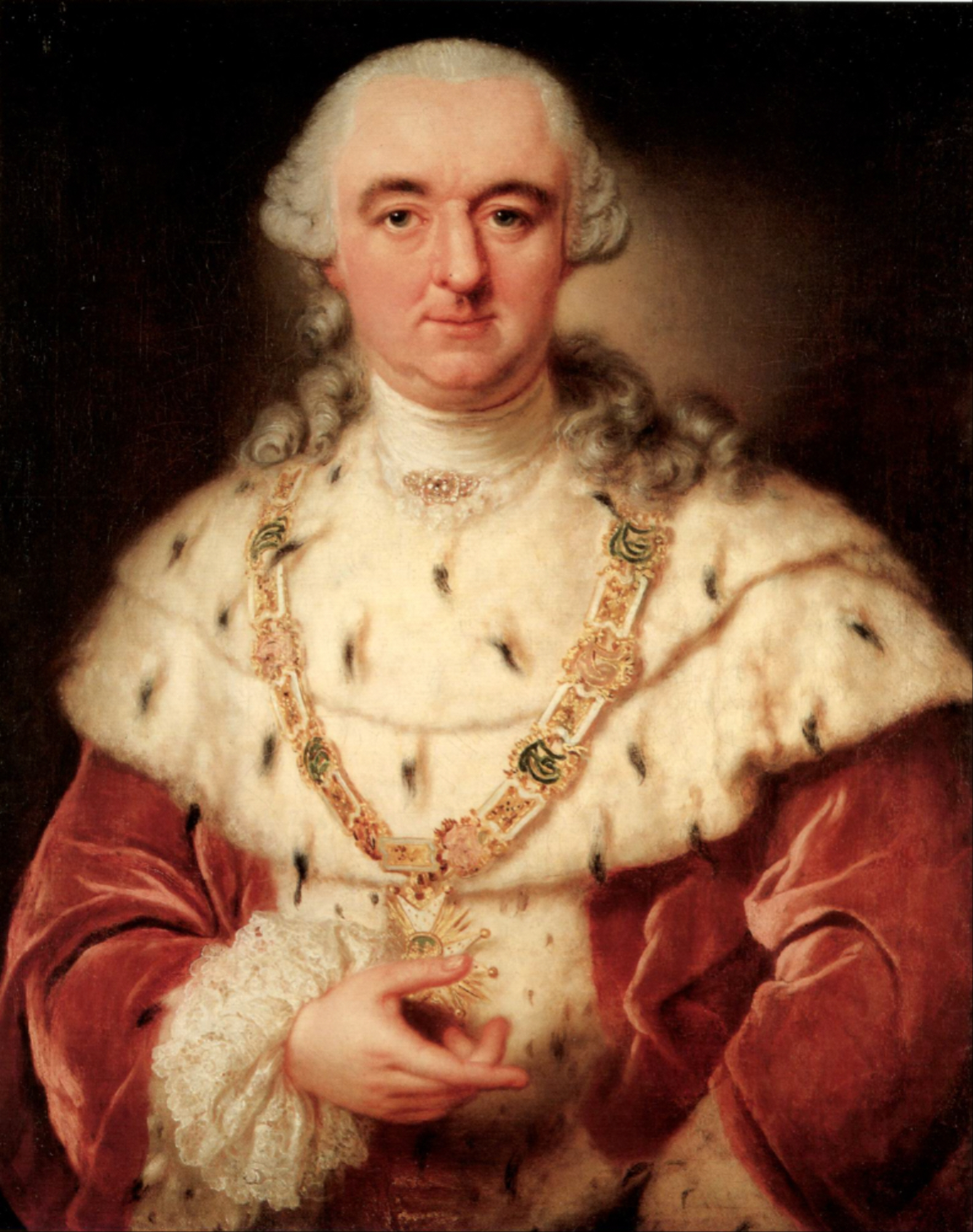
Two halves of the same document disagree about which edict came first. The summary of our research file says that on 2 March 1785 Elector Karl Theodor issued the first of several edicts banning all secret societies. Its own section on the suppression lists his edicts as 1784, 1785 and 1787, which puts one a full year before the one the summary calls the first. We have not independently verified the edict dates, and we are not going to pick a side on the strength of the same document that contradicts itself. What both halves agree on: the edicts progressively banned and criminalised secret societies with the Illuminati specifically targeted, Weishaupt was dismissed from his university post, and he left Bavaria.
A duke who was himself a member took him in and paid him for the rest of his life. Weishaupt fled to Gotha, where Duke Ernest II of Saxe-Gotha-Altenburg, an Illuminatus, gave him asylum and a pension. He lived there until his death in 1830, forty-five years after the order was destroyed. The most dangerous man in Europe, on the account that would later be given of him, spent the second half of his life as a pensioner of a small German court, and died in his eighties.
The Bavarian state seized the papers and then published them. Raids took the order's internal documents, and the government printed them as Einige Originalschriften des Illuminatenordens in 1787, with a supplementary volume the same year. These are genuine documents, and they show real things: rationalist anti-religious rhetoric, plans for gradual infiltration of institutions, the code-name system, and bitter internal power struggles. Now hold the consequence, which our file states plainly. Those same seized papers are the primary evidence base for all subsequent historical analysis and for all subsequent conspiracy theory. The historians and the conspiracists are reading the same book. They are simply reading it at different volumes.
04Two Books In 1797
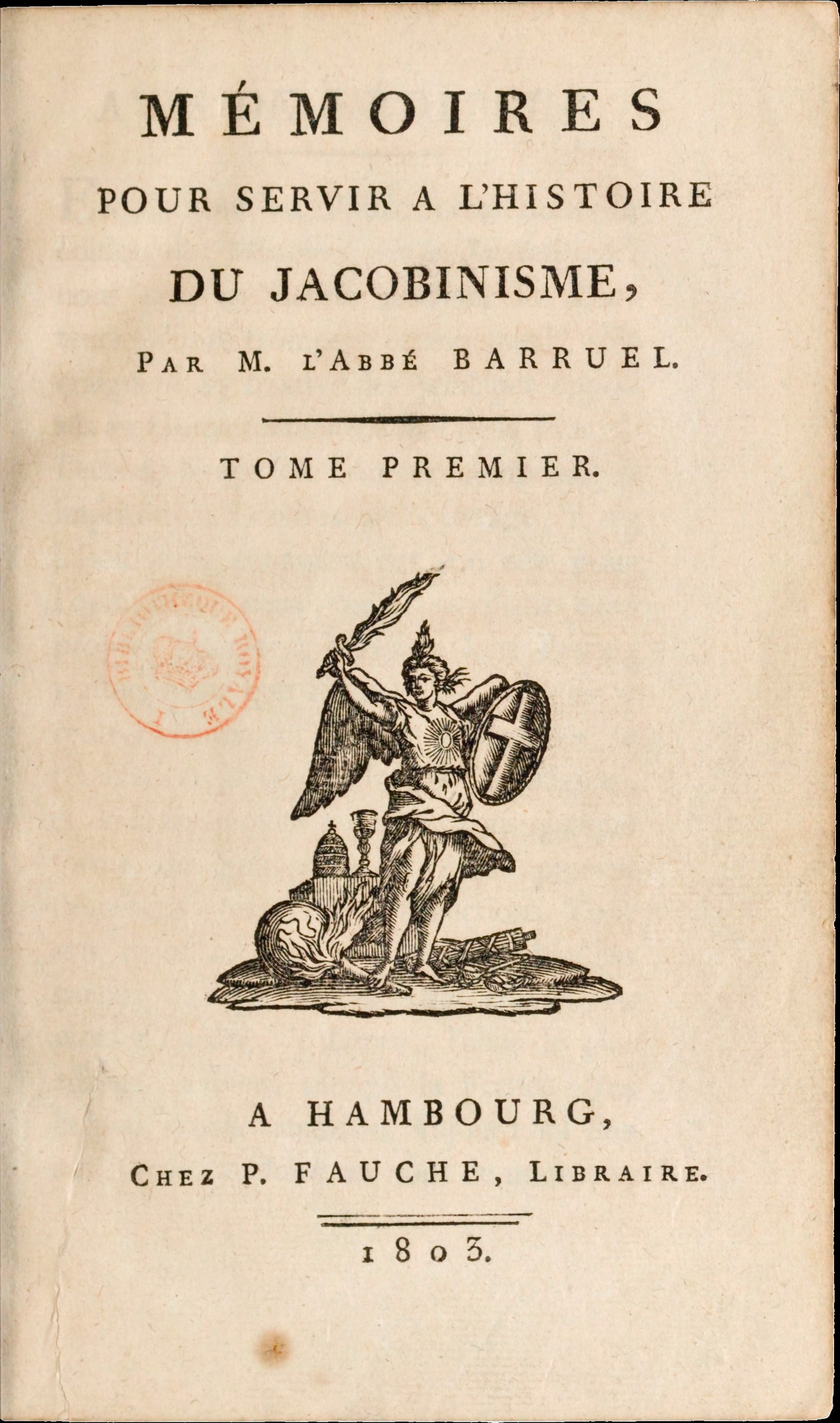
The myth has a birthday, and two authors, in the same year. In 1797 Abbé Augustin Barruel published Mémoires pour servir à l'histoire du Jacobinisme, and the Scottish professor John Robison published Proofs of a Conspiracy Against All the Religions and Governments of Europe. Both argued that the Illuminati had not been destroyed at all, but had gone underground and orchestrated the French Revolution. Every later version of the story, in every language, is downstream of these two books.
The Illuminati did not cause the French Revolution. Our file marks the claim unsupported and gives four separate reasons, any one of which would be enough. The Revolution's causes are comprehensively documented without invoking any secret society: fiscal crisis, social inequality, Enlightenment philosophy at large, food shortages and institutional failure. No credible evidence has ever been produced for the claim. The order had been suppressed in 1785, four years before 1789. And it had no documented presence in France whatsoever. A society that had already been dismantled, in a different country, operating in a different language, is being credited with the best-studied political event in modern European history.
And there is no continuity to the present. Claims that the Illuminati or their successors control world governments, financial systems, media and entertainment are marked unsupported in our file for the plainest of reasons: the documented organisation ceased to exist in 1785, no evidence of institutional continuity has ever been produced, and the Illuminati of modern conspiracy culture is a fictional construct bearing no meaningful connection to Weishaupt's order. Be precise about the shape of that refusal. It is not the claim that powerful people never coordinate, never meet privately, never act against the public interest. It is the narrower and much better supported claim that this particular organisation, the one whose name is invoked, has been gone for two hundred and forty years.
The name stays constant and the contents change every generation. Our file traces the line from Barruel and Robison in 1797, through the Protocols of the Elders of Zion, through Cold War anti-communism, through the New World Order of the late twentieth century, to contemporary theories in the QAnon orbit. Each era pours in whatever it is most afraid of. That is a fair description of how a myth behaves and a poor description of how an organisation behaves. Real institutions have specific enemies, specific interests and specific failures. This one has whatever its accusers currently fear, which is the tell.
Its largest measurable effect may have been to arm the people it opposed. Our file argues that the Illuminati contributed to the radicalisation of the German Enlightenment, with anti-clerical and anti-monarchical ideas circulating through the network and influencing later liberal movements even after the suppression. And then it argues the other way in the same breath, which is the mark of a document being honest with itself: the affair strengthened conservative reaction, because it handed the authorities concrete evidence, however wildly exaggerated in scope, that Enlightenment ideas could be organised into conspiratorial networks. That helped legitimise exactly the suppression of free thought and association that characterised the Restoration era. Weishaupt set out to spread reason quietly, and the most durable thing he produced was a reason to distrust people who meet quietly.
It is also why Freemasonry has never shaken the association. The Illuminati genuinely did infiltrate Masonic lodges; that part is documented and it was the whole of Knigge's recruitment method. Most Masons had no idea there was a separate agenda operating inside their own meetings, which makes them the victims of the infiltration rather than its authors. Barruel and Robison then conflated the two bodies, and our file notes that this conflation established a template that persists in conspiracy culture today. A real infiltration of a real organisation became, and remains, permanent evidence against the organisation that was infiltrated.
Did anything survive 1785? Our file splits the question rather than answering it. Agethen has suggested that Illuminati ideas and informal networks may have persisted among former members, and individual ex-members certainly continued their intellectual and political activities; men who had known each other went on knowing each other. But no evidence supports a reconstituted organisation with continuity of leadership, ritual, or coordinated action. That distinction carries the entire weight of the modern debate. Surviving friendships and shared convictions are not an order. They are an address book.
05A Note On Our Own Sources, With The Prediction Written First
Six identifiers, six predictions recorded in advance, six correct. Building the previous article in this series we noticed something about how bad citations fail. When a wrong identifier is attached to a book, it tends to land on a review of that book, because a book has no neighbouring article and the only other record in the world carrying its title is somebody's review of it. When a wrong identifier is attached to a journal article, it lands on the paper printed beside it in the issue. This file is fourteen entries and not one of them is a journal article. So before resolving anything, we wrote down what the rule predicted: the failures here should be reviews, and there should be no adjacent-article cases at all. Then we checked. One resolved correctly, exactly as predicted. Three came back as reviews. Two came back as something we had also predicted and will come to in a moment.
Each wrong link takes the reader to a genuine article about the book instead of the book. The identifier on Bieberstein's Die These von der Verschwörung resolves to Laurent Theis reviewing it in Annales in 1978. The one on Agethen's Geheimbund und Utopie resolves to Helen Liebel-Weckowicz reviewing it in the American Historical Review in 1986. The one on Israel's Democratic Enlightenment resolves to Marisa Linton reviewing it in the Journal of Modern History in 2014. Every one of those is real, findable, citable scholarship written by a named historian. It is simply not the work our bibliography names, and a reader who follows the link arrives at somebody's opinion of the source rather than the source.
Two entries turned out to be two fragments of the same unrelated book. Both resolve into Hans-Jürgen Schings, Die Brüder des Marquis Posa, De Gruyter, 1996. One of them grabbed a chapter of it and put van Dülmen's name on top. The other grabbed the list of illustrations from the back of the book. That is what one of our fourteen sources actually is: a section headed Nachweis der Abbildungen, meaning the picture credits, entered into a bibliography as a work in its own right, with the publisher standing in the author column. It is not a citation. It is a search result nobody read. And it means our file's count of fourteen sources is not fourteen distinct works.
Run the search yourself and the wrong answers come back ranked first. Ask Crossref today for van Dülmen's Der Geheimbund der Illuminaten and the top five results are all fragments of Schings's book: its bibliography, one of its chapters, its list of illustrations, its table of contents, and its front matter. The reason is mundane and completely determining. De Gruyter registers a separate identifier for every section of a book, apparatus included, and the apparatus of a book about the Illuminati is stuffed with exactly the words you searched for, because a bibliography and an index are nothing but the names of other works on the same subject. A query for one German book about the Illuminati returns the back matter of a different German book about the Illuminati, above everything else.
The empty column had to be filled with something. Both of those fragments come back from Crossref with no author field at all, because a list of illustrations does not have an author. Something downstream needed a name for that slot and used the publisher. That is how a major academic press ended up credited as the author of a source in our bibliography. This is the third time in this run of articles that a publisher has appeared where an author belongs, and it is the first time we can name the mechanism instead of guessing at it.
There is nothing to fix them to. We searched Crossref for a book or monograph record for every monograph in this bibliography, filtering to those types so that reviews could not crowd the results. Van Dülmen 1975: none. Agethen 1984: none. Israel 2011: none. Melanson 2009: none. Roberts 1972: none. What comes back instead is unrelated books; the best match offered for van Dülmen's study of an eighteenth-century secret society was a textbook on solving technical problems in C and C plus plus. These are monographs from publishers that never registered their back catalogues. The correct identifier for all five is no identifier, and an empty field is the truthful state rather than a gap waiting to be filled. One file in this series already gets this right: its entry for Darwin's 1875 book carries no identifier at all and does not borrow a modern reprint's.
The more important the book, the more wrong identifiers exist for it. We counted. Israel's Democratic Enlightenment, the most significant work in this bibliography, returns thirteen candidate review records in the top twenty results and no book record: reviews in Arbitrium, OEconomia, the English Historical Review, the American Historical Review, Choice Reviews Online, The European Legacy, the Journal of Modern History and more. Agethen returns five, including two separate records for the same review. Van Dülmen returns four. Bieberstein returns three. That inverts the intuition completely. You would expect a landmark book to be easier to cite correctly than an obscure one. In a world organised around identifiers it is strictly harder, because prominence manufactures decoys and nobody ever registered the target.
Three entries have a date range in the year field, lifted straight out of the title. One reads 1776 to 1945, which is part of Bieberstein's own subtitle. Another reads 1750 to 1790, which is the tail of Israel's title, Human Rights, 1750 to 1790. A third reads 1776 to 1781, which is the span covered by volume one of the Illuminati correspondence. And in all three cases the real publication year is still present, sitting in the publisher column: Peter Lang 1976, Oxford University Press 2011, Max Niemeyer 2005. Nothing was lost and nothing was invented. A date range was read out of a title and put where a year goes, and the year was left where the publisher goes. The author column has caught the same disease: one entry's author is the title of the 1787 government publication.
| Our File's Entry | Predicted In Advance | What It Actually Returns |
|---|---|---|
| 2. van Dülmen 1975, Der Geheimbund der Illuminaten (Frommann-Holzboog) | Wrong work: a chapter of some De Gruyter book, sharing a book id with entry 14 | A chapter of Schings, Die Brüder des Marquis Posa, De Gruyter 1996. Our file's own bibliographic data is right; only the identifier is wrong. NOT REPAIRABLE |
| 5. Stauffer 1918, New England and the Bavarian Illuminati (Columbia UP) | CORRECT, because the prefix is Columbia's own and the stem matches the author | Vernon Stauffer, that book, Columbia University Press 1918. CORRECT, and the only one of six that is |
| 6. Bieberstein, Die These von der Verschwörung (Peter Lang 1976) | A review in Annales, from the prefix and stem | Laurent Theis reviewing the book, Annales. Histoire, Sciences Sociales 33(4):754-756, 1978. NOT REPAIRABLE, and three reviews exist |
| 8. Agethen 1984, Geheimbund und Utopie (Oldenbourg) | A review in the American Historical Review; the identifier says so on its face | Helen Liebel-Weckowicz reviewing the book, American Historical Review 91(3):683-684, 1986. NOT REPAIRABLE, and five reviews exist including two records for this one |
| 9. Israel 2011, Democratic Enlightenment (Oxford UP) | A review in a University of Chicago journal, since the prefix is Chicago and the book is Oxford | Marisa Linton reviewing the book, The Journal of Modern History 86(1):145-147, 2014. NOT REPAIRABLE, and thirteen reviews exist |
| 14. DE GRUYTER (corp.), Nachweis der Abbildungen | The illustration-credits back matter of the same De Gruyter book as entry 2 | Exactly that: the list of illustrations from Schings, Die Brüder des Marquis Posa. Not a work. A search result |
One file, six identifiers, and four of the calls were half-readable before we started. An identifier's prefix names its registrant, so 10.1086 means the University of Chicago Press and 10.1017 means Cambridge, and one of these six literally contains the letters ahr for the American Historical Review. Reading those is closer to noticing a return address than to predicting the contents of the letter. The genuinely blind calls were the two De Gruyter fragments, where the prediction was that they would turn out to be two pieces of a single book including its back matter, and those are the two that came back most exactly. What the exercise establishes is not that the rule is proven. It is that the rule has predictive content and is not a story assembled after the fact. That distinction is worth more than the score.
Fast Facts
- Founded
- 1 May 1776, at Ingolstadt in Bavaria, by Adam Weishaupt (1748 to 1830), professor of canon law, with five of his students, under the name Perfectibilists
- Suppressed
- 1785, by edicts of Elector Karl Theodor. Our file's summary and its own body disagree on whether the 1785 edict was the first; the body lists edicts in 1784, 1785 and 1787
- Lifespan
- Nine years of documented existence, against 241 years since the suppression. The myth itself is younger than that: it dates from 1797
- Peak membership
- About 60 before Knigge joined; estimates of 650 to 2,500 by 1784. Several hundred are known by name
- Grades
- Novice, Minerval, Illuminatus Minor, Illuminatus Major, Illuminatus Dirigens, Presbyter, Regent, Magus, Rex. It is doubtful anyone but Weishaupt reached the highest
- Code names
- Weishaupt was Spartacus, Knigge was Philo, Munich was Athens, Austria was Egypt. Correspondence also used invisible ink
- Violence
- None. No known violent actions, assassinations or revolutions
- Notable member
- Goethe, who joined at Weimar around 1783 at the lowest grade and whose engagement our file calls brief and superficial
- Weishaupt's later life
- Asylum and a pension at Gotha from Duke Ernest II, himself a member. Died 1830, forty-five years after the suppression
- The evidence base
- The Bavarian government's own publication of the seized papers, Einige Originalschriften des Illuminatenordens, 1787. It is the primary source for the historians and for the conspiracists alike
- The myth's origin
- Two books in 1797: Barruel's Mémoires pour servir à l'histoire du Jacobinisme and Robison's Proofs of a Conspiracy
- Identifier audit
- 6 DOIs checked live 26 August 2026 against a prediction recorded in advance. 1 correct, 5 wrong, 6 of 6 predictions right. None of the five is repairable: no Crossref book record exists for any of the five monographs
What We Can Actually Stand Behind
The order was real and the history is documented. Founded 1 May 1776 at Ingolstadt by Weishaupt with five students. Expanded by Knigge from about 60 members to between 650 and 2,500, and weakened when he resigned in 1784. A nine-grade ladder whose top grades were almost certainly empty. Real code names and real invisible ink. Several hundred members known by name, drawn from the minor nobility and the professional classes, including Goethe at the lowest grade. No violent action of any kind. Denounced by its own ex-members, suppressed by the Elector of Bavaria, and its papers seized and published by the government in 1787. Weishaupt died on a ducal pension in 1830.
The Illuminati plausibly contributed to the radicalisation of the German Enlightenment, and just as plausibly strengthened the conservative reaction that followed by supplying evidence that Enlightenment ideas could be organised conspiratorially. Both readings are in our file, side by side, which is the right way to hold them. The conflation of Illuminism with Freemasonry by Barruel and Robison established a template still running today, and most Masons were the objects of the infiltration rather than parties to it.
Whether ideas and informal networks persisted among ex-members after 1785 is genuinely open, and Agethen has argued they did. What is not open is whether an organisation persisted: no evidence supports continuity of leadership, ritual or coordinated action. Surviving acquaintance is not a surviving order.
The Illuminati did not cause the French Revolution. They had been suppressed four years earlier, in a different country, with no documented presence in France, and the Revolution's causes are exhaustively documented without them. Nor is there any continuity to the present: the documented organisation ended in 1785 and no evidence of institutional survival has ever been produced. What is refused here is specific, and worth stating precisely. It is not the proposition that powerful people ever coordinate in private. It is the proposition that this organisation, the one whose name gets used, is still there.
Six identifiers resolved live on 26 August 2026, against predictions recorded in writing beforehand: six for six. One correct, three reviews standing in for the books they review, and two fragments of a single book our file never cites, one of which is that book's list of illustrations with the publisher entered as its author. None of the five is repairable, because Crossref holds no book record for any of the five monographs; the honest fix is an empty identifier field. Separately, three entries carry a date range in the year column that was read out of the work's own title, with the real publication year stranded in the publisher column. And the file contradicts itself on which of Karl Theodor's edicts came first, which we report rather than resolve. Four of the six predictions were partly readable from the identifier's prefix, so treat six for six as evidence that the rule predicts, not as proof that it is general.
Sources & further reading
The history above is drawn from our research library on Theories of Anything. The external records below are what our file's own identifiers actually resolve to, checked live against Crossref on 26 August 2026. Four of the five works our file cites with an identifier have no Crossref book record at all, so no corrected link can be offered for them; that absence is itself the finding. Open the full research file to check the sourcing and go deeper.
Image credits
- The Hohe Schule, Ingolstadt, seen from the south west Franconia, via Wikimedia Commons (CC BY-SA 3.0). CC BY-SA 3.0 Source.
- Adam Weishaupt, stipple engraving after Mansinger Engraved by Rossmässler, via Wikimedia Commons (public domain). Public domain Source.
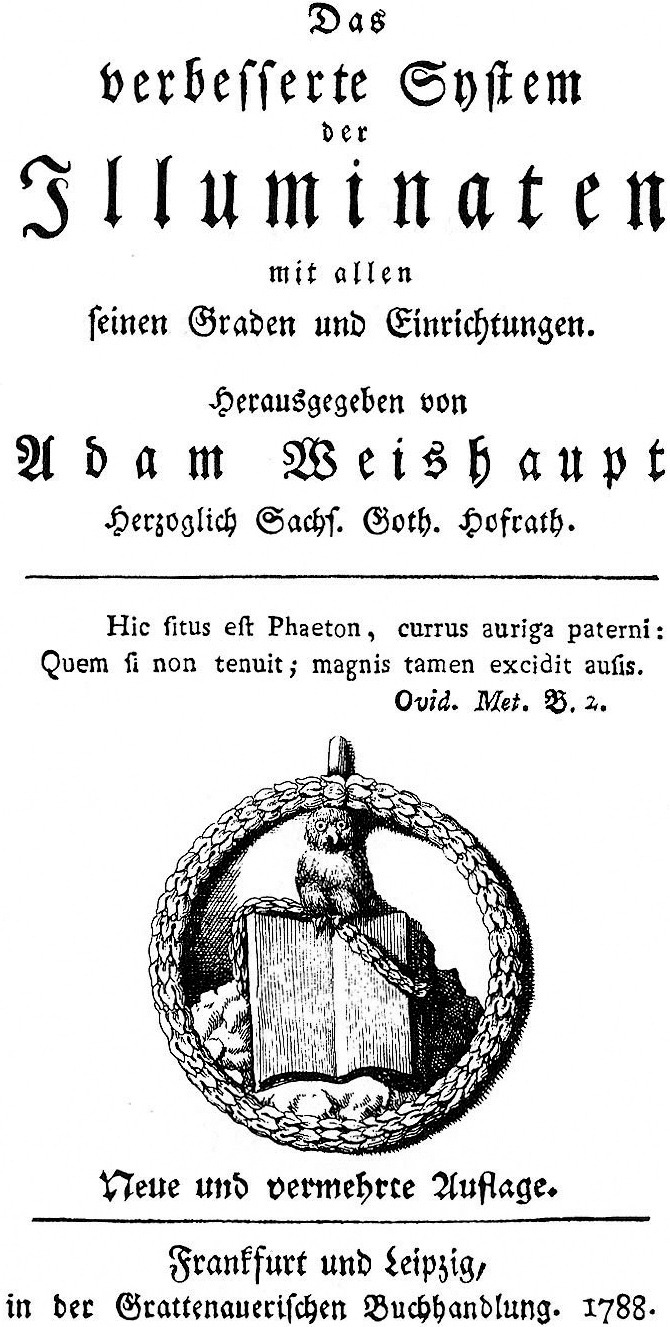
- Title page of Weishaupt, Das verbesserte System der Illuminaten, Frankfurt and Leipzig, 1788 Via Wikimedia Commons (public domain), where the file is named for the insignia it carries rather than the page it shows. Public domain Source.
- Karl Theodor, Elector of Bavaria Anna Dorothea Therbusch, via Wikimedia Commons (public domain). Public domain Source.
- Title page of Barruel, Mémoires pour servir à l'histoire du Jacobinisme, volume 1, Hamburg printing dated 1803 Via Wikimedia Commons (public domain). Public domain Source.


