
Baalbek: Eight Hundred Tonnes, Eight Hundred Meters
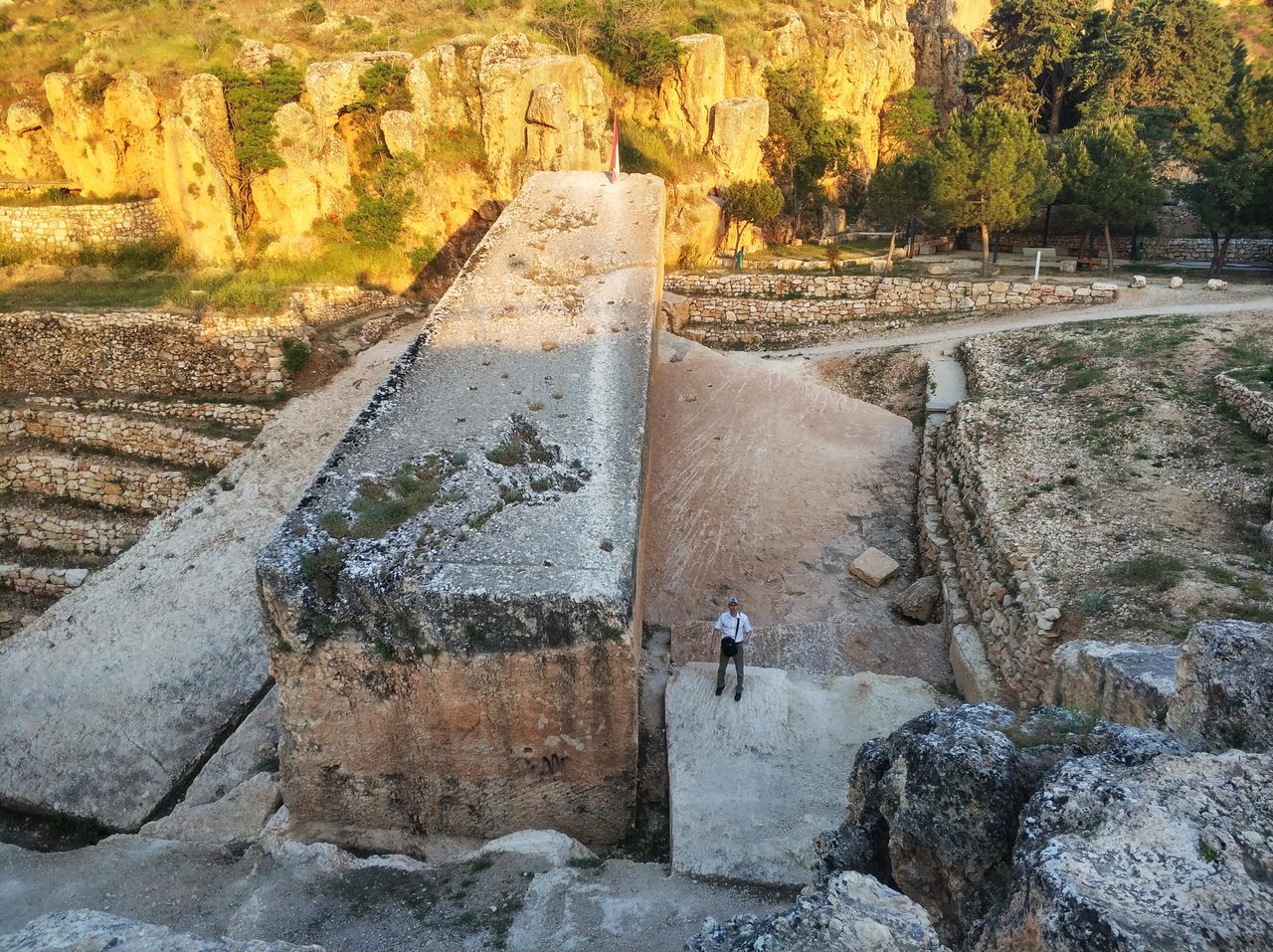
Three limestone blocks sit in the western retaining wall of the Temple of Jupiter at Baalbek. Each is about 19 meters long, each is estimated at roughly 800 tonnes, and each was set about 7 meters up on a course of six blocks running approximately 300 to 400 tonnes apiece. Eight hundred meters south, in the quarry they were cut from, three more monoliths are still lying where they were left: one at roughly 1,000 tonnes, one at roughly 1,240, and one found in 2014 that runs somewhere between 1,500 and 1,650. A fully loaded Boeing 747-400 weighs approximately 397 tonnes. The pottery, the coins, the tool marks, the Latin inscriptions, and the architecture all say Roman. What no Roman source says is how any of it was moved. Here is the file, opened claim by claim, each one wearing its evidence.
Three stones in a wall, and the wall is a retaining wall for a temple podium. That is the whole of it, physically. Each of the three is about 19 meters long, each is estimated at roughly 800 tonnes, and the six blocks holding them up run approximately 300 to 400 tonnes apiece. Eight hundred meters south, in the quarry they were cut from, three more monoliths are lying where they were left, one of them possibly the largest block of stone ever cut by human beings. Everything at the site that can be dated says Roman. Nothing at the site says how the stones got from the quarry to the wall, because no Roman writer thought to write it down. Let's open the file.
01Three Stones In a Retaining Wall
The Trilithon is three limestone blocks set into the western retaining wall of the podium of the Temple of Jupiter at Baalbek. The German Archaeological Institute, the DAI, measured them: the first at approximately 19.6 by 4.34 by 3.65 meters, the second at approximately 19.3 by 4.34 by 3.65 meters, the third at approximately 19.1 by 4.34 by 3.65 meters. Each is estimated at roughly 800 tonnes. Independent checking outside our own library gives 19 by 4.2 by 3.6 meters and 750 to 800 tonnes per block, which is the same stone described to a coarser decimal place rather than a different stone.
The three do not sit on the ground. They rest on a course of six blocks of approximately 300 to 400 tonnes each, and that course rests on a foundation of smaller blocks, where smaller is a relative word. The heaviest stones in this wall are not the lowest ones. They were set on top of a course that would be extraordinary anywhere else.
One number from outside archaeology entirely, for scale. A Boeing 747-400, the classic jumbo jet, has a maximum takeoff weight of approximately 397 tonnes in its heaviest certified configuration, which is 875,000 pounds or 396,893 kilograms; later variants of the 747-400 reach approximately 413 tonnes. A single Trilithon block therefore outweighs a fully loaded jumbo jet by roughly a factor of two, and the largest stone still lying in the quarry outweighs one by roughly a factor of four.
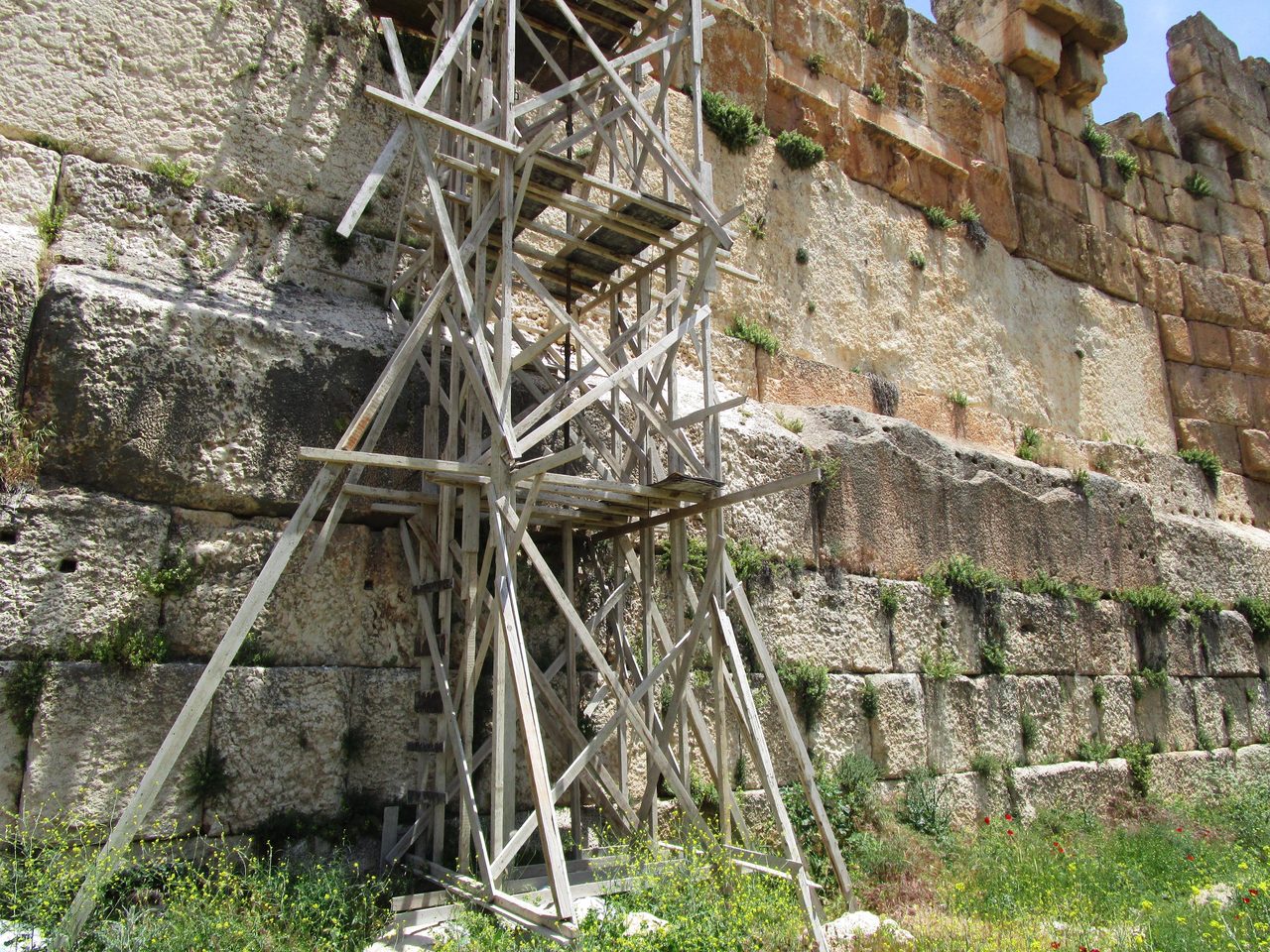
One figure is not agreed inside our own library, and it is worth flagging rather than smoothing. The primary Baalbek file and the construction-methods file both give roughly 800 tonnes per Trilithon block, on the DAI measurements. The general megalith survey file carries a looser quick-reference figure instead: a band starting at about 800 tons per block and running up to about 1,200 tons, with no specific measurement attached to it in that document. This article uses the measured figure throughout, and says plainly that a wider band exists elsewhere in our own corpus.
A stone in a wall has already been moved, which makes it poor evidence about moving. The better evidence is about 800 meters south, where the stones that never made the trip are still lying in the open.
02Eight Hundred Meters South, Still Lying There
The Stone of the Pregnant Woman, Hajjar al-Hibla, lies in the quarry approximately 800 meters south of the temple. It measures approximately 20.3 by 4.0 by 4.5 meters and is estimated at roughly 1,000 tonnes. That weight is not only ours: an Austrian geodetic team confirmed a figure of about 1,000 tonnes in 1996, with the length recorded at 20.31 to 20.76 meters.
A second monolith, found in the same quarry in the 1990s, is estimated at approximately 1,240 tonnes. Independent checking gives 1,242 tonnes for the same block, which is the same measurement rounded differently.
A third was found in 2014 by the German Archaeological Institute team led by Margarete van Ess. It measures approximately 19.6 by 6.0 by 5.5 meters and is estimated at roughly 1,650 tonnes, which would make it possibly the largest block of stone ever cut by human beings. That number needs one qualification stated out loud. Some tellings of the same stone give approximately 1,500 tonnes instead, the gap coming from different density and volume assumptions rather than from a different block. Roughly 1,500 to 1,650 tonnes is the honest range; 1,650 is the figure carried in the reporting closest to the original announcement, and it is the figure this claim opens with.
Detail our file does not carry, added by independent checking. The 2014 block was uncovered by the Oriental Department of the DAI in the summer of 2014, under Margarete van Ess, and the excavation was suspended when the trench became dangerously deep. Van Ess has argued that the block was cut using the same technique attested at the Pont du Gard, the Roman aqueduct in France, which places the cutting method inside the documented Roman repertoire rather than outside it.
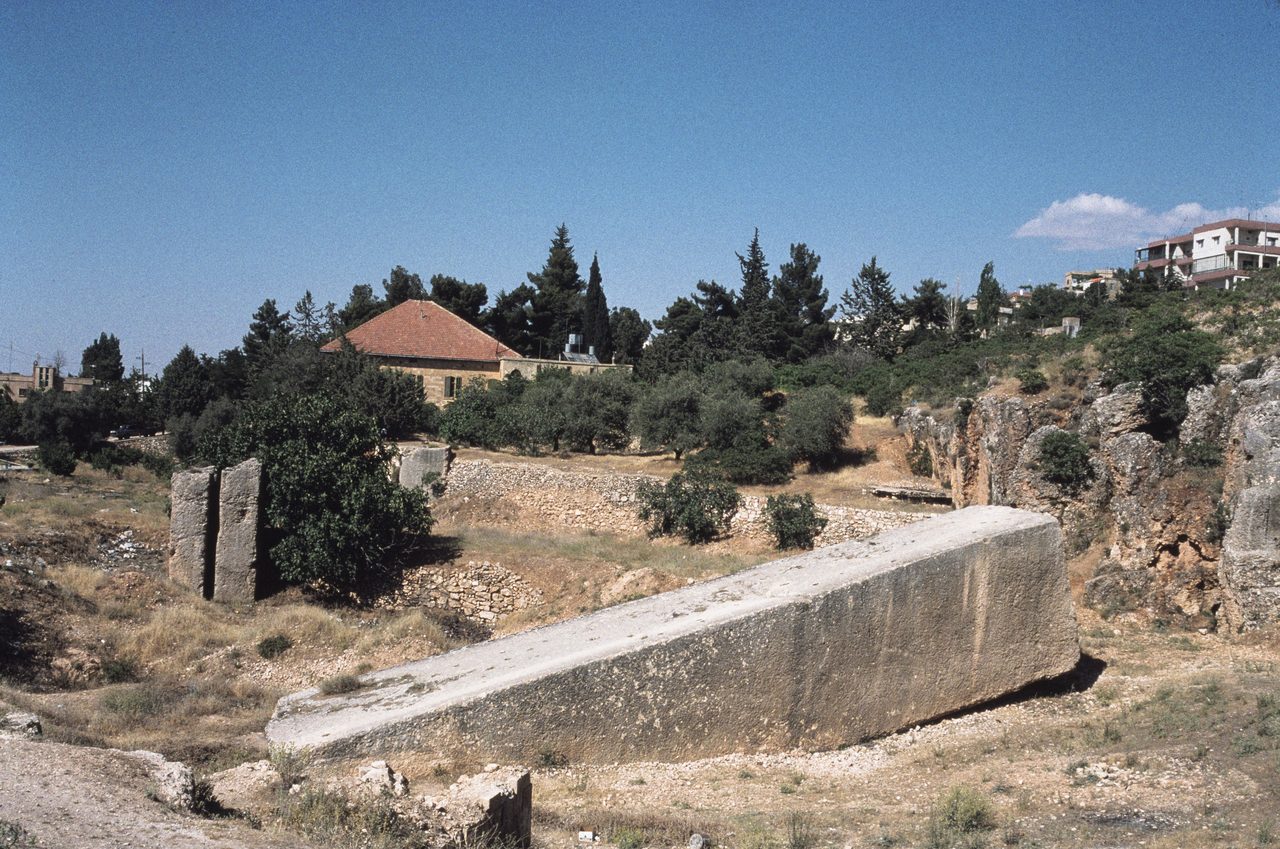
The quarry itself carries the maker's marks. Hajjar al-Hibla shows tool marks from iron wedges and picks, channel-cutting methods consistent with Roman stone-working practice, and monoliths abandoned in place, left either because they cracked or because the project they were cut for was completed or given up.
The quarry sits approximately 800 meters from the temple. That is a significant distance to move a block of this mass, and it is not an impossible one for the ancient world. The engineering question on this page lives entirely inside that distance.
| Stone | Measured Dimensions | Estimated Mass | Where It Is Now |
|---|---|---|---|
| Trilithon Block 1 | About 19.6 by 4.34 by 3.65 meters (DAI) | About 800 tonnes | Set in the western retaining wall of the Temple of Jupiter's podium |
| Trilithon Block 2 | About 19.3 by 4.34 by 3.65 meters (DAI) | About 800 tonnes | Set in the same wall course |
| Trilithon Block 3 | About 19.1 by 4.34 by 3.65 meters (DAI) | About 800 tonnes | Set in the same wall course |
| The Course Beneath Them | Not given in our sources | About 300 to 400 tonnes each, six blocks | Directly under the Trilithon, on a foundation of smaller but still large blocks |
| Stone of the Pregnant Woman | About 20.3 by 4.0 by 4.5 meters | About 1,000 tonnes | Still lying in the quarry, about 800 meters south of the temple |
| The Monolith Found In the 1990s | Not given in our sources | About 1,240 tonnes | Still lying in the same quarry |
| The Monolith Found In 2014 | About 19.6 by 6.0 by 5.5 meters | About 1,500 to 1,650 tonnes | Still in the quarry, partly excavated; the dig was stopped when the trench grew dangerously deep |
Two of those rows carry no dimensions because our sources give none, and filling them in would be inventing. What the table does show is a working quarry that produced a graded series. The stones that went into the wall are the lighter ones. The heavier ones are the ones that stayed.
03The Unexciting Evidence Says Roman
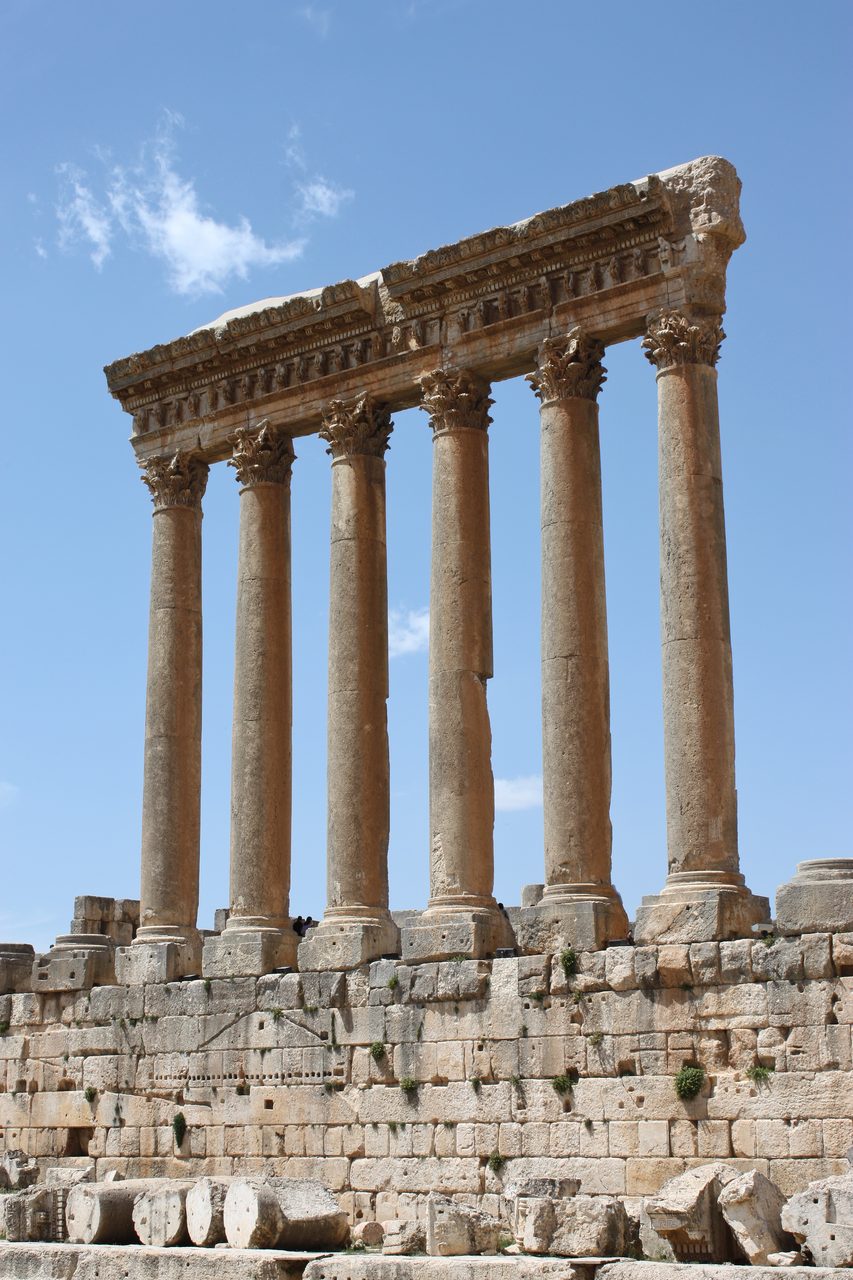
The Temple of Jupiter at Baalbek was built under Roman imperial patronage, from the late 1st century BCE into the early 1st century CE, with construction continuing through the 2nd century CE. The adjacent Temple of Bacchus was built under Antoninus Pius, who reigned from 138 to 161 CE. This is a sanctuary raised over generations, not a single campaign.
Pottery, coins, building techniques, architectural style, and Latin inscriptions all date the temple complex to the Roman period, and they agree with each other. No credible evidence for pre-Roman megalithic construction has been found at the site. That is five different kinds of evidence, each of which could have dissented and none of which does.
The podium, the Trilithon included, was integral to the Roman architectural design. It was not a pre-existing structure that the Romans found and reused, which is the specific thing the alternative readings in section 08 need it to be.
Notice how ordinary that evidence is. Pottery, coins, technique, style, inscriptions: not one of those is dramatic by itself, and that is the point. Archaeological dating usually looks like this when it is working, a mass of unremarkable material all pointing the same way, and it is a difficult kind of proof to argue against, because there is nothing dramatic to knock over.
04Pre-Industrial Loads, For Scale
Before any question of method, a question of plausibility. Is 800 tonnes outside what people without engines have actually moved? The answer is no, and it does not rest on archaeological inference. It rests on documented operations with names, dates, and headcounts attached.
Engineering historians, citing Adam, note that Roman engineers came to a problem like this with practice behind them. They had moved obelisks and columns. They had access to large labor forces and to draft animals. And they had sophisticated lifting machinery, within limits that section 06 gets to.
The Vatican Obelisk in St. Peter's Square weighs approximately 327 tonnes. It was moved and re-erected in 1586, under Pope Sixtus V, by the architect Domenico Fontana, using roughly 900 men, 75 horses, and a system of capstans, in an operation that ran roughly five months. Our own file gives approximately 323 tonnes for the same obelisk, which is rounding variance against the independently sourced figure rather than an error, and this article does not correct it in either direction.
Our file's second comparison carries a genuine factual error, and correcting it makes the comparison stronger rather than weaker. The file's summary describes the Thunder Stone, the pedestal cut for the Bronze Horseman statue of Peter the Great in St. Petersburg, as weighing approximately 400 tonnes when it was hauled overland in 1770. The real figures are far larger: approximately 1,500 tonnes as quarried at Lakhta in 1768, carved down during the 1770 overland transport to a finished weight of approximately 1,250 tonnes. Two independent lines converge on that, including a secondary summary of Adam's own 1977 Baalbek study, which gives the stone at 1,250,000 kilograms and has Adam using it as a comparison point at roughly 1.5 times the weight of a Trilithon block. The corrected figures are the ones this article uses; our file's number is quoted here only in order to retire it.
| The Load | Its Mass | What the Move Actually Took |
|---|---|---|
| A Baalbek Trilithon Block | About 800 tonnes | Unrecorded. About 800 meters from quarry to podium, then up to podium height |
| The Vatican Obelisk, 1586 | About 327 tonnes | Roughly 900 men, 75 horses, and a system of capstans, over roughly five months, under Domenico Fontana for Pope Sixtus V |
| The Thunder Stone, 1768 to 1770 | About 1,500 tonnes as quarried, about 1,250 tonnes finished | Carved down during the overland haul from Lakhta to St. Petersburg, where it became the pedestal of the Bronze Horseman |
| A Boeing 747-400, For Comparison Only | About 397 tonnes at maximum takeoff weight | Not a haulage operation. Listed because it is the mass most readers can picture |
None of that is a Roman operation at Baalbek, and none of it describes how the Trilithon was moved. What it retires is one specific argument, and only that one: the claim that 800 tonnes is a mass pre-industrial people could not shift. A 327-tonne obelisk went up in 1586 on roughly 900 men, 75 horses, and capstans. A stone of roughly 1,250 tonnes was hauled overland in 1770, and carved down on the way. The Trilithon blocks sit between those two, and they only had to travel about 800 meters.
05The Method Nobody Wrote Down
The exact method used to transport the Trilithon blocks from the quarry to the temple is not definitively known. No Roman source specifically describes how these particular blocks were moved. Everything that follows in this section is built on top of that sentence, and none of it is allowed to forget it.
What exists instead is a set of proposals, every one of them mechanically ordinary. Earthen ramps with timber rollers or sledges, worked by hundreds or thousands of laborers. Capstan and windlass systems, for mechanical advantage. Temporary roadways surfaced for low friction, with wet clay or grease.
One further proposal is not about equipment at all: a pre-planned downhill gradient, with the quarry sitting at slightly higher elevation than the temple. If that is right, then part of the transport solution was settled before a single stone was cut, at the moment somebody decided which end of the slope the quarry would be on.
There is a dedicated engineering study of exactly this question, and our own file cites it without listing it. Jean-Pierre Adam published A propos du trilithon de Baalbek in the journal Syria, volume 54, in 1977, at pages 31 to 63: a French-language article proposing a specific capstan-and-roller transport system for the roughly 800-tonne blocks. Our file's transport section cites Adam with the year 1977 attached to the title of his general 1994 book Roman Building, which folds two separate publications into one reference, and its bibliography then lists only the book. The 1977 article was identified through a secondary summary that carries the full citation; the French original was not read for this article, and this article does not pretend otherwise.
This is where the specifics stop being reliable, so this article will not hand anyone a headline number. Two independent secondary summaries of Adam's 1977 study give different equipment and workforce figures, and they do not appear to be describing the same modeled scenario. One has a full-scale block of roughly 800 tonnes moved by six capstans, 144 men, and roughly 78 tonnes of traction. The other has an explicitly scaled test case of 557 tonnes estimated to need 512 workers across 40 capstans on a ramp of 20 percent gradient. As stated, those are not two accounts of one calculation, and neither could be reconciled against the French original, which was not read. This article names the disagreement rather than picking a side or splitting the difference, because averaging two numbers that measure different things produces a third number that measures nothing.
Modern computational work points the same direction without closing it. Secondary summaries refer to finite-element re-analyses dating to the 2000s, estimating that moving an 800-tonne block on timber rollers up a ramp with a coefficient of friction around 0.2 would require a pulling force on the order of roughly 300 tonnes. That figure is carried here as an order of magnitude and nothing further. The original study was not identified by name and not located, so this article attaches it to no author and no paper, and a reader should take it as an illustration of the size of the problem rather than as a citation. It also does not sit alongside the traction figure in the previous claim: roughly 78 tonnes and roughly 300 tonnes describe different modeled arrangements, not two estimates of one quantity.
| The Proposal | What It Says | What It Rests On |
|---|---|---|
| Ramps, Rollers, and Sledges | Earthen ramps with timber rollers or sledges, worked by hundreds or thousands of laborers | General Roman practice. No source describes its use on these particular blocks (Tier 2) |
| Capstans and Windlasses | Capstan or windlass systems for mechanical advantage, the arrangement Adam's 1977 study models in detail | Adam, Syria (1977), read here only through secondary summaries that disagree on its numbers (Tier 2, with the specific workforce figures at Tier 3) |
| A Temporary Roadway | A temporary roadway surfaced for low friction, with wet clay or grease | Proposed method. No direct evidence of it at this site (Tier 2) |
| The Downhill Gradient | The quarry sits at slightly higher elevation than the temple, so the haul was planned to run downhill | Proposed method, and a claim about the site's own layout rather than about equipment (Tier 2) |
| Finite-Element Modeling | Moving an 800-tonne block on timber rollers up a ramp at a friction coefficient around 0.2 needs a pull on the order of roughly 300 tonnes | Secondary summaries only. The original study was not located, and it is attributed to nobody here (Tier 2) |
Look at the shape of that section again, because it is an unusual shape and it is the honest one. The mechanism is not in doubt. Levers, ramps, rollers, and capstans are ordinary equipment, and they scale with labor. What is missing is the specific: which combination, how many people, across how many days, over what surface. Our file grades this section credible rather than verified, and the two disagreeing summaries above are precisely why a confident number would be the least trustworthy sentence on this page.
06Getting It Seven Meters Up
The Trilithon blocks were placed at podium height, approximately 7 meters above the ground. The likeliest explanation is the one that leaves nothing behind: earthen construction ramps, filled in sequentially as the courses were laid, then removed once the wall was finished. A ramp that is dismantled on completion is invisible to archaeology by design, which is part of why this stays at Tier 2 and is likely to remain there.
Roman lifting machinery does not explain this. Treadwheel cranes handled blocks up to roughly 7 tonnes. A Trilithon block is estimated at roughly 800 tonnes, so it was never lifted in any ordinary sense of the word; blocks at that scale were moved horizontally instead. That is not a gap anyone closes with a bigger crane, and it means the ramp is not a convenience inside the proposal. It is the only way the geometry works at all.
So the placement problem and the transport problem turn out to be one problem. If the stone cannot be lifted, the ground has to be raised to meet it: hauled up a slope of earth by the same kind of capstans and rollers proposed for the haul out of the quarry, and then the slope has to be carried away again by hand. That last step is the largest invisible thing at Baalbek. Every photograph of the wall is a photograph of work that was undone on purpose.
07Why Cut Them That Big
Underneath the engineering question sits a stranger one, and our file treats it as genuinely open. Nothing about a temple podium requires a single stone to be about 19 meters long. Several smaller blocks would have held the same wall up, and would have been very much easier to move. Somebody chose the harder problem on purpose.
The first explanation is structural. Massive monoliths may carry a structural or seismic advantage over jointed courses, meaning courses assembled from smaller stones with seams running between them. A wall with fewer seams has fewer places to come apart.
The second is political and religious: monumental scale as a demonstration of imperial power. That is a reason to prefer the harder method rather than the easier one, which is exactly what needs explaining here.
The third is geological opportunity. The local limestone quarried cleanly in enormous slabs, so the size may have been offered by the rock before it was chosen by anybody.
Those three are not exclusive, and the third one reframes the other two. If the stone came out of the ground in slabs of that size already, then the Roman decision was not to cut something impossible. It was to keep what the quarry handed them instead of breaking it down into pieces a work gang could carry. The quarry evidence in section 02 is consistent with that reading. It does not confirm it.
08Where the Story Runs Off the Map
A wall like this pulls large stories toward it. One of them is a real proposal that deserves its strongest statement before it gets its counter-evidence. The others fail outright. All of them are worth walking through plainly, because the documented version of Baalbek is stranger than any of the substitutes offered for it.
Alternative authors, Graham Hancock and Brien Foerster among those our file names, have argued that the Trilithon predates the Roman construction by thousands of years: a platform raised by an earlier and unidentified civilization, or in some tellings a pre-Flood one, which the Romans found in place and built their sanctuary on top of. Put at its strongest, the case runs like this. The blocks are far heavier than anything Roman lifting machinery could handle. No Roman source describes the operation that put them where they are. The engineering accounts that do exist are modern reconstructions, and the two most detailed summaries of the best of them do not agree with each other. From that, the argument concludes that somebody else set these stones first.
Our file's own assessment is that the case turns on an assumption rather than on a finding: the assumption that Roman technology could not move 800-tonne blocks. That is an argument from incredulity, which is a statement about what the arguer finds believable and not a statement about the stone. And the positive evidence such a claim would need has not appeared. No pre-Roman artifacts, no pre-Roman construction methods, and no pre-Roman dating evidence have been found beneath or within the Trilithon.
Set against the proposal, the ordinary evidence is unanimous and dull. Pottery, coins, building techniques, architectural style, and Latin inscriptions all date the complex to the Roman period, and no credible evidence for pre-Roman megalithic construction has been found. The podium, Trilithon included, was integral to the Roman architectural design rather than a pre-existing structure the Romans reused. The quarry that supplied it carries Roman tool marks and Roman channel-cutting, with monoliths abandoned mid-project.
Notice what would settle this, and what would not. A single pre-Roman artifact under the Trilithon would do it, and it would do it immediately. Another argument about how heavy 800 tonnes feels would not, however many times it is made. The Tier 3 grade here is not politeness. It is the grade for a claim that has an available falsifier, has had somewhere to look for it, and has not found it.
No, Baalbek was not built by extraterrestrials, and it was not built by Biblical giants. The extraterrestrial version, popularized by Erich von Daniken in Chariots of the Gods, has no archaeological support of any kind. All physical evidence from the site is consistent with Roman construction techniques, Roman materials, and Roman dating.
No, there was no anti-gravity and no acoustic levitation. Claims that the builders used exotic technologies of that kind are completely unsupported, and they are also unnecessary, which is the part worth sitting with. The blocks could be moved using known mechanical principles, levers, ramps, rollers, and capstans, given sufficient labor. Extraordinary is the right word for what happened here. Supernatural is not.
Our file closes on a distinction this article has been circling the whole way down. The Trilithon is genuinely remarkable engineering. Remarkable does not mean impossible with ancient technology. Roman engineers operated at scales that continue to impress, and the Trilithon represents the extreme end of their demonstrated capabilities rather than evidence of a civilization nobody has otherwise found.
09The Site Today
Baalbek remains an active UNESCO World Heritage Site, and it has recently been very close to a war. During the 2024 Israel-Hezbollah conflict, Israeli strikes hit Baalbek city, damaging the Ottoman-era Manshiyeh house, the 150-year-old Hotel Palmyra, and part of the historic north gate. UNESCO's own remote-sensing assessment reported no identified damage to the Temple of Jupiter or to the Trilithon itself. As of 2026, travel-industry reporting has the site drawing visitors again, as part of a wider recovery in Middle East archaeological tourism.
That is a footnote to the engineering and it is not nothing. The stones have now outlasted the empire that set them, the quarry crews who cut them, and a good deal of what has happened in the valley since. Whatever moved them, it set them down to stay.
Fast Facts
- The Site
- Baalbek, Lebanon: the Temple of Jupiter complex, an active UNESCO World Heritage Site
- The Trilithon
- Three limestone blocks in the western retaining wall of the temple podium, measured by the German Archaeological Institute at approximately 19.6, 19.3, and 19.1 meters long, each approximately 4.34 by 3.65 meters in section, each estimated at roughly 800 tonnes
- What Holds Them Up
- A course of six blocks of approximately 300 to 400 tonnes each, resting in turn on a foundation of smaller but still large blocks
- Placement Height
- Approximately 7 meters, at podium height, most plausibly reached by earthen ramps filled in as the courses were laid and then removed (Tier 2)
- The Quarry
- Hajjar al-Hibla, approximately 800 meters south of the temple, showing iron wedge and pick marks, channel-cutting consistent with Roman practice, and monoliths abandoned in place
- Stone of the Pregnant Woman
- Approximately 20.3 by 4.0 by 4.5 meters, roughly 1,000 tonnes, still lying in the quarry; the weight confirmed by an Austrian geodetic team in 1996
- The Monolith Found In the 1990s
- Estimated at approximately 1,240 tonnes, given independently as 1,242 tonnes
- The Monolith Found In 2014
- Approximately 19.6 by 6.0 by 5.5 meters, estimated at roughly 1,500 to 1,650 tonnes, possibly the largest block of stone ever cut by human beings; uncovered by a German Archaeological Institute team under Margarete van Ess, with the dig suspended when the trench became dangerously deep
- For Scale
- A Boeing 747-400 at maximum takeoff weight is approximately 397 tonnes, so one Trilithon block outweighs a fully loaded jumbo jet by roughly a factor of two
- Who Built It
- Romans. The Temple of Jupiter dates from the late 1st century BCE into the early 1st century CE, with construction continuing through the 2nd century CE; the adjacent Temple of Bacchus was built under Antoninus Pius, who reigned from 138 to 161 CE
- How the Dating Holds
- Pottery, coins, building techniques, architectural style, and Latin inscriptions all agree, and the podium was integral to the Roman design rather than a reused older structure
- The Method
- Not definitively known. No Roman source describes how these particular blocks were moved (Tier 2)
- The Proposals
- Earthen ramps with timber rollers or sledges; capstan and windlass systems; temporary low-friction roadways of wet clay or grease; a pre-planned downhill gradient from a quarry at slightly higher elevation than the temple (Tier 2)
- The Best Dedicated Study
- Jean-Pierre Adam, A propos du trilithon de Baalbek, published in the journal Syria in 1977, proposing a capstan-and-roller system. Our own file cites it in its text and omits it from its bibliography
- The Numbers That Do Not Agree (Tier 3)
- Two secondary summaries of Adam's 1977 study describe scenarios that do not match: roughly 800 tonnes on six capstans with 144 men and roughly 78 tonnes of traction in one; a scaled 557-tonne case estimated to need 512 workers across 40 capstans up a 20 percent ramp in the other. Unresolved here, and deliberately not averaged
- For Comparison
- The Vatican Obelisk, approximately 327 tonnes, re-erected in 1586 with roughly 900 men, 75 horses, and capstans over roughly five months; the Thunder Stone, approximately 1,500 tonnes as quarried in 1768 and roughly 1,250 tonnes finished, hauled overland in 1770
- A Correction To Our Own File
- Our file understates the Thunder Stone by more than a factor of three. The corrected figures are the ones used above
- Unproven, Not Disproven (Tier 3)
- That the Trilithon is a pre-Roman platform raised by an unknown civilization, argued by Graham Hancock, Brien Foerster and others. No pre-Roman artifacts, methods, or dating evidence have been found beneath or within it, and the case rests on an assumption about what Roman technology could not do
- Not Supported (Tier 4)
- That extraterrestrials or Biblical giants built it; that anti-gravity or acoustic levitation moved the stones. Known mechanical principles and sufficient labor account for the movement
- The Site Today
- An active UNESCO World Heritage Site. Israeli strikes during the 2024 conflict damaged buildings in Baalbek city; UNESCO's remote-sensing assessment reported no identified damage to the Temple of Jupiter or the Trilithon
What We Can Actually Stand Behind
Three limestone blocks sit in the western retaining wall of the Temple of Jupiter's podium at Baalbek, measured by the German Archaeological Institute at approximately 19.6, 19.3, and 19.1 meters long, approximately 4.34 by 3.65 meters in section, and estimated at roughly 800 tonnes each. They rest on a course of six blocks of approximately 300 to 400 tonnes apiece, which rests on a foundation of smaller but still large stones. Approximately 800 meters south, in the quarry at Hajjar al-Hibla, three more monoliths are still lying where they were cut: the Stone of the Pregnant Woman at roughly 1,000 tonnes, a second found in the 1990s at roughly 1,240 tonnes, and a third found in 2014 at roughly 1,500 to 1,650 tonnes, possibly the largest block of stone ever cut by human beings. For scale, a Boeing 747-400 at maximum takeoff weight is approximately 397 tonnes.
The Temple of Jupiter was built under Roman imperial patronage from the late 1st century BCE into the early 1st century CE, with construction continuing through the 2nd century CE, and the adjacent Temple of Bacchus was built under Antoninus Pius, who reigned from 138 to 161 CE. Pottery, coins, building techniques, architectural style, and Latin inscriptions all place the complex in the Roman period, and no credible evidence for pre-Roman megalithic construction has been found. The podium, Trilithon included, was integral to the Roman architectural design rather than a pre-existing structure the Romans reused. The quarry agrees with the temple: iron wedge and pick marks, channel-cutting consistent with Roman practice, and monoliths abandoned in place, approximately 800 meters from the temple.
Roman engineers came to this with practice: obelisks and columns already moved, large labor forces and draft animals available, and sophisticated lifting machinery, though treadwheel cranes topped out at roughly 7 tonnes, so blocks at Trilithon scale were moved horizontally rather than lifted. The proposals for how are all mechanically ordinary: earthen ramps with timber rollers or sledges worked by hundreds or thousands of laborers, capstan and windlass systems for mechanical advantage, temporary roadways surfaced with wet clay or grease, and a pre-planned downhill gradient from a quarry sitting slightly higher than the temple. Placement at podium height, approximately 7 meters up, is most plausibly explained by earthen construction ramps filled in as the courses were laid and removed afterward, a method that erases its own evidence. And the plausibility question is answered by operations outside archaeology: the roughly 327-tonne Vatican Obelisk re-erected in 1586 on roughly 900 men, 75 horses, and capstans, and the Thunder Stone, roughly 1,250 tonnes finished, hauled overland in 1770.
How the Trilithon was actually moved is not known. No Roman source describes the operation, and every account available today is a modern reconstruction. The one dedicated engineering study, Jean-Pierre Adam's A propos du trilithon de Baalbek in the journal Syria in 1977, proposes a capstan-and-roller system, and our own file cites it in its text while omitting it from its bibliography. Why the Romans chose blocks this size is open in the same way: structural or seismic advantage over jointed courses, imperial prestige, and geological opportunity are all on the table, and our file crowns none of them.
The proposal that the Trilithon is a pre-Roman platform, raised by an unknown or pre-Flood civilization and later built upon by the Romans, is argued by Graham Hancock, Brien Foerster and others. It is unproven rather than disproven, and the difference is worth keeping. What would establish it, a pre-Roman artifact, a pre-Roman construction method, or pre-Roman dating evidence beneath or within the Trilithon, has not been found. What it rests on instead is the assumption that Roman technology could not move 800-tonne blocks, which is an argument from incredulity rather than a finding. A separate item sits at this same tier for a separate reason: the specific workforce figures attributed to Adam's 1977 study, where two secondary summaries give scenarios that do not match, leaving no headline number for the Trilithon that can currently be trusted.
No, Baalbek was not built by extraterrestrials, and it was not built by Biblical giants. Erich von Daniken's version in Chariots of the Gods has no archaeological support of any kind, and all physical evidence from the site is consistent with Roman construction techniques, Roman materials, and Roman dating.
No, anti-gravity, acoustic levitation, and other exotic technologies had nothing to do with it. Those claims are completely unsupported, and they are also redundant: the blocks could be moved using known mechanical principles, levers, ramps, rollers, and capstans, given sufficient labor. Extraordinary is the right word for what happened at Baalbek. Supernatural is not, and swapping one for the other costs the builders the credit.
The Trilithon is genuinely remarkable engineering, and remarkable is not the same as impossible with ancient technology. Roman engineers worked at scales that continue to impress, and this wall sits at the extreme end of their demonstrated capabilities rather than outside them. The error in the alternative case is not that it finds these stones astonishing. Anyone standing in front of them does. The error is that it converts astonishment into evidence.
So the honest account of Baalbek does not shrink the wonder. It moves it out of the wall and onto the open ground between the wall and the quarry. Three blocks of roughly 800 tonnes each were cut out of a hillside about 800 meters away, brought across that ground by people working with rope, timber, earth, and capstans, and set roughly 7 meters up in a wall where they still are. Heavier stones than those are lying in the quarry to this day, one of them possibly the largest anyone has ever cut, and the reason they are still there is the most human detail at the site: somebody stopped. What we do not have is the operation itself. No Roman wrote it down, the one dedicated study of it is a modern reconstruction that reaches us through summaries which disagree with each other, and the earthen ramps that would have proved the method were taken away by the same crews the moment the wall no longer needed them. Which leaves one question standing at the end of this file, and it is not who moved these stones, because the evidence answers that plainly. It is the question no source answers: how many people, for how many days, over what surface, to move something that was never going to be moved again?
Sources & further reading
Everything above is drawn from our research library on Theories of Anything, principally the Baalbek file M_2_09, with three of our own cross-referenced files independently corroborating its headline figures: M_2_01 on anomalous megaliths, J_3_06 on megalithic construction techniques, and M_3_01 on precision stonework. M_2_09's header displays a source count and weighted score of zero, which is a known display bug in this corpus rather than a statement about the document: the file is compact but complete, carrying a summary, all four claim tiers populated, a counter-arguments section, a twelve-entry bibliography, and a cross-reference index. Beyond the corpus, this article rests on independent verification at six points, each flagged in the text where it occurs: the German Archaeological Institute's 2014 quarry discovery and Margarete van Ess's Pont du Gard comparison; the 1996 Austrian geodetic weighing of the Stone of the Pregnant Woman; the Vatican Obelisk operation of 1586; the Boeing 747-400 maximum takeoff weight; the corrected Thunder Stone figures; and the 2024 conflict damage assessment for Baalbek. Housekeeping belongs here rather than being passed along quietly, and there is a lot of it on this file. First and most seriously, M_2_09's own summary gives the Thunder Stone at approximately 400 tonnes; the real figures are approximately 1,500 tonnes as quarried in 1768 and approximately 1,250 tonnes after being carved down during the 1770 transport, so the file's number is wrong by more than a factor of three and this article uses the corrected one. Its neighboring Vatican Obelisk comparison, by contrast, is sound: the file's approximately 323 tonnes is rounding variance against the roughly 327 tonnes independent sources give, and it is left alone. Second, the file's transport section cites Adam with the year 1977 attached to the title of his 1994 general book, which merges two separate real publications; the specific one, A propos du trilithon de Baalbek in the journal Syria, volume 54 (1977), pages 31 to 63, is the more relevant study and is missing from the bibliography entirely. That original French-language article was not read for this article, and the two secondary summaries of it that were consulted give workforce and equipment figures that do not describe the same scenario, which is why section 05 names the disagreement instead of publishing a number. Third, two bibliography entries in M_2_09 are defective and are therefore not used or linked here. The Lancaster entry conflates the title of a 2015 Cambridge University Press book with the publication year of a different 2005 one, and the DOI attached to it resolves to a 2018 book review in the Journal of Roman Archaeology rather than to either book. The Bianchi entry, a supposed 2003 Geotechnique article on Baalbek's geology, could not be found at all, and Geotechnique volume 61 issue 4 was in fact published in 2011; that entry reads as fabricated or severely garbled and should be removed from the corpus file. Fourth, three smaller citation problems: the file dates Ruprechtsberger's Linzer study to 2000 while library records and three of our own other files all give 1999; the Kalayan entry presents a 1969 paper as a standalone publication when it appears within the edited volume Cultural Resources in Lebanon; and the file's cross-reference index lists D_1_01 as a Sites and Artifacts overview when that document is specifically the Gobekli Tepe file, which does not mention Baalbek anywhere, so no reader should infer a link between the two sites from that row. Fifth, M_2_01's quick-reference table gives a looser mass band for the Trilithon blocks than M_2_09's measured figure, which section 01 states rather than resolves. And one lead rather than a defect: M_3_01 cites an additional Kropp paper of 2010 in Syria 87 that is absent from M_2_09's bibliography and was not independently verified for this article, so it is named here and not linked. Open the full file to check the sourcing and go deeper.
Image credits
- Partially quarried megaliths in the Hajjar al-Hibla quarry, Baalbek Lodo27, via Wikimedia Commons (CC BY-SA 3.0). CC BY-SA 3.0 Source.
- The Trilithon in the west wall of the Temple of Jupiter podium, Baalbek Lodo27, via Wikimedia Commons (CC BY-SA 3.0). CC BY-SA 3.0 Source.
- The Stone of the Pregnant Woman in the Baalbek quarry, 1996 Frank Kidner, Dumbarton Oaks (Harvard University), via Wikimedia Commons (CC BY-SA 4.0). CC BY-SA 4.0 Source.
- Columns of the Temple of Jupiter on their podium, Baalbek Guillaume Piolle, via Wikimedia Commons (CC BY 3.0). CC BY 3.0 Source.
- Card crop of a partially quarried megalith in the Hajjar al-Hibla quarry, Baalbek Lodo27, via Wikimedia Commons (CC BY-SA 3.0). CC BY-SA 3.0 Source.


,_Lebanon%E2%80%93Quarry%E2%80%93PHBZ024_2016_3300%E2%80%93Dumbarton_Oaks.jpg)
