
The Antikythera Mechanism: The 2,000-Year-Old Computer
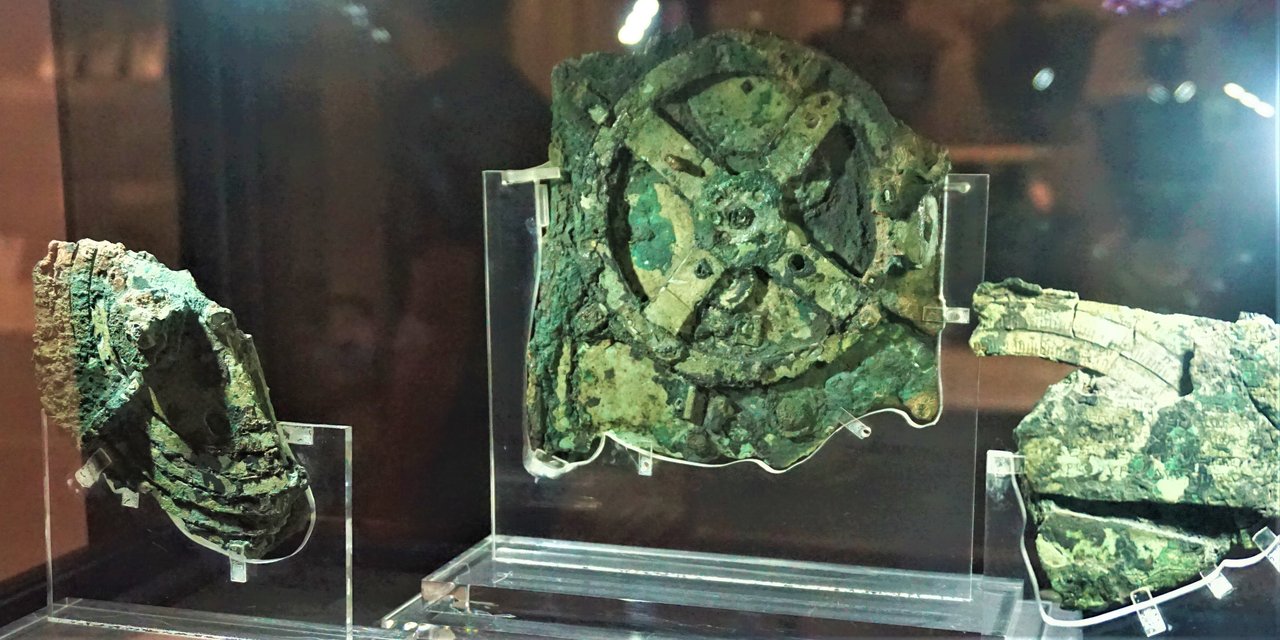
In the spring of 1901, Greek sponge divers salvaging a Roman-era shipwreck they had found off the island of Antikythera the year before brought up a corroded lump of bronze. Inside were more than thirty interlocking gears, cut with triangular teeth some barely a millimeter and a half across, encoding the motions of the Sun, the Moon, and the calendar of the heavens. Nothing of comparable complexity appears again in the surviving record for another fourteen centuries. Here is the file, opened claim by claim, each one wearing its evidence.
Start with what is not in dispute, because the Antikythera Mechanism is usually buried under stories far stranger than the truth. This is a real object. You can visit its fragments in Athens. It was built by human hands in the Greek world around two thousand years ago, and it modeled the sky with a precision the rest of the world would take more than a thousand years to match again. That is the astonishing part, and it is entirely human. Let's open the file.
01Pulled From a Shipwreck
The mechanism came out of the sea in the spring of 1901, though the story starts a year earlier. Greek sponge divers had found the wreck off Antikythera, an island between Crete and the Peloponnese, in 1900, working it at a depth of roughly 45 meters, and it was during the salvage the following spring that the archaeologist Valerios Stais spotted a corroded lump of bronze with a gear wheel embedded in it. The wreck itself dates to about 70 to 60 BCE, fixed by its pottery, coins, and other cargo. The ship was probably Italian, carrying goods from the eastern Mediterranean toward Rome when it went down.
What survives is fragmentary: 82 pieces in all. The largest, known as Fragment A, holds 27 of the identified gears. Reassembled, the whole device would have been about the size of a shoebox, roughly 34 by 18 by 9 centimeters, built from a low-tin bronze alloy. Its gears were cut with fine triangular teeth, some as small as 1.5 millimeters, and the works were housed in a wooden case, now decayed, closed by bronze cover plates carrying inscriptions.
The wreck is still giving up its cargo. A renewed investigation of the site by the Swiss School of Archaeology in 2025 recovered hull planks joined to an internal frame, wood analyzed as both elm and oak, a marble foot from a male statue, and amphoras from Chios, confirming a ship built shell-first in the Mediterranean tradition of the 4th to 1st centuries BCE. None of it changes the mechanism's story, but it keeps the context alive and under active study.
02A Gear Train No One Expected
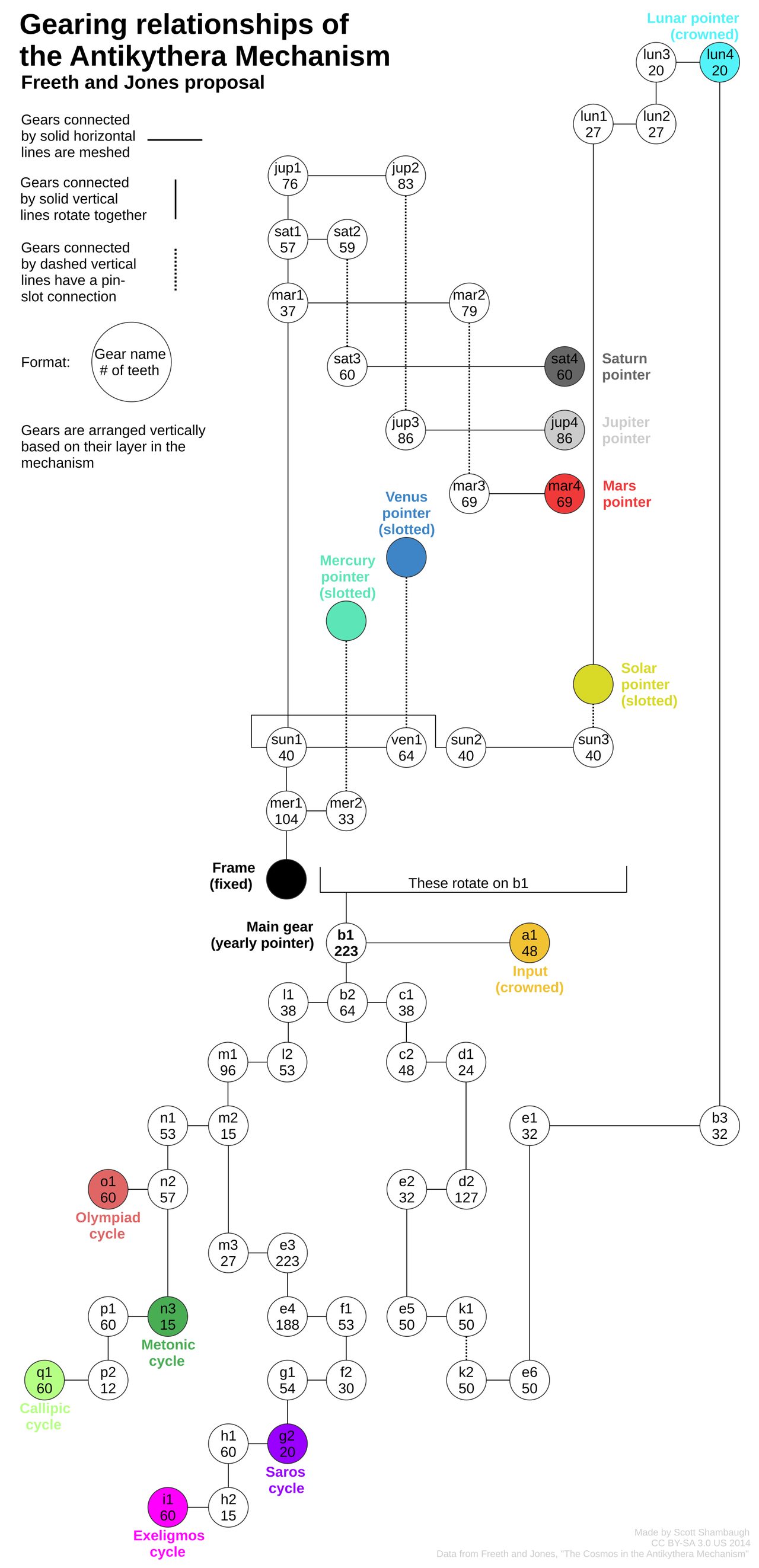
X-ray computed tomography, published by Freeth and colleagues in Nature in 2006, identified at least 37 gears inside the corroded fragments. Before those scans, no one could see how deep the gearing actually went.
The single most repeated claim about this gearing needs the correction the evidence now forces. When Derek de Solla Price published the first detailed reconstruction in 1974, he read part of the train as a differential gear, a configuration that combines two rotational inputs into a single output, a principle otherwise not clearly attested until the 16th century, and that reading is where the popular line about technology sixteen centuries early came from. It did not survive better imaging. The same 2006 X-ray tomography that revealed the 37 gears above substantially revised the mechanism, and the feature Price took for a differential turned out to be subtler: an epicyclic pin-and-slot arrangement that carries the Moon's uneven motion. That is the more accurate marvel, a genuinely ancient piece of gearing modeling a real astronomical irregularity, not a differential gear dropped into the second century BCE from a thousand years in the future.
A pin-and-slot mechanism turns steady circular motion into varying speed, modeling the way the Moon appears to speed up and slow down along its elliptical orbit, the first and second lunar anomalies. That same engineering trick was not reinvented until the Geneva drive of the 17th century.
The gear ratios are not rough approximations. They encode specific astronomical periods to a precision that only makes sense if the builders knew the numbers cold.
| Cycle | Period | What It Reconciles |
|---|---|---|
| Metonic cycle | 19 years, or 235 synodic months | Solar years against lunar months |
| Callippic cycle | 76 years, four Metonic cycles | A sharper long-term calendar correction |
| Saros cycle | 223 synodic months | The rhythm on which eclipses repeat |
| Exeligmos | 54 years, three Saros cycles | The leftover hours in a single Saros |
Crown gears, also called contrate gears, pass rotation between axes set at right angles to one another. That is how a gear train this intricate was folded into a case the size of a book, working in three dimensions rather than one flat plane.
03What It Actually Computes
Strip away the speculation and this is what the surviving gears and inscriptions actually drive. Every function in the table below is confirmed, read directly off the physical evidence rather than reconstructed from a gap.
| Dial or Display | Cycle It Tracks | What It Shows |
|---|---|---|
| Metonic dial (back, upper spiral) | 235 lunar months across 19 years | The lunisolar calendar, reconciling solar years with lunar months for farming and festivals |
| Saros dial (back, lower spiral) | 223 lunar months | Predicts solar and lunar eclipses, with glyphs marking type, time, and direction |
| Exeligmos dial (back, subsidiary) | 54 years and 33 days | Corrects the 8-hour remainder the Saros cycle leaves behind |
| Games (Olympiad) dial (back, subsidiary) | Four years | The cycle of Panhellenic games: Olympia, Pythia, Isthmia, Nemea |
| Lunar phase display (front) | One synodic month | A half-silver, half-black ball rotated to show the Moon's current phase |
| Calendar and Zodiac rings (front) | One year | An Egyptian 365-day ring paired with a movable Zodiac ring to absorb the quarter-day annual drift |
The Metonic function, on the back upper dial, is a 235-month spiral tracking the lunisolar calendar, the relationship between solar years and lunar months. That relationship was essential to any society that had to schedule both harvests and religious festivals.
The Saros function, on the back lower dial, is a 223-month spiral that predicts solar and lunar eclipses. Its glyphs record the type of eclipse, its expected time, and its direction. This is a machine that told you, in advance, when the sky would go dark.
A supplementary Exeligmos dial refines the eclipse prediction further, correcting the roughly 8-hour remainder that the Saros cycle leaves over across three complete Saros cycles, a span of 54 years and 33 days. The builders were not just approximating; they were carrying the correction terms.
The front and back carried more still. A lunar phase display, a small ball painted half silver and half black, was turned by the gear train to show the Moon's current phase. And a subsidiary Games dial on the back indicated the four-year cycle of the Panhellenic games: Olympia, Pythia, Isthmia, Nemea, and possibly Naa and Halieia.
On the front, a calendar dial carried an Egyptian ring of 365 days with a movable Zodiac ring, letting the user correct for the roughly quarter-day annual error the Egyptian calendar ignored. It is, in effect, a hand-set leap-year adjustment built into bronze.
The exact count on that calendar ring is now itself an open question. In 2024, researchers at the University of Glasgow's Institute for Gravitational Research applied Bayesian statistical methods borrowed from LIGO gravitational-wave analysis to the surviving fragment of the ring. Their conclusion, published in the Horological Journal, was that the ring most likely held 354 or 355 holes, consistent with a lunar calendar, a count they found hundreds of times more probable than a 360-hole ring and far more likely than the traditional 365-day Egyptian reading. This is live research revising an old assumption, not a settled correction, and it is worth watching rather than either ignoring or overstating.
04A User Manual in Bronze
The 2006 X-ray tomography did not only reveal gears. It revealed text: roughly 3,500 characters of Greek inscribed on the front and back cover plates and on internal plates, much of it invisible to the naked eye and legible only through the scans.
That text is not decoration. It functions as an instruction manual and astronomical description, explaining what each dial displays and how to read the outputs. The device came with its own directions for use, engraved into the case.
The language points somewhere specific. Linguistic analysis ties the inscriptions to the astronomical tradition of Corinth and its colonies, and the month names on the Metonic calendar match the Corinthian calendar tradition. Together they narrow the likely origin to the western Greek cultural sphere, and possibly to the tradition of Archimedes.
05The Planets Question
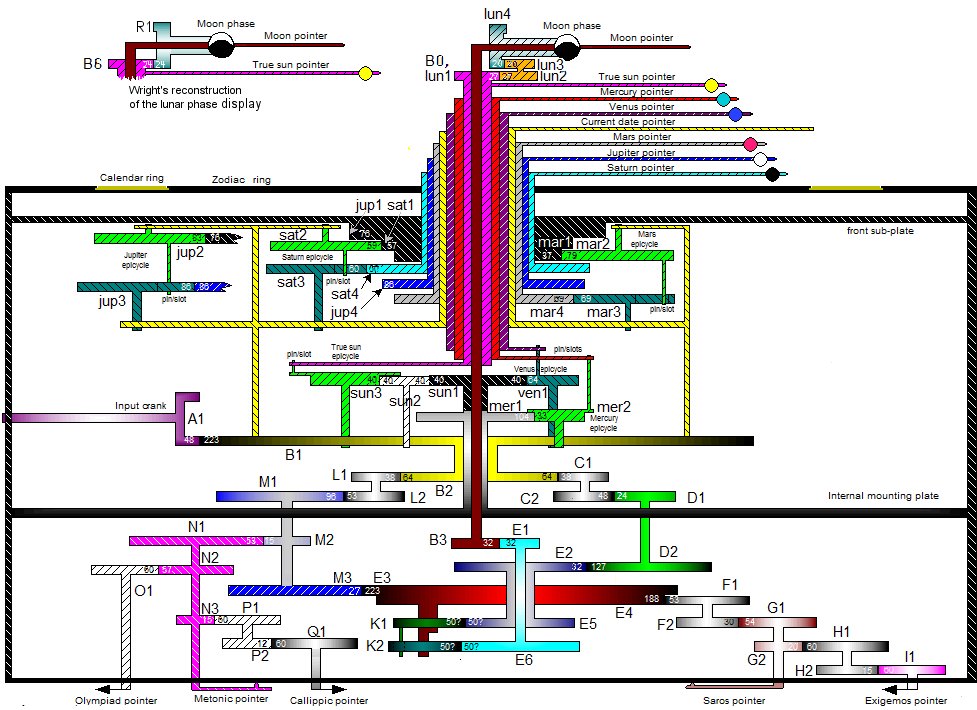
Everything above rests on gears and inscriptions we can actually point to. The front of the machine is different. It is the most damaged part of the whole device, and it is where the most ambitious modern reconstruction lives. Here the tier drops, honestly, from confirmed to plausible.
In 2021, Freeth and colleagues published in Scientific Reports a complete proposed reconstruction of the front display as a geocentric planetary model, showing the positions of the Sun, the Moon, and the five planets known to the ancient world: Mercury, Venus, Mars, Jupiter, and Saturn. It is a striking picture of the device as a working model of the cosmos.
That model requires a total of roughly 69 gears and uses nested co-axial tubes to drive concentric rings across the front face, each ring carrying a pointer or marker for a celestial body. It is elaborate, but it is built to be mechanically self-consistent.
It also has textual support: the reconstruction is consistent with inscriptions on Fragment C that describe the synodic cycles of the planets. The numbers the machine would need are, at least in part, written on the machine.
But this is the load-bearing hedge, and it matters. The planetary display remains a hypothesis. The front section is the most damaged part of the mechanism, and direct physical confirmation of all the planetary gears is simply not possible from the surviving fragments. The reconstruction is mechanically plausible and inscription-consistent. It is not read off recovered gears the way the calendar and eclipse dials are.
06Whose Hands Made It
The ancient sources say devices like this existed. Cicero, writing in the 1st century BCE, describes two machines made by Archimedes that modeled celestial motions, one of them showing the movements of the Sun, the Moon, and the planets on a bronze sphere. And Archimedes lived in Syracuse, a Corinthian colony, which fits the Corinthian calendar found on the mechanism and its western Greek provenance.
The setting fits too. The shipwreck's cargo of luxury goods, statues, and glassware was most likely destined for a wealthy Roman patron, exactly the kind of buyer who might have acquired Greek technological treasures alongside the art.
| Tradition | Evidence For | Standing |
|---|---|---|
| Archimedes of Syracuse | Cicero describes Archimedes modeling the heavens; Syracuse was a Corinthian colony, matching the calendar on the device | Direct authorship unlikely, he died in 212 BCE, but the tradition may be his |
| Workshop of Posidonius, Rhodes | Cicero also describes a celestial device by Posidonius; Jones argues the inscriptions and astronomical epoch point to Rhodes | A serious alternative, the question stays open |
Direct attribution to Archimedes himself is unlikely. He died in 212 BCE, roughly 150 years before the mechanism's estimated date, so this specific device is almost certainly not his own work. What it may represent is a tradition he founded or refined, carried forward by later hands.
There is a strong alternative candidate: the Workshop of Posidonius on Rhodes, active roughly 135 to 51 BCE. Cicero also described an astronomical device attributed to Posidonius, and in his 2017 study Jones argues that inscription analysis and astronomical epoch calibration point to Rhodes rather than Syracuse. The Syracuse-versus-Rhodes question is not settled.
Even the date is argued. Some scholars propose pushing the design back toward roughly 200 BCE, based on calibrating the epoch of the eclipse predictor. Carman and Evans, in a 2014 peer-reviewed analysis, land near 205 BCE for the predictor's start month, a similar but not identical figure. The device's calendar and eclipse functions may encode an origin older than the shipwreck that carried it.
07The 1,400-Year Gap
Here is the fact that unsettles people. No device of comparable mechanical complexity appears anywhere in the surviving archaeological record until medieval Islamic astronomical instruments and European clockwork of the 13th and 14th centuries CE. The Antikythera Mechanism seems to stand alone by more than a thousand years.
But a gap in the record is not a gap in reality. It means the devices did not survive, not that they were never made. Bronze is easily melted down and recycled, and complex mechanisms are inherently fragile. The things most worth reusing are exactly the things least likely to be found intact.
The written record backs this up. Hero of Alexandria, in the 1st century CE, described complex automata, and later Byzantine and Islamic sources reference astronomical devices. Knowledge of intricate mechanisms did not vanish at the water's edge; the physical objects did.
And the reason we have this one at all is almost accidental. The Antikythera Mechanism survived only because it was lost at sea, buried on the ocean floor and shielded from the recycling furnace that consumed everything like it on land. It is a near-perfect illustration of survivorship bias in archaeology: we do not see what did not sink.
08What Else Was Lost
If one such machine survived by accident, the obvious question is how many did not. This is where the file moves from evidence to reasonable extrapolation, and the tier moves with it, honestly, from credible inference to speculation.
The single-survivor logic runs like this: if one device made it through only because it sank, then similar or even more sophisticated devices were probably produced and simply lost to normal recycling and decay. It is a reasonable inference, but it is an inference, not a second find.
The quality of the manufacture points the same way. This does not look like a first attempt. The finish and precision suggest a mature engineering tradition, the product of accumulated expertise across multiple generations, rather than a lone genius building a prototype from scratch.
From there, some researchers speculate that calculating devices of various kinds may have been fairly common tools in the Hellenistic Mediterranean, used by astronomers, navigators, and perhaps administrators. Common is a strong word for something we have exactly one of, so this remains an open guess rather than a finding.
If such a tradition existed, its loss would be staggering. The destruction of the ancient world's centers of learning, the Library of Alexandria, the sack of Syracuse, the Roman conquest of the Greek world, would have carried an incalculable amount of technological knowledge with it. This is a plausible reading of history, not a documented event log.
The ship itself invites one more idea: that the mechanism had a navigational use, giving precise celestial positions and eclipse timing to seafarers. The association with a vessel is suggestive. But it is just as possible the device was simply cargo, being shipped as a treasure rather than used as an instrument at sea.
What is clearer is that its combined calendar and astronomical functions would have been genuinely useful on land: for agricultural planning, for scheduling religious festivals, and for astrological consultation. Those are practical uses that fit the world it came from, without needing any extraordinary explanation.
09Where the Story Runs Off the Map
A machine this far ahead of its apparent time is a magnet for the claim that human beings could not have made it. It is worth walking through those claims plainly, because the honest answer is not weaker than the myth. It is stronger.
The claim that the mechanism is too advanced for its era, and must therefore be alien technology or the work of a time traveler, collapses on contact with the evidence. It uses no material, technique, or principle unknown in the ancient Mediterranean: it combines standard bronze metallurgy with gear-cutting attested in other contexts and astronomy the Greeks demonstrably possessed. Its sophistication is remarkable, and it is fully explicable within the Alexandrian and Syracusan mathematical traditions of Archimedes, Ctesibius, and Hero. Ignoring that tradition is the only way to make the device look impossible.
It is also not, strictly, a computer. The word is a vivid metaphor and the reason the device is famous, but the machine is an analog mechanical calculator. It does not perform general-purpose computation, store arbitrary programs, or process digital data. Turn the crank and it models the sky. Calling it the world's first computer is a useful figure of speech, not a literal technical claim, and the truth is impressive enough without it.
Fast Facts
- Discovered
- Wreck found 1900, mechanism identified spring 1901; off Antikythera at a depth of about 45 meters
- Date
- Device roughly 1st century BCE, possibly designed earlier; the wreck dates to about 70 to 60 BCE
- Size
- About 34 by 18 by 9 centimeters, roughly the size of a shoebox
- Material
- Low-tin bronze, with triangular-cut teeth as small as 1.5 millimeters
- Fragments
- 82 known pieces; Fragment A alone holds 27 of the gears
- Gears Identified
- At least 37, revealed by X-ray computed tomography in 2006
- Confirmed Functions
- Metonic calendar, Saros eclipse dial, Exeligmos correction, Olympiad games dial, lunar phase, and the calendar and Zodiac rings
- Inscriptions
- Roughly 3,500 characters of Greek text, effectively a built-in user manual
- Where It Is Now
- National Archaeological Museum, Athens
- The Honest Floor
- A real, human, Hellenistic device; nothing anachronistic, alien, or time-displaced is needed to explain it
What We Can Actually Stand Behind
The object is real and it is human. A corroded bronze device pulled from a genuine shipwreck, carrying a gear train of at least 37 wheels, including an epicyclic pin-and-slot arrangement that models the Moon's varying speed, whose calendar and eclipse functions, the Metonic, Saros, and Exeligmos dials, the Olympiad games dial, the lunar phase ball, and the calendar ring, are physically documented in the surviving gears and in roughly 3,500 characters of inscribed Greek instructions. Nothing about it is anachronistic in material, technique, or principle.
Real questions remain unresolved. The full front display as a planetary model showing all five known planets is the 2021 reconstruction by Freeth and colleagues, mechanically plausible and consistent with the inscriptions, but the front is the most damaged section and those planetary gears have not been recovered. Who built it, Syracuse in the tradition of Archimedes or the workshop of Posidonius on Rhodes, and exactly when, near 200 BCE or later, are still argued. Even the calendar ring's hole count is under active revision.
That similar or more advanced devices were common across the Hellenistic world, and were lost when centers of learning were destroyed, is a reasonable extrapolation from a single surviving example. But it is an inference, not a find. No second mechanism has been recovered, and the navigational-use idea rests on the device sharing a ship with cargo it may simply have been.
There is no credible evidence for an extraterrestrial, time-traveler, or otherwise anachronistic origin. The mechanism uses only materials, techniques, and astronomy known in the ancient Mediterranean, and it sits squarely inside the engineering tradition of Alexandria and Syracuse. The too-advanced argument works only by pretending that tradition did not exist.
And it is not literally a digital computer. It is an analog mechanical calculator that models the sky when you turn a crank; it runs no programs and stores no data. Calling it the world's first computer is a useful metaphor, not a technical fact, and it does not need the exaggeration.
So the real answer is, once again, the more astonishing one. Not a relic dropped by visitors from elsewhere, but proof that human beings two thousand years ago understood the clockwork of the heavens well enough to cut it into bronze and turn it by hand. And the file stays open on a single question. If one such machine survived only because it sank, how many more were built, used, and quietly melted down, and what did the people who made them already know that we have had to rediscover?
Sources & further reading
Everything above is drawn from our research library on Theories of Anything. Open the full file to check the sourcing and go deeper.
Image credits
- Fragment A of the Antikythera Mechanism, National Archaeological Museum, Athens photograph by Joyofmuseums, via Wikimedia Commons. CC BY-SA 4.0 Source.
- Gearing relationships of the Antikythera Mechanism (schematic) diagram by Scott Shambaugh, via Wikimedia Commons. CC BY-SA 3.0 Source.
- Proposed planetary gearing schematic, after Freeth and Jones 2012 diagram by SkoreKeep, via Wikimedia Commons. CC BY-SA 3.0 Source.


