
Aksum: The Climate Story Runs the Other Way
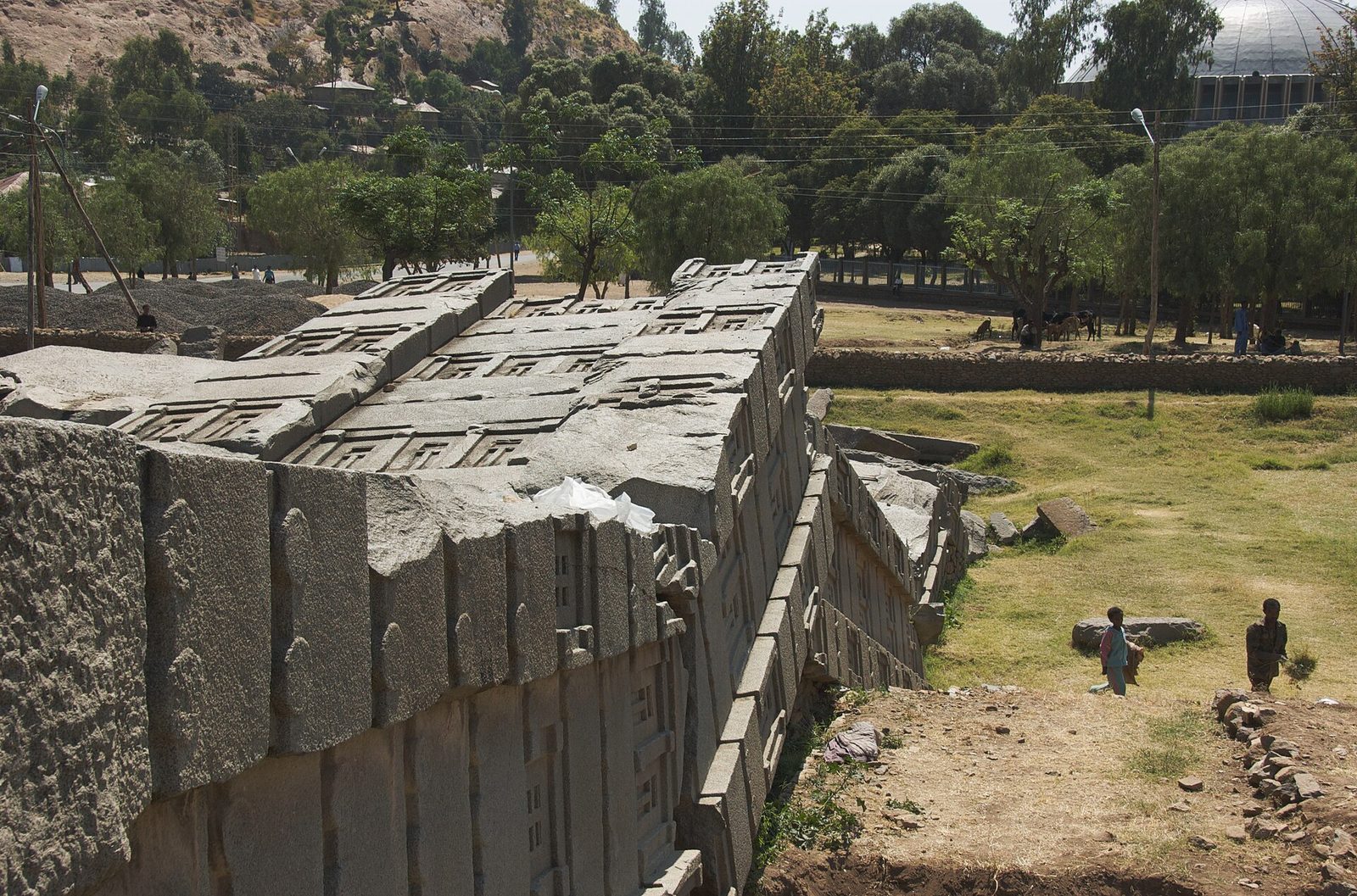
A trading empire in the Ethiopian highlands that minted its own gold, invented a script still in use, and raised the largest single stone ever erected anywhere in the ancient world. The environmental collapse everyone reaches for turns out to have better evidence behind the rise than the fall, and when the state did go, the farming carried on unchanged.
In the third century a Persian prophet called Mani listed the four great powers of the world. Rome, Persia, China, and Aksum. That is our own research file's claim and it is the kind of sentence that ought to be better known: a kingdom in the northern Ethiopian and Eritrean highlands, ranked by a contemporary alongside the three empires everybody can name.
It minted its own gold coinage, the first state south of the Sahara to do so. It developed a script that is still used to write Amharic and Tigrinya today. It converted to Christianity around 330, which makes it one of the earliest Christian states anywhere. And it raised a stone thirty-three metres tall, which fell over and is still lying where it fell.
01The Stones
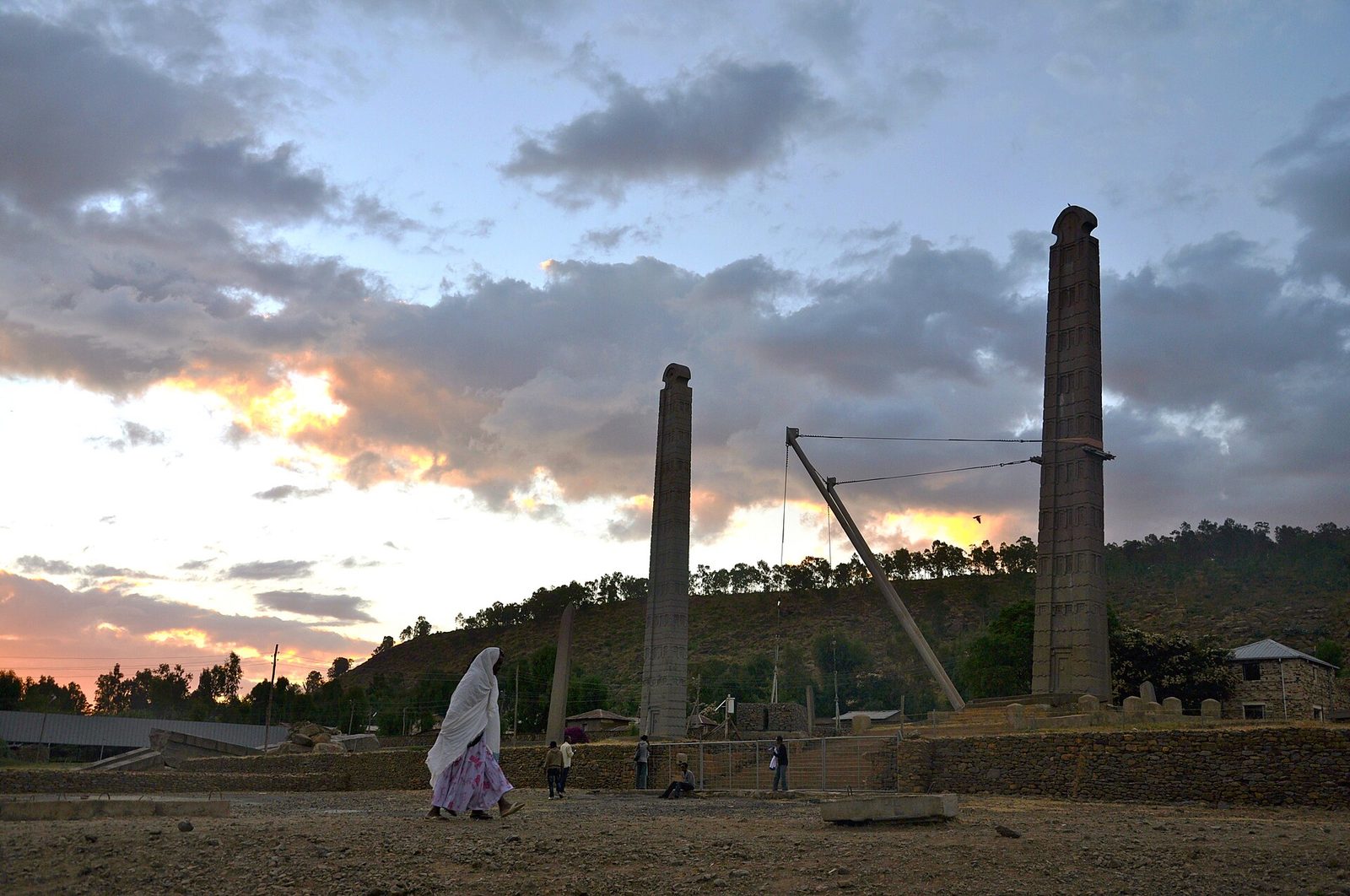
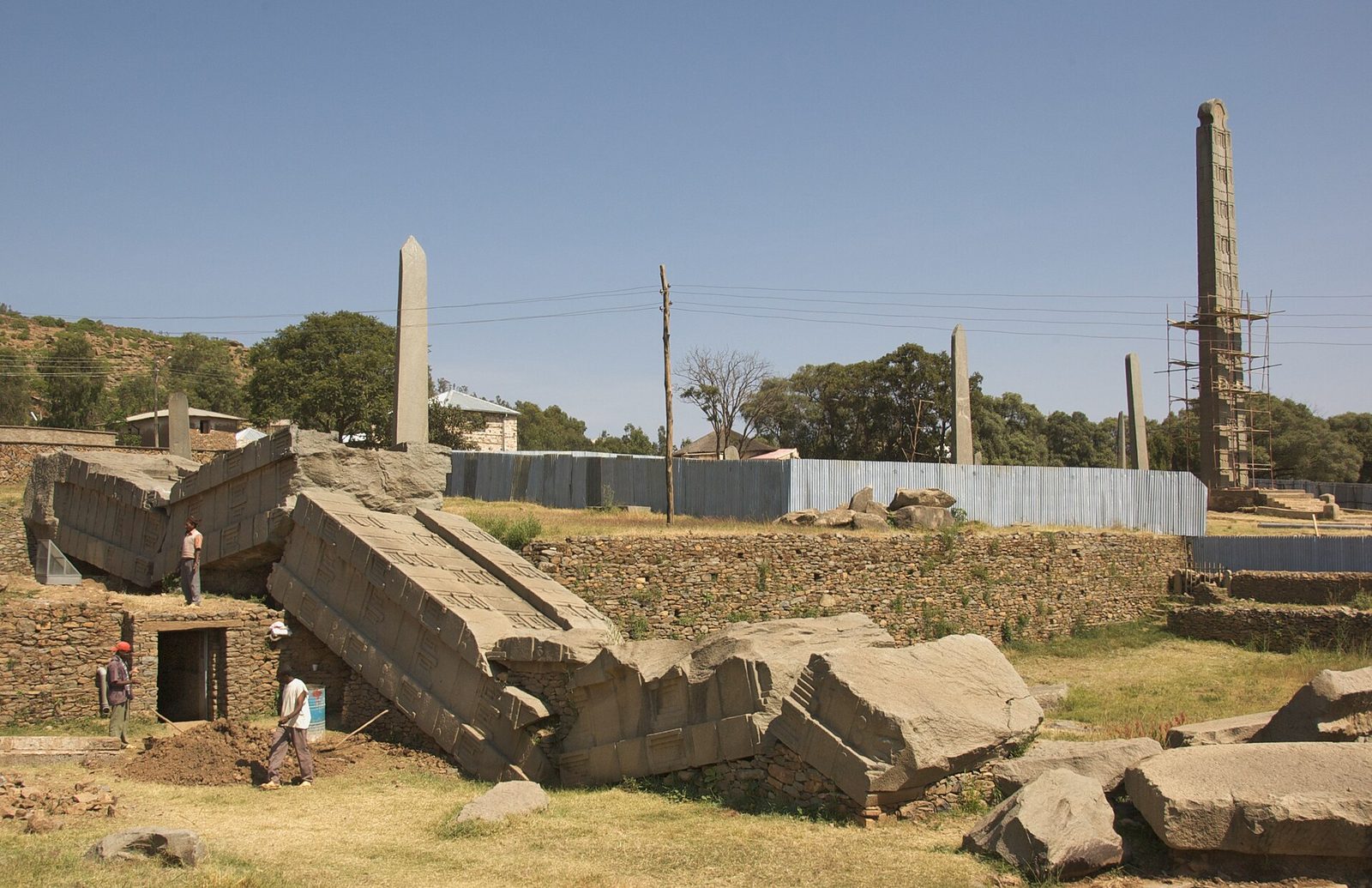
Our research file gives the stelae field at Aksum as holding over 120 carved monoliths. The largest still standing, King Ezana's Stela, is about 24 metres and roughly 160 tonnes. The Great Stela, now fallen and broken, stood about 33 metres and is estimated at 520 tonnes, which our file describes as one of the largest single stones ever quarried and erected in the ancient world. Those figures are our file's and were not independently re-checked for this article.
Aksum minted gold, silver and bronze coins from the late third century CE, and our file calls it the first sub-Saharan African state to do so. King Endubis, around 270, issued the first coins bearing Ge'ez script and a royal portrait, and Stuart Munro-Hay catalogued over a hundred distinct types. The script itself began as a consonantal abjad derived from South Arabian writing and became, by the fourth century, an abugida with vowel marks, which our file calls unique in Africa. The arithmetic it gives is neat: vowel diacritics added to 26 consonants produce 231 characters, and the system is the direct ancestor of the Amharic and Tigrinya scripts in use today.
02The Inscription, And The Three Men On The Wall
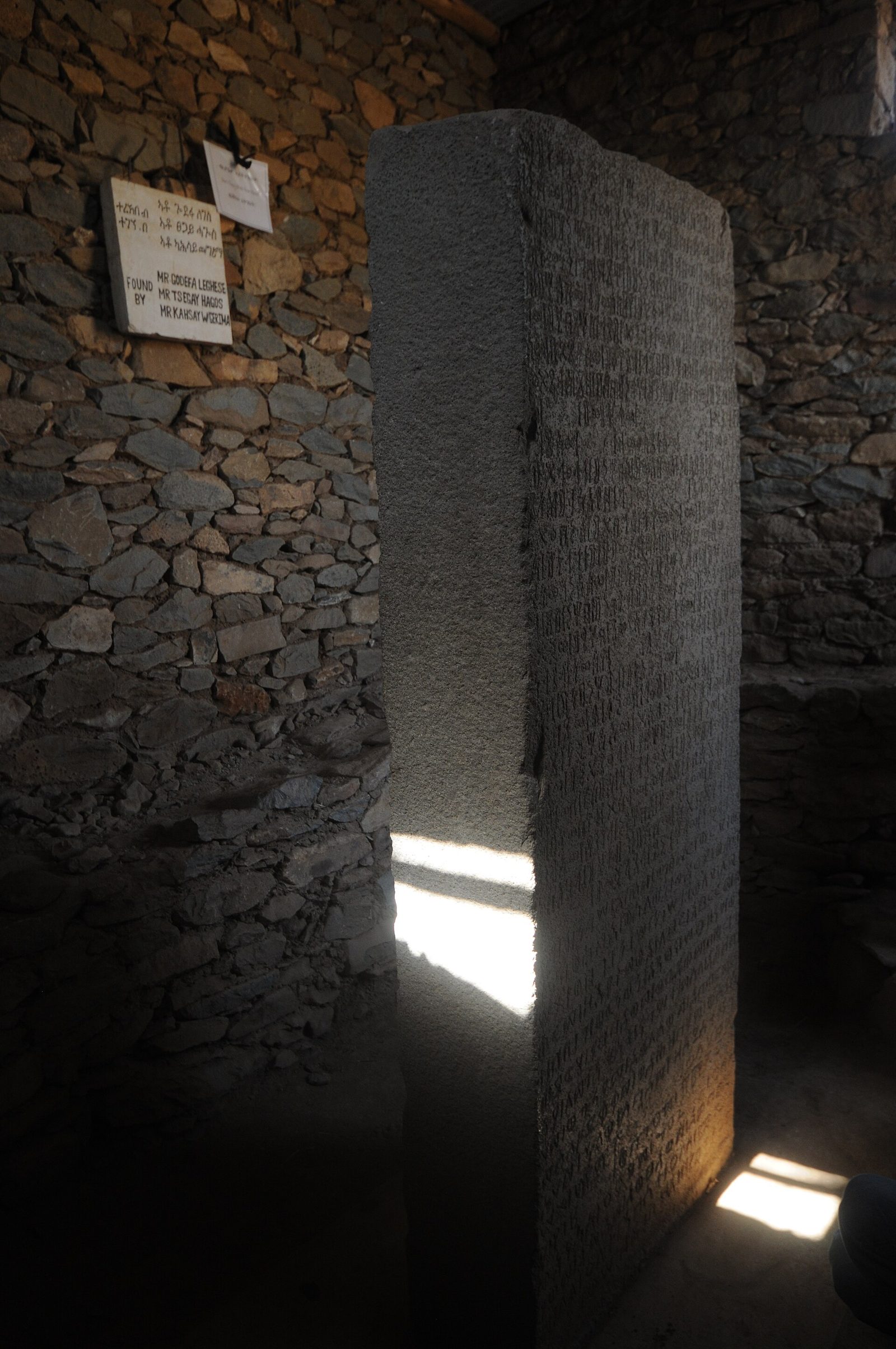
King Ezana, reigning about 320 to 360, adopted Christianity around 330. The evidence is a trilingual inscription at Aksum, in Ge'ez, Sabaean and Greek, which shifts from pagan to Christian invocations partway through. Our file records Frumentius, a Syrian captive, as traditionally credited with converting Ezana and as later consecrated bishop by Athanasius of Alexandria. And there is a second, independent line of dating: Christian crosses appear on the coinage after the conversion, so the money brackets the event.
03The Collapse, And Which Way The Climate Points
Now the part that has moved. Our research file discusses the environment as a cause of decline: deforestation, soil degradation, a kingdom that farmed its highlands into exhaustion. It is careful about it, noting that David Phillipson warns against environmental determinism and that other scholars put the disruption of Red Sea trade after the rise of Islam first. But the frame is the same one you meet everywhere: climate as the executioner.
In 2025 Degsew Mekonnen, Hugo Olivera and Ana Calapez Gomes published a review of 95 peer-reviewed papers on palaeoenvironmental data from the northern highlands of Ethiopia and Eritrea, covering six thousand to one thousand years before present. Three conclusions, in their words. Conditions during the transition to agriculture were highly variable, with differing tempos and magnitudes across the region. The emergence of early agriculture and pre-Aksumite society was NOT directly driven by environmental change around 3500 BP; social dynamics and interactions among local groups are the more plausible explanation. And the highlands shifted towards HIGHER HUMIDITY during the early Aksumite period, which likely enhanced agricultural productivity and produced the food surpluses that underpinned the kingdom's expansion. Their summary: early agriculture was culturally driven, and later state development was more closely tied to environmental factors.
The other half comes from a single site. In 2024 Yemane Meresa, Abel Ruiz-Giralt, Alemseged Beldados, Carla Lancelotti and A. Catherine D'Andrea published the archaeobotany of Ona Adi in Tigrai, covering an occupation running from roughly 750 or 600 BCE to the fall of the kingdom around 700 CE. They recovered wheat, barley, linseed, noog, lentil and finger millet, with tentative identifications of t'ef, and phytolith evidence of grass processing. Their conclusion is one sentence and it is the one worth carrying: the data demonstrate a significant degree of continuity in the local agricultural economy, which remained largely unchanged even after the decline of the Aksumite state.
| The Thing | The Usual Story | What The Recent Work Says |
|---|---|---|
| The climate | Deforestation and soil degradation helped bring Aksum down | A 2025 review of 95 papers finds a shift to HIGHER humidity in the early Aksumite period, producing the surpluses that underpinned expansion. The best-evidenced climate story is about the rise |
| The origin of farming | Environmental change drove the transition to agriculture | Not directly, on the same review. Social dynamics and interactions among local groups are called the more plausible explanation for the pre-Aksumite emergence |
| The farming itself | A civilization that exhausted its land and fell | At Ona Adi the agricultural economy shows significant continuity and remained largely unchanged AFTER the state declined. Whatever ended, it was not the fields |
| The trade | Red Sea routes disrupted by the rise of Islam in the seventh century | This is our own file's alternative and it is untouched by the above. A state can lose its revenue base while its farmers carry on exactly as before |
| The unified empire | One centralised kingdom ruled from one monumental capital | Our file's own counter-arguments: Fattovich questions the extent of central control and suggests a heterarchical network, and Finneran objects to treating Aksum as an exceptional lost civilization at all |
One more thing belongs here, and it is an absence rather than a finding. In 2019 Michael Harrower, Ioana Dumitru, Cinzia Perlingieri, Smiti Nathan, Kifle Zerue, Jessica Lamont and colleagues published Beta Samati: discovery and excavation of an Aksumite town, in Antiquity. No abstract was obtainable while writing this page, so nothing is claimed here about what they found. What can be said is that an entire Aksumite town was located, excavated and published in a major journal seven years ago, and that our research file, last updated in April 2026, does not mention it anywhere. A subject whose evidence base is still growing that fast should not be written as a closed case.
04The Ark, And The Dynasty
Ethiopian tradition, set out in the Kebra Nagast compiled around the fourteenth century, holds that the Ark of the Covenant was brought to Aksum by Menelik I, son of Solomon and the Queen of Sheba, and the Church of Our Lady Mary of Zion is said to house it. Our own file's assessment is exactly right and needs no improvement: no independent archaeological or textual evidence confirms the claim, the chapel has never been opened to outside researchers, and the Kebra Nagast was written roughly 1,600 years after the events it describes. That is not a debunking. It is a description of what can and cannot be known from where we are standing.
The claim of an unbroken Solomonic dynasty from Menelik I in the tenth century BCE to Haile Selassie, deposed in 1974, is refused in our own file as a political and religious founding myth rather than history. No archaeological or epigraphic evidence connects Aksumite rulers to ancient Israel, and the Solomonic dynasty in fact dates from the Zagwe transition of 1270 CE under Yekuno Amlak. Our file is equally brief on the proposal that Aksum overlaps the Egyptian Land of Punt: Punt's location is unresolved, with Somalia, Eritrea, Yemen and Mozambique all proposed, and no direct Aksumite-era evidence links the two.
05Our Own Bibliography, And One Instructive Pair
All five DOIs in our research file were resolved live for this article. The one attached to David Phillipson's Foundations of an African Civilisation, which is the most-used source in the document, returns Graham Connah's 2013 review of it in the Journal of African History, under the headline AKSUM AT THE CUTTING EDGE. The one attached to Munro-Hay's Aksum returns a review in the Antiquaries Journal that helpfully includes the book's physical dimensions, which is a reviewer describing an object rather than the object itself. The one attached to Phillipson's Ancient Churches of Ethiopia returns a review in the Cambridge Archaeological Journal. The Fattovich urbanism paper returns a flat 404. Only Hatke's Aksum and Nubia points at the work it names.
Our file also carries a Corrections block from the campaign that repairs this library's bibliographies, and it contains two ISBN rows with the same justification: the previous number failed its check digit. On the Finneran row that is TRUE. The old number's check digit genuinely fails, it does not resolve, and the replacement is the right book from the right publisher: a good repair, correctly explained. On the Hatke row the old and new values are the SAME STRING, the number was valid all along, and it resolves to the correct book. Nothing was wrong and nothing was changed. One block, two rows, one sentence, and it is right about one and wrong about the other. Elsewhere in this library that pattern has been counted: across 2,307 correction rows the stated reason is true in 72.8 per cent of them, false in 23.6 per cent, and 3.6 per cent are changes between identical strings. The repairs are sound. The reporting cannot be told apart.
Fast Facts
- When And Where
- About 100 to 940 CE, in the northern Ethiopian and Eritrean highlands, capital at Aksum. Our file's dating
- The Ranking
- Listed by the third-century Persian prophet Mani among the four great powers, with Rome, Persia and China
- The Stelae
- Over 120 monoliths. Tallest standing about 24 m and 160 tonnes; the fallen Great Stela about 33 m and an estimated 520 tonnes
- The Money
- Gold, silver and bronze from the late 3rd century, the first south of the Sahara. Endubis first, c. 270. Over 100 types catalogued
- The Script
- Ge'ez: a South Arabian-derived abjad that became an abugida by the 4th century. 26 consonants plus vowel marks gives 231 characters. Still ancestral to Amharic and Tigrinya
- The Conversion
- Ezana, around 330 CE, evidenced by a trilingual inscription and dated independently by crosses on the coinage
- The Port
- Adulis, on the Red Sea. The Periplus lists ivory, tortoiseshell, rhinoceros horn, gold and enslaved people going out; Roman glass, wine, metal and textiles coming in
- The Climate
- A 2025 review of 95 papers: higher humidity in the early Aksumite period, producing the surpluses behind the EXPANSION
- What Survived
- At Ona Adi the agricultural economy remained largely unchanged after the state declined
- What Our File Misses
- Beta Samati, an entire Aksumite town excavated and published in Antiquity in 2019
What We Can Actually Stand Behind
Aksum minted its own coinage from the late third century, converted under Ezana around 330 with a trilingual inscription and Christian coin types to date it, developed the Ge'ez abugida, and raised over 120 stelae including one of the largest single stones ever erected anywhere. Mekonnen, Olivera and Gomes published their palaeoenvironmental review in African Archaeological Review in 2025; Meresa and colleagues published the Ona Adi archaeobotany there in 2024; Harrower and colleagues published Beta Samati in Antiquity in 2019; and Insoll introduced the medieval Ethiopian cosmopolitanism section in Antiquity in 2021.
Why Aksum declined. Environmental degradation, the loss of Red Sea trade after the seventh century, or both, and our own file carries the argument in both directions. Whether it was a centralised empire at all: Fattovich proposes a heterarchical network and Finneran objects to the lost-civilization framing entirely. And the population and architecture figures, which are estimates from a site our file itself notes remains largely unexcavated.
The Ark of the Covenant at the Church of Our Lady Mary of Zion. No independent evidence, a chapel never opened to outside researchers, and a source text written roughly sixteen centuries after the events. Held open rather than refused, because unopened is not the same as disproved. And the Punt overlap, where Punt's own location is unresolved.
The unbroken Solomonic dynasty from Menelik I to Haile Selassie is a founding myth, and the actual dynasty dates from 1270 CE. And this page does not claim the climate brought Aksum down, because the review with the most data behind it points the other way: at the wet centuries that made the kingdom big in the first place.
The picture I keep coming back to is the stela field with its scaffolding and its corrugated hoarding and its plain uncarved stones standing among the famous ones. Everything about Aksum invites the lost-civilization treatment, and our own file carries a scholar's objection to exactly that: Finneran's point that it belongs in a Horn of Africa story that runs on either side of it, not in a category of marvels. The kingdom stopped. The script did not, and neither did the church, and neither, on the evidence from Ona Adi, did the wheat and the barley and the noog. Something ended at Aksum around the seventh century, and what it was is still being worked out by people with trowels, one of whom found a whole town in 2019.
Sources & further reading
WHERE THIS WORKED FROM, AND WHERE IT CAN BE CHECKED. This article worked from one file in our own research library, W_3_16, at Source Confidence 3 out of 5. All five of its DOIs were resolved live against Crossref and ONE points at the work it names, Hatke's Aksum and Nubia. Three are reviews attached to the books they review, including the identifier on David Phillipson's Foundations of an African Civilisation, which is the document's most-used source and which returns Graham Connah's 2013 review of it. The fifth, on Fattovich's urbanism paper, returns a flat 404; that is the second genuinely dead identifier found in this programme, where every other failure has returned a live page for the wrong work. Note also that our file dates that paper 2010 while giving volume 28.4, and African Archaeological Review volume 28 is 2011. All seven external sources cited below were found independently this session and resolved before being cited. ON THE CORRECTIONS BLOCK, AND WHY IT IS USEFUL RATHER THAN DAMNING. Our file carries two ISBN repairs from the corpus hygiene campaign, both justified with the same sentence. On Finneran the sentence is true: the old number's check digit really does fail, it does not resolve, and the replacement is the right book from Routledge. On Hatke the old and new values are the same string, the number was valid, and it resolves correctly. That pair is a live example of something measured across this whole library while writing a previous article: of 2,307 correction rows, 72.8 per cent state a true reason, 23.6 per cent state a false one, and 3.6 per cent record a change between identical strings, while every replacement computes clean. The repairs are sound and the reporting cannot be told apart from row to row. Reproducible with `python _scripts/estate/audit_isbn_corrections.py`. WHAT THIS PAGE ADDS THAT OUR FILE PREDATES OR OMITS. The 2025 palaeoenvironmental review, the 2024 Ona Adi archaeobotany, the 2021 medieval cosmopolitanism section, and Beta Samati, an Aksumite town excavated and published in Antiquity in 2019 that our file does not mention. WHAT IS CARRIED AS OUR FILE'S OWN, UNVERIFIED HERE. The date range, Mani's ranking, every stela measurement, the coinage figures, the Ge'ez character count, the Periplus cargo list, the Adulis excavation dates, the palace storeys, the urban population estimate, and the conquest of Meroe. ON THE IMAGES. Four, all opened before use, none dropped. The placard quoted in section 02 is legible in the delivered photograph and is a sign in the shelter, not a scholarly attribution; our own file names no finder for the stone.
Image credits
- The fallen Great Stela at Aksum, Ethiopia A. Davey, via Wikimedia Commons. CC BY 2.0 Source.
- Standing stelae at Aksum at sunset Fabian Lambeck, via Wikimedia Commons. CC BY-SA 4.0 Source.
- The Ezana Stone in its shelter at Aksum Breton Jean-Francois, via Wikimedia Commons. CC BY-SA 4.0 Source.
- The North Stelae Park at Aksum A. Davey, via Wikimedia Commons. CC BY 2.0 Source.
.jpg)


.jpg)