
The Yogic Siddhis: The Powers the Adepts Claimed
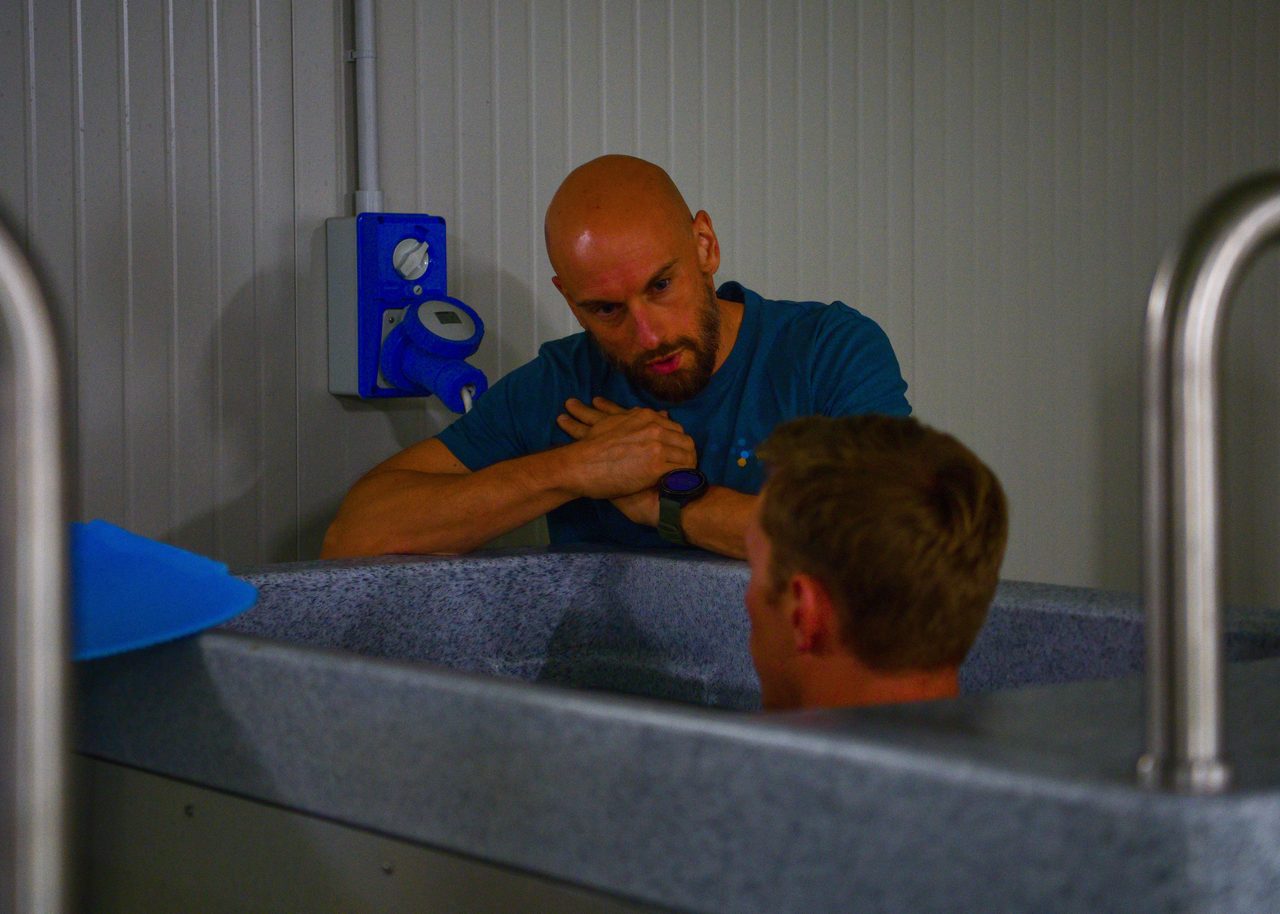
Our research file records the Yoga Sutras as listing capacities a practitioner is said to attain: becoming infinitely small, becoming infinitely light, knowing what is in another mind, walking unseen. Around that list sits a set of practices people have actually put in front of instruments, and the results split cleanly. Monks really do raise the temperature of their fingers and toes. Trained volunteers really do damp their own immune response on command. The drying of wet sheets in the snow, the image at the centre of the story, is the part that arrives with no measurement attached at all. This is the file on the siddhis, opened claim by claim, each one wearing its evidence.
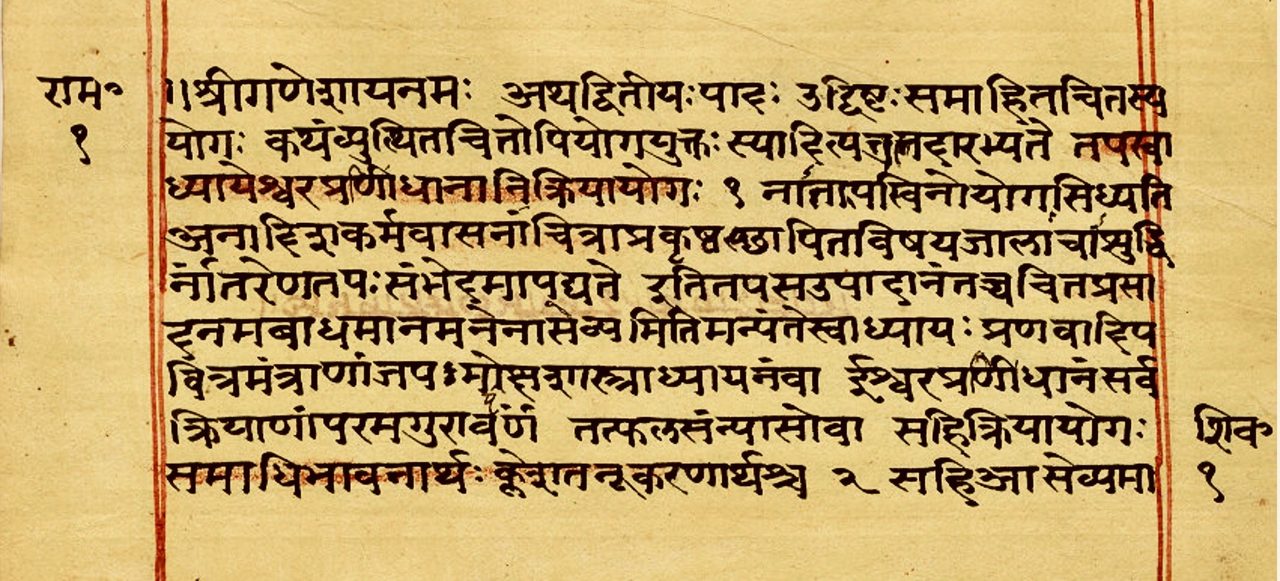
In the third book of the Yoga Sutras there is a list. It names capacities a practitioner is said to acquire: becoming infinitely small, becoming infinitely large, becoming infinitely light, knowing what is in another mind, walking unseen. That list is why this subject is so hard to write about honestly, because it invites two bad readings at once. One takes it as a field report. The other takes the whole tradition as a con. This article does neither, and the reason it can do neither is that a surprising amount of the practice surrounding the list has actually been put in front of instruments. The results are not what either side wants. Let's open the file.
One boundary first. The research file behind this article also carries a full treatment of firewalking. That is a subject of its own, with its own article still to come in this wing, and it is left to it entirely. Nothing from the fire material appears below.
01What The Text Is Recorded As Listing
Our research file gives the classical catalogue at a single verse locus, Yoga Sutras III.45, and lists seven names under it: anima, becoming infinitely small; mahima, becoming infinitely large; laghima, becoming infinitely light; prakamya, irresistible will; prapti, reaching anything; vashitva, control over the elements; and ishitva, lordship over creation. Seven is what the file's own table contains. The wider literature commonly speaks of an eight-fold set, and this article does not supply the eighth, because our file does not name it and no primary edition of the text was opened for this piece.
Three further claimed capacities sit at three separate loci in the same book, as our file gives them: knowledge of past lives at III.18, knowledge of other minds at III.19, which the file glosses as telepathy, and invisibility at III.21. All of that is a claim about a document. It is settled by reading and by philology, and it says nothing whatever about whether any of these things occur.
Two cautions on that paragraph, and they are the kind this article will keep making. The verse numbers are reproduced exactly as our own research file gives them, and verse numbering differs between editions and recensions of this text, so treat them as pointers rather than as citations. And nothing from the Yoga Sutras is quoted anywhere in this article, in Sanskrit or in translation, because no primary edition was read for it. An edition with translation and commentary, a reception history of the text, an edited scholarly volume on its powers material, and a public-domain English translation are all linked at the foot of this page for a reader who wants to go to the text itself. Reporting a term is honest. Quoting a book you have not opened is not.
| What Our File Lists | Locus, As Our File Gives It |
|---|---|
| anima, becoming infinitely small | III.45 |
| mahima, becoming infinitely large | III.45 |
| laghima, becoming infinitely light. Our file adds levitation, in its own parenthesis | III.45 |
| prakamya, irresistible will | III.45 |
| prapti, reaching anything | III.45 |
| vashitva, control over the elements | III.45 |
| ishitva, lordship over creation | III.45 |
| Knowledge of past lives | III.18 |
| Knowledge of other minds, which our file glosses as telepathy | III.19 |
| Invisibility | III.21 |
One line in that table is worth stopping on, because the whole distance this article has to travel is inside it. Against laghima our file writes becoming infinitely light, and then, in its own parenthesis, levitation. Those are not the same claim. The first is a statement about lightness in a text, and it is the kind of thing a commentator argues about. The second is a physical assertion about a body leaving the ground, and it is the kind of thing you can put a camera on. Somewhere inside that parenthesis a claim changes species, quietly enough to read straight past.
The text is not enthusiastic about any of this. Our file records that the Yoga Sutras themselves warn against attachment to the siddhis, treating them as distractions from liberation, kaivalya, and that developing powers without wisdom is regarded within the tradition as spiritually dangerous. The document that catalogues the powers is also the document that tells you not to want them. That is worth holding onto, because it comes from inside the tradition rather than from a critic outside it: the strongest caution against reading this list literally sits in the same document as the list.
02Two Sentences That Sound Alike
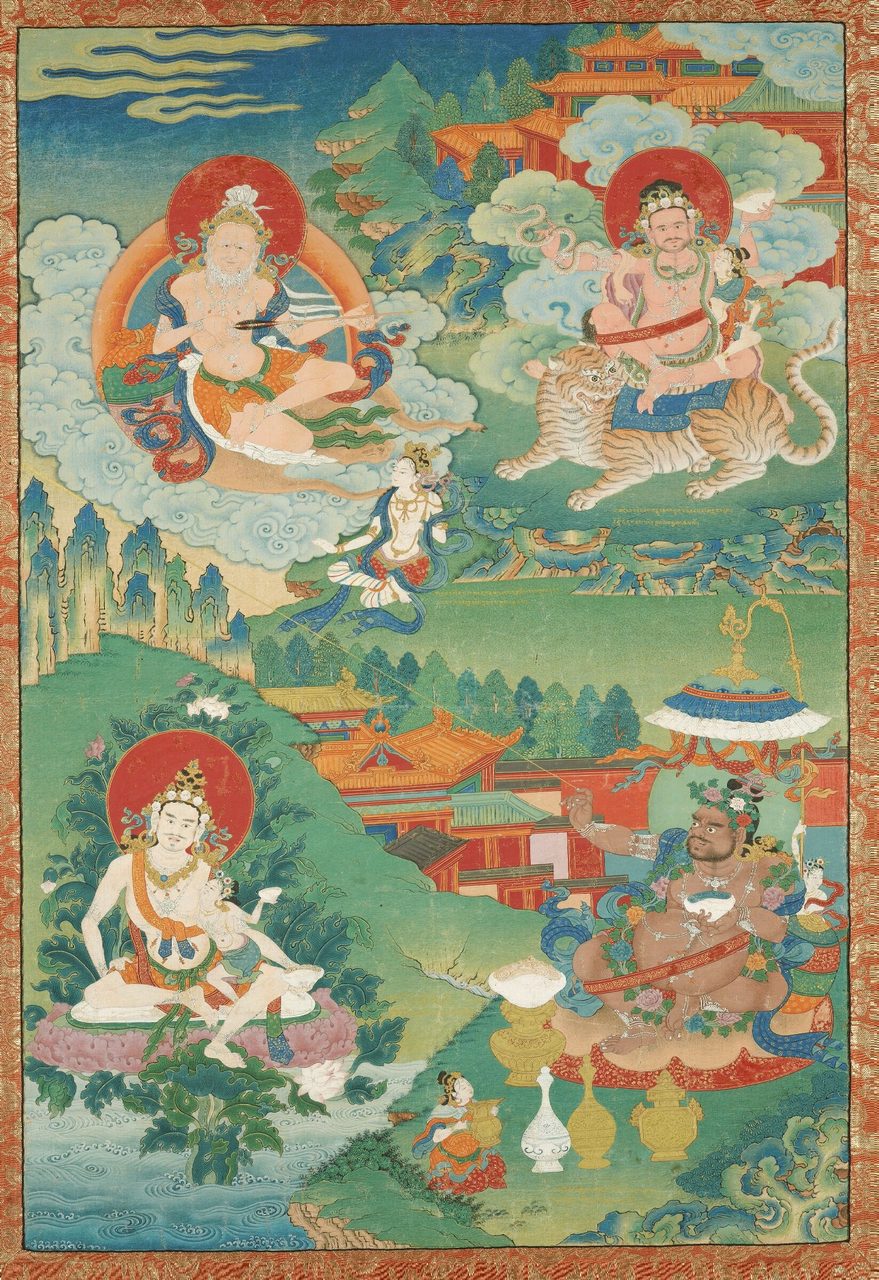
Everything below turns on keeping two sentences apart. The first is the tradition claims X. That is a claim about a text or a lineage; its evidence is historical and philological, and it is true or false about what the text says. The second is a study measured Y. That is a claim about an instrument reading, and it arrives with a method section attached. Both are worth having. They are not interchangeable. And the place they get confused is very rarely a lie. It is usually a table, where one of them has been laid out next to the other.
Our own research file puts this better than we can, in its counter-arguments section: "Traditional descriptions are not always meant literally: Siddhi literature often functions symbolically, pedagogically, or hagiographically. Reading every account as a lab-style report of supernormal powers is historically naive." That is not a debunker's line. It is our own file granting the tradition the courtesy of being read as literature before it is read as data, and it is the licence this article uses to take the material seriously without taking it literally.
03Inner Heat, And What Was Actually Measured
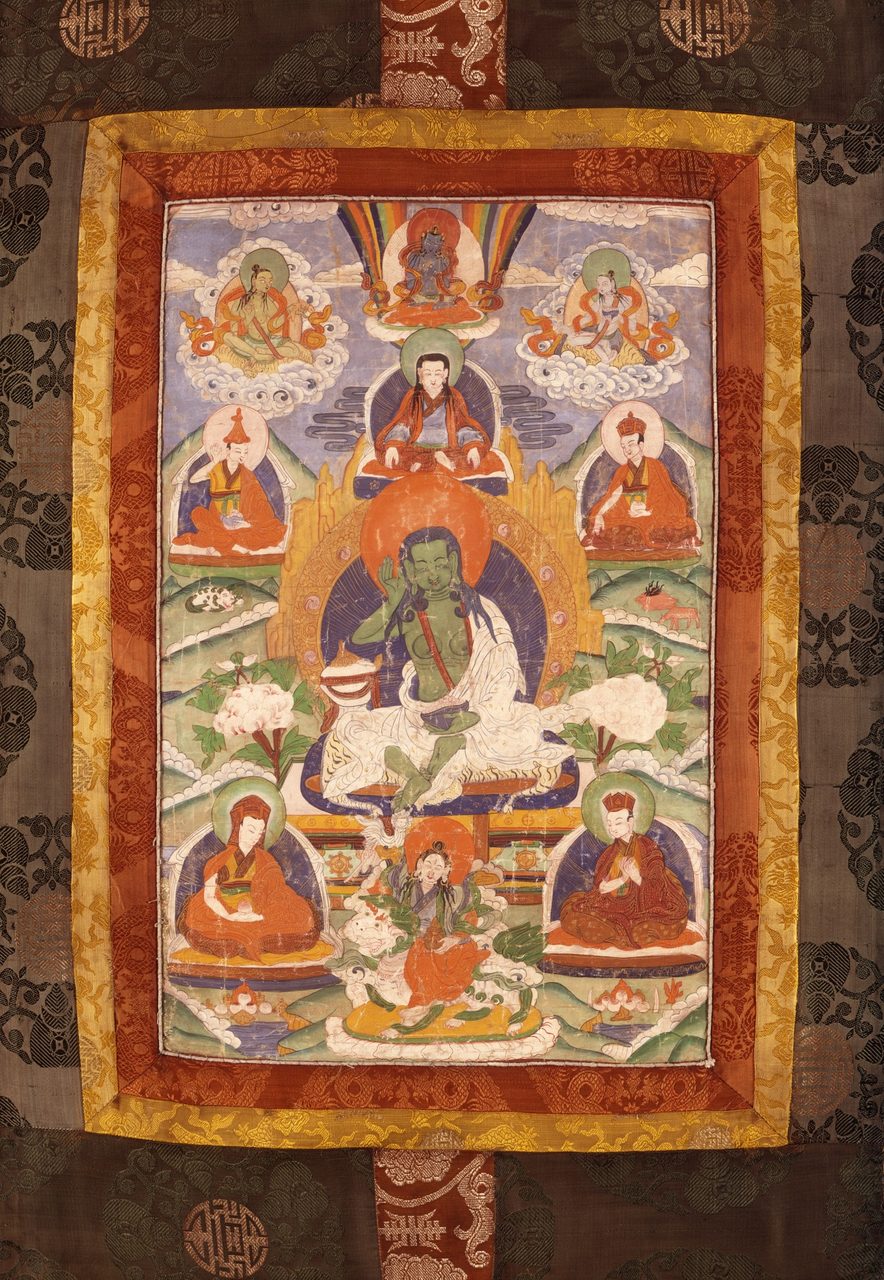
Now the practice at the centre of this article's own hook. Tummo, inner heat, is a Tibetan Buddhist discipline, and it is where a tradition's claim about the body and a laboratory's measurement of the body have met in the same room more than once.
The first measurement is old and it is good. Our file reports a Harvard study by Benson and colleagues that found Tibetan monks raising the temperature of their fingers and toes by up to 8.3 degrees Celsius during tummo meditation. It ran in Nature in 1982. Read the body part carefully, because it carries the weight of everything after it: fingers and toes. That is skin at the extremities. It is not core body temperature, and nothing in this section is about core body temperature unless it says so in as many words.
Our file cites a second Benson publication from 1990 alongside it. That one is a set of three case reports of metabolic and electroencephalographic changes during advanced Buddhist meditation techniques, in Behavioral Medicine. Three case reports is three people, which is real evidence and a small amount of it, and the phrase advanced Buddhist meditators should not be allowed to conjure a cohort. Our file names the year and carries no bibliography entry for the paper at all, so the identifier linked below was resolved independently for this article.
The distinction that matters most is more recent. Kozhevnikov and colleagues, in PLoS ONE in 2013, separated two kinds of tummo practice: a forceful-breath form that raises peripheral temperature, and a gentle-breath form that raises core temperature. The paper's published subtitle is Legend and Reality, which is a fair description of what it set out to do. Our file states the distinction correctly, and this article carries it with no number attached, because the paper's results section was not read here and any figure pinned to it would be invented.
Our file's own verdict on tummo is worth having in substance. Supporting evidence: the two Benson papers and Kozhevnikov, documented. Counter-evidence: the temperature changes are modest, which the file puts at 3 to 8 degrees Celsius. That band is our file's own typical range and it sits just under the 8.3 figure quoted above, which is a single study's maximum; they are two numbers in two different sections of one document, a range and a peak, and this article keeps them apart rather than merging them into one. Assessment: verified. On mechanism the file says two different things in two different places, calling it advanced autonomic nervous system control in one and partially understood in the other, and this article carries the weaker of the two, because a partially understood mechanism is what the evidence actually supports. Section 2.2 of the file describes that mechanism as a combination of breath control, visualisation and sympathetic nervous system activation. So: a trained person can do a real and unusual thing with their own nervous system, and the thing is smaller than the story.
04The Sheets In The Snow
Which brings us to the scene this article's own opening promised, and the reason this section exists at all.
Our research file's tummo section contains a row headed Wet sheet test. It asserts that monks dry icy wet sheets wrapped around their naked bodies using body heat alone, at 0 degrees Celsius, at altitude. It gives no citation. It names no observer, no date, no place, no protocol and no measurement of any kind. And it sits inside a section headed as well-documented phenomena, immediately beside two rows that do cite peer-reviewed studies, so the layout is doing work the sourcing does not support. The research pass behind this article went looking for a peer-reviewed record of the sheet-drying and found none. That absence is the finding, and it is why this row is filed here at Tier 3 rather than where our file's own layout implies it belongs.
So the honest answer to this article's own opening promise is the unflattering one, and it is more interesting than the flattering one would have been. The heat is real: it was measured at the fingers and the toes, and a later study separated a peripheral-warming form of the practice from a core-warming one. The sheets are the part that arrives with nothing attached. Nobody in the peer-reviewed record reachable here weighed a sheet, timed a drying, or stood in the snow with a thermometer, and no sentence in this article should be readable as saying that Benson's team or Kozhevnikov's did. Our own file, in its counter-evidence column, calls the sheet-drying impressive but not supernatural, which concedes the framing without ever establishing the observation.
05The Cold Room, And The Part That Did The Work
The same pattern shows up a long way from any monastery, in a row our file grades at its highest tier, and this time the follow-up literature is good enough to take the story apart.
Trained practitioners of the Wim Hof Method voluntarily modulated their own immune response, suppressing TNF-alpha and increasing IL-10, in a peer-reviewed study by Kox and colleagues published in the Proceedings of the National Academy of Sciences in 2014. The mechanism our file gives is a chain: hyperventilation produces respiratory alkalosis, which drives sympathetic nervous system activation, which produces the immune effect. Its own summary is that this is physiologically explained, extraordinary but not supernatural. Our file also attaches a sample size to that study, and this article does not repeat it: the resolved bibliographic record states no total enrolment, and the paper's methods were not read here. Call it a small controlled trial until somebody checks the figure against the paper.
Our file adds the detail that changes what the result means. Novices learned the immune modulation in ten days of training. That converts the finding from a fact about one unusual man into a technique somebody can be taught, which is a much harder claim and a much more useful one.
There is imaging as well. Muzik and colleagues at Wayne State University, in NeuroImage in 2018, showed Wim Hof activating thermoregulatory brain regions during cold exposure. Two limits ride on that sentence. Our file calls the method fMRI; the resolved record's own reference list is dominated by PET methodology, which is consistent with a combined design, and the methods were not read here, so this article says brain imaging and nothing narrower. And it is imaging of one named individual. A single-subject imaging study is real evidence about that subject and weak evidence about anybody else.
Then somebody took the method apart to find out which component does the work. A 2022 pilot study in Psychosomatic Medicine, by Zwaag and colleagues, tested the pieces separately. Its stated conclusion is that the combination of cold exposure training and a breathing exercise most potently attenuates the inflammatory response in healthy young males, and that the effects can be reproduced in a standardised manner. Underneath that conclusion the component results are sharper. The breathing exercise significantly enhanced anti-inflammatory and attenuated proinflammatory cytokine levels. Cold exposure training alone did not relevantly modulate the endotoxin-induced inflammatory response, though it significantly enhanced the effect of the breathing exercise. And the epinephrine increase did not vary with the length of training, or with which trainer delivered it, including an independent trainer rather than the creator of the intervention.
Three things about that study deserve saying out loud rather than being tucked into a footnote. Its own authors call it a pilot study in the title, and this article carries the word. Three of its five authors, Zwaag, Kox and Pickkers, are also on the 2014 paper, so this is the same group testing its own result, which is ordinary science and worth one clause of honesty rather than a raised eyebrow. And the volunteers were male: forty in the first arm, forty-eight in the second, all of them healthy young men. Whatever that result is, it is not yet a result about everybody.
That is what a claim surviving a hard test looks like, and it is worth naming what the test cost it. The effect held. The teacher did not survive the mechanism, because the same rise appeared with a trainer who had nothing to do with inventing the method. And the popular half of the story, that the cold is the point, is the half that did not hold on its own.
06Four Claims, Graded Four Ways
There is a paragraph in our research file that is, quietly, a model of how this ought to be done. It is short, it is about the Tibetan Buddhist framework, and it contains four claims at four completely different evidentiary temperatures.
Tummo, inner heat, it treats as verified, and cross-refers to its own measurement section. Lung-gom-pa, which it glosses as wind meditation, long-distance travel at extraordinary speed barely touching the ground, it attributes to reports by Alexandra David-Neel and marks not verified. Rainbow body, in which advanced practitioners' bodies are said to shrink or dissolve into light at death, it attributes to Tibetan witnesses and marks not scientifically investigated. Tukdam, a post-mortem meditation in which the body is said to remain fresh and seated for days after clinical death, it marks as having had some investigation. Note what carries the middle two. One rests on a travel narrative written by an interested participant, not a study. The other rests on witness testimony. Both may be reported as claims. Neither may be reported as an observation.
07The Instrument That Saw Nothing
One of those four has since had a real investigation, and it is the cleanest single answer in this article to the question in its own title.
Research directed from the Center for Healthy Minds at the University of Wisconsin-Madison was conducted in India on tukdam, the putative post-mortem meditative state in which decomposition is supposedly delayed. The team collected resting-state electroencephalographic data, mismatch negativity and auditory brainstem responses, from healthy baseline subjects and from postmortem subjects. The living subjects displayed well-defined mismatch negativity and auditory brainstem responses, which is the control that proves the rig was working under field conditions. In the tukdam cases, no recognisable EEG waveforms were discernible. The paper is in Frontiers in Psychology, published online in 2021.
Two things about that result, and both cut against reading it as a victory lap. It answers one question and not another: a null electroencephalographic finding addresses whether there is measurable brain activity, and it does not by itself address the separate claim about delayed decomposition, which the paper's own abstract calls putative and which this article's research pass did not confirm was tested. And this is not an outside debunking. The author list carries Tibetan co-authors who are participants in the community being studied, and its senior authors are from the same laboratory that published the gamma-synchrony work on long-term meditators. A research programme took its own tradition-facing question to a claim of its own tradition, and the claim did not hold.
That earlier work is the other half of the pattern and deserves its one sentence. Long-term meditators self-induce high-amplitude gamma synchrony during mental practice, published in the Proceedings of the National Academy of Sciences in 2004. Long training produces measurable electrical changes in the brain. Our own file carries that paper in its bibliography and never uses it anywhere in the body, which is a small waste, because it is precisely the evidence its own thesis needs.
08What A Body Will Take
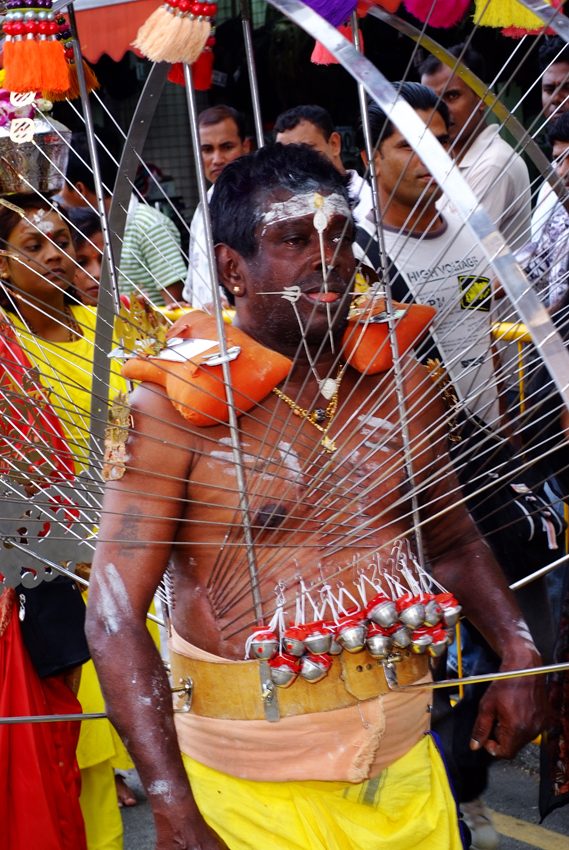
Our file's second worked example of the pattern is the one a reader can go and watch. It treats extreme pain tolerance as genuinely established and grades it Tier 1 to 2, phenomena real and mechanisms partially understood. Its examples: kavadi at Thaipusam, where Hindu devotees pierce cheeks, tongues and bodies with skewers with minimal bleeding and rapid healing; the Lakota Sun Dance, where participants are suspended by chest piercings for hours; and hook-hanging at Ganesh Chaturthi, where devotees are suspended by metal hooks through the skin of the back. The mechanisms it names are ordinary ones: pain gate modification, endorphin release, trance states and cultural conditioning, plus, for the piercings specifically, wound geometry that minimises bleeding, and hook placement and skin elasticity that reduce injury. Its assessment is this whole article in one line: extraordinary is not the same thing as supernatural. One caveat our file does not supply about itself: it attaches those mechanisms to these rituals without citing a study for any of them, and the research pass behind this article located none either.
09Hunger, And The Claim With Deaths Attached
Fasting is where this article has to be most careful, because it is where two true facts look, at a glance, like a contradiction.
Our file states, correctly, that extended fasting is documented. Some political hunger strikers survived 60 to 73 days on water only. Bobby Sands died on day 66. Medical documentation exists of several fasts beyond 60 days. Our file calls that range the verified human limit.
That phrase needs one correction, and the correction is the reason this section exists. The range is the limit of a narrow case: total food deprivation in an already lean adult taking water alone. It is not a limit on fasting in general. A supervised therapeutic fast of 382 days was published in the Postgraduate Medical Journal in 1973, in a 27-year-old obese patient who received fluids and supplementation and who afterwards maintained a normal weight. The paper reports blood glucose around 30 mg per 100 ml sustained through the last eight months while the patient remained ambulant, and states that the fast had no ill effects. Those two facts are not in conflict, because they describe different situations, and the difference between them is exactly what the rest of this section runs into. Human tolerance for going without food is enormous and documented. Human tolerance for going without water is not.
Which brings us to the modern case. An Indian sadhu, Prahlad Jani, said he had taken no food or water for more than seventy years. He was observed for ten days by DIPAS, an Indian military research organisation. Over that period, on the account our file gives, he did not eat or drink, and doctors found no dehydration or malnutrition. Our file's own assessment is a model of how to hold a case like this, and it is worth repeating whole: a ten-day observation is notable and it is very far from seventy years, bathroom access was not fully controlled, and the credibility of the observing institution was questioned. The research pass behind this article searched for a peer-reviewed publication of the observation and found none, which is consistent with our file's own doubt and is reported here rather than papered over with something weaker.
The older cases go the same way. Our file grades inedia, total abstention from food, at Tier 3 to 4, noting that some religious figures were investigated. It names Therese Neumann, gives her dates as 1898 to 1962, and says she was investigated by a bishop. An ecclesiastical investigation is not a medical one, and our file says so itself in the same breath: the cases were never placed under full medical surveillance. Her dates are reproduced as our file gives them and were not independently checked for this article. Our file spells her forename differently from the standard form in the literature, and this article uses the standard form.
And then the claim at the bottom of the file, which our research document grades at its lowest tier in two separate places. Breatharianism is the doctrine that a person can live on prana, or breath, or light alone, without food. Our file's stated grounds for the grade are that no case is verified and that practitioner deaths are documented, and its own summary line is blunt: the deaths prove the claim false, and the practice is genuinely dangerous.
This article names nobody in connection with that. Our file's account of the individual cases, which includes a death, a year, a living practitioner and a failed television test, rests on a single row with no citation of any kind, and the research pass behind this article could not corroborate a word of it against a checkable source. Naming a dead woman and a living person on that basis is not something a research article gets to do, so the names, the dates and the figures stay out, and the gap gets stated instead. What survives the deletion is the part that matters most. Everything else in this piece is an argument about what the evidence supports. This one, on our own file's account, has a body count.
10Telepathy, And What Happened When It Was Tested
Return for a moment to the entry our file glosses as telepathy. That the text lists it is a fact about the text. Whether anything of the kind occurs is an entirely separate question, and it has a literature with a specific and instructive shape. This article does not settle the ganzfeld debate, and it does not try: that argument belongs to a dossier still to come in this wing. What belongs here is the shape of the record itself, carried at the tier each piece of it earns, with no winner crowned that the evidence has not crowned.
The high-water mark first. In 1994 Bem and Honorton published a meta-analysis in Psychological Bulletin under the title Does psi exist? Replicable evidence for an anomalous process of information transfer. It is the reason this is a debate rather than a dismissal. This article carries its title, journal, year and authors, and claims nothing whatever about its method or its numbers, because the paper was not read here.
Five years later, in the same journal, Milton and Wiseman published Does psi exist? Lack of replication of an anomalous process of information transfer. The two titles differ in three words. That is in the published record, not an arrangement made here, and the second paper reports failure to replicate the first.
It did not resolve. In 2010 Storm, Tressoldi and Di Risio published a further meta-analysis of free-response studies covering 1992 to 2008 in the same journal, and Ray Hyman published a comment on it in the same volume, on the immediately following pages, titled Meta-analysis that conceals more than it reveals. One more thing about that meta-analysis, disclosed because a reader has a right to it: its bibliographic record carries two registered corrections, published five years apart. Both are labelled corrections rather than retractions, neither of their identifiers was independently resolved for this article, and neither is linked below. A meta-analysis corrected twice inside a contested literature is a fact about that literature. It is not by itself a disqualification of the paper.
The most consequential episode is the most recent, and it is not a debunking. It is also not about telepathy, which is why it is marked here rather than folded in. In 2011 Daryl Bem published Feeling the future: Experimental evidence for anomalous retroactive influences on cognition and affect in the Journal of Personality and Social Psychology, reporting experimental evidence that future events influence present cognition. That is a different psi claim from one mind reaching another, and it is carried here for what happened to it next rather than for what it claimed. In the same volume, Wagenmakers, Wetzels, Borsboom and van der Maas published a statistical critique, Why psychologists must change the way they analyze their data: The case of psi. In 2012 Ritchie, Wiseman and French published Failing the Future: Three Unsuccessful Attempts to Replicate Bem's Retroactive Facilitation of Recall Effect in PLoS ONE, and Galak, LeBoeuf, Nelson and Simmons published Correcting the past: Failures to replicate psi, back in the original journal. None of those four papers was read for this article either. Titles, journals, years and authors are what is carried, nothing about their statistics is claimed here, and the count of three in that third title is what that single paper reports rather than a tally of every replication attempt anyone has made.
That is the honest end of the thread, and it is a better story than a debunking. A rigorous, well-designed psi paper cleared peer review at a top journal and produced a positive result. The machinery of replication and statistical critique that the field then turned on it did not sustain the result, and that episode is one of the origin points of psychology's whole replication reckoning. The free-response work above is the part of this record that bears directly on the mind-to-mind claim, and it went the same way: a claimed replicable effect, a failed replication in the same journal, and a later meta-analysis contested on the pages beside it. So the tradition's telepathy claim has been taken seriously enough to be tested hard, and the testing did not sustain it. Both halves of that sentence are true, and neither half is the one anybody arrives wanting.
11The Ones That Do Not Survive
Now the claims that get our file's lowest grade. It is worth writing out what that grade actually rests on, because Tier 4 in this document is not a shrug. It is a specific statement about what has been looked for and not found.
Levitation. Our file grades it Tier 4. Its stated grounds: no documented case under controlled conditions; Transcendental Meditation's yogic flying is hopping; David Copperfield's levitation is illusion. This is where the parenthesis from section 01 comes down. The text lists laghima, lightness. The physical reading of that word gets the lowest grade our file issues. Our file's own cell then closes with a universal negative covering every tradition on Earth, and cites no survey that could establish one, so this article does not repeat that sentence. What it can say is narrower and still decisive: no controlled demonstration is documented in any source reachable for this piece, and the claim has not generated a testable literature at all, which is why nothing is cited here in either direction.
Telekinesis. Our file grades it Tier 4 on the grounds that there is no reproducible demonstration under controlled conditions, that James Randi's Million Dollar Challenge went unclaimed, and that Uri Geller was debunked. The first of those has a genuine peer-reviewed anchor, and it is the replication record set out in the section above. The second and third do not: our file names them without citing anything, this article did not independently verify the challenge's terms or the Geller episode, and so both are reported strictly as our file's own grounds, with no prize figure, no date and no count of claimants attached to either.
Bilocation, being in two places at once. Our file grades it Tier 4, noting that it is claimed for Catholic saints, naming Padre Pio and Maria de Agreda, and for some yogis, and that there is no photographic or controlled evidence. Neither name was independently verified for this article and both are reported as our file's own naming. The useful part here is not the verdict, it is the pattern. The same class of claim turns up inside a Catholic hagiography and inside a yogic one, travels the same way, and arrives at the same evidentiary place. That is a fact about how such stories are transmitted, and it sits squarely on the tradition side of the line drawn in section 02.
12The Echo In The Brain
One last thing, carried carefully, because it stands on somebody else's boundary. The closest thing in our file to a genuinely anomalous human ability that is also documented is savant syndrome. It names the documented types: calendar calculation, musical prodigy, eidetic memory, and acquired savant syndrome, in which a head injury or a stroke unlocks an ability that was not there before. Its grade is Tier 2, genuine phenomenon with the interpretation debated, and the standing synopsis is Treffert's 2009 review in Philosophical Transactions of the Royal Society B, whose title our file's bibliography truncates. The debated interpretation is the one with the echo in it: that acquired cases support a brain-as-filter model in which the brain normally suppresses latent capacities, which sounds a great deal like powers latent in everyone and released by practice. Our own file supplies the counter in the same document. Brain damage usually reduces function, savant cases are rare exceptions, and the effect may reflect disinhibition rather than hidden abilities. This article notices the echo and hands the metaphysics across the boundary, because the brain-as-filter question belongs to another dossier in this realm.
13What Our Own File Concludes
Our research file ends with a counter-arguments table, and its third row is this whole article in miniature. The supporting evidence it lists: a millennium-old tradition, multiple claimed witnesses, and some modern practitioners who claim abilities. Its counter-evidence cell, word for word: "No verified demonstration under controlled conditions for levitation, telekinesis, or bilocation". Its assessment cell, word for word: "Tier 3-4 for most siddhis; the PRACTICES (meditation, breath control) produce well-documented altered states". Our file writes the band as Tier 3 to 4; this article files the row at 4, the weaker of the two, because the operative half of the verdict is the negative one and filing it higher would let this page inherit credit the row does not give. That second quotation also carries a distributional claim about how many of the powers fall in that band, and our file supports it with no counted distribution of any kind, so it stays inside the quotation marks as our file's wording rather than ours. What survives outside them is the sentence this document has been building toward all along. The powers do not survive the measurement. The practices do.
| The Claim | How Our File Grades It | What The Reachable Evidence Shows |
|---|---|---|
| Tummo, inner heat | Tier 1, verified | Finger and toe temperature raised by up to 8.3 degrees Celsius, published in 1982; a peripheral-warming form separated from a core-warming one in 2013; mechanism partially understood |
| The wet sheet ordeal | Placed inside a section headed as well-documented, with no citation at all | No peer-reviewed record located. Filed here at Tier 3, and named as the one part of the tummo story with no measurement attached |
| Voluntary immune modulation | Tier 1, verified and replicated | A controlled trial in 2014, and a 2022 pilot study finding the breathing exercise rather than the cold carried the effect, in healthy young men only |
| Tukdam, post-mortem meditation | Some investigation | A field electroencephalography study validated on living subjects found no recognisable waveforms in the tukdam cases. The delayed-decomposition claim is a separate question it does not answer |
| Lung-gom-pa and rainbow body | Not verified; not scientifically investigated | A travel narrative and witness testimony. Reportable as claims, never as observations |
| Extended water-only fasting | Tier 1; 60 to 73 days given as the verified human limit | True of total food deprivation with water only. A supervised therapeutic fast of 382 days with fluids and supplementation is published |
| Living without food and water | Tier 3 for the modern case, Tier 3 to 4 for the older ones | A ten-day observation of a seventy-year claim, with bathroom access not fully controlled. No peer-reviewed publication located |
| Breatharianism | Tier 4, in two separate places | Practitioner deaths recorded in our file without any citation. No checkable source located here, and no names repeated |
| Extreme ritual pain tolerance | Tier 1 to 2, phenomena real | Ordinary pain physiology named as the mechanism, though our file cites no study for these particular rituals and none was located |
| Telepathy | Listed in the text; Tier 4 as a physical claim | A claimed replicable effect, a failed replication, and a meta-analysis corrected twice with a published rebuttal beside it. In the same literature, a top-journal result on a different psi claim that the replications did not sustain |
| Levitation, telekinesis, bilocation | Tier 4 | No controlled demonstration documented in any source reachable for this article |
Fast Facts
- The Text
- The Yoga Sutras of Patanjali. Our research file gives seven powers at one verse locus in the third book, and three further capacities at three separate loci in the same book
- The Word
- Siddhi, a capacity attained through practice. The same text, as our file records it, treats attachment to these capacities as a distraction from liberation
- Measured, And Real
- Tummo, inner heat. Finger and toe temperature raised by up to 8.3 degrees Celsius in a Harvard study published in Nature in 1982, and a peripheral-warming form of the practice separated from a core-warming one in 2013
- Also Measured
- Voluntary immune modulation after breathing training, published in 2014, and a 2022 pilot study finding that the breathing exercise rather than the cold carried the effect, in healthy young men only
- The Hook, Answered
- The wet-sheet ordeal is the part of the tummo story that arrives with no measurement. Our own file gives it no citation, and the research pass behind this article found no peer-reviewed record of it
- The Measured Null
- Tukdam. A field electroencephalography study validated on living subjects found no recognisable waveforms in the tukdam cases, and it does not address the separate claim about delayed decomposition
- Graded Lowest By Our Own File
- Levitation, telekinesis, bilocation, and breatharianism
- The Claim With Deaths Attached
- Breatharianism. Our file records practitioner deaths and calls the practice genuinely dangerous. This article carries that judgment and repeats none of the names behind it, because they rest on a single uncited row
- Deliberately Not Covered
- Firewalking, which the same research file treats at length and which is still to come in this wing as an article of its own
- Not Quoted Anywhere Here
- The Yoga Sutras themselves. No primary edition was read for this article, so the terms and verse numbers are given as our file gives them and no line of the text appears in quotation marks
- The Thesis
- The powers do not survive the measurement. The practices do
What We Can Actually Stand Behind
The practices are real and they were measured. A Harvard team recorded Tibetan monks raising the temperature of their fingers and toes by up to 8.3 degrees Celsius during tummo, in Nature in 1982, and a later study separated a forceful-breath form of the practice that warms the periphery from a gentle-breath form that raises core temperature. Trained practitioners of the Wim Hof Method voluntarily damped their own immune response in a controlled trial published in 2014, and novices learned it in ten days of training. Long-term meditators self-induce high-amplitude gamma synchrony during practice. Extended fasting on water alone is documented at 60 to 73 days, and separately, with fluids and supplementation, a supervised therapeutic fast of 382 days is published: two different situations rather than one contradiction. Extreme ritual pain tolerance is a real phenomenon with ordinary pain physiology behind it. None of that is supernatural and all of it is remarkable.
One tradition claim was checked directly and the check returned nothing. Researchers working from the Center for Healthy Minds took a field electroencephalography rig to India, validated it on living subjects who gave well-defined mismatch negativity and auditory brainstem responses, and pointed it at bodies in apparent tukdam. No recognisable waveforms were discernible. That is a real answer to a real question, and it answers only the question it asked: it says nothing about the separate claim that decomposition is delayed, which this article did not confirm was tested. It also was not an outside debunking, since the study was run with co-authors from the community whose claim it tested.
The tradition's reading of itself is the part this article trusts most and can prove least. Our file records that the Yoga Sutras warn against attachment to the powers and treat them as a distraction from liberation, and its own methodological caveat is that siddhi literature often works symbolically, pedagogically or hagiographically. Both are well-founded readings of a text rather than measurements of anything, and the scholarly editions that could test them were not opened for this article. The savant material sits at this tier too: the phenomenon is genuine, and the brain-as-filter reading of the acquired cases is disputed inside our own file. So is the parapsychological meta-analytic case, which was published, criticised in the same volume, and corrected twice.
The famous images are the unproven ones. The drying of wet sheets in the snow appears in our research file inside a section headed as well-documented, with no citation, no observer, no date, no protocol and no measurement, and the research pass behind this article found no peer-reviewed record of it anywhere. The modern fasting case rests on a ten-day observation of a claim about seventy years, with bathroom access not fully controlled and the observing institution's credibility questioned by our own file. The older inedia cases were investigated ecclesiastically and never placed under full medical surveillance. None of these is refuted. All of them are unestablished, which is a different and more honest thing to be.
No, there is no documented case of levitation under controlled conditions. Our research file grades the claim at its lowest tier and gives its grounds, which include that Transcendental Meditation's yogic flying is hopping and that the stage version is illusion. No controlled demonstration appears in any source reachable for this article, and the claim has not generated a testable literature at all, which is why nothing is cited here in either direction.
No, telekinesis and bilocation do not have evidence behind them either. Our file grades both at its lowest tier: no reproducible demonstration under controlled conditions for the first, no photographic or controlled evidence for the second. The genuine peer-reviewed anchor for the general shape of that finding is the replication record in section 10, not the popular debunking stories our file names without citing.
No, nobody lives on light. Our file grades breatharianism at its lowest tier in two separate places, records practitioner deaths, and calls the practice genuinely dangerous. This article carries that judgment and none of the individual cases behind it, because our file's account of them is one uncited row naming real people and no checkable source for it could be found. The doctrine is the part that can be assessed on the evidence here, and it fails.
So the honest account disappoints both camps in the same sentence, which is usually the sign that it is the right one. A trained person really can raise the temperature of their own fingers in the cold. They really can damp their own immune response on command, and be taught to. They really can hang from hooks through the skin of the back and bleed very little. Each of those sounds like it ought to be impossible, and each turned out to have ordinary physiology underneath it. The powers went the other way. Where a measurement exists it did not come back in their favour: the mind-to-mind claim was tested hard and the testing did not sustain it, and the living-on-air claim produced a ten-day observation of a seventy-year story. Where no measurement exists at all, as with a body leaving the ground, the claim never generated a test it could fail, which is its own kind of answer. Which leaves the question the tradition asked about these powers long before anyone measured anything. The text that catalogues these powers is the same text that says they are a distraction from the only thing worth having. If the practices are the real part and the powers are the story, what were the powers ever for?
Sources & further reading
This article was written from our own research library, principally file Y_5_04, and the research files are where it worked FROM. The sources below are where it can be checked, and every one of them was resolved live against its registry and its returned title read against the claim it is attached to before it was carried here. Eighteen digital object identifiers are linked below; all eighteen resolved exactly and none resolved to a different work. A nineteenth was resolved during the same research pass, belongs to the firewalking file rather than to this article, and is deliberately absent here. Two identifiers could not be checked independently: the two registered corrections attached to the 2010 meta-analysis in section 10, which were read off the parent record's own update block, and neither is linked here because neither is verified. One further candidate identifier for the Brill volume on yoga powers returned a 404 and was dropped before carry, so that volume is cited by its book number instead. Five limits are worth stating plainly rather than leaving for a reader to discover. First, no external source was read in full for this article: every entry below is carried with its resolved title, journal, year and authors, plus whatever its resolved abstract states in its own words, and nothing beyond that. Where a figure or a component result appears above, as with the two arms of the 2022 pilot study, it is what that paper's own abstract states; where our own file supplied a number the abstract does not, as with the 2014 trial, the number is left out. Second, no primary edition of the Yoga Sutras was read, which is why the text is named and never quoted; Bryant's edition with translation and commentary, White's reception history of the text, Jacobsen's edited scholarly volume on the powers material, and the public-domain Woods translation are listed so a reader can go where this article did not. Third, a number of things stated above carry no external identifier, because the research pass looked and none exists to carry: the wet-sheet ordeal; the levitation and bilocation assessments; the older inedia case; the breatharianism material; the ten-day observation behind the modern fasting claim; the physiological mechanisms our file attaches to the piercing rituals; and the two popular debunking stories our file gives as grounds for its telekinesis grade, the unclaimed prize challenge and the Geller episode. In each case the absence is the finding and it is stated in the body rather than papered over with a weaker citation, and it is why no name from the breatharianism row appears anywhere on this page. Fourth, our own file's bibliography is field-shredded by whatever tool generated it, with author names split across the wrong columns and page ranges landing in author slots, so no identifier below was transcribed from it; each was resolved independently. The identifiers inside those mangled entries were, where present, correct. Fifth, our file's cross-reference links are broken in five places pointing at four wrong target documents, and not one of them was propagated into this page. Two smaller notes for completeness: the published title of the 2018 imaging paper uses an en-dash, and house style writes a hyphen in its place; and the year of the Jacobsen volume is given as 2011 by OpenLibrary and the LCCN record while some catalogues list 2012, so both are recorded rather than one being picked silently.
Image credits
- A Wim Hof Method instructor coaching a 57th Rescue Squadron pararescueman through a breathing pattern during cold water immersion at Aviano Air Base, Italy U.S. Air Force photo by Senior Airman Brooke Keisler, 31st Fighter Wing Public Affairs (VIRIN 220622-F-ZR251-1077, DVIDS 7352076), via Wikimedia Commons. Public Domain (17 U.S.C. 105) Source.
- A folio from an eighteenth century Sanskrit manuscript of the Yoga Sutras with Patanjali's bhasya, the sutra lines daubed in orange saffron powder Ms Sarah Welch, 2018, via Wikimedia Commons; manuscript preserved at the University of Pennsylvania. CC BY-SA 4.0 Source.
- The Mahasiddhas Saraha, Dombi Heruka, Naropa and Virupa, an eighteenth century Tibetan thangka Anonymous, 18th century; Museum of Fine Arts, Boston (object 22412), via Wikimedia Commons. Public Domain Source.
- A nineteenth century thangka of Milarepa from Tibet or Nepal, mounted in silk borders anonymous, 19th century; Los Angeles County Museum of Art, gift of Mr. and Mrs. Michael Phillips (M.82.165.2), via Wikimedia Commons. Public Domain Source.
- A kavadi bearer at Thaipusam in Singapore, a skewer through both cheeks and bells hung from hooks in the skin William Cho, 2009, via Wikimedia Commons. CC BY-SA 2.0 Source.
- Card crop of A Wim Hof Method instructor coaching a 57th Rescue Squadron pararescueman through a breathing pattern during cold water immersion at Aviano Air Base, Italy U.S. Air Force photo by Senior Airman Brooke Keisler, 31st Fighter Wing Public Affairs (VIRIN 220622-F-ZR251-1077, DVIDS 7352076), via Wikimedia Commons. Public Domain (17 U.S.C. 105) Source.
.jpg)

_-_(multiple_figures)18th_century_Boston_MFA.jpg)
_LACMA_M.82.165.2.jpg)
_(3262597945).jpg)