
Vesuvius and Pompeii: The City Caught in Its Final Hour
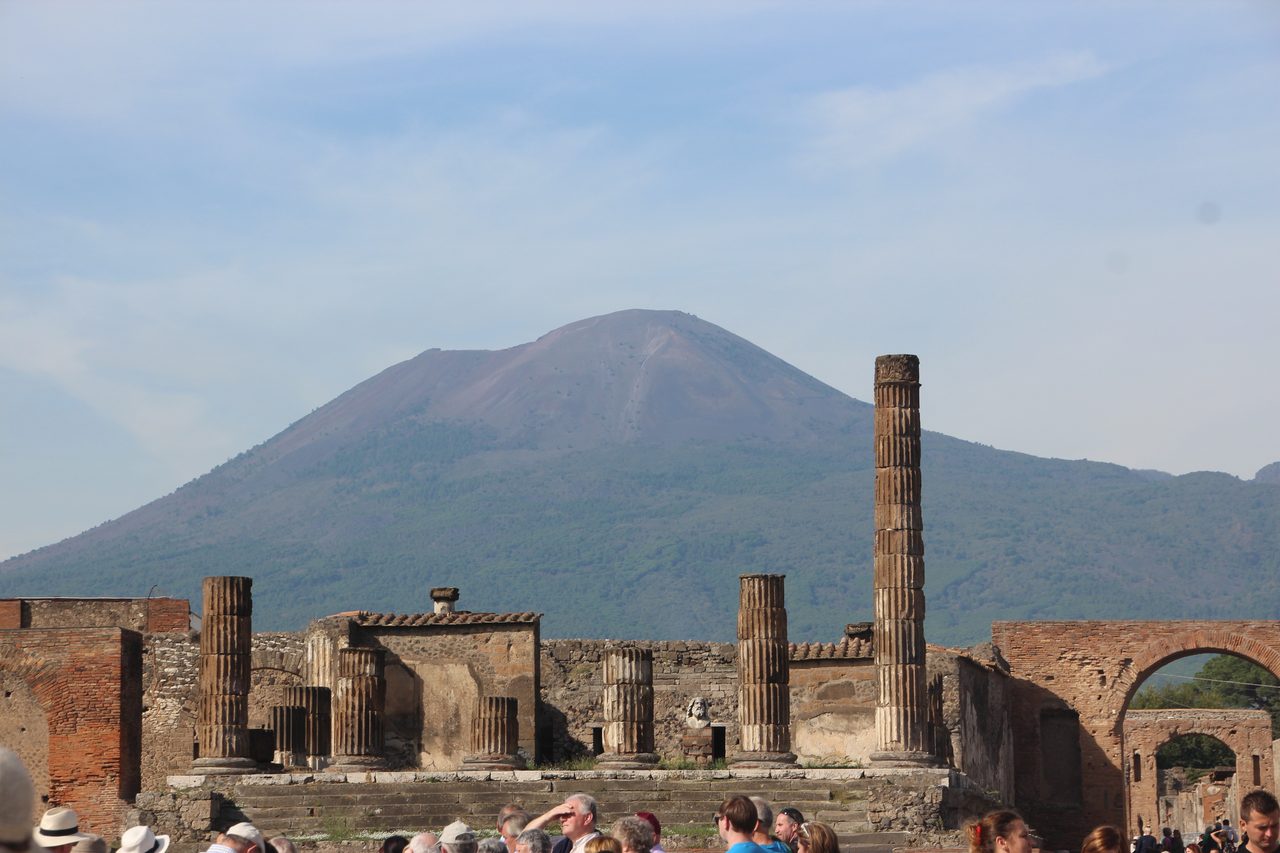
For about eighteen hours in 79 CE, Mount Vesuvius held a column of ash and pumice roughly thirty-three kilometers high over the Bay of Naples. Then the column fell. Pyroclastic surges hotter than 250 degrees swept down the slopes and buried two Roman towns where they stood: Pompeii under four to six meters of pumice and ash, Herculaneum under as much as twenty. What the ash sealed, it also kept. Here is the file, opened claim by claim, each one wearing its evidence.
Two Roman towns on the Bay of Naples went about an ordinary day, and by the next morning both were gone, sealed under volcanic rock with their streets, their houses, their frescoes, and many of their people still in place. Vesuvius did not erase Pompeii and Herculaneum. It preserved them, more completely than almost anywhere else in the ancient world, by killing them fast and burying them deep. That is the strange gift at the center of this file: a catastrophe that turned two cities into the most detailed record we have of daily Roman life. Let's open it.
01Eighteen Hours, Then the Surges
The 79 CE eruption did not kill in a single blow. It came in two very different phases, and the difference between them decided who had time to flee and who did not.
Modern volcanology classifies the 79 CE event as a Plinian eruption, a Volcanic Explosivity Index 5. It ejected roughly 1.5 cubic kilometers of tephra and drove an eruption column to a height of about 33 kilometers, well up into the stratosphere.
The reconstruction worked out by Haraldur Sigurdsson and Steven Carey, and by Giuseppe Mastrolorenzo and colleagues, splits the eruption in two. Phase one, lasting about eighteen hours, was a sustained Plinian column that rained white pumice down on Pompeii to a depth of around 2.6 meters, followed by grey pumice. Phase two began when that column collapsed, generating six pyroclastic density currents, the surges and flows of superheated gas and rock that did the real killing.
Herculaneum sat closer to the vent, about 7 kilometers away against Pompeii's 10, and it died first. The opening pyroclastic surge overwhelmed the town at around one in the morning, while Pompeii was still being buried under falling pumice.
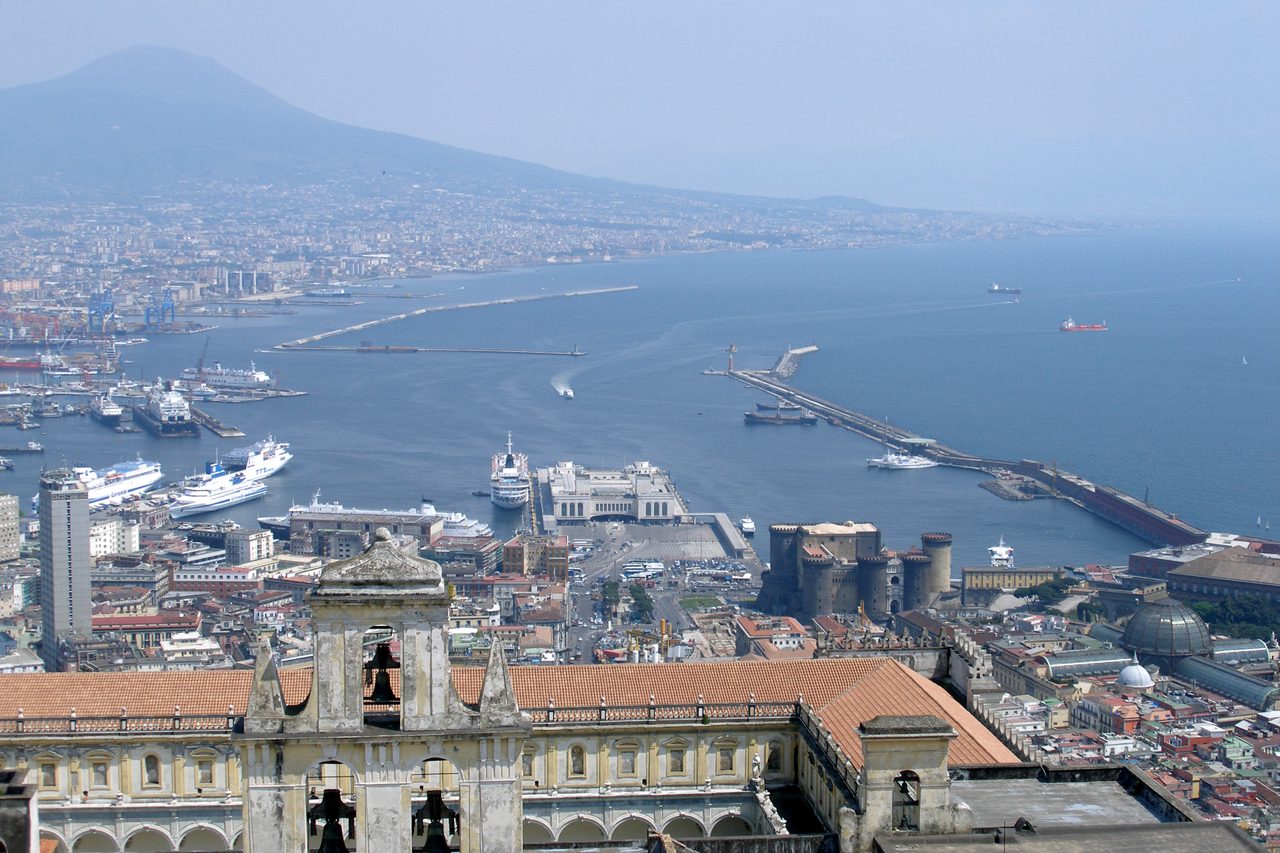
At Pompeii the fourth of the six surges arrived at about half past seven the following morning. It killed the inhabitants who had stayed, by thermal shock, at temperatures estimated between 250 and 300 degrees Celsius.
When it was over, the burial was deep and fast. Pompeii lay under 4 to 6 meters of pumice and ash. Herculaneum, swamped by successive flows, lay under as much as 20 meters of pyroclastic material. That depth is a large part of why the two towns survived so intact.
| Measure | What the Evidence Gives |
|---|---|
| Type | A Plinian eruption, Volcanic Explosivity Index 5 |
| Material ejected | About 1.5 cubic kilometers of tephra |
| Column height | About 33 kilometers |
| Phase one | A sustained eruption column for about 18 hours, dropping around 2.6 m of pumice on Pompeii |
| Phase two | Column collapse into six pyroclastic density currents |
| Pompeii | About 10 km from the vent, buried under 4 to 6 m of pumice and ash |
| Herculaneum | About 7 km from the vent, buried under up to 20 m of pyroclastic material |
02A City That Had Been Warned
The mountain was not silent before it erupted.
Vesuvius had given a sign seventeen years earlier. Seneca records a severe earthquake that damaged Pompeii on February 5 in the year 62 (Naturales Quaestiones VI.1), and the archaeology backs him up: many of the town's buildings were still under repair when the eruption came in 79. Volcanologists have suggested that earthquake was driven by magma moving beneath the mountain in the preceding decades, though the exact link between the tremor and the eruption that followed remains debated.
03The Only Witness
Almost everything a historian would want to know about that day comes filtered through a single pair of letters, written a generation later by a teenager who watched it from across the bay.
Gaius Plinius Caecilius Secundus, whom we call Pliny the Younger, was about 17 when Vesuvius erupted. Around 106 to 107 CE he wrote two letters to the historian Tacitus describing what he had seen, Epistulae 6.16 and 6.20. They are the only surviving eyewitness account of the disaster, from anyone.
Letter 6.16 is about his uncle. Pliny the Elder, a naval commander and famous naturalist, sailed from Misenum straight toward the eruption to rescue friends stranded at Stabiae. He never came back. He died there, most likely of cardiac arrest or asphyxiation from the volcanic gases.
Letter 6.20 is Pliny's own story from Misenum: the ground heaving with earthquakes, pumice falling, and a darkness he described as unlike a moonless night, more like a room with the lamp extinguished. It is from these two letters that volcanology takes the name for this kind of eruption. A Plinian eruption is named for the boy who watched this one.
04Buried, Then Dug Back Up
For sixteen centuries the two towns lay under farmland and new soil, their names only half remembered. Then, in the 1700s, people began to dig.
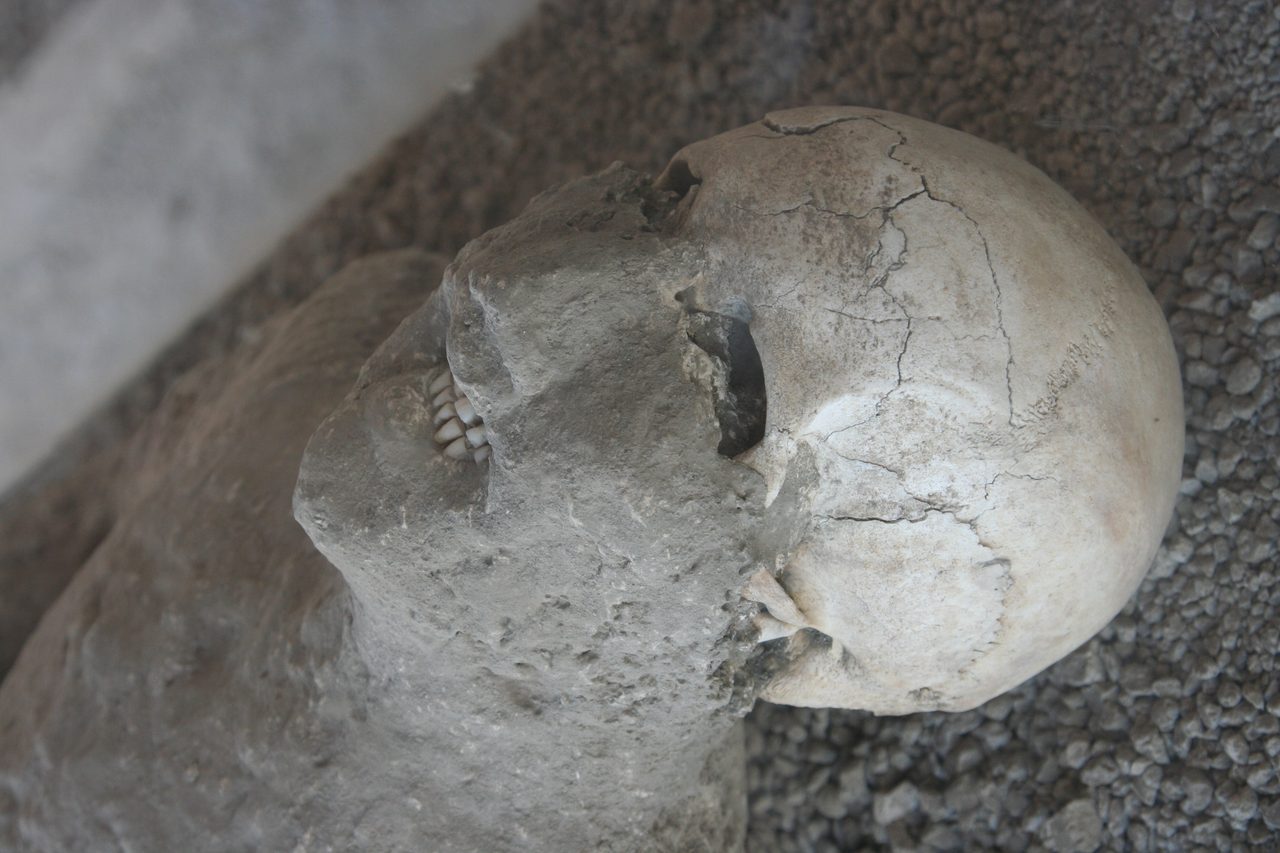
Systematic excavation began at Herculaneum under Karl Weber in 1748, and at Pompeii under Rocque Joaquin de Alcubierre from the same year. The single most important technique came later, from Giuseppe Fiorelli, who took over at Pompeii in 1860. In 1863 he developed the plaster-casting method: where a buried body had decayed inside the hardened ash, it left a cavity in the exact shape of the person, and pouring liquid plaster into that void recovers the form of a Pompeiian in the last moment of life.
About two-thirds of Pompeii's 66-hectare site has now been excavated, uncovering more than 1,500 buildings. Among them are the Forum, an amphitheater that seated roughly 20,000, public baths, brothels, and private houses whose frescoes, mosaics, and scratched graffiti survived two thousand years underground.
That excavation is also the site's biggest problem. Andrew Wallace-Hadrill and other conservation specialists have argued that exposing buildings faster than they can be conserved has let structures and frescoes that survived two thousand years underground decay in the open air. The crisis was serious enough that in 2012 the Great Pompeii Project, the Grande Progetto Pompei, was created with about 105 million euros in European Union funding to stabilize what has already been dug.
05How Many Died
The famous plaster casts can make it feel as though everyone in Pompeii perished at their doorways. Most did not.
| Measure | Pompeii | Herculaneum |
|---|---|---|
| Distance from the vent | About 10 km | About 7 km |
| Estimated population | 11,000 to 20,000 | 4,000 to 5,000 |
| Bodies recovered so far | About 1,150 | Several hundred, most in the boat chambers |
| Estimated total dead | Around 2,000 (about 10 to 15 percent) | Not separately estimated |
Estimates put Pompeii's population somewhere between 11,000 and 20,000, based on house counts and the capacity of its water supply. About 1,150 bodies have been recovered in the excavations. Because roughly a third of the city is still unexcavated, and because many residents fled during the long pumice-fall phase before the surges arrived, the total death toll at Pompeii is estimated at around 2,000, on the order of 10 to 15 percent of the population.
Herculaneum was smaller, perhaps 4,000 to 5,000 people. For a long time it looked as though almost all of them had escaped, because so few bodies turned up inside the town. Then the excavators looked at the old shoreline.
06The Boat Chambers of Herculaneum
In 1982, excavations led by Giuseppe Maggi opened the vaulted stone chambers, the fornici, along what had been Herculaneum's waterfront. Inside were the skeletal remains of about 300 people. They had gathered there at the edge of the sea, sheltering in the boat houses and waiting for a rescue by water that never reached them.
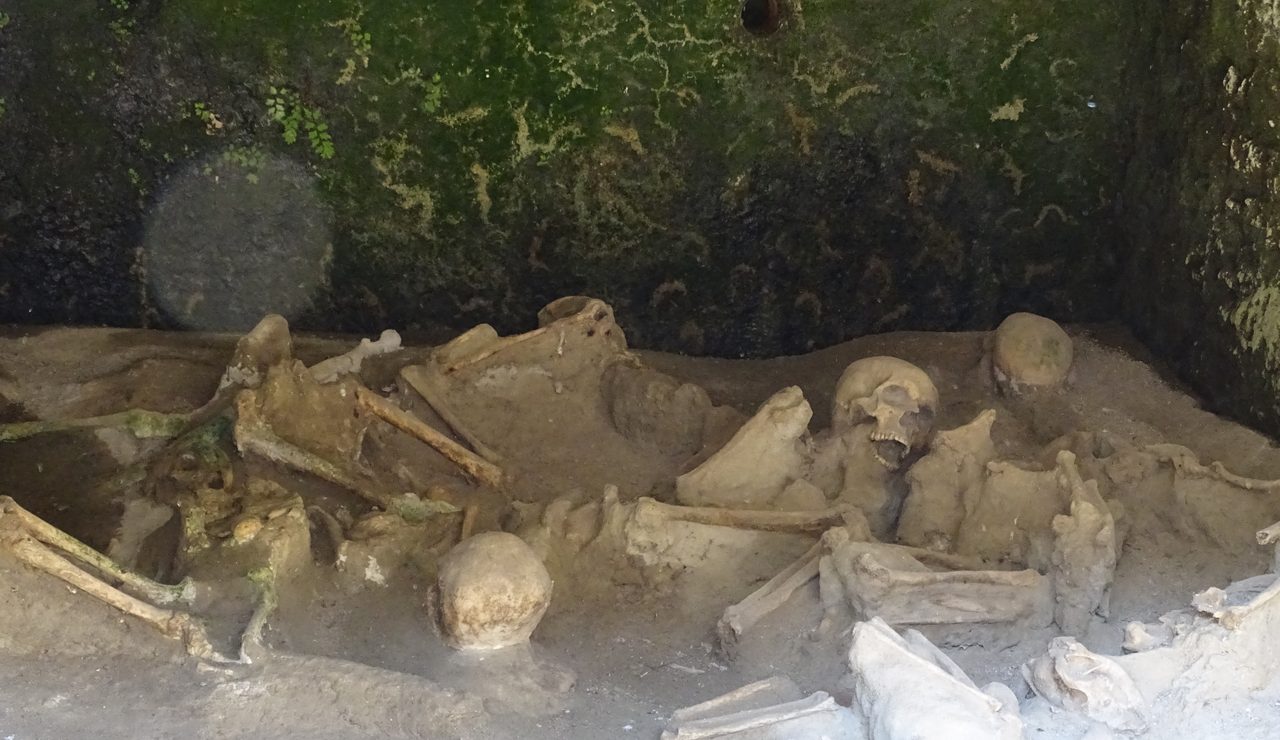
What killed them, and how fast, is written into their bones. Study of the boat-chamber victims by Sara Bisel, and later by Pier Paolo Petrone and colleagues, found the marks of instantaneous death. A 2018 paper in PLOS ONE reported black staining on the inner surface of some skulls, consistent with brain tissue that had boiled. A follow-up in 2020, in the New England Journal of Medicine, described something rarer still: vitrified brain material, the first archaeological evidence of a human brain preserved by rapid thermal vitrification, at temperatures estimated between 400 and 500 degrees Celsius. These were people who died in the instant the heat reached them, faster than the body can register.
07The Only Library to Survive From Antiquity
Not everything Vesuvius buried was flesh and stone. In one villa at Herculaneum it buried a library, and it is the only one from the ancient world that has come down to us at all.
The Villa of the Papyri, dug by Karl Weber in the 1750s through narrow underground tunnels, gave up around 1,800 papyrus scrolls. The heat had carbonized them, charring them into fragile black cylinders rather than burning them away, which is the only reason any of them still exist. Most hold works by the Epicurean philosopher Philodemus of Gadara. It is the sole surviving library of antiquity.
For centuries the scrolls were unreadable, too fragile to unroll without destroying them. That changed in 2023. The Vesuvius Challenge, built on AI-driven X-ray micro-CT scanning and machine learning developed by Brent Seales at the University of Kentucky, read passages from unopened scrolls for the first time, pulling philosophical text on pleasure and the senses out of a cylinder no one has ever physically opened.
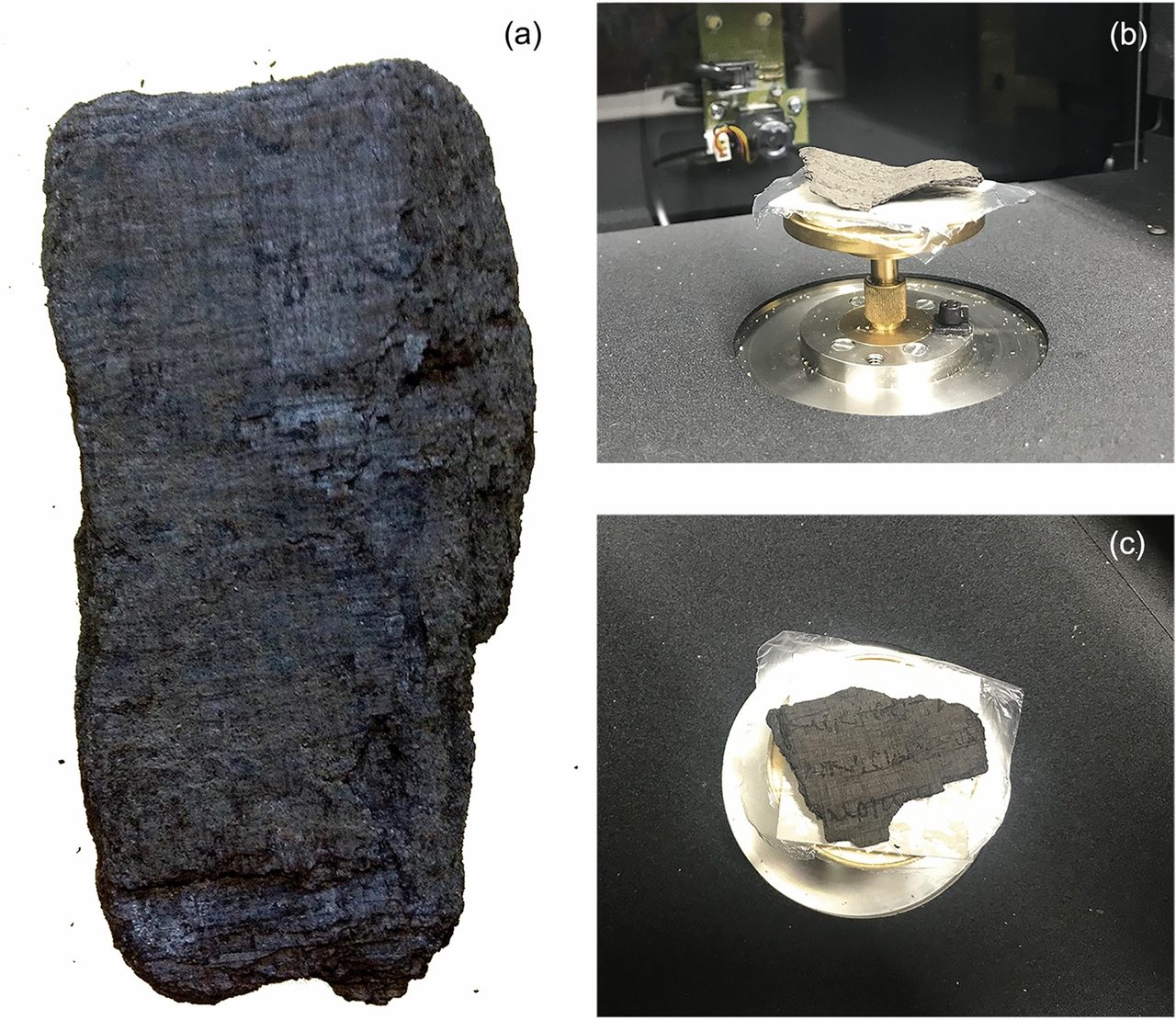
And the villa may not be empty yet. Parts of its library are thought to lie in deeper chambers that have never been excavated. Scholars allow themselves to hope the unrecovered sections could hold lost works of Greek and Latin literature, plays by Sophocles or Euripides, treatises by Aristotle, missing books of Livy, though this is speculation rather than expectation. Political, structural, and conservation concerns have kept anyone from tunneling deeper since the 18th century.
08Vesuvius Was Never the Biggest Threat
Terrible as it was, the 79 CE eruption was not the largest volcano in its own neighborhood, nor the only Mediterranean city a volcano ever swallowed whole.
Vesuvius belongs to the same Campanian volcanic province as the Campi Flegrei caldera, the restless ground about 15 kilometers west of Naples. Campi Flegrei's own Campanian Ignimbrite super-eruption, around 39,280 years ago, was a Volcanic Explosivity Index 7 event that threw out an estimated 250 to 300 cubic kilometers of tephra, something like 170 to 200 times what Vesuvius ejected in 79 CE, and the largest volcanic event in the Mediterranean region in the past 200,000 years.
And Pompeii was not the first Mediterranean city buried by fire. Akrotiri, on the island of Thera, modern Santorini, is often called the Pompeii of the Bronze Age. It was entombed by its own volcano roughly 1,600 years earlier, around 1600 BCE, and its preservation is as good as Pompeii's, sometimes better. But there is one haunting difference. Where Pompeii has yielded around 1,150 bodies, Akrotiri has produced none. Everyone there seems to have gotten out in time.
09Where the Story Runs Off the Map
A disaster this famous collects claims that outrun the evidence, plus one genuine puzzle the evidence itself has reopened. All of them are worth naming plainly.
Start with the date, because it is no longer settled. During 2018 excavations in Regio V at Pompeii, archaeologists found a charcoal graffito reading XVI K NOV, the 16th day before the Kalends of November, which is October 17. Set alongside other autumn signs at the site, pomegranates, wine still in the pressing, warm clothing on some of the victims, it points to an eruption in late October of 79 CE rather than the traditional August 24.
The August date was never as solid as it looked. It comes from a medieval manuscript tradition of Pliny's letters, where the phrase Nonum Kal. Septembres, the ninth day before the Kalends of September, August 24, may be a copyist's slip for Nonum Kal. Novembres, October 24. A single miscopied word could account for the whole discrepancy.
But the October case is not closed either. Mary Beard and others have pointed out that a single charcoal graffito proves less than it seems: charcoal writing is casual and impermanent, and that note could have been scrawled days or even weeks before the eruption sealed it. The honest position, and the one the evidence currently supports, is that we do not know for certain in which month Pompeii died.
A second, quieter question is whether the eruption also sent water. Researchers have proposed that pyroclastic flows pouring into the Bay of Naples could have generated localized tsunamis along the coast. It is plausible on the physics, but no clear geological or archaeological deposit from such a wave in 79 CE has ever been conclusively identified. For now it stays a possibility, not a finding.
And then there is the oldest story ever told about Pompeii's end, that it was punishment. Some early Christian writers read the eruption as divine retribution for the town's supposed depravity, pointing to its erotic frescoes and its brothels. That reading does not survive contact with the archaeology. The erotic art at Pompeii is ordinary Roman decorative convention, found in respectable homes across the empire, and Pompeii itself was a typical prosperous Roman town, no more debauched than its neighbors. The eruption was a geological event, not a verdict.
Fast Facts
- The Event
- The 79 CE eruption of Mount Vesuvius, which buried Pompeii and Herculaneum on the Bay of Naples
- Type
- A Plinian eruption, Volcanic Explosivity Index 5, column about 33 km high
- The Two Phases
- About 18 hours of pumice fall, then column collapse into six pyroclastic density currents
- Burial Depths
- Pompeii under 4 to 6 m; Herculaneum under up to 20 m
- The Only Witness
- Pliny the Younger, Letters 6.16 and 6.20, written to Tacitus around 106 to 107 CE
- Key Excavator
- Giuseppe Fiorelli, who developed the plaster-casting technique at Pompeii in 1863
- Excavated So Far
- About two-thirds of Pompeii's 66-hectare site; more than 1,500 buildings
- The Buried Library
- About 1,800 carbonized scrolls from the Villa of the Papyri, now being read by AI
- The Open Date
- Traditionally August 24, but 2018 evidence points to late October; still debated
What We Can Actually Stand Behind
The eruption itself is beyond dispute. In 79 CE Vesuvius produced a Plinian eruption, roughly 18 hours of pumice fall followed by six pyroclastic surges, and buried Pompeii under 4 to 6 meters of ash and Herculaneum under as much as 20. Pliny the Younger's two letters are the only eyewitness account, and they are why we call this kind of eruption Plinian. Systematic excavation since 1748, and Fiorelli's plaster casts from 1863, have uncovered about two-thirds of Pompeii.
Several of the most striking findings are well supported but still carry real uncertainty: the death-toll estimate of around 2,000 at Pompeii, the roughly 300 sheltering victims in the Herculaneum boat chambers, the 2020 evidence of thermal brain vitrification at 400 to 500 degrees, and the roughly 1,800 carbonized scrolls now being read by AI for the first time. The critique that Pompeii has been dug faster than it can be conserved is also fair and on the record.
The month of the eruption is genuinely unresolved. A 2018 charcoal graffito and autumn produce favor late October over the traditional August 24, but as Mary Beard notes, a single casual inscription cannot close the question. This is a live debate, not a settled correction.
Two threads are worth thinking about but unproven: that the eruption generated local tsunamis in the Bay of Naples, for which no deposit has been confirmed, and that the unexcavated deeper chambers of the Villa of the Papyri still hold lost works of ancient literature. Both are real possibilities resting on hope and inference, not on anything yet recovered.
No, the eruption was not divine punishment for Pompeii's supposed wickedness. That reading rests on mistaking ordinary Roman erotic art for evidence of exceptional vice. Pompeii was a normal Roman town, and Vesuvius destroyed it for reasons that were entirely geological.
So the real story needs no moralizing and no mystery to be astonishing. Two towns were caught mid-sentence and kept, down to the frescoes on their walls and the graffiti scratched beside their doors, by the very thing that killed them. And the file is still open in more ways than one. We are not sure which month the sky fell. We are, nearly three centuries into the digging, still only two-thirds of the way through Pompeii, with a third of the city untouched. And somewhere beneath Herculaneum, in the deeper rooms of a villa no one has fully entered since the 18th century, a library may still be waiting in the dark, its scrolls charred but not destroyed, holding words in a hand no living person has read. What is still down there, and are we finally about to be able to read it?
Sources & further reading
Everything above is drawn from our research library on Theories of Anything. Open the full file to check the sourcing and go deeper.
Image credits
- The Forum of Pompeii with Mount Vesuvius rising behind it photograph by Takver (John Englart), from Australia, via Wikimedia Commons. Creative Commons Attribution-Share Alike 2.0 Generic (CC BY-SA 2.0) Source.
- A view over the Bay of Naples with Mount Vesuvius above the coastline photograph by Vyacheslav Argenberg, via Wikimedia Commons. Creative Commons Attribution 4.0 International (CC BY 4.0) Source.
- A plaster cast of a Pompeii eruption victim, made using Fiorelli's 1863 technique photograph by Surge1223 (Wikimedia Commons user), via Wikimedia Commons. Creative Commons Attribution-Share Alike 3.0 Unported (CC BY-SA 3.0) Source.
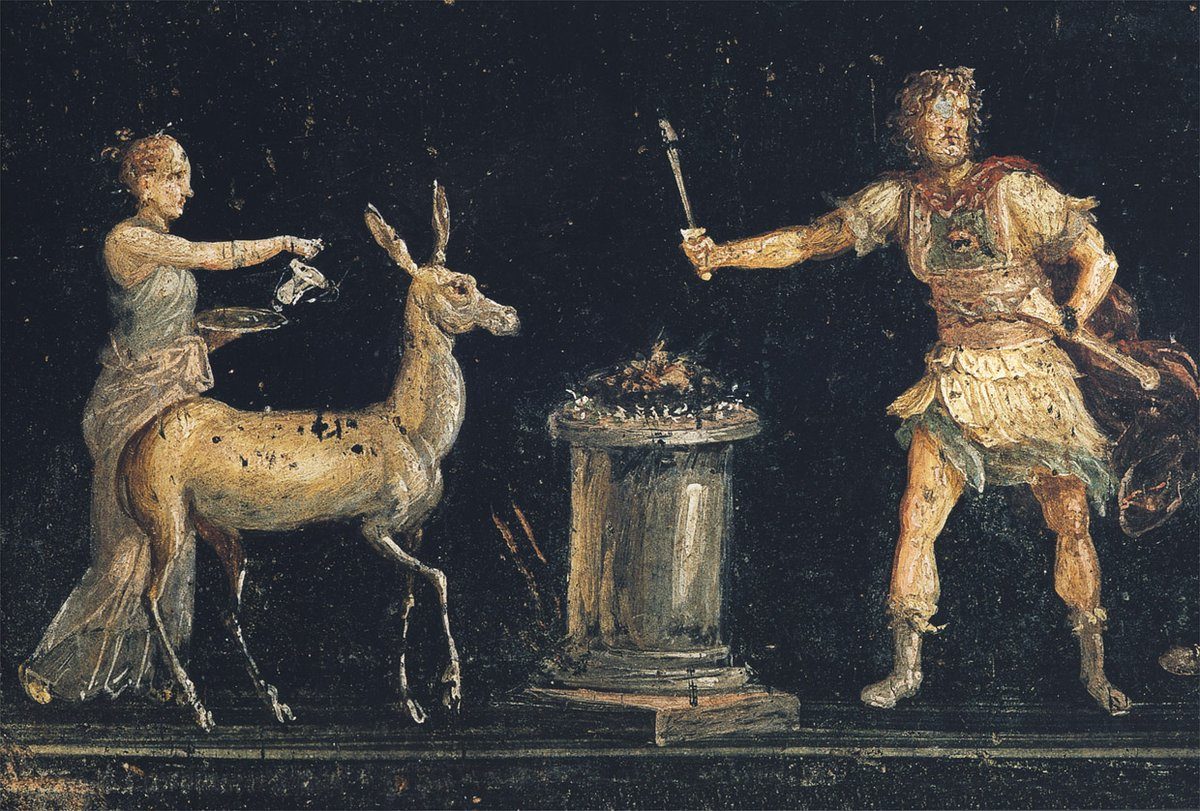
- A Roman fresco depicting a sacrifice to Diana, from the House of the Vettii, Pompeii photograph by Ancient Roman painter(s), unknown; photograph uploaded by PericlesofAthens, via Wikimedia Commons. Public domain (the ancient artwork itself, per its country-of-origin copyright term) plus Creative Commons Public Domain Mark 1.0 on the photographic reproduction Source.
- The Herculaneum boat chambers, where human remains were discovered in 1982 photograph by Ad Meskens, via Wikimedia Commons. Creative Commons Attribution-Share Alike 4.0 International (CC BY-SA 4.0) Source.
- Carbonized papyrus fragments from the Villa of the Papyri, Herculaneum research photograph by Sara Stabile, Francesca Palermo, Inna Bukreeva, Daniela Mele, Vincenzo Formoso, Roberto Bartolino & Alessia Cedola (research-paper authors), via Wikimedia Commons. Creative Commons Attribution 4.0 International (CC BY 4.0) Source.
- The Forum of Pompeii with Mount Vesuvius rising behind it photograph by Takver (John Englart), from Australia, via Wikimedia Commons. Creative Commons Attribution-Share Alike 2.0 Generic (CC BY-SA 2.0) Source.
.jpg)


