
Tunguska: The Morning the Sky Exploded Over Siberia
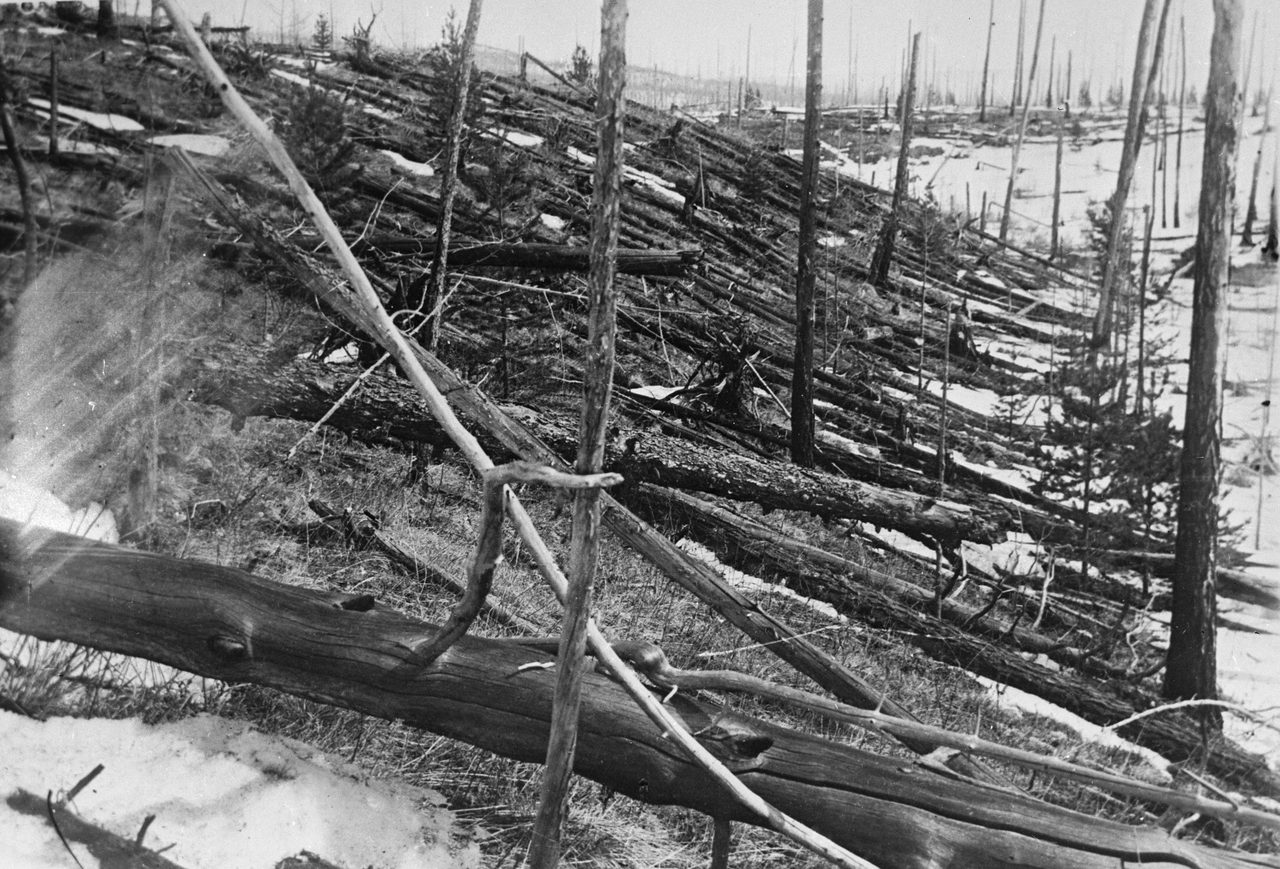
On the last morning of June 1908, something came apart in the air above the Podkamennaya Tunguska River and the forest beneath it went down. Seismographs across Eurasia registered the blast. The pressure wave circled the planet twice. Nineteen years later the first scientist to reach the middle of the flattened forest found the fact that has kept the event interesting ever since: there was no crater. This is the file on Tunguska, opened claim by claim, each one wearing its evidence.
Almost everything about Tunguska is agreed on. The date is agreed on, the time is agreed on, the coordinates are agreed on, and the mechanism has been the same in the textbooks for decades: an object entered the atmosphere over central Siberia and detonated before it reached the ground. What is not agreed on is what the object was, and the reason is the simplest possible one. Nobody has ever held a piece of it. Every figure you will read below for its size, its speed, and its energy is a model run backwards from flattened trees, which is a real method and a soft one. Let's open the file.
01The Morning Of June 30, 1908
The event has a date, a time, and coordinates, and none of them are in dispute. It happened on June 30, 1908, at approximately 7:17 AM local time, near the Podkamennaya Tunguska River in Krasnoyarsk Krai, Siberia, at 60.886 degrees north and 101.894 degrees east.
There is no impact crater, and there never was one. The event was an airburst: the object exploded at an altitude of approximately 5 to 10 kilometers above the ground. That single fact shapes every other question in this file, because whatever came down did not arrive.
The blast was recorded far outside Siberia. Seismographs across Eurasia registered it. The barometric pressure wave circled the Earth twice. And for several days afterward, observers across Europe and western Asia reported bright nights, skies unusually luminous after dark.
The human cost was close to nothing, and that is an accident of geography rather than of scale. No human deaths are confirmed, although some accounts report two possible ones. Hundreds of reindeer were killed. The area was, and largely remains, extremely remote.
Some accounts also describe geomagnetic disturbances at the time of the event. That would be consistent with a plasma trail from atmospheric entry, which is a real physical expectation. It is also difficult to verify against 1908 instrumentation, which is why it sits at this tier rather than the one above.
The bright nights went unexplained for a long time and now have a standard reading: noctilucent clouds, formed by water vapor and dust injected into the mesosphere. Hold on to that explanation. It returns in section 04, because it is one of the few pieces of evidence in this whole file that speaks directly to what the object was made of.
| What Was Observed | What The Record Gives |
|---|---|
| When | June 30, 1908, at approximately 7:17 AM local time |
| Where | Near the Podkamennaya Tunguska River, Krasnoyarsk Krai, Siberia, at 60.886 N and 101.894 E |
| Kind of event | An airburst at approximately 5 to 10 km altitude; no impact crater |
| Recorded at distance | Seismographs across Eurasia; a barometric pressure wave that circled the Earth twice |
| In the days after | Bright nights across Europe and western Asia, now attributed to noctilucent clouds (Tier 3) |
| Human deaths | None confirmed; some accounts report two possible; hundreds of reindeer killed |
| Meteorite fragments recovered | None of significance, at any point, from the first expedition onward |
02Nineteen Years To The Epicenter
The gap between the event and the first look at it is part of why Tunguska stayed strange for so long. By the time a scientific expedition stood at the epicenter, the forest itself had had nineteen years to change.
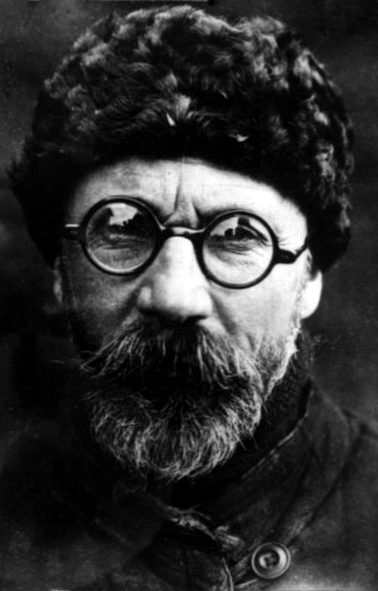
The first scientific expedition to the site was led by Leonid Kulik in 1927, nineteen years after the event.
What Kulik found is the most diagnostic observation in the file. Trees lay flattened in a radial pattern, pointing away from a central epicenter. But the trees standing directly at ground zero were still standing, stripped of their branches and bark, a shape the literature calls telegraph poles. That combination is consistent with a directly overhead airburst rather than with a ground impact, and it is why the airburst reading has held ever since.
No significant meteorite fragments were recovered at the site. Not by Kulik, not since. That absence is consistent with complete atmospheric disintegration of the object, and it is also the reason several of the questions below cannot be closed. There is nothing in a drawer anywhere to run a test on.
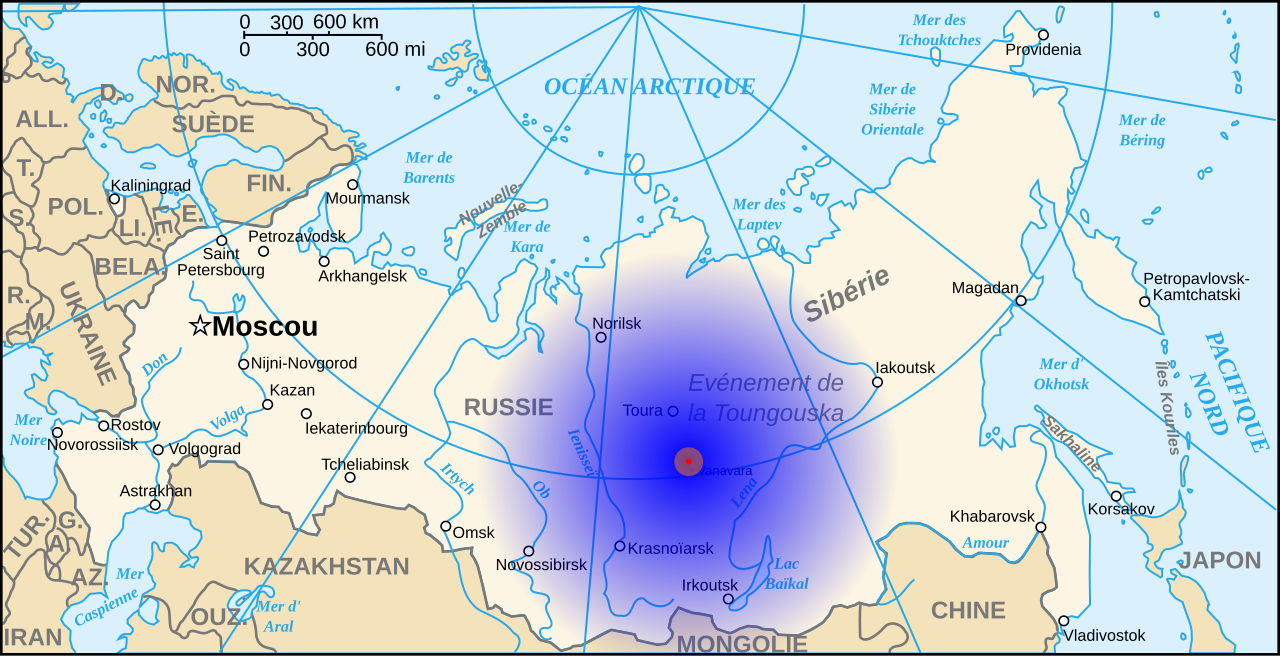
The famous damage figures deserve a note about where they come from. The standard headline numbers are roughly 80 million trees flattened across about 2,150 square kilometers, sometimes given more precisely as 2,150 plus or minus 50. Both trace back to Kulik-era ground surveys from 1927 onward and to later remapping, not to any single count. And that area figure marks the zone where at least some treefall attributable to the event was noticed, a broad and patchy region rather than a footprint of uniform destruction. A stricter map of the fully flattened core, compiled from aerial photographs no later than 1949, gives a considerably smaller figure, closer to 500 square kilometers. None of that makes the standard numbers wrong. It does mean they are a survey history rather than a measurement.
03The Numbers Are Softer Than The Story
Most retellings give you a yield and a diameter stated flat, as though someone had measured them. Nobody measured them. No fragment was recovered to weigh, and no instrument in 1908 was pointed at the right piece of sky. Every figure in this section is an output of a model reasoning backwards from damage, and the models do not agree with each other.
Published yield estimates span a genuinely wide range, and over time they have moved rather than converged. Twentieth-century estimates ran roughly 3 to 20 megatons of TNT. Our own research file's table hedges to about 3 to 15 megatons and names roughly 12 megatons as the most common estimate, even though the same file's own summary line states a flat 12 without the hedge. Mark Boslough, whose 2008 modeling work with Crawford the file itself cites, has argued in later work for a lower figure, on the order of 3 to 5 megatons, a number that reaches us through summaries of his public modeling statements rather than through one named paper. A newer combined seismic and infrasound analysis, comparing the 1908 signal against the well-instrumented 2013 Chelyabinsk record, gives a best estimate in the 10 to 20 megaton range.
The size figure is soft in the same way. The number nearly every account gives is roughly 60 meters, and it is the diameter the leading hypothesis uses. But published modeling has proposed anywhere from about 34 meters up to about 190 meters, depending on the composition, density, and entry velocity each model assumes, with 50 to 80 meters the band most commonly adopted in recent work. A 2019 probabilistic study by Wheeler and colleagues, published in Icarus, found that once uncertainty in all the input variables is properly propagated, objects of 70 to 80 meters and 20 to 30 megatons are actually more likely than smaller ones to produce ground damage on the Tunguska scale. So the familiar figure is a midpoint inside a wide distribution, not a measurement of anything.
| Quantity | The Range In The Literature | The Figure Usually Quoted |
|---|---|---|
| Explosive yield | Roughly 3 to 20 megatons TNT across twentieth-century estimates; roughly 3 to 5 in Boslough's later modeling, from summaries of his public statements rather than a named paper; roughly 10 to 20 on a combined seismic and infrasound analysis (Tier 2) | About 12 megatons |
| Object diameter | Roughly 34 to 190 meters depending on assumed composition and density; roughly 50 to 80 meters most commonly adopted (Tier 2) | About 60 meters |
| Burst altitude | Approximately 5 to 10 km (Tier 1) | Approximately 5 to 10 km |
| Composition | Stony asteroid on the leading model; a cometary body a live minority position; an iron body ruled out (Tier 2) | Stony asteroid |
| Physical material available to check any of this against | None | None |
04Stone Or Ice
Here is the genuinely open question at Tunguska, and it is not the one the fringe literature is interested in. Nobody serious doubts that something entered the atmosphere and detonated. What that something was made of is unsettled, and it stays unsettled for the same reason everything else here is soft. There is no piece of it to test.
The most widely accepted hypothesis is a stony asteroid of roughly 60 meters diameter. Most airburst models favor it, it is consistent with the energy estimates, and it accounts for the lack of recovered material.
The strongest single result behind that reading is computational. Supercomputer modeling by Boslough and Crawford in 2008 reproduced the characteristic butterfly-shaped devastation pattern at the site, using an airburst model with a roughly 60 meter stony asteroid entering at about 15 kilometers per second on a shallow angle. Reproducing the actual shape of the damage from first principles is a real achievement, and it is the main reason this is the mainstream account rather than merely the popular one.
One candidate is treated as excluded rather than merely disfavored. An iron asteroid would not have undergone complete atmospheric disruption at this size. It would have reached the ground and left a crater. There is no crater.
The cometary hypothesis is old and it is not fringe. Fesenkov proposed a cometary body or fragment in 1961, tied to Zotkin's study the same year of the bright-nights phenomenon across 114 observation points, and its attraction is obvious: a comet would explain complete disintegration, and the water vapor it injected would explain those luminous skies directly. It is less favored today for two stated reasons. A comet this small would most likely have disintegrated at a higher altitude than the damage implies, and no cometary isotope signatures have been found. That makes it a minority position in the literature, not a discarded one.
Two more recent items keep the comet case alive without settling it. In 2009 a group of Cornell and Clemson researchers, Michael Kelley, Charles Seyler and Miguel Larsen, argued for a cometary impactor by comparing the 1908 bright nights to noctilucent clouds produced by Space Shuttle exhaust plumes. A single shuttle launch injects roughly 300 metric tons of water vapor into the thermosphere and produces similar high-altitude ice-particle clouds days later at polar latitudes. To carry that water far enough, the researchers proposed a transport mechanism of counter-rotating eddies moving vapor at roughly 300 feet per second across thousands of kilometers. The lead researcher himself described that mechanism as totally new and unexpected physics. It is an argument that strengthens a case, not a finding that closes one.
The second is a physical-evidence claim that has never been confirmed. The Russian researcher Andrei Zlobin, of the Russian Academy of Sciences, collected three rock samples from sandbars on the Khushmo River in the Tunguska region in 1998, and reported that they showed possible meteoritic characteristics including melting and regmaglypts. He did not publish the finding for roughly twenty-five years. His density calculations, based on estimated impactor mass and size, he argues are consistent with a cometary nucleus of a density similar to Halley's Comet. He has not completed a full chemical analysis and describes the finding himself as preliminary. That is exactly how this article carries it: preliminary, not proof of a comet.
A small-comet-swarm hypothesis has also been proposed, to account for some anomalous features of the event. Our own file assesses the evidence for it as insufficient and the idea itself as overcomplicated, and this article has nothing to add on either side of that.
And the file is honest about the one thing it cannot fully account for. It treats the lack of recovered meteoritic material as a minor puzzle, but one consistent with complete thermal disruption at altitude. That absence is the fact both sides of this debate have to explain, and it does not favor either of them. An asteroid that disintegrated completely and a comet that disintegrated completely leave behind exactly the same nothing.
05Lake Cheko, And Whether Anything Landed
There is a third version of the question, and our own research file does not carry it at all. It is not whether the object was stone or ice. It is whether any part of it reached the ground.
Lake Cheko is a funnel-shaped lake roughly 300 meters wide, sitting a few kilometers from the assumed Tunguska epicenter. In 2007 Gasperini and colleagues proposed that it is an impact crater, formed by a surviving fragment of the object. The same research group's later work added supporting evidence: sediment-core isotope and pollen analysis consistent with the lake's upper sediment sequence beginning close to 1908, and magnetic and seismic-reflection surveys they interpret as showing a buried anomalous object beneath the lake floor. This is peer-reviewed work, published across roughly 2007 to 2012, and it is still cited.
It is also substantially disputed, and the objections are specific rather than dismissive. The lake's morphology does not resemble a typical impact crater. No impactor material has been found in it or around it. Mature, apparently undisturbed trees stand close to the lake's edge, which sits badly against a formation date of 1908. And there is a physical argument that cuts deepest: a fragment strong enough to survive atmospheric entry intact and excavate a crater of this size would need a tensile strength on the order of 10 to 40 megapascals, and a body that robust is hard to reconcile with the complete atmospheric disintegration that explains why nothing was recovered anywhere else at Tunguska.
Neither side has closed it. A direct rebuttal paper argues that Lake Cheko is not an impact crater at all, and later Russian-led work reported in 2017 disputes the crater interpretation further. This article does not adjudicate between them, and it flags one thing about its own library while it is here: our research file is silent on Lake Cheko in every section, in its bibliography, and in its cross-reference index. That is a gap in the file rather than a verdict on the hypothesis, and it is logged for a future corpus pass.
06The Answers That Did Not Survive
Tunguska is close to an ideal vacuum for explanation: an enormous blast, in a place nobody could reach, at a moment when the physics of atmospheric airbursts was not understood. Four of the things that filled that vacuum are worth handling properly, because dismissing them in a sentence teaches nobody anything. Each one made a claim about the world, each claim had a consequence, and each consequence was checked.
The alien-spacecraft idea began as a short story, and that origin is routinely lost. In 1946 the writer Alexander Kazantsev published a piece titled Vzryv, meaning Explosion, in which a nuclear-powered Martian craft seeking fresh water from Lake Baikal exploded in mid-air. Kazantsev wrote it after visiting Hiroshima in late 1945, and it was published explicitly as science fiction. It was not a scientific paper and it was not offered as a real report. What makes it stick is an accident. Its central plot device, an explosion in the air rather than an impact on the ground, was later and separately corroborated as physically correct, by Igor Zotkin's scale-model simulations of a real airburst. Kazantsev's fiction happened to anticipate the actual mechanism, which is very likely why the alien-craft framing outlived every memory of where it came from. No evidence supports the craft. The airburst it accidentally got right belongs to a rock.
The Tesla death-ray claim connects Nikola Tesla's Wardenclyffe Tower experiments to the 1908 blast. It is best described precisely: a persistent popular conspiracy theory with no single identifiable originator, not a proposal any named researcher made in the literature. It grew in an era when directed-energy claims were culturally everywhere, with Harry Grindell Matthews making similar claims in England, and Tesla fed it himself by repeatedly claiming his wireless power transmission work could function as a weapon. Two things end it. Tesla was not conducting relevant experiments in 1908, and the energy arithmetic is not close: producing a blast in the roughly 10 megaton class would require billions of watts of transmitted power, thousands of times beyond what Wardenclyffe or the era's power grid could deliver.
The antimatter hypothesis was a real scientific paper, and it lost the way a scientific paper is supposed to lose. Clyde Cowan, C. R. Atluri and Willard Libby published Possible Antimatter Content of the Tunguska Meteor of 1908 in Nature in 1965. They reported a roughly 1 percent jump in radiocarbon in tree rings from 1909, in two trees, one in Los Angeles and a 300-year-old Douglas fir in Tucson, Arizona, and proposed the annihilation of an anti-rock as the cause. That was a checkable prediction, and it was checked. More careful radiocarbon measurements from a tree much closer to the actual blast site failed to reproduce the anomaly. The refusal here is not a dismissal. It is a specific replication failure with a specific address.
The black hole belongs at a different tier from the three above, and our own file places it there deliberately. In 1973 Jackson and Ryan proposed in Nature that the Tunguska object was a small black hole passing through the Earth. The file calls the idea creative, notes that no exit event was detected, and treats it as effectively ruled out. It is filed as speculative rather than dubious because it was a serious physical proposal carrying a testable consequence, not a claim made in defiance of evidence. This article keeps it at the file's own tier.
And the test was actually run. Beasley and Tinsley examined microbarograph records in 1974, looking for the anomalous atmospheric pressure wave that a black hole's predicted exit through the Atlantic Ocean should have produced. They found none, which closed off the hypothesis's own testable prediction one year after it was made. That is the cleanest outcome any proposal in this section achieved, and it is worth naming, because our file gestures at it without citing it.
Our file's synthesis of this group is blunt: the alien craft, the death ray and the antimatter meteorite have all been thoroughly examined and rejected, and the stony-asteroid airburst model explains all of the observed evidence. That verdict is about this group of claims and not about section 04. Explaining the evidence, here, means that nothing at the site requires an exotic cause. It is a different statement from saying the impactor's composition is settled, which it is not.
One modern claim belongs in the same tier. There is no evidence that governments are concealing knowledge of imminent asteroid impacts. Near-Earth object tracking data is public, at NASA's CNEOS and ESA's NEODyS among others, and the astronomical community is global and transparent. The challenge is detection capability, not secrecy. The next three sections are largely a list of the things nobody saw coming, which is a very different problem from the things nobody was told.
07Chelyabinsk, 2013: The Same Kind Of Morning, With Cameras
The best-evidenced thing in this file is not the 1908 event. It is the 2013 one, because that one happened in front of several hundred cameras, and because somebody afterwards picked a piece of it up.
The Chelyabinsk event occurred on February 15, 2013, at 9:20 AM local time, near Chelyabinsk, Russia, at 55.0 degrees north and 61.4 degrees east. The impactor was approximately 20 meters in diameter and approximately 12,000 metric tons, an LL-type ordinary chondrite, entering the atmosphere at approximately 19 kilometers per second, faster than any human-made object.
The energy figure needs one line of care, and the care is about method rather than about doubt. Our own file's table gives approximately 440 kilotons of TNT, about 30 times Hiroshima, with the main fragmentation event at approximately 29.7 kilometers altitude and the airburst around 23 kilometers. The most cited peer-reviewed figure is higher: Brown and colleagues, in a 2013 Nature paper whose title opens A 500-Kiloton Airburst Over Chelyabinsk, give 500 kilotons with a stated uncertainty of 100 for an impactor 17 to 20 meters across. The two are not in tension. The file's figure sits inside that paper's own band, and the gap between them is estimate method rather than error. This article carries both rather than picking one.
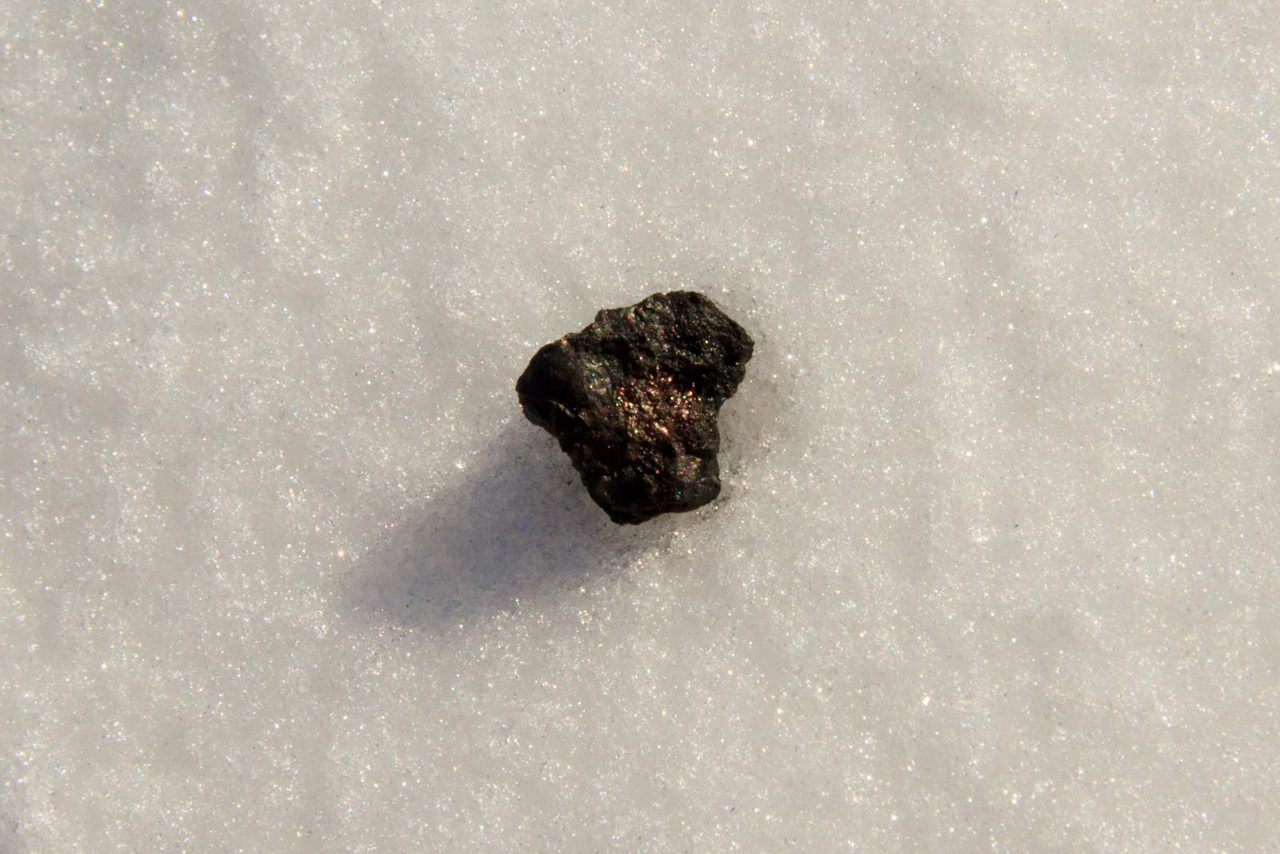
The damage was done by the shockwave, not by anything striking a city. Approximately 1,500 people were injured, mostly by glass shattered by the blast wave. Approximately 7,200 buildings were damaged. Damage totaled approximately 33 million dollars. And the object was not detected before it entered: it arrived from the Sun-facing direction, an optical blind spot for ground-based surveys. Hundreds of dashcam and security-camera videos make it the most thoroughly documented impact event in history.
It also left material behind. A fragment of roughly 654 kilograms was recovered from Lake Chebarkul, where it had punched a 7 meter hole through the ice. The independent scientific record is correspondingly deep: alongside the Brown paper, Popova and colleagues published a full damage assessment, meteorite recovery and characterization study in Science the same year. What Chelyabinsk demonstrated is that an object as small as 20 meters can cause significant damage and casualties.
| Measure | Tunguska, 1908 | Chelyabinsk, 2013 |
|---|---|---|
| Object diameter | About 60 meters on the usual estimate, with published models spanning roughly 34 to 190 meters (Tier 2) | Approximately 20 meters |
| Energy | Roughly 3 to 20 megatons TNT across the published range (Tier 2) | Approximately 440 kilotons in our file; 500 kilotons with an uncertainty of 100 in the key Nature paper |
| Burst altitude | Approximately 5 to 10 km | Main fragmentation at approximately 29.7 km; airburst around 23 km |
| Composition | Unresolved: a stony asteroid is the leading model, a cometary body a live minority position (Tier 2) | LL-type ordinary chondrite, identified from recovered material |
| Material recovered | None of significance | Many fragments, including roughly 654 kg from Lake Chebarkul |
| Detected in advance | No | No; it arrived from the Sun-facing direction |
| Casualties | None confirmed; some accounts report two possible | Approximately 1,500 injured, mostly by shattered glass |
| Documentation | Eyewitness accounts, and an expedition record that begins nineteen years later | Hundreds of dashcam and security-camera videos, plus recovered specimens |
08Jupiter, 1994: The Demonstration
Between the two Russian events sits the one that changed how seriously anybody took the whole subject, and it did not happen here.
Comet Shoemaker-Levy 9, formally D/1993 F2, was discovered on March 24, 1993 by Carolyn and Eugene Shoemaker and David Levy. It had been captured by Jupiter's gravity and fragmented by tidal forces into approximately 21 pieces. Those fragments struck Jupiter between July 16 and 22, 1994.
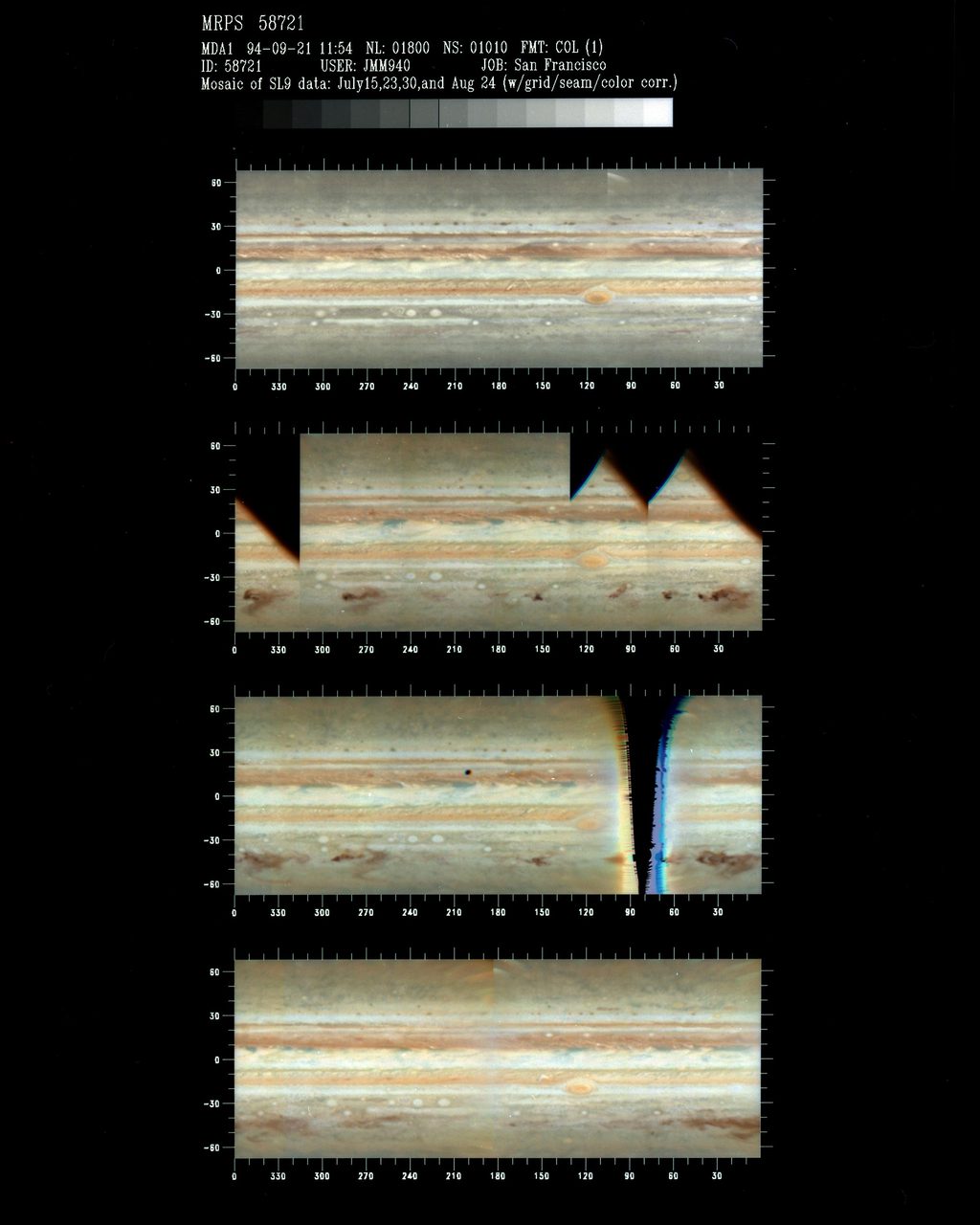
The largest of them, Fragment G, is estimated at roughly 6 kilometers in diameter, with an impact energy of approximately 6 million megatons of TNT. It left a dark scar in Jupiter's atmosphere larger than the planet Earth.
And it was watched. The Hubble Space Telescope, the Galileo spacecraft and ground-based observatories worldwide observed the impacts, which made this the first directly observed collision between two solar system bodies. It was also, in the file's own framing, the watershed moment for planetary-defense awareness. The argument stopped being theoretical the week a comet visibly hit a planet.
09How Often This Happens, And What It Would Cost
Two questions follow from everything above, and both step down a tier, because both are estimates about a class of events rather than measurements of a single one.
Statistical estimates put Tunguska-scale events, meaning an impactor in the roughly 50 to 60 meter class, at approximately once every 500 to 1,000 years on average. An average is not a schedule.
The near miss in 1908 is the detail that does the most work on a reader, and it should be stated carefully for exactly that reason. Had the object arrived 4 hours and 47 minutes later, the Earth's rotation would have placed St. Petersburg, a city of roughly 1.5 million people in 1908, at the impact point. That is a counterfactual, it is filed as speculative, and its force does not actually depend on the precision of the figure.
The historical record may hold at least one worse case. Chinese records from 1490 describe the Ch'ing-yang event, in which stones fell like rain, with roughly 10,000 reported deaths. It may have been an airburst or a meteorite shower. The documentation is not sufficient to confirm either reading, and this is the tier where a vivid historical account with thin documentation belongs.
Physical candidates are similarly unresolved. The Rio Cuarto structures in Argentina are elongated depressions proposed as low-angle impact features from roughly 10,000 years ago. That reading is disputed. They may instead be aeolian, shaped by wind.
As for what a repeat would cost: a Tunguska-scale airburst over a major city today would cause millions of casualties and damage worth hundreds of billions of dollars. An ocean impact carries the potential for localized tsunamis, depending on water depth and the size of the object. These are modeled consequences of an event that has not happened, which is what puts them at this tier rather than a higher one.
And the upper bound has a name. A Chicxulub-scale impact today would end technological civilization, and that is the existential risk driving planetary-defense investment in the first place. Chicxulub has its own file in this wing, and this article leaves the story there and takes only the comparison.
10What We Can See Coming
Detection and deflection are two different capabilities, and the honest picture differs sharply between them. Detection comes first here, because it is the weaker of the two.
The success story is real, and it is about the largest objects. The Spaceguard Survey, running from 1998 to 2020 under a NASA mandate to find 90 percent of near-Earth objects larger than 1 kilometer, is largely complete, with roughly 95 percent found. None of the cataloged large near-Earth objects poses a near-term threat. The class of object that could end a civilization is close to fully mapped, and nothing in the catalog is on its way.
Below that size the picture inverts. As of 2025, NASA estimates that roughly 40 percent of near-Earth objects larger than 140 meters remain undiscovered. Objects approaching from the Sun-facing direction are effectively invisible to ground-based surveys. And in the size class this article is actually about, tracking is largely absent: millions of objects in the Tunguska and Chelyabinsk range are estimated to exist, and only thousands are cataloged.
That completeness figure should be read as a moving target, and possibly an optimistic one. Several independent 2024 and 2025 sources put current completeness for the 140 meter class closer to 38 to 50 percent, which implies roughly 50 to 62 percent still undiscovered rather than roughly 40. No single authoritative up-to-the-day number was found to substitute, and the number is genuinely in motion: the Vera C. Rubin Observatory's LSST survey went live in mid-2025 and is actively changing it. The direction of the correction is the part worth keeping. If it moves, it moves toward less complete than advertised.
Two recent objects show the range of outcomes. Asteroid 2019 OK, roughly 100 meters across and squarely in the city-killer class, passed within 65,000 kilometers of Earth on July 25, 2019. Multiple surveys detected it 24 hours after its closest approach. It came from the Sun-facing direction.
Asteroid 2023 BU, a far smaller body of roughly 3.5 to 8.5 meters, passed within 3,600 kilometers of Earth on January 26, 2023, and was detected 4 days before closest approach. The contrast is the whole point. Detection is not uniformly broken. It is conditional, and geometry decides.
One upcoming pass is worth naming plainly, because it will be reported loudly. Apophis, formally 99942, roughly 370 meters across, will pass within about 31,000 kilometers of Earth on April 13, 2029, closer in than geostationary satellites. It has been known since 2004, and an initial estimate that gave it a 2.7 percent impact probability for 2029 has since been ruled out. It is a close approach, not an impact.
11What We Could Actually Do About It
And here the file turns, because this is the one part of the story where the honest answer got better within living memory.
On September 26, 2022, NASA's DART mission deliberately impacted the asteroid Dimorphos, a 160 meter moon of Didymos, and altered its orbital period by 33 minutes. That is the first demonstration of kinetic-impactor asteroid deflection: not a simulation and not a proposal, but an asteroid whose orbit is measurably different because we changed it.
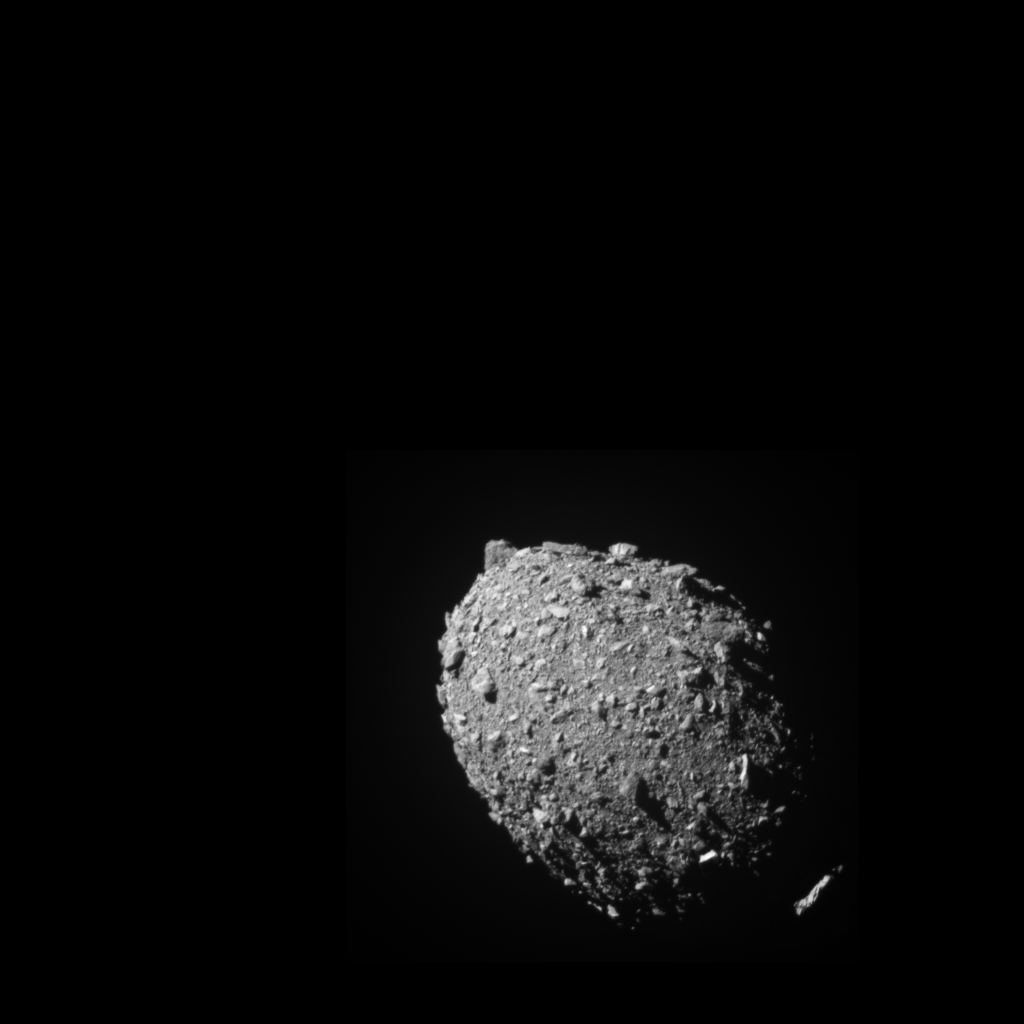
The rest of the apparatus is partly built and partly on the way. NEO Surveyor, a space-based infrared telescope intended to find 90 percent of near-Earth objects larger than 140 meters, has a planned launch around 2028, although some current agency and press sources cite a target nearer 2027; the announced date has moved more than once, so it is best read as a range rather than a fixed year. ESA's Hera mission, the follow-up to DART, launched in October 2024 to study the impact crater and the mass change at Dimorphos. And the International Asteroid Warning Network actively coordinates global detection and characterization work.
Fast Facts
- The Event
- The Tunguska airburst, near the Podkamennaya Tunguska River, Krasnoyarsk Krai, Siberia
- When
- June 30, 1908, at approximately 7:17 AM local time
- What Happened
- An airburst at approximately 5 to 10 km altitude; no impact crater, then or since
- Object Size
- About 60 meters on the usual estimate; published models span roughly 34 to 190 meters (Tier 2)
- Energy
- About 12 megatons on the most common estimate; the published range runs roughly 3 to 20 megatons (Tier 2)
- Forest Damage
- Roughly 80 million trees over about 2,150 square kilometers of patchy treefall; the fully flattened core closer to about 500 square kilometers (Tier 2)
- First Expedition
- Led by Leonid Kulik in 1927, nineteen years after the event
- Fragments Recovered
- None of significance, which is precisely why the composition question stays open
- What The Object Was
- A stony asteroid on the leading model; a cometary body remains a live minority position; an iron body is ruled out (Tier 2)
- Lake Cheko
- Proposed in 2007 as a crater made by a surviving fragment; substantially disputed, and absent from our own file (Tier 3)
- The Modern Parallel
- Chelyabinsk, February 15, 2013: approximately 20 meters, approximately 1,500 injured, and material recovered
- How Often
- Roughly once every 500 to 1,000 years for this size class, on statistical estimates (Tier 3)
- Deflection Demonstrated
- Yes, once: DART shifted Dimorphos's orbital period by about 33 minutes in 2022 (Tier 2)
What We Can Actually Stand Behind
The event happened, and the mechanism is settled. On June 30, 1908, at approximately 7:17 AM local time, an object detonated in the air above the Podkamennaya Tunguska River at an altitude of approximately 5 to 10 kilometers. Seismographs across Eurasia registered it and the pressure wave circled the Earth twice. Kulik's 1927 expedition found trees flattened radially away from a central epicenter with the trees at ground zero still standing and stripped bare, which is what an overhead airburst does and not what a ground impact does. There is no crater and no significant recovered fragment. The modern parallels are equally solid: Chelyabinsk in 2013, documented by hundreds of cameras and by a recovered 654 kilogram fragment from Lake Chebarkul, and Shoemaker-Levy 9 at Jupiter in 1994, the first directly observed collision between two solar system bodies.
What the object was made of is not settled, and this article does not settle it. A stony asteroid is the leading model, supported by most airburst modeling and by Boslough and Crawford's reproduction of the butterfly damage pattern in 2008. A cometary body remains a live minority position, supported by the bright-nights argument going back to Fesenkov and by a 2009 comparison with Space Shuttle exhaust plumes. An iron body is the one candidate ruled out, because it would have left a crater. The size and yield figures belong in this tier too: they are model outputs, not measurements, and the published ranges are wide in both cases. On the modern side, the detection numbers sit here as estimates in motion, and DART's demonstrated deflection sits here as a single successful test rather than a general capability.
Lake Cheko as an impact crater from a surviving fragment is a real published hypothesis with real published objections, and it is unresolved in both directions. The comet-side supporting items, the 2009 noctilucent-cloud argument and Zlobin's unconfirmed river samples, strengthen a case without closing it. The frequency estimate, the St. Petersburg counterfactual, the 1490 Ch'ing-yang event, the Rio Cuarto structures, and the projected cost of a modern repeat are all estimates or reconstructions rather than observations. The 1973 black-hole proposal also sits here rather than lower, at our own file's tier assignment: it was a serious physical idea with a testable prediction, and the prediction failed when Beasley and Tinsley found no exit pressure wave in 1974.
No, this was not an alien spacecraft. That idea entered the world in 1946 as a named work of science fiction, Kazantsev's Vzryv, and it survived because its mid-air explosion plot device happened to anticipate the real airburst mechanism. Fiction that guesses right is still fiction. No evidence of any kind supports a craft.
No, Tesla did not do this. He was not conducting relevant experiments in 1908, there is no physical mechanism connecting Wardenclyffe to Siberia, and the energy required is thousands of times beyond what that tower or the era's power grid could deliver. It is a popular conspiracy theory with no identifiable originator, not a contested scientific claim.
No, it was not antimatter. Cowan, Atluri and Libby made a real, checkable proposal in Nature in 1965 on the strength of a radiocarbon anomaly in two distant trees. More careful measurements from a tree much closer to the blast site failed to reproduce that anomaly, and the hypothesis fell on its own evidence.
No, nothing is being covered up. Near-Earth object tracking data is publicly available at NASA's CNEOS and ESA's NEODyS, and the astronomical community is global and transparent. The failures in this file are failures of detection capability, and section 10 lists them by name.
So the plain account holds, and it is stranger than the myth rather than smaller. An object came apart in the air over Siberia on a June morning in 1908, the forest went down beneath it in a radial pattern that only an overhead explosion makes, and the ground itself was never touched. The airburst is not in doubt. Everything downstream of it, what the thing was made of and how heavy and how fast and how large, rests on models reasoning backwards from flattened trees, because the object is not anywhere. That absence is the room the fringe explanations moved into, and it is also why the mainstream account still carries an open question inside it. The one modern event that answers the same questions properly answers them because somebody walked onto a frozen lake and picked a piece of it up. Tunguska has no such piece, and after more than a century of looking it probably never will. So the question the file leaves open is not whether an asteroid did it. It is what could still be found, this long afterward, that would tell us which kind.
Sources & further reading
Everything above is drawn from our research library on Theories of Anything, and three things needed handling in the open before use. One citation in our file carried the wrong publication year and is listed below in its corrected form (the DART requirements paper, dated 2023 in our file, actually published 2021). One is not cited here at all: our file's Dearborn entry merges the title of a real 2018 paper in one volume of Acta Astronautica with the volume and year of a different real 2020 paper by an overlapping author team, so the citation as written points at no single publication, and rather than silently repair it this article simply does not use it. And one whole subject, the Lake Cheko hypothesis in section 05 together with the substantial case against it, is absent from our file entirely; it is carried here from the peer-reviewed literature and flagged for a future corpus pass. Several further sources named in the prose carry no stable identifier in our own file and are cited by name rather than linked: Cowan, Atluri and Libby (1965), Jackson and Ryan (1973), Beasley and Tinsley (1974), Wheeler and colleagues (2019), the Gasperini group's Lake Cheko papers, and the 2009 Kelley, Seyler and Larsen argument. Open the full file to check the sourcing and go deeper.
Image credits
- The flattened forest at Tunguska, Kulik expedition Leonid Kulik expedition, via Wikimedia Commons. Public domain Source.
- Leonid Alekseyevich Kulik Evgeny Leonidovich Krinov, via Wikimedia Commons. Public domain Source.
- Location of the Tunguska event, Siberia Wikimedia Commons user Denys, with a contribution credited to historicair. CC BY-SA Source.
- Chelyabinsk meteorite fragment on Lake Chebarkul ice, 2013 Denis Panteleev, via Wikimedia Commons. CC BY-SA 3.0 Source.
- Shoemaker-Levy 9 impact scars on Jupiter, Hubble, 1994 NASA, ESA and the Space Telescope Science Institute. Public domain Source.
- Dimorphos imaged by DART before impact, 2022 NASA, Johns Hopkins APL. Public domain Source.
- Card crop of The flattened forest at Tunguska, Kulik expedition Leonid Kulik expedition, via Wikimedia Commons. Public domain Source.


.jpg)
