
The Toba Supereruption: The Winter That Nearly Ended Us
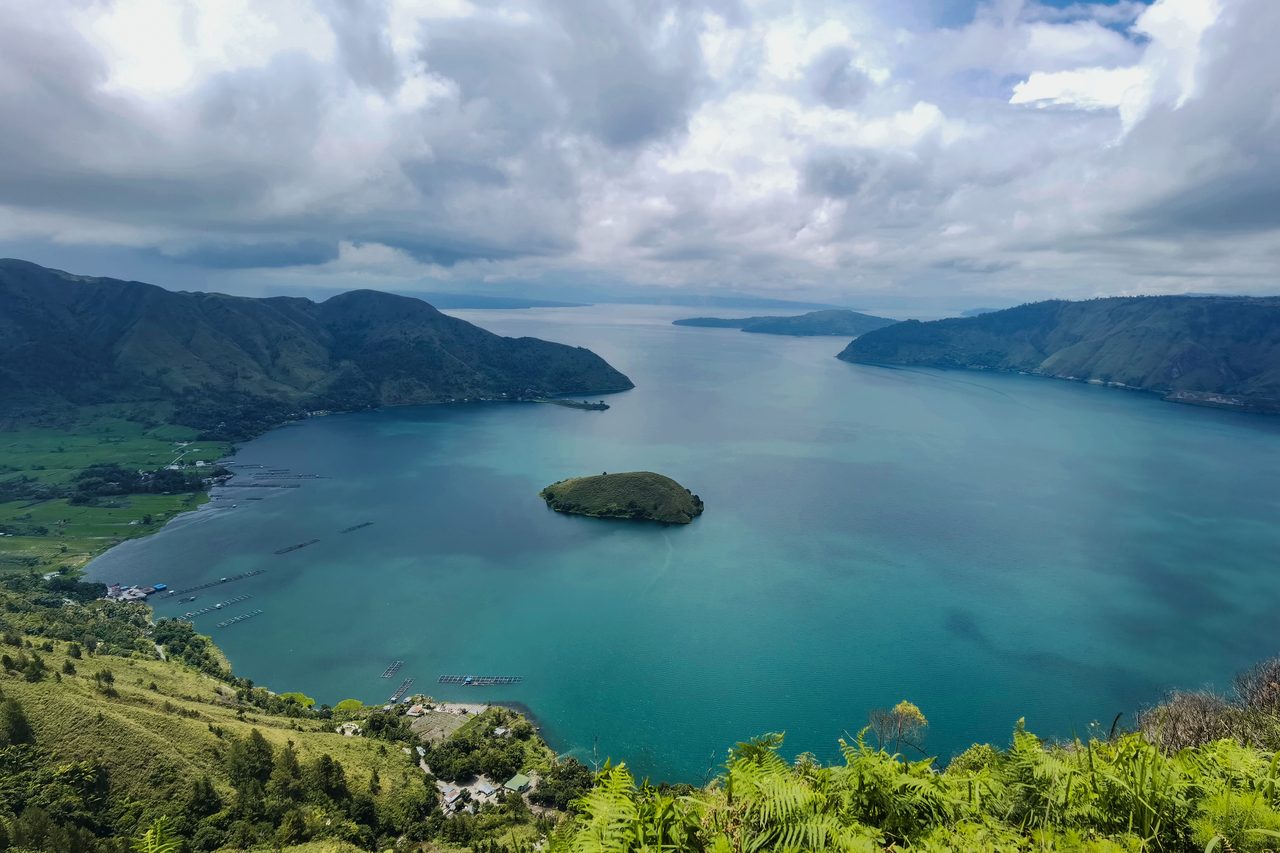
About 74,000 years ago a volcano in Sumatra erupted with a force the planet has not matched since. It threw out roughly 2,800 cubic kilometers of rock, buried millions of square kilometers of Asia in ash, and left behind a caldera a hundred kilometers long that is now a lake. That much is settled beyond serious dispute. Then there is the second claim, the one hiding in the title: that the winter Toba brought nearly finished our species, squeezing our ancestors down to a few thousand survivors. That claim is not settled. It is one of the most genuinely contested questions in all of human origins, and the field has spent thirty years walking it steadily backward. This is the file, opened claim by claim, with the settled eruption and the open question kept firmly apart.
Everything about Toba splits cleanly into two stories, and the trouble only starts when people blur them together. The first story is the eruption itself, and it is about as solid as deep-time geology ever gets. We know roughly when it happened, where, how large it was, and what it left behind. The second story is about us, and it is a real and unfinished argument. Begin with the first, on ground where the evidence does not argue with itself.
01The Mountain That Became a Lake
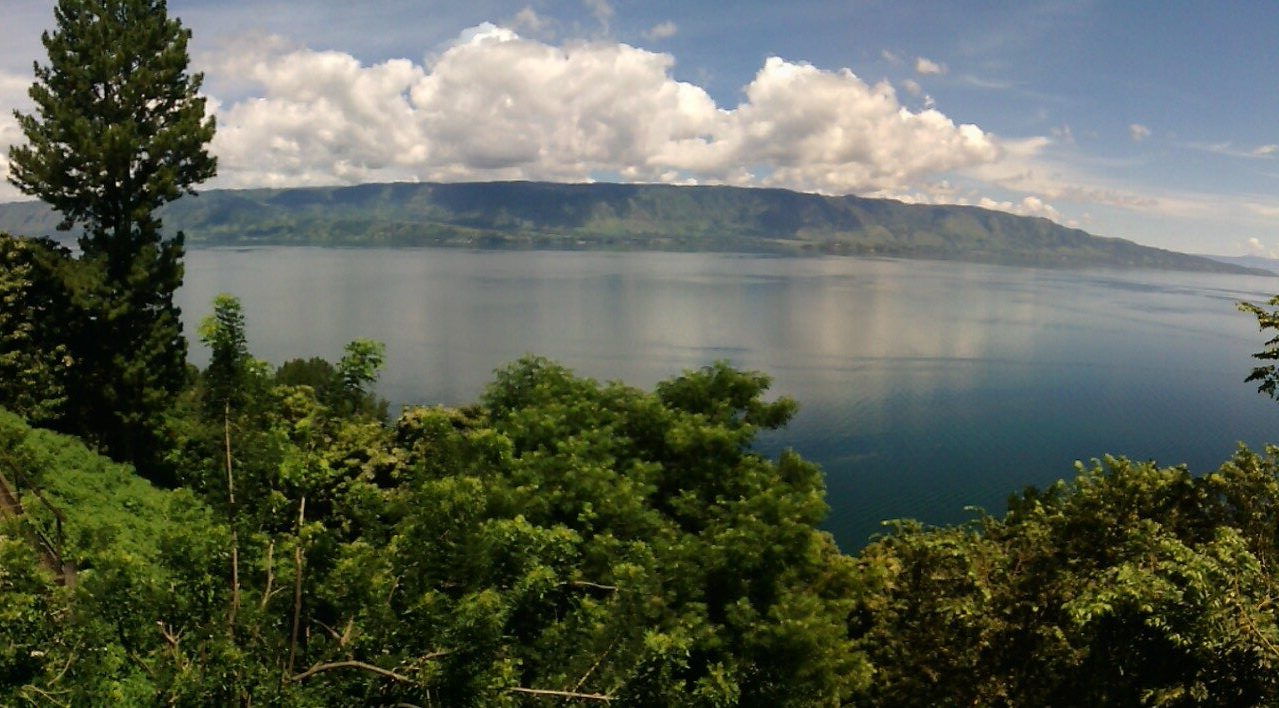
The eruption has a date and an address. It happened about 74,000 years ago on the island of Sumatra, in what is now Indonesia, at roughly 2.7 degrees north and 98.9 degrees east. The looser figure in our own research file is 74,000 years give or take 5,000. The tightest published dating, an argon-argon measurement of the erupted tuff by Mark and colleagues in 2014, pins it more precisely at 74,000 years give or take 2,000. Either way, this is one of the better-fixed moments in the last hundred thousand years of Earth history.
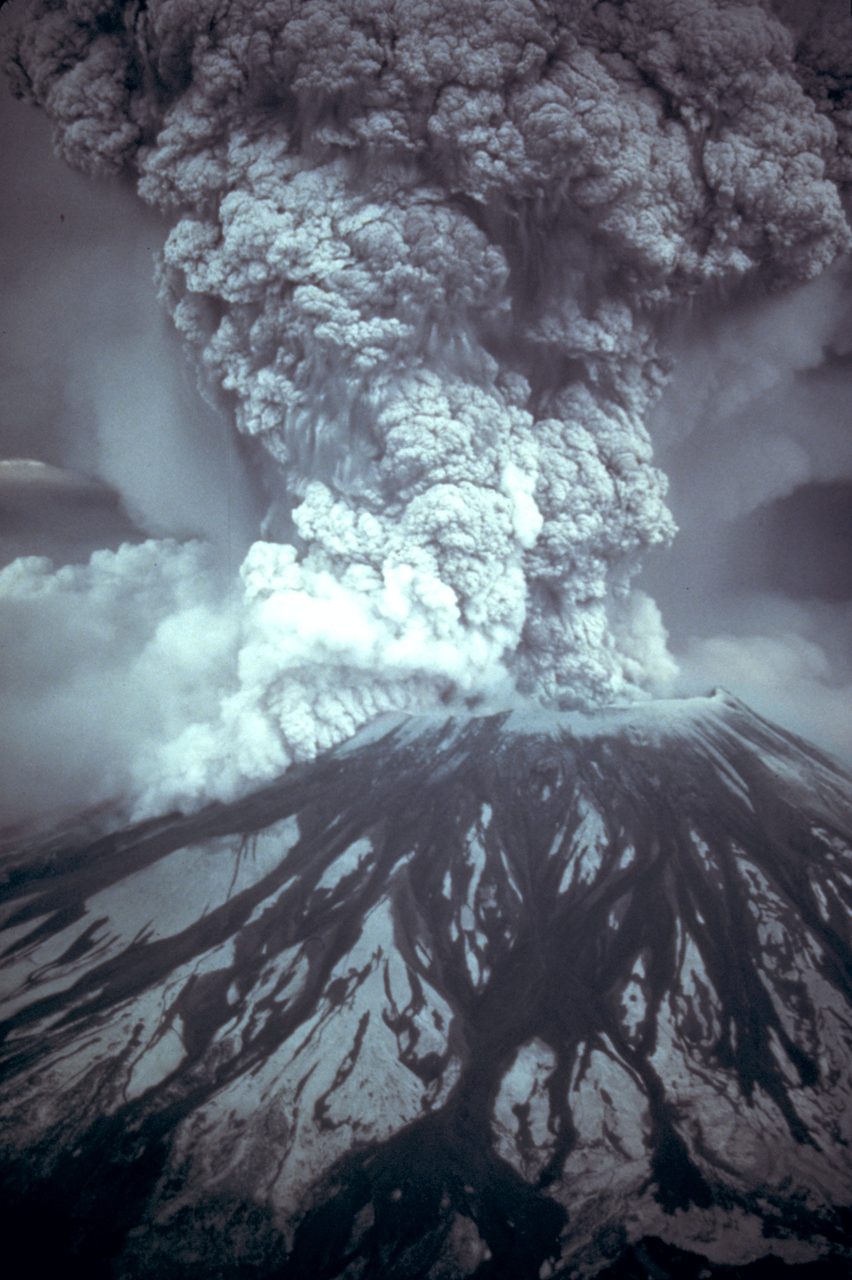
It was enormous, the largest eruption anywhere on Earth in the last two million years. Toba rates a full VEI-8, the maximum value on the Volcanic Explosivity Index, and it ejected on the order of 2,800 cubic kilometers of material measured as dense rock. Numbers that large stop meaning anything without a yardstick, so here is the one our file uses. Mount St. Helens in 1980 put out about 1 cubic kilometer. Tambora in 1815, the largest eruption in recorded human history, put out about 160. Toba was therefore roughly 2,800 times the volume of Mount St. Helens and about 17.5 times the volume of Tambora.
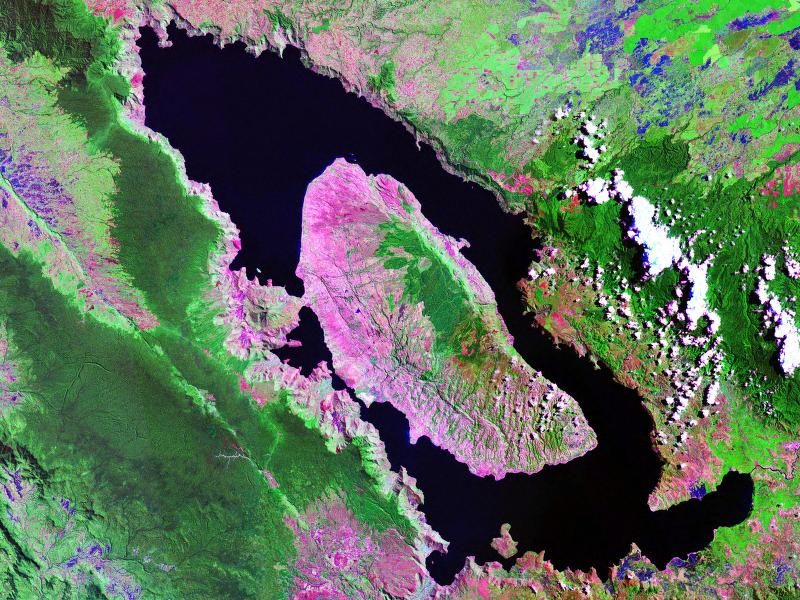
The hole it left is now a lake. The Toba caldera, the basin that dropped when the emptied magma chamber collapsed, is about 100 kilometers long and 30 kilometers wide, and it holds Lake Toba, the largest volcanic lake on Earth. Samosir Island, the large island near its center, is not a separate feature at all but the caldera floor itself, slowly pushed back up after the eruption. The mountain did not simply explode. It swallowed the ground it had been standing on.
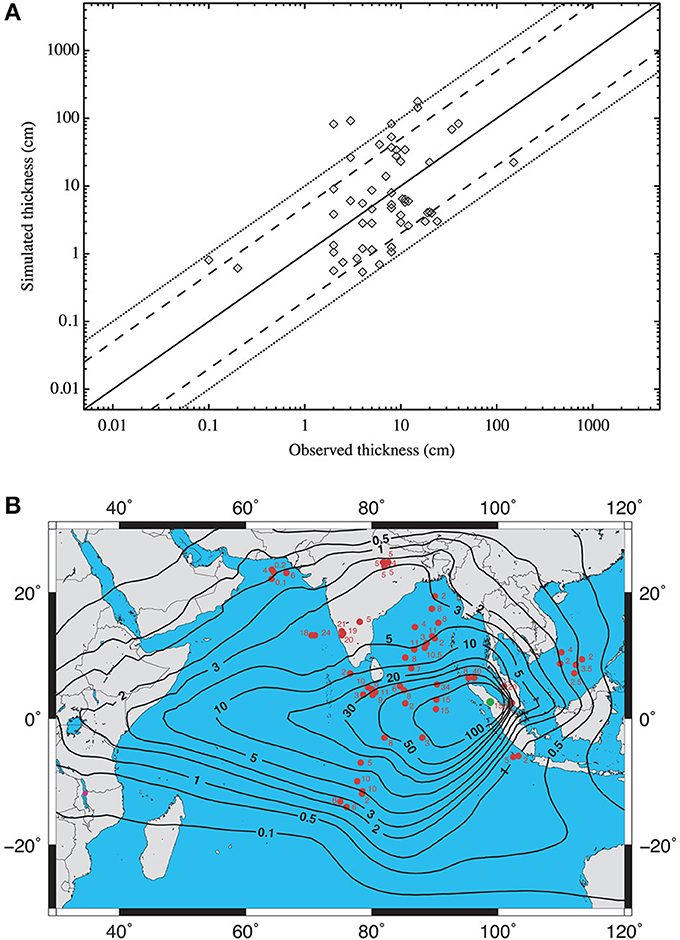
The ash reached almost incomprehensibly far. The Youngest Toba Tuff, the technical name for the eruption's fallout, blankets South and Southeast Asia, the floor of the Indian Ocean, the Arabian Sea, and East Africa. Deposits more than 15 centimeters thick have been mapped across roughly 4 million square kilometers. In central India, some 2,500 kilometers from the volcano, the ash still reaches up to 6 meters thick, and it turns up at archaeological sites, including one called Jwalapuram that will matter a great deal later in this story.
What it did to the sky is harder to measure, and the file is honest about the uncertainty. The eruption is estimated to have injected somewhere between 1 and 10 gigatonnes of sulfur dioxide into the stratosphere, which could have cut incoming sunlight by anywhere from 25 to 90 percent. That is an enormous range, and the width of it is the point. Reconstructing the atmosphere of a single year 74,000 years gone is genuinely hard, and no one should pretend the figure is tighter than it is.
| Measure | What the Evidence Gives |
|---|---|
| When | About 74,000 years ago; argon-argon dating gives 74,000 give or take 2,000 (Mark et al., 2014) |
| Where | The island of Sumatra, Indonesia (about 2.7 N, 98.9 E) |
| Scale | VEI-8, the maximum on the index; the largest eruption on Earth in two million years |
| Ejecta | About 2,800 cubic km, roughly 2,800 times Mount St. Helens and 17.5 times Tambora |
| The caldera | About 100 by 30 km, now Lake Toba, the largest volcanic lake on Earth |
| Ashfall | Over 15 cm thick across about 4 million sq km; up to 6 m thick in central India |
| Sulfur injected | An estimated 1 to 10 gigatonnes of SO2, possibly cutting sunlight 25 to 90 percent |
02Where Toba Sits Among the Giants
To feel how rare an event like this is, it helps to line Toba up against the other eruptions geologists talk about. Almost every eruption a living person has ever witnessed sits far, far down the scale from it.
Toba belongs to a small and dreaded class. A VEI-8 eruption, sometimes called mega-colossal, ejects more than 1,000 cubic kilometers of material and recurs, very roughly, on the order of once every hundred thousand years somewhere on Earth. Only a handful of such eruptions are known across the whole geological record, and the still-active example everyone worries about is the Yellowstone hotspot, which shares Toba's VEI-8 rating exactly. When people reach for a comparison to Toba, Yellowstone is the one they reach for, because there is almost nothing else in the same category.
| Eruption | When | VEI | Ejecta (approx.) | Human Toll or Note |
|---|---|---|---|---|
| Toba (Sumatra) | ~74,000 years ago | 8 | ~2,800 cubic km | The largest eruption in two million years; its human impact is the subject of this file |
| Yellowstone (Huckleberry Ridge) | ~2.1 million years ago | 8 | ~2,500 cubic km | Pre-human in the Americas |
| Yellowstone (Lava Creek) | ~640,000 years ago | 8 | ~1,000 cubic km | The Yellowstone hotspot's most recent super-eruption |
| Campanian Ignimbrite (Italy) | ~39,000 years ago | 7 | ~300 cubic km | A possible factor in the decline of the Neanderthals |
| Tambora (Indonesia) | 1815 CE | 7 | ~160 cubic km | Caused the Year Without a Summer; over 100,000 dead |
| Krakatoa (Indonesia) | 1883 CE | 6 | ~25 cubic km | About 36,000 dead, mostly from the tsunami |
| Pinatubo (Philippines) | 1991 CE | 6 | ~10 cubic km | About 800 dead; the first volcanic climate forcing measured by modern science |
03Ambrose's Bottleneck
Here the ground changes under your feet. Everything to this point has been Tier 1, the settled physics and geology of a very large eruption. What follows is Tier 2, a genuine and unresolved scientific argument, and it is where the title of this article actually lives. In 1998 the anthropologist Stanley Ambrose proposed that Toba did not merely darken the sky. He proposed that it nearly ended us.
Start with a real and slightly unsettling fact about our species, because Ambrose's argument is built on it. For a mammal spread across the entire planet, human beings carry startlingly little genetic diversity. Our effective population size, the geneticist's measure of how much variation we actually harbor, sits at only about 10,000, far below what our headcount would predict. Two chimpanzee troops living on opposite banks of a single African river can hold more genetic diversity between them than the whole human species does. In population genetics, a sharp drop in numbers that strips out this kind of variation is called a bottleneck, and its mathematics was worked out by Sewall Wright and others decades before anyone thought to point it at a volcano.
Ambrose's move was to connect that genetic thinness to the eruption. If humanity had passed through a severe bottleneck sometime between roughly 50,000 and 100,000 years ago, it would explain why we are all so genetically alike today. Genetic calculations put the effective breeding population at the low point at something like 3,000 to 10,000 individuals, and the timing of that squeeze overlaps with Toba at about 74,000 years ago. Ambrose read the overlap as cause and effect. The volcanic winter, he argued, drove a near-extinction, and every living human descends from the few thousand who made it through. It was an elegant hypothesis, and it stitched geology, climate science, and genetics together in a way that drove decades of research.
The mechanism he proposed was ecological collapse from the bottom up. A years-long volcanic winter would have wrecked vegetation, thinned out animal populations, and dried up water sources, starving the human food web until it broke. He also noted that different human populations carry slightly different bottleneck signatures, which he read as evidence of survival in scattered refugia, small pockets of humanity riding out the cold in sheltered places rather than one clean global event.
04Three Ways to Read the Same Evidence
For a while the Toba catastrophe was one of those irresistible ideas that leap straight from journals into documentaries. The problem is that the evidence for it never firmed up, and as more people went looking, the hypothesis began to come apart at exactly the seams Ambrose had stitched. You can lay the disagreement out two ways. As readings of the evidence, it runs strong, moderate, and weak: a global near-extinction, a regional catastrophe, or no real Toba connection at all. As camps of living researchers, it splits three ways too, and it is worth naming them honestly, because not one of them is fringe.
The three positions line up like this. The Catastrophist reading, associated above all with Stanley Ambrose, holds that Toba caused a six to ten year volcanic winter, a global ecological collapse, and a human crash to a few thousand breeding individuals. The Continuist reading, argued most forcefully by the archaeologist Michael Petraglia, holds that humans rode out the eruption without catastrophic disruption and that the genetic bottleneck, real as it is, has some other cause. The Moderate reading, associated with Clive Oppenheimer and Martin Williams, sits between them: the eruption was regionally devastating across South and Southeast Asia but not a global near-extinction, and some populations carried on with little disruption. The single most important thing to notice is the direction of travel. Over the last two decades the field has moved away from the Catastrophist end and toward the other two.
| Position | Leading Voices | The Core Claim | The Evidence Cited |
|---|---|---|---|
| Catastrophist | Stanley Ambrose (Illinois) | A 6 to 10 year winter and a human crash to ~3,000 to 10,000 breeding individuals | The temporal overlap, the genetic effective-population calculation, early climate models, and the sheer VEI-8 scale |
| Continuist | Michael Petraglia (Max Planck) | Humans survived without catastrophic disruption; the bottleneck has other causes | Identical stone tools above and below the ash at Jwalapuram, African sites showing no collapse, and revised, milder climate models |
| Moderate | Clive Oppenheimer, Martin Williams | Regionally devastating but not a global near-extinction | Regional variation in ash and cooling, Lake Malawi cores with no East African winter, humans thriving in South Africa through the eruption |
Several specific findings pull against the strong version. In Africa, the likely homeland of modern humans at 74,000 years ago, the archaeological record shows continuity, not collapse. If our species was doing fine in the place most of us came from, a truly global near-extinction becomes hard to sustain. Nor is there any clear mass die-off of other species at 74,000 years ago. A catastrophe severe enough to nearly finish humanity should have left similar bottleneck scars across many mammals, and few of them show any.
There is also a subtler objection that cuts to the heart of the claim. The human bottleneck might be entirely real and Toba might still have nothing to do with it. The genetic squeeze may predate the eruption, or it may be the signature of the Out of Africa migration itself, a founder effect produced when a small band left the continent and seeded the rest of the world. On that reading the bottleneck is genuine, but pinning it on the volcano is a separate and unproven step.
05Jwalapuram: The Site That Won't Settle
If one place has become the battlefield for this whole argument, it is a stretch of ground in southern India called Jwalapuram. It is the closest thing the debate has to a controlled experiment, and both sides claim it.
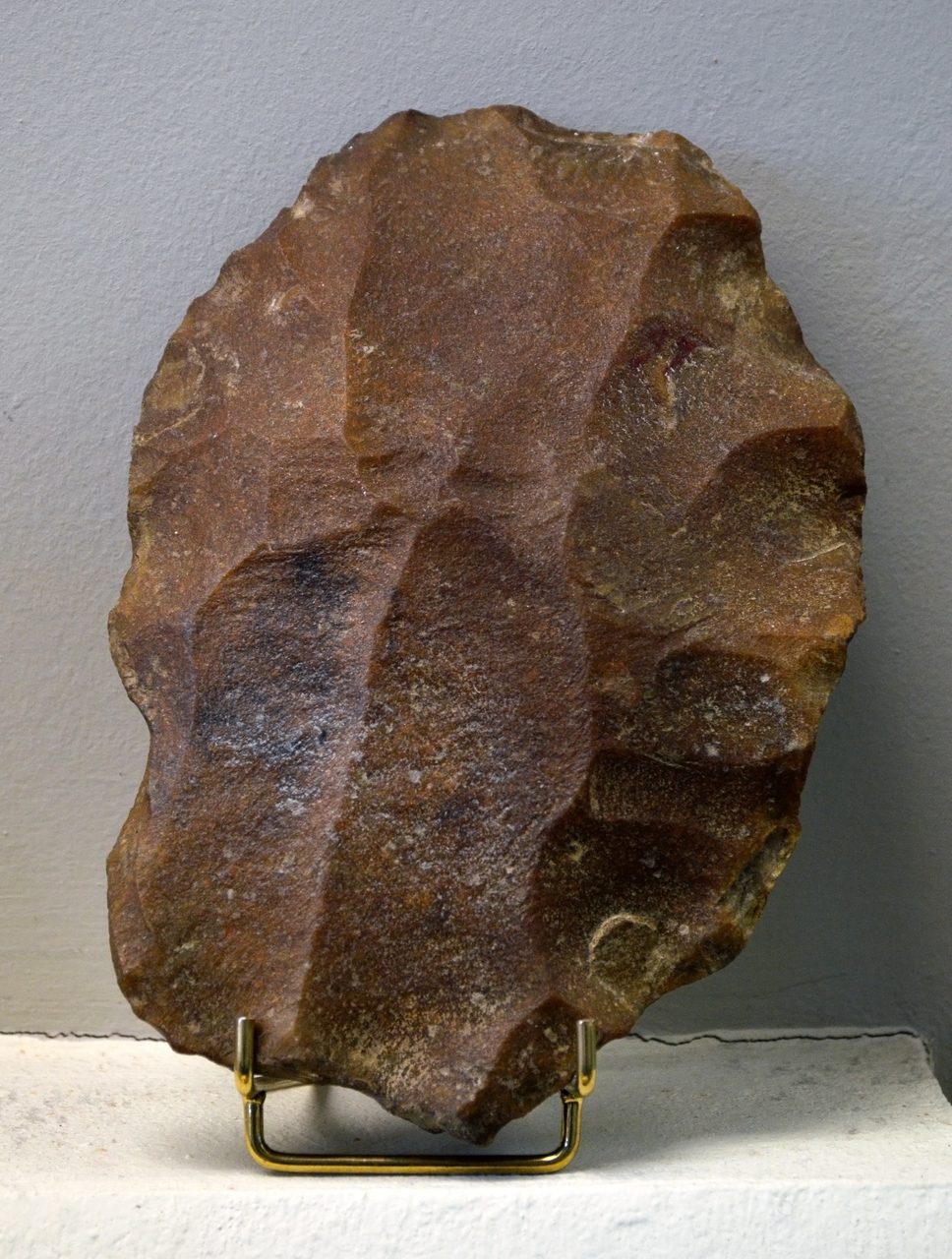
Jwalapuram, in the Kurnool District of Andhra Pradesh, sits about 2,500 kilometers from Toba, squarely inside the ash-fall zone, with a Youngest Toba Tuff layer about 2 meters thick lying visibly in its stratigraphy. That ash is a clock frozen in the ground. Below it, archaeologists find Middle Paleolithic stone tools made with the Levallois technique and clear signs of human occupation. Above it, they find the same tools, made the same way, with no obvious break in occupation and no change in where the toolmakers sourced their raw stone. To Petraglia the reading is straightforward: the people at Jwalapuram lived through the ashfall and simply carried on, with no sign of collapse, flight, or cultural rupture. Nor is Jwalapuram alone. At a second Indian site, Dhaba, stone-tool assemblages span the Toba ash layer without significant change as well, published by Clarkson and colleagues in 2020, giving the subcontinent a second continuous record straight across the eruption.
Ambrose has a rebuttal, and it is not a weak one. A few surviving sites, he argues, do not disprove a wider crash. Jwalapuram might record rapid recolonization rather than unbroken occupation, because the sediments may lack the time resolution to catch a brief abandonment. A layer that looks continuous to us could hide a gap of decades. This is exactly why the site settles nothing on its own: the same stratigraphy reads as survival to one camp and as a resolution problem to the other, and no one has yet found a way to force the ground to choose.
06How the Winter Kept Shrinking
The single most revealing thread in the whole Toba story is not the archaeology. It is the climate modeling, because in it you can watch the science correct itself in real time. The volcanic winter has not held its size. Every major follow-up study has made it smaller.
The original figures were genuinely frightening. In 1992 Michael Rampino and Stephen Self modeled the eruption's aerosol cloud and proposed 3 to 5 degrees Celsius of global cooling, a volcanic winter lasting six to ten years, and the possibility of a deeper volcanic freeze. Those numbers are real, in the sense that they were honestly published and widely cited for years. They are also, on the current evidence, too high. What follows is not a scandal. It is how the process is supposed to work.
| Study | Method | What It Found |
|---|---|---|
| Rampino and Self (1992) | Atmospheric aerosol injection modeling | 3 to 5 C of global cooling; a 6 to 10 year winter; a possible volcanic freeze |
| Robock et al. (2009) | Revised general circulation model | Cooling closer to 1.5 to 3 C; not enough for global glaciation |
| Timmreck et al. (2010) | Earth system model with aerosol microphysics | Only 1 to 2 C for about 5 years; earlier nuclear-winter scenarios called exaggerated |
| Lane et al. (2013) | Lake Malawi sediment cores, East Africa | No volcanic-winter signal at all in the East African record |
| Smith et al. (2018) | Archaeology and environment, Pinnacle Point, South Africa | Humans thrived through the eruption; no ecological disruption at that latitude |
Follow the shrinkage. Robock and colleagues, rerunning the eruption through an updated general circulation model in 2009, found cooling nearer 1.5 to 3 degrees, not enough to trigger global glaciation and looking more regional than planetary. Timmreck and colleagues went further in 2010: once you model the way sulfur aerosols clump together and fall out faster than the older models assumed, the cooling drops to something like 1 to 2 degrees for about five years, and the old nuclear-winter language starts to look overblown.
Then the modeling met the mud, and the mud did not cooperate. Lane and colleagues pulled sediment cores from Lake Malawi in East Africa in 2013 and found no volcanic-winter signal in them at all, no ashy fingerprint of a frozen world at the very latitudes where our ancestors were living. And in 2018 Smith and colleagues, working the archaeology at Pinnacle Point on the South African coast, found people not merely surviving but thriving straight through the eruption, with no evidence of ecological disruption at all. The test was run, in exactly the place a global winter should have shown up. It came back empty.
Those results do not stand alone. Curtis Marean's long excavation of the South African coast at Pinnacle Point points to continuous human occupation straight across the 74,000-year window, and Chad Yost's analysis of phytoliths and charcoal from Lake Malawi found no sign of catastrophic environmental disruption in East Africa either. Taken together, the honest reading of all this is not that Ambrose was foolish. It is that the bottleneck, if it happened, was likely either geographically selective, hammering South and Southeast Asia while African populations carried on, or milder than the extreme figure of a few thousand breeding pairs. The catastrophe kept surviving contact with the data by getting smaller.
07The Cheetah That Proves the Mechanism Is Real
It would be easy, after all that, to conclude that population bottlenecks are just a story geneticists tell. They are not. We have at least one airtight, undisputed example of a real species that went through exactly the kind of crash Ambrose imagined for us, and it is alive today.
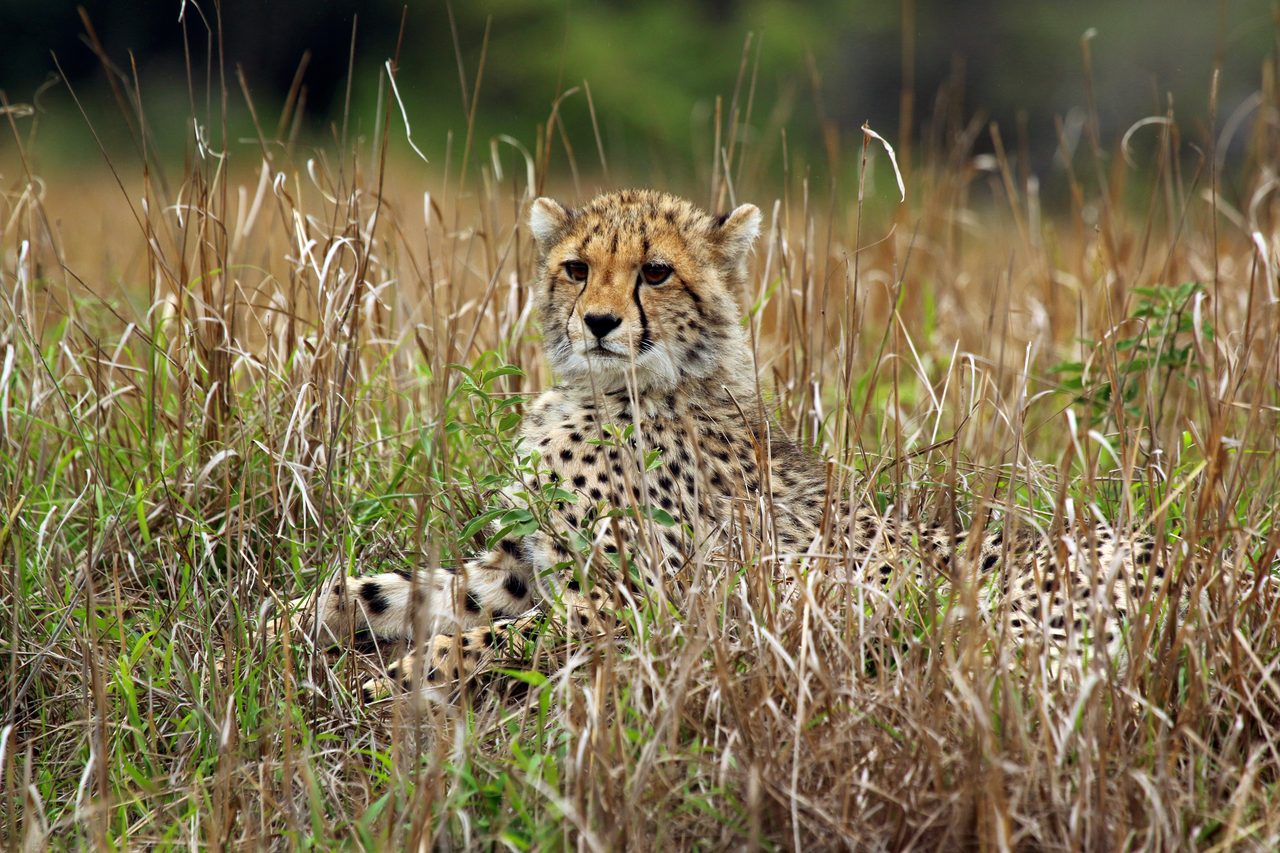
The cheetah is genetically almost a copy of itself. You can graft skin from one unrelated cheetah onto another and the recipient will not reject it, because their immune systems can barely tell each other apart. Cheetah sperm is poor across the whole species. Genome sequencing has confirmed why: cheetahs passed through a severe bottleneck around the end of the last ice age, one that flattened their genetic diversity down to levels you would otherwise only find in inbred laboratory mice. This is what Ambrose's mechanism looks like when it genuinely happens. The cheetah case is disputed by no one. It is the clean control that shows the human question is at least a reasonable one to ask, even though the answer for us keeps coming back uncertain.
08What Mitochondrial Eve Is Not
Any article that mentions genetic evidence for a human bottleneck is going to summon two famous names, and they cause more confusion than almost anything else in this field. It is worth stopping to say plainly what they are not.
Mitochondrial Eve is the most recent woman from whom every living person inherits their mitochondrial DNA, usually placed around 150,000 to 200,000 years ago. Y-Chromosomal Adam is the equivalent most recent common ancestor down the male line, commonly cited between about 120,000 and 156,000 years ago, though the estimate shifts with the method. Here is what they are not. They were not the first woman and man. They were not a couple. They did not even live at the same time. And, crucially for this story, neither one is a population count. They are statistical facts about which genetic lineages happened to survive, not evidence that humanity was ever reduced to two people, or to any particular number at all. Mitochondrial Eve had a great many contemporaries. She is simply the one whose unbroken maternal line reaches all the way to the present.
The genetics do point to a real founder event, but perhaps not Toba's. When modern humans dispersed out of Africa, sometime around 70,000 to 50,000 years ago, they did so as a founding group estimated at only about 1,000 to 5,000 effective individuals. That migration left a clear fingerprint: human genetic diversity decreases steadily the farther a population lives from Africa, exactly the pattern a serial founder effect produces as each new group is seeded from the last. This Out of Africa bottleneck may be large enough to account for the low diversity of our species all by itself. If it is, then the volcano is not needed to explain the genetics at all, and the very number Ambrose leaned on has an entirely non-volcanic home.
One last caution belongs here, about the machinery behind every one of these numbers. Ancient genetic material is short, chemically damaged, and desperately easy to contaminate, so any claimed population size from tens of thousands of years ago rests on careful authentication: the characteristic decay patterns in the DNA, the tiny fragment lengths, clean-room extraction, contamination estimates. Modern paleogenomics has largely replaced the old picture of human evolution as a single marching line with something messier and truer, full of interbreeding, population structure, and repeated demographic turnover. The Toba bottleneck debate lives inside that messiness, not above it.
09Where the Story Runs Past the Evidence
As with any catastrophe large enough to catch the imagination, Toba has collected claims that run past what the rock and the genes can support. Two are worth naming, one still open and one firmly closed.
The open one is a genuinely interesting idea about what a near-extinction might have done to the survivors. Ambrose and others have suggested that the bottleneck, if it happened, could have accelerated the arrival of behavioral modernity, forcing small, isolated bands into tighter cooperation, richer symbolic communication, and faster technological invention as the very price of survival. The burst of symbolic artifacts in the African record after about 70,000 years ago, the beads and pigments and engravings at sites like Blombos Cave, has been hung on this idea. It is a good story. It is also explicitly speculative, a causal chain no one has come close to demonstrating, and it rests on a bottleneck that may not have happened in the first place.
The closed one is simpler. Toba did not cause the ice ages. The Quaternary glaciations began about 2.6 million years ago, driven by the slow arithmetic of Earth's orbit, the Milankovitch cycles, and by tectonic change, long before Toba existed. The eruption may have deepened the cooling of one glacial phase, Marine Isotope Stage 4, but it did not start the ice ages, and the claim that it did is simply wrong.
Fast Facts
- The Event
- The Toba supereruption, Sumatra, and the disputed genetic-bottleneck hypothesis
- When
- About 74,000 years ago (74,000 give or take 2,000, Mark et al., 2014)
- Where
- The island of Sumatra, Indonesia
- Scale
- VEI-8, the largest eruption on Earth in two million years
- Ejecta
- About 2,800 cubic km, roughly 17.5 times Tambora
- The Caldera
- Now Lake Toba, about 100 by 30 km, the largest volcanic lake on Earth
- The Bottleneck Claim
- Ambrose (1998): a human crash to ~3,000 to 10,000 breeding individuals
- Status of That Claim
- Actively debated and trending skeptical; the bottleneck is real, Toba as its cause is not established
- The Winter, Revised
- From 3 to 5 C (1992) down to 1 to 2 C for ~5 years (2010), with no signal in East African cores (2013)
- The Two Registers
- Tier 1 on the eruption; Tier 2 and genuinely open on its effect on humanity
What We Can Actually Stand Behind
The eruption is beyond dispute. About 74,000 years ago Toba erupted on Sumatra with a VEI-8 force, ejected some 2,800 cubic kilometers of rock, buried roughly 4 million square kilometers of Asia and beyond in ash, and left the caldera that is now Lake Toba. It was the largest eruption in two million years. Every research source and every study agrees on this, and nothing in the human debate touches it.
Whether that eruption nearly ended us is the real question, and it is honestly unresolved. The human genetic bottleneck is real; that Toba caused it is not established. Over thirty years the field has drifted away from Ambrose's catastrophic version and toward the moderate and skeptical readings, as milder climate models and continuous archaeological records at Jwalapuram, Dhaba, Lake Malawi, and Pinnacle Point have piled up. The most balanced current statement is that Toba caused real environmental stress and may have contributed to a broader demographic decline, but was not the sole or even the primary cause of the bottleneck, and recent whole-genome work points to a gradual decline rather than a sudden crash. The debate remains active. We are not resolving it here, and no one honestly can yet.
One genuinely intriguing possibility sits just past the evidence: that a near-extinction, if it occurred, sharpened the cooperation, symbolism, and invention we call behavioral modernity. The African record does bloom with symbolic artifacts after about 70,000 years ago. But the causal link is speculation resting on a bottleneck that may not have happened, and it should be read as a provocative idea, not a finding.
No, Toba did not cause the ice ages. Global glaciation began about 2.6 million years ago on orbital and tectonic timescales, long before the eruption. Toba may have deepened one cold phase; it did not start the ice ages, and that specific claim is flatly false.
And no, Mitochondrial Eve and Y-Chromosomal Adam were not a couple, were not the first humans, and are not a population count. They are the surviving endpoints of two genetic lineages, nothing more, and by themselves they are no evidence of any Toba-scale crash. The popular image of all humanity funneling through a literal handful of people confuses a statistical construct with a headcount.
So the file closes on the eruption and stays open on us. We can date the blast, measure its ash across two continents, and stand on the caldera rim, all with real confidence. What we cannot yet say is whether it mattered to human survival at all. The honest state of the science is a trend, not a verdict: the case for catastrophe has been shrinking for thirty years, but a trend is not a proof, and the skeptical reading could still be overturned by the right discovery. What would actually settle it? Probably two things our records do not yet contain. One is a climate model that finally reconciles the eruption's undeniable scale with the near-total absence of a winter signal in African sediment cores. The other is a set of African archaeological sequences dated finely enough to catch, or to rule out, a brief crash right at 74,000 years ago. Until one or both arrive, the question in the title stays a question. The winter was real. Whether it nearly ended us is something the rock has not yet agreed to tell.
Sources & further reading
Everything above is drawn from our research library on Theories of Anything. Open the full file to check the sourcing and go deeper.
Image credits
- Lake Toba filling the caldera left by the supereruption, seen from the crater rim in Sumatra, Indonesia Yudhapohan, photographed April 27, 2021 via Wikimedia Commons. CC BY-SA 4.0 Source.
- Lake Toba viewed from Parapat, North Sumatra, with Samosir Island visible at the center of the lake Sharon Gultom (Wikimedia user MShaGh), uploaded May 27, 2015 via Wikimedia Commons. CC BY-SA 4.0 Source.
- NASA Landsat satellite photograph of Lake Toba and Samosir Island from space, Sumatra, Indonesia NASA Landsat, uploaded July 2, 2005 via Wikimedia Commons. Public Domain (United States) Source.
- A scientific diagram comparing modeled and measured Youngest Toba Tuff ash thickness, with isopach maps of ash dispersion across South and Southeast Asia Victoria Christina Smith, Antonio Costa, Giovanni Macedonio, and Naomi E. Matthews, uploaded January 10, 2019 via Wikimedia Commons. CC BY 4.0 Source.
- Mount St. Helens erupting on May 18, 1980, showing the eruption column from the most destructive eruption in modern American history Austin Post (1922-2012), USGS, photographed May 18, 1980 via Wikimedia Commons. Public Domain (United States) Source.
- A quartzite stone core produced using the Levallois knapping technique, from Saint-Mard, France, held in the Musee Saint-Remi, Reims Vassil, photographed September 21, 2016 via Wikimedia Commons. CC0 1.0 Universal (Public Domain Dedication) Source.
- A cheetah cub in South Africa, a living member of the species whose extreme genetic bottleneck is not in dispute Charles J. Sharp, photographed at Phinda Private Game Reserve, uploaded April 9, 2015 via Wikimedia Commons. CC BY-SA 4.0 Source.
- Lake Toba filling the caldera left by the supereruption, seen from the crater rim in Sumatra, Indonesia Yudhapohan, photographed April 27, 2021 via Wikimedia Commons. CC BY-SA 4.0 Source.


_cub.jpg)