
The Near Misses: The Asteroids That Did Not Hit
Between 12 and 21 August 2026, four near-Earth asteroids passed within or close to the Moon's orbit, and two of them were not detected until after they had gone. That is not an unusual fortnight. It is what an ordinary fortnight looks like once somebody is counting. This page is about the encounters themselves: the objects that came close and missed, the record book of closest passes with our own files corrected against NASA's data in seven places, the arrivals nobody was watching for and how their entire scientific record was reconstructed afterwards by instruments built for something else, and the honest odds underneath all of it. A near miss is not a warning shot, because nothing aimed. It is a measurement of how well we are looking.
Four asteroids came close to Earth in ten days this August. None of them hit. Two of them were not detected until after they had gone past. That is what this page is about: not the impacts, which have their own files in this wing, but the encounters. What came close, how close, what was measured, and what was missed until afterwards. Every distance below is geocentric, measured from the centre of the Earth rather than from the ground. The difference between those two bases is 6,371 km, and it is large enough that comparing one against the other put a false statement into our own research library. That statement is corrected here, along with six others, and the corrections are the reason to trust the rest.
01Four Objects In Ten Days
In the ten days between 12 and 21 August 2026, four separate near-Earth asteroids passed within or close to the Moon's orbit: 2026 PC6 at 20,468 km, 2026 PS9 at 165,836 km, 2026 QR at 50,529 km and 2026 QA3 at 328,034 km, every figure geocentric. Two of the four were not detected until after they had gone. This is not an unusual fortnight. It is what an ordinary fortnight looks like once somebody is counting.
Asteroid 2026 PC6 passed Earth on 12 August 2026 at 00:50 UTC at a distance the database records as 0.000136817233945178 astronomical units. Converted with the IAU definition of the astronomical unit, that is 20,468 km from the centre of the Earth, 0.0532 lunar distances, and about 14,100 km above the mean surface. The geostationary satellite ring sits at 42,164 km from Earth's centre, so the object crossed well inside it. It is the closest known non-impacting flyby of 2026. It is an Aten-class near-Earth asteroid with an absolute magnitude of 27.943 plus or minus 0.304, which puts its estimated diameter at roughly 7 to 15 m depending on how dark its surface is.
Four words are worth separating before going further, and our own research file defines them correctly. An asteroid is a rocky remnant of solar-system formation; a meteoroid is a small rocky or metallic body in space; a meteor is the streak of light one makes entering the atmosphere; a meteorite is the fragment that reaches the ground. One more distinction comes from JPL's own orbit-class field and matters later: Aten objects have orbits mostly inside Earth's and cross it from the sunward side, while Apollo objects have orbits mostly outside Earth's and cross it from outside. 2026 PC6 and 2025 UC11 are Atens. 2026 QR, 2026 QA3, 2026 PS9, 2026 JH2, 2023 BU, 2019 OK and 2024 YR4 are Apollos.
2026 PC6 was first observed on 11 August 2026, the day before it passed. JPL's orbit solution for it rests on 103 observations, all of them from that single date, with a null data arc and a condition code of 5 on the 0 to 9 scale where 0 is a perfectly determined orbit. An object crossed inside the geostationary belt with roughly a day of notice, and its entire scientific record is one night's observing.
Not all four were surprises. Asteroid 2026 PS9 passed on 16 August 2026 at 01:04 UTC at 165,836 km geocentric, 0.431 lunar distances, and it was seen coming: first observed on 4 August 2026, twelve days before closest approach. Its absolute magnitude of 27.614 gives an estimated 8 to 18 m across.
Asteroid 2026 QR passed on 18 August 2026 at 20:09 UTC at 50,529 km geocentric, 0.131 lunar distances, about 44,158 km above the mean surface, just outside the geostationary ring. It was first observed on 19 August 2026, the day after it passed. Its orbit rests on twelve observations with a condition code of 7. At an absolute magnitude of 30.388 plus or minus 0.684, it is an estimated 2 to 5 m across.
Asteroid 2026 QA3 passed on 21 August 2026 at 06:44 UTC at 328,034 km geocentric, 0.853 lunar distances. It too was first observed the day after it passed, on 22 August 2026, and its orbit rests on nine observations with a condition code of 8, the second-worst grade JPL issues. At an absolute magnitude of 29.323 it is an estimated 4 to 8 m across.
A note on those sizes, because they are estimates and not measurements. Where no published diameter exists, the ranges in this article are derived from the object's absolute magnitude using the standard relation, evaluated across the conventional albedo bracket from 0.25 down to 0.05. That is the same bracket NASA's Center for Near-Earth Object Studies uses to publish its own estimated diameter ranges, so the numbers agree with the agency's public figures, but they are derived rather than observed. For the same observed brightness a darker rock has to be bigger than a shinier one, and nobody has measured the reflectivity of an object seen for a single night. Where a measured value does exist, from JWST for 2024 YR4 and from ESA for 2026 JH2, this page uses the measured value and says so. This page gives no diameter for Apophis, measured or derived.
02A Miss Leaves Nothing Behind
There is no historical record of near misses, and there cannot be one. An impact leaves a crater, a scatter of meteorites, a burnt layer, a story. A miss leaves nothing at all: no mark on the ground, no fragment, nothing for a chronicle to record, usually not even a visible object. Every near miss in this article was recorded by instruments, and the earliest of them is 1989. The apparent recent surge in close approaches is a surge in detection, not a surge in traffic. That is the single most important thing to hold on to while reading the rest of this page.
Objects that hit are a different matter, and our own research files keep a careful line between the physical record and the mythological one. Where a crater is dated and a tradition near it describes fire falling from the sky, the correlation can be strong: the files rate the archaeology at the Kaali crater on Saaremaa in Estonia Tier 1, since its main crater sits in what was a populated area and was later walled and used as a fortified shrine, and the Finnish Kalevala describes a fire-child stolen from heaven that burns the land. The files also carry the counter-argument at full strength. Vansina's Oral Tradition as History set a methodological ceiling in 1985 of roughly 500 years for reliable historical information in oral transmission, and while Nunn and Reid showed in 2015 that some Australian Aboriginal traditions preserve accurate sea-level information from about 7,000 years ago, extrapolating that to specific impact events in deep time is a separate and much weaker claim.
Pushed further, that reasoning stops being evidence, and this is the Tier 3 example our own file handles well. Edith Kristan-Tollmann and Alexander Tollmann proposed in Terra Nova in 1994 that a comet broke into seven pieces and struck Earth around 7,640 BCE, and that worldwide flood traditions of seven suns are a memory of it. Our research file tiers the proposal 3 to 4 and states plainly what is wrong with it: it is a single-source hypothesis, it is not independently supported, no geological confirmation of a simultaneous multi-impact exists, and it is cited primarily in catastrophist literature rather than in mainstream planetary science. It is named here as a Tier 3 hypothesis and nothing more, and its publication is cited so that a reader can go and weigh it.
03The Record Book, Corrected
Our own impact-catalogue file names 2023 BU, which passed on 27 January 2023, as the closest non-impacting approach on record. It is not, and it was not even when the file said so. Ranked by geocentric distance, the closest known non-impacting passes are 2025 UC11 on 30 October 2025 at 6,599 km, 2020 VT4 on 13 November 2020 at 6,746 km, and 2025 TF on 1 October 2025 at 6,781 km. 2023 BU, at 9,967 km, is the tenth closest, and 2020 VT4 already held the record more than two years before 2023 BU passed. The file's companion figure is correct and stands: 2023 BU did pass about 3,596 km above the surface, which the file rounds to 3,600 km.
The current record holder for the closest known non-impacting pass is 2025 UC11, on 30 October 2025 at 12:11 UTC, at 6,599 km from Earth's centre and about 228 km above the mean surface. That is below the altitude at which the International Space Station orbits. And here is the part a record framing tends to lose: it is an Aten-class object with an absolute magnitude of 34.06 plus or minus 0.459, which puts its estimated diameter at roughly 0.4 to 0.9 m. The single closest approach in the whole record was made by a boulder under a metre across that the atmosphere would have consumed entirely. That is the honest fact and it is the more interesting one.
Asteroid 2020 VT4 passed on 13 November 2020 at 17:21 UTC at 6,746 km geocentric, about 375 km above the mean surface, lower than the space station's usual altitude. JPL's first observation of it is dated 14 November 2020, the day after, and its data arc runs five days, from 14 to 19 November. An object of roughly 5 to 11 m across flew through the middle of low Earth orbit and the first anybody knew of it was the following day.
That inference has to be made carefully, because JPL's first-observation field is a date rather than a time, and it is not always the discovery date: images of an object found in archives afterwards are folded into it. 2019 OK proves the trap. It was announced as a discovery roughly a day before its 25 July 2019 pass, yet its database first-observation date now reads 21 February 2017 with a data arc of 884 days, because archival images of it were identified later. So found afterwards is only safe to say where the first observation is strictly later than the approach and the data arc is null or very short. It holds for 2020 VT4, whose arc is five days, for 2026 QR, whose arc is null, and for 2026 QA3, whose arc is one day. It cannot be said of 2025 UC11 or 2025 TF, where the first observation and the pass fall on the same calendar date and the record cannot resolve the order. This page does not say it of them.
The system does sometimes work, and the article has to say so. 2023 BU was first observed on 21 January 2023 and passed on 27 January 2023 at 00:29 UTC, six days later, at 9,967 km geocentric and about 3,596 km above the surface. Its orbit rests on 254 observations over a ten-day arc with a condition code of 1, the second-best grade JPL issues. The pass was predicted precisely and announced in advance. Whether an object is seen coming is not simply luck. It depends on how bright it is, where in the sky it comes from, and whether a survey happened to be looking there.
The most recent well-observed pass before August was 2026 JH2, on 18 May 2026 at 22:00 UTC, at 91,572 km geocentric, 0.238 lunar distances, about 85,201 km above the surface. It was first observed on 10 May 2026, eight days out, and its orbit now rests on 170 observations over a ten-day arc. It is an Apollo-class object, and ESA's own page for the encounter gives its size as 14 to 30 m, which matches the range derived from its brightness. One caution belongs on the record: that ESA page states the time as 21:58 UTC against the CNEOS 22:00, carries an internally inconsistent local-time conversion, and describes the distance qualitatively in a way we could not reconcile with 0.238 lunar distances. Every quantitative figure in this paragraph therefore comes from CNEOS alone, and ESA is used only for the size.
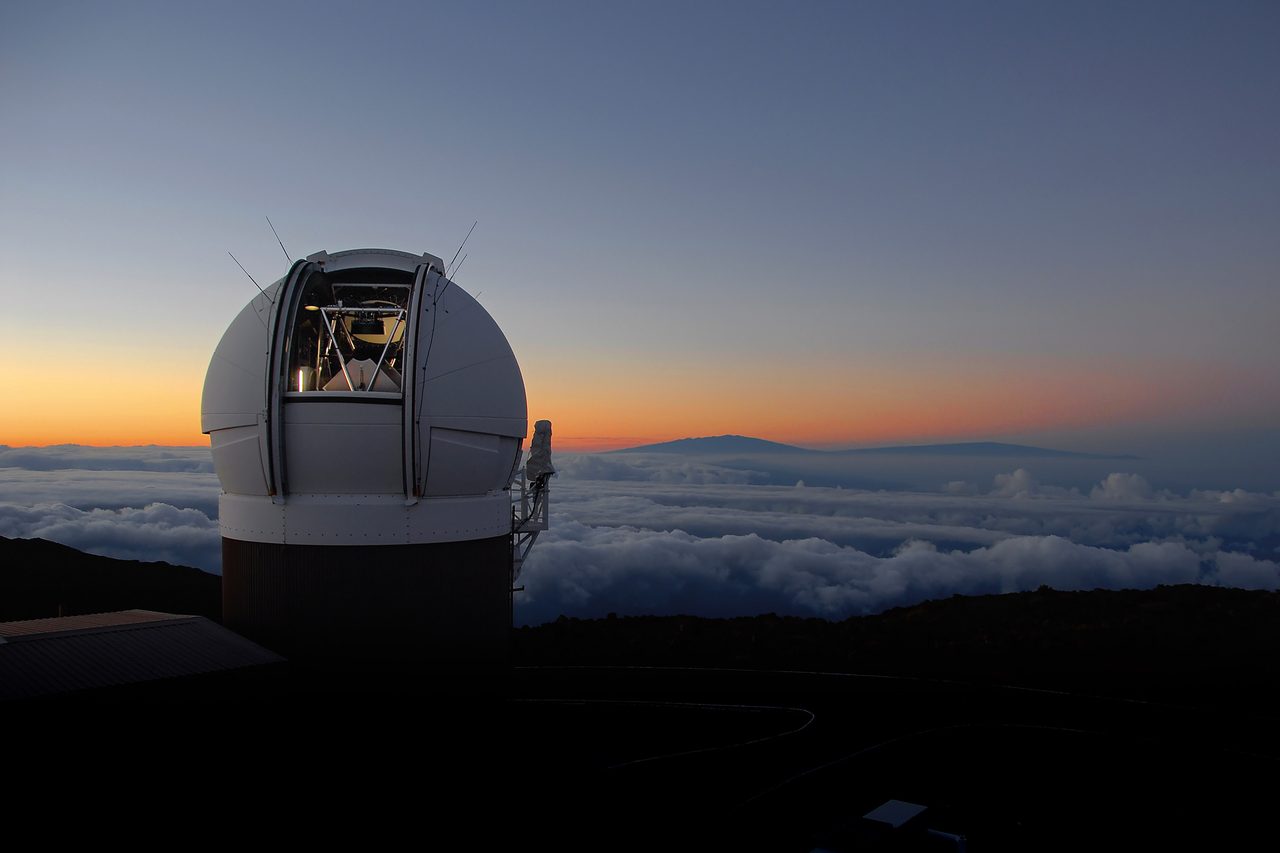
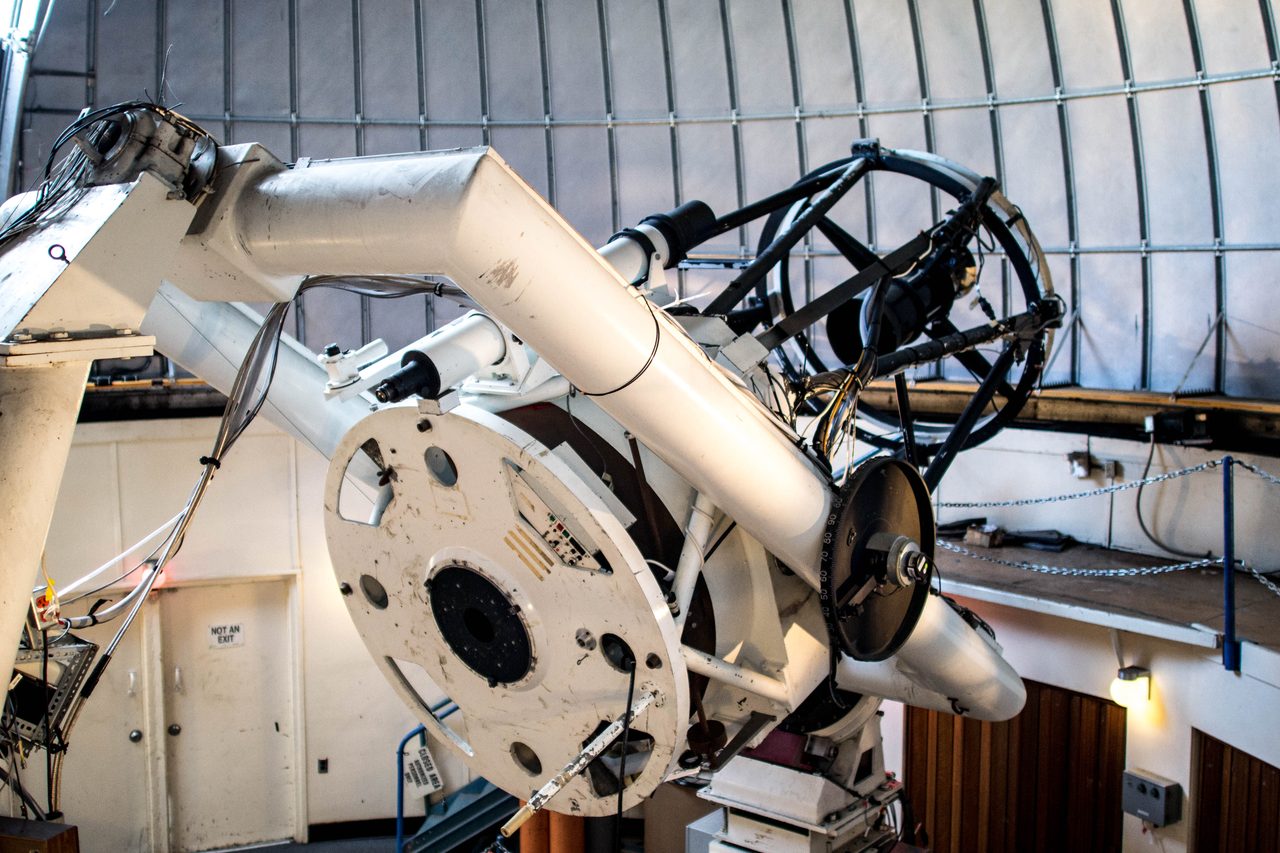
The objects in this article were found by a small number of ground-based survey programmes: the Catalina Sky Survey on Mount Lemmon and Mount Bigelow in Arizona, Pan-STARRS on Haleakala in Hawaii, and ATLAS. The Mount Lemmon Survey found 2026 JH2; ATLAS found 2024 YR4. The surveys themselves, their instruments and what is being built to replace them belong to a different file, and this page holds to the encounters.
04Two Numbers For The Same Distance
The second correction is the one that is also this article's subject matter. Our catalogue file states that 2004 FH, which passed on 18 March 2004 at 22:09 UTC, went inside geostationary orbit at 43,000 km. It did not. Its geocentric distance was 49,100 km, and the geostationary ring is at 42,164 km from Earth's centre, so 2004 FH passed roughly 6,900 km outside it. The 43,000 km in the file is the distance above the surface, which by the same solution is 42,729 km, and 42,729 km of altitude is far above geostationary altitude of 35,786 km. The error is not an error of arithmetic. It is a surface figure compared against a geocentric threshold, which is the same mistake this page is trying to make impossible to repeat.
One pass in the file genuinely did go inside the ring. Asteroid 367943 Duende, discovered as 2012 DA14, passed on 15 February 2013 at 19:26 UTC at 34,053 km from Earth's centre, about 27,682 km above the surface. Our file's figure of 27,700 km is right, but it is the surface distance sitting in a table column whose other rows are geocentric, and a reader cannot compare rows in a column like that. The same day, hours earlier and on an entirely unrelated orbit, the Chelyabinsk object arrived over Russia. The two events are not connected, and the coincidence has been a source of confusion ever since.
The oldest entry in the record is 4581 Asclepius, which passed on 22 March 1989 at 21:42 UTC at 684,008 km geocentric, 1.78 lunar distances. Our file gives 690,000 km, about 6,000 km high. Its estimated diameter of roughly 190 to 420 m is consistent with the file's figure of about 300 m as a mid-range value. The much-repeated line that Asclepius crossed the point in space Earth had occupied six hours earlier is not verifiable from the close-approach record, and no primary source for the six-hour figure was found. This page therefore does not use it.
For scale on how routine this is: across calendar year 2026 to date, 77 known objects passed within 0.002 astronomical units of Earth, which is 299,196 km, closer than the Moon's mean distance. 2026 PC6 was by a wide margin the closest of them; the second closest was 2026 EM on 7 March 2026, at about 27,700 km geocentric. That 77 is a count of known passes recorded in the database on the day it was queried. It is a lower bound on the real traffic rather than a measurement of it, and it will grow as archival and later-discovered objects are added to the record.
| Object | Closest Approach (UTC) | Geocentric Distance | Lunar Distances | Altitude Above Mean Surface | Estimated Diameter | First Observed |
|---|---|---|---|---|---|---|
| 2026 PC6 | 12 Aug 2026, 00:50 | 20,468 km | 0.0532 | 14,097 km | About 7 to 15 m | 11 Aug 2026, one day before |
| 2026 PS9 | 16 Aug 2026, 01:04 | 165,836 km | 0.431 | Not carried | About 8 to 18 m | 4 Aug 2026, twelve days before |
| 2026 QR | 18 Aug 2026, 20:09 | 50,529 km | 0.131 | 44,158 km | About 2 to 5 m | 19 Aug 2026, the day after |
| 2026 QA3 | 21 Aug 2026, 06:44 | 328,034 km | 0.853 | Not carried | About 4 to 8 m | 22 Aug 2026, the day after |
| 2026 JH2 | 18 May 2026, 22:00 | 91,572 km | 0.238 | 85,201 km | 14 to 30 m (ESA) | 10 May 2026, eight days before |
| 2025 UC11 | 30 Oct 2025, 12:11 | 6,599 km | 0.0172 | About 228 km | About 0.4 to 0.9 m | 30 Oct 2025, the same date as the pass |
| 2020 VT4 | 13 Nov 2020, 17:21 | 6,746 km | 0.0175 | About 375 km | About 5 to 11 m | 14 Nov 2020, the day after |
| 2025 TF | 1 Oct 2025, 00:49 | 6,781 km | 0.0176 | About 410 km | About 1.2 to 2.7 m | 1 Oct 2025, the same date as the pass |
| 2023 BU | 27 Jan 2023, 00:29 | 9,967 km | 0.0259 | 3,596 km | About 3 to 7 m | 21 Jan 2023, six days before |
| 2019 OK | 25 Jul 2019, 01:22 | 71,355 km | 0.186 | 64,984 km | About 58 to 130 m | 21 Feb 2017 in the database, an archival image identified later; announced about a day before the pass |
| 367943 Duende (2012 DA14) | 15 Feb 2013, 19:26 | 34,053 km | 0.0886 | 27,682 km | About 39 to 86 m | Not carried |
| 2004 FH | 18 Mar 2004, 22:09 | 49,100 km | 0.128 | 42,729 km | About 14 to 31 m | Not carried |
| 4581 Asclepius | 22 Mar 1989, 21:42 | 684,008 km | 1.78 | Not carried | About 190 to 420 m | Not carried |
| 99942 Apophis (still to come) | 13 Apr 2029, 21:46 | 38,012 km | 0.0989 | 31,641 km | Not carried | Discovered June 2004, a discovery date rather than the database field; pre-discovery images from March 2004 were identified later |
| 2024 YR4 (still to come) | 22 Dec 2032, 08:22 | 278,333 km | 0.724 | Not carried | Roughly 60 m (measured) | Discovered 27 Dec 2024 by ATLAS, a discovery date rather than the database field |
Every distance in that table is geocentric, from the centre of the Earth, converted from the database's own value in astronomical units using 1 astronomical unit equals 149,597,870.7 km and 1 lunar distance equals 384,400 km. The altitudes are the geocentric distance less Earth's mean radius of 6,371 km, so they are good to about plus or minus 11 km depending on latitude. Diameters are estimates derived from absolute magnitude except where a measured value is marked. The two future rows are the encounters covered in the next section, and 2024 YR4's separate lunar encounter on the same day is given there rather than here, because it is measured from the Moon and not from the Earth.
05The Direction Nobody Can Search
One object in the record put size together with almost no notice. Asteroid 2019 OK passed on 25 July 2019 at 01:22 UTC at 71,355 km geocentric, 0.186 lunar distances, about 64,984 km above the surface. Its brightness puts its estimated diameter at roughly 58 to 130 m: the size that flattens a region rather than a street. It was announced to the world with about a day's warning, a figure that comes from the contemporaneous announcement record rather than from the database, for the reason given in section 03. It is not the only object of that scale in the table above: 4581 Asclepius is an estimated 190 to 420 m, 367943 Duende 39 to 86 m, 2024 YR4 roughly 60 m, and Apophis is several times 2024 YR4's size. What separates 2019 OK from all of them is not its size. It is that nobody knew it existed until about a day before it passed.
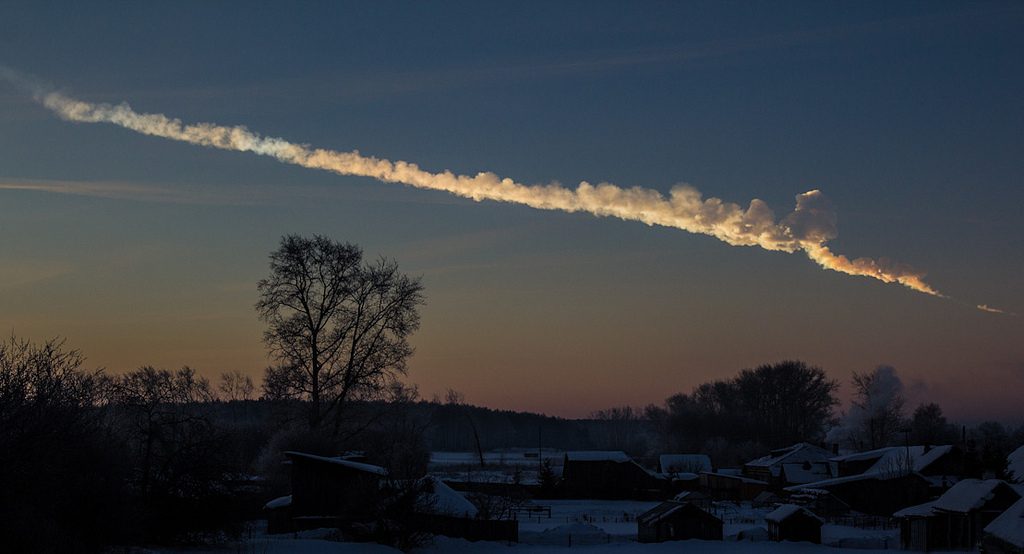
On 15 February 2013 an asteroid roughly 17 to 20 m across entered the atmosphere over Chelyabinsk in Russia at about 19 km/s and detonated as an airburst with an energy near 500 kilotons of TNT. It was not detected before entry, and the reason is structural: it approached from the sunward direction, the one part of the sky no ground-based optical survey can search. Chelyabinsk is the control case for this whole page. Every object catalogued above missed, and the two still to come are calculated to miss. This one was inside the size range of that table and did not, and nobody saw it coming.
Ground-based optical surveys find asteroids by catching reflected sunlight against a dark sky. An object approaching from the direction of the Sun is invisible to them, which is why Chelyabinsk arrived unannounced and why Aten-class objects on sunward approaches are systematically under-found. Objects also arrive fast. Hypervelocity entry runs from about 11 to 72 km/s, so something first seen at a few million kilometres may be days away rather than weeks, and the interval between finding it and its arrival is not a schedule anybody controls.
06Two Encounters Already On The Calendar
On 13 April 2029 at 21:46 UTC, asteroid 99942 Apophis will pass at 38,012 km from Earth's centre, 0.0989 lunar distances, about 31,641 km above the mean surface. The geostationary ring sits at 42,164 km from Earth's centre, so Apophis will pass roughly 4,150 km inside it. Chesley's contemporaneous account of the object puts the same figure as about six Earth radii from the geocentre. Our own file's statement that it comes within 31,600 km of Earth's surface is correct, and this is one of the places the file is right and should be said to be.
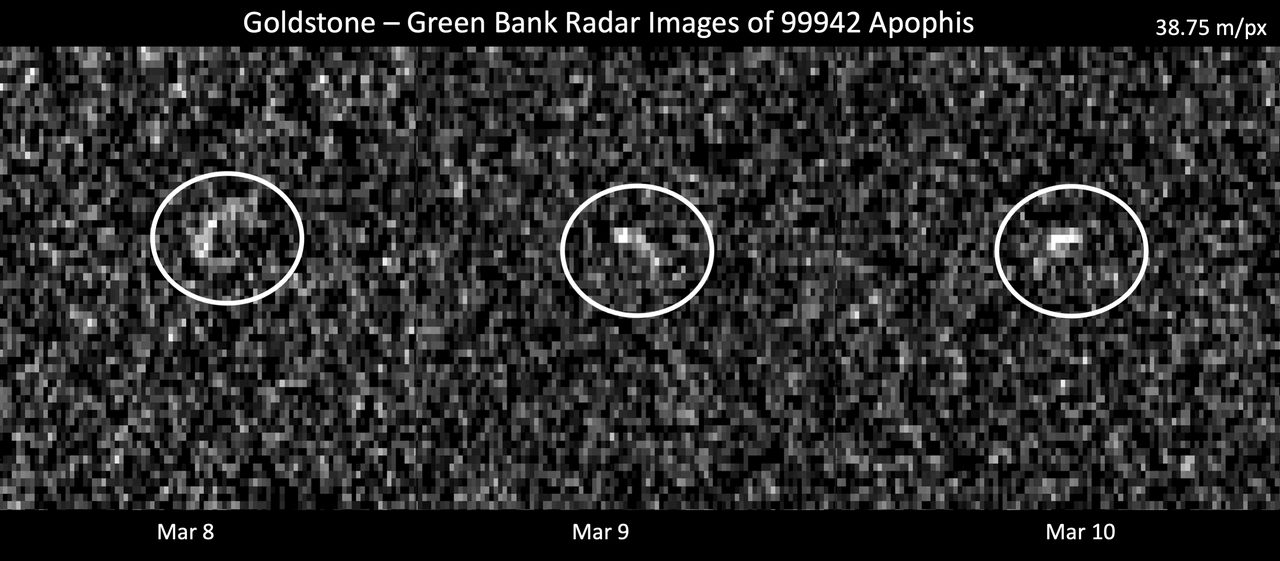
Apophis is the most watched object in the sky for a reason. It was found in June 2004, lost, and recovered that December. On 27 December 2004 its impact probability for 13 April 2029 peaked at about 2.7 percent and it reached Torino Level 4. Pre-discovery observations from March 2004, reported the same day, eliminated the 2029 impact. Radar observations on 8 to 10 March 2021, using the Goldstone Deep Space Network antenna and the Green Bank Telescope, removed it from the impact risk list altogether.
Those radar observations are worth pausing on, because they are the whole mechanism by which a near miss stops being a risk. They were made at a range of about 10.6 million miles, at a resolution of about 127 feet per pixel. Nothing was decided and nothing was negotiated. A measurement was made precise enough to shrink the region of possible orbits until Earth fell outside it.
The second encounter on the calendar has a shorter and much more recent history. Asteroid 2024 YR4 was discovered by the ATLAS survey on 27 December 2024. Its probability of striking Earth on 22 December 2032 crossed 1 percent on 27 January 2025 and peaked at 3.1 percent on 18 February 2025. It fell to 0.39 percent the next day, 19 February, and below 0.1 percent by 23 February. At roughly 60 m across, it holds the highest Earth-impact probability ever recorded for an object of its size or larger.
2024 YR4 and Apophis hold two different records and merging them produces a falsehood. 2024 YR4 reached the higher impact probability, 3.1 percent, but peaked at Torino Level 3. Apophis reached a lower probability, about 2.7 percent, but reached Torino Level 4, which remains the highest Torino rating ever assigned to any object. The reason is that the Torino scale combines probability with kinetic energy, and Apophis is several times the larger body. Riskiest asteroid ever detected is true of 2024 YR4 only with the qualifier for an object of its size, and this page keeps the qualifier attached.
Querying NASA JPL's Sentry impact-monitoring system for 2024 YR4 today returns no risk table. It returns a removal record: {"error":"specified object removed","removed":"2026-03-05 16:02:50","signature":{"version":"2.0","source":"NASA/JPL Sentry Data API"}}. The object was formally taken off the impact risk list on 5 March 2026 at 16:02:50 UTC. That timestamp is machine-generated, and it is the end of the story in the plainest form it comes in.
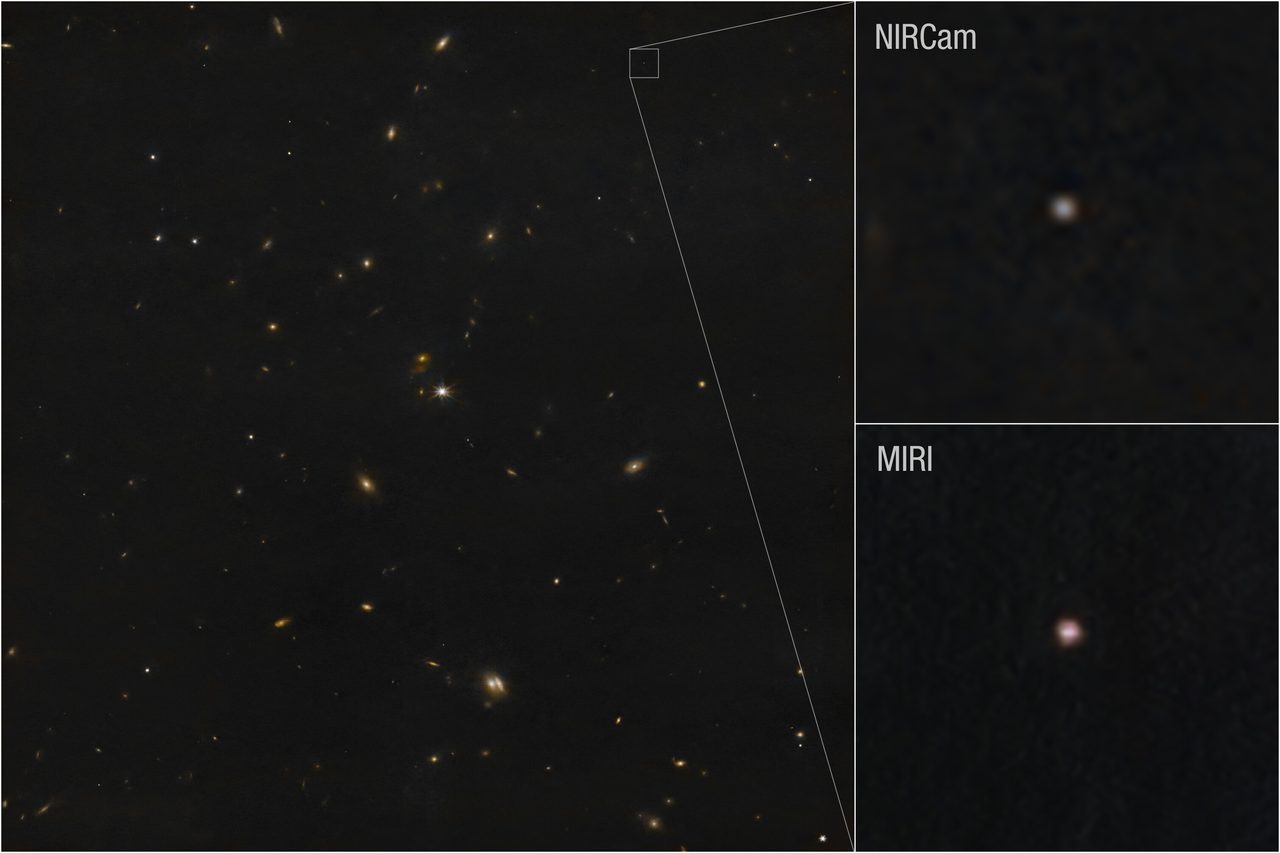
Earth was cleared within days in February 2025, but the Moon was not. By the end of the object's discovery apparition the probability that 2024 YR4 would strike the Moon on 22 December 2032 stood at 4.3 percent. JWST observed it on 18 and 26 February 2026, extending the observed arc by eight months and shrinking the uncertainty on the lunar encounter by a factor of more than thirty. The refined solution gives a miss distance of 22,900 km, plus or minus 800 km at one sigma, from the centre of the Moon, which rules out a lunar impact.
The paper reporting it is titled JWST Observations of Asteroid 2024 YR4 Rule Out a 2032 Lunar Impact and Demonstrate a New Regime for Planetary Defense Follow-up, and the second half of that title is the point. A space telescope built for cosmology and exoplanets was used to track a 60 m rock, at a moment when no ground-based telescope could see it at all. The authors present this as a new capability rather than a routine one.
JPL's current close-approach solution for 2024 YR4 gives two encounters on 22 December 2032: Earth at 08:22 UTC at 278,333 km geocentric, 0.724 lunar distances, and the Moon at 14:57 UTC at 22,938 km from the Moon's centre. The published three-sigma bounds on that lunar distance run from 20,618 km to 25,258 km, and the Moon's radius is 1,737.4 km, so even the innermost bound clears the lunar surface by more than 18,000 km. The figure derived independently from that solution, 22,938 km, agrees with the peer-reviewed 22,900 plus or minus 800 km to within 38 km. One warning goes with it, and it is this article's recurring theme: the same encounter is quoted elsewhere as about 21,200 km, measured from the lunar surface rather than from the Moon's centre. Both are correct. 22,938 minus 1,737.4 is 21,201. A reader who is not told which basis is in use will conclude that one of the two sources is wrong.
Those two are what is currently on the books: Apophis in 2029 and 2024 YR4 in 2032, and neither is an impact risk under the present orbit solutions. Longer-range items exist in our own catalogue file as cumulative probability statements spread over centuries, and they are outside this article's scope. That table also carries at least three demonstrable errors, including a probability attached to the wrong year and a hypothetical impact date filed as a future close approach, so this page lifts nothing from it.
07Nothing Was Watching Over Washington
On 14 August 2026 a bolide crossed central Washington State, and NASA's fireball database holds its authoritative record. Peak brightness at 07:48:36 UTC, which is 00:48:36 Pacific Daylight Time; position 47.7 degrees north, 119.4 degrees west; altitude at peak brightness 30.0 km, or 18.6 miles; velocity 12.2 km/s, or 27,290 mph; total radiated energy 3.8 in the database's units of 10 to the tenth joules; calculated total impact energy 0.13 kilotons, which is 130 tonnes of TNT equivalent. Those coordinates fall within a kilometre or two of Sims Corner, Washington, the fragmentation point named in the local reporting, and the timestamp matches the reported 12:48 a.m. Pacific exactly.
Nothing was watching for it. What recorded it was a network built to listen for volcanoes. Infrasound instruments operated by the United States Geological Survey and the Pacific Northwest Seismic Network picked up the object's fragmentation at five Cascade volcanoes: Glacier Peak, Mount Rainier, Mount Adams, Mount St. Helens and Mount Hood. The pressure wave reached the five stations between 12:55 a.m. and 1:10 a.m. Pacific, minutes after the peak brightness at 12:48:36. The Cascades Volcano Observatory confirmed that all the volcanoes concerned remained at background levels. Arrival times across a network like that constrain the object's path, the shape of the waveform indicates where it broke apart, and the amplitude bears on its size, speed and energy. An asteroid's entire scientific record, reconstructed after the fact by pressure sensors pointed at mountains.
One limit on that paragraph, stated rather than smoothed over. The USGS notice about the detection is a social-media post that could not be fetched and read directly for this page; its substance reached us through the outlets quoting it, and the five volcano names, the detection window and the background-level confirmation were consistent across every account checked. No words are quoted from USGS here, and none should be quoted from this page as though they were. The machine-readable half of the event, the time, position, altitude, velocity and energy, comes from NASA's fireball database, which was queried directly.
The two published accounts of the Washington bolide do not agree, and the gap is not small. NASA's fireball database gives 12.2 km/s, or 27,290 mph; peak brightness at 30.0 km, or 18.6 miles; and a total impact energy of 0.13 kilotons, which is 130 tonnes of TNT. The news reporting, repeated across outlets, gives roughly 33,000 mph, a detonation about 28 miles up, a mass around 170 pounds or 77 kg, and an energy yield of about 10 tonnes of TNT. The energy figures differ by a factor of thirteen. They are also not the same kind of quantity: the database value is derived from a measured total radiated energy through an empirical luminous-efficiency relation, while the reported figure comes from a separate trajectory reconstruction. The news figures are not internally consistent either, since 77 kg at 33,000 mph is about 2 tonnes of TNT rather than 10. This page gives both sets with their provenance and settles neither.
08One Fireball, Two Sets Of NASA's Own Numbers
The New England fireball of 30 May 2026 is in the same database. Peak brightness at 18:06:23 UTC, which is 2:06:23 p.m. Eastern Daylight Time; position 42.0 degrees north, 70.5 degrees west, which is Cape Cod Bay; altitude at peak brightness 32.0 km, or 19.9 miles; total radiated energy 42.1 in the database's units; calculated total impact energy 1.1 kilotons, or 1,100 tonnes of TNT equivalent. The velocity field is empty. The database carries no velocity solution for this event at all, which means the authoritative source cannot arbitrate between the competing speed figures below. That emptiness is a finding, not an omission.
NASA also published its own reconstruction of the same event: 2:06 p.m. Eastern on Saturday 30 May 2026; about 5 feet, or 1.6 m, in diameter; a mass of 5.6 metric tonnes; atmospheric entry at roughly 42,000 mph; a track running northwest to southeast for about 26 miles; break-up at an altitude of about 31 miles; and a meteorite fall into Cape Cod Bay, where the water is roughly 100 feet deep, making recovery impractical. The energy released at break-up is given as about 230 tonnes of TNT, which is where the sonic boom came from, and later analysis indicated an iron meteorite. Sightings were reported from Delaware to Montreal and a double boom was felt across New England. Those figures check out against each other: 5,600 kg at 42,000 mph is a kinetic energy of about 236 tonnes of TNT, which is the number given. As with the Washington event, these figures reached this page through the outlets quoting NASA's meteor watch team rather than from an agency page we could open, and that is stated rather than glossed.
Three of the four headline numbers for this fireball disagree between NASA's own two outputs. Altitude: the database gives 32.0 km, or 19.9 miles, for peak brightness, while the reconstruction gives about 31 miles, or 50 km, for break-up. Those are different moments in the object's descent, so both can be right, and they are routinely quoted as though they were the same number. Energy: the database gives 1.1 kilotons of total impact energy, while the reconstruction gives about 230 tonnes released at break-up, which one outlet's headline rounded to 300 tonnes. The database figure comes from the whole light curve; the reconstruction's comes from the fragmentation event. They differ by a factor of about five and they are not measuring the same thing. Velocity: the reconstruction gives roughly 42,000 mph and the database gives nothing. The lesson is not that somebody got it wrong. It is that two figures produced by the same agency from the same event can differ fivefold because they answer different questions, and almost nobody quoting them says which question.
One small tension inside those published figures is worth naming, as an open question rather than a correction, and it is our arithmetic on NASA's numbers rather than a finding of anybody's. A sphere 1.6 m across with a mass of 5,600 kg implies a bulk density near 2,600 kg per cubic metre, which sits in the range of stony bodies rather than near the roughly 7,800 of an iron one, while the later analysis indicated iron. There are ordinary explanations, including that the quoted diameter is an effective pre-entry size from a different fit. Nothing here asserts that the published figures are wrong.
Two figures in circulation for this event are not used on this page because no source supports them. A speed of 75,000 mph is widely repeated: NASA's own statement gives roughly 42,000 mph, the fireball database carries no velocity for the event at all, and no report checked for this page gives 75,000. A diameter of three feet is also in circulation against the stated 5 feet, or 1.6 m. Both are recorded here as refused rather than silently omitted, so that neither can drift back in from memory.
09How Often This Happens
Between 1 January 2016 and 1 January 2026, NASA's fireball database recorded 360 events: an average of 36 a year, or roughly one every ten days. In the four months from 1 May to 1 September 2026 it recorded nine, a pace of about 27 a year. These are only the events that United States Government sensors detected and that the database publishes, so 36 a year is a floor rather than a count.
Most of those are trivial. The energetic tail is far thinner: over the same decade only 49 events carried a total radiated energy of 30 or more in the database's units, corresponding to a calculated impact energy of roughly 0.85 kilotons and up. That is about five a year in the kiloton class. The largest of the decade was the Bering Sea event of 18 December 2018, at 56.9 north and 172.4 east, altitude 26.0 km, velocity 13.6 km/s. Its energy is deliberately not given here: our own files and NASA's live database disagree about it by a wide margin and the disagreement could not be settled for this page. The New England fireball of 30 May 2026 is later than that decade window, but placed against it, its 1.1 kilotons would rank around thirty-fifth. It was a large event by the standards of what people notice, and an unremarkable one by the standards of the database.
Calendar year 2026 to date carries 19 fireball events at a total radiated energy of 0.3 or more in the database's units. The New England fireball of 30 May is by a wide margin the largest at 42.1; the next is an event over Ohio on 17 March 2026 at 12.6, which is 0.37 kilotons, at 41.2 north and 82.0 west, altitude 45.0 km, velocity 14.9 km/s. The Washington bolide of 14 August ranks ninth for the year at 3.8. And a second event on 15 August 2026, at 3.9, over the eastern Pacific at 4.0 north and 115.4 west, was marginally larger than the Washington one and drew no coverage at all, because nobody was underneath it. Two near-identical arrivals one day apart, one a regional news story and one invisible. The difference is geography, not physics.
Even the record of what has already arrived is incomplete, and the agency that keeps it says so on the page that serves it. The standing notice there reads, in part, 'Note that data are not provided in real-time and not all fireballs are reported' and 'CNEOS does not independently verify or reanalyze these events ... These data should be used with appropriate caution'. The ellipsis marks words omitted between the two statements, and the notice runs longer than the part quoted here. Our own research file carries the same caveat about the same database, and it is one of the more careful lines in the file.
10Twelve Times In Eighteen Years
It has been done. 2008 TC3 was the first object ever detected in space before it hit Earth. It was found at 06:39 UTC on 6 October 2008 by the Catalina Sky Survey and entered the atmosphere over Sudan about twenty hours later, on 7 October. Fragments were recovered from the Nubian Desert and catalogued as the Almahata Sitta meteorites. Our own files record this correctly in both documents, which is worth saying, because the rows around it are where the errors are.
ESA's Near-Earth Object Coordination Centre keeps the register of objects detected in space before they entered the atmosphere, and its counter reads twelve. Eleven are confirmed by name. From ESA's own listing, with impact times in UTC: 2018 LA, 2 June 2018 at 16:45:30, over Botswana; 2019 MO, 22 June 2019 at 21:30:25, over the Caribbean; 2022 EB5, 11 March 2022 at 21:22:47, over the Norwegian Sea; 2022 WJ1, 19 November 2022 at 08:26:58, over Ontario; 2023 CX1, 13 February 2023 at 02:59:22, over the English Channel and Normandy; 2024 BX1, 21 January 2024 at 00:32:44, over Germany; 2024 RW1, 4 September 2024 at 16:39:33, over the northern Philippines; 2024 UQ, 22 October 2024 at 10:54:29, over the Pacific; 2024 XA1, 3 December 2024 at 16:15:01, over the Sakha Republic in Russia; and 2026 JN4, 15 May 2026 at 15:39:28, the most recent. Add 2008 TC3, which ESA maintains a separate record for. The register states twelve and displays ten, and its second page returned the same ten rows when requested, so the twelfth entry could not be read and is not named here.
2024 RW1 is the best-documented member of the set. It was discovered at 05:43 UTC and entered the atmosphere at 16:39 UTC on 4 September 2024 near the northern Philippines, a warning of about eleven hours. JPL's database records a single observation date, 4 September 2024, with 76 observations, a null data arc and a condition code of 5: the object's entire existence in the record is one morning. Our own catalogue file gets two details wrong about it. It dates the event 12 September 2024, eight days out, and gives the warning as 8.5 hours rather than about eleven. The eleven-hour interval is stated explicitly in a 2025 preprint on the object, which is submitted rather than published, and it is independently corroborated by ESA's register and by JPL's own first-observation date, so the correction does not rest on the preprint alone.
Two of the pre-detected objects also appear in the fireball database, and the match between prediction and sensor record is a genuinely impressive piece of work. ESA's predicted impact time for 2022 EB5 is 11 March 2022 at 21:22:47 UTC. The fireball database logs an event at 21:22:45 UTC that day, at 70.0 north and 9.1 west in the Norwegian Sea, altitude 33.3 km, velocity 17.2 km/s. A prediction made from a couple of hours of observations landed within two seconds of the sensor record. That event released a calculated 3.8 kilotons. Our own file describes 2022 EB5 as 'Detected 2 hours before impact; harmless'. It was harmless because it arrived over open ocean, not because it was small: 3.8 kilotons is roughly a quarter of the Hiroshima yield. 2019 MO shows the same pattern at 6.0 kilotons over the Caribbean.
Now set the two numbers beside each other. In the decade to January 2026, NASA's sensors logged 360 fireballs. In that same decade, nine objects were spotted in space before they arrived. Across the whole eighteen-year history of the practice, from 2008 to 2026, the total is about twelve. Every one of them was found less than a day before impact. What that count does not mean is that they were negligible: two of them, as the paragraph above records, arrived with kiloton energies, and the first of them left recoverable meteorites on the ground in Sudan. The two counts are not drawn from the same population and must not be read as a clean ratio: a pre-detected object does not always generate a published fireball entry, and most fireball entries come from objects too small ever to have been catalogued. They are two separate measurements of the same gap.
The most recent peer-reviewed forecast of how much this improves is not triumphant. Chow and colleagues, modelling the Rubin Observatory's Legacy Survey of Space and Time against 343 metre-size objects drawn from NASA's own fireball database, predict that the survey will discover about one to two metre-size and larger imminent impactors per year. They state that this represents about 4 percent of all Earth impactors of 1 m and above, and that it will almost double the current discovery rate. Median warning time in their model is about 1.57 days between discovery and impact, with the first observation about 3.06 days out. Two things follow, and the second is our arithmetic rather than their conclusion. Doubling a rate of roughly one a year gives roughly two a year. And if the improved system catches about 4 percent of metre-class arrivals, then on the order of 25 to 50 such arrivals a year would still go unseen.
11The Odds, And The Denominator Beneath Them
The impact-frequency figures repeated everywhere, including in our own research library, trace back to a small number of studies, of which Brown and colleagues in Nature in 2002 is the anchor: it derived the flux of small near-Earth objects colliding with Earth from eight and a half years of satellite records of atmospheric detonations. The point for a reader is simple. Those intervals are not counts of actual impacts. They are extrapolations from a short and incomplete record, and they get revised.
They were revised, and in the unfavourable direction. The paper that analysed Chelyabinsk is titled 'A 500-kiloton airburst over Chelyabinsk and an enhanced hazard from small impactors', and its central conclusion is in its title: Brown and colleagues found that the number of impactors with diameters of tens of metres may be an order of magnitude higher than estimates derived from telescopic surveys. Our own file carries a risk table giving, for instance, one Chelyabinsk-class object every 60 years. Those are the older telescopic estimates. They are model outputs with real uncertainty, and no interval from that table should be quoted without this qualification attached to it.
How many objects are known? Queried live on 27 August 2026 through JPL's Small-Body Database, using the conventional brightness proxies for size: 42,219 known near-Earth asteroids in total; 11,703 with an absolute magnitude at or below 22.0, the standard proxy for 140 m and larger; and 874 at or below 17.75, the proxy for 1 km and larger. Our own file's figures, dated 8 February 2026, were 40,853, 11,565 and 882. Two caveats belong to that measurement rather than to the file. The counts come from a brightness cut on the database rather than from the agency's own published bin, and objects with no assigned magnitude are excluded; the strict form of the query returns 867 instead of 874, so seven objects sit exactly on the boundary. And the kilometre count has fallen since February, from 882 to 874, which is normal behaviour as magnitude estimates are revised and objects move between bins. This page is not claiming the older figure was wrong.
There is a legal deadline attached to all of this, and it has passed. The George E. Brown, Jr. Near-Earth Object Survey was enacted as Section 321 of Public Law 109-155 on 30 December 2005. It directs NASA to detect, track, catalogue and characterise near-Earth objects equal to or greater than 140 metres in diameter, and it sets a goal. Fifteen years after 30 December 2005 was 30 December 2020. That date passed more than five years ago and the catalogue is not 90 percent complete. Our own research file names the Act and the 90 percent figure and does not mention the deadline at all.
The statutory language carries its own escape hatch, and it is an honest one. Completion is to be measured, in the law's own words, based on statistically predicted populations. The numerator, how many objects have been found, is known exactly. The denominator, how many exist, is a model output. Every completeness percentage a reader is ever quoted is a fraction whose bottom half is an estimate, and that is the pivot from the parade of encounters to any honest statement of the odds.
So how complete is the catalogue for city-destroying asteroids? The count is 11,703. The estimate of how many exist is not settled. NASA's own search-programme page states 'There are thought to be about 1000 NEAs larger than one kilometer and roughly 15,000 larger than 140 meters', which would put completeness near 78 percent. The estimate that the next generation of survey work is planned against puts the 140 m population nearer 25,000, which would put completeness near 47 percent. Harris and Chodas in Icarus in 2021 is cited below as the standing reference for that population literature, not as the source of the 25,000, because its full text could not be opened for this page. Our own files say about 40 percent. The truthful statement is that somewhere between about half and about three quarters of the 140 m population has been catalogued, and nobody can tell a reader which, because the disagreement is about the denominator and not about the count. The spread is the finding. Averaging it away, or choosing the friendlier end, would be the failure.
For the largest size class the picture is reassuring and this page says so plainly. NASA set a goal in 1998 of finding 90 percent of near-Earth objects larger than one kilometre, and states that the surveys have found more than 90 percent of them. The live count of 874 known objects in that class against a population estimate of about 1,000 is consistent with the statement. The extinction-grade objects are largely accounted for. It is the city-grade objects that are not.
12What A Near Miss Measures
The shape of the risk is not the shape a headline suggests. The objects that could end a civilisation are mostly found: more than nine in ten of the kilometre-class population is catalogued, and none of the known ones is on a collision course. The objects that could destroy a city are somewhere between about half and about three quarters found, and which of those it is depends on a population estimate nobody has settled. And the objects in the metres-to-tens-of-metres class, the ones that actually arrive within a human lifetime, are routinely detected the day before they pass, or the day after. A near miss is not a warning shot, because nothing aimed. It is also not nothing, because each one is a measurement of how well we are looking.
The close approaches show objects found late, or found the day after. The arrivals show something harder. About thirty-six times a year something enters the atmosphere brightly enough for a sensor to log it, roughly five times a year in the kiloton class, and in eighteen years about twelve of them have been seen in advance, eleven of those confirmed by name, never by more than a day. What exists instead is reconstruction: a volcano network's pressure sensors, a satellite's light curve, a boom felt across a state. We are not, for the most part, watching the sky for these. We are reading the receipts afterwards.
No known asteroid or comet poses a significant risk of striking Earth in the next hundred years. Every object on this page missed, and the two still to come are calculated to miss. That is not a reassurance anybody can extend to objects nobody has found yet, and it is not a claim that the calculations cannot change: 2024 YR4 sat on the risk list for fourteen months before it was removed. It is what the catalogue currently says, and the word known is doing real work in that sentence.
Fast Facts
- The Subject
- Near-Earth objects that came close to Earth and did not hit it, and the arrivals that were not seen coming
- Closest Known Non-Impacting Pass
- 2025 UC11, 30 October 2025, 6,599 km from Earth's centre, about 228 km above the mean surface. The object is an estimated 0.4 to 0.9 m across (Tier 1)
- Closest Pass Of 2026 So Far
- 2026 PC6, 12 August 2026, 20,468 km geocentric, inside the geostationary ring. First observed the day before it passed (Tier 1)
- Found Only After They Passed
- 2020 VT4, 2026 QR and 2026 QA3, where the database's first observation is strictly later than the approach and the data arc is null or very short (Tier 1)
- Highest Recorded Impact Probability
- 2024 YR4, 3.1 percent for 22 December 2032, reached on 18 February 2025: the highest ever recorded for an object of its size or larger. It peaked at Torino Level 3 (Tier 1)
- Highest Torino Rating Ever Assigned
- Apophis, Level 4, on 27 December 2004 at about 2.7 percent. A different record from 2024 YR4's, because the Torino scale combines probability with energy (Tier 1)
- Next Scheduled Encounters
- Apophis on 13 April 2029 at 38,012 km geocentric, roughly 4,150 km inside the geostationary ring, and 2024 YR4 on 22 December 2032 at 278,333 km. Neither is an impact risk under current solutions (Tier 1)
- Fireballs Logged
- About 36 a year over the decade to January 2026, roughly five of them in the kiloton class. A floor rather than a count: the database's own caveat is that not all fireballs are reported (Tier 1)
- Detected Before Arrival
- About twelve objects in eighteen years, eleven of them confirmed by name from ESA's register. Every one found less than a day out. 2022 EB5, one of the two that also appear in the fireball database, released 3.8 kilotons over open ocean (Tier 1)
- Catalogue Completeness, 1 km And Larger
- 874 known against a population estimate of about 1,000. NASA states the surveys have found more than 90 percent of this class (Tier 1)
- Catalogue Completeness, 140 m And Larger
- 11,703 known. Somewhere between about half and about three quarters, depending which population estimate is used, and the disagreement is about the denominator rather than the count (Tier 1)
- The Statutory Deadline
- 90 percent completion of the 140 m catalogue was due by 30 December 2020 under Public Law 109-155. The date passed and the catalogue is not there (Tier 1)
- The Control Case
- Chelyabinsk, 15 February 2013: roughly 17 to 20 m, an airburst near 500 kilotons, approaching from the sunward direction and not detected before entry (Tier 1)
What We Can Actually Stand Behind
The encounter record is solid, because it is primary agency data and it was read directly. Four asteroids passed within or close to the Moon's orbit between 12 and 21 August 2026, and two of them were first observed after the pass with data arcs of one day or none. 2025 UC11 is the closest known non-impacting pass at 6,599 km from Earth's centre, and it is under a metre across. 2020 VT4 crossed low Earth orbit and was first observed the following day. 2023 BU was found six days out and predicted precisely, so the system does work when the geometry allows it. Apophis will pass at 38,012 km geocentric on 13 April 2029, inside the geostationary ring, and radar in March 2021 took it off the risk list. 2024 YR4 peaked at a 3.1 percent Earth-impact probability on 18 February 2025 and was formally removed from the risk list on 5 March 2026 at 16:02:50 UTC. Chelyabinsk arrived from the sunward direction undetected in 2013. NASA's fireball database logged 360 events in the decade to January 2026, about five a year in the kiloton class. ESA's register counts twelve objects ever detected in space before arrival. And the statutory 90 percent deadline of 30 December 2020 passed unmet.
The sizes are estimates, not measurements. Except for 2024 YR4 and 2026 JH2, every diameter in the close-approach table is derived from an object's brightness across an assumed reflectivity range, and a dark rock and a bright one of the same brightness are different sizes. The two sizes given outside that table, Chelyabinsk at roughly 17 to 20 m and the New England fireball at about 1.6 m, come from the published analyses of those events rather than from brightness. The frequency intervals are model outputs from a short satellite record, and the leading measurement of the last fifteen years says the small end may be an order of magnitude worse than the telescopic estimates. The completeness figure for the 140 m class is a range, roughly half to roughly three quarters, and it is a range because the denominator is disputed. Our own arithmetic on NASA's published mass and diameter for the New England fireball points at a stony rather than an iron body, which is a question and not a correction. And where a crater is dated near a population with a tradition of fire falling from the sky, the correlation can be real while the extrapolation to deep time is much weaker.
Tollmann's bolide, the proposal that a comet broke into seven pieces and struck Earth in prehistory and that flood traditions of seven suns remember it, is carried here exactly as our own file carries it: a single-source hypothesis, not independently supported, with no geological confirmation of a simultaneous multi-impact, cited primarily in catastrophist literature rather than in mainstream planetary science. It is named so that a reader can go and weigh it, and it is not evidence for anything on this page.
2023 BU is not the closest non-impacting approach on record, as our own catalogue file states. It is the tenth closest, and 2020 VT4 already held the record more than two years before 2023 BU passed. The current holder is 2025 UC11.
2004 FH did not pass inside geostationary orbit. It passed at 49,100 km geocentric, roughly 6,900 km outside a ring that sits at 42,164 km. The 43,000 km figure in our own file is an altitude, and comparing an altitude against a geocentric threshold is what produced the error.
Two figures in wide circulation for the New England fireball of 30 May 2026 are refused here, and section 08 names them rather than repeating them into a summary. NASA's own statement gives roughly 42,000 mph and about 5 feet, or 1.6 m, the fireball database carries no velocity for the event at all, and no source could be found for either circulating figure. The 690,000 km figure our own file gives for 4581 Asclepius is also wrong by about 6,000 km, and the widely repeated claim that Asclepius crossed the point Earth had occupied six hours earlier has no primary source that could be located, so this page does not make it.
And the reassuring negative, with its one qualifier intact: no known asteroid or comet poses a significant risk of striking Earth in the next hundred years. That is what the catalogue says today. It is not a statement about objects nobody has found, it is not permanent, and 2024 YR4 sat on the risk list for fourteen months before the observations that cleared it existed.
So the honest summary of the misses is not that we have been lucky. Some of them were caught days out and tracked precisely, and one of them was taken off the risk list by three days of radar in March 2021. Others crossed inside the ring of communications satellites while nobody on the planet knew they existed, and were entered into the catalogue the following day. The record of near misses is mostly a record of successful observation, and its gaps are the places where the observation is not yet good enough: the sunward sky, the small end of the size range, the objects whose whole scientific existence is one night of one telescope's time. The things large enough to end a civilisation are, as far as the catalogue goes, accounted for. The things large enough to take a city are between about half and about three quarters accounted for, and the bottom half of that fraction is a model rather than a count. Meanwhile the small ones keep arriving, about thirty-six times a year that a sensor notices and twelve times in eighteen years that anybody saw first. None of that is a warning. It is a measurement. And the question it leaves open is not when the next one comes, which nobody knows, but how much of the sky we are willing to keep watching between now and then.
Sources & further reading
WHERE THIS PAGE WORKED FROM, AND WHERE IT CAN BE CHECKED. Three files in our own research library stand behind it: E_1_02 on meteor and asteroid impacts, which is the case file this page belongs to; E_1_04, the impact catalogue, whose section on near-miss events is the only near-miss material anywhere in our corpus and the source of most of the corrections below; and E_1_10, for the hypervelocity entry-velocity range in section 05. Those are our own claims and cannot corroborate themselves, so they are listed as provenance. The twenty-four external entries below are where the claims can be checked independently, and each one names the section it supports rather than standing as general reading. Every journal DOI here was resolved live against CrossRef in August 2026 and the returned title, venue, author list and year were read against the work the citation names; the one preprint identifier, arXiv:2505.23736, is a DataCite record rather than a CrossRef one, and it was read live from arXiv instead. THIS PAGE CORRECTS ITS OWN FILES IN SEVEN PLACES, each disclosed on the claim it belongs to: 2023 BU is not the closest non-impacting approach on record and was not when our file said so; 2004 FH passed outside geostationary orbit, not inside it; the miss-distance column those two rows sit in mixes surface and geocentric figures without labelling either; 4581 Asclepius passed at 684,008 km rather than 690,000 km; the 2024 RW1 impact was on 4 September 2024, not 12 September; its warning interval was about eleven hours, not 8.5; and 2022 EB5 was harmless because it arrived over open ocean, not because it was negligible, since it released about 3.8 kilotons. TWO SOURCES CARRY NO STABLE LINK AND ARE THEREFORE NOT LISTED BELOW, which is stated rather than hidden. The USGS and Pacific Northwest Seismic Network infrasound detections of the 14 August 2026 Washington bolide reached this page through the outlets quoting a USGS social-media post that could not be fetched directly, so no words are quoted from USGS here; and NASA's own reconstruction of the 30 May 2026 New England fireball reached this page the same way, through GBH News, NBC Boston, Space.com and Fortune quoting NASA's meteor watch team, rather than from an agency page that could be opened. Both events have an independent machine-readable record in the fireball database listed below, which was queried directly. WHAT THIS PAGE DELIBERATELY DOES NOT PRINT: any single number for either 2026 bolide, because both events have two published number sets that disagree and on the New England event both sets are NASA's; a velocity for the New England fireball, because the authoritative database has no velocity solution for it; an energy for the 2018 Bering Sea event, because our own files and the live database disagree about it by a wide margin and the disagreement could not be settled; the name of the twelfth object on ESA's pre-detection register, because the register displays only ten and its second page returned the same ten; any row from our own catalogue file's future-approach table, which carries at least three demonstrable errors; the widely repeated six-hour line about 4581 Asclepius, for which no primary source was found; and a daily figure for the mass of meteoritic material Earth receives, which our own file carries without a citation that could be traced.
Image credits
- A Catalina Sky Survey telescope at Mount Lemmon Observatory, Arizona Daniel Oberhaus, via Wikimedia Commons. CC BY-SA 4.0 Source.
- The Pan-STARRS Observatory on Haleakala, Maui R. Ratkowski, NASA and STScI (Hubblesite). Public domain (NASA and ESA Hubble material; the template requires NASA, STScI and/or ESA as the credited source) Source.
- The trail left over the Urals after the Chelyabinsk airburst, 15 February 2013 Alex Alishevskikh, via Wikimedia Commons. CC BY-SA 2.0 Source.
- Radar observations of asteroid 99942 Apophis, 8 to 10 March 2021 NASA/JPL-Caltech and NSF/AUI/GBO. JPL image use policy (NASA/JPL-Caltech; images may be used for any purpose without prior permission, with no use of the NASA or JPL insignia and no implied endorsement) Source.
- JWST observations of asteroid 2024 YR4 NASA, ESA, CSA, STScI, A Rivkin (JHU APL). CC BY 4.0 Source.
- Card crop of A Catalina Sky Survey telescope at Mount Lemmon Observatory, Arizona Daniel Oberhaus, via Wikimedia Commons. CC BY-SA 4.0 Source.

.jpg)


_(2024YR4).jpg)