
Global Workspace Theory: Consciousness as the Brain's Broadcast
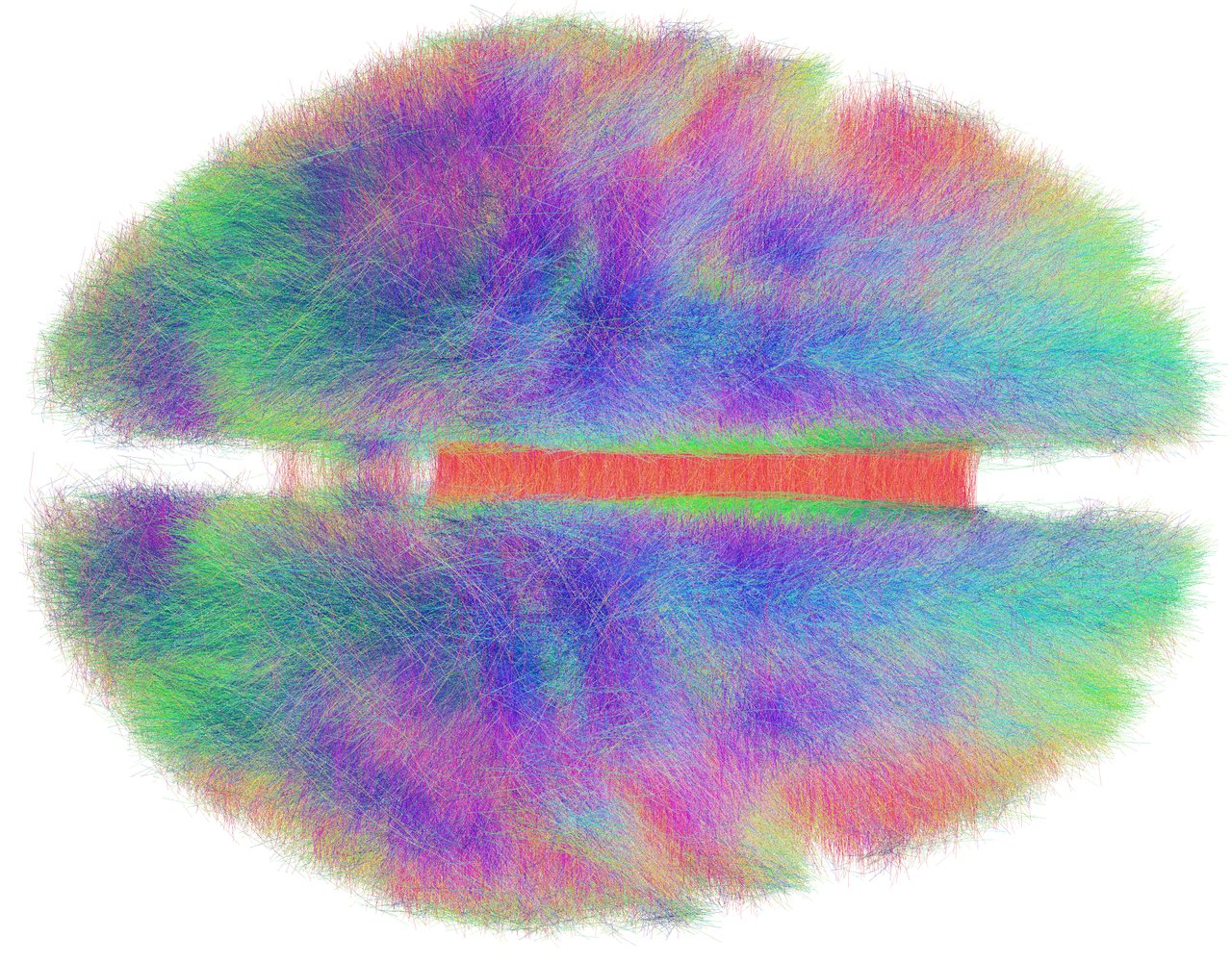
Flash a word on a screen and hide it behind a mask, and the brain registers it in early visual areas and goes quiet. Show the same word unmasked, and roughly 270 milliseconds later the activity spreads across prefrontal, parietal and anterior cingulate cortex. Global Workspace Theory says that second event, one representation suddenly made available to the whole brain, is what conscious access is. This is the file on the framework that has driven more experiments than almost any other in consciousness science, opened claim by claim, each one wearing its evidence. It ends on a careful line: this is a theory of access, of what makes information reportable and usable. Whether that is the same thing as what makes it felt is a different question, and this file does not close it.
Two words appear on a screen for the same handful of milliseconds. The first is followed immediately by a mask, a jumble of shapes that overwrites it; the second is left alone. Afterwards the subject reports seeing the second word and denies seeing the first, and inside the skull the difference is stark. The masked word activates fusiform and early visual areas and stops there. The unmasked word does the same and then keeps going, setting off a spreading blaze of activity across prefrontal, parietal and anterior cingulate cortex. Same eyes, same photons, two different fates. Global Workspace Theory is built on that fork in the road, and it has turned that one contrast into one of the most productive experimental programs consciousness science has. Let's open the file.
01The Bright Spot on the Stage
The theory begins not in a scanner but in cognitive psychology, with a question about traffic. Your brain is doing an enormous number of things at once, almost none of which you are aware of. The question is what the small, slow, serial thing we call consciousness is actually for, given all that parallel machinery underneath it.
Global Workspace Theory, set out by Bernard Baars in 1988, proposes that consciousness serves one specific function: making information globally available to a wide variety of cognitive processes. Beneath awareness, unconscious specialist processors for language, vision, motor control and emotion run in parallel, each expert at its own narrow job. They compete for access to a limited-capacity global workspace. The winning representation is then broadcast to all the processors simultaneously, and on this account that broadcasting is conscious experience. Consciousness, in the theory, is not a place or a substance. It is a distribution event.
Baars made the architecture memorable with a theater metaphor: consciousness is the bright spot on the stage. The workspace is the stage itself, with limited capacity, holding only one coherent representation at a time. Attention is the spotlight that selects what occupies it. The unconscious processors sit in the audience, and behind the scenes stand the director and the stagehands, the executive, contextual and motivational processes that shape what gets lit without ever appearing in the light. The metaphor carries one detail worth keeping hold of: not all stage activity is broadcast. Subliminal priming activates the stage briefly without broadcasting at all.
| In the Metaphor | In the Theory |
|---|---|
| The bright spot | Consciousness itself: whatever is currently being broadcast |
| The stage | The global workspace, limited in capacity to one coherent representation at a time |
| The spotlight | Attention, selecting what occupies the stage |
| The audience | The unconscious specialist processors receiving the broadcast |
| Director and stagehands | Executive, contextual and motivational processes working behind the scenes |
The theory earns its keep by naming what broadcasting is good for. GWT lists six functions served by it: flexible and novel problem-solving, since unconscious processors are rigid and specialized and only a shared workspace can recruit them to an unfamiliar task; verbal reportability; working memory, understood as sustained broadcasting; voluntary control of action; learning and memory encoding; and the integration of information across sensory modalities and across time points. Everything routine, automatic and well-practiced is handled unconsciously instead. Note the second item on that list, because it will come back to complicate the evidence later.
02From Metaphor to Mechanism
A metaphor is not a mechanism, and a metaphor cannot be falsified. The step that turned Baars's architecture into an experimental program was taken a decade later by a different team, and the two contributions are worth keeping apart, because they usually get blurred into one name.
Stanislas Dehaene, Changeux and colleagues formalized the idea neurally, in work running from 1998 through 2011, as the Global Neuronal Workspace. Here the workspace is not a metaphorical stage but a physical network: long-range cortical workspace neurons, with axons spanning prefrontal, parietal, anterior cingulate and temporal cortex, forming a distributed system rather than sitting in one region. When a sensory stimulus is strong enough, it triggers ignition, a sudden nonlinear amplification driven by recurrent processing and positive feedback loops that transforms a local sensory representation into a global, sustained, widespread cortical activation pattern. Baars proposed the function and the architecture in the language of cognitive psychology. Dehaene and Changeux gave it a neural implementation with a signature you could go looking for.
That signature is a threshold, not a dimmer switch. Consciousness, on this claim, is not graded: stimuli presented right at the perceptual threshold produce a bimodal distribution of cortical responses, either full ignition or no response, rather than a continuous increase as the stimulus strengthens. Dehaene and colleagues demonstrated this in 2003 using masked words. Subliminal stimuli activate early visual cortex only. Supraliminal stimuli show a sudden explosion of activity into prefrontal and parietal regions after approximately 270 to 300 milliseconds. This is the theory at its most testable, and, as section 05 shows, at its most exposed.
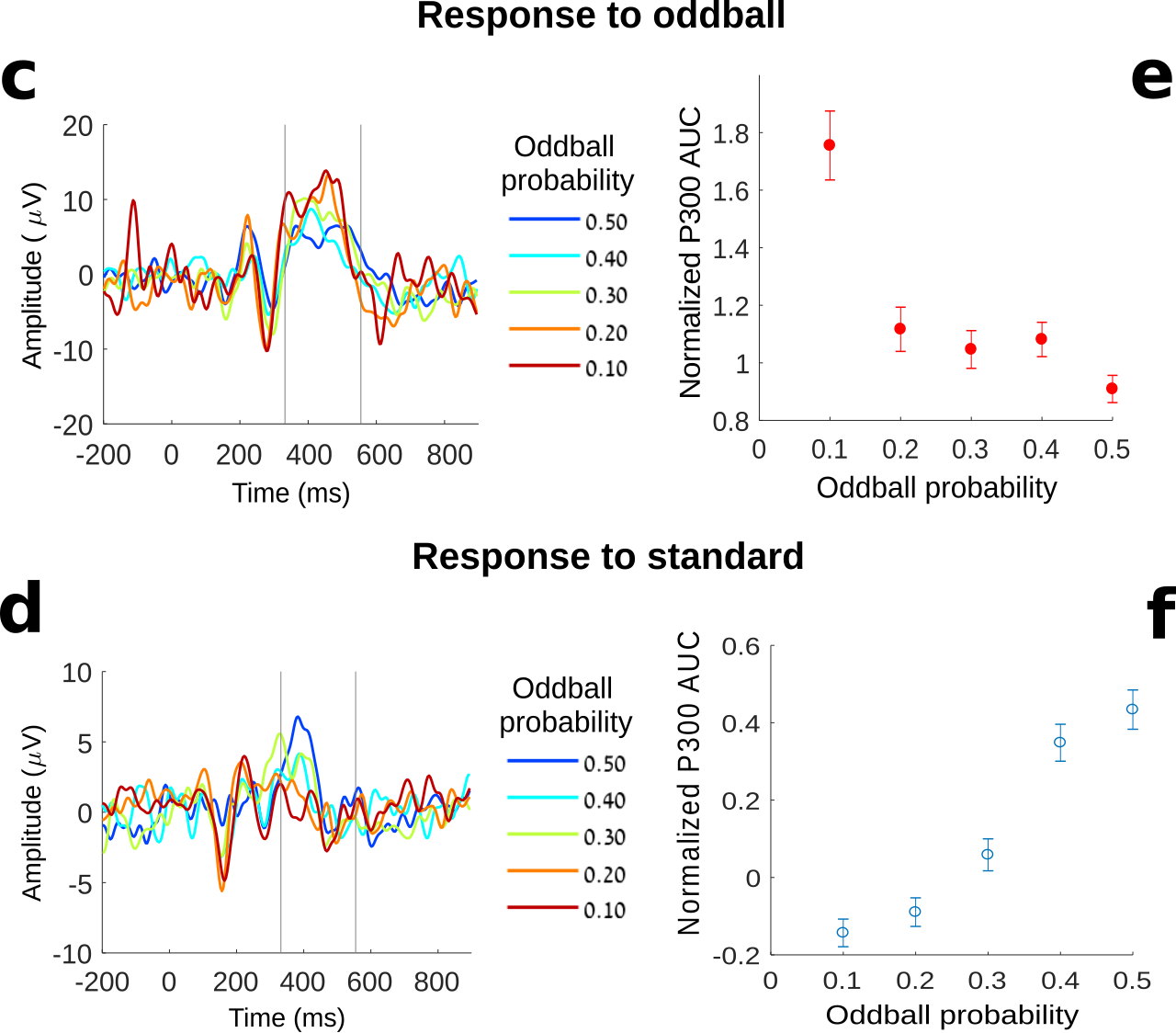
If ignition is real, it should leave marks that instruments can pick up, and four have been proposed as neural signatures of conscious access. The first is the P3b, a late positive event-related potential over parietal cortex at approximately 300 to 500 milliseconds, present for consciously perceived stimuli and absent for subliminal ones. The second is late sustained activity, seen as fMRI activation in prefrontal and parietal cortex for conscious percepts. The third is long-range synchronization: increased phase synchrony between frontal and posterior regions in the beta band, approximately 13 to 30 Hz, and the gamma band, approximately 30 to 100 Hz. The fourth is increased information complexity, indexed by the perturbational complexity index.
| Signature | What Is Measured | What Marks Conscious Access |
|---|---|---|
| The P3b | A late positive ERP over parietal cortex, approximately 300 to 500 milliseconds after the stimulus | Present for consciously perceived stimuli, absent for subliminal ones |
| Late sustained activity | fMRI activation in prefrontal and parietal cortex | Sustained widespread response for conscious percepts |
| Long-range synchronization | Phase synchrony between frontal and posterior regions, beta approximately 13 to 30 Hz, gamma approximately 30 to 100 Hz | Increased synchrony during conscious processing |
| Information complexity | The perturbational complexity index (PCI) | Increased complexity of the cortical response |
03The Experimental Record
None of this would matter if the fork could not be produced on demand in a laboratory. The core trick of the field is to hold the physical stimulus constant and let the experience vary, so that whatever changes in the brain is a change in awareness rather than a change in the input.
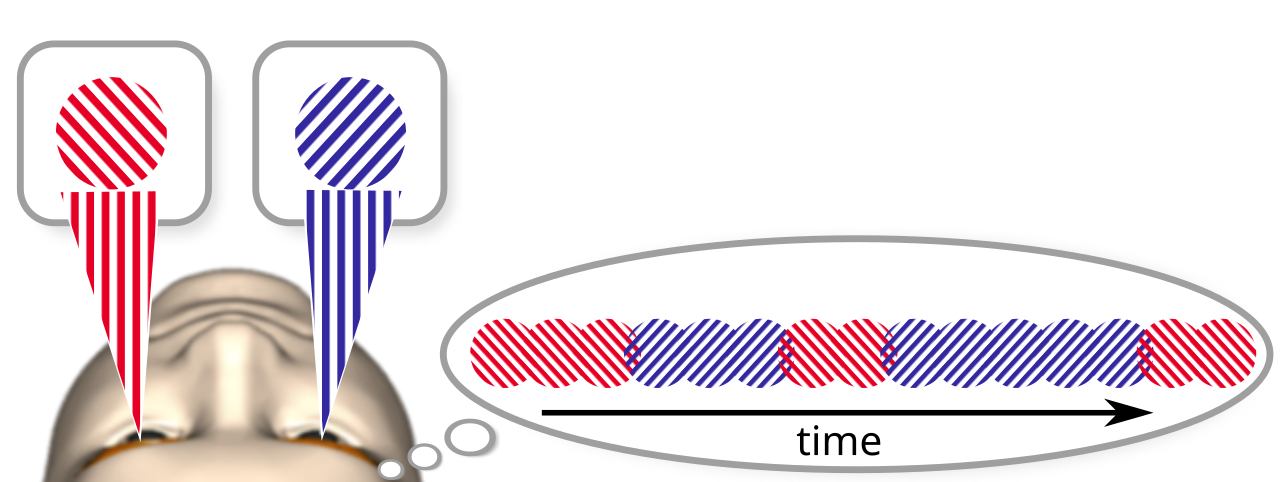
Two paradigms do most of that work. In binocular rivalry, a different image is presented to each eye and perception alternates every few seconds between them instead of blending them, while the input never changes at all. In masking and threshold-stimulus paradigms, the stimulus is pitched right at the edge of visibility. Masking in particular is what determines the ignition threshold: stimuli just above it activate widespread cortical networks including prefrontal and parietal cortex, while stimuli just below it activate only early sensory cortex.
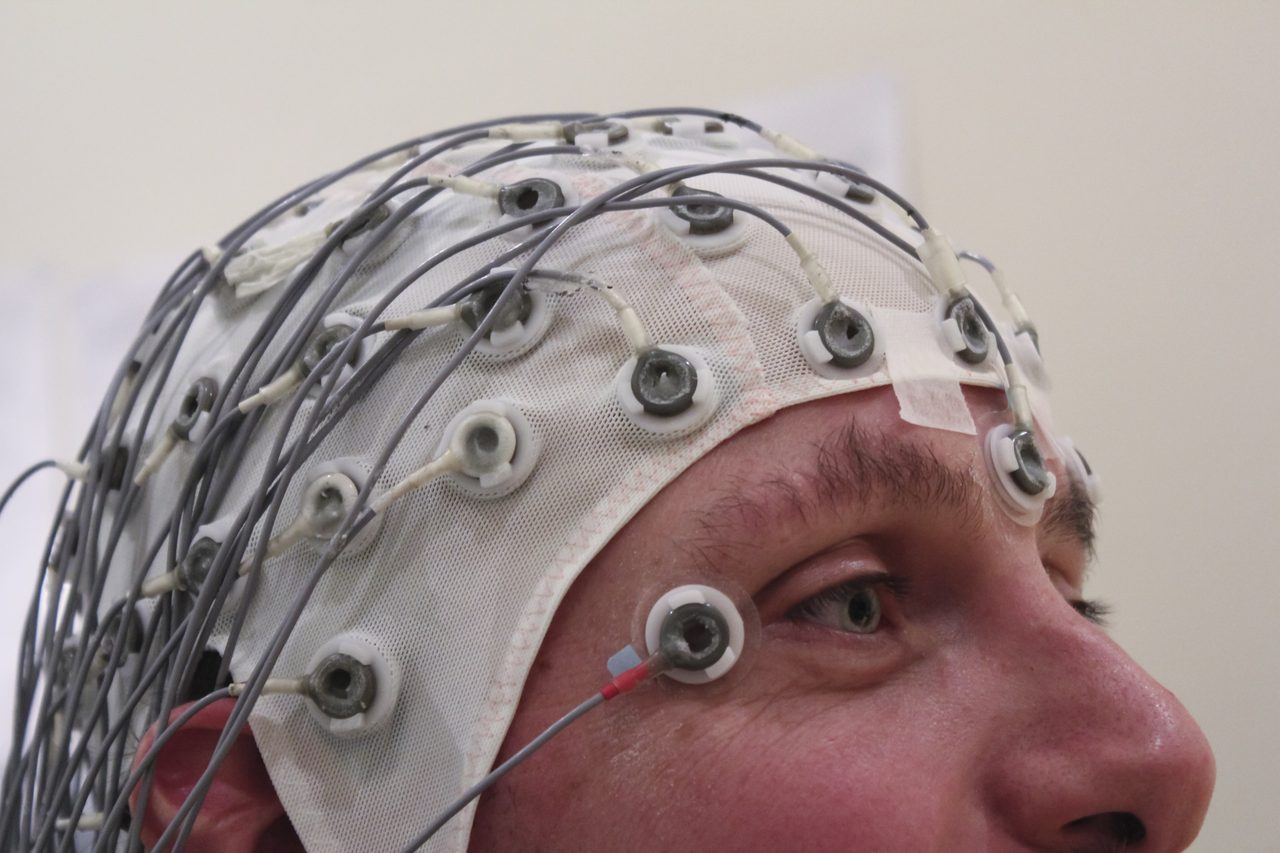
The masking result is the theory's flagship. In work published in 2001, Dehaene and colleagues used backward masking to render words invisible. Masked words activated fusiform and early visual areas and did not ignite the frontoparietal workspace. Unmasked, consciously seen words produced widespread prefrontal, parietal and anterior cingulate activation after approximately 270 milliseconds. The transition between the two was sharp rather than gradual, which is exactly what all-or-none ignition predicts.
The attentional blink sharpens the same point from a different angle. When a second target is presented rapidly after a first, it is sometimes consciously perceived and sometimes missed, and the early brain response does not care which: the second target activates sensory cortex equivalently either way. The difference between seen and unseen is the presence or absence of late frontoparietal ignition, which Sergent and colleagues reported in 2005. Ignition, on this evidence, requires attention as a gating mechanism. Something has to open the door of the workspace, and attention is what does it.
The clinical evidence comes at the question from the other end, from patients who cannot report anything at all. The perturbational complexity index is a measure of cortical information integration taken after a TMS perturbation of the brain, and it tracks consciousness where behavior cannot. Vegetative-state patients show absent or reduced PCI compared with conscious individuals; minimally conscious patients fall in between. Casali and colleagues found in 2013 that PCI accurately distinguishes levels of consciousness in brain-injured patients, which is read as support for the role of widespread cortical integration in consciousness.
04Access, Not Experience
Here is where a great deal of writing about this theory takes a step it has not earned, and the step is worth marking precisely. Everything above is evidence about what makes information available: reportable, holdable in memory, usable for control. That is a real and important thing to explain, and the evidence that the theory explains it is strong. It is not obviously the same thing as explaining why any of it is felt.
Critics note that GWT explains the functions of consciousness, reportability, flexible behavior, integration, but does not explain why there is subjective experience at all. Baars and Dehaene both acknowledge this limitation. In the standard vocabulary, GWT is a theory of access consciousness, meaning what information is available for processing, rather than a theory of phenomenal consciousness, meaning what it is like to have an experience. Whether a complete scientific theory of consciousness must address that second question is itself debated, and the debate is unresolved.
That is not a caveat to tuck in at the end. It is the shape of what the theory claims. Global Workspace Theory could be entirely correct about which information gets broadcast, and how, and when, and the question of why the broadcast is accompanied by an inner life would still be standing exactly where it was. Whether that remaining question is a deep feature of reality or a confusion in our own concepts is the hard problem, and this wing has a full file on it. What matters here is only this: nothing in the evidence above settles it, and the theory's own founders do not claim otherwise.
One family of responses inside the GWT camp tries to close part of that distance by adding a level. On these versions, consciousness requires not only that content be broadcast but that the system also hold a meta-representation of the first-order content, a representation of its own state. Lau and Rosenthal proposed in 2011 that prefrontal metacognitive monitoring is part of the workspace mechanism, folding a higher-order theory into the workspace picture. This hybrid of GWT and higher-order theories is not universally accepted within the GWT camp, and it remains a proposal rather than a result.
05Where the Ignition Claim Is Contested
The theory's great strength is that it made a specific, locatable, falsifiable prediction. That is also where the pressure has landed. Three lines of criticism press on the same joint: whether ignition is really all-or-none, whether the front of the brain is really where it matters, and whether the experiments can tell awareness apart from the act of reporting it.
Take the all-or-none framing first. Windey and Cleeremans, in a conceptual analysis published in Consciousness and Cognition in 2015, argued that the transition from unaware to aware is not one uniform thing. Their reconciling proposal, the levels-of-processing hypothesis, is that the transition is graded for low-level stimulus properties, raw stimulus energy or basic features, but dichotomous, genuinely all-or-none, for high-level content such as recognizing a letter, a word or a meaning. This does not simply contradict Dehaene's ignition data. It reframes when all-or-none applies, which leaves open the awkward question of which regime any given experiment was probing.
Then there is the location. GNW predicts that prefrontal cortex is essential for conscious perception, and there is real support for that: prefrontal cortex deactivates under anesthesia, prefrontal activity is reduced in vegetative state, and dorsolateral prefrontal cortex is involved in reportability. Against it stand two awkward facts. Patients who have undergone prefrontal lobectomy retain consciousness. And no-report paradigms suggest that frontal activity may correlate with report rather than with consciousness itself, which would mean the theory's best evidence is measuring the wrong thing.
The sharpest version of that objection comes from a rival camp. Koch, Massimini, Boly and Tononi reviewed the evidence in 2016 for what they called the posterior hot zone, a temporo-parietal-occipital region more closely associated with conscious content than prefrontal cortex is. The lesion pattern is their strongest card: damage there causes specific content losses, prosopagnosia, color agnosia, spatial neglect, but not global unconsciousness, while prefrontal lesions cause cognitive deficits but rarely abolish consciousness entirely. Keep the claim precise, because a different posterior claim arrives in section 07: this one places the correlates of conscious content in posterior cortex, which is not the same thing as the sustained posterior synchronization that the adversarial test went looking for and did not find. That territory belongs to Integrated Information Theory, which has its own file in this wing. It matters here for one reason only. It turns GNW's prefrontal prediction into a genuine contest with a genuine competitor, rather than an unopposed description of the data.
06The Report Problem
Underneath all of it sits a methodological difficulty the field states openly. Traditional studies of the neural correlates of consciousness conflate consciousness with the requirement to report. The no-report paradigm, set out by Tsuchiya and colleagues in 2015, was developed in response: instead of asking the subject, it uses objective physiological measures, eye tracking, pupil dilation, optokinetic nystagmus, to establish what is being experienced. The findings suggest that frontal activity may reflect report rather than consciousness itself, which strengthens the case for posterior cortical correlates over frontal ones.
The circularity is worth stating plainly, because it is not a technicality. Verbal reportability is one of the six functions Baars named for the global workspace. A theory whose evidence comes overwhelmingly from subjects reporting what they saw is therefore leaning on exactly the capacity it exists to explain. That does not make the evidence worthless, and no-report methods are a serious attempt to get underneath it. It does mean that a large part of the record cannot yet cleanly separate being aware of something from being able to say so.
07The Adversarial Test
In the most unusual episode in the theory's history, GNW and Integrated Information Theory agreed to be tested against each other, with both camps committing in writing to what their theory predicted before any data existed. It is worth being careful about what was published when, because the two halves of that project are routinely confused.
The pre-registration came first. In 2023, Melloni and colleagues published the adversarial collaboration's protocol in PLOS ONE, describing the planned methodology across six theory-impartial laboratories using fMRI, M-EEG and intracranial recordings. That paper reports no results at all, which is the entire point of a pre-registration, and it is frequently cited as though it did. The results came two years later and in a different journal: the Cogitate Consortium's report in Nature in 2025.
What those results did was refuse both theories a clean win, in different ways. The challenge to Integrated Information Theory was that no sustained synchronization was found between early and mid-level visual areas in posterior cortex, directly contradicting its prediction of sustained posterior integration. The challenge to GNW came in two parts. Stimulus category was represented in prefrontal activity, as the theory expects, but critical aspects of experience, such as a stimulus's orientation or its identity, were largely absent from prefrontal representation despite being consciously perceived. And the predicted ignition burst at stimulus offset never materialized: prefrontal cortex produced a strong onset burst and no offset ignition at all. Neither theory's core empirical predictions survived fully intact.
| Theory | Prediction Tested | Outcome |
|---|---|---|
| Integrated Information Theory | Sustained synchronization within posterior cortex | Not found between early and mid-level visual areas, contradicting the prediction |
| Global Neuronal Workspace | Stimulus category represented in prefrontal cortex | Held: category information was present in prefrontal activity |
| Global Neuronal Workspace | Critical experiential content represented in prefrontal cortex | Orientation and identity largely absent, despite being consciously perceived |
| Global Neuronal Workspace | An ignition burst at stimulus offset | Never materialized: a strong onset burst, no offset ignition |
Our own research file carries a simpler summary of this episode, in three parts: sustained posterior activity favoring IIT, inconsistent prefrontal ignition patterns, and a collaboration that sharpened both theories rather than eliminating either. The first part is not a coarser version of what the 2025 results found. It is the reverse of it. As the table above records, no sustained posterior synchronization was found, so the very item that reads in that summary as IIT's win is the prediction the results contradicted. The second part broadly held, since the prefrontal picture did come out mixed rather than clean. The third part is the one that survived. That same file records the GNW camp's answer beside its own account of the episode, an account built on the 2023 protocol paper rather than on the Nature results: the paradigm was not optimal for testing ignition, and the argument has continued rather than closed. Adversarial collaboration turned out to be very good at showing where two theories are wrong, and not good at crowning a winner.
08What Grew Out of It
The workspace has been built in simulation. Dehaene, Sergent and Changeux implemented GNW as a spiking neural network in 2003, with bottom-up sensory modules and top-down workspace modules joined by strong recurrent connections. The model shows spontaneous ignition, bistability, hysteresis and the all-or-none signature, and it reproduces masking effects, the psychological refractory period and attentional-blink dynamics. A model that generates the phenomena it was built to explain does not prove the brain works that way. It does show that the architecture is sufficient to produce them, which is more than most theories of consciousness can demonstrate.
The architecture has also travelled outside neuroscience. Cognitive architectures such as LIDA and COGENT use a global workspace module that broadcasts information to specialized subsystems, and researchers have drawn parallels to the attention mechanism in transformers, though that analogy is debated. GWT does not necessarily predict that AI systems with workspace architectures are conscious, and the question of whether any machine could be belongs to this wing's own file on machine consciousness, not to this one.
09The Thing It Is Not
It is a mistake to say that Global Workspace Theory has been disproven. The adversarial collaboration found some GNW predictions unsupported; it did not disprove the theory. The core insight, global broadcasting as the mechanism for conscious access, remains well supported by the masking, attentional-blink and clinical evidence, and it is the specific predictions about prefrontal ignition and its timing that may need revision. There is a real difference between a theory that has been partly disconfirmed and one that has been refuted, and GWT continues to be one of the most empirically productive frameworks in consciousness science, alongside Integrated Information Theory and higher-order theories. A framework that keeps generating experiments capable of going against it is doing exactly what a scientific theory is supposed to do.
Fast Facts
- The Theory
- Consciousness as a global broadcast: one representation wins the competition and goes out to every processor at once
- Proposed By
- Bernard Baars, 1988, in cognitive-psychology terms
- Made Neural By
- Dehaene, Changeux and colleagues, 1998 through 2011, as the Global Neuronal Workspace
- The Signature
- Ignition: a sudden nonlinear amplification spreading a local sensory representation across the cortex
- The Timing
- Widespread frontoparietal activation at approximately 270 to 300 milliseconds; the P3b at approximately 300 to 500 milliseconds
- Best Evidence
- Masked versus unmasked words, the attentional blink, and PCI in brain-injured patients
- What It Explains
- Access consciousness: what information is available for report, memory and control
- What It Does Not
- Phenomenal consciousness: why any of that processing is felt. Baars and Dehaene both acknowledge the limit
- Chief Rival
- Integrated Information Theory, which places the correlates of conscious content in a posterior hot zone
- The Adversarial Test
- Nature, 2025: neither theory's core predictions survived fully intact
What We Can Actually Stand Behind
The core phenomenon is real and measurable. A stimulus that reaches awareness produces a late, widespread frontoparietal activation that a physically comparable unaware stimulus does not, and the transition looks sharp rather than smooth. Masking and the attentional blink converge on the same picture: conscious access goes with widespread cortical broadcasting, not with local sensory activity alone. The perturbational complexity index sits on a different axis, distinguishing levels of consciousness in brain-injured patients rather than access to a particular content, and it is read as support for the same emphasis on widespread cortical integration. As an account of what makes information available for report, memory and control, GWT is one of the most empirically productive frameworks in consciousness science.
Where ignition happens, and whether it is truly all-or-none, are open. GNW's claim that prefrontal cortex is essential has real support and real counter-evidence: prefrontal-lobectomy patients remain conscious, and no-report paradigms suggest frontal activity may track reporting rather than awareness. Windey and Cleeremans argue the all-or-none transition holds for high-level content but not for low-level stimulus properties. The adversarial test found the predicted offset ignition absent and critical experiential content missing from prefrontal representation, while also failing to confirm the rival theory's own posterior-synchronization prediction. The spiking-network model shows the architecture is sufficient to generate these effects in simulation, which is not the same as showing the brain uses it. Both theories took damage. Neither was crowned.
The theory's own limits and its proposed extensions are unsettled. That GWT explains access rather than phenomenal consciousness is pressed by critics and acknowledged by Baars and Dehaene, but what that concession costs the theory, and whether a complete scientific account of consciousness must answer the phenomenal question at all, is itself debated. Hybrid versions that add a higher-order meta-representation to the broadcast, following Lau and Rosenthal, are one attempt to close some of that distance, and they are not universally accepted even inside the GWT camp.
No, Global Workspace Theory has not been disproven. Some specific GNW predictions were unsupported by the adversarial collaboration, and a partial disconfirmation of predictions about prefrontal ignition is not a refutation of global broadcasting. And no, the theory does not explain why experience feels like anything, because it is not a theory of that. Treating an account of access as an answer to the question of felt experience is the most common overreach in the popular telling of this theory, and its own founders do not make it.
So the file stays open, and it is open in an unusually well-defined way. We have a mechanism that can be measured, a signature that can be looked for, and a run of results that keeps saying the mechanism is roughly right and the details are wrong. That is what a healthy scientific theory looks like from the inside, and it is the reason this framework has outlasted its obituaries. What it does not give us is the thing people most want from a theory of consciousness. Global Workspace Theory tells you what gets into the room, and how fast the news travels once it is there. It does not tell you why there is anyone in the room to hear it. If ignition is what makes a thought available, what makes an available thought feel like something?
Sources & further reading
Everything above is drawn from our research library on Theories of Anything. Open the full file to check the sourcing and go deeper. One exception is worth naming: the 2003 work by Dehaene and colleagues, cited twice in the text above, for the masked-word threshold result and for the spiking-network model, is carried by our research file as a name and a year without a full citation, so there is no link for it in the list below.
Image credits
- White-matter tractography, group reconstruction Andreashorn, via Wikimedia Commons. CC BY-SA 4.0 Source.
- Binocular rivalry diagram Head image is from Anatomography by DBCLS, via Wikimedia Commons. CC BY-SA 2.1 jp Source.
- EEG recording cap Chris Hope, via Wikimedia Commons. CC BY 2.0 Source.
- P300 response against oddball probability Hadarl, via Wikimedia Commons. CC BY-SA 4.0 Source.
- Card crop of White-matter tractography, group reconstruction Andreashorn, via Wikimedia Commons. CC BY-SA 4.0 Source.


