
Chicxulub: The Asteroid That Ended the Dinosaurs
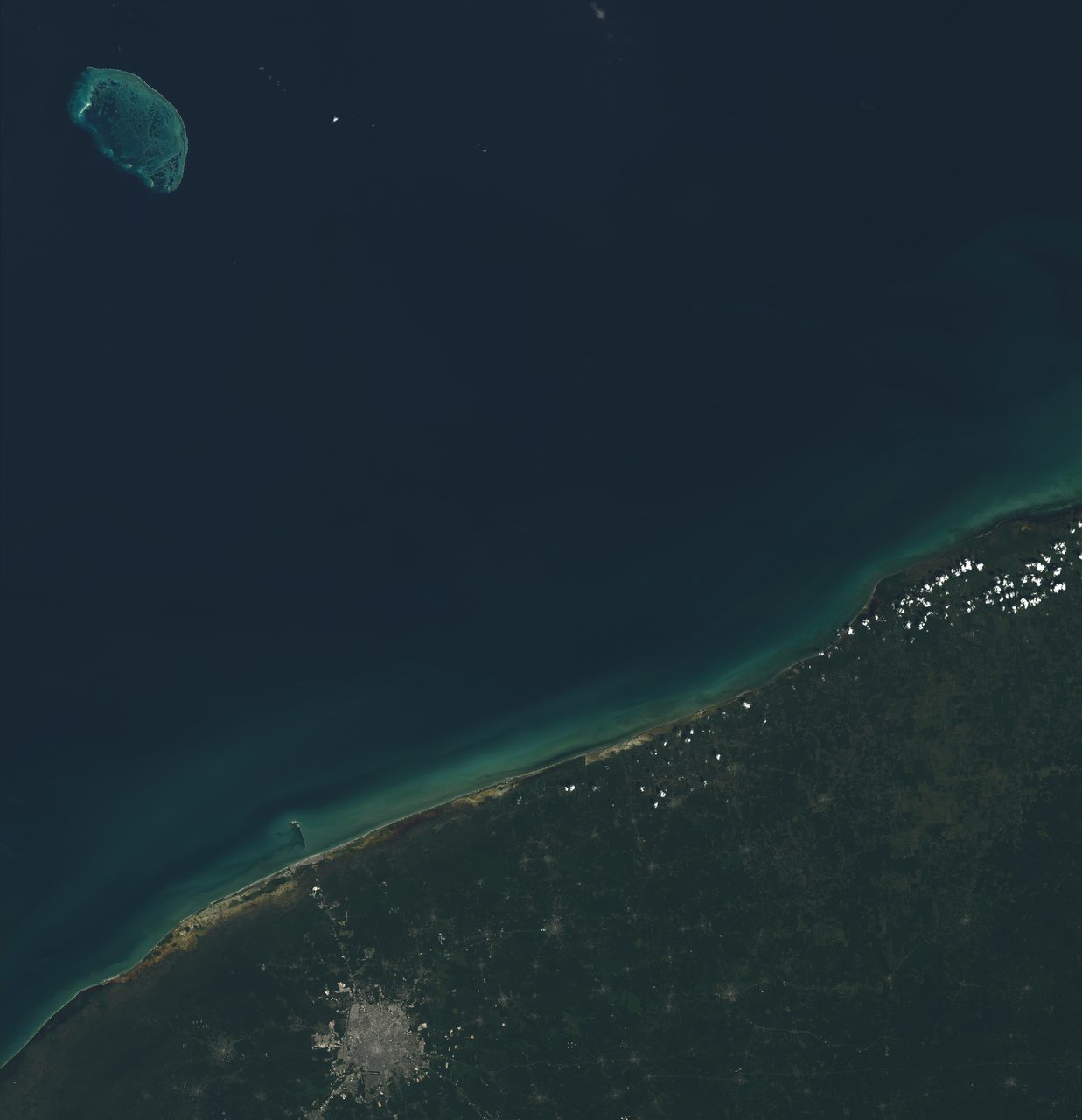
Sixty-six million years ago a mountain of rock roughly ten kilometers across struck the shallow sea off what is now the Yucatan Peninsula, and the world it hit did not survive. Within a single day the sky was on fire and the ocean was a wall of water. Within a few years, roughly three-quarters of all species on Earth were gone, every last non-avian dinosaur among them. This is the best-understood catastrophe in the planet's history. Here is the file, opened claim by claim, each one wearing its evidence.
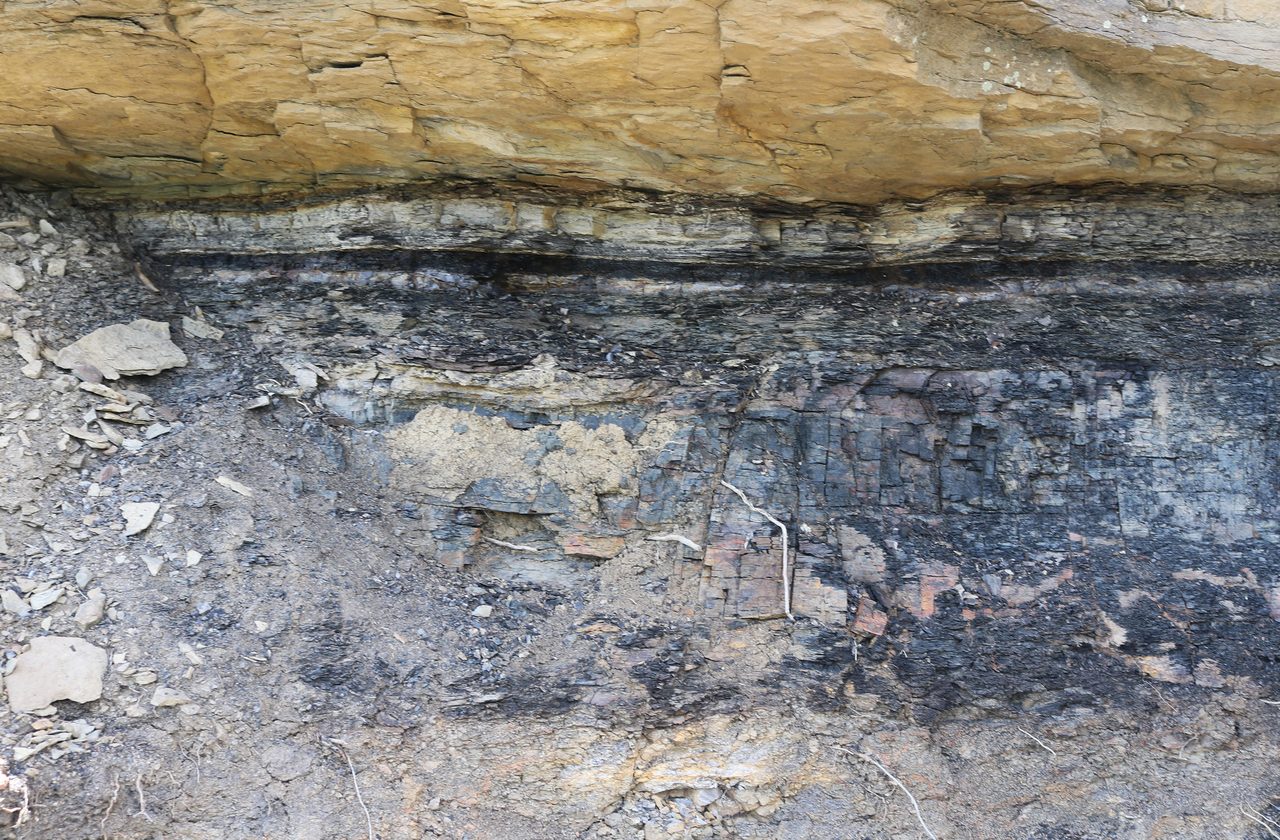
Start with the fact that anchors everything else, because the rest of the story hangs from it. A layer of clay, no thicker than your hand in most places, runs through rock all over the world. Above it, no dinosaurs. Below it, the richest reptile-dominated ecosystems the planet has ever known. That layer was laid down in a geological instant about sixty-six million years ago, and for more than a century nobody knew what it was. We know now. It is the ash and dust and vaporized rock of the single worst day in the history of complex life. Let's open the file.
01The Day the Mesozoic Ended
The impact has a date and an address. Argon-argon (40Ar/39Ar) dating puts it at 66.043 million years ago, give or take about eleven thousand years, one of the most precisely fixed events in all of deep time. The impactor struck the Yucatan Peninsula of Mexico, near the modern town of Chicxulub Puerto, at about 21.4 degrees north and 89.5 degrees west. Chromium isotopes in the boundary layer identify it as a carbonaceous chondrite asteroid, roughly ten to fifteen kilometers across.
The crater it left is about 180 kilometers wide, a buried multi-ring structure, with a transient bowl around 100 kilometers across at the moment of impact. The energy released was on the order of 4.2 x 10^23 joules, roughly 72 to 100 teratonnes of TNT, beyond any natural event in recorded human experience.
When the dust settled, roughly three-quarters of all species on Earth were extinct. The primary figure in our records is about 76 percent, though one of our own catalogs gives 75; either way it was a near-total culling of the tree of life. All non-avian dinosaurs died, a clean 100 percent, and they are only the most famous of the dead. What makes the K-Pg extinction unique among the great dyings is that it has a single, clear primary trigger, which sets it apart from murkier catastrophes like the Permian-Triassic Great Dying.
| Measure | What the Evidence Gives |
|---|---|
| When | 66.043 million years ago, give or take about 11,000 years (40Ar/39Ar dating) |
| Where | The Yucatan Peninsula, Mexico, near Chicxulub Puerto (21.4 N, 89.5 W) |
| The impactor | A carbonaceous chondrite asteroid, roughly 10 to 15 km across |
| The crater | About 180 km wide, a buried multi-ring structure |
| The energy | About 4.2 x 10^23 joules, on the order of 72 to 100 teratonnes of TNT |
| Species lost | Roughly three-quarters of all species (about 76 percent, cited as 75 in one catalog) |
| Non-avian dinosaurs lost | All of them |
02How We Found the Killer
For most of the twentieth century the reigning idea was that the dinosaurs faded out slowly, over millions of years, done in by gradual climate change or their own evolutionary exhaustion. The evidence that overturned that view came not from a fossil bed but from a thin band of clay in a gorge in Italy.
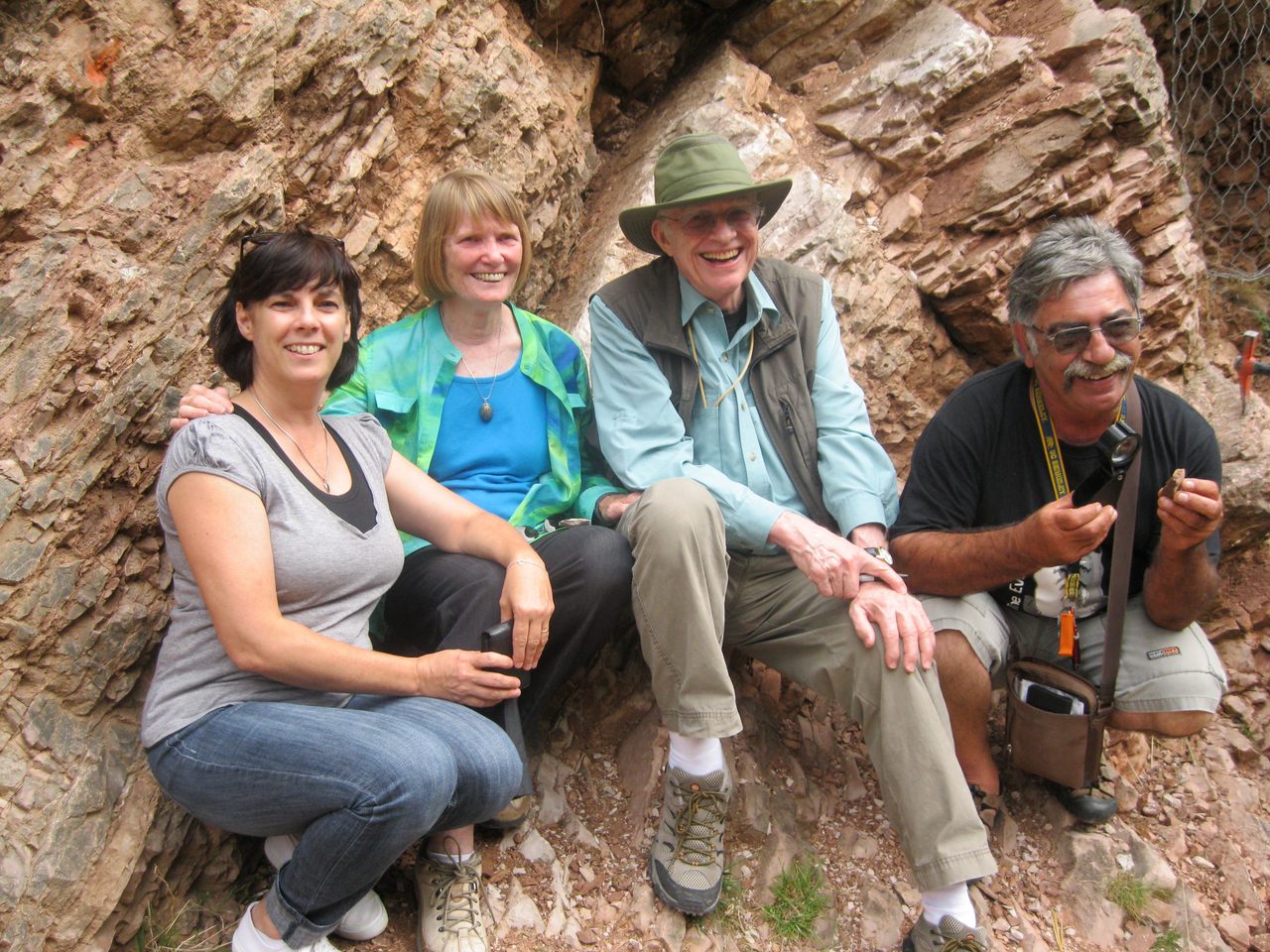
In 1980 a team at the University of California, Berkeley, the physicist and Nobel laureate Luis Alvarez, his son the geologist Walter Alvarez, and the chemists Frank Asaro and Helen Michel, reported something strange in the boundary clay at Gubbio, Italy. It was loaded with iridium, an element that is vanishingly rare in Earth's crust but common in asteroids and meteorites. The enrichment ran from thirty to a hundred and sixty times the normal background level.
That was not a local fluke. The same iridium spike was soon found at more than a hundred K-Pg boundary sites, on every continent and in deep-sea cores, a single global signature laid down at the same instant everywhere. It is now the anchor of the most complete set of impact markers in the entire geological record: the iridium, worldwide shocked quartz, altered glass microspherules, nickel-rich spinels, wildfire soot, and an osmium-isotope shift to extraterrestrial values, all in one clay layer.
The reception was frosty. Many paleontologists had built careers on gradual-extinction models and did not welcome a couple of physicists telling them a rock from space had done it in an afternoon. The argument ran for a decade. It ended not with a debate won on rhetoric but with the discovery of the murder weapon itself: the crater.
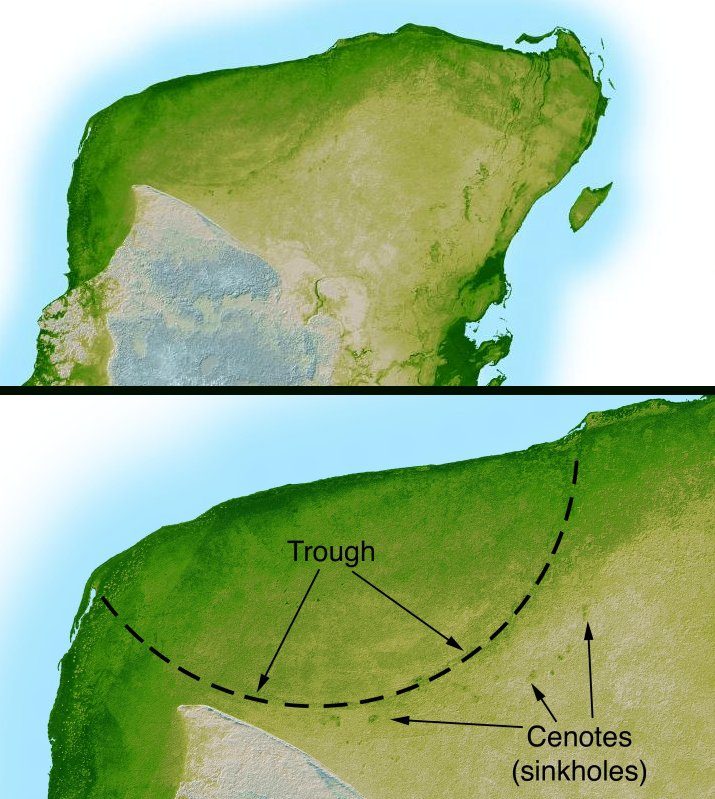
The crater had, in a sense, already been found. In 1978 the geophysicists Antonio Camargo and Glen Penfield, surveying for the Mexican oil company Pemex, spotted a vast buried circular anomaly in the gravity and magnetic data beneath the Yucatan. He suspected it was an impact structure but could not publish, because the data were proprietary. It was only in 1991 that Alan Hildebrand, at the University of Calgary, independently pieced the structure together and, publishing in the journal Geology with Penfield, tied it to the K-Pg boundary. The buried crater even has a surface trace: a ring of water-filled sinkholes, the cenotes, arcs across the Yucatan along its rim, visible from orbit.
03Drilling Into the Wound
Knowing a crater is there is not the same as understanding it. Chicxulub is buried under six hundred to eleven hundred meters of younger limestone, and its original depth, before it filled back in, is put at somewhere between twenty and thirty kilometers, depending on which reconstruction you read. To see the structure directly, someone had to drill into it.
In 2016, IODP-ICDP Expedition 364, co-led by Joanna Morgan of Imperial College London and Sean Gulick of the University of Texas, drilled 835 meters of continuous core out of the crater's peak ring, the inner ring of hills that only the largest impacts raise. The core was unambiguous: shocked minerals, melt rock, and suevite, the shattered breccia of a hypervelocity impact.
The peak ring told a stranger story still. Its rocks are granite, hauled up from deep in the crust, and the core showed they had risen through a process called acoustic fluidization. For a few minutes after impact the solid crust behaved like a fluid, rebounded upward by roughly ten kilometers, overshot the center, collapsed outward, and froze in place, exactly as Jay Melosh of Purdue University had predicted from computer models years earlier. This is what a complex crater is: not a simple bowl but a structure with a central peak or peak ring thrown up by the ground rebounding, the same class of feature seen at Manicouagan in Quebec, only far larger.
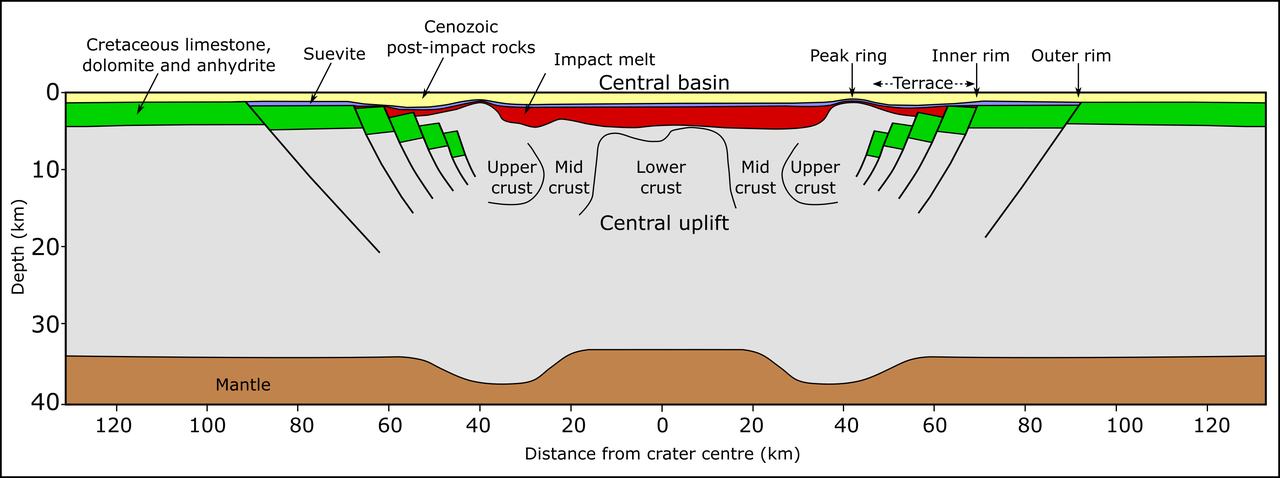
Then the core delivered the detail that ties the crater to the killing. The Yucatan bedrock is rich in gypsum and other sulfate minerals. The peak-ring core had almost none. All that sulfur had not stayed in the ground; it had been vaporized and blown into the sky, which is precisely what the impact-winter model needs in order to shut down the Sun.
Later modeling sharpened the picture of the strike itself. From the crater's asymmetric shape, Collins and colleagues concluded in 2020 that the asteroid came in at a steep angle, roughly forty-five to sixty degrees from horizontal, traveling from the northeast, close to the worst-case geometry for lofting climate-altering gas high into the atmosphere. It is a model result rather than a direct measurement, but a well-constrained one.
For scale: only a couple of hundred impact structures are confirmed on the whole planet, most long since erased by erosion and plate tectonics. Chicxulub, at 180 kilometers, is among the largest and best preserved. Only two confirmed craters clearly outrank it in size, both far older and deeply eroded: Vredefort in South Africa, about 300 kilometers across and two billion years old, and Sudbury in Ontario, originally around 250 kilometers, whose ancient wound still hosts one of the richest nickel deposits on Earth.
04The Fingerprints Left Everywhere
The iridium was only the first fingerprint. The impact left a whole suite of physical traces, and finding the same markers in the same layer around the globe is what turned a bold hypothesis into settled fact.
| Marker | What It Records |
|---|---|
| Iridium anomaly | Asteroid material spread worldwide, 30 to 160x background at 100+ sites |
| Shocked quartz | Grains deformed by pressures above 5 to 10 GPa, unique to impacts or nuclear blasts |
| Spherules and tektites | Droplets of rock vaporized and flung out, then condensed and rained back down |
| Tsunami deposits | Waves of 100 to 300+ meters recorded around the Gulf and Caribbean |
| Soot and charcoal | A global ash layer from continent-scale wildfires |
| The fern spike | A burst of fern pollen, the first green things to return |
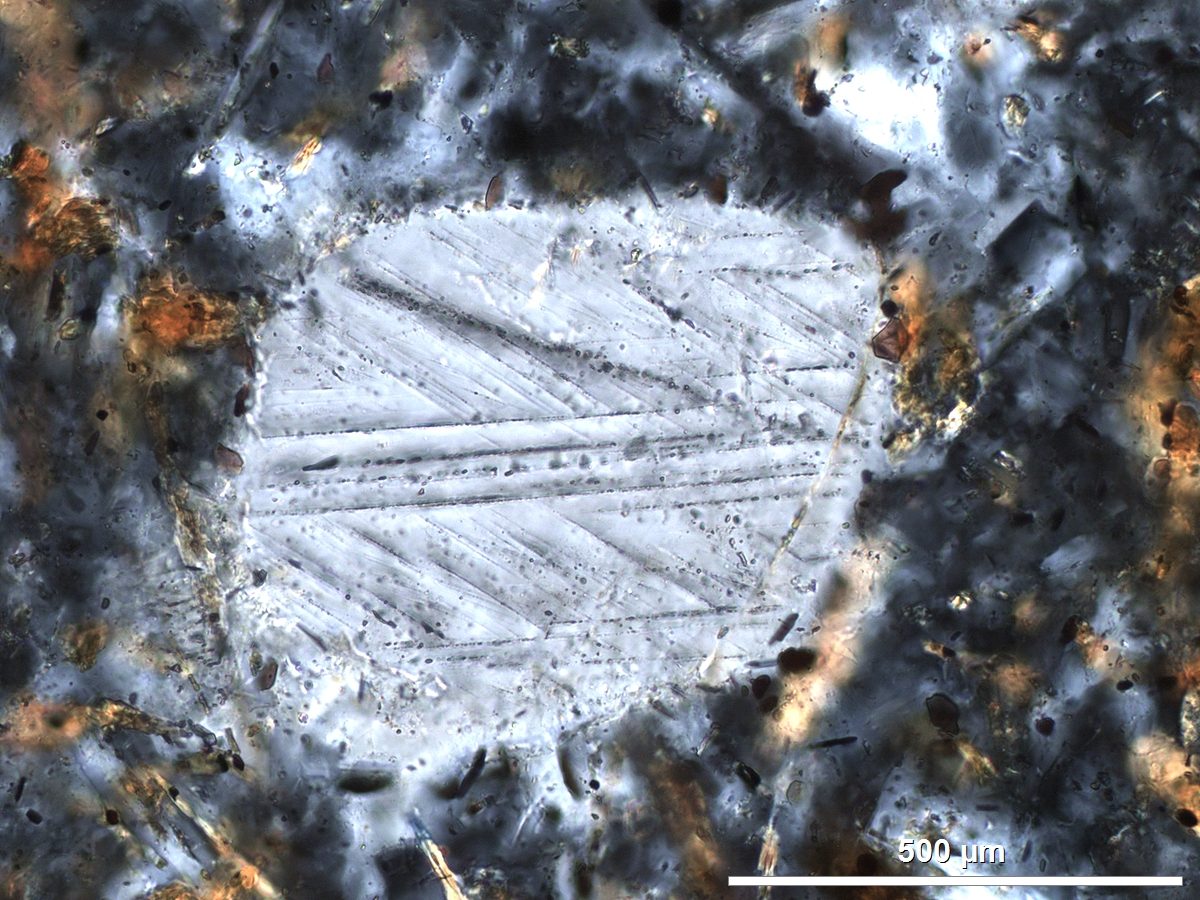
Shocked quartz is the hardest of these to argue with. Its grains carry multiple sets of parallel planar deformation features, crystallographic scars that form only above pressures of five to ten gigapascals, pressures produced in nature by nothing but an impact. It appears at K-Pg sections worldwide, concentrated near the Yucatan and thinning with distance, exactly as ejecta from a single Gulf-of-Mexico source should.
Tektites and microtektites, droplets of target rock melted and thrown clear on ballistic arcs, form only in the most violent impacts, where shock pressures top a hundred gigapascals and temperatures exceed two thousand degrees Celsius. Chicxulub's own are found across the Caribbean, the Gulf of Mexico, and the western Atlantic, with condensed microkrystite spherules distributed globally.
Along the Gulf Coast, from Texas to Alabama and across the Caribbean, geologists find the deposits of megatsunamis, runup heights documented from 100 to more than 300 meters. These are not gradual features. They are the record of a wave set in motion within minutes.
Two more markers close the case on how bad it got. A soot and charcoal layer sits in the boundary clay worldwide, the residue of wildfires on a scale hard to imagine. And directly above it comes the fern spike, a sudden flood of fern pollen. Ferns are the weeds of catastrophe, the first plants to recolonize scorched ground, and their pollen marks the moment the recovery began.
There may even be a piece of the asteroid itself. In 1998 Frank Kyte reported a 2.5-millimeter fossil meteorite fragment preserved in boundary clay from a Pacific deep-sea core, a possible surviving splinter of the impactor. Its identification is not universally accepted, but if it holds, it is a physical shard of the object that ended the Mesozoic.
05The First Day of the Cenozoic
For a long time the first hours after the impact were a matter of modeling and inference. Then the Expedition 364 core gave us something close to an eyewitness account, written in stone. In 2019 Sean Gulick and colleagues published the reconstruction under a title that says it all.
| Time After Impact | What Happened |
|---|---|
| The first minutes | Seismic shaking near magnitude 11; rock from 10+ km down blasted out of the ground |
| The first hours | Tsunamis over 100 meters swept the Gulf of Mexico; re-entering ejecta heated the sky and surface to hundreds of degrees, igniting fires |
| Within 24 hours | Soot and charcoal settling worldwide; dust and vaporized sulfur injected into the stratosphere |
The core preserves the sequence as cleanly as a stack of pages: impact melt rock at the bottom, then coarse sediment dumped by the returning tsunami, then the fine material that drifted down as the water stilled, all laid down in about a day. The extinction that followed was, by geological standards, instantaneous. High-precision dating brackets the whole event inside roughly thirty-three thousand years, and the killing blow itself likely took decades to centuries, not millions of years.
06Why Everything Died
An asteroid ten kilometers wide is a local disaster, however violent. To kill three-quarters of all species on a whole planet takes something that reaches everywhere at once. That something was the atmosphere itself.
The primary killer, on the current reading of the evidence, was impact winter. The dust and sulfur aerosols lofted into the stratosphere blocked an estimated eighty to ninety percent of sunlight, global temperatures fell by around ten degrees Celsius, and photosynthesis collapsed. Everything else came as a cascade: seismic shaking and global landslides in the first minutes, a pulse of infrared heat as ejecta rained back through the atmosphere, megatsunamis, then months to years of cold and dark, acid rain from vaporized rock, and a battered ozone layer letting ultraviolet through. Impact winter starving the food web from the bottom up is the leading kill mechanism, not a settled certainty.
Climate modeling by Bardeen and colleagues in 2017 found that soot alone could have driven three to sixteen years of subfreezing temperatures across the mid-latitudes. Whatever the exact number, it was long enough. A food web that runs on sunlight does not survive years without it.
Chicxulub was also, in a grim sense, unlucky in where it hit. The Yucatan target rock was rich in sulfate-bearing evaporites and carbonates. Vaporizing those rocks threw far more climate-wrecking sulfur into the air than a strike on granite or basalt would have. The same asteroid landing on different ground might have been a far smaller catastrophe.
The pattern of who lived and who died fits this exactly. The hardest hit were the animals and plants tied most directly to sunlight-fed food webs: the non-avian dinosaurs, the flying pterosaurs, the marine reptiles like mosasaurs and plesiosaurs, the coiled ammonites, the reef-building rudist clams, and most of the floating plankton. The survivors were the small, the buried, and the undemanding: mammals in burrows, birds, crocodilians, turtles, some sharks, insects, the detritivores that could live on dead matter while the Sun stayed dark.
Recovery was slow and uneven. Depending on the group, ecosystems took anywhere from two to ten million years to rebuild, and mammals diversified rapidly, in geological terms, in the aftermath.
More finely, marine ecosystems needed about two to four million years to fully recover, and the first few hundred thousand years belonged to opportunistic disaster taxa, fern spikes on land and small generalists in the sea. Mammalian diversification itself did not accelerate significantly until two to three hundred thousand years after the impact; the emptied world took time to fill.
07The Other Suspect: The Deccan Traps
The asteroid did not have the end of the Cretaceous entirely to itself. On the other side of the planet, one of the largest volcanic events in Earth's history was already underway, and it has a serious claim on part of the blame.
The Deccan Traps in western India are a flood-basalt province covering something like five hundred thousand square kilometers. The eruptions began roughly a quarter of a million years before Chicxulub and continued for about half a million years after it, releasing enormous volumes of carbon dioxide and sulfur dioxide. That is more than enough to stress the global climate on its own, with warming and acid rain, before the asteroid ever arrived.
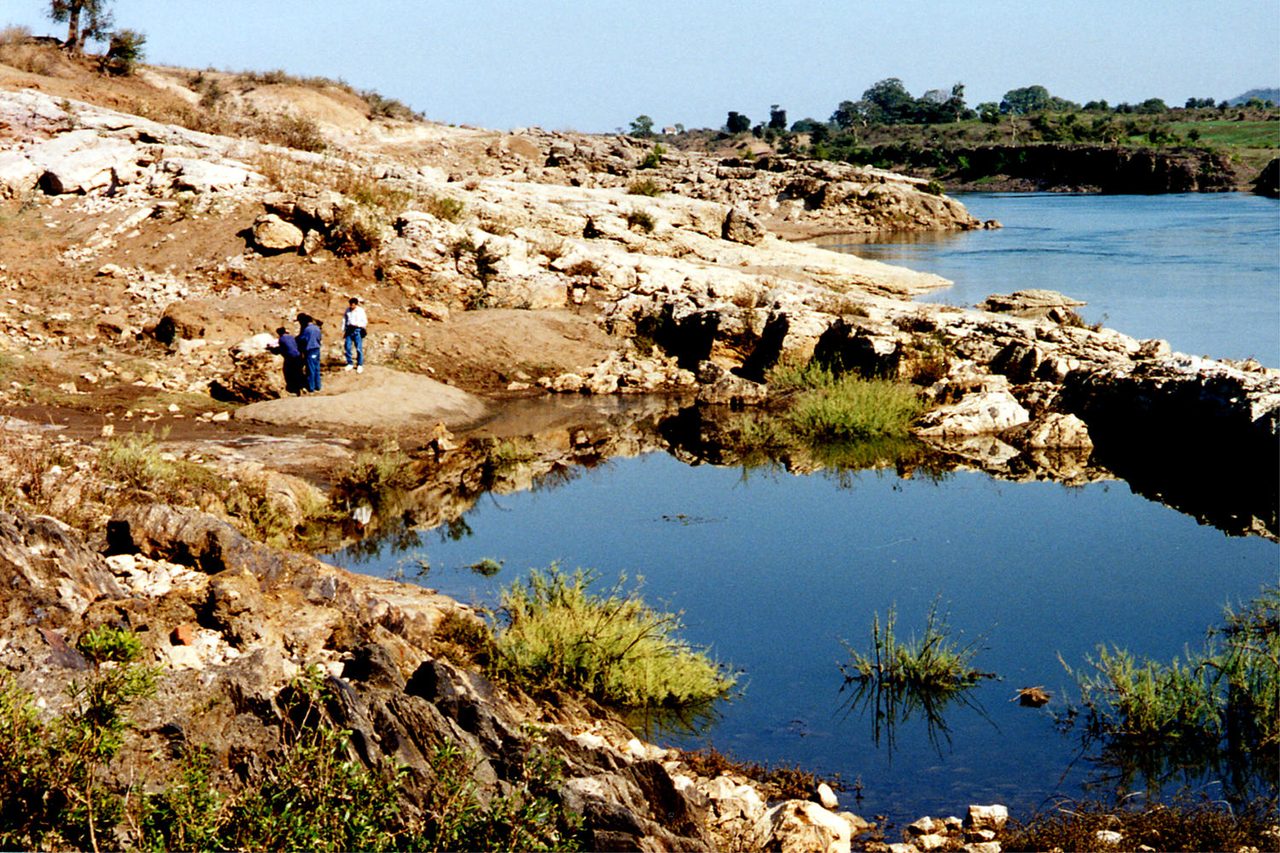
This gave rise to the press-pulse model, proposed by Arens and West in 2008: the Deccan volcanism was the long, grinding press that weakened ecosystems, and Chicxulub was the sudden pulse that tipped them over. A minority of researchers, most prominently Gerta Keller, argue the balance the other way, making Deccan volcanism the primary cause and the impact a secondary blow. The research documents label this a minority position, and it is worth understanding why.
Keller's stronger version rests on a reading of the El Penon section in Mexico that places the impact about three hundred thousand years before the extinction. High-precision radiometric dating has not supported that gap. Work by Renne and colleagues in 2013, and since, has established that the impact and the extinction boundary are synchronous, and Hull and colleagues showed in 2020 that marine ecosystems show no major turnover during even the most intense pre-impact Deccan eruptions. The biological collapse begins at the impact horizon, not before it.
There is also a twist that ties the two suspects together. Studies in 2015 and 2019 found that the Deccan eruptions actually accelerated within tens of thousands of years of the impact, as if the seismic shock had shaken the volcanic plumbing into overdrive, a literal one-two punch. Antipodal focusing, the idea that impact energy converged on the far side of the planet, is one proposed mechanism.
The honest bottom line, and the one the research documents settle on, is not a coin toss. Both the impact and the Deccan Traps contributed to the environmental stress of the end-Cretaceous world. But the impact was the primary trigger of the mass extinction. The volcano loaded the gun; the asteroid pulled the trigger.
08The World the Impact Made
It is worth pausing on what this one bad day set in motion, because we are standing in its aftermath.
With the dinosaurs gone, the mammals that had spent a hundred million years small and nocturnal inherited an emptied world and radiated into it. The blunt version, which the research supports, is that without the K-Pg extinction, mammals, and therefore humans, would very likely never have risen to ecological dominance at all. We are, in a real sense, the beneficiaries of a catastrophe.
Stephen Jay Gould pushed this further into a famous argument about contingency: rerun the tape of life, let the asteroid miss, and the dinosaurs keep the planet while mammals stay small forever, so nothing like us ever appears. It is a genuinely speculative claim, unprovable in either direction. The counter-case is real too, that mammals were already diversifying in the late Cretaceous and might have pressed the dinosaurs eventually regardless. The question is unfalsifiable, and it is also one of the most quietly staggering thoughts in all of paleontology.
09Where the Story Runs Off the Map
An event this famous and this consequential attracts claims that run well past the evidence. Some are live scientific questions worth taking seriously. Others are contradicted by the rock itself. Both deserve to be named plainly.
Some models of the crater's shape hint that the impactor may have been a binary asteroid, two bodies orbiting each other rather than one. It is a real reading of the morphology, and it is unproven.
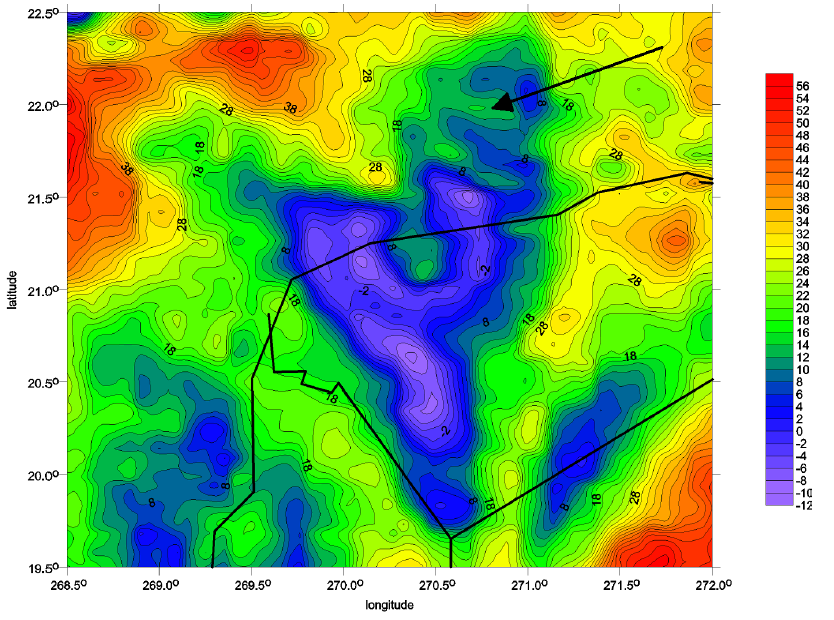
There is also a second, much smaller crater in the mix. The Boltysh crater in Ukraine, about 24 kilometers across, formed close enough to the K-Pg boundary that it has been proposed as a companion, or even as a precursor that stressed ecosystems before the main blow. But how close is exactly the problem. Our own research documents give its timing relative to Chicxulub three different ways: one puts the gap at just two to five thousand years, another at around eight hundred thousand years before, a third at several hundred thousand. Those figures differ by more than two orders of magnitude, so any claim that Boltysh and Chicxulub were a linked pair has to be treated as unresolved, not established.
A larger claim, the so-called Shiva crater, a proposed five-hundred-kilometer structure off the west coast of India, has been put forward by Sankar Chatterjee as a second, even bigger K-Pg impact. Most geophysicists read that structure as volcanic or tectonic in origin, and the geological consensus treats it as debunked rather than confirmed.
Further out still is the idea that impacts come on a schedule. Randall and Reece proposed in 2014 that the Solar System's passage through a disk of dark matter in the galactic plane could periodically fling Oort Cloud comets inward, producing a roughly thirty-million-year rhythm of impacts. It is a genuinely creative hypothesis, and highly speculative, resting on a periodicity in the extinction record that is itself disputed. Related proposals invoke a hidden companion star, Nemesis, or a distant Planet X. The impact record may simply be too patchy to show a cycle at all.
On the other side of the ledger sit the claims the evidence rules out. The idea that the K-Pg extinction was caused purely by volcanism, with the Yucatan structure not an impact crater at all, is flatly contradicted by the physical record: the shocked quartz, the global iridium, the crater's own morphology. Officer and Drake mounted a serious challenge to the impact hypothesis back in 1985, but their objections have been answered point by point by the decades of work since.
The stronger version of the volcanic argument, associated with Gerta Keller, that the impact was only a minor factor and the extinction was primarily volcanic, runs straight into the sharp, geologically instantaneous extinction signal recorded at the boundary worldwide. As a call for the impact's importance to be weighed honestly against the Deccan Traps, the Keller camp has kept the field careful. As a claim that the asteroid was a bit player, it is not supported by the weight of the evidence.
And no, the dinosaurs did not quietly survive. Claims of dinosaur fossils from above the boundary surface from time to time, but none has ever survived peer review; every one is explained by reworking, older bones eroded out and redeposited in younger sediment. The one honest caveat is the one that sounds like a technicality but is not: birds are dinosaurs, the living branch of the family. Every non-avian lineage, though, ended at the boundary and stayed ended.
Fast Facts
- The Event
- The Chicxulub asteroid impact and the Cretaceous-Paleogene (K-Pg) mass extinction
- When
- 66.043 million years ago, give or take about 11,000 years
- Where
- The Yucatan Peninsula, Mexico, near Chicxulub Puerto
- The Impactor
- A carbonaceous chondrite asteroid, roughly 10 to 15 km across
- The Crater
- About 180 km wide, buried under 600 to 1,100 m of limestone
- The Discovery
- Iridium anomaly, Alvarez team, 1980; crater tied to the boundary by Hildebrand, 1991
- The Drilling
- IODP-ICDP Expedition 364, 2016, 835 m of core from the peak ring
- Species Lost
- Roughly three-quarters of all species; all non-avian dinosaurs
- Primary Kill Mechanism
- Impact winter, sunlight and photosynthesis shut down for years
- The Other Suspect
- The Deccan Traps, a real contributing stress, not the primary trigger
What We Can Actually Stand Behind
The impact is real, dated, and located. About 66 million years ago a 10-kilometer asteroid struck the Yucatan and left a 180-kilometer crater, confirmed by a global iridium layer, worldwide shocked quartz, and 835 meters of core drilled straight out of the peak ring in 2016. Roughly three-quarters of all species died, every non-avian dinosaur among them, in what is by geological standards a single instant.
The exact machinery of the killing, and the precise share of the blame owed to the Deccan Traps, are still live science. The strong consensus is that impact winter was the primary kill mechanism and the asteroid the primary trigger, with Deccan volcanism a real contributing stress. That the impact came first in the causal chain is well supported; the fine details of the cascade are genuinely open.
A cluster of ideas is worth thinking about but not established: that the impactor was a binary asteroid, that the Boltysh crater in Ukraine was a linked companion, that impacts follow a dark-matter-driven galactic rhythm, and Gould's argument that without this one event nothing like us would exist. These rest on contested readings and unfalsifiable what-ifs, not on settled evidence.
No, the extinction was not caused by volcanism alone, and the Yucatan structure is not something other than an impact crater. The shocked quartz, the global iridium, and the crater's own form rule that out, and the older challenges to the impact hypothesis have been answered. The view that the asteroid was only a minor factor is not supported by the weight of the evidence.
No, the non-avian dinosaurs did not survive. Every claimed post-boundary dinosaur fossil is explained by reworked older bone, and none has passed peer review. Birds are the living dinosaurs; every other lineage ended at the boundary.
So the plain account is stranger and more complete than any myth we could hang on it. We know the date to within a few thousand years, the size of the rock, the angle it came in at, and, from a single core pulled out of the crater, very nearly the hour-by-hour story of the worst day life on Earth has ever had. And yet the file does not close. That smaller crater in Ukraine still refuses to settle into a single date, its gap from Chicxulub written three different ways in our own records, anywhere from a few thousand years to the better part of a million. If a second impact really did bracket the end of the Cretaceous, was Chicxulub a lone assassin or the last and largest blow in a swarm? The core that gave us the first day of the Cenozoic came from one borehole in one crater. What is still waiting in the rock we have not yet drilled?
Sources & further reading
Everything above is drawn from our research library on Theories of Anything. Open the full file to check the sourcing and go deeper.
Image credits
- Landsat 8 satellite image of the Yucatan Peninsula's Gulf of Mexico coastline, showing the buried location of the Chicxulub impact crater near Chicxulub Puerto Landsat 8 satellite data, processed by Paul Quast, published via O.V.E.R.V.I.E.W on Flickr, November 5, 2014 via Wikimedia Commons. CC BY 2.0 Source.
- The K-Pg boundary clay layer exposed in rock strata at Trinidad Lake State Park, Colorado (Longs Canyon outcrop), the thin dark band carrying the global iridium signature Jeffrey Beall (own work), photographed June 18, 2019 via Wikimedia Commons. CC BY 4.0 Source.
- NASA radar-topography map of the Yucatan Peninsula, color-coded by elevation, showing the surface trace of the buried Chicxulub impact crater NASA/JPL-Caltech, Photo ID PIA03379 via Wikimedia Commons. Public Domain (United States) Source.
- Geologist Walter Alvarez at the K-Pg boundary discovery site in Bottaccione Gorge near Gubbio, Italy, where the iridium anomaly was first identified Orangeboxes2 (own work) via Wikimedia Commons. CC BY-SA 4.0 Source.
- Schematic cross-section diagram of the Chicxulub impact structure, showing the peak ring, melt sheet, breccia, and sediment cover (Melosh, 2001; Christeson et al., 2001; Kaskes et al., 2021; de Graaf et al., 2021) Mikenorton (Wikimedia Commons user), created March 8, 2022, based on Melosh (2001), Christeson et al. (2001), Kaskes et al. (2021), de Graaf et al. (2021) via Wikimedia Commons. CC BY-SA 4.0 Source.
- The Lameta Formation and Deccan Traps flood-basalt flows along the Narmada River near Jabalpur, India, a volcanic province that contributed to K-Pg extinction climate stress Joseph H. Hartman, Geoscience Digital Image Library (GeoDIL number 78), photographed 1995 via Wikimedia Commons. CC0 1.0 Universal (Public Domain Dedication) Source.
- Published Free-Air gravity anomaly map of the Chicxulub structure (Klokocnik et al., 2010), with a marked possible companion-crater feature J. Klokocnik, J. Kostelecky, I. Pesek, P. Novak, C.A. Wagner, J. Sebera; Klokocnik et al. (2010), Solid Earth 1:71-83 via Wikimedia Commons. CC BY 3.0 Source.
- Photomicrograph under cross-polarized light of a shocked quartz grain from the Boltysh crater in Ukraine (NOT Chicxulub), showing planar deformation features characteristic of impact cratering Dr. Martin Schmieder, Houston (own work, polarization microscope, March 31, 2016) via Wikimedia Commons. CC BY-SA 3.0 DE, CC BY-SA 3.0 Unported, and GNU Free Documentation License v1.2+ Source.
- Landsat 8 satellite image of the Yucatan Peninsula's Gulf of Mexico coastline, showing the buried location of the Chicxulub impact crater near Chicxulub Puerto Landsat 8 satellite data, processed by Paul Quast, published via O.V.E.R.V.I.E.W on Flickr, November 5, 2014 via Wikimedia Commons. CC BY 2.0 Source.
.jpg)


_Boundary_at_Bottaccione_Gorge_near_Gubbio_Italy.jpg)

.jpg)

