
Blindsight: Seeing Without Knowing You See
Damage the primary visual cortex and a patient goes blind in part of the visual field. Ask them what is there and they say, sincerely, nothing at all. Then ask them to guess, and they point at the target anyway, discriminate shapes they insist they cannot see, and register motion they never report noticing. The phenomenon has been documented since 1974 and it is not seriously in doubt. What it demonstrates about consciousness is a different claim, and that one is contested in print by researchers who think the blind field may not be blind so much as very dim. This is the file on blindsight, opened claim by claim, each one wearing its evidence.
A patient sits in front of a screen. A target appears in the half of their visual field served by the part of the brain that was destroyed. Asked what they see there, they say nothing, and they mean it: no shadow, no dimness, no impression of anything. Then the experimenter asks them to point at it anyway. To guess. They point at it. Asked to guess whether the shape was an X or an O, they get that right too, more often than chance allows, insisting the whole time that they are making it up. This is blindsight. The striking thing about it is not that it sounds impossible. It is that the phenomenon is solid and the meaning of it is not, and those are two very different claims that popular accounts routinely fuse into one. Let's open the file.
01The Patient Who Guessed Right
Type 1 blindsight is defined by a flat contradiction between what a patient reports and what a patient does: no awareness of a visual stimulus in the blind field, and above-chance performance on forced-choice tasks about that same stimulus. The founding case is patient DB, described by Weiskrantz and colleagues in 1974. His right striate cortex had been surgically removed to treat an arteriovenous malformation, leaving him blind in the left visual field. In the laboratory he could locate visual targets in that field by pointing, discriminate between an X and an O, and detect motion, while consistently reporting that he could not see anything and was, as he put it, just guessing.
The performance is real, and it is not vision restored. Accuracy in blindsight runs from roughly 60 to 90 percent depending on the task, against near-100 percent in the same patient's sighted field. Whatever survives the loss of the primary visual cortex is not normal seeing at reduced volume. It is a narrower, cruder channel, and every claim below has to be read against that ceiling.
02Whose Evidence This Actually Is
Blindsight is usually written about as something that happens to blindsight patients, as though there were a surveyed population of them. There is not, or at least nobody has counted one. This is a literature built on a small number of people studied very hard for a very long time, and an honest account has to say so before it says anything else, because the phrasing changes what every finding below is a finding about.
Patient GY is the most extensively studied blindsight subject in the literature. He sustained damage to his left primary visual cortex in childhood, and shows above-chance performance detecting, localizing, and discriminating stimuli in his right visual field. His performance improves with high contrast, fast motion, and large stimuli, which is itself a useful description of the channel: it answers to things that are strong, moving and obvious, and not to much else.
There is no established epidemiological count of blindsight patients anywhere in the world. The great majority of the foundational literature, including the pathway anatomy, the Type 1 and Type 2 distinction, and the amygdala and motion findings set out in the sections below, rests on intensive, decades-long study of a small number of named individuals. Above all two: DB, studied from the mid-1970s, and GY, whose damage dates from childhood and who has been studied for over three decades. When a sentence in this article begins blindsight patients, read it as a finding from a handful of people, because that is what it is.
The evidence is not confined to those two names, though the cohorts stay small. Sahraie and colleagues, with Weiskrantz himself among the nine authors, tested 10 cortically blind patients in 2003 and found a narrowly tuned residual spatial-frequency channel in 8 of the 10. That is real evidence that residual visual function in a blind field is not a peculiarity of the two most famous cases. It is also still 10 patients. The honest phrasing is documented in a range of patients beyond the two canonical cases, in cohorts numbering in the low tens, and it is neither common nor a population in the epidemiological sense.
03What the Blind Field Can Do
With the sample size stated, here is what has actually been demonstrated inside a blind field. The pattern in the list matters as much as the items on it: what survives is coarse, fast and spatial, and what mostly does not survive is fine, slow and identifying.
The split follows a known division of labor in the visual system. The dorsal stream, the where and how pathway, is more accessible in blindsight than the ventral stream, the what pathway. Patients are consistently better at detecting where something is and whether it is moving than at identifying what shape or color it was. Put crudely, the blind field can tell you that something happened over there without being able to tell you what it was.
Four capacities are empirically demonstrated across multiple patients and studies. Localization: pointing to the position of a visual target (Weiskrantz, 1986). Motion, which is the strongest of them: detecting and discriminating the direction of moving stimuli, suggesting involvement of area V5/MT (Azzopardi and Cowey, 1998). Orientation: above-chance discrimination of grating orientation (Stoerig and Cowey, 1997). And wavelength: some capacity for color discrimination (Stoerig and Cowey, 1992), which is the item on the list that sits least comfortably beside the dorsal-stream picture just described.
The fifth capacity is the one that tends to stop people. Facial expressions of emotion, fear and happiness, presented in the blind field can influence behavior and produce measurable responses in the amygdala, even though the patient reports no awareness of the face at all (de Gelder and colleagues, 1999; Morris and colleagues, 2001). Something in the head registered the expression on a face the person will tell you, honestly, that they never saw.
| Capacity | What Was Shown | Source Named in Our File |
|---|---|---|
| Localization | Pointing to the position of a target the patient reports not seeing | Weiskrantz (1986) |
| Motion | Detecting and discriminating the direction of moving stimuli; the strongest capacity, pointing to area V5/MT | Azzopardi and Cowey (1998) |
| Orientation | Above-chance discrimination of grating orientation | Stoerig and Cowey (1997) |
| Wavelength | Some capacity for color discrimination | Stoerig and Cowey (1992) |
| Emotional Expression | Fearful and happy faces influence behavior and produce amygdala responses with no reported awareness of the face | de Gelder and colleagues (1999); Morris and colleagues (2001) |
And here is the boundary of the list. The claim that blindsight patients can see normally is false. Performance is far below normal vision, above chance but typically well below ceiling, limited to simple discriminations, and it does not support complex visual cognition. There is no reading in the blind field and no face recognition in it, and that last one is worth separating from the amygdala finding above: an emotional expression presented in a blind field can influence behavior and produce a measurable amygdala response, which is a reaction to the expression and not recognition of whose face it was. Any popular account describing blindsight as intact vision routed around awareness is describing something that has never been observed in anyone.
04How the Signal Gets Through Without V1
If the primary visual cortex is destroyed and the field it served is blind, then whatever the rest of the brain is responding to has to be arriving by some other road. Roads of that kind exist, and they are mapped. That much is anatomy rather than interpretation, and the existence of the routes is correspondingly solid. That blindsight actually runs on them is a further step, and it is the step the objection two sections below denies: if small functioning islands of striate cortex survived the damage and are doing the work, then no bypass route is being used at all. Read what follows as established wiring whose role in blindsight is the contested part.
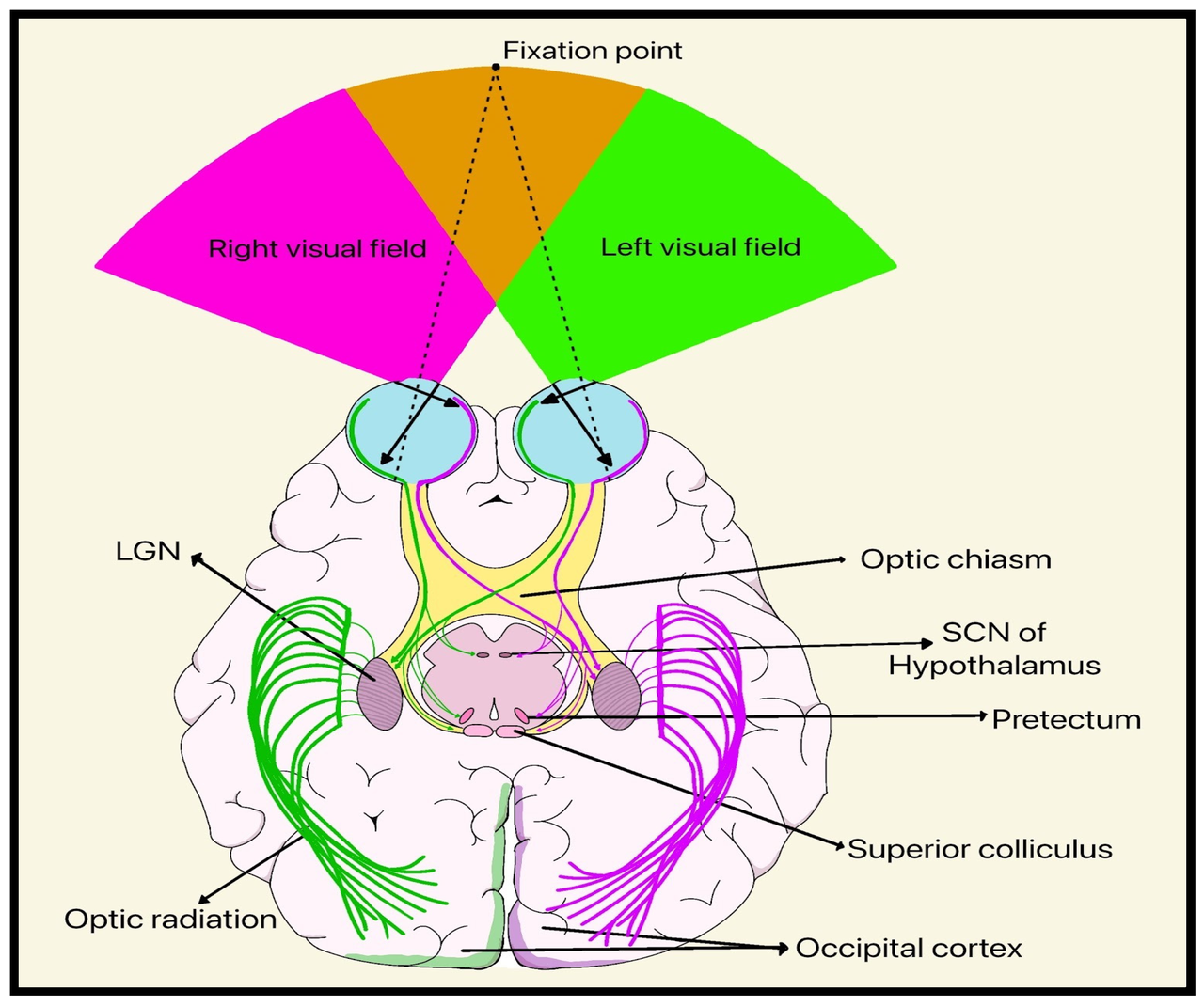
Blindsight is mediated by visual pathways that bypass V1. The principal one is the retino-tectal pathway: retina to the superior colliculus in the midbrain, on to the pulvinar in the thalamus, and from there to extrastriate visual areas including V5/MT, V4 and parietal cortex. None of that traffic passes through the primary visual cortex, which is precisely why destroying the primary visual cortex does not silence it.
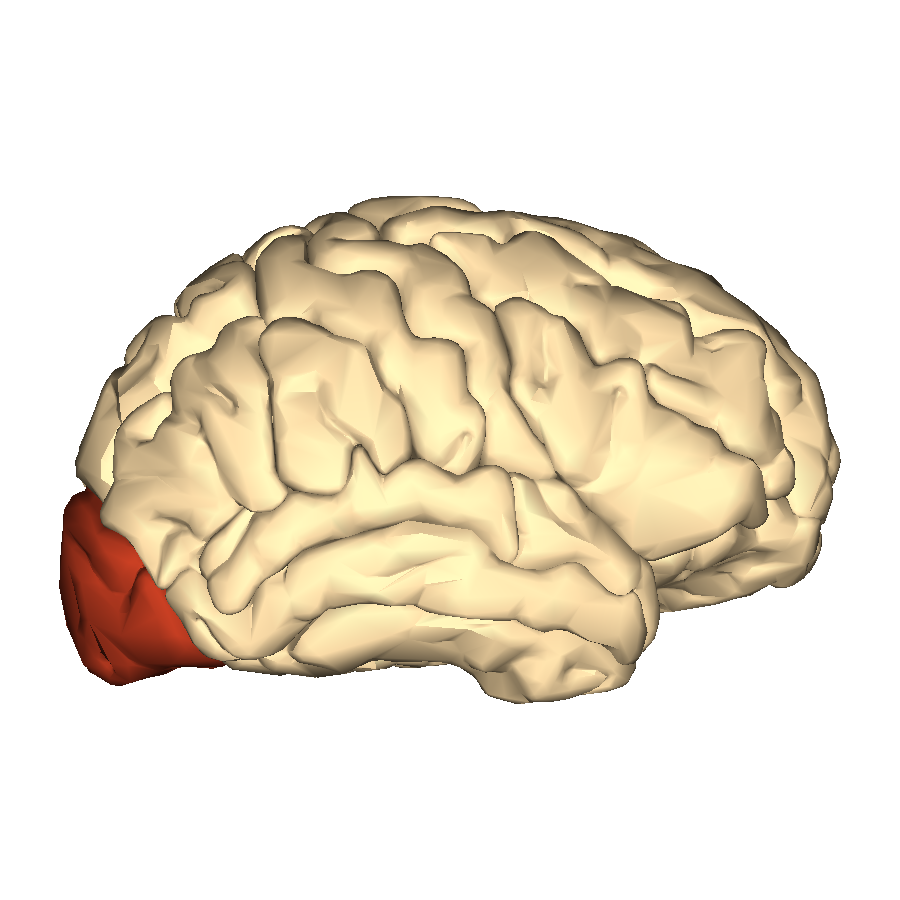
A second bypass sits at the thalamus itself. The lateral geniculate nucleus, the relay that normally feeds V1, can project directly to extrastriate visual areas without routing through V1 at all. So there are at least two anatomical ways for visual information to reach surviving cortex in a brain whose main visual entry point is gone. Nothing about blindsight requires the signal to arrive by magic; it requires only that the wiring diagram have more than one entrance, and it does.
One further line of evidence belongs here, and it belongs in its own paragraph because it is a different class of evidence entirely. Blindsight-like phenomena have been documented in monkeys with surgical V1 lesions: ablated animals show residual detection, localization, and some form discrimination that parallels the human cases (Cowey and Stoerig, 1995). That matters exactly because it is not a case study. In the animal work the location and extent of the lesion are experimentally controlled and known precisely, whereas the human cases arise from accident, stroke, or surgery for unrelated reasons and are studied after the fact. This is not the same finding as DB's or GY's and should never be quoted as if it were. It is an independent finding that happens to agree with them, which is worth more than a louder version of the same one.
05Type 1 and Type 2: The Distinction That Does the Work
Everything so far has treated blindsight as processing without awareness. That is only half the phenomenon, and the other half is where the theoretical weight actually falls. Conflating the two halves is the most common error in popular writing on this subject, and it is not a small one: it decides what the whole case is evidence for.
Type 2 blindsight is the case in which the patient does report something. Not normal seeing, but a feeling that something is there (Weiskrantz, 1998). GY describes sensations in his blind field as a feeling of something happening, distinct both from ordinary vision and from a complete absence of experience. This has been described as a form of degraded phenomenal experience rather than true unconscious processing. The distinction is not a technicality. Type 1, no awareness at all, is the clearest case of visual processing running with nothing conscious attached to it, which makes Type 1 the only version that does the job theories of consciousness want blindsight to do.
| Kind | What It Is |
|---|---|
| Type 1 | The patient reports no awareness of the stimulus and performs above chance on it anyway. This is the clearest case of visual processing with no consciousness attached. |
| Type 2 | The patient reports some vague awareness, not normal seeing but a feeling that something is there. GY describes it as a feeling of something happening. |
| Why It Matters | Type 2 has been described as degraded phenomenal experience rather than true unconscious processing, so a result from a Type 2 case does not carry the weight a Type 1 case carries. |
06The Case Against: Scattered Light, Spared Cortex, Near-Threshold Vision
Our own research file on blindsight states, in its counter-arguments section, that no significant counter-arguments exist in the scholarly literature for its core claims. That sentence is the weakest line in the document and this article will not repeat it. The objection to blindsight is real, it was published as a target article in a journal that runs formal open peer commentary, and it has been revisited for decades. Here it is at strength, with the names attached.
The classic and most-cited skeptical case is Campion, Latto and Smith, Is Blindsight an Effect of Scattered Light, Spared Cortex, and Near-Threshold Vision?, in Behavioral and Brain Sciences, volume 6, 1983, pages 423 to 448. Their argument is that the reported blindsight performance of the early studies could be explained without positing any unconscious vision at all, by three ordinary mechanisms: light scattering from a bright stimulus into the intact visual field; incompletely destroyed striate cortex leaving small functioning islands behind; and near-threshold conscious vision that patients simply under-reported. Their own conclusion was that an adequate case for blindsight had not been made by the evidence then available. This is a peer-reviewed, formally target-articled position, not a fringe dismissal, and it deserves to be met rather than waved at.
There is a specific empirical version of the spared-cortex limb. Fendrich, Wessinger and Gazzaniga, writing in Science in 1992, used careful eye-tracking to confirm retinal stability and located a small, discrete island of residual visual sensitivity inside a blindsight patient's scotoma, separated from the region of macular sparing. Their argument was that spared tissue of this kind, rather than a genuine unconscious pathway, could account for at least some reported blindsight in some patients. Note the scope of that claim, because it is often overstated in both directions: it is a finding in one patient, and it is a claim about some cases, not a refutation of all of them.
| The Objection | What It Says | What Has Been Offered Against It |
|---|---|---|
| Scattered Light | Light from a bright stimulus scatters into the patient's intact visual field, where it is seen normally | Precise stimulus placement and eye tracking; Cowey's 2004 review is standardly summarized as concluding that the phenomenon survives those controls |
| Spared Cortex | The striate cortex was not completely destroyed; small functioning islands remain, and they do the work | Lesion boundaries verified by modern neuroimaging rather than assumed from surgical notes; Zeki and Ffytche found extrastriate activation in GY without detectable activation in spared primary visual cortex for the motion stimuli tested |
| Near-Threshold Vision | The patient has degraded conscious vision in the field and is under-reporting it | This is the limb the replies in our file do not directly take on; the Type 1 and Type 2 distinction is an attempt to draw the line rather than a demonstration of where it falls |
The substantial reply exists and it is worth naming properly. Alan Cowey's 30th Sir Frederick Bartlett Lecture, published in the Quarterly Journal of Experimental Psychology in 2004 under a title that announces its intent, Fact, Artefact, and Myth About Blindsight, addresses the scattered-light and spared-cortex objections directly. It is standardly summarized as concluding that the core phenomenon survives them once stimulus placement is controlled, eye position is tracked, and lesion boundaries are verified with modern neuroimaging rather than assumed from a surgeon's notes. The title alone signals that Cowey treated the skeptical case as something to answer rather than something to dismiss, which is the correct posture and not the one our own file adopted.
The strongest single piece of patient-specific evidence against the spared-islands limb comes from Zeki and Ffytche, in Brain in 1998. Using functional imaging on GY, they found activation in extrastriate visual areas, notably V5/MT, without detectable activation in the spared portions of his primary visual cortex for the motion stimuli tested. That is evidence for a genuine extrastriate route rather than reliance on a hidden intact patch of V1. Secondary syntheses of this and related work report that the majority of blindsight subjects studied to date do not appear to have spared V1 islands large enough to explain their performance, and this article carries that statement as the well-corroborated secondary claim it is rather than as a first-hand finding.
The objection has not been dissolved. It has been answered, and those are different outcomes, so treat any account of blindsight that presents the phenomenon as uncontested, including our own file's, as having skipped the part that matters. Our file answers the objection in a single sentence, saying that early criticisms about light scattering have been controlled for in numerous studies and that blindsight is a genuine phenomenon. That sentence is directionally correct and it is not an argument: it names no study, no critic and no control. It sits beside a counter-arguments section claiming that no active scholarly dispute exists here at all, which is simply not true of this subject. What fails here is not the phenomenon. It is the framing that closes the question.
07What Blindsight Is Taken to Show
Several theories of consciousness reach for blindsight as evidence. This article does not adjudicate between them, because that work belongs to their own files in this wing. What follows is only what each says about this phenomenon, and it is worth noticing that every line in this section is Tier 2. The phenomenon is Tier 1. What it means is not.
The standard philosophical reading is that blindsight shows visual information can be accessed, used to guide behavior, without being phenomenally experienced. That maps onto Ned Block's 1995 distinction between phenomenal consciousness, the felt character of an experience, and access consciousness, the availability of information to the rest of the system. The reading is standard, and the exact mapping between the phenomenon and the philosophical distinction is itself debated.
Recurrent processing theory, in Victor Lamme's 2006 statement of it, holds that conscious visual perception requires recurrent, feedback processing involving V1, and that feedforward processing alone, which is what survives V1 damage, produces only unconscious processing. That is consistent with blindsight. Consistent with is not the same as demonstrated by, and the distance between those two phrases is where most of this section lives.
The global workspace reading, as our own file glosses it, is that V1 damage may prevent visual information from entering the global workspace: the information is processed locally but is never broadcast widely enough across cortical networks for conscious access. That is a gloss on blindsight rather than a developed argument, and the theory's own dossier belongs to its own file, not this one.
And here is the complication that keeps the verdict honest. It is tempting to read blindsight as proof that V1 is irrelevant to consciousness. Our companion file on the neural correlates of consciousness does not license that reading. Crick and Koch originally argued that V1 is not a neural correlate of consciousness, on the grounds that its activity does not track conscious perception in binocular rivalry. But that same file notes that some evidence, super-resolution perception and blindsight recovery among it, suggests V1 may play a role after all, and that which cortical areas are in or out of the neural correlates of consciousness remains actively debated. Blindsight is a data point inside that argument. It is not the end of it.
08The Speculative Edges
Two ideas sit at the edge of this file, and both are worth naming as exactly what they are: genuinely interesting and genuinely unestablished.

Some evidence suggests that extensive training can improve blindsight performance and potentially expand the range of residual visual capacity. What that improvement consists of is unresolved. It could be plasticity in the subcortical pathways. It could be recruitment of spared V1 tissue. Or it could be the emergence of degraded conscious vision, a drift from Type 1 toward Type 2, in which case the training is not enlarging an unconscious channel but slowly building a dim conscious one. Those are three different stories with three different meanings, and the evidence does not currently separate them.
Some philosophers, Chalmers and Koch among them, have invoked blindsight as evidence for the possible existence of zombie systems: neural processing functionally equivalent to conscious processing but lacking subjective experience altogether. The full development of that argument belongs to this wing's file on the Hard Problem and is not rerun here. What blindsight itself contributes is one sentence, and it is as much a limitation as a contribution: whether Type 1 blindsight involves zero phenomenal experience or merely degraded experience is difficult to determine from behavioral and verbal reports alone.
Fast Facts
- The Definition
- Above-chance performance on visual tasks in a field the patient reports seeing nothing in
- The Founding Case
- Patient DB, described by Weiskrantz and colleagues in 1974 after removal of the right striate cortex
- The Most-Studied Case
- Patient GY, childhood damage to the left primary visual cortex, studied for over three decades
- The Ceiling
- Roughly 60 to 90 percent accuracy in the blind field, against near-100 percent in the sighted field
- The Bypass Routes
- Retina to superior colliculus to pulvinar to extrastriate cortex, plus a direct lateral geniculate projection that skips V1
- Type 1 Versus Type 2
- No awareness at all, versus a vague feeling that something is there
- Strongest and Weakest
- Motion and location are strongest, associated with the dorsal stream; shape and color are weakest
- The Sample
- No epidemiological count exists; documented beyond the two canonical cases in cohorts numbering in the low tens
- The Main Objection
- Campion, Latto and Smith (1983): scattered light, spared cortex, and near-threshold conscious vision
- The Main Reply
- Cowey (2004) on the controls; Zeki and Ffytche (1998) on GY's extrastriate activation
- What It Is Not
- Not normal vision at low volume: no reading and no face recognition in the blind field
What We Can Actually Stand Behind
The phenomenon is established and so is the anatomy. Patients with damage to the primary visual cortex do perform above chance on visual tasks in a field they report seeing nothing in. DB did it in 1974 and GY has done it for over three decades. There are real anatomical routes from eye to cortex that do not pass through V1: retina to superior colliculus to pulvinar to extrastriate areas, and a direct projection from the lateral geniculate nucleus. Localization, motion, orientation, wavelength and emotional expression have all been demonstrated in a blind field.
Whether the blind field is genuinely blind is not settled. Campion, Latto and Smith argued in 1983 that scattered light, spared cortex and near-threshold conscious vision could account for the results with no unconscious vision anywhere in the picture, and Fendrich, Wessinger and Gazzaniga later found a real island of residual sensitivity inside a patient's scotoma. Cowey's review and Zeki and Ffytche's imaging of GY are the substantial replies and they are good ones, but the honest position is that the objection was answered rather than dissolved. The theoretical readings sit at the same tier: phenomenal versus access consciousness, recurrent processing, the global workspace gloss. Blindsight is used as evidence by several theories of consciousness and settles none of them, and our companion file on the neural correlates of consciousness explicitly leaves open whether V1 has a role after all.
Training may expand what a blind field can do, and nobody knows what the improvement is made of: subcortical plasticity, recruitment of spared tissue, or a slow drift from Type 1 toward degraded conscious vision are all live and unseparated. And the philosophical use of blindsight as evidence for zombie systems rests on a determination that behavioral and verbal reports may not be able to make. Both are speculation about the phenomenon, labeled as such, not findings from it.
No, blindsight patients cannot see normally. Performance is far below normal vision, limited to simple discriminations, and does not support reading or face recognition in the blind field; the popular picture of intact sight running quietly beneath awareness describes something nobody has ever observed. And no, the objection has not been disposed of. Our own file's statement that no significant counter-arguments exist in this literature is wrong, and it is worth saying so in the file's own house: a single sentence reporting that early criticisms have been controlled for names no study, no critic and no control, and a document that grades evidence has to be checkable about its own.
So the file stays open, and it stays open in a specific place. The pointing is real. The anatomy is real, and the routes carrying signal past the ruined cortex are drawn. What is unsettled is the word sitting in the middle of the phenomenon's own name. If Type 2 blindsight is degraded conscious experience rather than unconscious processing, and if near-threshold conscious vision is the limb of the 1983 objection that the replies in our file do not directly take on, then those two are pointing at the same possibility from opposite ends, and it is a possibility the evidence has not excluded. It would not make blindsight any less strange; a person who says nothing is there and points at it anyway is strange under either reading. It would only change what the strangeness is evidence of. Which leaves the question the whole file turns on, and it is not a question about brains. When a patient says they saw nothing, how would anyone establish, from outside that person, whether they mean nothing at all or nothing worth reporting?
Sources & further reading
Everything above is drawn from our research library on Theories of Anything, principally file K_3_12 on blindsight, with one section drawing on the companion file K_2_03 on the neural correlates of consciousness. Six things about the sourcing belong in the open. First, our file's citation for Weiskrantz's 1986 book, Blindsight: A Case Study and Implications, Oxford University Press, carries a DOI that does not resolve to the book at all: it resolves to a 1988 review of the book by M. Jeannerod in the journal Neuropsychologia. The book is real and correctly titled, and a book of that year would ordinarily carry no DOI at all, so it is cited above by title, publisher and year and is deliberately not linked here. Second, our file prints the founding 1974 Weiskrantz paper as Brain volume 97, issue 4, while the DOI on the same line says issue 1; the publisher's own record gives issue 1, so the identifier is right and the printed issue number is the error, and the corrected link is below. Third, our file cites Weiskrantz 1998 twice in its section on Type 2 blindsight, but no 1998 Weiskrantz work appears anywhere in its bibliography; the most likely intended source is Consciousness Lost and Found: A Neuropsychological Exploration, Oxford University Press, which independent records date to 1997 rather than 1998, so the year is named here as unresolved rather than quietly corrected. Fourth, and this is the same defect twice more: the wavelength result above is cited as Stoerig and Cowey 1992 and the monkey-lesion work as Cowey and Stoerig 1995, and neither year has a bibliography entry standing behind it, the only Stoerig and Cowey entry in our sourcing being the 1997 review. Both are printed above exactly as our file gives them, neither went through the identifier verification the other entries here received, and neither is linked. Fifth, the 1983 Behavioral and Brain Sciences target article by Campion, Latto and Smith, which carries the entire skeptical case in this article, came through verification with no stable identifier attached to it, so it is cited above by author, title, journal, volume and pages and is not linked. Sixth, on characterization rather than citation: Cowey's 2004 Bartlett Lecture is linked below and its identifier is verified, but the account of what it concludes is drawn from standard summaries of the lecture rather than from a reading of its full text, which is why the block carrying it is chipped Tier 2 here and not Tier 1, and the same qualification applies to the statement that most blindsight subjects studied so far lack spared V1 islands large enough to explain their performance. Both are marked as such where they appear. One link below carries nothing above it: Weiskrantz's 2009 book, Blindsight: A Case Study Spanning 35 Years and New Developments, sits in our file's bibliography with an identifier that verified cleanly, and it is listed here as further reading rather than as the source of any claim in this article. Open the full file to check the sourcing and go deeper.
Image credits
- Diagram of the human visual pathway Firoz, M. and others, via Wikimedia Commons. CC BY 4.0 Source.
- Occipital lobe, lateral view Anatomography, via Wikimedia Commons. CC BY-SA 2.1 jp Source.
- Juvenile rhesus macaque, Kathmandu Charles J. Sharp, via Wikimedia Commons. CC BY-SA 4.0 Source.
- Card crop of Diagram of the human visual pathway Firoz, M. and others, via Wikimedia Commons. CC BY 4.0 Source.


_juvenile_head_Kathmandu.jpg)